Class:Reptilia-Classification
Turtles, Tortoises, Tuataras,
Crocodilians, Lizards, and Snakes
B.Ashok Kumar
Assistant Professor
KRK Govt. Degree College
Addanki-523201
9652929696
ashokkumarzoology@gmail.com
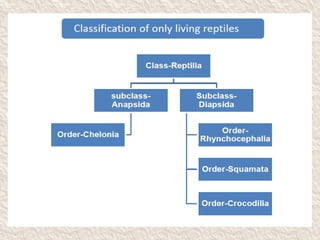
Classification
• Kingdom Animalia
• Phylum Chordata
– Subphylum Vertebrata
• Class Reptilia
There are more than 7,000 living and several
extinct species
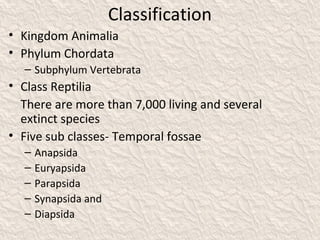
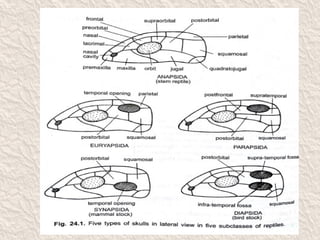
• Five sub classes- Temporal fossae
– Anapsida
– Euryapsida
– Parapsida
– Synapsida and
– Diapsida
Sub class: Anapsida
• Temporal fossae absent
• Temporal region is completely bony
• Two orders:
– 1. Cotylosauria
– 2. Chelonia
Order:Cotylosauria
• Extinct
• Stem reptiles
• Pelvic girdle plate like
• Resembles Labyrinthodont Amphibians
• Eg: Seymouria
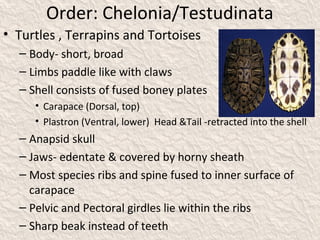
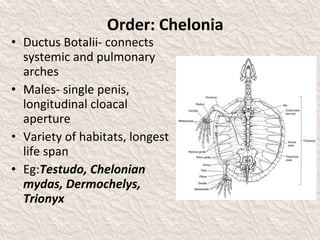
Order: Chelonia/Testudinata
• Turtles , Terrapins and Tortoises
– Body- short, broad
– Limbs paddle like with claws
– Shell consists of fused boney plates
• Carapace (Dorsal, top)
• Plastron (Ventral, lower) Head &Tail -retracted into the shell
– Anapsid skull
– Jaws- edentate & covered by horny sheath
– Most species ribs and spine fused to inner surface of
carapace
– Pelvic and Pectoral girdles lie within the ribs
– Sharp beak instead of teeth
• Ductus Botalii- connects
systemic and pulmonary
arches
• Males- single penis,
longitudinal cloacal
aperture
• Variety of habitats, longest
life span
• Eg:Testudo, Chelonian
mydas, Dermochelys,
Trionyx
Order: Chelonia
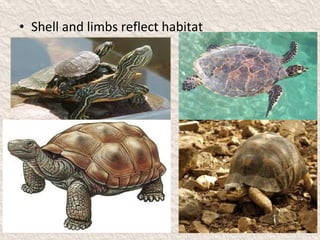
• Shell and limbs reflect habitat
Sub class2: Euryapsida
Extinct
Skull with a single dorso-lateral temporal
opening on either side.
These openings are bounded below by
postorbital and squamosal bones.
They lived during Triassic period.
Sub class3: Parapsida
• Extinct
• Skull-parapsid
• Skull with a single dorso-lateral temporal opening
on either side.
• These openings are bounded below by the supra
temporal and post frontal bones.
• They lived during Mesozoic to cretaceous period.
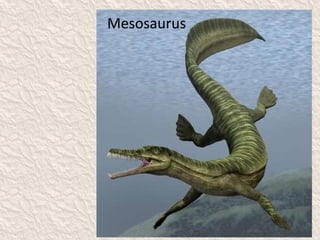
– Mesosauria- Extinct Eg: Mesosaurus
– Ichthyosauria- Extinct Eg: Ichthyosaurus
– Proterosauria- Extinct Eg: Araoscelis
– Sauropterygia- Extinct Eg: Cyamodus, Kronosaurus
Mesosaurus
Sub-class 4:SYNAPSIDA
• Extinct
• Synapsid skull
• Skull with a single lateral temporal opening on
either side.
• These openings are bounded above by the
postorbital and squamosal bones.
• They lived during Carboniferous to Permian
period.
• Eg: Dimetradon, Cyanognathus, Tritylodon
Sub class4: Diapsida
• Skull with two temporal openings on either
side separated by the bar of postorbital and
squamosal bones.
• This sub- class includes 2 super orders.
• Super order 1. Lepidosauria(Scaly lizards)
• Super order 2. Archosauria(Ruling reptiles)
Super order1: Lepidosauria
• Two temporal vacuities- diapsid skull
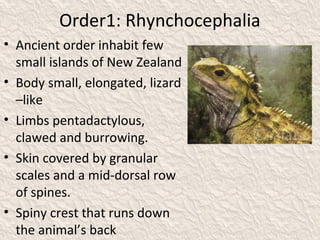
Order1: Rhynchocephalia
• Ancient order inhabit few
small islands of New Zealand
• Body small, elongated, lizard
–like
• Limbs pentadactylous,
clawed and burrowing.
• Skin covered by granular
scales and a mid-dorsal row
of spines.
• Spiny crest that runs down
the animal’s back
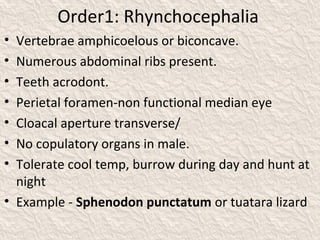
Order1: Rhynchocephalia
• Vertebrae amphicoelous or biconcave.
• Numerous abdominal ribs present.
• Teeth acrodont.
• Perietal foramen-non functional median eye
• Cloacal aperture transverse/
• No copulatory organs in male.
• Tolerate cool temp, burrow during day and hunt at
night
• Example - Sphenodon punctatum or tuatara lizard
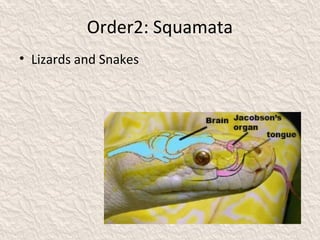
Order2: Squamata
• Lizards and Snakes
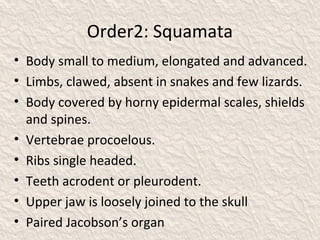
Order2: Squamata
• Body small to medium, elongated and advanced.
• Limbs, clawed, absent in snakes and few lizards.
• Body covered by horny epidermal scales, shields
and spines.
• Vertebrae procoelous.
• Ribs single headed.
• Teeth acrodent or pleurodent.
• Upper jaw is loosely joined to the skull
• Paired Jacobson’s organ
Order2: Squamata
• Cloacal aperture is transverse
• Male with eversible double copulatory organs
(hemi-penes)
• This order includes two sub-orders.
• Sub order – 1 Lacertilia
• Sub order – 2 Ophidia
Suborder – 1 – Lacertilia
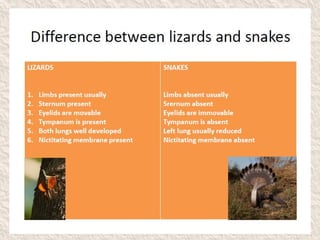
• Commonly known as lizards.
• Limbs and girdles usually well-developed.
• Eyelids movable. Nictitating membranes present.
• Ear openings and tympanum present.
• Maxillae, palatines ad pterygoids fixed.
• Mouth non-expansible.
• Sternum, episternum and urinary bladder usually
present.
• Tongue rarely notched or extensile.
• Eg:Hemidactylus, Calotes, Uromastix Varanus,
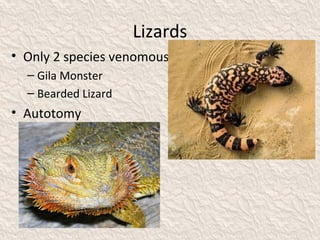
Lizards
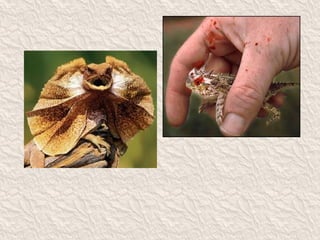
• Only 2 species venomous
– Gila Monster
– Bearded Lizard
• Autotomy
Sub- order – 2 Ophidia
• Limbs and griddles absent, vestigial hind limbs and
pelvic girdle in boa, python etc.
• Eye lids fixed. Nictitating membranes absent.
• Auditory openings and tympanum lost.
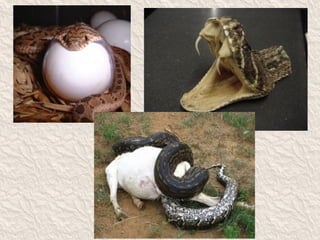
• Maxillae, palatines and pterygoids movable helping
in biting mechanism.
• Mouth can be widely separated.
• Sternum, episternum and urinary bladder usually
absent.
• Tongue slender, bifid and extensible.
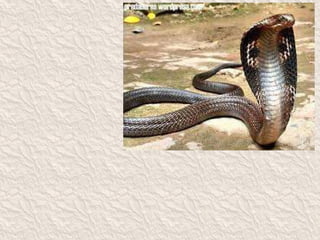
• Ex - Python, Boa, Naja, Bungarus, Vipera etc.
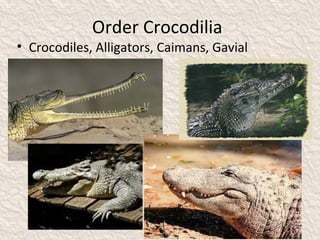
Order Crocodilia
• Crocodiles, Alligators, Caimans, Gavial
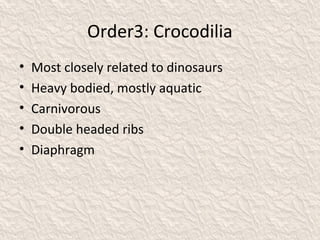
Order3: Crocodilia
• Most closely related to dinosaurs
• Heavy bodied, mostly aquatic
• Carnivorous
• Double headed ribs
• Diaphragm
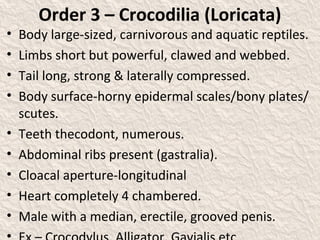
Order 3 – Crocodilia (Loricata)
• Body large-sized, carnivorous and aquatic reptiles.
• Limbs short but powerful, clawed and webbed.
• Tail long, strong & laterally compressed.
• Body surface-horny epidermal scales/bony plates/
scutes.
• Teeth thecodont, numerous.
• Abdominal ribs present (gastralia).
• Cloacal aperture-longitudinal
• Heart completely 4 chambered.
• Male with a median, erectile, grooved penis.
Classification of reptilia

Classification of reptilia

  • 1.
    Class:Reptilia-Classification Turtles, Tortoises, Tuataras, Crocodilians,Lizards, and Snakes B.Ashok Kumar Assistant Professor KRK Govt. Degree College Addanki-523201 9652929696 ashokkumarzoology@gmail.com
  • 2.
    Classification • Kingdom Animalia •Phylum Chordata – Subphylum Vertebrata • Class Reptilia There are more than 7,000 living and several extinct species • Five sub classes- Temporal fossae – Anapsida – Euryapsida – Parapsida – Synapsida and – Diapsida
  • 5.
    Sub class: Anapsida •Temporal fossae absent • Temporal region is completely bony • Two orders: – 1. Cotylosauria – 2. Chelonia
  • 6.
    Order:Cotylosauria • Extinct • Stemreptiles • Pelvic girdle plate like • Resembles Labyrinthodont Amphibians • Eg: Seymouria
  • 7.
    Order: Chelonia/Testudinata • Turtles, Terrapins and Tortoises – Body- short, broad – Limbs paddle like with claws – Shell consists of fused boney plates • Carapace (Dorsal, top) • Plastron (Ventral, lower) Head &Tail -retracted into the shell – Anapsid skull – Jaws- edentate & covered by horny sheath – Most species ribs and spine fused to inner surface of carapace – Pelvic and Pectoral girdles lie within the ribs – Sharp beak instead of teeth
  • 8.
    • Ductus Botalii-connects systemic and pulmonary arches • Males- single penis, longitudinal cloacal aperture • Variety of habitats, longest life span • Eg:Testudo, Chelonian mydas, Dermochelys, Trionyx Order: Chelonia
  • 9.
    • Shell andlimbs reflect habitat
  • 10.
    Sub class2: Euryapsida Extinct Skullwith a single dorso-lateral temporal opening on either side. These openings are bounded below by postorbital and squamosal bones. They lived during Triassic period.
  • 11.
    Sub class3: Parapsida •Extinct • Skull-parapsid • Skull with a single dorso-lateral temporal opening on either side. • These openings are bounded below by the supra temporal and post frontal bones. • They lived during Mesozoic to cretaceous period. – Mesosauria- Extinct Eg: Mesosaurus – Ichthyosauria- Extinct Eg: Ichthyosaurus – Proterosauria- Extinct Eg: Araoscelis – Sauropterygia- Extinct Eg: Cyamodus, Kronosaurus
  • 12.
  • 13.
    Sub-class 4:SYNAPSIDA • Extinct •Synapsid skull • Skull with a single lateral temporal opening on either side. • These openings are bounded above by the postorbital and squamosal bones. • They lived during Carboniferous to Permian period. • Eg: Dimetradon, Cyanognathus, Tritylodon
  • 14.
    Sub class4: Diapsida •Skull with two temporal openings on either side separated by the bar of postorbital and squamosal bones. • This sub- class includes 2 super orders. • Super order 1. Lepidosauria(Scaly lizards) • Super order 2. Archosauria(Ruling reptiles)
  • 15.
    Super order1: Lepidosauria •Two temporal vacuities- diapsid skull
  • 16.
    Order1: Rhynchocephalia • Ancientorder inhabit few small islands of New Zealand • Body small, elongated, lizard –like • Limbs pentadactylous, clawed and burrowing. • Skin covered by granular scales and a mid-dorsal row of spines. • Spiny crest that runs down the animal’s back
  • 17.
    Order1: Rhynchocephalia • Vertebraeamphicoelous or biconcave. • Numerous abdominal ribs present. • Teeth acrodont. • Perietal foramen-non functional median eye • Cloacal aperture transverse/ • No copulatory organs in male. • Tolerate cool temp, burrow during day and hunt at night • Example - Sphenodon punctatum or tuatara lizard
  • 18.
  • 19.
    Order2: Squamata • Bodysmall to medium, elongated and advanced. • Limbs, clawed, absent in snakes and few lizards. • Body covered by horny epidermal scales, shields and spines. • Vertebrae procoelous. • Ribs single headed. • Teeth acrodent or pleurodent. • Upper jaw is loosely joined to the skull • Paired Jacobson’s organ
  • 20.
    Order2: Squamata • Cloacalaperture is transverse • Male with eversible double copulatory organs (hemi-penes) • This order includes two sub-orders. • Sub order – 1 Lacertilia • Sub order – 2 Ophidia
  • 22.
    Suborder – 1– Lacertilia • Commonly known as lizards. • Limbs and girdles usually well-developed. • Eyelids movable. Nictitating membranes present. • Ear openings and tympanum present. • Maxillae, palatines ad pterygoids fixed. • Mouth non-expansible. • Sternum, episternum and urinary bladder usually present. • Tongue rarely notched or extensile. • Eg:Hemidactylus, Calotes, Uromastix Varanus,
  • 23.
    Lizards • Only 2species venomous – Gila Monster – Bearded Lizard • Autotomy
  • 25.
    Sub- order –2 Ophidia • Limbs and griddles absent, vestigial hind limbs and pelvic girdle in boa, python etc. • Eye lids fixed. Nictitating membranes absent. • Auditory openings and tympanum lost. • Maxillae, palatines and pterygoids movable helping in biting mechanism. • Mouth can be widely separated. • Sternum, episternum and urinary bladder usually absent. • Tongue slender, bifid and extensible. • Ex - Python, Boa, Naja, Bungarus, Vipera etc.
  • 28.
    Order Crocodilia • Crocodiles,Alligators, Caimans, Gavial
  • 29.
    Order3: Crocodilia • Mostclosely related to dinosaurs • Heavy bodied, mostly aquatic • Carnivorous • Double headed ribs • Diaphragm
  • 30.
    Order 3 –Crocodilia (Loricata) • Body large-sized, carnivorous and aquatic reptiles. • Limbs short but powerful, clawed and webbed. • Tail long, strong & laterally compressed. • Body surface-horny epidermal scales/bony plates/ scutes. • Teeth thecodont, numerous. • Abdominal ribs present (gastralia). • Cloacal aperture-longitudinal • Heart completely 4 chambered. • Male with a median, erectile, grooved penis.