Ecological Roles of Protists
Plant-like Protists
Harmful:
1. Euglenophytes thrive where
sewage is discharged because
they can absorb nutrients
– Large masses of cells can
result and are known as
blooms
– When they run out of
nutrients, they die and add to
the waste matter. This can
decrease the oxygen of lakes,
which will affect fish & other
creatures.
Harmful plant-like protists continued:
2. Red Tide: blooms of
dinoflagellates
(Pyrrophyta) occur
– They produce a toxin
that can become
concentrated in the
tissues of shellfish
(clams, mussels, oysters)
– The toxin affects the
nervous system causing
illness, paralysis, or
death of humans, fish
and other marine
animals.
Beneficial Plant-like Protists
1. Coral can contain
dinoflagellates which
photosynthesize. Coral can
live off of the products of
photosynthesis and
therefore, can live where
there are not many
nutrients in the water.
Beneficial plant-like protists continued:
2. Phytoplankton is an
important part of the
food chain for many
organisms (whales,
shrimp, & squid)
3. Phytoplankton
produces oxygen for
the Earth.
Animal-like Protists
Harmful:
1. Plasmodium (Sporozoa) causes
Malaria – passed on by a
mosquito (vector = method of
transfer)
2. Trypanosomiasis
(Mastigophora/Zoomastigina)
– causes African sleeping
sickness – passed on by tsetse
fly
Harmful animal-like protist continued:
3. Entamoeba (Sarcodina) –
amoeba that lives in the
digestive tract and causes
dysentery.
• Spread through
contaminated water
sources.
Beneficial Animal-like Protists:
1. Trichonympha
(Mastigophora /
Zoomastigina) lives in the
intestines of termites to
digest wood. (Termites
cannot digest wood without
them! = symbiotic)
2. Zooplankton are an important
part of the food chain.
Controlling Pathogenic Protists
• By knowing how the protist reproduces, you
can control their spread. This shows where
the organism is vulnerable in their life cycle.
Ex. To control Malaria, they spray mosquitoes –
same with Tsetse fly for African Sleeping
sickness
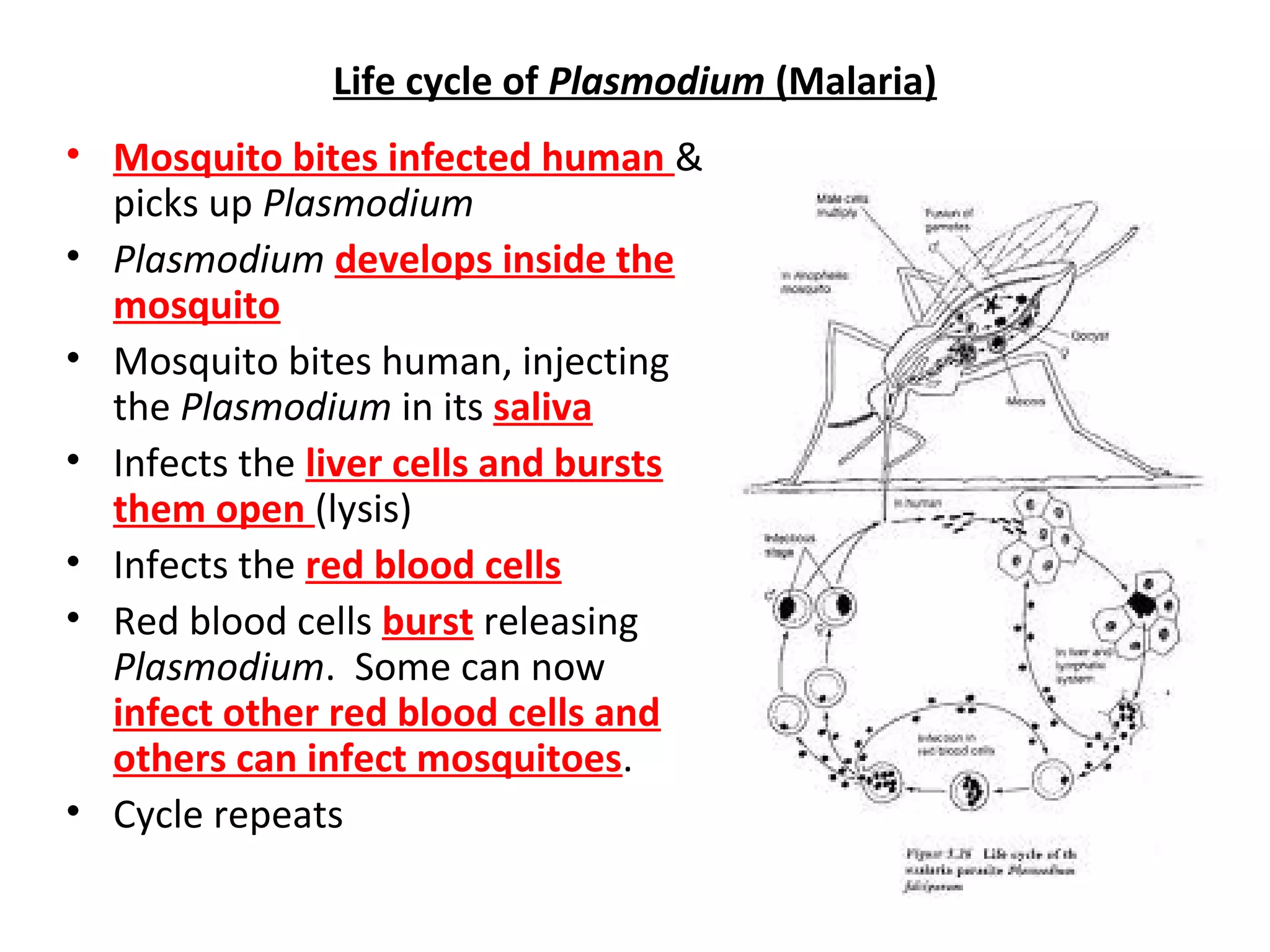
Life cycle of Plasmodium (Malaria)
• Mosquito bites infected human &
picks up Plasmodium
• Plasmodium develops inside the
mosquito
• Mosquito bites human, injecting
the Plasmodium in its saliva
• Infects the liver cells and bursts
them open (lysis)
• Infects the red blood cells
• Red blood cells burst releasing
Plasmodium. Some can now
infect other red blood cells and
others can infect mosquitoes.
• Cycle repeats
Slime Molds = Fungi-like Protists
• 2 parts of their life cycle:
A) Produces spores from
fruiting bodies
(reproductive structure).
• These spores help spread
the slime mold to new
areas.
A) It is able to move to new
areas by cytoplasmic
streaming – like an
amoeba.
Slime mold life cycle
TED Talk
• What Humans Can Learn from Intelligent
Slime: https://www.youtube.com/watch?
v=2UxGrde1NDA&ebc=ANyPxKpTALCheg2OG
Cob4bJ7QdlbcHBa8wFk0Pfnzqdo4Cm6CKC5Q
eHf5e9nD7wUrWhswRm5mgH5LsrirbBO4Cv9
BIlkvgaTBA

ecological roles of protists 2016

  • 1.
  • 2.
    Plant-like Protists Harmful: 1. Euglenophytesthrive where sewage is discharged because they can absorb nutrients – Large masses of cells can result and are known as blooms – When they run out of nutrients, they die and add to the waste matter. This can decrease the oxygen of lakes, which will affect fish & other creatures.
  • 3.
    Harmful plant-like protistscontinued: 2. Red Tide: blooms of dinoflagellates (Pyrrophyta) occur – They produce a toxin that can become concentrated in the tissues of shellfish (clams, mussels, oysters) – The toxin affects the nervous system causing illness, paralysis, or death of humans, fish and other marine animals.
  • 4.
    Beneficial Plant-like Protists 1.Coral can contain dinoflagellates which photosynthesize. Coral can live off of the products of photosynthesis and therefore, can live where there are not many nutrients in the water.
  • 5.
    Beneficial plant-like protistscontinued: 2. Phytoplankton is an important part of the food chain for many organisms (whales, shrimp, & squid) 3. Phytoplankton produces oxygen for the Earth.
  • 6.
    Animal-like Protists Harmful: 1. Plasmodium(Sporozoa) causes Malaria – passed on by a mosquito (vector = method of transfer) 2. Trypanosomiasis (Mastigophora/Zoomastigina) – causes African sleeping sickness – passed on by tsetse fly
  • 7.
    Harmful animal-like protistcontinued: 3. Entamoeba (Sarcodina) – amoeba that lives in the digestive tract and causes dysentery. • Spread through contaminated water sources.
  • 8.
    Beneficial Animal-like Protists: 1.Trichonympha (Mastigophora / Zoomastigina) lives in the intestines of termites to digest wood. (Termites cannot digest wood without them! = symbiotic) 2. Zooplankton are an important part of the food chain.
  • 9.
    Controlling Pathogenic Protists •By knowing how the protist reproduces, you can control their spread. This shows where the organism is vulnerable in their life cycle. Ex. To control Malaria, they spray mosquitoes – same with Tsetse fly for African Sleeping sickness
  • 10.
    Life cycle ofPlasmodium (Malaria) • Mosquito bites infected human & picks up Plasmodium • Plasmodium develops inside the mosquito • Mosquito bites human, injecting the Plasmodium in its saliva • Infects the liver cells and bursts them open (lysis) • Infects the red blood cells • Red blood cells burst releasing Plasmodium. Some can now infect other red blood cells and others can infect mosquitoes. • Cycle repeats
  • 11.
    Slime Molds =Fungi-like Protists • 2 parts of their life cycle: A) Produces spores from fruiting bodies (reproductive structure). • These spores help spread the slime mold to new areas. A) It is able to move to new areas by cytoplasmic streaming – like an amoeba.
  • 12.
  • 13.
    TED Talk • WhatHumans Can Learn from Intelligent Slime: https://www.youtube.com/watch? v=2UxGrde1NDA&ebc=ANyPxKpTALCheg2OG Cob4bJ7QdlbcHBa8wFk0Pfnzqdo4Cm6CKC5Q eHf5e9nD7wUrWhswRm5mgH5LsrirbBO4Cv9 BIlkvgaTBA