PERT & CPM
…are the two most widely use techniques for
planning and coordinating large-scale projects…
…by using PERT or CPM, managers are able to
obtain:
1. A graphical display of projects activities.
2. An estimate of how long the project will
take.
3. An indication of which activities are the most
critical to timely completion of the project.
4. An indication of how long any activity can be
delayed without lengthening the project.
PERT & CPM
The network diagram:
• The arrows represent the project
activities
• The nodes represent both
beginnings and endings of
activities
CPM Terminology
 Activity
 A task or a certain amount of work required in the
project
 Requires time to complete
 Represented by an arrow
 Dummy Activity
 Indicates only precedence relationships
 Does not require any time of effort
CPM Terminology
 Event
 Signals the beginning or ending of an activity
 Designates a point in time
 Represented by a circle (node)
 Network
 Shows the sequential relationships among activities
using nodes and arrows
CPM Terminology
 Path
 A connected sequence of activities leading from the
starting event to the ending event
 Critical Path
 The longest path (time); determines the project
duration
 Critical Activities
 All of the activities that make up the critical path
CPM Terminology
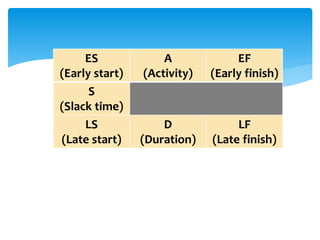
 Earliest Start (ES)
 The earliest that an activity can begin; assumes all
preceding activities have been completed
 Earliest Finish (EF)
 ES + activity time
 Latest Finish (LF)
 The latest that an activity can finish and not change the
project completion time
 Latest Start (LS)
 LF - activity time
Steps in CPM Analysis
 Draw the CPM network
 A graphic view of the relationships among the required
activities
 Analyze the paths through the network
 Determine the length of each path (time required to
complete each path)
 Starting at the beginning of the network and working
toward the end (from left to right), determine the ES and EF
for each activity
 . . . more
Steps in CPM Analysis
 Path analysis (continued)
 Identify the critical path(s) (the longest path[s]
through the network)
 The critical path(s) determines how long the project
will take
 . . . more
Steps in CPM Analysis
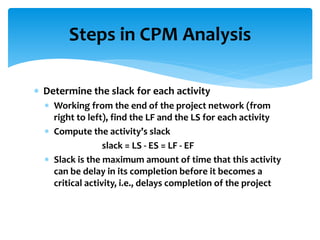
 Determine the slack for each activity
 Working from the end of the project network (from
right to left), find the LF and the LS for each activity
 Compute the activity’s slack
slack = LS - ES = LF - EF
 Slack is the maximum amount of time that this activity
can be delay in its completion before it becomes a
critical activity, i.e., delays completion of the project
PERT Analysis
Critical Path Method
…is one of two ways or tools to identify
the path through your project…
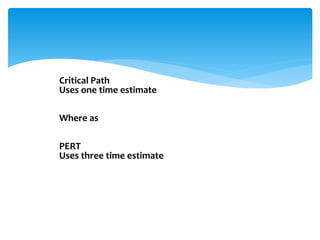
Critical Path
Uses one time estimate
Where as
PERT
Uses three time estimate
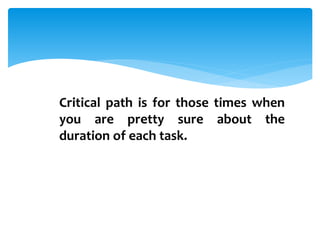
Critical path is for those times when
you are pretty sure about the
duration of each task.
PERT is used in more uncertain
situations.
ES
(Early start)
A
(Activity)
EF
(Early finish)
S
(Slack time)
LS
(Late start)
D
(Duration)
LF
(Late finish)
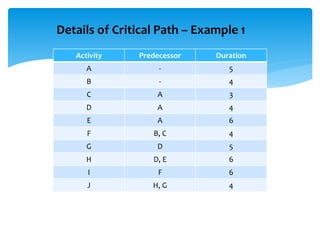
Details of Critical Path – Example 1
Activity Predecessor Duration
A - 5
B - 4
C A 3
D A 4
E A 6
F B, C 4
G D 5
H D, E 6
I F 6
J H, G 4
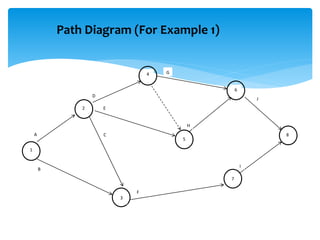
Path Diagram (For Example 1)
1
2
3
4
5
6
7
8A
B
C
D
E
F
G
H
I
J
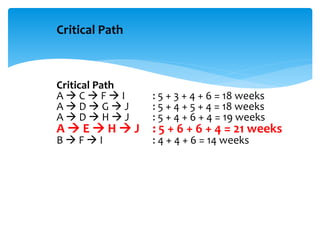
Critical Path
Critical Path
A  C  F  I : 5 + 3 + 4 + 6 = 18 weeks
A  D  G  J : 5 + 4 + 5 + 4 = 18 weeks
A  D  H  J : 5 + 4 + 6 + 4 = 19 weeks
A  E  H  J : 5 + 6 + 6 + 4 = 21 weeks
B  F  I : 4 + 4 + 6 = 14 weeks
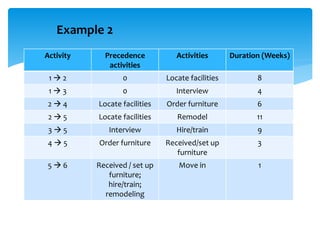
Example 2
Activity Precedence
activities
Activities Duration (Weeks)
1  2 0 Locate facilities 8
1  3 0 Interview 4
2  4 Locate facilities Order furniture 6
2  5 Locate facilities Remodel 11
3  5 Interview Hire/train 9
4  5 Order furniture Received/set up
furniture
3
5  6 Received / set up
furniture;
hire/train;
remodeling
Move in 1
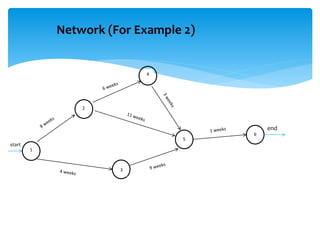
Network (For Example 2)
1
2
3
4
5
6
start
end
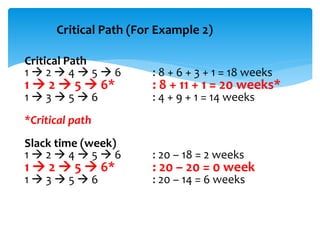
Critical Path (For Example 2)
Critical Path
1  2  4  5  6 : 8 + 6 + 3 + 1 = 18 weeks
1  2  5  6* : 8 + 11 + 1 = 20 weeks*
1  3  5  6 : 4 + 9 + 1 = 14 weeks
*Critical path
Slack time (week)
1  2  4  5  6 : 20 – 18 = 2 weeks
1  2  5  6* : 20 – 20 = 0 week
1  3  5  6 : 20 – 14 = 6 weeks
Practicing draw a network
See Example on page 102 – 103 (Notes)
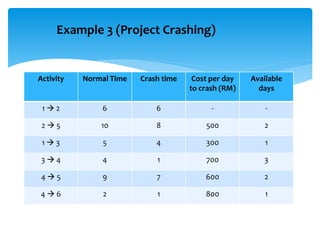
Example 3 (Project Crashing)
Activity Normal Time Crash time Cost per day
to crash (RM)
Available
days
1  2 6 6 - -
2  5 10 8 500 2
1  3 5 4 300 1
3  4 4 1 700 3
4  5 9 7 600 2
4  6 2 1 800 1
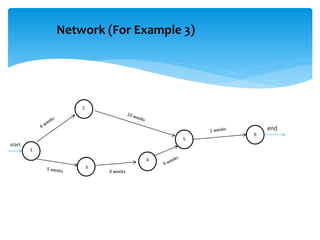
Network (For Example 3)
1
2
3
4
5
6
4 weeks
start
end
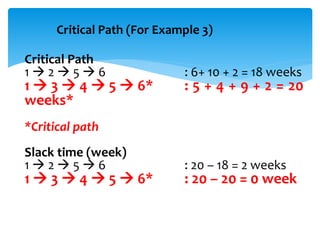
Critical Path (For Example 3)
Critical Path
1  2  5  6 : 6+ 10 + 2 = 18 weeks
1  3  4  5  6* : 5 + 4 + 9 + 2 = 20
weeks*
*Critical path
Slack time (week)
1  2  5  6 : 20 – 18 = 2 weeks
1  3  4  5  6* : 20 – 20 = 0 week
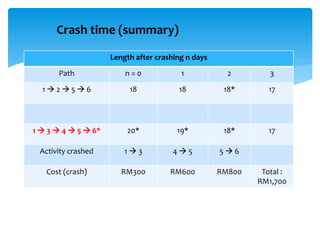
Crash time (summary)
Length after crashing n days
Path n = 0 1 2 3
1  2  5  6 18 18 18* 17
1  3  4  5  6* 20* 19* 18* 17
Activity crashed 1  3 4  5 5  6
Cost (crash) RM300 RM600 RM800 Total :
RM1,700
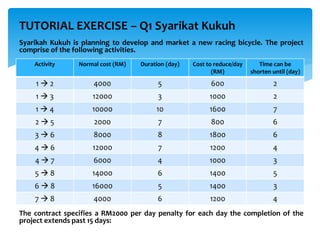
TUTORIAL EXERCISE – Q1 Syarikat Kukuh
Syarikah Kukuh is planning to develop and market a new racing bicycle. The project
comprise of the following activities.
Activity Normal cost (RM) Duration (day) Cost to reduce/day
(RM)
Time can be
shorten until (day)
1  2 4000 5 600 2
1  3 12000 3 1000 2
1  4 10000 10 1600 7
2  5 2000 7 800 6
3  6 8000 8 1800 6
4  6 12000 7 1200 4
4  7 6000 4 1000 3
5  8 14000 6 1400 5
6  8 16000 5 1400 3
7  8 4000 6 1200 4
The contract specifies a RM2000 per day penalty for each day the completion of the
project extends past 15 days:
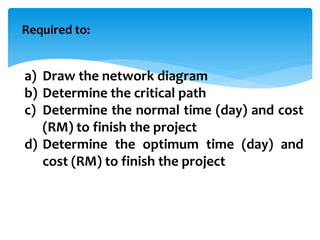
Required to:
a) Draw the network diagram
b) Determine the critical path
c) Determine the normal time (day) and cost
(RM) to finish the project
d) Determine the optimum time (day) and
cost (RM) to finish the project
Solution (a) – Tutorial (Q1 – Syarikat Kukuh)
Please draw the network
Solution (b) – Tutorial (Q1 – Syarikat Kukuh)
Please determine the critical path
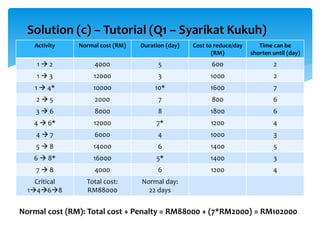
Solution (c) – Tutorial (Q1 – Syarikat Kukuh)
Activity Normal cost (RM) Duration (day) Cost to reduce/day
(RM)
Time can be
shorten until (day)
1  2 4000 5 600 2
1  3 12000 3 1000 2
1  4* 10000 10* 1600 7
2  5 2000 7 800 6
3  6 8000 8 1800 6
4  6* 12000 7* 1200 4
4  7 6000 4 1000 3
5  8 14000 6 1400 5
6  8* 16000 5* 1400 3
7  8 4000 6 1200 4
Critical
1468
Total cost:
RM88000
Normal day:
22 days
Normal cost (RM): Total cost + Penalty = RM88000 + (7*RM2000) = RM102000
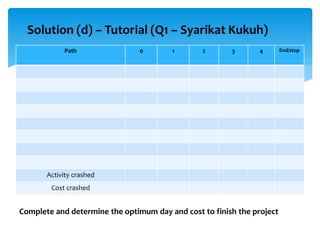
Solution (d) – Tutorial (Q1 – Syarikat Kukuh)
Path 0 1 2 3 4 End/stop
Activity crashed
Cost crashed
Complete and determine the optimum day and cost to finish the project
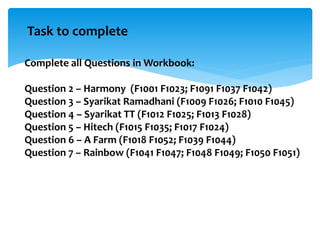
Task to complete
Complete all Questions in Workbook:
Question 2 – Harmony (F1001 F1023; F1091 F1037 F1042)
Question 3 – Syarikat Ramadhani (F1009 F1026; F1010 F1045)
Question 4 – Syarikat TT (F1012 F1025; F1013 F1028)
Question 5 – Hitech (F1015 F1035; F1017 F1024)
Question 6 – A Farm (F1018 F1052; F1039 F1044)
Question 7 – Rainbow (F1041 F1047; F1048 F1049; F1050 F1051)

Pert analysis

  • 1.
    PERT & CPM …arethe two most widely use techniques for planning and coordinating large-scale projects… …by using PERT or CPM, managers are able to obtain: 1. A graphical display of projects activities. 2. An estimate of how long the project will take. 3. An indication of which activities are the most critical to timely completion of the project. 4. An indication of how long any activity can be delayed without lengthening the project.
  • 2.
    PERT & CPM Thenetwork diagram: • The arrows represent the project activities • The nodes represent both beginnings and endings of activities
  • 3.
    CPM Terminology  Activity A task or a certain amount of work required in the project  Requires time to complete  Represented by an arrow  Dummy Activity  Indicates only precedence relationships  Does not require any time of effort
  • 4.
    CPM Terminology  Event Signals the beginning or ending of an activity  Designates a point in time  Represented by a circle (node)  Network  Shows the sequential relationships among activities using nodes and arrows
  • 5.
    CPM Terminology  Path A connected sequence of activities leading from the starting event to the ending event  Critical Path  The longest path (time); determines the project duration  Critical Activities  All of the activities that make up the critical path
  • 6.
    CPM Terminology  EarliestStart (ES)  The earliest that an activity can begin; assumes all preceding activities have been completed  Earliest Finish (EF)  ES + activity time  Latest Finish (LF)  The latest that an activity can finish and not change the project completion time  Latest Start (LS)  LF - activity time
  • 7.
    Steps in CPMAnalysis  Draw the CPM network  A graphic view of the relationships among the required activities  Analyze the paths through the network  Determine the length of each path (time required to complete each path)  Starting at the beginning of the network and working toward the end (from left to right), determine the ES and EF for each activity  . . . more
  • 8.
    Steps in CPMAnalysis  Path analysis (continued)  Identify the critical path(s) (the longest path[s] through the network)  The critical path(s) determines how long the project will take  . . . more
  • 9.
    Steps in CPMAnalysis  Determine the slack for each activity  Working from the end of the project network (from right to left), find the LF and the LS for each activity  Compute the activity’s slack slack = LS - ES = LF - EF  Slack is the maximum amount of time that this activity can be delay in its completion before it becomes a critical activity, i.e., delays completion of the project
  • 10.
    PERT Analysis Critical PathMethod …is one of two ways or tools to identify the path through your project…
  • 11.
    Critical Path Uses onetime estimate Where as PERT Uses three time estimate
  • 12.
    Critical path isfor those times when you are pretty sure about the duration of each task.
  • 13.
    PERT is usedin more uncertain situations.
  • 14.
    ES (Early start) A (Activity) EF (Early finish) S (Slacktime) LS (Late start) D (Duration) LF (Late finish)
  • 15.
    Details of CriticalPath – Example 1 Activity Predecessor Duration A - 5 B - 4 C A 3 D A 4 E A 6 F B, C 4 G D 5 H D, E 6 I F 6 J H, G 4
  • 16.
    Path Diagram (ForExample 1) 1 2 3 4 5 6 7 8A B C D E F G H I J
  • 17.
    Critical Path Critical Path A C  F  I : 5 + 3 + 4 + 6 = 18 weeks A  D  G  J : 5 + 4 + 5 + 4 = 18 weeks A  D  H  J : 5 + 4 + 6 + 4 = 19 weeks A  E  H  J : 5 + 6 + 6 + 4 = 21 weeks B  F  I : 4 + 4 + 6 = 14 weeks
  • 18.
    Example 2 Activity Precedence activities ActivitiesDuration (Weeks) 1  2 0 Locate facilities 8 1  3 0 Interview 4 2  4 Locate facilities Order furniture 6 2  5 Locate facilities Remodel 11 3  5 Interview Hire/train 9 4  5 Order furniture Received/set up furniture 3 5  6 Received / set up furniture; hire/train; remodeling Move in 1
  • 19.
    Network (For Example2) 1 2 3 4 5 6 start end
  • 20.
    Critical Path (ForExample 2) Critical Path 1  2  4  5  6 : 8 + 6 + 3 + 1 = 18 weeks 1  2  5  6* : 8 + 11 + 1 = 20 weeks* 1  3  5  6 : 4 + 9 + 1 = 14 weeks *Critical path Slack time (week) 1  2  4  5  6 : 20 – 18 = 2 weeks 1  2  5  6* : 20 – 20 = 0 week 1  3  5  6 : 20 – 14 = 6 weeks
  • 21.
    Practicing draw anetwork See Example on page 102 – 103 (Notes)
  • 22.
    Example 3 (ProjectCrashing) Activity Normal Time Crash time Cost per day to crash (RM) Available days 1  2 6 6 - - 2  5 10 8 500 2 1  3 5 4 300 1 3  4 4 1 700 3 4  5 9 7 600 2 4  6 2 1 800 1
  • 23.
    Network (For Example3) 1 2 3 4 5 6 4 weeks start end
  • 24.
    Critical Path (ForExample 3) Critical Path 1  2  5  6 : 6+ 10 + 2 = 18 weeks 1  3  4  5  6* : 5 + 4 + 9 + 2 = 20 weeks* *Critical path Slack time (week) 1  2  5  6 : 20 – 18 = 2 weeks 1  3  4  5  6* : 20 – 20 = 0 week
  • 25.
    Crash time (summary) Lengthafter crashing n days Path n = 0 1 2 3 1  2  5  6 18 18 18* 17 1  3  4  5  6* 20* 19* 18* 17 Activity crashed 1  3 4  5 5  6 Cost (crash) RM300 RM600 RM800 Total : RM1,700
  • 26.
    TUTORIAL EXERCISE –Q1 Syarikat Kukuh Syarikah Kukuh is planning to develop and market a new racing bicycle. The project comprise of the following activities. Activity Normal cost (RM) Duration (day) Cost to reduce/day (RM) Time can be shorten until (day) 1  2 4000 5 600 2 1  3 12000 3 1000 2 1  4 10000 10 1600 7 2  5 2000 7 800 6 3  6 8000 8 1800 6 4  6 12000 7 1200 4 4  7 6000 4 1000 3 5  8 14000 6 1400 5 6  8 16000 5 1400 3 7  8 4000 6 1200 4 The contract specifies a RM2000 per day penalty for each day the completion of the project extends past 15 days:
  • 27.
    Required to: a) Drawthe network diagram b) Determine the critical path c) Determine the normal time (day) and cost (RM) to finish the project d) Determine the optimum time (day) and cost (RM) to finish the project
  • 28.
    Solution (a) –Tutorial (Q1 – Syarikat Kukuh) Please draw the network
  • 29.
    Solution (b) –Tutorial (Q1 – Syarikat Kukuh) Please determine the critical path
  • 30.
    Solution (c) –Tutorial (Q1 – Syarikat Kukuh) Activity Normal cost (RM) Duration (day) Cost to reduce/day (RM) Time can be shorten until (day) 1  2 4000 5 600 2 1  3 12000 3 1000 2 1  4* 10000 10* 1600 7 2  5 2000 7 800 6 3  6 8000 8 1800 6 4  6* 12000 7* 1200 4 4  7 6000 4 1000 3 5  8 14000 6 1400 5 6  8* 16000 5* 1400 3 7  8 4000 6 1200 4 Critical 1468 Total cost: RM88000 Normal day: 22 days Normal cost (RM): Total cost + Penalty = RM88000 + (7*RM2000) = RM102000
  • 31.
    Solution (d) –Tutorial (Q1 – Syarikat Kukuh) Path 0 1 2 3 4 End/stop Activity crashed Cost crashed Complete and determine the optimum day and cost to finish the project
  • 32.
    Task to complete Completeall Questions in Workbook: Question 2 – Harmony (F1001 F1023; F1091 F1037 F1042) Question 3 – Syarikat Ramadhani (F1009 F1026; F1010 F1045) Question 4 – Syarikat TT (F1012 F1025; F1013 F1028) Question 5 – Hitech (F1015 F1035; F1017 F1024) Question 6 – A Farm (F1018 F1052; F1039 F1044) Question 7 – Rainbow (F1041 F1047; F1048 F1049; F1050 F1051)