1
Network
A- PERT (Program Evaluation Review Technique) network
Example
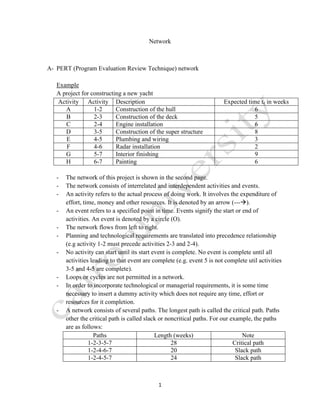
A project for constructing a new yacht
Activity Activity Description Expected time te in weeks
A 1-2 Construction of the hull 6
B 2-3 Construction of the deck 5
C 2-4 Engine installation 6
D 3-5 Construction of the super structure 8
E 4-5 Plumbing and wiring 3
F 4-6 Radar installation 2
G 5-7 Interior finishing 9
H 6-7 Painting 6
- The network of this project is shown in the second page.
- The network consists of interrelated and interdependent activities and events.
- An activity refers to the actual process of doing work. It involves the expenditure of
effort, time, money and other resources. It is denoted by an arrow (---).
- An event refers to a specified point in time. Events signify the start or end of
activities. An event is denoted by a circle (O).
- The network flows from left to right.
- Planning and technological requirements are translated into precedence relationship
(e.g activity 1-2 must precede activities 2-3 and 2-4).
- No activity can start until its start event is complete. No event is complete until all
activities leading to that event are complete (e.g. event 5 is not complete util activities
3-5 and 4-5 are complete).
- Loops or cycles are not permitted in a network.
- In order to incorporate technological or managerial requirements, it is some time
necessary to insert a dummy activity which does not require any time, effort or
resources for it completion.
- A network consists of several paths. The longest path is called the critical path. Paths
other the critical path is called slack or noncritical paths. For our example, the paths
are as follows:
Paths Length (weeks) Note
1-2-3-5-7 28 Critical path
1-2-4-6-7 20 Slack path
1-2-4-5-7 24 Slack path
2
Calculation of TE
- For each event , identify the various paths that connect the network beginning event
to that event.
- Proceeding forward (left to right), add te of the activities along each such path.
- The longest chain or path determines its TE.
Calculation of TL
- For each event, identify various paths that connect the network ending event to that
event.
- Proceeding backward (right to left) subtract te of the activities along each such path.
- The longest chain or path determines its TL.
Event slack S
- Event slack S=TL of the same event- TE of the same event.
- A slack represents the time by which we can delay the realization of that event
without jeopardizing the timely realization of the successor events.
Activity A-B slack
- Activity slack=(TL of event B – TE of event A) – (te of activity A-B)
3
- As an example, the 4-6 activity slack = 8 weeks.
Path slack
- Total slack on a specific path = Σ(te of the critical path) - Σ(te of the specific path)
- As an example, the 1-2-4-6-7 path slack = 8 weeks.
Usually the given data include a,m, and b time estimates and we then conclude the
expected time (te) and the standard deviation (σ) for each activity. (a) stands for the
most optimistic time. (m) stands for the most likely time. (b) stands for the most
pessimistic time.
Where
te=
𝑎+4𝑚+𝑏
6
and, σ=
𝑏−𝑎
6
for the given example the data table is as follows:
Description activity (a)in
weeks
(m) in
weeks
(b) in
weeks
(te) in
weeks
(σ) in
weeks
Hull 1-2 4 6 8 6 0.66
Deck 2-3 2 5 8 5 1
Engine 2-4 3 5 13 6 1.66
Superstructure 3-5 5 8 11 8 1
Plumbing & wiring 4-5 2 3 4 3 0.66
Radar 4-6 1 2 3 2 0.66
Finshing 5-7 6 9 12 9 1
Painting 6-7 4 6 8 6 0.66
The above values were based on the assumed Beta distribution.
(te) for the critical path 1-2-3-5-7 = 28 weeks.
(σ) for the critical path 1-2-3-5-7 =√𝜎1−2
2
+ 𝜎2−3
2
+ 𝜎3−5
2
+ 𝜎5−7
2
=1.86
The p(finishing the project in 28 weeks)=0.5
The p(finishing the project in 30 weeks)=0.86
The p(finishing the project in 31.05 weeks)=0.95
Gantt's chart is as follows:
(0)-(6) A * * * * * *
(6-11) B * * * * *
(6)-(16) C * * * * * *
(11)-(19) D * * * * * * * *
(12)-(19) E * * *
(12)-(22) F * *
(19)-(28) G * * * * * * * * *
(14)-(28) H * * * * * *
1 2 3 4 5 6 7 8 9 10 11 12 13 14 15 16 17 18 19 20 21 22 23 24 25 26 27 28
4
B- CPM network
The CPM approach is useful when both time and cost of each activity is known. Two sets
of data are usually supplied the normal set and the crash set There is a time-cost tradeoff
function for each activity. The function is assumed linear.
Example
Activity Time(weeks) Cost (L.E.) ∆ 𝑐𝑜𝑠𝑡
∆ 𝑡𝑖𝑚𝑒Normal Crash Normal Crash
1-2 10 7 1000 1600 200
1-3 15 10 2000 3000 200
2-4 8 6 1800 2600 400
2-5 20 16 4500 5300 200
3-6 30 20 7200 9600 240
4-5 14 12 5000 6000 500
5-6 12 9 3300 4500 400
Network
5
Path Normal Crash Comment
1-3-6 45 30 Normal critical path
1-2-5-6 42 32 -------------------
1-2-4-5-6 44 34 Crash critical path
6
- What is the minimum project completion_time for a budget of L.E. 27000?
- What is the minimum cost to complete the project in 39 days?

Management Network Lec 3

  • 1.
    1 Network A- PERT (ProgramEvaluation Review Technique) network Example A project for constructing a new yacht Activity Activity Description Expected time te in weeks A 1-2 Construction of the hull 6 B 2-3 Construction of the deck 5 C 2-4 Engine installation 6 D 3-5 Construction of the super structure 8 E 4-5 Plumbing and wiring 3 F 4-6 Radar installation 2 G 5-7 Interior finishing 9 H 6-7 Painting 6 - The network of this project is shown in the second page. - The network consists of interrelated and interdependent activities and events. - An activity refers to the actual process of doing work. It involves the expenditure of effort, time, money and other resources. It is denoted by an arrow (---). - An event refers to a specified point in time. Events signify the start or end of activities. An event is denoted by a circle (O). - The network flows from left to right. - Planning and technological requirements are translated into precedence relationship (e.g activity 1-2 must precede activities 2-3 and 2-4). - No activity can start until its start event is complete. No event is complete until all activities leading to that event are complete (e.g. event 5 is not complete util activities 3-5 and 4-5 are complete). - Loops or cycles are not permitted in a network. - In order to incorporate technological or managerial requirements, it is some time necessary to insert a dummy activity which does not require any time, effort or resources for it completion. - A network consists of several paths. The longest path is called the critical path. Paths other the critical path is called slack or noncritical paths. For our example, the paths are as follows: Paths Length (weeks) Note 1-2-3-5-7 28 Critical path 1-2-4-6-7 20 Slack path 1-2-4-5-7 24 Slack path
  • 2.
    2 Calculation of TE -For each event , identify the various paths that connect the network beginning event to that event. - Proceeding forward (left to right), add te of the activities along each such path. - The longest chain or path determines its TE. Calculation of TL - For each event, identify various paths that connect the network ending event to that event. - Proceeding backward (right to left) subtract te of the activities along each such path. - The longest chain or path determines its TL. Event slack S - Event slack S=TL of the same event- TE of the same event. - A slack represents the time by which we can delay the realization of that event without jeopardizing the timely realization of the successor events. Activity A-B slack - Activity slack=(TL of event B – TE of event A) – (te of activity A-B)
  • 3.
    3 - As anexample, the 4-6 activity slack = 8 weeks. Path slack - Total slack on a specific path = Σ(te of the critical path) - Σ(te of the specific path) - As an example, the 1-2-4-6-7 path slack = 8 weeks. Usually the given data include a,m, and b time estimates and we then conclude the expected time (te) and the standard deviation (σ) for each activity. (a) stands for the most optimistic time. (m) stands for the most likely time. (b) stands for the most pessimistic time. Where te= 𝑎+4𝑚+𝑏 6 and, σ= 𝑏−𝑎 6 for the given example the data table is as follows: Description activity (a)in weeks (m) in weeks (b) in weeks (te) in weeks (σ) in weeks Hull 1-2 4 6 8 6 0.66 Deck 2-3 2 5 8 5 1 Engine 2-4 3 5 13 6 1.66 Superstructure 3-5 5 8 11 8 1 Plumbing & wiring 4-5 2 3 4 3 0.66 Radar 4-6 1 2 3 2 0.66 Finshing 5-7 6 9 12 9 1 Painting 6-7 4 6 8 6 0.66 The above values were based on the assumed Beta distribution. (te) for the critical path 1-2-3-5-7 = 28 weeks. (σ) for the critical path 1-2-3-5-7 =√𝜎1−2 2 + 𝜎2−3 2 + 𝜎3−5 2 + 𝜎5−7 2 =1.86 The p(finishing the project in 28 weeks)=0.5 The p(finishing the project in 30 weeks)=0.86 The p(finishing the project in 31.05 weeks)=0.95 Gantt's chart is as follows: (0)-(6) A * * * * * * (6-11) B * * * * * (6)-(16) C * * * * * * (11)-(19) D * * * * * * * * (12)-(19) E * * * (12)-(22) F * * (19)-(28) G * * * * * * * * * (14)-(28) H * * * * * * 1 2 3 4 5 6 7 8 9 10 11 12 13 14 15 16 17 18 19 20 21 22 23 24 25 26 27 28
  • 4.
    4 B- CPM network TheCPM approach is useful when both time and cost of each activity is known. Two sets of data are usually supplied the normal set and the crash set There is a time-cost tradeoff function for each activity. The function is assumed linear. Example Activity Time(weeks) Cost (L.E.) ∆ 𝑐𝑜𝑠𝑡 ∆ 𝑡𝑖𝑚𝑒Normal Crash Normal Crash 1-2 10 7 1000 1600 200 1-3 15 10 2000 3000 200 2-4 8 6 1800 2600 400 2-5 20 16 4500 5300 200 3-6 30 20 7200 9600 240 4-5 14 12 5000 6000 500 5-6 12 9 3300 4500 400 Network
  • 5.
    5 Path Normal CrashComment 1-3-6 45 30 Normal critical path 1-2-5-6 42 32 ------------------- 1-2-4-5-6 44 34 Crash critical path
  • 6.
    6 - What isthe minimum project completion_time for a budget of L.E. 27000? - What is the minimum cost to complete the project in 39 days?