CPM AND PERT
Introduction to CPM
Defination:-
Critical path is a sequence of activity between a project’s start and finish that takes the longest time to
complete.
Critical path method is based on mathematical calculations and it is used for scheduling project activities.
activities.
 In 1950, Critical path method(CPM) was developed by Kelly and Walker to assist in building and
maintains of chemical plants.
The initial critical path method was used for managing plant maintenance projects.
Critical path is the sequential activities from start to the end of a project. Although many projects have
only one critical path, some projects may have more than one critical paths depending on the flow logic
used in the project
The essential technique for using CPM is to construct a model of the project that includes the following:
A list of all activities required to complete the project (typically categorized within a work breakdown
structure
The time (duration) that each activity will take to completion,
The dependencies between the activities
Terminologies used in CPM
In order to explain the purpose, structure and operation of CPM, it is helpful to define the
following terms:
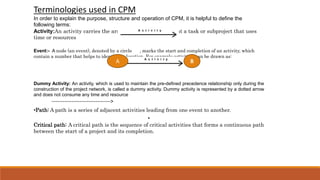
Activity:An activity carries the arrow symbol.This represent a task or subproject that uses
time or resources
Event:- A node (an event), denoted by a circle , marks the start and completion of an activity, which
contain a number that helps to identify its location. For example activity A can be drawn as:
Dummy Activity: An activity, which is used to maintain the pre-defined precedence relationship only during the
construction of the project network, is called a dummy activity. Dummy activity is represented by a dotted arrow
and does not consume any time and resource
-------------------------------->
•Path: A path is a series of adjacent activities leading from one event to another.
•
Critical path: A critical path is the sequence of critical activities that forms a continuous path
between the start of a project and its completion.
A B
Forward pass:
 The Early Start and Early Finish Time Calculated by moving Forward Through
the Network.
• Consider Maximum.
Backward pass:
•The Latest Start and Latest Finish Time Calculated by moving Backward Through
the Network.
•Consider Minimum
Float activity:
Float activity For an Activity is The Difference between its Earliest and Latest Start
Time or Earliest and Latest Finish Time .
Steps in Critical Path Method
•Step 1: Make a forward pass through the network as follows: For each activity i
beginning at the Start node, compute:
Earliest Start Time (ES) = the maximum of the earliest finish times of all activities
immediately preceding activity i. (This is 0 for an activity with no predecessors.). This is
the earliest time an activity can begin without violation of immediate predecessor
requirements.
Earliest Finish Time (Ef) = (Earliest Start Time) + (Time to complete activity i. This
represent the earliest time at which an activity can end.
The project completion time is the maximum of the Earliest Finish Times at the Finish
node.
•Step 2: Make a backwards pass through the network as follows: Move sequentially backwards from
the Finish node to the Start node. At a given node, j, consider all activities ending at node j. For each
of these activities, (i,j), compute:
Latest Finish Time (LF) = the minimum of the latest start times beginning at node j. (For node N, this
is the project completion time.). This is the latest time an activity can end without delaying the entire
project.
Latest Start Time (LS) = (Latest Finish Time) - (Time to complete activity (i,j)). This is the latest time an
activity can begin without delaying the entire project.
•Step 3: Calculate the float time for each activity by:
float = (Latest Start) - (Earliest Start), or
= (Latest Finish)-(EarliesFinish).
A critical path is a path of activities, from the Start node to the Finish node, with 0 float times.
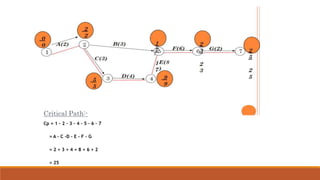
Example:
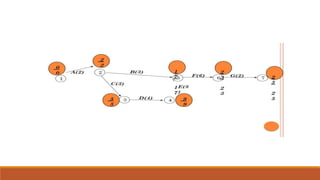
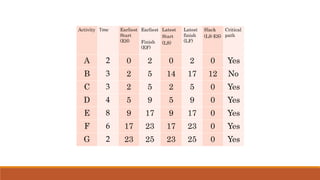
1. Construct the CPM Network using the details below and determine
the critical path
Activity Tme Earliest
Start
(ES)
Earliest
Finish
(EF)
Latest
Start
(LS)
Latest
finish
(LF)
Slack
(LS-ES)
Critical
path
A 2 0 2 0 2 0 Yes
B 3 2 5 14 17 12 No
C 3 2 5 2 5 0 Yes
D 4 5 9 5 9 0 Yes
E 8 9 17 9 17 0 Yes
F 6 17 23 17 23 0 Yes
G 2 23 25 23 25 0 Yes
Critical Path:-
Cp = 1 - 2 – 3 - 4 – 5 – 6 – 7
= A – C -D - E - F - G
= 2 + 3 + 4 + 8 + 6 + 2
= 25
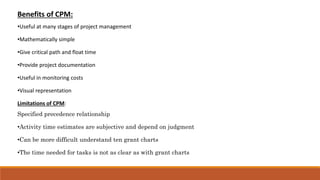
Benefits of CPM:
•Useful at many stages of project management
•Mathematically simple
•Give critical path and float time
•Provide project documentation
•Useful in monitoring costs
•Visual representation
Limitations of CPM:
Specified precedence relationship
•Activity time estimates are subjective and depend on judgment
•Can be more difficult understand ten grant charts
•The time needed for tasks is not as clear as with grant charts
How CPM Works
•Critical Path: The sequence of stages determining the minimum time needed for an operation.
•Steps to determine the critical path:
• List all activities required to complete the project.
• Determine the dependencies between activities.
• Estimate the duration of each activity.
• Identify the longest path through the network.
How PERT Works
•PERT charts: Visual representations of a project's timeline.
•Steps to create a PERT chart:
• Identify the project tasks.
• Determine task dependencies.
• Estimate optimistic, pessimistic, and most likely durations.
• Calculate expected time for each task.
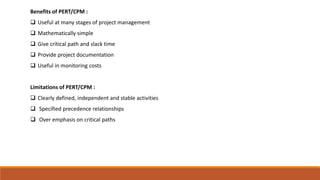
Benefits of PERT/CPM :
 Useful at many stages of project management
 Mathematically simple
 Give critical path and slack time
 Provide project documentation
 Useful in monitoring costs
Limitations of PERT/CPM :
 Clearly defined, independent and stable activities
 Specified precedence relationships
 Over emphasis on critical paths
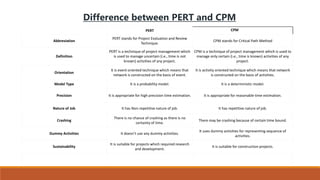
PERT CPM
Abbreviation
PERT stands for Project Evaluation and Review
Technique.
CPM stands for Critical Path Method
Definition
PERT is a technique of project management which
is used to manage uncertain (i.e., time is not
known) activities of any project.
CPM is a technique of project management which is used to
manage only certain (i.e., time is known) activities of any
project.
Orientation
It is event oriented technique which means that
network is constructed on the basis of event.
It is activity oriented technique which means that network
is constructed on the basis of activities.
Model Type It is a probability model. It is a deterministic model.
Precision It is appropriate for high precision time estimation. It is appropriate for reasonable time estimation.
Nature of Job It has Non-repetitive nature of job. It has repetitive nature of job.
Crashing
There is no chance of crashing as there is no
certainty of time.
There may be crashing because of certain time bound.
Dummy Activities It doesn’t use any dummy activities.
It uses dummy activities for representing sequence of
activities.
Sustainability
It is suitable for projects which required research
and development.
It is suitable for construction projects.
Difference between PERT and CPM
Applications of CPM / PERT
These methods have been applied to a wide variety of problems in industries and have found acceptance even in
government organizations.
These include :
 Construction of a dam or a canal system in a region
 Construction of a building or highway
 Maintenance or overhaul of airplanes or oil refinery
 Space flight
 Cost control of a project using PERT / COST
 Designing a prototype of a machine
 Development of supersonic planes
CPM(CRITICAL PATH METHOD)
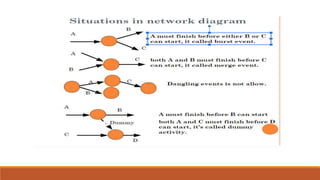
• NETWORK DIAGRAM
• Early Start Time(EST) & Early Finish Time(EFT)
• Late Start Time(LST) &Late Finish Time(LFT)
• Total Float
• Free Float
• Independent Float
CPM AND PERT(critical path method) .pptx

CPM AND PERT(critical path method) .pptx

  • 1.
  • 2.
    Introduction to CPM Defination:- Criticalpath is a sequence of activity between a project’s start and finish that takes the longest time to complete. Critical path method is based on mathematical calculations and it is used for scheduling project activities. activities.  In 1950, Critical path method(CPM) was developed by Kelly and Walker to assist in building and maintains of chemical plants. The initial critical path method was used for managing plant maintenance projects.
  • 3.
    Critical path isthe sequential activities from start to the end of a project. Although many projects have only one critical path, some projects may have more than one critical paths depending on the flow logic used in the project The essential technique for using CPM is to construct a model of the project that includes the following: A list of all activities required to complete the project (typically categorized within a work breakdown structure The time (duration) that each activity will take to completion, The dependencies between the activities
  • 4.
    Terminologies used inCPM In order to explain the purpose, structure and operation of CPM, it is helpful to define the following terms: Activity:An activity carries the arrow symbol.This represent a task or subproject that uses time or resources Event:- A node (an event), denoted by a circle , marks the start and completion of an activity, which contain a number that helps to identify its location. For example activity A can be drawn as: Dummy Activity: An activity, which is used to maintain the pre-defined precedence relationship only during the construction of the project network, is called a dummy activity. Dummy activity is represented by a dotted arrow and does not consume any time and resource --------------------------------> •Path: A path is a series of adjacent activities leading from one event to another. • Critical path: A critical path is the sequence of critical activities that forms a continuous path between the start of a project and its completion. A B
  • 6.
    Forward pass:  TheEarly Start and Early Finish Time Calculated by moving Forward Through the Network. • Consider Maximum. Backward pass: •The Latest Start and Latest Finish Time Calculated by moving Backward Through the Network. •Consider Minimum Float activity: Float activity For an Activity is The Difference between its Earliest and Latest Start Time or Earliest and Latest Finish Time .
  • 7.
    Steps in CriticalPath Method •Step 1: Make a forward pass through the network as follows: For each activity i beginning at the Start node, compute: Earliest Start Time (ES) = the maximum of the earliest finish times of all activities immediately preceding activity i. (This is 0 for an activity with no predecessors.). This is the earliest time an activity can begin without violation of immediate predecessor requirements. Earliest Finish Time (Ef) = (Earliest Start Time) + (Time to complete activity i. This represent the earliest time at which an activity can end. The project completion time is the maximum of the Earliest Finish Times at the Finish node.
  • 8.
    •Step 2: Makea backwards pass through the network as follows: Move sequentially backwards from the Finish node to the Start node. At a given node, j, consider all activities ending at node j. For each of these activities, (i,j), compute: Latest Finish Time (LF) = the minimum of the latest start times beginning at node j. (For node N, this is the project completion time.). This is the latest time an activity can end without delaying the entire project. Latest Start Time (LS) = (Latest Finish Time) - (Time to complete activity (i,j)). This is the latest time an activity can begin without delaying the entire project. •Step 3: Calculate the float time for each activity by: float = (Latest Start) - (Earliest Start), or = (Latest Finish)-(EarliesFinish). A critical path is a path of activities, from the Start node to the Finish node, with 0 float times.
  • 9.
    Example: 1. Construct theCPM Network using the details below and determine the critical path
  • 11.
    Activity Tme Earliest Start (ES) Earliest Finish (EF) Latest Start (LS) Latest finish (LF) Slack (LS-ES) Critical path A2 0 2 0 2 0 Yes B 3 2 5 14 17 12 No C 3 2 5 2 5 0 Yes D 4 5 9 5 9 0 Yes E 8 9 17 9 17 0 Yes F 6 17 23 17 23 0 Yes G 2 23 25 23 25 0 Yes
  • 12.
    Critical Path:- Cp =1 - 2 – 3 - 4 – 5 – 6 – 7 = A – C -D - E - F - G = 2 + 3 + 4 + 8 + 6 + 2 = 25
  • 13.
    Benefits of CPM: •Usefulat many stages of project management •Mathematically simple •Give critical path and float time •Provide project documentation •Useful in monitoring costs •Visual representation Limitations of CPM: Specified precedence relationship •Activity time estimates are subjective and depend on judgment •Can be more difficult understand ten grant charts •The time needed for tasks is not as clear as with grant charts
  • 14.
    How CPM Works •CriticalPath: The sequence of stages determining the minimum time needed for an operation. •Steps to determine the critical path: • List all activities required to complete the project. • Determine the dependencies between activities. • Estimate the duration of each activity. • Identify the longest path through the network. How PERT Works •PERT charts: Visual representations of a project's timeline. •Steps to create a PERT chart: • Identify the project tasks. • Determine task dependencies. • Estimate optimistic, pessimistic, and most likely durations. • Calculate expected time for each task.
  • 15.
    Benefits of PERT/CPM:  Useful at many stages of project management  Mathematically simple  Give critical path and slack time  Provide project documentation  Useful in monitoring costs Limitations of PERT/CPM :  Clearly defined, independent and stable activities  Specified precedence relationships  Over emphasis on critical paths
  • 16.
    PERT CPM Abbreviation PERT standsfor Project Evaluation and Review Technique. CPM stands for Critical Path Method Definition PERT is a technique of project management which is used to manage uncertain (i.e., time is not known) activities of any project. CPM is a technique of project management which is used to manage only certain (i.e., time is known) activities of any project. Orientation It is event oriented technique which means that network is constructed on the basis of event. It is activity oriented technique which means that network is constructed on the basis of activities. Model Type It is a probability model. It is a deterministic model. Precision It is appropriate for high precision time estimation. It is appropriate for reasonable time estimation. Nature of Job It has Non-repetitive nature of job. It has repetitive nature of job. Crashing There is no chance of crashing as there is no certainty of time. There may be crashing because of certain time bound. Dummy Activities It doesn’t use any dummy activities. It uses dummy activities for representing sequence of activities. Sustainability It is suitable for projects which required research and development. It is suitable for construction projects. Difference between PERT and CPM
  • 17.
    Applications of CPM/ PERT These methods have been applied to a wide variety of problems in industries and have found acceptance even in government organizations. These include :  Construction of a dam or a canal system in a region  Construction of a building or highway  Maintenance or overhaul of airplanes or oil refinery  Space flight  Cost control of a project using PERT / COST  Designing a prototype of a machine  Development of supersonic planes
  • 18.
    CPM(CRITICAL PATH METHOD) •NETWORK DIAGRAM • Early Start Time(EST) & Early Finish Time(EFT) • Late Start Time(LST) &Late Finish Time(LFT) • Total Float • Free Float • Independent Float