4.0 REAL PROPERTY GAIN TAX
By the end of the lesson, student should be able:
4.1 Understand the meaning of RPGT
4.2 Understand chargeability of RPGT
4.3 Understand the treatment of gift
4.4 Explain date of disposal and date of acquisition
What is RPGT?
RPGT is a tax on capital gains imposed on
the disposal of a chargeable asset and this
includes real property. It is governed by
the Real Property Gains Tax Act 1976.
• The Real Property Gain Tax (exemption) Order
2007 exempted all persons from the
provisions of RPGT Act 1976 with regards to
any disposal of chargeable assets from 1 April
2007 to 31 December 2009.
• Real Property Gains Tax (RPGT) was
reintroduced effective 1 January 2010 after a
lapse of 2 years and 9 months.
Who is covered?
• It applies to both tax resident and non-
resident persons who transact in real property
situated in Malaysia and shares in real
property companies.
• Person includes a company, a partnership, a
body of person and corporation sole.
What is real property?
• It is land situated in Malaysia or any interest,
option or right in or such land situated in
Malaysia.
What is the definition of land?
• Section 2 of RPGTA defines land as:
i. The surface of the earth all substances
forming that surface.
ii. The earth below the surface and substances
therein.
iii. Building on land and anything attached to
land or permanently fastened to anything
attached to land.
iv. Standing timber, trees, crops and vegetarian
grown on land.
v. Land covered with water.
The real property include:
• Any landed property in Malaysia such as
residential properties (apartments,
condominium and houses), commercial
properties (factories, office buildings, shop
houses) and land.
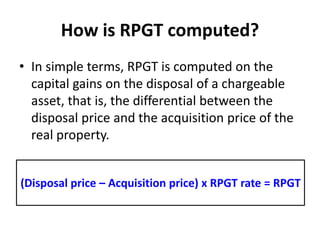
How is RPGT computed?
• In simple terms, RPGT is computed on the
capital gains on the disposal of a chargeable
asset, that is, the differential between the
disposal price and the acquisition price of the
real property.
(Disposal price – Acquisition price) x RPGT rate = RPGT
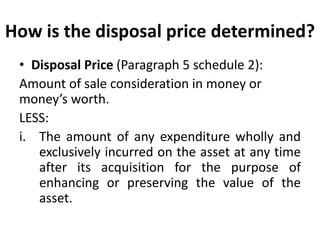
How is the disposal price determined?
• Disposal Price (Paragraph 5 schedule 2):
Amount of sale consideration in money or
money’s worth.
LESS:
i. The amount of any expenditure wholly and
exclusively incurred on the asset at any time
after its acquisition for the purpose of
enhancing or preserving the value of the
asset.
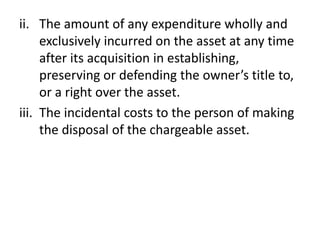
ii. The amount of any expenditure wholly and
exclusively incurred on the asset at any time
after its acquisition in establishing,
preserving or defending the owner’s title to,
or a right over the asset.
iii. The incidental costs to the person of making
the disposal of the chargeable asset.
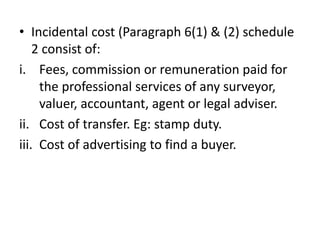
• Incidental cost (Paragraph 6(1) & (2) schedule
2 consist of:
i. Fees, commission or remuneration paid for
the professional services of any surveyor,
valuer, accountant, agent or legal adviser.
ii. Cost of transfer. Eg: stamp duty.
iii. Cost of advertising to find a buyer.
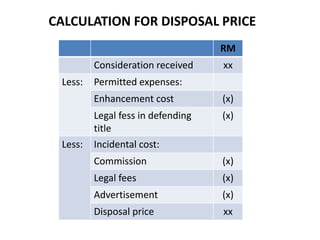
CALCULATION FOR DISPOSAL PRICE
RM
Consideration received xx
Less: Permitted expenses:
Enhancement cost (x)
Legal fess in defending
title
(x)
Less: Incidental cost:
Commission (x)
Legal fees (x)
Advertisement (x)
Disposal price xx
Permitted expenses refer to any expenses
incurred wholly and exclusively on the asset
after its acquisition for the purpose of enhancing
or preserving its value and expenses incurred in
established and defending title or right over the
asset.
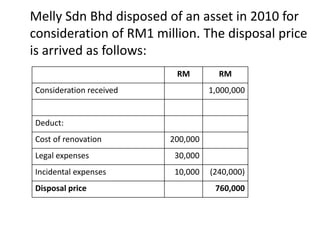
Melly Sdn Bhd disposed of an asset in 2010 for
consideration of RM1 million. The disposal price
is arrived as follows:
RM RM
Consideration received 1,000,000
Deduct:
Cost of renovation 200,000
Legal expenses 30,000
Incidental expenses 10,000 (240,000)
Disposal price 760,000
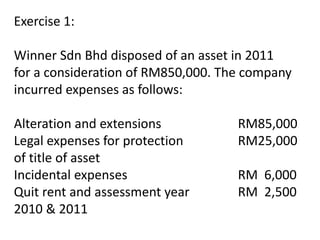
Exercise 1:
Winner Sdn Bhd disposed of an asset in 2011
for a consideration of RM850,000. The company
incurred expenses as follows:
Alteration and extensions RM85,000
Legal expenses for protection RM25,000
of title of asset
Incidental expenses RM 6,000
Quit rent and assessment year RM 2,500
2010 & 2011
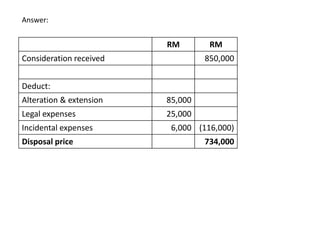
Answer:
RM RM
Consideration received 850,000
Deduct:
Alteration & extension 85,000
Legal expenses 25,000
Incidental expenses 6,000 (116,000)
Disposal price 734,000
How is the acquisition price determined?
Acquisition price (Paragraph 4 Schedule 2)
Acquisition of an asset is the purchase
consideration plus any incidental costs (or
permitted expenses) which include:
i. Fees, commission or remuneration paid for the
professional services of any surveyor, valuer,
accountant, agent, architect or legal adviser
ii. Cost of transfer (eg: stamp duty)
iii. Other incidental costs (example advertising cost
to find a seller)
iv. Interest paid on capital employed to acquire the
asset where a claim for such an expenses has not
been made under the ITA
From 1 January 2010, the interest paid to finance
the acquisition of a chargeable asset will no longer
be regarded as an incidental cost to the acquisition
price of chargeable asset.
In addition, the following may be deducted in
arriving at the acquisition price:
i. Compensation for damages, injury, destruction,
risk of depreciation
ii. Receipt under a policy of insurance for damages
to the property
iii. Deposit forfeited in respect of the property
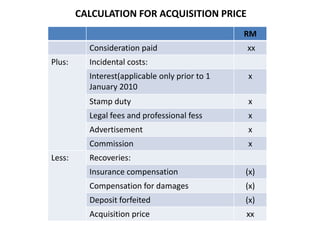
CALCULATION FOR ACQUISITION PRICE
RM
Consideration paid xx
Plus: Incidental costs:
Interest(applicable only prior to 1
January 2010
x
Stamp duty x
Legal fees and professional fess x
Advertisement x
Commission x
Less: Recoveries:
Insurance compensation (x)
Compensation for damages (x)
Deposit forfeited (x)
Acquisition price xx
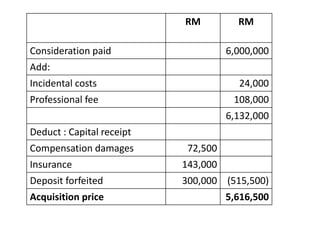
Example 2:
Biji Saga Sdn Bhd acquired an asset in 2010 for a
consideration of RM6,000,000. The acquisition
price, taking into consideration incidental costs and
deductions, is computed as follows:
RM RM
Consideration paid 6,000,000
Add:
Incidental costs 24,000
Professional fee 108,000
6,132,000
Deduct : Capital receipt
Compensation damages 72,500
Insurance 143,000
Deposit forfeited 300,000 (515,500)
Acquisition price 5,616,500
Exercise 2:
Pn Hartini bought the terrace house for RM450,000
at Bandar Baru Bangi. Payment was paid on
20 August 2009. The house was transferred to her on
10 February 2010. Purchase of agreement made on
1 October 2010. Other cost incurred by Pn Hartini
were as follows:
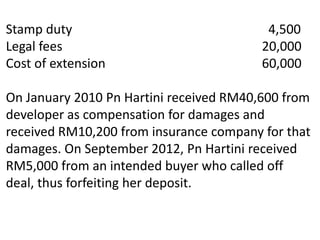
Stamp duty 4,500
Legal fees 20,000
Cost of extension 60,000
On January 2010 Pn Hartini received RM40,600 from
developer as compensation for damages and
received RM10,200 from insurance company for that
damages. On September 2012, Pn Hartini received
RM5,000 from an intended buyer who called off
deal, thus forfeiting her deposit.
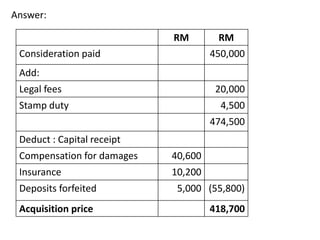
Answer:
RM RM
Consideration paid 450,000
Add:
Legal fees 20,000
Stamp duty 4,500
474,500
Deduct : Capital receipt
Compensation for damages 40,600
Insurance 10,200
Deposits forfeited 5,000 (55,800)
Acquisition price 418,700
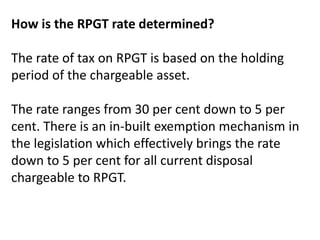
How is the RPGT rate determined?
The rate of tax on RPGT is based on the holding
period of the chargeable asset.
The rate ranges from 30 per cent down to 5 per
cent. There is an in-built exemption mechanism in
the legislation which effectively brings the rate
down to 5 per cent for all current disposal
chargeable to RPGT.
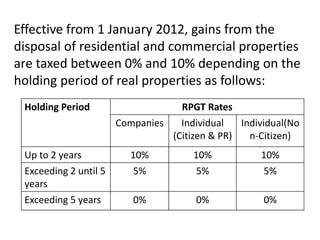
Effective from 1 January 2012, gains from the
disposal of residential and commercial properties
are taxed between 0% and 10% depending on the
holding period of real properties as follows:
Holding Period RPGT Rates
Companies Individual
(Citizen & PR)
Individual(No
n-Citizen)
Up to 2 years 10% 10% 10%
Exceeding 2 until 5
years
5% 5% 5%
Exceeding 5 years 0% 0% 0%
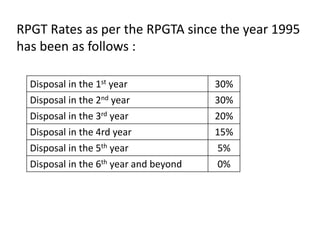
RPGT Rates as per the RPGTA since the year 1995
has been as follows :
Disposal in the 1st year 30%
Disposal in the 2nd year 30%
Disposal in the 3rd year 20%
Disposal in the 4rd year 15%
Disposal in the 5th year 5%
Disposal in the 6th year and beyond 0%
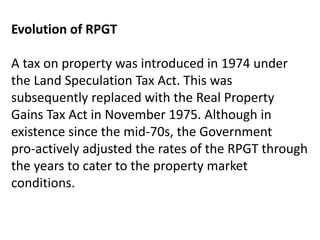
Evolution of RPGT
A tax on property was introduced in 1974 under
the Land Speculation Tax Act. This was
subsequently replaced with the Real Property
Gains Tax Act in November 1975. Although in
existence since the mid-70s, the Government
pro-actively adjusted the rates of the RPGT through
the years to cater to the property market
conditions.
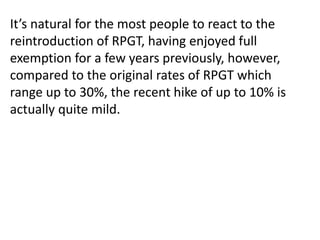
It’s natural for the most people to react to the
reintroduction of RPGT, having enjoyed full
exemption for a few years previously, however,
compared to the original rates of RPGT which
range up to 30%, the recent hike of up to 10% is
actually quite mild.
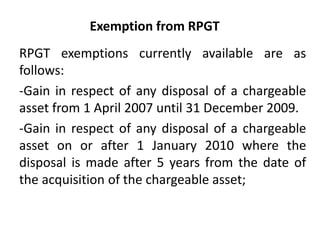
Exemption from RPGT
RPGT exemptions currently available are as
follows:
-Gain in respect of any disposal of a chargeable
asset from 1 April 2007 until 31 December 2009.
-Gain in respect of any disposal of a chargeable
asset on or after 1 January 2010 where the
disposal is made after 5 years from the date of
the acquisition of the chargeable asset;
RM10,000 or 10% of the chargeable gain,
whichever is greater accruing to an individual
in respect of a disposal of a chargeable asset;
- Gain accruing to an individual who is a
citizen or permanent resident of Malaysia in
respect of the disposal of one private
residence;
- Gain accruing to a wife who is a citizen or
permanent resident of Malaysia but whose
husband is neither a citizen nor a permanent
resident, in respect of the disposal of one
private residence owned by the wife; and
- Gain accruing to the Government, State
Government or a local authority.
How to determine the acquisition date?
Generally, the acquisition date of the acquirer
coincides with the disposal date of the
disposer.
When is the disposal date?
Disposal date is the date of the agreement for
disposal of the asset. Where there is no
agreement, disposal date is the date of
completion of the disposal, i.e. the earlier of:
• Date of transfer of ownership of the asset by
the disposer, or
• Date when the whole amount of consideration
is received by the disposer
Treatment of losses on disposal
Unutilized losses can be carried forward
indefinitely except losses arising from the
disposal of shares in a real property company.
Transactions in which the disposal price is
deemed equal to acquisition price (i.e. “No
gain no loss” transaction) – per Para 3 Sch 2 of
the RPGT Act 1976:
a) Devolution of a deceased person’s assets
to his trustee or legatee.
b) Transfer between spouses.
c) Transfer of assets owned by an individual, his wife
or by an individual jointly with his wife or with a
connected person to a company controlled by the
individual, his wife or by an individual jointly with his
wife or with a connected person, for a consideration
consisting substantially (more than 75%) of shares in
that company.
d) Transfer between an individual and a nominee who
has no vested interest in the assets.
e) Transfer by way of security in or over an
asset.
f) Gift to the Government, local authority or
charity exempt from income tax.
g) Disposal due to compulsory acquisition.
h) Disposal of chargeable assets pursuant to
an approved financing scheme which is in
accordance with Syariah principle, where such
disposal will not be required for conventional
financing schemes.
Gifts – per Sch Para 12 of the RPGT Act 1976
Gifts between husband and wife, parent and
child or grandparent and grandchild are
deemed to be “No gain no loss” transaction.
Example:
Mr Tan transferred a house to his daughter
Susan on 25 Feb 2008 when its market price
was RM650,000. The incidental costs for the
transferred amounted to RM5,000 the house
was acquired by Mr Tan on 1 Mac 2004 for
RM300,000.
Answer:
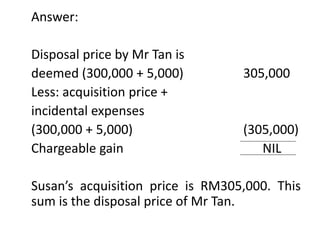
Disposal price by Mr Tan is
deemed (300,000 + 5,000) 305,000
Less: acquisition price +
incidental expenses
(300,000 + 5,000) (305,000)
Chargeable gain NIL
Susan’s acquisition price is RM305,000. This
sum is the disposal price of Mr Tan.
Where the asset is acquired as a gift on
death, the recipient is deemed to acquire the
asset at its market value as at the date of
transfer or ownership of the asset to the
recipient.
Private residence exemption
Malaysian citizens or permanent resident
individuals are given RPGT exemption on
disposal of one residential property. This is a
“once in a life time” exemption and must be
fulfilled in order to get the exemption:
1) Individual must be a citizen or permanent
resident of Malaysia.
2) Real property must be a residential
property or part of the building is used for
residence (eg : shophouse)
3) Residential building is occupied or rented
or fit for occupation
4) Residential property is owned by such
individual or spouse of the individual; or
5) Disposer had not elected for the
exemption prior to this as the exemption is
only available once in a lifetime.
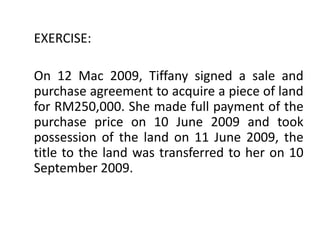
EXERCISE:
On 12 Mac 2009, Tiffany signed a sale and
purchase agreement to acquire a piece of land
for RM250,000. She made full payment of the
purchase price on 10 June 2009 and took
possession of the land on 11 June 2009, the
title to the land was transferred to her on 10
September 2009.
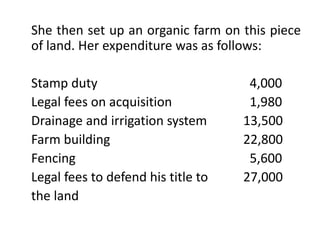
She then set up an organic farm on this piece
of land. Her expenditure was as follows:
Stamp duty 4,000
Legal fees on acquisition 1,980
Drainage and irrigation system 13,500
Farm building 22,800
Fencing 5,600
Legal fees to defend his title to 27,000
the land
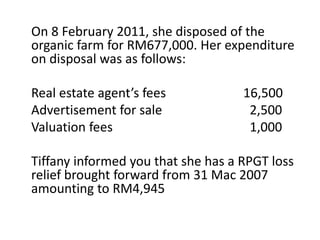
On 8 February 2011, she disposed of the
organic farm for RM677,000. Her expenditure
on disposal was as follows:
Real estate agent’s fees 16,500
Advertisement for sale 2,500
Valuation fees 1,000
Tiffany informed you that she has a RPGT loss
relief brought forward from 31 Mac 2007
amounting to RM4,945
You are required to compute the RPGT liability
of Tiffany in respect of the disposal of organic
farm.

Chapter 4 RPGT

  • 1.
    4.0 REAL PROPERTYGAIN TAX By the end of the lesson, student should be able: 4.1 Understand the meaning of RPGT 4.2 Understand chargeability of RPGT 4.3 Understand the treatment of gift 4.4 Explain date of disposal and date of acquisition
  • 2.
    What is RPGT? RPGTis a tax on capital gains imposed on the disposal of a chargeable asset and this includes real property. It is governed by the Real Property Gains Tax Act 1976.
  • 3.
    • The RealProperty Gain Tax (exemption) Order 2007 exempted all persons from the provisions of RPGT Act 1976 with regards to any disposal of chargeable assets from 1 April 2007 to 31 December 2009. • Real Property Gains Tax (RPGT) was reintroduced effective 1 January 2010 after a lapse of 2 years and 9 months.
  • 4.
    Who is covered? •It applies to both tax resident and non- resident persons who transact in real property situated in Malaysia and shares in real property companies. • Person includes a company, a partnership, a body of person and corporation sole.
  • 5.
    What is realproperty? • It is land situated in Malaysia or any interest, option or right in or such land situated in Malaysia.
  • 6.
    What is thedefinition of land? • Section 2 of RPGTA defines land as: i. The surface of the earth all substances forming that surface. ii. The earth below the surface and substances therein. iii. Building on land and anything attached to land or permanently fastened to anything attached to land.
  • 7.
    iv. Standing timber,trees, crops and vegetarian grown on land. v. Land covered with water.
  • 8.
    The real propertyinclude: • Any landed property in Malaysia such as residential properties (apartments, condominium and houses), commercial properties (factories, office buildings, shop houses) and land.
  • 9.
    How is RPGTcomputed? • In simple terms, RPGT is computed on the capital gains on the disposal of a chargeable asset, that is, the differential between the disposal price and the acquisition price of the real property. (Disposal price – Acquisition price) x RPGT rate = RPGT
  • 10.
    How is thedisposal price determined? • Disposal Price (Paragraph 5 schedule 2): Amount of sale consideration in money or money’s worth. LESS: i. The amount of any expenditure wholly and exclusively incurred on the asset at any time after its acquisition for the purpose of enhancing or preserving the value of the asset.
  • 11.
    ii. The amountof any expenditure wholly and exclusively incurred on the asset at any time after its acquisition in establishing, preserving or defending the owner’s title to, or a right over the asset. iii. The incidental costs to the person of making the disposal of the chargeable asset.
  • 12.
    • Incidental cost(Paragraph 6(1) & (2) schedule 2 consist of: i. Fees, commission or remuneration paid for the professional services of any surveyor, valuer, accountant, agent or legal adviser. ii. Cost of transfer. Eg: stamp duty. iii. Cost of advertising to find a buyer.
  • 13.
    CALCULATION FOR DISPOSALPRICE RM Consideration received xx Less: Permitted expenses: Enhancement cost (x) Legal fess in defending title (x) Less: Incidental cost: Commission (x) Legal fees (x) Advertisement (x) Disposal price xx
  • 14.
    Permitted expenses referto any expenses incurred wholly and exclusively on the asset after its acquisition for the purpose of enhancing or preserving its value and expenses incurred in established and defending title or right over the asset.
  • 15.
    Melly Sdn Bhddisposed of an asset in 2010 for consideration of RM1 million. The disposal price is arrived as follows: RM RM Consideration received 1,000,000 Deduct: Cost of renovation 200,000 Legal expenses 30,000 Incidental expenses 10,000 (240,000) Disposal price 760,000
  • 16.
    Exercise 1: Winner SdnBhd disposed of an asset in 2011 for a consideration of RM850,000. The company incurred expenses as follows: Alteration and extensions RM85,000 Legal expenses for protection RM25,000 of title of asset Incidental expenses RM 6,000 Quit rent and assessment year RM 2,500 2010 & 2011
  • 17.
    Answer: RM RM Consideration received850,000 Deduct: Alteration & extension 85,000 Legal expenses 25,000 Incidental expenses 6,000 (116,000) Disposal price 734,000
  • 18.
    How is theacquisition price determined? Acquisition price (Paragraph 4 Schedule 2) Acquisition of an asset is the purchase consideration plus any incidental costs (or permitted expenses) which include: i. Fees, commission or remuneration paid for the professional services of any surveyor, valuer, accountant, agent, architect or legal adviser
  • 19.
    ii. Cost oftransfer (eg: stamp duty) iii. Other incidental costs (example advertising cost to find a seller) iv. Interest paid on capital employed to acquire the asset where a claim for such an expenses has not been made under the ITA
  • 20.
    From 1 January2010, the interest paid to finance the acquisition of a chargeable asset will no longer be regarded as an incidental cost to the acquisition price of chargeable asset.
  • 21.
    In addition, thefollowing may be deducted in arriving at the acquisition price: i. Compensation for damages, injury, destruction, risk of depreciation ii. Receipt under a policy of insurance for damages to the property iii. Deposit forfeited in respect of the property
  • 22.
    CALCULATION FOR ACQUISITIONPRICE RM Consideration paid xx Plus: Incidental costs: Interest(applicable only prior to 1 January 2010 x Stamp duty x Legal fees and professional fess x Advertisement x Commission x Less: Recoveries: Insurance compensation (x) Compensation for damages (x) Deposit forfeited (x) Acquisition price xx
  • 23.
    Example 2: Biji SagaSdn Bhd acquired an asset in 2010 for a consideration of RM6,000,000. The acquisition price, taking into consideration incidental costs and deductions, is computed as follows:
  • 24.
    RM RM Consideration paid6,000,000 Add: Incidental costs 24,000 Professional fee 108,000 6,132,000 Deduct : Capital receipt Compensation damages 72,500 Insurance 143,000 Deposit forfeited 300,000 (515,500) Acquisition price 5,616,500
  • 25.
    Exercise 2: Pn Hartinibought the terrace house for RM450,000 at Bandar Baru Bangi. Payment was paid on 20 August 2009. The house was transferred to her on 10 February 2010. Purchase of agreement made on 1 October 2010. Other cost incurred by Pn Hartini were as follows:
  • 26.
    Stamp duty 4,500 Legalfees 20,000 Cost of extension 60,000 On January 2010 Pn Hartini received RM40,600 from developer as compensation for damages and received RM10,200 from insurance company for that damages. On September 2012, Pn Hartini received RM5,000 from an intended buyer who called off deal, thus forfeiting her deposit.
  • 27.
    Answer: RM RM Consideration paid450,000 Add: Legal fees 20,000 Stamp duty 4,500 474,500 Deduct : Capital receipt Compensation for damages 40,600 Insurance 10,200 Deposits forfeited 5,000 (55,800) Acquisition price 418,700
  • 28.
    How is theRPGT rate determined? The rate of tax on RPGT is based on the holding period of the chargeable asset. The rate ranges from 30 per cent down to 5 per cent. There is an in-built exemption mechanism in the legislation which effectively brings the rate down to 5 per cent for all current disposal chargeable to RPGT.
  • 29.
    Effective from 1January 2012, gains from the disposal of residential and commercial properties are taxed between 0% and 10% depending on the holding period of real properties as follows: Holding Period RPGT Rates Companies Individual (Citizen & PR) Individual(No n-Citizen) Up to 2 years 10% 10% 10% Exceeding 2 until 5 years 5% 5% 5% Exceeding 5 years 0% 0% 0%
  • 30.
    RPGT Rates asper the RPGTA since the year 1995 has been as follows : Disposal in the 1st year 30% Disposal in the 2nd year 30% Disposal in the 3rd year 20% Disposal in the 4rd year 15% Disposal in the 5th year 5% Disposal in the 6th year and beyond 0%
  • 31.
    Evolution of RPGT Atax on property was introduced in 1974 under the Land Speculation Tax Act. This was subsequently replaced with the Real Property Gains Tax Act in November 1975. Although in existence since the mid-70s, the Government pro-actively adjusted the rates of the RPGT through the years to cater to the property market conditions.
  • 32.
    It’s natural forthe most people to react to the reintroduction of RPGT, having enjoyed full exemption for a few years previously, however, compared to the original rates of RPGT which range up to 30%, the recent hike of up to 10% is actually quite mild.
  • 33.
    Exemption from RPGT RPGTexemptions currently available are as follows: -Gain in respect of any disposal of a chargeable asset from 1 April 2007 until 31 December 2009. -Gain in respect of any disposal of a chargeable asset on or after 1 January 2010 where the disposal is made after 5 years from the date of the acquisition of the chargeable asset;
  • 34.
    RM10,000 or 10%of the chargeable gain, whichever is greater accruing to an individual in respect of a disposal of a chargeable asset; - Gain accruing to an individual who is a citizen or permanent resident of Malaysia in respect of the disposal of one private residence;
  • 35.
    - Gain accruingto a wife who is a citizen or permanent resident of Malaysia but whose husband is neither a citizen nor a permanent resident, in respect of the disposal of one private residence owned by the wife; and - Gain accruing to the Government, State Government or a local authority.
  • 36.
    How to determinethe acquisition date? Generally, the acquisition date of the acquirer coincides with the disposal date of the disposer.
  • 37.
    When is thedisposal date? Disposal date is the date of the agreement for disposal of the asset. Where there is no agreement, disposal date is the date of completion of the disposal, i.e. the earlier of: • Date of transfer of ownership of the asset by the disposer, or • Date when the whole amount of consideration is received by the disposer
  • 38.
    Treatment of losseson disposal Unutilized losses can be carried forward indefinitely except losses arising from the disposal of shares in a real property company.
  • 39.
    Transactions in whichthe disposal price is deemed equal to acquisition price (i.e. “No gain no loss” transaction) – per Para 3 Sch 2 of the RPGT Act 1976: a) Devolution of a deceased person’s assets to his trustee or legatee. b) Transfer between spouses.
  • 40.
    c) Transfer ofassets owned by an individual, his wife or by an individual jointly with his wife or with a connected person to a company controlled by the individual, his wife or by an individual jointly with his wife or with a connected person, for a consideration consisting substantially (more than 75%) of shares in that company. d) Transfer between an individual and a nominee who has no vested interest in the assets.
  • 41.
    e) Transfer byway of security in or over an asset. f) Gift to the Government, local authority or charity exempt from income tax. g) Disposal due to compulsory acquisition. h) Disposal of chargeable assets pursuant to an approved financing scheme which is in accordance with Syariah principle, where such disposal will not be required for conventional financing schemes.
  • 42.
    Gifts – perSch Para 12 of the RPGT Act 1976 Gifts between husband and wife, parent and child or grandparent and grandchild are deemed to be “No gain no loss” transaction.
  • 43.
    Example: Mr Tan transferreda house to his daughter Susan on 25 Feb 2008 when its market price was RM650,000. The incidental costs for the transferred amounted to RM5,000 the house was acquired by Mr Tan on 1 Mac 2004 for RM300,000.
  • 44.
    Answer: Disposal price byMr Tan is deemed (300,000 + 5,000) 305,000 Less: acquisition price + incidental expenses (300,000 + 5,000) (305,000) Chargeable gain NIL Susan’s acquisition price is RM305,000. This sum is the disposal price of Mr Tan.
  • 45.
    Where the assetis acquired as a gift on death, the recipient is deemed to acquire the asset at its market value as at the date of transfer or ownership of the asset to the recipient.
  • 46.
    Private residence exemption Malaysiancitizens or permanent resident individuals are given RPGT exemption on disposal of one residential property. This is a “once in a life time” exemption and must be fulfilled in order to get the exemption: 1) Individual must be a citizen or permanent resident of Malaysia.
  • 47.
    2) Real propertymust be a residential property or part of the building is used for residence (eg : shophouse) 3) Residential building is occupied or rented or fit for occupation 4) Residential property is owned by such individual or spouse of the individual; or 5) Disposer had not elected for the exemption prior to this as the exemption is only available once in a lifetime.
  • 48.
    EXERCISE: On 12 Mac2009, Tiffany signed a sale and purchase agreement to acquire a piece of land for RM250,000. She made full payment of the purchase price on 10 June 2009 and took possession of the land on 11 June 2009, the title to the land was transferred to her on 10 September 2009.
  • 49.
    She then setup an organic farm on this piece of land. Her expenditure was as follows: Stamp duty 4,000 Legal fees on acquisition 1,980 Drainage and irrigation system 13,500 Farm building 22,800 Fencing 5,600 Legal fees to defend his title to 27,000 the land
  • 50.
    On 8 February2011, she disposed of the organic farm for RM677,000. Her expenditure on disposal was as follows: Real estate agent’s fees 16,500 Advertisement for sale 2,500 Valuation fees 1,000 Tiffany informed you that she has a RPGT loss relief brought forward from 31 Mac 2007 amounting to RM4,945
  • 51.
    You are requiredto compute the RPGT liability of Tiffany in respect of the disposal of organic farm.