Introduction to
CPM
Guided: Ruchita shah
Presented By:
Kajal Vasar(115371)
Khushi Makwana(115372)
Mahesh Parmar(114352)
Dushyant Nasit(114339)
Project Management
 Managers have been planning, scheduling, monitoring,
and controlling large scale projects for hundred years, but
it has only been in the last 50 years that management
science techniques have been applied to major projects.
 They are two types:
1. Critical Path Method(CPM)
2. Project Evaluation and Review Technique(PERT)
Introduction- CPM
 Defination:-
Critical path is a sequence of activity between a project’s start and
finish that takes the longest time to complete.
 Critical path method is based on mathematical calculations and it is
used for scheduling project activities.
 In 1950, Critical path method(CPM) was developed by Kelly and
Walker to assist in building and maintains of chemical plants.
 The initial critical path method was used for managing plant
maintenance projects.
 Critical path is the sequential activities from start to
the end of a project. Although many projects have only
one critical path, some projects may have more than
one critical paths depending on the flow logic used in
the project
 The essential technique for using CPM is to construct a
model of the project that includes the following:
 A list of all activities required to complete the
project (typically categorized within a work
breakdown structure
 The time (duration) that each activity will take to
completion,
 The dependencies between the activities
.
Terminologies used in CPM
In order to explain the purpose, structure and operation of CPM, it is helpful to
define the following terms:
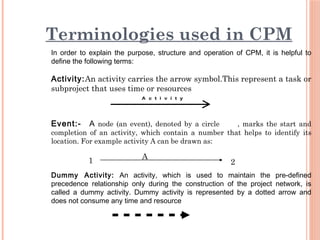
Activity:An activity carries the arrow symbol.This represent a task or
subproject that uses time or resources
Event:- A node (an event), denoted by a circle , marks the start and
completion of an activity, which contain a number that helps to identify its
location. For example activity A can be drawn as:
Dummy Activity: An activity, which is used to maintain the pre-defined
precedence relationship only during the construction of the project network, is
called a dummy activity. Dummy activity is represented by a dotted arrow and
does not consume any time and resource
2
1
A
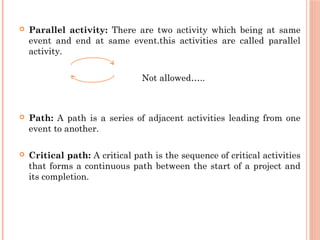
 Parallel activity: There are two activity which being at same
event and end at same event.this activities are called parallel
activity.
Not allowed…..
 Path: A path is a series of adjacent activities leading from one
event to another.
 Critical path: A critical path is the sequence of critical activities
that forms a continuous path between the start of a project and
its completion.
1 2
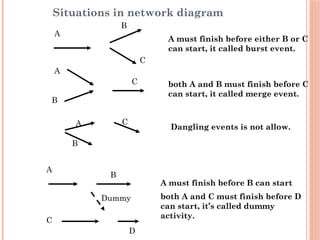
Situations in network diagram
A
B
C
A must finish before either B or C
can start, it called burst event.
A
B
C both A and B must finish before C
can start, it called merge event.
Dangling events is not allow.
A
C
B
D
Dummy
A must finish before B can start
both A and C must finish before D
can start, it’s called dummy
activity.
A
B
C
Forward pass:
 The Early Start and Early Finish Time
Calculated by moving Forward Through the
Network.
 Consider Maximum.
Backward pass:
 The Latest Start and Latest Finish Time
Calculated by moving Backward Through the
Network.
 Consider Minimum
Float activity:
 Float activity For an Activity is The Difference
between its Earliest and Latest Start Time or
Earliest and Latest Finish Time .
Steps in Critical Path Method
 Step 1: Make a forward pass through the network as
follows: For each activity i beginning at the Start node,
compute:
Earliest Start Time (ES) = the maximum of the earliest finish times
of all activities immediately preceding activity i. (This is 0 for an
activity with no predecessors.). This is the earliest time an activity
can begin without violation of immediate predecessor requirements.
Earliest Finish Time (Ef) = (Earliest Start Time) + (Time to complete
activity i. This represent the earliest time at which an activity can
end.
The project completion time is the maximum of the
Earliest Finish Times at the Finish node.
Continue..........
 Step 2: Make a backwards pass through the network as follows:
Move sequentially backwards from the Finish node to the Start
node. At a given node, j, consider all activities ending at node j.
For each of these activities, (i,j), compute:
Latest Finish Time (LF) = the minimum of the latest start
times beginning at node j. (For node N, this is the project
completion time.). This is the latest time an activity can end
without delaying the entire project.
Latest Start Time (LS) = (Latest Finish Time) - (Time to
complete activity (i,j)). This is the latest time an activity can
begin without delaying the entire project.
Continue..........
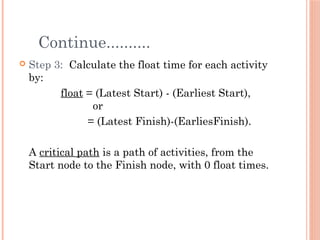
 Step 3: Calculate the float time for each activity
by:
float = (Latest Start) - (Earliest Start),
or
= (Latest Finish)-(EarliesFinish).
A critical path is a path of activities, from the
Start node to the Finish node, with 0 float times.
Example
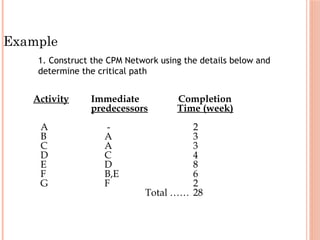
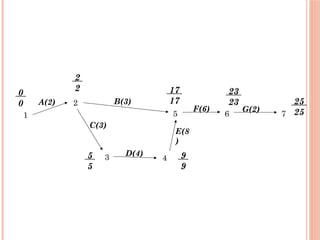
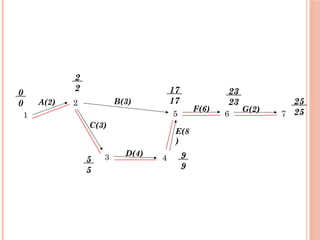
1. Construct the CPM Network using the details below and
determine the critical path
Activity Immediate Completion
predecessors Time (week)
A - 2
B A 3
C A 3
D C 4
E D 8
F B,E 6
G F 2
Total …… 28
1
2
7
6
5
4
3
0
0 25
25
23
23
9
9
17
17
5
5
2
2
A(2) B(3)
D(4)
C(3)
E(8
)
F(6) G(2)
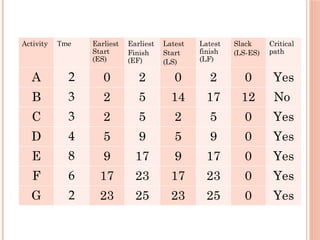
Activity Tme Earliest
Start
(ES)
Earliest
Finish
(EF)
Latest
Start
(LS)
Latest
finish
(LF)
Slack
(LS-ES)
Critical
path
A 2 0 2 0 2 0 Yes
B 3 2 5 14 17 12 No
C 3 2 5 2 5 0 Yes
D 4 5 9 5 9 0 Yes
E 8 9 17 9 17 0 Yes
F 6 17 23 17 23 0 Yes
G 2 23 25 23 25 0 Yes
1
2
7
6
5
4
3
0
0 25
25
23
23
9
9
17
17
5
5
2
2
A(2) B(3)
D(4)
C(3)
E(8
)
F(6) G(2)
Critical Path:-
Cp = 1 - 2 – 3 - 4 – 5 – 6 – 7
= A – C -D - E - F - G
= 2 + 3 + 4 + 8 + 6 + 2
= 25
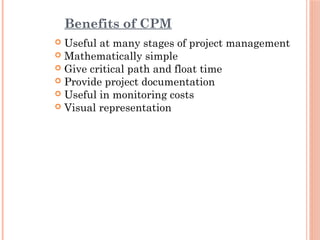
Benefits of CPM
 Useful at many stages of project management
 Mathematically simple
 Give critical path and float time
 Provide project documentation
 Useful in monitoring costs
 Visual representation
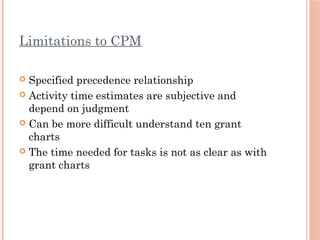
Limitations to CPM
 Specified precedence relationship
 Activity time estimates are subjective and
depend on judgment
 Can be more difficult understand ten grant
charts
 The time needed for tasks is not as clear as with
grant charts

criticalpathmethod-151022164503-lva1-app6892.pdf

  • 1.
    Introduction to CPM Guided: Ruchitashah Presented By: Kajal Vasar(115371) Khushi Makwana(115372) Mahesh Parmar(114352) Dushyant Nasit(114339)
  • 2.
    Project Management  Managershave been planning, scheduling, monitoring, and controlling large scale projects for hundred years, but it has only been in the last 50 years that management science techniques have been applied to major projects.  They are two types: 1. Critical Path Method(CPM) 2. Project Evaluation and Review Technique(PERT)
  • 3.
    Introduction- CPM  Defination:- Criticalpath is a sequence of activity between a project’s start and finish that takes the longest time to complete.  Critical path method is based on mathematical calculations and it is used for scheduling project activities.  In 1950, Critical path method(CPM) was developed by Kelly and Walker to assist in building and maintains of chemical plants.  The initial critical path method was used for managing plant maintenance projects.
  • 4.
     Critical pathis the sequential activities from start to the end of a project. Although many projects have only one critical path, some projects may have more than one critical paths depending on the flow logic used in the project  The essential technique for using CPM is to construct a model of the project that includes the following:  A list of all activities required to complete the project (typically categorized within a work breakdown structure  The time (duration) that each activity will take to completion,  The dependencies between the activities .
  • 5.
    Terminologies used inCPM In order to explain the purpose, structure and operation of CPM, it is helpful to define the following terms: Activity:An activity carries the arrow symbol.This represent a task or subproject that uses time or resources Event:- A node (an event), denoted by a circle , marks the start and completion of an activity, which contain a number that helps to identify its location. For example activity A can be drawn as: Dummy Activity: An activity, which is used to maintain the pre-defined precedence relationship only during the construction of the project network, is called a dummy activity. Dummy activity is represented by a dotted arrow and does not consume any time and resource 2 1 A
  • 6.
     Parallel activity:There are two activity which being at same event and end at same event.this activities are called parallel activity. Not allowed…..  Path: A path is a series of adjacent activities leading from one event to another.  Critical path: A critical path is the sequence of critical activities that forms a continuous path between the start of a project and its completion. 1 2
  • 7.
    Situations in networkdiagram A B C A must finish before either B or C can start, it called burst event. A B C both A and B must finish before C can start, it called merge event. Dangling events is not allow. A C B D Dummy A must finish before B can start both A and C must finish before D can start, it’s called dummy activity. A B C
  • 8.
    Forward pass:  TheEarly Start and Early Finish Time Calculated by moving Forward Through the Network.  Consider Maximum.
  • 9.
    Backward pass:  TheLatest Start and Latest Finish Time Calculated by moving Backward Through the Network.  Consider Minimum
  • 10.
    Float activity:  Floatactivity For an Activity is The Difference between its Earliest and Latest Start Time or Earliest and Latest Finish Time .
  • 11.
    Steps in CriticalPath Method  Step 1: Make a forward pass through the network as follows: For each activity i beginning at the Start node, compute: Earliest Start Time (ES) = the maximum of the earliest finish times of all activities immediately preceding activity i. (This is 0 for an activity with no predecessors.). This is the earliest time an activity can begin without violation of immediate predecessor requirements. Earliest Finish Time (Ef) = (Earliest Start Time) + (Time to complete activity i. This represent the earliest time at which an activity can end. The project completion time is the maximum of the Earliest Finish Times at the Finish node.
  • 12.
    Continue..........  Step 2:Make a backwards pass through the network as follows: Move sequentially backwards from the Finish node to the Start node. At a given node, j, consider all activities ending at node j. For each of these activities, (i,j), compute: Latest Finish Time (LF) = the minimum of the latest start times beginning at node j. (For node N, this is the project completion time.). This is the latest time an activity can end without delaying the entire project. Latest Start Time (LS) = (Latest Finish Time) - (Time to complete activity (i,j)). This is the latest time an activity can begin without delaying the entire project.
  • 13.
    Continue..........  Step 3:Calculate the float time for each activity by: float = (Latest Start) - (Earliest Start), or = (Latest Finish)-(EarliesFinish). A critical path is a path of activities, from the Start node to the Finish node, with 0 float times.
  • 14.
    Example 1. Construct theCPM Network using the details below and determine the critical path Activity Immediate Completion predecessors Time (week) A - 2 B A 3 C A 3 D C 4 E D 8 F B,E 6 G F 2 Total …… 28
  • 15.
  • 16.
    Activity Tme Earliest Start (ES) Earliest Finish (EF) Latest Start (LS) Latest finish (LF) Slack (LS-ES) Critical path A2 0 2 0 2 0 Yes B 3 2 5 14 17 12 No C 3 2 5 2 5 0 Yes D 4 5 9 5 9 0 Yes E 8 9 17 9 17 0 Yes F 6 17 23 17 23 0 Yes G 2 23 25 23 25 0 Yes
  • 17.
  • 18.
    Critical Path:- Cp =1 - 2 – 3 - 4 – 5 – 6 – 7 = A – C -D - E - F - G = 2 + 3 + 4 + 8 + 6 + 2 = 25
  • 19.
    Benefits of CPM Useful at many stages of project management  Mathematically simple  Give critical path and float time  Provide project documentation  Useful in monitoring costs  Visual representation
  • 20.
    Limitations to CPM Specified precedence relationship  Activity time estimates are subjective and depend on judgment  Can be more difficult understand ten grant charts  The time needed for tasks is not as clear as with grant charts