PROJECT MANAGEMENT :
NETWORK ANALYSIS
(CPM & PERT)
What is a project?
A project is an interrelated set of activities that has
definite starting and ending points and that result in a
unique product or service
Cuts across organizational lines – they need varied skills of
different profession
Uncertainties like new technology & external environment
can change the character of the project
Personnel, materials, facilities etc. are temporarily
assembled to accomplish a goal within a specified time
frame and then disbanded
Upon finish, a project releases lot of resources which were
engaged in execution of the project
Example of project
Planning a wedding
Designing and implementing a computer system
Hosting a holiday party
Designing and producing a brochure
Executing an environmental clean-up of a contaminated site
Holding a high school reunion
Performing a series of surgeries on an accident victim
A project is a one shot, time limited, goal
directed, major undertaking, requiring the
commitment of varied skills & resources. It
also describes project as a combination of
human and non human resources pooled
together in a temporary organization to
achieve specific purpose
Definition of project:
Project Attributes
A project:
•Has a unique purpose.
•Is temporary.
•Is developed using progressive elaboration.
•Requires resources, often from various areas.
•Should have a primary customer or sponsor.
•The project sponsor usually provides the
direction and funding for the project.
•Involves uncertainty.
Project and Program Managers
Project managers work with project sponsors, project
teams, and other people involved in projects to meet
project goals.
Program: “A group of related projects managed in a
coordinated way to obtain benefits and control not
available from managing them individually.”*
Program managers oversee programs and often act as
bosses for project managers.
Project management is “the application of
knowledge, skills, tools and techniques to project
activities to meet project requirements.”*
Project Management Tools and
Techniques
Project management tools and techniques assist project
managers and their teams in various aspects of project
management.
Specific tools and techniques include:
Project charters, scope statements, and WBS (scope).
Gantt charts, network diagrams, critical path
analyses, critical chain scheduling (time).
Cost estimates and earned value management
(cost).
NETWORK ANALYSIS
Network Analysis refers to a number of techniques for
the planning and control of complex projects.
The two most frequently used forms of network
planning are:
1. Programme Evaluation and Review Technique
(PERT)
2. Critical Path Method (CPM)
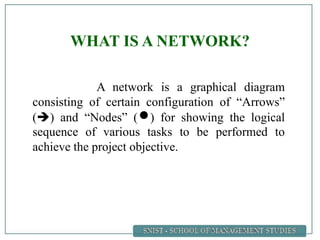
WHAT IS A NETWORK?
A network is a graphical diagram
consisting of certain configuration of “Arrows”
() and “Nodes” () for showing the logical
sequence of various tasks to be performed to
achieve the project objective.
PERT / CPM Techniques
The initial step in PERT/CPM project
scheduling process is the determination of all
specific activities that comprise the project
and their relationships.
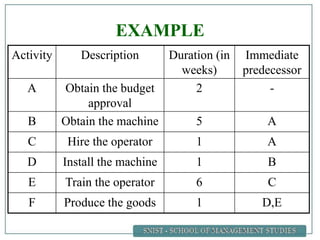
EXAMPLE
Activity Description Duration (in
weeks)
Immediate
predecessor
A Obtain the budget
approval
2 -
B Obtain the machine 5 A
C Hire the operator 1 A
D Install the machine 1 B
E Train the operator 6 C
F Produce the goods 1 D,E
TERMS USED IN A NETWORK
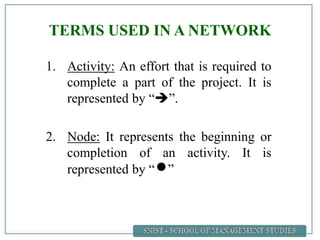
1. Activity: An effort that is required to
complete a part of the project. It is
represented by “”.
2. Node: It represents the beginning or
completion of an activity. It is
represented by “”
RULES OF NETWORK CONSTRUCTION
1. Each defined activity is represented by one
and only one arrow in the network.
2. Before an activity can be undertaken, all
activities preceding it must be completed.
3. The arrows depicting various activities are
indicative of logical procedure only. The
length and bearing of the arrows are of no
significance.
4. The arrow direction indicates the general
progression in time. Head events and Tail events.
5. When a number of activities terminate at one
event, it indicates that no activity emanating from
that event may start unless all activities terminating
there have been completed.
6. Events are identified by numbers.
7. The activities are identified by the numbers of their
starting and ending events or by alphabets.
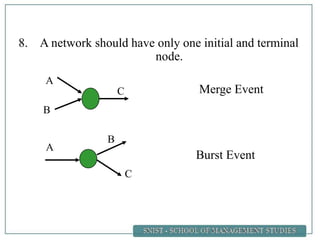
8. A network should have only one initial and terminal
node.
Merge Event
Burst Event
A
B
C
A
B
C
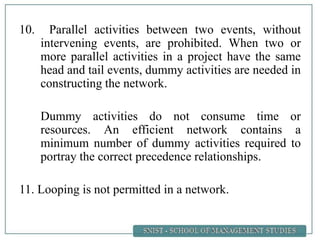
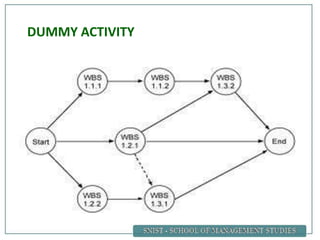
10. Parallel activities between two events, without
intervening events, are prohibited. When two or
more parallel activities in a project have the same
head and tail events, dummy activities are needed in
constructing the network.
Dummy activities do not consume time or
resources. An efficient network contains a
minimum number of dummy activities required to
portray the correct precedence relationships.
11. Looping is not permitted in a network.
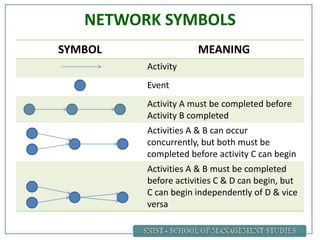
NETWORK SYMBOLS
SYMBOL MEANING
Activity
Event
Activity A must be completed before
Activity B completed
Activities A & B can occur
concurrently, but both must be
completed before activity C can begin
Activities A & B must be completed
before activities C & D can begin, but
C can begin independently of D & vice
versa
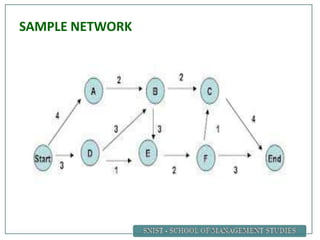
SAMPLE NETWORK
DUMMY ACTIVITY
CRITICAL PATH METHOD
CPM aims at the determination of the
time to complete a project and the
important activities on which a
manager shall focus attention.
PROCEDURE
 Consider all the paths in a project, beginning with
the start event and stopping at the end event.
 For each path, calculate the time of execution.
 The path with the largest time is called the critical
path and the activities along this path are called
critical activities or bottleneck activities.
THANK YOU

Project management & Network analysis

  • 1.
    PROJECT MANAGEMENT : NETWORKANALYSIS (CPM & PERT)
  • 2.
    What is aproject? A project is an interrelated set of activities that has definite starting and ending points and that result in a unique product or service Cuts across organizational lines – they need varied skills of different profession Uncertainties like new technology & external environment can change the character of the project Personnel, materials, facilities etc. are temporarily assembled to accomplish a goal within a specified time frame and then disbanded Upon finish, a project releases lot of resources which were engaged in execution of the project
  • 3.
    Example of project Planninga wedding Designing and implementing a computer system Hosting a holiday party Designing and producing a brochure Executing an environmental clean-up of a contaminated site Holding a high school reunion Performing a series of surgeries on an accident victim
  • 4.
    A project isa one shot, time limited, goal directed, major undertaking, requiring the commitment of varied skills & resources. It also describes project as a combination of human and non human resources pooled together in a temporary organization to achieve specific purpose Definition of project:
  • 5.
    Project Attributes A project: •Hasa unique purpose. •Is temporary. •Is developed using progressive elaboration. •Requires resources, often from various areas. •Should have a primary customer or sponsor. •The project sponsor usually provides the direction and funding for the project. •Involves uncertainty.
  • 6.
    Project and ProgramManagers Project managers work with project sponsors, project teams, and other people involved in projects to meet project goals. Program: “A group of related projects managed in a coordinated way to obtain benefits and control not available from managing them individually.”* Program managers oversee programs and often act as bosses for project managers. Project management is “the application of knowledge, skills, tools and techniques to project activities to meet project requirements.”*
  • 7.
    Project Management Toolsand Techniques Project management tools and techniques assist project managers and their teams in various aspects of project management. Specific tools and techniques include: Project charters, scope statements, and WBS (scope). Gantt charts, network diagrams, critical path analyses, critical chain scheduling (time). Cost estimates and earned value management (cost).
  • 8.
    NETWORK ANALYSIS Network Analysisrefers to a number of techniques for the planning and control of complex projects. The two most frequently used forms of network planning are: 1. Programme Evaluation and Review Technique (PERT) 2. Critical Path Method (CPM)
  • 9.
    WHAT IS ANETWORK? A network is a graphical diagram consisting of certain configuration of “Arrows” () and “Nodes” () for showing the logical sequence of various tasks to be performed to achieve the project objective.
  • 10.
    PERT / CPMTechniques The initial step in PERT/CPM project scheduling process is the determination of all specific activities that comprise the project and their relationships.
  • 11.
    EXAMPLE Activity Description Duration(in weeks) Immediate predecessor A Obtain the budget approval 2 - B Obtain the machine 5 A C Hire the operator 1 A D Install the machine 1 B E Train the operator 6 C F Produce the goods 1 D,E
  • 12.
    TERMS USED INA NETWORK 1. Activity: An effort that is required to complete a part of the project. It is represented by “”. 2. Node: It represents the beginning or completion of an activity. It is represented by “”
  • 13.
    RULES OF NETWORKCONSTRUCTION 1. Each defined activity is represented by one and only one arrow in the network. 2. Before an activity can be undertaken, all activities preceding it must be completed. 3. The arrows depicting various activities are indicative of logical procedure only. The length and bearing of the arrows are of no significance.
  • 14.
    4. The arrowdirection indicates the general progression in time. Head events and Tail events. 5. When a number of activities terminate at one event, it indicates that no activity emanating from that event may start unless all activities terminating there have been completed. 6. Events are identified by numbers. 7. The activities are identified by the numbers of their starting and ending events or by alphabets.
  • 15.
    8. A networkshould have only one initial and terminal node. Merge Event Burst Event A B C A B C
  • 16.
    10. Parallel activitiesbetween two events, without intervening events, are prohibited. When two or more parallel activities in a project have the same head and tail events, dummy activities are needed in constructing the network. Dummy activities do not consume time or resources. An efficient network contains a minimum number of dummy activities required to portray the correct precedence relationships. 11. Looping is not permitted in a network.
  • 17.
    NETWORK SYMBOLS SYMBOL MEANING Activity Event ActivityA must be completed before Activity B completed Activities A & B can occur concurrently, but both must be completed before activity C can begin Activities A & B must be completed before activities C & D can begin, but C can begin independently of D & vice versa
  • 18.
  • 19.
  • 20.
    CRITICAL PATH METHOD CPMaims at the determination of the time to complete a project and the important activities on which a manager shall focus attention.
  • 21.
    PROCEDURE  Consider allthe paths in a project, beginning with the start event and stopping at the end event.  For each path, calculate the time of execution.  The path with the largest time is called the critical path and the activities along this path are called critical activities or bottleneck activities.
  • 22.