Engineering Mangement


Program Evaluation Review
     Technique (PERT)
         Prepared by :
   Anas Tomeh               Fira Eid

         Prepared for :
         Dr. Reema Nassar
Objective of the presentation


• To understand the formula , the use and
  the benefits of Program , Evaluation ,and
  Review Technic (PERT) analysis .
What is the PERT ?


Program (Project) Evaluation and Review Technique (PERT): is
a project management tool used to schedule, organize, and
coordinate tasks within a project. It is basically a method to
analyse the tasks involved in completing a given
project, especially the time needed to complete each task, and
to identify the minimum time needed to complete the total
project.
When we use PERT ?


 • PERT is used when activity times are uncertain.
    – Determine the duration of the project .
    – Decision making under risk (“P” for probabilistic)
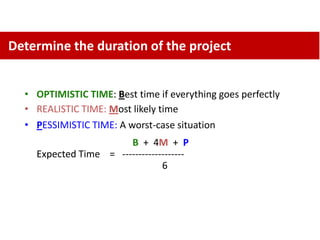
Determine the duration of the project


  • OPTIMISTIC TIME: Best time if everything goes perfectly
  • REALISTIC TIME: Most likely time
  • PESSIMISTIC TIME: A worst-case situation
                       B + 4M + P
    Expected Time = -------------------
                                6
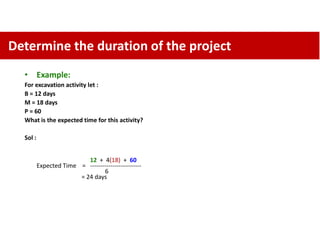
Determine the duration of the project
  • Example:
  For excavation activity let :
  B = 12 days
  M = 18 days
  P = 60
  What is the expected time for this activity?

  Sol :


                           12 + 4(18) + 60
          Expected Time = -------------------------
                                 6
                        = 24 days
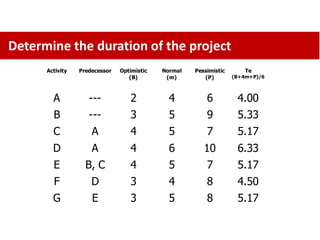
Determine the duration of the project
        Activity   Predecessor   Optimistic   Normal   Pessimistic       Te
                                    (B)        (m)        (P)        (B+4m+P)/6


          A           ---           2           4          6          4.00
          B           ---           3           5          9          5.33
          C            A            4           5          7          5.17
          D            A            4           6         10          6.33
          E          B, C           4           5          7          5.17
          F            D            3           4          8          4.50
          G            E            3           5          8          5.17
    f
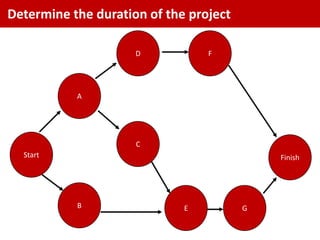
Determine the duration of the project

                     D           F


           A


                     C
  Start                                     Finish


           B                 E          G
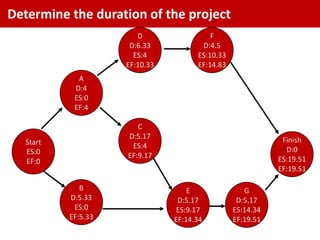
Determine the duration of the project
                        D                 F
                      D:6.33           D:4.5
                       ES:4           ES:10.33
                     EF:10.33         EF:14.83
             A
            D:4
            ES:0
            EF:4

                        C
                     D:5.17                                  Finish
   Start              ES:4
   ES:0                                                       D:0
                     EF:9.17                                ES:19.51
   EF:0
                                                            EF:19.51

              B                     E               G
           D:5.33                D:5.17           D:5.17
            ES:0                 ES:9.17         ES:14.34
           EF:5.33              EF:14.34         EF:19.51
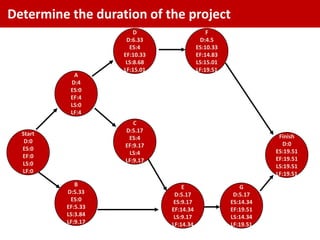
Determine the duration of the project
                        D                     F
                     D:6.33                D:4.5
                      ES:4                ES:10.33
                    EF:10.33              EF:14.83
                     LS:8.68              LS:15.01
                    LF:15.01              LF:19.51
            A
           D:4
           ES:0
           EF:4
           LS:0
           LF:4
                       C
                    D:5.17
  Start                                                          Finish
                     ES:4
   D:0                                                             D:0
                    EF:9.17
  ES:0                                                          ES:19.51
                     LS:4
  EF:0                                                          EF:19.51
                    LF:9.17
  LS:0                                                          LS:19.51
  LF:0                                                          LF:19.51
             B                     E                    G
          D:5.33                D:5.17                D:5.17
           ES:0                 ES:9.17              ES:14.34
          EF:5.33              EF:14.34              EF:19.51
          LS:3.84               LS:9.17              LS:14.34
          LF:9.17              LF:14.34              LF:19.51
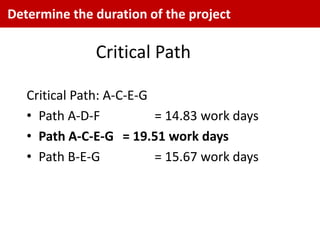
Determine the duration of the project

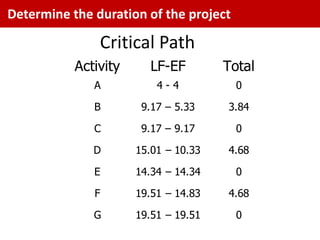
              Critical Path

   Critical Path: A-C-E-G
   • Path A-D-F           = 14.83 work days
   • Path A-C-E-G = 19.51 work days
   • Path B-E-G           = 15.67 work days
Determine the duration of the project

               Critical Path
           Activity     LF-EF         Total
              A           4-4           0

              B        9.17 – 5.33    3.84

              C        9.17 – 9.17      0

              D       15.01 – 10.33   4.68

              E       14.34 – 14.34     0

              F       19.51 – 14.83   4.68

              G       19.51 – 19.51     0
Assessing Risks


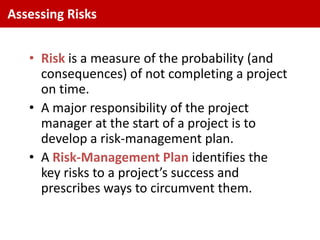
   • Risk is a measure of the probability (and
     consequences) of not completing a project
     on time.
   • A major responsibility of the project
     manager at the start of a project is to
     develop a risk-management plan.
   • A Risk-Management Plan identifies the
     key risks to a project’s success and
     prescribes ways to circumvent them.
Assessing Risks


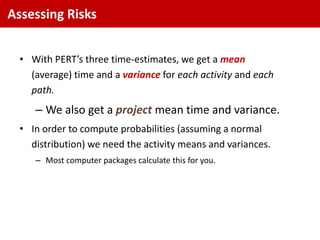
  • With PERT’s three time-estimates, we get a mean
    (average) time and a variance for each activity and each
    path.
     – We also get a project mean time and variance.
  • In order to compute probabilities (assuming a normal
    distribution) we need the activity means and variances.
     – Most computer packages calculate this for you.
Assessing Risks
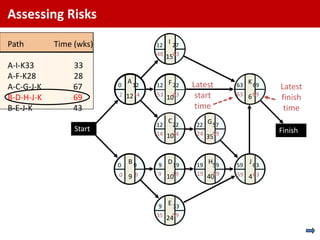
Path        Time (wks)                12
                                         I 27
                                      48 1563
A-I-K33         33
A-F-K28         28
                             A                                  K
A-C-G-J-K       67       0       12   12 F 22   Latest     63   69     Latest
B-D-H-J-K       69       2 1214       53 1063    start     63 6 69
                                                                       finish
B-E-J-K         43                               time                   time
                                         C
                                      12   22    22 G 57
                 Start                                                 Finish
                                      14 1024    24   59
                                                    35


                         0
                             B9       9
                                         D19     19
                                                    H 59   59
                                                                J 63
                         0 9 9        9 1019     19 4059   59 4 63


                                       9 E 33
                                      35 2459
Assessing Risks


• What is the probability that our sample project
  will finish in 69 weeks as scheduled?
   100%     (Why?)
   – Because we used CPM!
      • (This means we were certain of all of our activity times.)
   – If we weren’t certain, we should have used PERT
      • You can’t do risk analysis if you use CPM
Assessing Risks

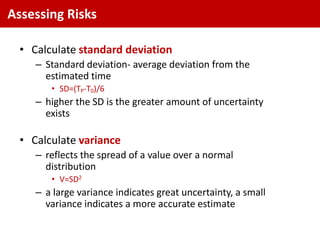
  • Calculate standard deviation
     – Standard deviation- average deviation from the
       estimated time
        • SD=(TP-T0)/6
     – higher the SD is the greater amount of uncertainty
       exists

  • Calculate variance
     – reflects the spread of a value over a normal
       distribution
        • V=SD2
     – a large variance indicates great uncertainty, a small
       variance indicates a more accurate estimate
Assessing Risks


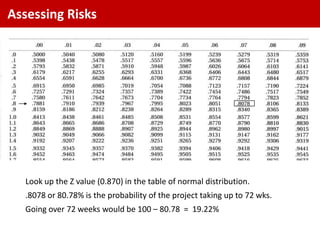
             What is the Probability of it taking 72 weeks?

  Critical       Critical Path = B - D - H - J – K = 69 weeks
  Path           T = 72 weeks        C = 69 weeks
  Varianc                                                  T–C
 e
  2 =  (variances of activities along critical path) =
                                                      z
                                                            2
 2 = 1.78 + 1.78 + 2.78 + 5.44 + 0.11 = 11.89


        z=    72 – 69
               11.89         Look up Z value in normal distribution table
        Z = 0.870                         Pz = .8078 or 80.78%
                                       (Probability of it taking 72 weeks)
Assessing Risks


   Look up the Z value (0.870) in the table of normal distribution.
   .8078 or 80.78% is the probability of the project taking up to 72 wks.
   Going over 72 weeks would be 100 – 80.78 = 19.22%
Assessing Risks


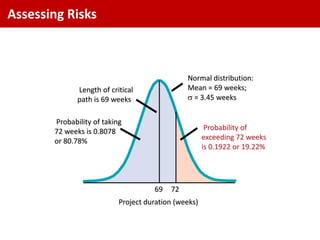
                                               Normal distribution:
              Length of critical               Mean = 69 weeks;
              path is 69 weeks                  = 3.45 weeks


       Probability of taking
       72 weeks is 0.8078                              Probability of
       or 80.78%                                      exceeding 72 weeks
                                                      is 0.1922 or 19.22%


                                     69   72
                           Project duration (weeks)
Assessing Risks

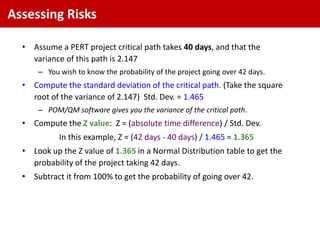
  • Assume a PERT project critical path takes 40 days, and that the
    variance of this path is 2.147
      – You wish to know the probability of the project going over 42 days.
  • Compute the standard deviation of the critical path. (Take the square
    root of the variance of 2.147) Std. Dev. = 1.465
      – POM/QM software gives you the variance of the critical path.
  • Compute the Z value: Z = (absolute time difference) / Std. Dev.
            In this example, Z = (42 days - 40 days) / 1.465 = 1.365
  • Look up the Z value of 1.365 in a Normal Distribution table to get the
    probability of the project taking 42 days.
  • Subtract it from 100% to get the probability of going over 42.
Assessing Risks


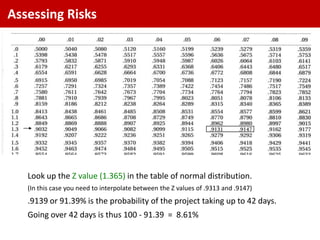
   Look up the Z value (1.365) in the table of normal distribution.
   (In this case you need to interpolate between the Z values of .9313 and .9147)
   .9139 or 91.39% is the probability of the project taking up to 42 days.
   Going over 42 days is thus 100 - 91.39 = 8.61%
Thank you for attention
  Any Questions ????

Program evaluation review technique (pert)

  • 1.
    Engineering Mangement Program EvaluationReview Technique (PERT) Prepared by : Anas Tomeh Fira Eid Prepared for : Dr. Reema Nassar
  • 2.
    Objective of thepresentation • To understand the formula , the use and the benefits of Program , Evaluation ,and Review Technic (PERT) analysis .
  • 3.
    What is thePERT ? Program (Project) Evaluation and Review Technique (PERT): is a project management tool used to schedule, organize, and coordinate tasks within a project. It is basically a method to analyse the tasks involved in completing a given project, especially the time needed to complete each task, and to identify the minimum time needed to complete the total project.
  • 4.
    When we usePERT ? • PERT is used when activity times are uncertain. – Determine the duration of the project . – Decision making under risk (“P” for probabilistic)
  • 5.
    Determine the durationof the project • OPTIMISTIC TIME: Best time if everything goes perfectly • REALISTIC TIME: Most likely time • PESSIMISTIC TIME: A worst-case situation B + 4M + P Expected Time = ------------------- 6
  • 6.
    Determine the durationof the project • Example: For excavation activity let : B = 12 days M = 18 days P = 60 What is the expected time for this activity? Sol : 12 + 4(18) + 60 Expected Time = ------------------------- 6 = 24 days
  • 7.
    Determine the durationof the project Activity Predecessor Optimistic Normal Pessimistic Te (B) (m) (P) (B+4m+P)/6 A --- 2 4 6 4.00 B --- 3 5 9 5.33 C A 4 5 7 5.17 D A 4 6 10 6.33 E B, C 4 5 7 5.17 F D 3 4 8 4.50 G E 3 5 8 5.17 f
  • 8.
    Determine the durationof the project D F A C Start Finish B E G
  • 9.
    Determine the durationof the project D F D:6.33 D:4.5 ES:4 ES:10.33 EF:10.33 EF:14.83 A D:4 ES:0 EF:4 C D:5.17 Finish Start ES:4 ES:0 D:0 EF:9.17 ES:19.51 EF:0 EF:19.51 B E G D:5.33 D:5.17 D:5.17 ES:0 ES:9.17 ES:14.34 EF:5.33 EF:14.34 EF:19.51
  • 10.
    Determine the durationof the project D F D:6.33 D:4.5 ES:4 ES:10.33 EF:10.33 EF:14.83 LS:8.68 LS:15.01 LF:15.01 LF:19.51 A D:4 ES:0 EF:4 LS:0 LF:4 C D:5.17 Start Finish ES:4 D:0 D:0 EF:9.17 ES:0 ES:19.51 LS:4 EF:0 EF:19.51 LF:9.17 LS:0 LS:19.51 LF:0 LF:19.51 B E G D:5.33 D:5.17 D:5.17 ES:0 ES:9.17 ES:14.34 EF:5.33 EF:14.34 EF:19.51 LS:3.84 LS:9.17 LS:14.34 LF:9.17 LF:14.34 LF:19.51
  • 11.
    Determine the durationof the project Critical Path Critical Path: A-C-E-G • Path A-D-F = 14.83 work days • Path A-C-E-G = 19.51 work days • Path B-E-G = 15.67 work days
  • 12.
    Determine the durationof the project Critical Path Activity LF-EF Total A 4-4 0 B 9.17 – 5.33 3.84 C 9.17 – 9.17 0 D 15.01 – 10.33 4.68 E 14.34 – 14.34 0 F 19.51 – 14.83 4.68 G 19.51 – 19.51 0
  • 13.
    Assessing Risks • Risk is a measure of the probability (and consequences) of not completing a project on time. • A major responsibility of the project manager at the start of a project is to develop a risk-management plan. • A Risk-Management Plan identifies the key risks to a project’s success and prescribes ways to circumvent them.
  • 14.
    Assessing Risks • With PERT’s three time-estimates, we get a mean (average) time and a variance for each activity and each path. – We also get a project mean time and variance. • In order to compute probabilities (assuming a normal distribution) we need the activity means and variances. – Most computer packages calculate this for you.
  • 15.
    Assessing Risks Path Time (wks) 12 I 27 48 1563 A-I-K33 33 A-F-K28 28 A K A-C-G-J-K 67 0 12 12 F 22 Latest 63 69 Latest B-D-H-J-K 69 2 1214 53 1063 start 63 6 69 finish B-E-J-K 43 time time C 12 22 22 G 57 Start Finish 14 1024 24 59 35 0 B9 9 D19 19 H 59 59 J 63 0 9 9 9 1019 19 4059 59 4 63 9 E 33 35 2459
  • 16.
    Assessing Risks • Whatis the probability that our sample project will finish in 69 weeks as scheduled? 100% (Why?) – Because we used CPM! • (This means we were certain of all of our activity times.) – If we weren’t certain, we should have used PERT • You can’t do risk analysis if you use CPM
  • 17.
    Assessing Risks • Calculate standard deviation – Standard deviation- average deviation from the estimated time • SD=(TP-T0)/6 – higher the SD is the greater amount of uncertainty exists • Calculate variance – reflects the spread of a value over a normal distribution • V=SD2 – a large variance indicates great uncertainty, a small variance indicates a more accurate estimate
  • 18.
    Assessing Risks What is the Probability of it taking 72 weeks? Critical Critical Path = B - D - H - J – K = 69 weeks Path T = 72 weeks C = 69 weeks Varianc T–C e 2 =  (variances of activities along critical path) = z 2 2 = 1.78 + 1.78 + 2.78 + 5.44 + 0.11 = 11.89 z= 72 – 69 11.89 Look up Z value in normal distribution table Z = 0.870 Pz = .8078 or 80.78% (Probability of it taking 72 weeks)
  • 19.
    Assessing Risks Look up the Z value (0.870) in the table of normal distribution. .8078 or 80.78% is the probability of the project taking up to 72 wks. Going over 72 weeks would be 100 – 80.78 = 19.22%
  • 20.
    Assessing Risks Normal distribution: Length of critical Mean = 69 weeks; path is 69 weeks  = 3.45 weeks Probability of taking 72 weeks is 0.8078 Probability of or 80.78% exceeding 72 weeks is 0.1922 or 19.22% 69 72 Project duration (weeks)
  • 21.
    Assessing Risks • Assume a PERT project critical path takes 40 days, and that the variance of this path is 2.147 – You wish to know the probability of the project going over 42 days. • Compute the standard deviation of the critical path. (Take the square root of the variance of 2.147) Std. Dev. = 1.465 – POM/QM software gives you the variance of the critical path. • Compute the Z value: Z = (absolute time difference) / Std. Dev. In this example, Z = (42 days - 40 days) / 1.465 = 1.365 • Look up the Z value of 1.365 in a Normal Distribution table to get the probability of the project taking 42 days. • Subtract it from 100% to get the probability of going over 42.
  • 22.
    Assessing Risks Look up the Z value (1.365) in the table of normal distribution. (In this case you need to interpolate between the Z values of .9313 and .9147) .9139 or 91.39% is the probability of the project taking up to 42 days. Going over 42 days is thus 100 - 91.39 = 8.61%
  • 23.
    Thank you forattention Any Questions ????