(Professional Business Analyst Training organisation)
Work Breakdown
Structure
Every one of us has some goals and we plan
accordingly to achieve them.
 One of the effective ways to reach our goal
quickly is to break down larger goals into
realistic achievable steps.
A work breakdown structure (WBS), as the
name says, is the process or technique of
dividing complex and difficult projects into
smaller units.
This smaller unit can be a data, product,
service or any combination.
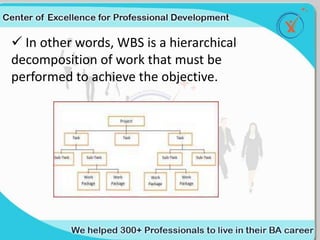
 In other words, WBS is a hierarchical
decomposition of work that must be
performed to achieve the objective.
Traditional BA (Waterfall) Agile BA
Requirements are documented in Use
Cases,Business Requirements, Functional
requirements, UI Specifications, Business Rules.
Requirements are documented in Epics, User
Stories and optionally Business (or Essential) Use
cases.
Focuses on completeness of requirement and
spends time in ensuring the requirement is
unambiguous and has all the details.
Focuses on understanding the problem and being
the domain expert so that s/he can answer
questions from the development team swiftly and
decisively.
Focuses on getting a ‘sign off’ on the requirements.
Focuses on ensuring the requirements meet the
currentbusiness needs, even if it requires
updating them.
Often there is a wall between the BA/Business and
the Development team.
Agile BA (Often called as Product Owner) is part of
the team.
Tends to dictate solutions.
Has to remain in the problem domain, leaving the
development team ‘space’ to explore different
solutions.
Long turnaround. Quick turnaround.
Focus on what the requirements document said. In
other words, output (Artifact) is a well written
thorough requirements document.
Focus on the functionality of the developed
software. In other words, output (Artifact) is the
software that meets thebusiness needs.
 To constructs a WBS, project managers or
subject matter experts first identify the main
functional deliverables and break them into
tasks, sub-tasks and further into work
packages.
 The work package is a list of tasks or "to-
dos" to produce a specific or particular unit of
work.
 Generally few rules are followed in constructing a WBS:
1. Two Weeks Rule: Any broken down level of the above
structure cannot be smaller than two weeks of work.
2. 8/80 Rule: Any level of work should not be less than
8hrs of work or more than 80hrs of work.
 There are many ways to represent a WBS, such as Tree,
Table, or List. The tree type structure is mostly used and an
efficient way of representation.
 Inputs of WBS:
Project scope statement and requirements
documentation are the basic inputs for creating
the WBS. Enterprise environmental factors and
organizational process assets are also
considered in this process. Organizational
process assets include organizational policies
and procedures for the WBS, previous project
files, and lessons learned from previous
projects.
 Outputs of WBS:
WBS document
It includes the total scope of the project as it starts
from the deliverables and then decomposes into
smaller sections.
WBS Dictionary
The WBS dictionary is a document that provides
detailed descriptions of the components in the WBS,
such as work packages and control accounts.
Project Documents Updates
These include the requirements
documentation of approved change requests.
Scope baseline
The scope statement, WBS document,
and WBS dictionary grouped together forms
Scope baseline.
Advantages/Importance of WBS:
1. Easy to define, organize and manage the
project.
2. Improves the efficiency of the project.
3. Helps to estimate the resources required,
such as cost, time, staff, etc.
4. Easy allocation of resources based on the
importance of the task/sub-task.
5. Helps to set up milestones in the project.
6. Gives a better understanding of the project
to the stakeholders.
7. Easy to identify potential risks in a given
project .
8. Helps in identifying communication points
and formulating communication plan across the
project team.
Work breakdown structure

Work breakdown structure

  • 1.
    (Professional Business AnalystTraining organisation) Work Breakdown Structure
  • 2.
    Every one ofus has some goals and we plan accordingly to achieve them.  One of the effective ways to reach our goal quickly is to break down larger goals into realistic achievable steps.
  • 3.
    A work breakdownstructure (WBS), as the name says, is the process or technique of dividing complex and difficult projects into smaller units. This smaller unit can be a data, product, service or any combination.
  • 4.
     In otherwords, WBS is a hierarchical decomposition of work that must be performed to achieve the objective.
  • 5.
    Traditional BA (Waterfall)Agile BA Requirements are documented in Use Cases,Business Requirements, Functional requirements, UI Specifications, Business Rules. Requirements are documented in Epics, User Stories and optionally Business (or Essential) Use cases. Focuses on completeness of requirement and spends time in ensuring the requirement is unambiguous and has all the details. Focuses on understanding the problem and being the domain expert so that s/he can answer questions from the development team swiftly and decisively. Focuses on getting a ‘sign off’ on the requirements. Focuses on ensuring the requirements meet the currentbusiness needs, even if it requires updating them. Often there is a wall between the BA/Business and the Development team. Agile BA (Often called as Product Owner) is part of the team. Tends to dictate solutions. Has to remain in the problem domain, leaving the development team ‘space’ to explore different solutions. Long turnaround. Quick turnaround. Focus on what the requirements document said. In other words, output (Artifact) is a well written thorough requirements document. Focus on the functionality of the developed software. In other words, output (Artifact) is the software that meets thebusiness needs.  To constructs a WBS, project managers or subject matter experts first identify the main functional deliverables and break them into tasks, sub-tasks and further into work packages.  The work package is a list of tasks or "to- dos" to produce a specific or particular unit of work.
  • 6.
     Generally fewrules are followed in constructing a WBS: 1. Two Weeks Rule: Any broken down level of the above structure cannot be smaller than two weeks of work. 2. 8/80 Rule: Any level of work should not be less than 8hrs of work or more than 80hrs of work.  There are many ways to represent a WBS, such as Tree, Table, or List. The tree type structure is mostly used and an efficient way of representation.
  • 7.
     Inputs ofWBS: Project scope statement and requirements documentation are the basic inputs for creating the WBS. Enterprise environmental factors and organizational process assets are also considered in this process. Organizational process assets include organizational policies and procedures for the WBS, previous project files, and lessons learned from previous projects.
  • 8.
     Outputs ofWBS: WBS document It includes the total scope of the project as it starts from the deliverables and then decomposes into smaller sections. WBS Dictionary The WBS dictionary is a document that provides detailed descriptions of the components in the WBS, such as work packages and control accounts.
  • 9.
    Project Documents Updates Theseinclude the requirements documentation of approved change requests. Scope baseline The scope statement, WBS document, and WBS dictionary grouped together forms Scope baseline.
  • 10.
    Advantages/Importance of WBS: 1.Easy to define, organize and manage the project. 2. Improves the efficiency of the project. 3. Helps to estimate the resources required, such as cost, time, staff, etc. 4. Easy allocation of resources based on the importance of the task/sub-task.
  • 11.
    5. Helps toset up milestones in the project. 6. Gives a better understanding of the project to the stakeholders. 7. Easy to identify potential risks in a given project . 8. Helps in identifying communication points and formulating communication plan across the project team.