
CRITICAL PATH METHOD
ACTIVITIES AND EVENTS, FLOAT/SLACKS
INTRODUCTION
• The Critical Path Method is an Algorithm for scheduling a set of project
activities using the longest path of all tasks which determines the project
duration.
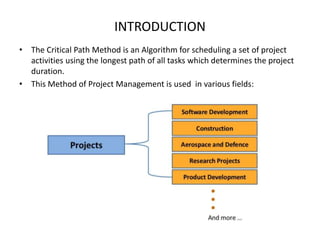
• This Method of Project Management is used in various fields:
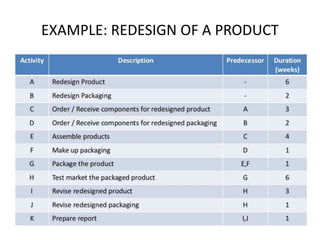
EXAMPLE: REDESIGN OF A PRODUCT
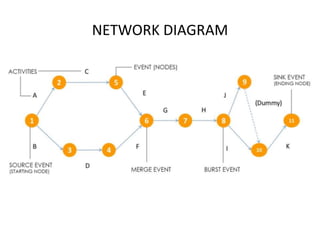
NETWORK DIAGRAM
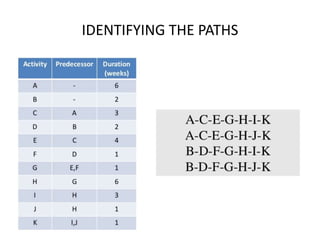
IDENTIFYING THE PATHS
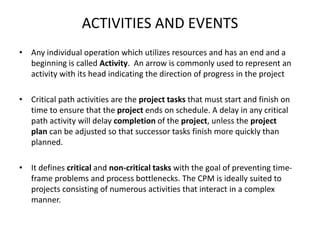
ACTIVITIES AND EVENTS
• Any individual operation which utilizes resources and has an end and a
beginning is called Activity. An arrow is commonly used to represent an
activity with its head indicating the direction of progress in the project
• Critical path activities are the project tasks that must start and finish on
time to ensure that the project ends on schedule. A delay in any critical
path activity will delay completion of the project, unless the project
plan can be adjusted so that successor tasks finish more quickly than
planned.
• It defines critical and non-critical tasks with the goal of preventing time-
frame problems and process bottlenecks. The CPM is ideally suited to
projects consisting of numerous activities that interact in a complex
manner.
• These are classified into four categories
1. Predecessor activity – Activities that must be completed immediately prior to the
start of another activity are called predecessor activities.
2. Successor activity – Activities that cannot be started until one or more of other
activities are completed but immediately succeed them are called successor activities.
3. Concurrent activity – Activities which can be accomplished concurrently are known
as concurrent activities. It may be noted that an activity can be a predecessor or a
successor to an event or it may be concurrent with one or more of other activities.
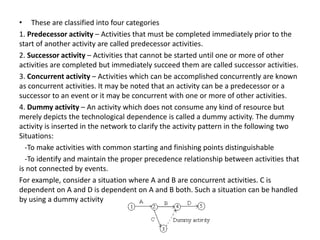
4. Dummy activity – An activity which does not consume any kind of resource but
merely depicts the technological dependence is called a dummy activity. The dummy
activity is inserted in the network to clarify the activity pattern in the following two
Situations:
-To make activities with common starting and finishing points distinguishable
-To identify and maintain the proper precedence relationship between activities that
is not connected by events.
For example, consider a situation where A and B are concurrent activities. C is
dependent on A and D is dependent on A and B both. Such a situation can be handled
by using a dummy activity
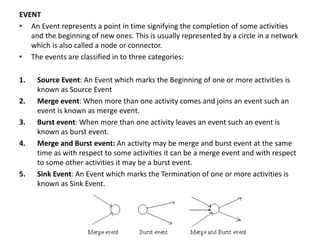
EVENT
• An Event represents a point in time signifying the completion of some activities
and the beginning of new ones. This is usually represented by a circle in a network
which is also called a node or connector.
• The events are classified in to three categories:
1. Source Event: An Event which marks the Beginning of one or more activities is
known as Source Event
2. Merge event: When more than one activity comes and joins an event such an
event is known as merge event.
3. Burst event: When more than one activity leaves an event such an event is
known as burst event.
4. Merge and Burst event: An activity may be merge and burst event at the same
time as with respect to some activities it can be a merge event and with respect
to some other activities it may be a burst event.
5. Sink Event: An Event which marks the Termination of one or more activities is
known as Sink Event.
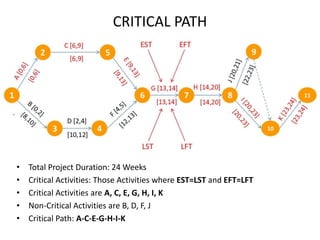
CRITICAL PATH
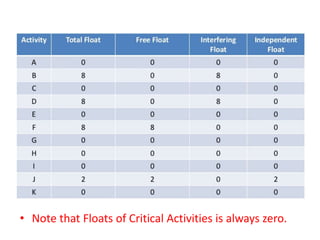
• Total Project Duration: 24 Weeks
• Critical Activities: Those Activities where EST=LST and EFT=LFT
• Critical Activities are A, C, E, G, H, I, K
• Non-Critical Activities are B, D, F, J
• Critical Path: A-C-E-G-H-I-K
FLOAT / SLACK
In project management, float or slack is the amount of time that a task in
a project network can be delayed without causing a delay to:
• subsequent tasks ("free float")
• project completion date ("total float")
The terms "SLACK" and "FLOAT" are often used interchangeably. However,
the essential difference between the terms is that slack is typically associated
with inactivity, while float is associated with activity. Slack time allows an
activity to start later than originally planned, while float time allows an
activity to take longer than originally planned.
It denotes the amount of time each activity can be delayed without violating
the entire project duration. The FLOAT of an activity can be calculated as the
difference between its latest start and earliest start time, or alternatively, as
the difference between its latest and earliest finishing time.
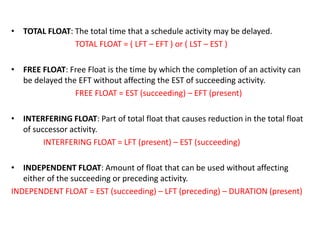
• TOTAL FLOAT: The total time that a schedule activity may be delayed.
TOTAL FLOAT = ( LFT – EFT ) or ( LST – EST )
• FREE FLOAT: Free Float is the time by which the completion of an activity can
be delayed the EFT without affecting the EST of succeeding activity.
FREE FLOAT = EST (succeeding) – EFT (present)
• INTERFERING FLOAT: Part of total float that causes reduction in the total float
of successor activity.
INTERFERING FLOAT = LFT (present) – EST (succeeding)
• INDEPENDENT FLOAT: Amount of float that can be used without affecting
either of the succeeding or preceding activity.
INDEPENDENT FLOAT = EST (succeeding) – LFT (preceding) – DURATION (present)
• Note that Floats of Critical Activities is always zero.
THANK YOU 
SAURABH DEOTALE – BA13ARC043
PRASAD THANTHRATEY – BA13ARC049
PAWAN TIRPUDE – BA13ARC050

Critical Path Method: Activities And Events, Float/Slacks

  • 1.
    CRITICAL PATH METHOD ACTIVITIESAND EVENTS, FLOAT/SLACKS
  • 2.
    INTRODUCTION • The CriticalPath Method is an Algorithm for scheduling a set of project activities using the longest path of all tasks which determines the project duration. • This Method of Project Management is used in various fields:
  • 3.
  • 4.
  • 5.
  • 6.
    ACTIVITIES AND EVENTS •Any individual operation which utilizes resources and has an end and a beginning is called Activity. An arrow is commonly used to represent an activity with its head indicating the direction of progress in the project • Critical path activities are the project tasks that must start and finish on time to ensure that the project ends on schedule. A delay in any critical path activity will delay completion of the project, unless the project plan can be adjusted so that successor tasks finish more quickly than planned. • It defines critical and non-critical tasks with the goal of preventing time- frame problems and process bottlenecks. The CPM is ideally suited to projects consisting of numerous activities that interact in a complex manner.
  • 7.
    • These areclassified into four categories 1. Predecessor activity – Activities that must be completed immediately prior to the start of another activity are called predecessor activities. 2. Successor activity – Activities that cannot be started until one or more of other activities are completed but immediately succeed them are called successor activities. 3. Concurrent activity – Activities which can be accomplished concurrently are known as concurrent activities. It may be noted that an activity can be a predecessor or a successor to an event or it may be concurrent with one or more of other activities. 4. Dummy activity – An activity which does not consume any kind of resource but merely depicts the technological dependence is called a dummy activity. The dummy activity is inserted in the network to clarify the activity pattern in the following two Situations: -To make activities with common starting and finishing points distinguishable -To identify and maintain the proper precedence relationship between activities that is not connected by events. For example, consider a situation where A and B are concurrent activities. C is dependent on A and D is dependent on A and B both. Such a situation can be handled by using a dummy activity
  • 8.
    EVENT • An Eventrepresents a point in time signifying the completion of some activities and the beginning of new ones. This is usually represented by a circle in a network which is also called a node or connector. • The events are classified in to three categories: 1. Source Event: An Event which marks the Beginning of one or more activities is known as Source Event 2. Merge event: When more than one activity comes and joins an event such an event is known as merge event. 3. Burst event: When more than one activity leaves an event such an event is known as burst event. 4. Merge and Burst event: An activity may be merge and burst event at the same time as with respect to some activities it can be a merge event and with respect to some other activities it may be a burst event. 5. Sink Event: An Event which marks the Termination of one or more activities is known as Sink Event.
  • 9.
    CRITICAL PATH • TotalProject Duration: 24 Weeks • Critical Activities: Those Activities where EST=LST and EFT=LFT • Critical Activities are A, C, E, G, H, I, K • Non-Critical Activities are B, D, F, J • Critical Path: A-C-E-G-H-I-K
  • 10.
    FLOAT / SLACK Inproject management, float or slack is the amount of time that a task in a project network can be delayed without causing a delay to: • subsequent tasks ("free float") • project completion date ("total float") The terms "SLACK" and "FLOAT" are often used interchangeably. However, the essential difference between the terms is that slack is typically associated with inactivity, while float is associated with activity. Slack time allows an activity to start later than originally planned, while float time allows an activity to take longer than originally planned. It denotes the amount of time each activity can be delayed without violating the entire project duration. The FLOAT of an activity can be calculated as the difference between its latest start and earliest start time, or alternatively, as the difference between its latest and earliest finishing time.
  • 11.
    • TOTAL FLOAT:The total time that a schedule activity may be delayed. TOTAL FLOAT = ( LFT – EFT ) or ( LST – EST ) • FREE FLOAT: Free Float is the time by which the completion of an activity can be delayed the EFT without affecting the EST of succeeding activity. FREE FLOAT = EST (succeeding) – EFT (present) • INTERFERING FLOAT: Part of total float that causes reduction in the total float of successor activity. INTERFERING FLOAT = LFT (present) – EST (succeeding) • INDEPENDENT FLOAT: Amount of float that can be used without affecting either of the succeeding or preceding activity. INDEPENDENT FLOAT = EST (succeeding) – LFT (preceding) – DURATION (present)
  • 12.
    • Note thatFloats of Critical Activities is always zero.
  • 13.
    THANK YOU  SAURABHDEOTALE – BA13ARC043 PRASAD THANTHRATEY – BA13ARC049 PAWAN TIRPUDE – BA13ARC050