SIMPLEX METHOD
Simplex Method When decision variables are  more than 2 , we always use Simplex Method Slack Variable :  Variable added to a    constraint to convert  it to an equation (=). A slack variable represents unused resources A slack variable contributes nothing to the objective function value. Surplus Variable :  Variable  subtracted from a    constraint to convert it to an equation (=). A surplus variable represents an excess above a constraint requirement level. Surplus variables contribute nothing to the calculated value of the objective function.
Cont…. Basic Solution(BS)  : This solution is obtained by setting any  n  variables (among  m+n  variables) equal to zero and solving for remaining  m  variables, provided the determinant of the coefficients  of these variables is non-zero. Such  m  variables are called  basic variables  and remaining  n  zero valued variables are called  non basic variables . Basic Feasible Solution(BFS)  : It is a basic solution which also satisfies the non negativity restrictions.
Cont….. BFS are of two types: Degenerate BFS : If one or more basic variables are zero. Non-Degenerate BFS : All basic variables are non-zero. Optimal BFS : BFS which optimizes the objective function.
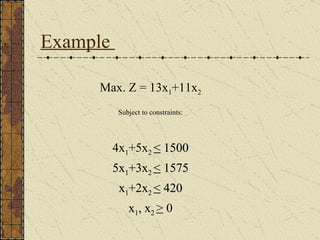
Example  Max. Z = 13x 1 +11x 2 Subject to constraints: 4x 1 +5x 2  <  1500 5x 1 +3x 2  <  1575 x 1 +2x 2  <  420 x 1 , x 2  >  0
Solution  : Step 1:   Convert all the inequality constraints  into equalities by the use of slack variables . Let S 1 , S 2  , S 3  be three slack variables. Introducing these slack variables into the inequality constraints and rewriting the objective function such that all variables are on the left-hand side of the equation. Model can rewritten as: Z - 13x 1  -11x 2  = 0 Subject to constraints: 4x 1 +5x 2  + S 1  =  1500 5x 1 +3x 2  +S 2 = 1575 x 1 +2x 2  +S 3  = 420 x 1 , x 2 , S 1 , S 2 , S 3  >  0
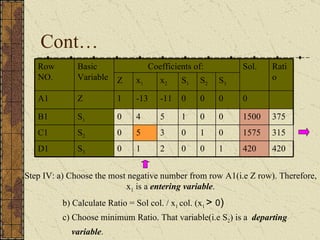
Cont… Step II : Find the Initial BFS. One Feasible solution that satisfies all the constraints is: x 1 = 0, x 2 = 0, S 1 = 1500,  S 2 = 1575, S 3 = 420 and Z=0. Now,  S 1 , S 2 , S 3  are Basic variables. Step III : Set up an initial table as:
Cont… Step IV: a) Choose the most negative number from row A1(i.e Z row). Therefore, x 1  is a  entering variable . b) Calculate Ratio = Sol col. / x 1  col. (x 1  >  0 ) c) Choose minimum Ratio. That variable(i.e S 2 ) is a  departing  variable . D1 C1 B1 A1 Row NO. 0 0 0 0 -11 -13 1 Z 420 315 375 Ratio 420 1 0 0 2 1 0 S 3 1575 0 1 0 3 5 0 S 2 1500 0 0 1 5 4 0 S 1 Sol. S 3 S 2 S 1 x 2 x 1 Z Coefficients of:  Basic Variable
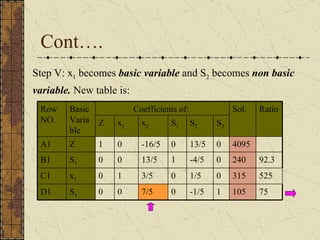
Cont…. Step V: x 1  becomes  basic variable  and S 2  becomes  non basic variable.  New table is:  75 525 92.3 Ratio 105 1 -1/5 0 7/5 0 0 S 3 D1 315 0 1/5 0 3/5 1 0 x 1 C1 240 0 -4/5 1 13/5 0 0 S 1 B1 4095 0 13/5 0 -16/5 0 1 Z A1 Sol. S 3 S 2 S 1 x 2 x 1 Z Coefficients of:  Basic Variable Row NO.
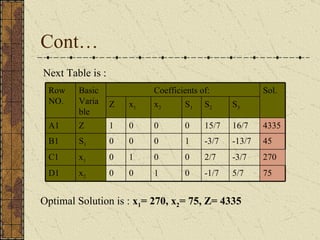
Cont… Next Table is : Optimal Solution is :  x 1 = 270, x 2 = 75, Z= 4335 75 5/7 -1/7 0 1 0 0 x 2 D1 270 -3/7 2/7 0 0 1 0 x 1 C1 45 -13/7 -3/7 1 0 0 0 S 1 B1 4335 16/7 15/7 0 0 0 1 Z A1 Sol. S 3 S 2 S 1 x 2 x 1 Z Coefficients of:  Basic Variable Row NO.
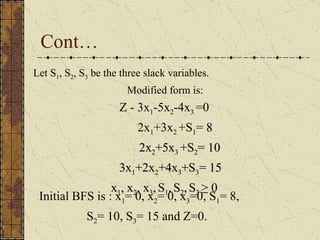
Example Max. Z = 3x 1 +5x 2 +4x 3 Subject to constraints: 2x 1 +3x 2  <  8 2x 2 +5x 3  <  10 3x 1 +2x 2 +4x 3  <  15 x 1 , x 2 , x 3  >  0
Cont… Let S 1 , S 2 , S 3  be the three slack variables.  Modified form is: Z - 3x 1 -5x 2 -4x 3  =0 2x 1 +3x 2  +S 1 =  8 2x 2 +5x 3  +S 2 = 10 3x 1 +2x 2 +4x 3 +S 3 = 15 x 1 , x 2 , x 3 ,   S 1 ,   S 2 ,   S 3  >  0 Initial BFS is : x 1 = 0, x 2 = 0, x 3 =0, S 1 = 8,  S 2 = 10, S 3 = 15 and Z=0.
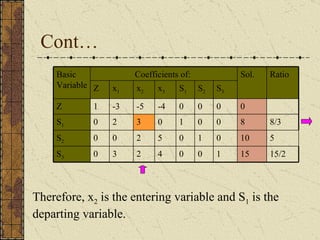
Cont… Therefore, x 2  is the entering variable and S 1  is the departing variable. 4 5 0 -4 x 3 15/2 5 8/3 Ratio 15 1 0 0 2 3 0 S 3 10 0 1 0 2 0 0 S 2 8 0 0 1 3 2 0 S 1 0 0 0 0 -5 -3 1 Z Sol. S 3 S 2 S 1 x 2 x 1 Z Coefficients of:  Basic Variable
Cont… Therefore, x 3  is the entering variable and S 2  is the departing variable. 4 5 0 -4 x 3 29/12 14/15 - Ratio 29/3 1 0 -2/3 0 5/3 0 S 3 14/3 0 1 -2/3 0 -4/3 0 S 2 8/3 0 0 1/3 1 2/3 0 x 2 40/3 0 0 5/3 0 1/3 1 Z Sol. S 3 S 2 S 1 x 2 x 1 Z Coefficients of:  Basic Variable
Cont… Therefore, x 1  is the entering variable and S 3  is the departing variable. 0 1 0 0 x 3 89/41 - 4 Ratio 89/15 1 -4/5 2/15 0 41/15 0 S 3 14/15 0 1/5 -2/15 0 -4/15 0 x 3 8/3 0 0 1/3 1 2/3 0 x 2 256/15 0 4/5 17/15 0 -11/15 1 Z Sol. S 3 S 2 S 1 x 2 x 1 Z Coefficients of:  Basic Variable
Cont… Optimal Solution is :  x 1 = 89/41, x 2 = 50/41, x 3 =62/41, Z= 765/41 0 1 0 0 x 3 89/41 15/41 -12/41 -2/41 0 1 0 x 1 62/41 4/41 5/41 -6/41 0 0 0 x 3 50/41 -10/41 8/41 15/41 1 0 0 x 2 765/41 11/41 24/41 45/41 0 0 1 Z Sol. S 3 S 2 S 1 x 2 x 1 Z Coefficients of:  Basic Variable
Example Min.. Z = x 1  - 3x 2  + 2x 3 Subject to constraints: 3x 1  - x 2  + 3x 3   <   7 -2x 1  + 4x 2  <  12 -4x 1  + 3x 2  + 8x 3   <  10 x 1 , x 2 , x 3  >  0
Cont… Convert the problem into maximization problem Max.. Z’ = -x 1  + 3x 2  - 2x 3  where Z’= -Z Subject to constraints: 3x 1  - x 2  + 3x 3   <   7 -2x 1  + 4x 2  <  12 -4x 1  + 3x 2  + 8x 3   <  10 x 1 , x 2 , x 3  >  0
Cont… Let S 1 , S 2  and S 3  be three slack variables. Modified form is: Z’ + x 1  - 3x 2  + 2x 3  = 0 3x 1  - x 2  + 3x 3  +S 1  =   7 -2x 1  + 4x 2  + S 2  = 12 -4x 1  + 3x 2  + 8x 3  +S 3  =  10 x 1 , x 2 , x 3  >  0 Initial BFS is : x 1 = 0, x 2 = 0, x 3 =0, S 1 = 7, S 2 = 12, S 3  = 10  and Z=0.
Cont… Therefore, x 2  is the entering variable and S 2  is the departing variable. 10/3 10 1 0 0 8 3 -4 0 S 3 0 0 0 S 3 0 3 2 x 3 3 - Ratio 12 1 0 4 -2 0 S 2 7 0 1 -1 3 0 S 1 0 0 0 -3 1 1 Z’ Sol. S 2 S 1 x 2 x 1 Z’ Coefficients of:  Basic Variable
Cont… Therefore, x 1  is the entering variable and S 1  is the departing variable. - 1 1 -3/4 0 8 0 -5/2 0 S 3 0 0 0 S 3 0 3 2 x 3 - 4 Ratio 3 1/4 0 1 -1/2 0 x 2 10 1/4 1 0 5/2 0 S 1 9 3/4 0 0 -1/2 1 Z’ Sol. S 2 S 1 x 2 x 1 Z’ Coefficients of:  Basic Variable
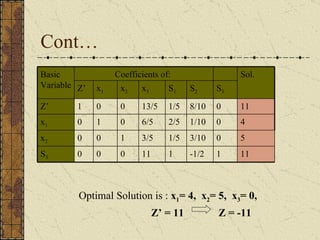
Cont… Optimal Solution is :  x 1 = 4,  x 2 = 5,  x 3 = 0, Z’ = 11  Z = -11 11 1 -1/2 1 11 0 0 0 S 3 0 0 0 S 3 3/5 6/5 13/5 x 3 5 3/10 1/5 1 0 0 x 2 4 1/10 2/5 0 1 0 x 1 11 8/10 1/5 0 0 1 Z’ Sol. S 2 S 1 x 2 x 1 Z’ Coefficients of:  Basic Variable
Example Max.. Z = 3x 1  + 4x 2 Subject to constraints: x 1  - x 2  <   1 -x 1  + x 2  <  2 x 1 , x 2  >  0
Cont… Let S 1  and S 2  be two slack variables . Modified form is: Z -3x 1  - 4x 2  = 0 x 1  - x 2  +S 1  =   1 -x 1  + x 2  +S 2  = 2 x 1 , x 2 , S 1 , S 2  >  0 Initial BFS is : x 1 = 0, x 2 = 0, S 1 = 1, S 2 = 2 and Z=0.
Cont… Therefore, x 2  is the entering variable and S 2  is the departing variable. 2 - Ratio 2 1 0 1 -1 0 S 2 1 0 1 -1 1 0 S 1 0 0 0 -4 -3 1 Z Sol. S 2 S 1 x 2 x 1 Z Coefficients of:  Basic Variable
Cont… x 1  is the entering variable, but as in x 1  column every no. is less than equal to zero, ratio cannot be calculated. Therefore given problem is having a  unbounded solution . - - Ratio 2 1 0 1 -1 0 x 2 3 1 1 0 0 0 S 1 8 4 0 0 -7 1 Z Sol. S 2 S 1 x 2 x 1 Z Coefficients of:  Basic Variable
Two Phase  Method
Introduction LPP, in which constraints may also have  >   and  =  signs, we introduce a new type of variable , called the  artificial variable . These variables are fictitious and cannot have any physical meaning.  Two Phase Simplex   Method   is used to solve a problem in which some artificial variables are involved. The solution is obtained in two phases.
Example Min.. Z = 15/2 x 1  - 3x 2  Subject to constraints: 3x 1  - x 2  - x 3   >  3 x 1  - x 2  + x 3   >  2 x 1 , x 2 , x 3  >  0
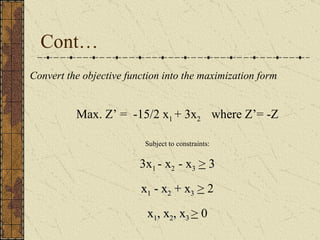
Cont… Convert the objective function into the maximization form Max. Z’ =  -15/2 x 1  + 3x 2  where Z’= -Z Subject to constraints: 3x 1  - x 2  - x 3   >  3 x 1  - x 2  + x 3   >  2 x 1 , x 2 , x 3  >  0
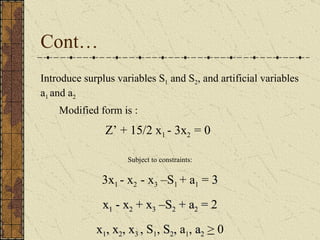
Cont… Modified form is : Introduce surplus variables S 1  and S 2 , and artificial variables a 1  and a 2   Z’ + 15/2 x 1  - 3x 2  = 0   Subject to constraints: 3x 1  - x 2  - x 3  –S 1  + a 1  =  3 x 1  - x 2  + x 3  –S 2  + a 2  =  2 x 1 , x 2 , x 3  ,  S 1 ,  S 2 ,  a 1 ,  a 2   >  0
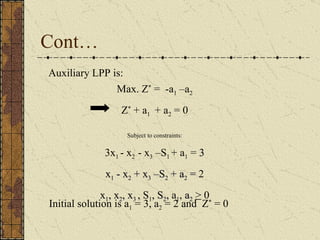
Cont… Phase I  : Simplex method is applied to a specially constructed  Auxiliary LPP  leading to a final simplex table containing a BFS to the original problem. Step 1 : Assign a cost –1 to each artificial variable and a cost 0 to all other variables in the objective function. Step 2 : Construct the auxiliary LPP in which the new objective function Z *  is to be maximized subject to the given set of constraints.
Cont… Max. Z *  =  -a 1  –a 2 Z *  + a 1  + a 2  = 0 Subject to constraints: 3x 1  - x 2  - x 3  –S 1  + a 1  =  3 x 1  - x 2  + x 3  –S 2  + a 2  =  2 x 1 , x 2 , x 3  ,  S 1 ,  S 2 ,  a 1 ,  a 2   >  0 Auxiliary LPP is:  Initial solution is a 1  = 3, a 2  = 2 and  Z *  = 0
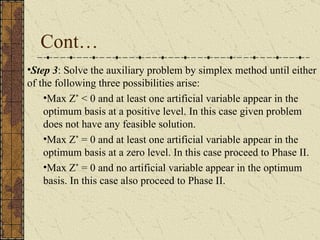
Cont… Step 3 : Solve the auxiliary problem by simplex method until either of the following three possibilities arise: Max Z *  < 0 and at least one artificial variable appear in the optimum basis at a positive level. In this case given problem does not have any feasible solution. Max Z *  = 0 and at least one artificial variable appear in the optimum basis at a zero level. In this case proceed to Phase II. Max Z *  = 0 and no artificial variable appear in the optimum basis. In this case also proceed to Phase II.
Cont… This table is not feasible as a 1  and a 2  has non zero coefficients in Z *  row. Therefore next step is to make the table feasible. 1 0 1 a 2 0 1 1 a 1 1 -1 0 x 3 2 -1 0 -1 1 0 a 2 3 0 -1 -1 3 0 a 1 0 0 0 0 0 1 Z * Sol. S 2 S 1 x 2 x 1 Z * Coefficients of:  Basic Variable
Cont… Therefore, x 1  is the entering variable and a 1  is the departing variable. 2 1 Ratio 1 0 0 a 2 0 1 0 a 1 1 -1 0 x 3 2 -1 0 -1 1 0 a 2 3 0 -1 -1 3 0 a 1 -5 1 1 2 -4 1 Z * Sol. S 2 S 1 x 2 x 1 Z * Coefficients of:  Basic Variable
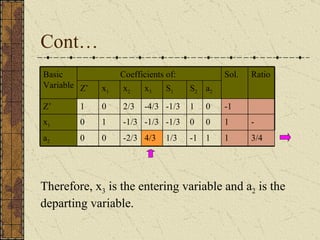
Cont… Therefore, x 3  is the entering variable and a 2  is the departing variable. 3/4 - Ratio 1 0 0 a 2 4/3 -1/3 -4/3 x 3 1 -1 1/3 -2/3 0 0 a 2 1 0 -1/3 -1/3 1 0 x 1 -1 1 -1/3 2/3 0 1 Z * Sol. S 2 S 1 x 2 x 1 Z * Coefficients of:  Basic Variable
Cont… As there is no variable to be entered in the basis, this table is optimum for Phase I. In this table Max. Z *  = 0 and no artificial variable appears in the optimum basis, therefore we can proceed to Phase II. 1 0 0 x 3 3/4 -3/4 1/4 -1/2 0 0 x 3 5/4 -1/4 -1/4 -1/2 1 0 x 1 0 0 0 0 0 1 Z * Sol. S 2 S 1 x 2 x 1 Z * Coefficients of:  Basic Variable
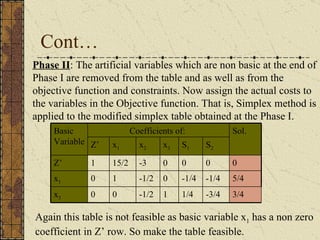
Cont… Phase II : The artificial variables which are non basic at the end of Phase I are removed from the table and as well as from the objective function and constraints. Now assign the actual costs to the variables in the Objective function. That is, Simplex method is applied to the modified simplex table obtained at the Phase I. Again this table is not feasible as basic variable x 1  has a non zero coefficient in Z’ row. So make the table feasible. 1 0 0 x 3 3/4 -3/4 1/4 -1/2 0 0 x 3 5/4 -1/4 -1/4 -1/2 1 0 x 1 0 0 0 -3 15/2 1 Z’ Sol. S 2 S 1 x 2 x 1 Z’ Coefficients of:  Basic Variable
Cont… Optimal Solution is :  x 1 = 5/4,  x 2 = 0,  x 3 = 3/4, Z’ = -75/8  Z = 75/8 1 0 0 x 3 3/4 -3/4 1/4 -1/2 0 0 x 3 5/4 -1/4 -1/4 -1/2 1 0 x 1 -75/8 15/8 15/8 3/4 0 1 Z’ Sol. S 2 S 1 x 2 x 1 Z’ Coefficients of:  Basic Variable
Example Min.. Z =  x 1  - 2x 2  –3x 3 Subject to constraints: -2x 1  + x 2  + 3x 3  =  2 2x 1  + 3x 2  + 4x 3  =  1 x 1 , x 2 , x 3  >  0
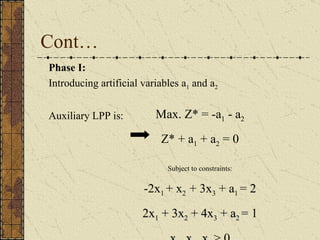
Cont… Phase I: Introducing artificial variables a 1  and a 2 Auxiliary LPP is:  Max. Z* = -a 1  - a 2   Z* + a 1  + a 2  = 0 Subject to constraints: -2x 1  + x 2  + 3x 3  + a 1  =  2 2x 1  + 3x 2  + 4x 3  + a 2  =  1 x 1 , x 2 , x 3  >  0
Cont… This table is not feasible as a 1  and a 2  has non zero coefficients in Z *  row. Therefore next step is to make the table feasible. 1 0 1 a 2 0 1 1 a 1 4 3 0 x 3 1 3 2 0 a 2 2 1 -2 0 a 1 0 0 0 1 Z * Sol. x 2 x 1 Z * Coefficients of:  Basic Variable
Cont… Therefore, x 3  is the entering variable and a 2  is the departing variable. 1/4 2/3 Ratio 1 0 0 a 2 0 1 0 a 1 4 3 -7 x 3 1 3 2 0 a 2 2 1 -2 0 a 1 -3 -4 0 1 Z * Sol. x 2 x 1 Z * Coefficients of:  Basic Variable
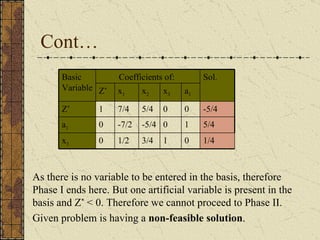
Cont… As there is no variable to be entered in the basis, therefore Phase I ends here. But one artificial variable is present in the basis and Z *  < 0. Therefore we cannot proceed to Phase II. Given problem is having a  non-feasible solution . 0 1 0 a 1 1 0 0 x 3 1/4 3/4 1/2 0 x 3 5/4 -5/4 -7/2 0 a 1 -5/4 5/4 7/4 1 Z * Sol. x 2 x 1 Z * Coefficients of:  Basic Variable
Example  Min.. Z =  4x 1  + x 2  Subject to constraints: 3x 1  + x 2  =  3 4x 1  + 3x 2   >  6 x 1  +2x 2   <  4 x 1 , x 2   >  0
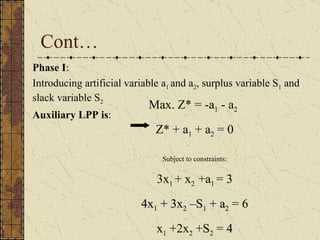
Cont… Phase I : Introducing artificial variable a 1  and a 2 , surplus variable S 1  and slack variable S 2 Auxiliary LPP is : Max. Z* = -a 1  - a 2   Z* + a 1  + a 2  = 0 Subject to constraints: 3x 1  + x 2  +a 1  =  3 4x 1  + 3x 2  –S 1  + a 2   = 6 x 1  +2x 2  +S 2  =  4 x 1 , x 2   >  0
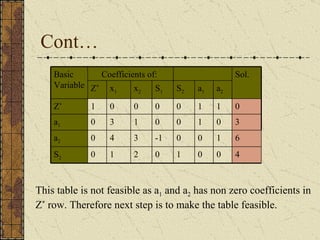
Cont…  This table is not feasible as a 1  and a 2  has non zero coefficients in Z *  row. Therefore next step is to make the table feasible. 4 0 0 1 0 2 1 0 S 2 0 0 0 S 2 1 0 1 a 2 0 1 1 a 1 -1 0 0 S 1 6 3 4 0 a 2 3 1 3 0 a 1 0 0 0 1 Z * Sol. x 2 x 1 Z * Coefficients of:  Basic Variable
Cont… Therefore, x 1  is the entering variable and a 1  is the departing variable. 4 3/2 1 Ratio 4 0 0 1 0 2 1 0 S 2 0 0 0 S 2 1 0 0 a 2 0 1 0 a 1 -1 0 1 S 1 6 3 4 0 a 2 3 1 3 0 a 1 -9 -4 -7 1 Z * Sol. x 2 x 1 Z * Coefficients of:  Basic Variable
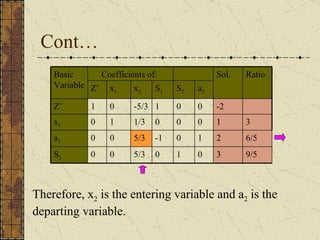
Cont… Therefore, x 2  is the entering variable and a 2  is the departing variable. 9/5 6/5 3 Ratio 3 0 1 0 5/3 0 0 S 2 0 0 0 S 2 1 0 0 a 2 -1 0 1 S 1 2 5/3 0 0 a 2 1 1/3 1 0 x 1 -2 -5/3 0 1 Z * Sol. x 2 x 1 Z * Coefficients of:  Basic Variable
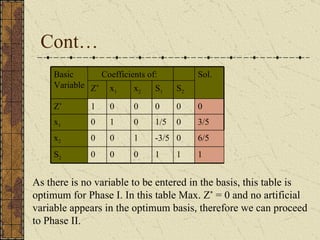
Cont… As there is no variable to be entered in the basis, this table is optimum for Phase I. In this table Max. Z *  = 0 and no artificial variable appears in the optimum basis, therefore we can proceed to Phase II. 1 1 1 0 0 0 S 2 0 0 0 S 2 -3/5 1/5 0 S 1 6/5 1 0 0 x 2 3/5 0 1 0 x 1 0 0 0 1 Z * Sol. x 2 x 1 Z * Coefficients of:  Basic Variable
Cont… Phase II : Original Objective function is: Min.. Z =  4x 1  + x 2 Convert the objective function into the maximization form Max. Z’ =  -4 x 1  - x 2  where Z’= -Z Again this table is not feasible as basic variable x 1  and x 2  has a non zero coefficient in Z’ row. So make the table feasible. 1 1 1 0 0 0 S 2 0 0 0 S 2 -3/5 1/5 0 S 1 6/5 1 0 0 x 2 3/5 0 1 0 x 1 0 1 4 1 Z * Sol. x 2 x 1 Z * Coefficients of:  Basic Variable
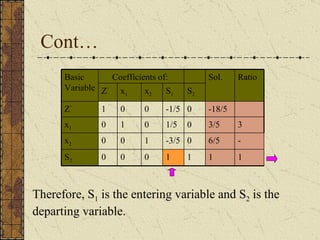
Cont… Therefore, S 1  is the entering variable and S 2  is the departing variable. 1 - 3 Ratio 1 1 1 0 0 0 S 2 0 0 0 S 2 -3/5 1/5 -1/5 S 1 6/5 1 0 0 x 2 3/5 0 1 0 x 1 -18/5 0 0 1 Z ’ Sol. x 2 x 1 Z ’ Coefficients of:  Basic Variable
Cont… Optimal Solution is :  x 1 = 2/5,  x 2 = 9/5,  Z’ = -17/5  Z = 17/5 1 1 1 0 0 0 S 2 3/5 -1/5 1/5 S 2 0 0 0 S 1 9/5 1 0 0 x 2 2/5 0 1 0 x 1 -17/5 0 0 1 Z ’ Sol. x 2 x 1 Z ’ Coefficients of:  Basic Variable
DEGENERACY
Introduction At the stage of improving the solution during Simplex procedure, if a  tie for the minimum ratio occurs  at least one basic variable becomes equal to zero in the next iteration and the new solution is said to be  Degenerate .
Example Max.. Z =  3x 1  + 9x 2  Subject to constraints: x 1  + 4x 2  <  8 x 1  + 2x 2   <  4 x 1 , x 2   >  0
Cont… Let S 1  and S 2  be two slack variables.  Modified form is: Z - 3x 1  - 9x 2  = 0 x 1  + 4x 2  + S 1  =  8 x 1  + 2x 2  +S 2  =  4 x 1 , x 2 , S 1 , S 2   >  0 Initial BFS is : x 1 = 0, x 2 = 0, S 1 = 8, S 2 = 4 and Z=0.
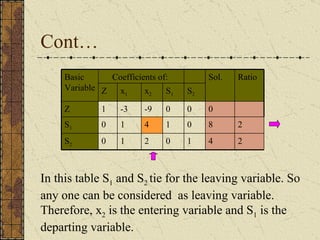
Cont… In this table S 1  and S 2  tie for the leaving variable. So any one can be considered  as leaving variable. Therefore, x 2  is the entering variable and S 1  is the departing variable. 2 2 Ratio 4 1 0 2 1 0 S 2 0 0 S 2 1 0 S 1 8 4 1 0 S 1 0 -9 -3 1 Z Sol. x 2 x 1 Z Coefficients of:  Basic Variable
Cont… Therefore, x 1  is the entering variable and S 2  is the departing variable. 0 8 Ratio 0 1 -1/2 0 1/2 0 S 2 0 0 S 2 1/4 9/4 S 1 2 1 1/4 0 x 2 18 0 -3/4 1 Z Sol. x 2 x 1 Z Coefficients of:  Basic Variable
Cont… Optimal Solution is :  x 1 = 0,  x 2 = 2  Z = 18 It results in a  Degenerate Basic Solution. 0 2 -1 0 1 0 x 1 -1/2 3/2 S 2 1/2 3/2 S 1 2 1 0 0 x 2 18 0 0 1 Z Sol. x 2 x 1 Z Coefficients of:  Basic Variable

Simplex Method

  • 1.
  • 2.
    Simplex Method Whendecision variables are more than 2 , we always use Simplex Method Slack Variable : Variable added to a  constraint to convert it to an equation (=). A slack variable represents unused resources A slack variable contributes nothing to the objective function value. Surplus Variable : Variable subtracted from a  constraint to convert it to an equation (=). A surplus variable represents an excess above a constraint requirement level. Surplus variables contribute nothing to the calculated value of the objective function.
  • 3.
    Cont…. Basic Solution(BS) : This solution is obtained by setting any n variables (among m+n variables) equal to zero and solving for remaining m variables, provided the determinant of the coefficients of these variables is non-zero. Such m variables are called basic variables and remaining n zero valued variables are called non basic variables . Basic Feasible Solution(BFS) : It is a basic solution which also satisfies the non negativity restrictions.
  • 4.
    Cont….. BFS areof two types: Degenerate BFS : If one or more basic variables are zero. Non-Degenerate BFS : All basic variables are non-zero. Optimal BFS : BFS which optimizes the objective function.
  • 5.
    Example Max.Z = 13x 1 +11x 2 Subject to constraints: 4x 1 +5x 2 < 1500 5x 1 +3x 2 < 1575 x 1 +2x 2 < 420 x 1 , x 2 > 0
  • 6.
    Solution :Step 1: Convert all the inequality constraints into equalities by the use of slack variables . Let S 1 , S 2 , S 3 be three slack variables. Introducing these slack variables into the inequality constraints and rewriting the objective function such that all variables are on the left-hand side of the equation. Model can rewritten as: Z - 13x 1 -11x 2 = 0 Subject to constraints: 4x 1 +5x 2 + S 1 = 1500 5x 1 +3x 2 +S 2 = 1575 x 1 +2x 2 +S 3 = 420 x 1 , x 2 , S 1 , S 2 , S 3 > 0
  • 7.
    Cont… Step II: Find the Initial BFS. One Feasible solution that satisfies all the constraints is: x 1 = 0, x 2 = 0, S 1 = 1500, S 2 = 1575, S 3 = 420 and Z=0. Now, S 1 , S 2 , S 3 are Basic variables. Step III : Set up an initial table as:
  • 8.
    Cont… Step IV:a) Choose the most negative number from row A1(i.e Z row). Therefore, x 1 is a entering variable . b) Calculate Ratio = Sol col. / x 1 col. (x 1 > 0 ) c) Choose minimum Ratio. That variable(i.e S 2 ) is a departing variable . D1 C1 B1 A1 Row NO. 0 0 0 0 -11 -13 1 Z 420 315 375 Ratio 420 1 0 0 2 1 0 S 3 1575 0 1 0 3 5 0 S 2 1500 0 0 1 5 4 0 S 1 Sol. S 3 S 2 S 1 x 2 x 1 Z Coefficients of: Basic Variable
  • 9.
    Cont…. Step V:x 1 becomes basic variable and S 2 becomes non basic variable. New table is: 75 525 92.3 Ratio 105 1 -1/5 0 7/5 0 0 S 3 D1 315 0 1/5 0 3/5 1 0 x 1 C1 240 0 -4/5 1 13/5 0 0 S 1 B1 4095 0 13/5 0 -16/5 0 1 Z A1 Sol. S 3 S 2 S 1 x 2 x 1 Z Coefficients of: Basic Variable Row NO.
  • 10.
    Cont… Next Tableis : Optimal Solution is : x 1 = 270, x 2 = 75, Z= 4335 75 5/7 -1/7 0 1 0 0 x 2 D1 270 -3/7 2/7 0 0 1 0 x 1 C1 45 -13/7 -3/7 1 0 0 0 S 1 B1 4335 16/7 15/7 0 0 0 1 Z A1 Sol. S 3 S 2 S 1 x 2 x 1 Z Coefficients of: Basic Variable Row NO.
  • 11.
    Example Max. Z= 3x 1 +5x 2 +4x 3 Subject to constraints: 2x 1 +3x 2 < 8 2x 2 +5x 3 < 10 3x 1 +2x 2 +4x 3 < 15 x 1 , x 2 , x 3 > 0
  • 12.
    Cont… Let S1 , S 2 , S 3 be the three slack variables. Modified form is: Z - 3x 1 -5x 2 -4x 3 =0 2x 1 +3x 2 +S 1 = 8 2x 2 +5x 3 +S 2 = 10 3x 1 +2x 2 +4x 3 +S 3 = 15 x 1 , x 2 , x 3 , S 1 , S 2 , S 3 > 0 Initial BFS is : x 1 = 0, x 2 = 0, x 3 =0, S 1 = 8, S 2 = 10, S 3 = 15 and Z=0.
  • 13.
    Cont… Therefore, x2 is the entering variable and S 1 is the departing variable. 4 5 0 -4 x 3 15/2 5 8/3 Ratio 15 1 0 0 2 3 0 S 3 10 0 1 0 2 0 0 S 2 8 0 0 1 3 2 0 S 1 0 0 0 0 -5 -3 1 Z Sol. S 3 S 2 S 1 x 2 x 1 Z Coefficients of: Basic Variable
  • 14.
    Cont… Therefore, x3 is the entering variable and S 2 is the departing variable. 4 5 0 -4 x 3 29/12 14/15 - Ratio 29/3 1 0 -2/3 0 5/3 0 S 3 14/3 0 1 -2/3 0 -4/3 0 S 2 8/3 0 0 1/3 1 2/3 0 x 2 40/3 0 0 5/3 0 1/3 1 Z Sol. S 3 S 2 S 1 x 2 x 1 Z Coefficients of: Basic Variable
  • 15.
    Cont… Therefore, x1 is the entering variable and S 3 is the departing variable. 0 1 0 0 x 3 89/41 - 4 Ratio 89/15 1 -4/5 2/15 0 41/15 0 S 3 14/15 0 1/5 -2/15 0 -4/15 0 x 3 8/3 0 0 1/3 1 2/3 0 x 2 256/15 0 4/5 17/15 0 -11/15 1 Z Sol. S 3 S 2 S 1 x 2 x 1 Z Coefficients of: Basic Variable
  • 16.
    Cont… Optimal Solutionis : x 1 = 89/41, x 2 = 50/41, x 3 =62/41, Z= 765/41 0 1 0 0 x 3 89/41 15/41 -12/41 -2/41 0 1 0 x 1 62/41 4/41 5/41 -6/41 0 0 0 x 3 50/41 -10/41 8/41 15/41 1 0 0 x 2 765/41 11/41 24/41 45/41 0 0 1 Z Sol. S 3 S 2 S 1 x 2 x 1 Z Coefficients of: Basic Variable
  • 17.
    Example Min.. Z= x 1 - 3x 2 + 2x 3 Subject to constraints: 3x 1 - x 2 + 3x 3 < 7 -2x 1 + 4x 2 < 12 -4x 1 + 3x 2 + 8x 3 < 10 x 1 , x 2 , x 3 > 0
  • 18.
    Cont… Convert theproblem into maximization problem Max.. Z’ = -x 1 + 3x 2 - 2x 3 where Z’= -Z Subject to constraints: 3x 1 - x 2 + 3x 3 < 7 -2x 1 + 4x 2 < 12 -4x 1 + 3x 2 + 8x 3 < 10 x 1 , x 2 , x 3 > 0
  • 19.
    Cont… Let S1 , S 2 and S 3 be three slack variables. Modified form is: Z’ + x 1 - 3x 2 + 2x 3 = 0 3x 1 - x 2 + 3x 3 +S 1 = 7 -2x 1 + 4x 2 + S 2 = 12 -4x 1 + 3x 2 + 8x 3 +S 3 = 10 x 1 , x 2 , x 3 > 0 Initial BFS is : x 1 = 0, x 2 = 0, x 3 =0, S 1 = 7, S 2 = 12, S 3 = 10 and Z=0.
  • 20.
    Cont… Therefore, x2 is the entering variable and S 2 is the departing variable. 10/3 10 1 0 0 8 3 -4 0 S 3 0 0 0 S 3 0 3 2 x 3 3 - Ratio 12 1 0 4 -2 0 S 2 7 0 1 -1 3 0 S 1 0 0 0 -3 1 1 Z’ Sol. S 2 S 1 x 2 x 1 Z’ Coefficients of: Basic Variable
  • 21.
    Cont… Therefore, x1 is the entering variable and S 1 is the departing variable. - 1 1 -3/4 0 8 0 -5/2 0 S 3 0 0 0 S 3 0 3 2 x 3 - 4 Ratio 3 1/4 0 1 -1/2 0 x 2 10 1/4 1 0 5/2 0 S 1 9 3/4 0 0 -1/2 1 Z’ Sol. S 2 S 1 x 2 x 1 Z’ Coefficients of: Basic Variable
  • 22.
    Cont… Optimal Solutionis : x 1 = 4, x 2 = 5, x 3 = 0, Z’ = 11 Z = -11 11 1 -1/2 1 11 0 0 0 S 3 0 0 0 S 3 3/5 6/5 13/5 x 3 5 3/10 1/5 1 0 0 x 2 4 1/10 2/5 0 1 0 x 1 11 8/10 1/5 0 0 1 Z’ Sol. S 2 S 1 x 2 x 1 Z’ Coefficients of: Basic Variable
  • 23.
    Example Max.. Z= 3x 1 + 4x 2 Subject to constraints: x 1 - x 2 < 1 -x 1 + x 2 < 2 x 1 , x 2 > 0
  • 24.
    Cont… Let S1 and S 2 be two slack variables . Modified form is: Z -3x 1 - 4x 2 = 0 x 1 - x 2 +S 1 = 1 -x 1 + x 2 +S 2 = 2 x 1 , x 2 , S 1 , S 2 > 0 Initial BFS is : x 1 = 0, x 2 = 0, S 1 = 1, S 2 = 2 and Z=0.
  • 25.
    Cont… Therefore, x2 is the entering variable and S 2 is the departing variable. 2 - Ratio 2 1 0 1 -1 0 S 2 1 0 1 -1 1 0 S 1 0 0 0 -4 -3 1 Z Sol. S 2 S 1 x 2 x 1 Z Coefficients of: Basic Variable
  • 26.
    Cont… x 1 is the entering variable, but as in x 1 column every no. is less than equal to zero, ratio cannot be calculated. Therefore given problem is having a unbounded solution . - - Ratio 2 1 0 1 -1 0 x 2 3 1 1 0 0 0 S 1 8 4 0 0 -7 1 Z Sol. S 2 S 1 x 2 x 1 Z Coefficients of: Basic Variable
  • 27.
    Two Phase Method
  • 28.
    Introduction LPP, inwhich constraints may also have > and = signs, we introduce a new type of variable , called the artificial variable . These variables are fictitious and cannot have any physical meaning. Two Phase Simplex Method is used to solve a problem in which some artificial variables are involved. The solution is obtained in two phases.
  • 29.
    Example Min.. Z= 15/2 x 1 - 3x 2 Subject to constraints: 3x 1 - x 2 - x 3 > 3 x 1 - x 2 + x 3 > 2 x 1 , x 2 , x 3 > 0
  • 30.
    Cont… Convert theobjective function into the maximization form Max. Z’ = -15/2 x 1 + 3x 2 where Z’= -Z Subject to constraints: 3x 1 - x 2 - x 3 > 3 x 1 - x 2 + x 3 > 2 x 1 , x 2 , x 3 > 0
  • 31.
    Cont… Modified formis : Introduce surplus variables S 1 and S 2 , and artificial variables a 1 and a 2 Z’ + 15/2 x 1 - 3x 2 = 0 Subject to constraints: 3x 1 - x 2 - x 3 –S 1 + a 1 = 3 x 1 - x 2 + x 3 –S 2 + a 2 = 2 x 1 , x 2 , x 3 , S 1 , S 2 , a 1 , a 2 > 0
  • 32.
    Cont… Phase I : Simplex method is applied to a specially constructed Auxiliary LPP leading to a final simplex table containing a BFS to the original problem. Step 1 : Assign a cost –1 to each artificial variable and a cost 0 to all other variables in the objective function. Step 2 : Construct the auxiliary LPP in which the new objective function Z * is to be maximized subject to the given set of constraints.
  • 33.
    Cont… Max. Z* = -a 1 –a 2 Z * + a 1 + a 2 = 0 Subject to constraints: 3x 1 - x 2 - x 3 –S 1 + a 1 = 3 x 1 - x 2 + x 3 –S 2 + a 2 = 2 x 1 , x 2 , x 3 , S 1 , S 2 , a 1 , a 2 > 0 Auxiliary LPP is: Initial solution is a 1 = 3, a 2 = 2 and Z * = 0
  • 34.
    Cont… Step 3: Solve the auxiliary problem by simplex method until either of the following three possibilities arise: Max Z * < 0 and at least one artificial variable appear in the optimum basis at a positive level. In this case given problem does not have any feasible solution. Max Z * = 0 and at least one artificial variable appear in the optimum basis at a zero level. In this case proceed to Phase II. Max Z * = 0 and no artificial variable appear in the optimum basis. In this case also proceed to Phase II.
  • 35.
    Cont… This tableis not feasible as a 1 and a 2 has non zero coefficients in Z * row. Therefore next step is to make the table feasible. 1 0 1 a 2 0 1 1 a 1 1 -1 0 x 3 2 -1 0 -1 1 0 a 2 3 0 -1 -1 3 0 a 1 0 0 0 0 0 1 Z * Sol. S 2 S 1 x 2 x 1 Z * Coefficients of: Basic Variable
  • 36.
    Cont… Therefore, x1 is the entering variable and a 1 is the departing variable. 2 1 Ratio 1 0 0 a 2 0 1 0 a 1 1 -1 0 x 3 2 -1 0 -1 1 0 a 2 3 0 -1 -1 3 0 a 1 -5 1 1 2 -4 1 Z * Sol. S 2 S 1 x 2 x 1 Z * Coefficients of: Basic Variable
  • 37.
    Cont… Therefore, x3 is the entering variable and a 2 is the departing variable. 3/4 - Ratio 1 0 0 a 2 4/3 -1/3 -4/3 x 3 1 -1 1/3 -2/3 0 0 a 2 1 0 -1/3 -1/3 1 0 x 1 -1 1 -1/3 2/3 0 1 Z * Sol. S 2 S 1 x 2 x 1 Z * Coefficients of: Basic Variable
  • 38.
    Cont… As thereis no variable to be entered in the basis, this table is optimum for Phase I. In this table Max. Z * = 0 and no artificial variable appears in the optimum basis, therefore we can proceed to Phase II. 1 0 0 x 3 3/4 -3/4 1/4 -1/2 0 0 x 3 5/4 -1/4 -1/4 -1/2 1 0 x 1 0 0 0 0 0 1 Z * Sol. S 2 S 1 x 2 x 1 Z * Coefficients of: Basic Variable
  • 39.
    Cont… Phase II: The artificial variables which are non basic at the end of Phase I are removed from the table and as well as from the objective function and constraints. Now assign the actual costs to the variables in the Objective function. That is, Simplex method is applied to the modified simplex table obtained at the Phase I. Again this table is not feasible as basic variable x 1 has a non zero coefficient in Z’ row. So make the table feasible. 1 0 0 x 3 3/4 -3/4 1/4 -1/2 0 0 x 3 5/4 -1/4 -1/4 -1/2 1 0 x 1 0 0 0 -3 15/2 1 Z’ Sol. S 2 S 1 x 2 x 1 Z’ Coefficients of: Basic Variable
  • 40.
    Cont… Optimal Solutionis : x 1 = 5/4, x 2 = 0, x 3 = 3/4, Z’ = -75/8 Z = 75/8 1 0 0 x 3 3/4 -3/4 1/4 -1/2 0 0 x 3 5/4 -1/4 -1/4 -1/2 1 0 x 1 -75/8 15/8 15/8 3/4 0 1 Z’ Sol. S 2 S 1 x 2 x 1 Z’ Coefficients of: Basic Variable
  • 41.
    Example Min.. Z= x 1 - 2x 2 –3x 3 Subject to constraints: -2x 1 + x 2 + 3x 3 = 2 2x 1 + 3x 2 + 4x 3 = 1 x 1 , x 2 , x 3 > 0
  • 42.
    Cont… Phase I:Introducing artificial variables a 1 and a 2 Auxiliary LPP is: Max. Z* = -a 1 - a 2 Z* + a 1 + a 2 = 0 Subject to constraints: -2x 1 + x 2 + 3x 3 + a 1 = 2 2x 1 + 3x 2 + 4x 3 + a 2 = 1 x 1 , x 2 , x 3 > 0
  • 43.
    Cont… This tableis not feasible as a 1 and a 2 has non zero coefficients in Z * row. Therefore next step is to make the table feasible. 1 0 1 a 2 0 1 1 a 1 4 3 0 x 3 1 3 2 0 a 2 2 1 -2 0 a 1 0 0 0 1 Z * Sol. x 2 x 1 Z * Coefficients of: Basic Variable
  • 44.
    Cont… Therefore, x3 is the entering variable and a 2 is the departing variable. 1/4 2/3 Ratio 1 0 0 a 2 0 1 0 a 1 4 3 -7 x 3 1 3 2 0 a 2 2 1 -2 0 a 1 -3 -4 0 1 Z * Sol. x 2 x 1 Z * Coefficients of: Basic Variable
  • 45.
    Cont… As thereis no variable to be entered in the basis, therefore Phase I ends here. But one artificial variable is present in the basis and Z * < 0. Therefore we cannot proceed to Phase II. Given problem is having a non-feasible solution . 0 1 0 a 1 1 0 0 x 3 1/4 3/4 1/2 0 x 3 5/4 -5/4 -7/2 0 a 1 -5/4 5/4 7/4 1 Z * Sol. x 2 x 1 Z * Coefficients of: Basic Variable
  • 46.
    Example Min..Z = 4x 1 + x 2 Subject to constraints: 3x 1 + x 2 = 3 4x 1 + 3x 2 > 6 x 1 +2x 2 < 4 x 1 , x 2 > 0
  • 47.
    Cont… Phase I: Introducing artificial variable a 1 and a 2 , surplus variable S 1 and slack variable S 2 Auxiliary LPP is : Max. Z* = -a 1 - a 2 Z* + a 1 + a 2 = 0 Subject to constraints: 3x 1 + x 2 +a 1 = 3 4x 1 + 3x 2 –S 1 + a 2 = 6 x 1 +2x 2 +S 2 = 4 x 1 , x 2 > 0
  • 48.
    Cont… Thistable is not feasible as a 1 and a 2 has non zero coefficients in Z * row. Therefore next step is to make the table feasible. 4 0 0 1 0 2 1 0 S 2 0 0 0 S 2 1 0 1 a 2 0 1 1 a 1 -1 0 0 S 1 6 3 4 0 a 2 3 1 3 0 a 1 0 0 0 1 Z * Sol. x 2 x 1 Z * Coefficients of: Basic Variable
  • 49.
    Cont… Therefore, x1 is the entering variable and a 1 is the departing variable. 4 3/2 1 Ratio 4 0 0 1 0 2 1 0 S 2 0 0 0 S 2 1 0 0 a 2 0 1 0 a 1 -1 0 1 S 1 6 3 4 0 a 2 3 1 3 0 a 1 -9 -4 -7 1 Z * Sol. x 2 x 1 Z * Coefficients of: Basic Variable
  • 50.
    Cont… Therefore, x2 is the entering variable and a 2 is the departing variable. 9/5 6/5 3 Ratio 3 0 1 0 5/3 0 0 S 2 0 0 0 S 2 1 0 0 a 2 -1 0 1 S 1 2 5/3 0 0 a 2 1 1/3 1 0 x 1 -2 -5/3 0 1 Z * Sol. x 2 x 1 Z * Coefficients of: Basic Variable
  • 51.
    Cont… As thereis no variable to be entered in the basis, this table is optimum for Phase I. In this table Max. Z * = 0 and no artificial variable appears in the optimum basis, therefore we can proceed to Phase II. 1 1 1 0 0 0 S 2 0 0 0 S 2 -3/5 1/5 0 S 1 6/5 1 0 0 x 2 3/5 0 1 0 x 1 0 0 0 1 Z * Sol. x 2 x 1 Z * Coefficients of: Basic Variable
  • 52.
    Cont… Phase II: Original Objective function is: Min.. Z = 4x 1 + x 2 Convert the objective function into the maximization form Max. Z’ = -4 x 1 - x 2 where Z’= -Z Again this table is not feasible as basic variable x 1 and x 2 has a non zero coefficient in Z’ row. So make the table feasible. 1 1 1 0 0 0 S 2 0 0 0 S 2 -3/5 1/5 0 S 1 6/5 1 0 0 x 2 3/5 0 1 0 x 1 0 1 4 1 Z * Sol. x 2 x 1 Z * Coefficients of: Basic Variable
  • 53.
    Cont… Therefore, S1 is the entering variable and S 2 is the departing variable. 1 - 3 Ratio 1 1 1 0 0 0 S 2 0 0 0 S 2 -3/5 1/5 -1/5 S 1 6/5 1 0 0 x 2 3/5 0 1 0 x 1 -18/5 0 0 1 Z ’ Sol. x 2 x 1 Z ’ Coefficients of: Basic Variable
  • 54.
    Cont… Optimal Solutionis : x 1 = 2/5, x 2 = 9/5, Z’ = -17/5 Z = 17/5 1 1 1 0 0 0 S 2 3/5 -1/5 1/5 S 2 0 0 0 S 1 9/5 1 0 0 x 2 2/5 0 1 0 x 1 -17/5 0 0 1 Z ’ Sol. x 2 x 1 Z ’ Coefficients of: Basic Variable
  • 55.
  • 56.
    Introduction At thestage of improving the solution during Simplex procedure, if a tie for the minimum ratio occurs at least one basic variable becomes equal to zero in the next iteration and the new solution is said to be Degenerate .
  • 57.
    Example Max.. Z= 3x 1 + 9x 2 Subject to constraints: x 1 + 4x 2 < 8 x 1 + 2x 2 < 4 x 1 , x 2 > 0
  • 58.
    Cont… Let S1 and S 2 be two slack variables. Modified form is: Z - 3x 1 - 9x 2 = 0 x 1 + 4x 2 + S 1 = 8 x 1 + 2x 2 +S 2 = 4 x 1 , x 2 , S 1 , S 2 > 0 Initial BFS is : x 1 = 0, x 2 = 0, S 1 = 8, S 2 = 4 and Z=0.
  • 59.
    Cont… In thistable S 1 and S 2 tie for the leaving variable. So any one can be considered as leaving variable. Therefore, x 2 is the entering variable and S 1 is the departing variable. 2 2 Ratio 4 1 0 2 1 0 S 2 0 0 S 2 1 0 S 1 8 4 1 0 S 1 0 -9 -3 1 Z Sol. x 2 x 1 Z Coefficients of: Basic Variable
  • 60.
    Cont… Therefore, x1 is the entering variable and S 2 is the departing variable. 0 8 Ratio 0 1 -1/2 0 1/2 0 S 2 0 0 S 2 1/4 9/4 S 1 2 1 1/4 0 x 2 18 0 -3/4 1 Z Sol. x 2 x 1 Z Coefficients of: Basic Variable
  • 61.
    Cont… Optimal Solutionis : x 1 = 0, x 2 = 2 Z = 18 It results in a Degenerate Basic Solution. 0 2 -1 0 1 0 x 1 -1/2 3/2 S 2 1/2 3/2 S 1 2 1 0 0 x 2 18 0 0 1 Z Sol. x 2 x 1 Z Coefficients of: Basic Variable