Leadership Style and 
Organizational Effectiveness 
The Sony-Ericsson Endeavour1 
Presented by 
Hashamuddin bin Yaakob (900278) 
Presented to 
Dr Caroline M. Acosta 
2014 OYAGSB UUM Slide 1
Agenda 
1. Introduction – What is Leadership? 
2. Major Leadership issues/decision made in case 
3. Effectiveness Leadership decision at the time 
4. Effect Leadership decision in current situation 
5. Leadership Lessons 
6. Conclusion 
2014 OYAGSB UUM Slide 2
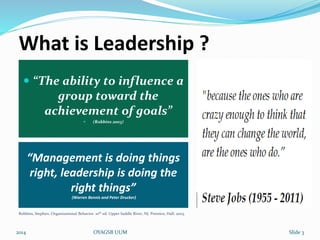
What is Leadership ? 
 “The ability to influence a 
group toward the 
achievement of goals” 
 (Robbins 2003) 
“Management is doing things 
right, leadership is doing the 
right things” 
(Warren Bennis and Peter Drucker) 
Robbins, Stephen. Organizational Behavior. 10th ed. Upper Saddle River, NJ: Prentice, Hall, 2003. 
2014 OYAGSB UUM Slide 3
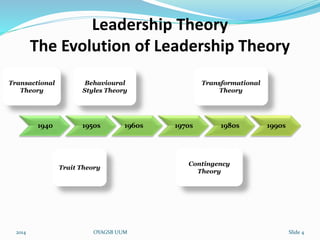
Leadership Theory 
The Evolution of Leadership Theory 
Behavioural 
Styles Theory 
Transformational 
Theory 
Transactional 
Theory 
1940 1950s 1960s 1970s 1980s 1990s 
Trait Theory 
Contingency 
Theory 
2014 OYAGSB UUM Slide 4
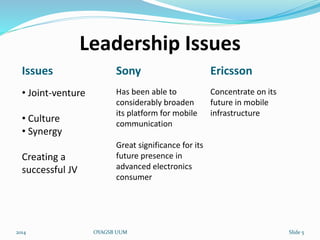
Leadership Issues 
Issues Sony Ericsson 
• Joint-venture 
• Culture 
• Synergy 
Creating a 
successful JV 
Has been able to 
considerably broaden 
its platform for mobile 
communication 
Great significance for its 
future presence in 
advanced electronics 
consumer 
Concentrate on its 
future in mobile 
infrastructure 
2014 OYAGSB UUM Slide 5
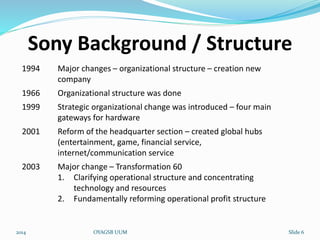
Sony Background / Structure 
1994 Major changes – organizational structure – creation new 
company 
1966 Organizational structure was done 
1999 Strategic organizational change was introduced – four main 
gateways for hardware 
2001 Reform of the headquarter section – created global hubs 
(entertainment, game, financial service, 
internet/communication service 
2003 Major change – Transformation 60 
1. Clarifying operational structure and concentrating 
technology and resources 
2. Fundamentally reforming operational profit structure 
2014 OYAGSB UUM Slide 6
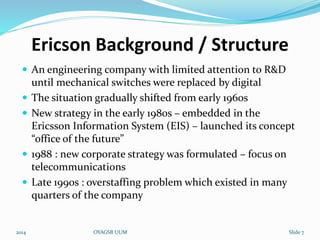
Ericson Background / Structure 
 An engineering company with limited attention to R&D 
until mechanical switches were replaced by digital 
 The situation gradually shifted from early 1960s 
 New strategy in the early 1980s – embedded in the 
Ericsson Information System (EIS) – launched its concept 
“office of the future” 
 1988 : new corporate strategy was formulated – focus on 
telecommunications 
 Late 1990s : overstaffing problem which existed in many 
quarters of the company 
2014 OYAGSB UUM Slide 7
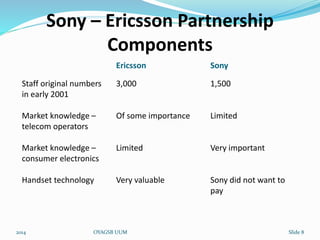
Sony – Ericsson Partnership 
Components 
Ericsson Sony 
Staff original numbers 
in early 2001 
3,000 1,500 
Market knowledge – 
telecom operators 
Of some importance Limited 
Market knowledge – 
consumer electronics 
Limited Very important 
Handset technology Very valuable Sony did not want to 
pay 
2014 OYAGSB UUM Slide 8
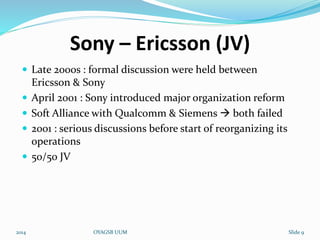
Sony – Ericsson (JV) 
 Late 2000s : formal discussion were held between 
Ericsson & Sony 
 April 2001 : Sony introduced major organization reform 
 Soft Alliance with Qualcomm & Siemens  both failed 
 2001 : serious discussions before start of reorganizing its 
operations 
 50/50 JV 
2014 OYAGSB UUM Slide 9
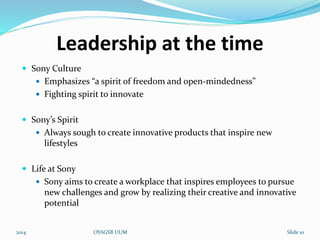
Leadership at the time 
 Sony Culture 
 Emphasizes “a spirit of freedom and open-mindedness” 
 Fighting spirit to innovate 
 Sony’s Spirit 
 Always sough to create innovative products that inspire new 
lifestyles 
 Life at Sony 
 Sony aims to create a workplace that inspires employees to pursue 
new challenges and grow by realizing their creative and innovative 
potential 
2014 OYAGSB UUM Slide 10
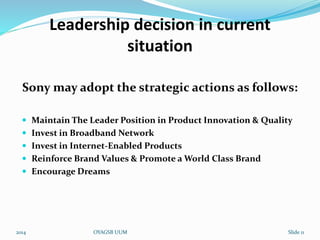
Leadership decision in current 
situation 
Sony may adopt the strategic actions as follows: 
 Maintain The Leader Position in Product Innovation & Quality 
 Invest in Broadband Network 
 Invest in Internet-Enabled Products 
 Reinforce Brand Values & Promote a World Class Brand 
 Encourage Dreams 
2014 OYAGSB UUM Slide 11
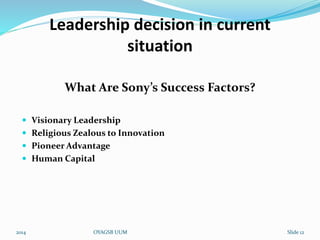
Leadership decision in current 
situation 
What Are Sony’s Success Factors? 
 Visionary Leadership 
 Religious Zealous to Innovation 
 Pioneer Advantage 
 Human Capital 
2014 OYAGSB UUM Slide 12
Leadership Lesson 
2014 OYAGSB UUM Slide 13
Leadership Theory 
Transformational Leader 
1. Leaders stimulate and inspire (transform) 
followers to achieve extraordinary 
outcomes 
2. Characteristics: 
I. Leadership is proactive 
II. Works to change the organizational culture 
by implementing new ideas 
III. Employees achieve objectives through higher 
ideals and moral values 
IV. Motivates followers by encouraging them to 
put group interests first 
V. Intellectual stimulation: Promote creative 
and innovative ideas to solve problems. 
People will 
follow a 
person who 
inspires 
them. 
2014 OYAGSB UUM Slide 14
Leadership Theory 
Transactional Leader 
1. Leaders promote compliance of his 
followers through both reward or 
punishment. 
2. Characteristics: 
I. Leadership is reactive 
II. Works within the organizational culture 
III. Employees achieve objectives through 
rewards and punishments set by leader 
IV. Motivates followers by appealing to their own 
self interest 
V. Management-by-exception: maintain the 
status quo; stress correct actions to improve 
performance 
Subordinates 
are not self-motivating 
2014 OYAGSB UUM Slide 15
Leadership Theory 
Contingency Theory 
1. According to the contingency approach of 
leadership, a single leadership style is not 
applicable to all situations. 
2. Contingency models of leadership styles: 
I. Fiedler’s Contingency Model 
II. Hersey and Blanchard’s situational theory 
III. Path Goal Theory 
IV. Tannenbaum and Schmidt’s leadership 
continuum 
a single 
leadership 
style is not 
applicable to 
all situations 
2014 OYAGSB UUM Slide 16
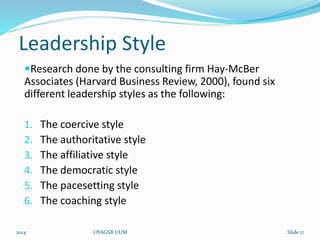
Leadership Style 
Research done by the consulting firm Hay-McBer 
Associates (Harvard Business Review, 2000), found six 
different leadership styles as the following: 
1. The coercive style 
2. The authoritative style 
3. The affiliative style 
4. The democratic style 
5. The pacesetting style 
6. The coaching style 
2014 OYAGSB UUM Slide 17
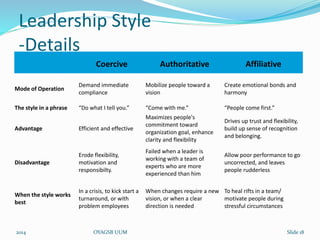
Leadership Style 
-Details 
Coercive Authoritative Affiliative 
Mode of Operation 
Demand immediate 
compliance 
Mobilize people toward a 
vision 
Create emotional bonds and 
harmony 
The style in a phrase “Do what I tell you.” “Come with me.” “People come first.” 
Advantage Efficient and effective 
Maximizes people's 
commitment toward 
organization goal, enhance 
clarity and flexibility 
Drives up trust and flexibility, 
build up sense of recognition 
and belonging. 
Disadvantage 
Erode flexibility, 
motivation and 
responsibilty. 
Failed when a leader is 
working with a team of 
experts who are more 
experienced than him 
Allow poor performance to go 
uncorrected, and leaves 
people rudderless 
When the style works 
best 
In a crisis, to kick start a 
turnaround, or with 
problem employees 
When changes require a new 
vision, or when a clear 
direction is needed 
To heal rifts in a team/ 
motivate people during 
stressful circumstances 
2014 OYAGSB UUM Slide 18
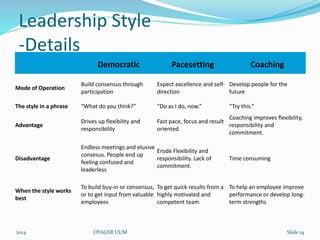
Leadership Style 
-Details 
Democratic Pacesetting Coaching 
Mode of Operation 
Build consensus through 
participation 
Expect excellence and self-direction 
Develop people for the 
future 
The style in a phrase “What do you think?” “Do as I do, now.” “Try this.” 
Advantage 
Drives up flexibility and 
responsibility 
Fast pace, focus and result 
oriented. 
Coaching improves flexibility, 
responsibility and 
commitment. 
Disadvantage 
Endless meetings and elusive 
consesus. People end up 
feeling confused and 
leaderless 
Erode Flexibility and 
responsibility. Lack of 
commitment. 
Time consuming 
When the style works 
best 
To build buy-in or consensus, 
or to get input from valuable 
employees 
To get quick results from a 
highly motivated and 
competent team 
To help an employee improve 
performance or develop long-term 
strengths 
2014 OYAGSB UUM Slide 19
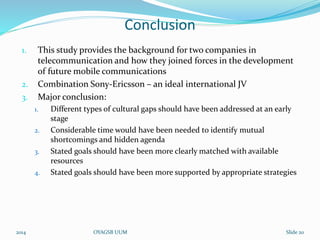
Conclusion 
1. This study provides the background for two companies in 
telecommunication and how they joined forces in the development 
of future mobile communications 
2. Combination Sony-Ericsson – an ideal international JV 
3. Major conclusion: 
1. Different types of cultural gaps should have been addressed at an early 
stage 
2. Considerable time would have been needed to identify mutual 
shortcomings and hidden agenda 
3. Stated goals should have been more clearly matched with available 
resources 
4. Stated goals should have been more supported by appropriate strategies 
2014 OYAGSB UUM Slide 20
Conclusion 
“…to create organizational effectiveness and ensure 
sustainability, business leaders need to focus their 
attention on aligning their people, the systems, the 
structure and roles with the organization’s strategy, 
while engaging their employees with their jobs and 
with the organization.” 
2014 OYAGSB UUM Slide 21

Leadership Style - Case of Sony Ericsson

  • 1.
    Leadership Style and Organizational Effectiveness The Sony-Ericsson Endeavour1 Presented by Hashamuddin bin Yaakob (900278) Presented to Dr Caroline M. Acosta 2014 OYAGSB UUM Slide 1
  • 2.
    Agenda 1. Introduction– What is Leadership? 2. Major Leadership issues/decision made in case 3. Effectiveness Leadership decision at the time 4. Effect Leadership decision in current situation 5. Leadership Lessons 6. Conclusion 2014 OYAGSB UUM Slide 2
  • 3.
    What is Leadership?  “The ability to influence a group toward the achievement of goals”  (Robbins 2003) “Management is doing things right, leadership is doing the right things” (Warren Bennis and Peter Drucker) Robbins, Stephen. Organizational Behavior. 10th ed. Upper Saddle River, NJ: Prentice, Hall, 2003. 2014 OYAGSB UUM Slide 3
  • 4.
    Leadership Theory TheEvolution of Leadership Theory Behavioural Styles Theory Transformational Theory Transactional Theory 1940 1950s 1960s 1970s 1980s 1990s Trait Theory Contingency Theory 2014 OYAGSB UUM Slide 4
  • 5.
    Leadership Issues IssuesSony Ericsson • Joint-venture • Culture • Synergy Creating a successful JV Has been able to considerably broaden its platform for mobile communication Great significance for its future presence in advanced electronics consumer Concentrate on its future in mobile infrastructure 2014 OYAGSB UUM Slide 5
  • 6.
    Sony Background /Structure 1994 Major changes – organizational structure – creation new company 1966 Organizational structure was done 1999 Strategic organizational change was introduced – four main gateways for hardware 2001 Reform of the headquarter section – created global hubs (entertainment, game, financial service, internet/communication service 2003 Major change – Transformation 60 1. Clarifying operational structure and concentrating technology and resources 2. Fundamentally reforming operational profit structure 2014 OYAGSB UUM Slide 6
  • 7.
    Ericson Background /Structure  An engineering company with limited attention to R&D until mechanical switches were replaced by digital  The situation gradually shifted from early 1960s  New strategy in the early 1980s – embedded in the Ericsson Information System (EIS) – launched its concept “office of the future”  1988 : new corporate strategy was formulated – focus on telecommunications  Late 1990s : overstaffing problem which existed in many quarters of the company 2014 OYAGSB UUM Slide 7
  • 8.
    Sony – EricssonPartnership Components Ericsson Sony Staff original numbers in early 2001 3,000 1,500 Market knowledge – telecom operators Of some importance Limited Market knowledge – consumer electronics Limited Very important Handset technology Very valuable Sony did not want to pay 2014 OYAGSB UUM Slide 8
  • 9.
    Sony – Ericsson(JV)  Late 2000s : formal discussion were held between Ericsson & Sony  April 2001 : Sony introduced major organization reform  Soft Alliance with Qualcomm & Siemens  both failed  2001 : serious discussions before start of reorganizing its operations  50/50 JV 2014 OYAGSB UUM Slide 9
  • 10.
    Leadership at thetime  Sony Culture  Emphasizes “a spirit of freedom and open-mindedness”  Fighting spirit to innovate  Sony’s Spirit  Always sough to create innovative products that inspire new lifestyles  Life at Sony  Sony aims to create a workplace that inspires employees to pursue new challenges and grow by realizing their creative and innovative potential 2014 OYAGSB UUM Slide 10
  • 11.
    Leadership decision incurrent situation Sony may adopt the strategic actions as follows:  Maintain The Leader Position in Product Innovation & Quality  Invest in Broadband Network  Invest in Internet-Enabled Products  Reinforce Brand Values & Promote a World Class Brand  Encourage Dreams 2014 OYAGSB UUM Slide 11
  • 12.
    Leadership decision incurrent situation What Are Sony’s Success Factors?  Visionary Leadership  Religious Zealous to Innovation  Pioneer Advantage  Human Capital 2014 OYAGSB UUM Slide 12
  • 13.
    Leadership Lesson 2014OYAGSB UUM Slide 13
  • 14.
    Leadership Theory TransformationalLeader 1. Leaders stimulate and inspire (transform) followers to achieve extraordinary outcomes 2. Characteristics: I. Leadership is proactive II. Works to change the organizational culture by implementing new ideas III. Employees achieve objectives through higher ideals and moral values IV. Motivates followers by encouraging them to put group interests first V. Intellectual stimulation: Promote creative and innovative ideas to solve problems. People will follow a person who inspires them. 2014 OYAGSB UUM Slide 14
  • 15.
    Leadership Theory TransactionalLeader 1. Leaders promote compliance of his followers through both reward or punishment. 2. Characteristics: I. Leadership is reactive II. Works within the organizational culture III. Employees achieve objectives through rewards and punishments set by leader IV. Motivates followers by appealing to their own self interest V. Management-by-exception: maintain the status quo; stress correct actions to improve performance Subordinates are not self-motivating 2014 OYAGSB UUM Slide 15
  • 16.
    Leadership Theory ContingencyTheory 1. According to the contingency approach of leadership, a single leadership style is not applicable to all situations. 2. Contingency models of leadership styles: I. Fiedler’s Contingency Model II. Hersey and Blanchard’s situational theory III. Path Goal Theory IV. Tannenbaum and Schmidt’s leadership continuum a single leadership style is not applicable to all situations 2014 OYAGSB UUM Slide 16
  • 17.
    Leadership Style Researchdone by the consulting firm Hay-McBer Associates (Harvard Business Review, 2000), found six different leadership styles as the following: 1. The coercive style 2. The authoritative style 3. The affiliative style 4. The democratic style 5. The pacesetting style 6. The coaching style 2014 OYAGSB UUM Slide 17
  • 18.
    Leadership Style -Details Coercive Authoritative Affiliative Mode of Operation Demand immediate compliance Mobilize people toward a vision Create emotional bonds and harmony The style in a phrase “Do what I tell you.” “Come with me.” “People come first.” Advantage Efficient and effective Maximizes people's commitment toward organization goal, enhance clarity and flexibility Drives up trust and flexibility, build up sense of recognition and belonging. Disadvantage Erode flexibility, motivation and responsibilty. Failed when a leader is working with a team of experts who are more experienced than him Allow poor performance to go uncorrected, and leaves people rudderless When the style works best In a crisis, to kick start a turnaround, or with problem employees When changes require a new vision, or when a clear direction is needed To heal rifts in a team/ motivate people during stressful circumstances 2014 OYAGSB UUM Slide 18
  • 19.
    Leadership Style -Details Democratic Pacesetting Coaching Mode of Operation Build consensus through participation Expect excellence and self-direction Develop people for the future The style in a phrase “What do you think?” “Do as I do, now.” “Try this.” Advantage Drives up flexibility and responsibility Fast pace, focus and result oriented. Coaching improves flexibility, responsibility and commitment. Disadvantage Endless meetings and elusive consesus. People end up feeling confused and leaderless Erode Flexibility and responsibility. Lack of commitment. Time consuming When the style works best To build buy-in or consensus, or to get input from valuable employees To get quick results from a highly motivated and competent team To help an employee improve performance or develop long-term strengths 2014 OYAGSB UUM Slide 19
  • 20.
    Conclusion 1. Thisstudy provides the background for two companies in telecommunication and how they joined forces in the development of future mobile communications 2. Combination Sony-Ericsson – an ideal international JV 3. Major conclusion: 1. Different types of cultural gaps should have been addressed at an early stage 2. Considerable time would have been needed to identify mutual shortcomings and hidden agenda 3. Stated goals should have been more clearly matched with available resources 4. Stated goals should have been more supported by appropriate strategies 2014 OYAGSB UUM Slide 20
  • 21.
    Conclusion “…to createorganizational effectiveness and ensure sustainability, business leaders need to focus their attention on aligning their people, the systems, the structure and roles with the organization’s strategy, while engaging their employees with their jobs and with the organization.” 2014 OYAGSB UUM Slide 21