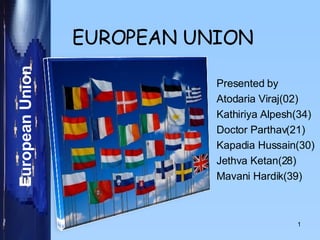
EUROPEAN UNION Presented by Atodaria Viraj(02) Kathiriya Alpesh(34) Doctor Parthav(21) Kapadia Hussain(30) Jethva Ketan(28) Mavani Hardik(39)
In a Nutshell History & Evolution of European Union Objectives of EU Legislation of EU EU Trade Policy Euro Euro Currency Market EU-India Trade Relations EU-Microsoft Antitrust Case Study
European Union   Intergovernmental and supernational union of 27 European countries  Established under that name in 1992 by the  Treaty on European Union  (the Maastricht Treaty) With almost 500 million citizens, the EU generates an  estimated 31% share of the world's nominal GDP (US$16.6 trillion) in 2007.  European Union's activities cover: public policy  health economic policy  foreign affairs  defence
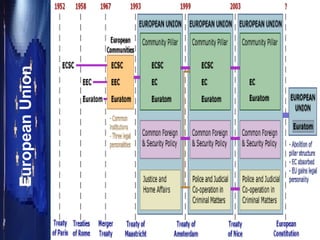
History & Evolution Of  European Union 9 th  May 1950 France proposed a `European Federation’ 1952: The basis of the EU began with the signing of the  Treaty of Paris , establishing the  European Coal and Steel Community  (ECSC), to regulate European industry & improve commerce, post  WWII . The six founding states were Belgium, France, Germany,  Italy, Luxembourg, and The Netherlands. 1957: the  Treaties of Rome  were signed by the six member states, forming: - The European Economic Community (EEC) -The European Atomic Energy Community (Euro atom ) These units worked concurrently with the ECSC.
Contd. 1967: ECSC, EEC, and EuroAtom merged to form the basis of the EC.  1973: the United Kingdom, Denmark and Ireland joined the EC. 1981: Greece joined. 1986: Spain and Portugal  joined. 1995: Finland, Sweden, and Austria joined . 2004: Cyprus, Czech Republic, Estonia, Hungary, Latvia, Lithuania, Malta, Poland, Slovakia, Slovenia
The Present
Goals of the EC To continue to improve Europe’s economy by regulating trade and commerce. To form a single market for Europe's economic resources. As these goals were accomplished, other goals were developed:  Environmental movements Regulatory acts Human rights concerns.
Principal Objectives of the  EU     Establish European Citizenship   Ensure freedom, security, and justice   Promote economic and social progress   Assert Europe’s role in the world
The  EU  is run by five institutions   European Parliament   - elected by the peoples of the Member States    Council of the Union   - composed of the governments of the Member States    European Commission   - driving force and executive body    Court of Justice   - compliance with the law    Court of Auditors  -sound and lawful management of the  EU  budget
European Parliament     Members elected every 5 years  732 members,  750 max.     Three essential functions: Legislate laws along w/ Council Budget authority along w/ Council Supervision of Commission  
Council of the  EU     Composed of the head of each member country (Prime Minster/President, etc) & the President of the  EU  Commission  (27 members)   1 Minister acts as President, rotating twice yearly 2 meetings a year, in President’s country     Main decision making body  of the  EU   Responsibilities Legislation & budgetary policies along with Parliament Economic policies International agreements
European Commission   Embodies and upholds the general interest of the Union.    27 members: 1 President, 2 vice-Presidents & 22 Commissioners Elected every 5 years by the Member States after they have been approved by the European Parliament.     As the  EU ’s executive body, it: Drafts legislation for Parliament & Council; Implements legislation Guardian of treaties, along with Court of Justice Represents  EU  internationally  Manages the 15  EU  agencies
Court of Justice    25 judges  and 8 advocate generals  appointed by member states for 6 year terms.     The Court of Justice ensures that Community law is uniformly interpreted and effectively applied.    It has jurisdiction in disputes involving Member States,  EU  institutions, businesses and individuals
25 members   located in Luxembourg  checks how EU money is spent  help European taxpayers to get better value for the money  European Court of Auditors
Financial Bodies European Central Bank  –  Frames & implements monetary policy Conducts foreign exchange operations Ensures smooth operation of payment system European Investment Bank  –  ‘ owned’ by member states. Raise finance through financial markets,  Invest in projects to promote aims of EU – large scale projects
What does the EU do? Euro - a single currency for Europeans Free to move Keeping the peace An area of freedom, security and justice Fewer frontiers: more jobs! An information society for everybody Caring about our environment
CURRENT  EU  ISSUES  
CURRENT  EU  ISSUES   1  Enlargement : Ten countries joined the  EU  in 2004, making 25 countries total & 2 countries joining later making 27 countries. 2.  Single Market  : free movement of goods, services, labour and capital between member states 3.  The Euro : The Common Currency for the  EU  Countries. 4.  Openness, Access and Transparency: How to get the documents to the people? 5.  Safety & security of Europe :Against terrorism.
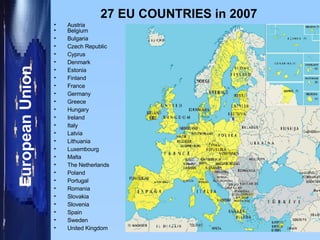
27 EU COUNTRIES in 2007 Austria Belgium Bulgaria Czech Republic Cyprus Denmark Estonia Finland France Germany Greece Hungary Ireland Italy Latvia Lithuania Luxembourg Malta The Netherlands Poland  Portugal Romania Slovakia Slovenia Spain Sweden  United Kingdom
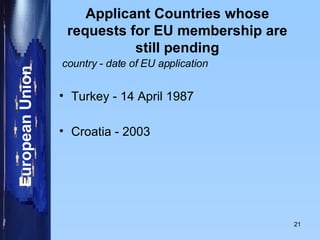
Applicant Countries whose requests for EU membership are still pending country - date of EU application Turkey - 14 April 1987 Croatia - 2003
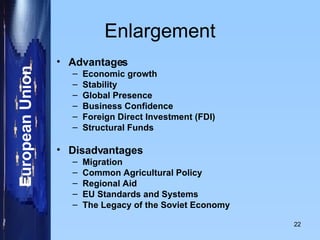
Enlargement Advantages Economic growth   Stability   Global Presence Business Confidence   Foreign Direct Investment (FDI) Structural Funds   Disadvantages Migration   Common Agricultural Policy   Regional Aid   EU Standards and Systems   The Legacy of the Soviet Economy
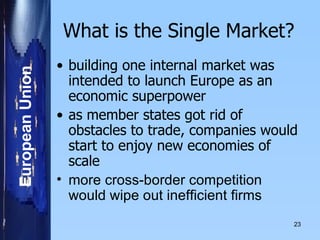
What is the Single Market? building one internal market was intended to launch Europe as an economic superpower  as member states got rid of obstacles to trade, companies would start to enjoy new economies of scale  more cross-border competition would wipe out inefficient firms 
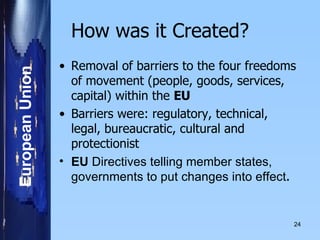
How was it Created? Removal of barriers to the four freedoms of movement (people, goods, services, capital) within the  EU Barriers were: regulatory, technical, legal, bureaucratic, cultural and protectionist EU  Directives telling member states, governments to put changes into effect .
Who Benefits?  Consumers: lower prices, greater choice of goods and services, work within EU Businesses: fair competition, economies of scale, expand to global markets
By How Much?  European Commission estimates the Single Market has produced: 2.5 m new jobs since 1993 800 billion euro extra wealth over 15 m people now go to another  EU  state either to work or retire 
Issues dealt till now Recognition of Professional qualifications and diplomas  Access to education  Residence permits  Voting rights  Social security  Employment rights  Driving licences  Motor vehicle registration  Border controls  Market access for products  Market access for services  Establishment as self-employed  Public procurement  Taxation  Free movement of capital or payments
European Union Trade Policy
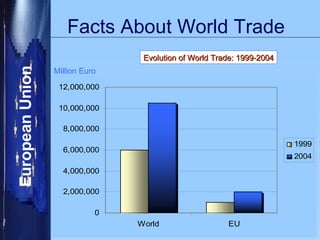
Facts About World Trade Evolution of World Trade: 1999-2004 Million Euro
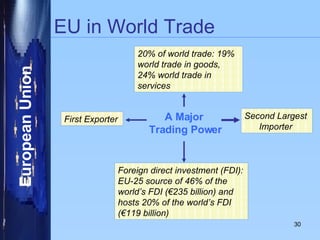
EU in World Trade A Major  Trading Power First Exporter   Second Largest  Importer   20% of world trade: 19% world trade in goods, 24% world trade in services Foreign direct investment (FDI): EU-25 source of 46% of the world’s FDI (€235 billion) and hosts 20% of the world’s FDI (€119 billion)
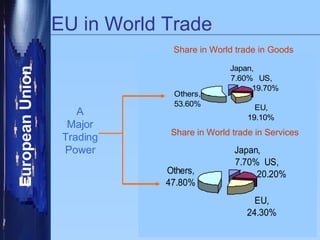
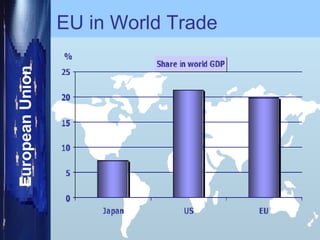
EU in World Trade A Major Trading Power Share in World trade in Goods Share in World trade in Services
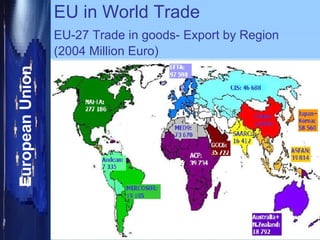
EU in World Trade EU-27 Trade in goods- Export by Region   (2004 Million Euro)
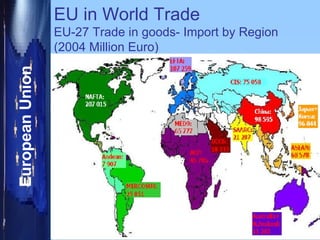
EU in World Trade EU-27 Trade in goods- Import by Region (2004 Million Euro)
EU in World Trade
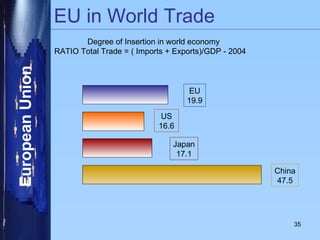
EU in World Trade Degree of Insertion in world economy RATIO Total Trade = ( Imports + Exports)/GDP - 2004  EU 19.9 US 16.6 Japan 17.1 China 47.5
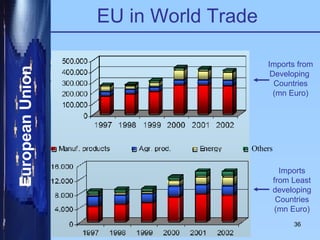
EU in World Trade Imports from Developing  Countries (mn Euro) Others Imports from Least developing  Countries (mn Euro)
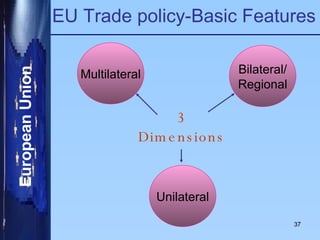
EU Trade policy-Basic Features 3 Dimensions Multilateral Bilateral/ Regional Unilateral
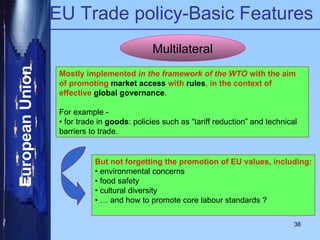
EU Trade policy-Basic Features Multilateral Mostly implemented  in the framework of the WTO  with the aim of promoting  market access  with  rules , in the context of effective  global governance . For example - •  for trade in  goods : policies such as “tariff reduction” and technical barriers to trade. But not forgetting the promotion of EU values, including: •  environmental concerns •  food safety •  cultural diversity • …  and how to promote core labour standards ?
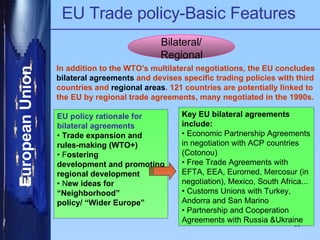
EU Trade policy-Basic Features Bilateral/ Regional In addition to the WTO's multilateral negotiations, the EU concludes  bilateral agreements  and devises specific trading policies with third countries and  regional areas . 121 countries are potentially linked to the EU by regional trade agreements, many negotiated in the 1990s. EU policy rationale for bilateral agreements •  Trade expansion and rules-making (WTO+) •  F ostering development and promoting regional development •  N ew ideas for “ Neighborhood” policy/ “Wider Europe” Key EU bilateral agreements include: •  Economic Partnership Agreements in negotiation with ACP countries (Cotonou) •  Free Trade Agreements with EFTA, EEA, Euromed, Mercosur (in negotiation), Mexico, South Africa... •  Customs Unions with Turkey, Andorra and San Marino •  Partnership and Cooperation Agreements with Russia &Ukraine
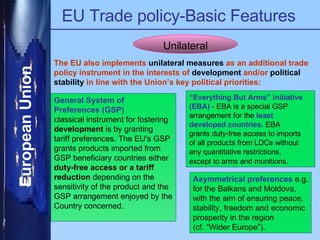
EU Trade policy-Basic Features Unilateral The EU also implements  unilateral measures  as an additional trade policy instrument in the interests of  development  and/or  political stability  in line with the Union’s key political priorities: General System of Preferences (GSP)   classical instrument for fostering development  is by granting tariff preferences. The EU's GSP grants products imported from GSP beneficiary countries either duty-free access or a tariff reduction  depending on the sensitivity of the product and the GSP arrangement enjoyed by the Country concerned. “ Everything But Arms” initiative (EBA)   - EBA is a special GSP arrangement for the  least developed countries . EBA grants duty-free access to imports of all products from LDCs without any quantitative restrictions, except to arms and munitions . Asymmetrical preferences   e.g. for the Balkans and Moldova, with the aim of ensuring peace, stability, freedom and economic prosperity in the region (cf. “Wider Europe”).
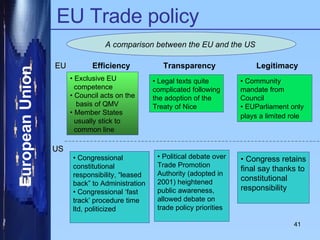
EU Trade policy A comparison between the EU and the US  Efficiency Transparency Legitimacy •  Exclusive EU competence •  Council acts on the basis of QMV •  Member States usually stick to common line •  Legal texts quite complicated following the adoption of the Treaty of Nice •  Community mandate from Council •  EUParliament only plays a limited role   EU •  Congressional constitutional responsibility, “leased back” to Administration •  Congressional ‘fast track’ procedure time ltd, politicized •  Political debate over Trade Promotion Authority (adopted in 2001) heightened public awareness, allowed debate on trade policy priorities •  Congress retains final say thanks to constitutional responsibility US
The impact of the EU decisions All areas of public policy:  market regulation, social policy, environment, agriculture, regional policy, research and development, policing and law and order, citizenship, human rights, international trade, foreign policy, defence, consumer affairs, transport, public health, education and culture EU sets Over 80% of rules governing the production, distribution, exchange of goods, services and capital About 300 of pieces of legislation pass through the EU institutions every year, more than in any other single set of policy institutions in the democratic world
The impact of the EU decisions Primary and secondary acts of the EU are supreme over national law. Most of the acts have direct effects and create rights for individuals. Powerful indirect effect on the distribution of resources between individuals, groups and nations in Europe Several Member states receive around 5% of their gross domestic product from the EU budget
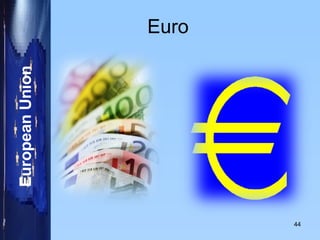
Euro
Introduction of Euro The euro was established by the provisions in the 1992 Maastricht Treaty on European Union The introduction of the euro took place principally on 31 December 1998 Physically launched as Banknotes & Coins on 1 January, 2002.
Introduction of Euro The rates were determined by the Council of the European Union, based on a recommendation from the European Commission based on the market rates on 31 December 1998 one ECU (European Currency Unit) would equal one euro  The European Currency Unit was an accounting unit used by the EU, based on the currencies of the member states; it was not a currency in its own right
Criteria for Participating  to participate in the new currency, member states had to meet strict criteria a budget deficit of less than 3% of their GDP a debt ratio of less than 60% of GDP low inflation and  interest rates close to the EU average.
Euro currency sign:  € banking code:  EUR Official currency of the European Union (EU) Currently consists of 15 states  Austria Belgium Cyprus    France Germany  Greece   Ireland Malta  Luxembourg  Slovenia  Portugal  the Netherlands  Spain Italy   Finland
Cont.. It is the single currency for more than 320 million Europeans the euro directly affects close to 500 million people worldwide more than €610 billion in circulation as of December 2006  (equivalent to US$802 billion at the exchange rates at the time) the currency with the highest combined value of cash in circulation in the world, having surpassed the U.S. dollar
Cont.. It is managed and administered by the Frankfurt-based European Central Bank (ECB) and the Eurosystem Eurosystem participates in the printing, minting and distribution of notes and coins in all member states, and the operation of the Eurozone payment systems
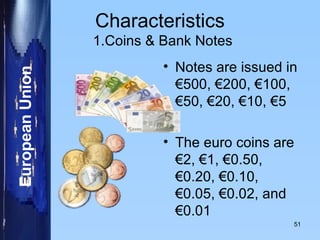
Characteristics  1.Coins & Bank Notes Notes are issued in €500, €200, €100, €50, €20, €10, €5 The euro coins are €2, €1, €0.50, €0.20, €0.10, €0.05, €0.02, and €0.01
2. Payments clearing, electronic funds transfer intra-Eurozone transfers shall cost the same as a domestic one  Credit/debit card charging and ATM withdrawals within the Eurozone are also charged as if they were domestic The ECB has set up a clearing system, TARGET( T rans-European  A utomated  R eal-time  G ross Settlement  E xpress  T ransfer System) for large euro transactions.
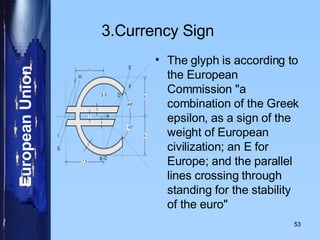
3.Currency Sign  The glyph is according to the European Commission "a combination of the Greek epsilon, as a sign of the weight of European civilization; an E for Europe; and the parallel lines crossing through standing for the stability of the euro"
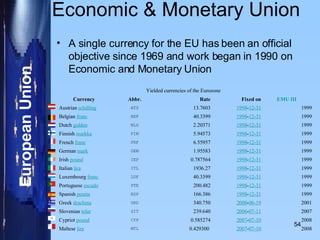
Economic & Monetary Union A single currency for the EU has been an official objective since 1969 and work began in 1990 on Economic and Monetary Union Yielded currencies of the Eurozone    Currency Abbr. Rate Fixed on EMU III Austrian  schilling ATS 13.7603 1998 - 12-31 1999 Belgian  franc BEF 40.3399 1998 - 12-31 1999 Dutch  gulden NLG 2.20371 1998 - 12-31 1999 Finnish  markka FIM 5.94573 1998 - 12-31 1999 French  franc FRF 6.55957 1998 - 12-31 1999 German  mark DEM 1.95583 1998 - 12-31 1999 Irish  pound IEP 0.787564 1998 - 12-31 1999 Italian  lira ITL 1936.27 1998 - 12-31 1999 Luxembourg  franc LUF 40.3399 1998 - 12-31 1999 Portuguese  escudo PTE 200.482 1998 - 12-31 1999 Spanish  peseta ESP 166.386 1998 - 12-31 1999 Greek  drachma GRD 340.750 2000 - 06-19 2001 Slovenian  tolar SIT 239.640 2006 - 07-11 2007 Cypriot  pound CYP 0.585274 2007 - 07-10 2008 Maltese  lira MTL 0.429300  2007 - 07-10 2008
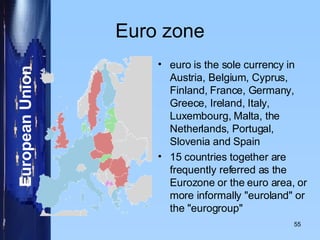
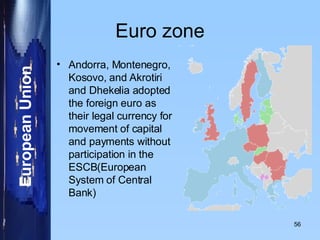
Euro zone euro is the sole currency in Austria, Belgium, Cyprus, Finland, France, Germany, Greece, Ireland, Italy, Luxembourg, Malta, the Netherlands, Portugal, Slovenia and Spain 15 countries together are frequently referred as the Eurozone or the euro area, or more informally "euroland" or the "eurogroup"
Euro zone Andorra, Montenegro, Kosovo, and Akrotiri and Dhekelia adopted the foreign euro as their legal currency for movement of capital and payments without participation in the ESCB(European System of Central Bank)
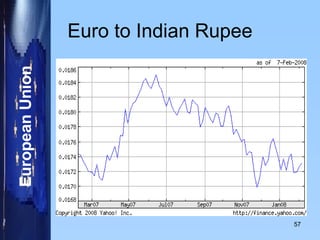
Euro to Indian Rupee
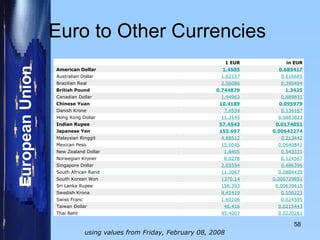
Euro to Other Currencies  using values from Friday, February 08, 2008   1 EUR    in EUR     American Dollar     1.4505     0.689417      Australian Dollar     1.62157     0.616685      Brazilian Real     2.56086     0.390494      British Pound     0.744879     1.3425      Canadian Dollar     1.44963     0.689831      Chinese Yuan     10.4189     0.095979      Danish Krone     7.4534     0.134167      Hong Kong Dollar     11.3145     0.0883823      Indian Rupee     57.4543     0.0174051      Japanese Yen     155.697     0.00642274      Malaysian Ringgit     4.68512     0.213442      Mexican Peso     15.6045     0.0640841      New Zealand Dollar     1.8405     0.543331      Norwegian Kroner     8.0278     0.124567      Singapore Dollar     2.05594     0.486396      South African Rand     11.3067     0.0884435      South Korean Won     1370.14     0.000729851      Sri Lanka Rupee     156.393     0.00639415      Swedish Krona     9.41419     0.106223      Swiss Franc     1.60106     0.624585      Taiwan Dollar     46.416     0.0215443      Thai Baht     45.4007     0.0220261  
Euro-Currency Markets Introduction Euro-currency Markets are also called Euro-dollar market. Euro- currency market is a market principally located in Europe for lending and borrowing the world’s most important  convertible currencies , namely dollar, sterling, DM, French franc, yen, etc.
Euro-Currency Markets Introduction Currency Market & Exchange Market: The international currency markets are a subordinate of the foreign exchange markets. In FEM currencies are exchanged one for the other & in the currency markets the currencies are borrowed and lent for varying maturities.
Euro-Currency Markets Origins of the Euro-Currency Markets: US & European banks took deposits outside US, after 2 nd  world war. US dollars were used widely. The momentum gathered & so these banks were encouraged to depend on dollars. No restrictions on these banks were laid as that on domestic banks. Lower costs as per domestic banks.
Euro-Currency Markets Impact on Exchange Markets: Impact of Euro-currency markets on the foreign exchange markets is  multi -dimensional . Not only the demand and supply of various currencies are influenced through pressures from the Euro-currency markets but the exchange rates are altered by speculation in currencies.
Euro-Currency Markets Segments of the Market: Two segments: Inter-Bank Non-Bank Public Purpose of banks’ involvement in the ECM is to satisfy the genuine demand for currency in the commercial operations of the borrowers which is the market for non-bank public.
Euro-Currency Markets Sources: The main sources of funds for the market came from varied groups-individuals, corporations, commercial banks, international institutions, multinationals, the central banks, the governments.
Euro-Currency Markets Uses: Balance of payments requirements of governments. Monetary authorities for commercial short or long-term investments in the private sector.
Euro-Currency Markets Importance of the Market: Financing deficits in BOP. Investments & working capital requirements. Channel for profitable investment for excess funds of governments, central banks and business corporations. Lightening the pressures on the  international monetary system Dealers in the market: Lawyers and Auditors:
Euro-Currency Markets Euro-bond market: This is an international market for borrowing capital by any country’s government, corporate and institutions.  Instruments Issued and Traded (1)  Fixed Rate Bonds : (2)  Convertibles : (3)  Swaps :
Euro-Currency Markets Magnitude of Trade: The magnitude of trade in this market runs into trillions of dollars, particularly in the inter bank deal. In 1987 the amount of Euro-bonds was $150  billion , while the same in 1964 was $500 million.
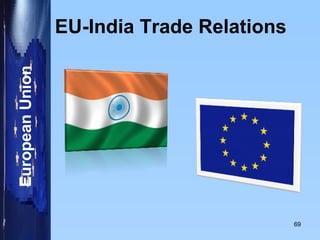
EU-India Trade Relations
Origins EU-India relations go back to the early 1960s: India was amongst the first countries to set up diplomatic relations with EEC Bilateral agreements signed in 1973, 1981, The  1994 co-operation agreement (signed 20 Dec 1993) is a wide-ranging 3rd generation agreement, well beyond trade and economic co-operation.
EU-India Relations- Milestones   1963 India establishes diplomatic relations with EEC 1973 Commercial cooperation agreement 1983 EC sets up a Delegation in New Delhi 1988 EC-India, first Joint Commission meeting 1993 Joint Political Statement 1994 Cooperation agreement on partnership and  development 1996 Enhanced EU-India partnership 2000 First Summit, in Lisbon 2004 5th Summit in Hague: launch of Strategic  Partnership 2005 6th Summit in New Delhi: Joint Action Plan 2006 7 th  Summit in Helsinki
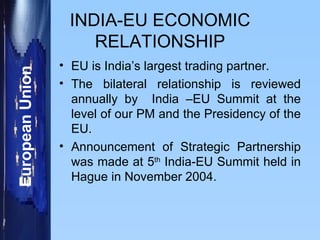
INDIA-EU ECONOMIC RELATIONSHIP EU is India’s largest trading partner. The bilateral relationship is reviewed annually by  India –EU Summit at the level of our PM and the Presidency of the EU. Announcement of Strategic Partnership was made at 5 th  India-EU Summit held in Hague in November 2004.
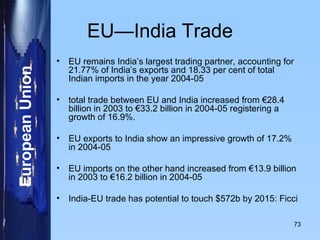
EU—India Trade EU remains India’s largest trading partner, accounting for 21.77% of India’s exports and 18.33 per cent of total Indian imports in the year 2004-05  total trade between EU and India increased from €28.4 billion in 2003 to €33.2 billion in 2004-05 registering a growth of 16.9%.  EU exports to India show an impressive growth of 17.2% in 2004-05 EU imports on the other hand increased from €13.9 billion in 2003 to €16.2 billion in 2004-05 India-EU trade has potential to touch $572b by 2015: Ficci
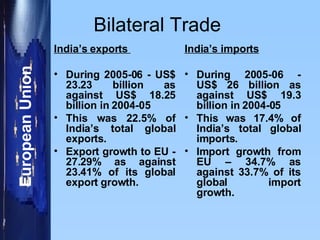
Bilateral Trade  India’s exports  During 2005-06 - US$ 23.23 billion as against US$ 18.25 billion in 2004-05  This was 22.5% of India’s total global exports. Export growth to EU - 27.29% as against 23.41% of its global export growth. India’s imports   During 2005-06 - US$ 26 billion as against US$ 19.3 billion in 2004-05  This was 17.4% of India’s total global imports. Import growth from EU – 34.7% as against 33.7% of its global import growth.
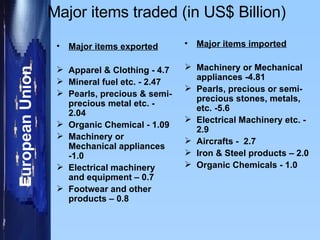
Major items traded (in US$ Billion) Major items exported   Apparel & Clothing - 4.7 Mineral fuel etc. - 2.47 Pearls, precious & semi- precious metal etc. - 2.04 Organic Chemical - 1.09 Machinery or Mechanical appliances -1.0 Electrical machinery and equipment – 0.7 Footwear and other products – 0.8 Major items imported Machinery or Mechanical appliances -4.81 Pearls, precious or semi-precious stones, metals, etc. -5.6 Electrical Machinery etc. - 2.9 Aircrafts -  2.7 Iron & Steel products – 2.0 Organic Chemicals - 1.0
What happened after October 2006 The decision at the Summit was considered by the Council of the EU and the European Commission was authorized to enter into negotiations with India in April 2007. The First Round of negotiations took place in June 2007 in Brussels, Belgium. The delegation was led by Commerce Secretary, Government of India. Broader objectives for negotiations were agreed. Working Groups established for negotiating various issues.
Present Status Trade in Goods : Text of Agreement exchanged. India to identify: Items that are sensitive - No tariff liberalization to be offered. (approximately 520 items covering an import value of not more than US$2.6 billion). Items of export interest which we need to ask EU not to be kept in their Exclusion List. Non-Tariff Measures which are increasing our exports to EU.
Key areas of co-operation are : Political relations Trade and investment Economic and Development Co-operation Cultural exchanges
  Development Cooperation EU working with India to tackle poverty. Integrating three pillars of sustainable development:  social, economic and environmental development. India is now a receiver  and provider  of development aid  The Indian context:  human development indicators show good progress but poverty still widespread. Unemployment is high. Vast income disparities between and within states  New approaches:  2002-2006 Country Strategy Paper for India forecasts  €  225 million in grants for India, focusing on Rajasthan and Chhattisgarh. Sectoral reform support in elementary education and health.  EU Cooperation in India:  India has number of donors to 6 i.e (US, Russia, Japan, UK, Germany, EC).  Better coordination needed among donors. An EU-India Strategic Partnership
EC Development and Economic Cooperation in India: The total of European Commission’s assistance to India, all in the form of grants, is reaching the landmark of  Euro 2 billion , over  Rs 8000 crores .  The EC is the  largest donor  of grant funds to India.
The Development Cooperation Strategy: EU-India cooperation agreement focuses on:  Poverty reduction projects These promote an efficient and sustainable use of resources and sector programmes aimed at improving basic social services Public Health and Primary Education These are the largest sector programme at the moment
1.Primary Education   2.Sarva Shiksha Abhiyan Programme   3. Health :   Support to Health and  Family Welfare Sector Development  4. Development
State Partnership Programme A multi sector policy support Programme aims at  Poverty Alleviation  in Chhattisgarh and Rajasthan  Targeted Sectors Chhattisgarh- Education, Health and Forest  Rajasthan –Water Sector Budget Support Programme Grant of € 160 Million total, € 80 M to each State  Scheduled to be launched in 2006  Implementation Period – 6-7 Years
State Partnership Programme Both partnerships focus on policy and reforms with high Poverty Alleviation effects Chhattisgarh and Rajasthan chosen as states with poor Human Development indicators, but ‘Reform Minded’ Additionality of resources to Centre and State Complementary to reforms through centrally sponsored schemes Institutional reforms to promote Accountability Decentralization and community Participation
Non Governmental Organizations  Essential partners in the development process With more than 300 NGO projects in several fields,  India is the largest recipient of the EC’s NGO funds   in Asia.  The current portfolio consists of more than 130  NGO Co-financing projects  accounting for about 125 million euros (Rs 500 crores)  The current allocation is 40 million euros (Rs 160  crores).
Emergency Aid/Humanitarian Aid Since 1998 the EC has increased its humanitarian operations in India contributing 300 million Euros (Rs 130 crores).  Emergency and humanitarian aid managed by the EC Humanitarian Office (ECHO) provides emergency aid of humanitarian/relief nature, financing assistance, protection and emergency food aid after disasters.  ECHO also provides assistance for pre-emptive  action for disaster prevention.
Economic cooperation The EC has horizontal programmes and bilateral programmes for its economic cooperation.  Horizontal programmes aim at establishing new links and reinforcing existing ones between EU and India. They also promote European environment practices and facilitate business cooperation between EU and Asia in general.  Bilateral programmes include in addition to the scientific cooperation, the cooperation between EU and India on product standards, maritime transport and civil aviation.
Future prospective India’s trade with the European Union has the potential to reach a whopping $572 billion by 2015 once the FTA with the 27-nation bloc is implemented, Ficci says.  The India-EU FTA is likely to be fully implemented by 2015 by when India’s trade in goods with the bloc could be around $251 billion and trade in services $321 billion, according to a study by the chamber on ‘India-EU Trade & Investment: Current Status and Issues’. Going by the study, India-EU trade would account for more than 25% of the country’s GDP which may grow up to over two trillion dollars if 10% economic growth is achieved and maintained. At present, bilateral trade accounts for less than 10% of India’s GDP.  According to the study, in 2008 India’s merchandise trade with EU would be about $79 billion and in services it would be $32 billion.
However, the study said trade deficit in goods between India and EU has grown six-fold to $3 billion in 2006-07 from $492 million in 2001-02.  The chamber further said a number of issues need to be resolved under the FTA negotiations to increase the share of India’s exports of goods and services to the EU market, which is currently only around 3%.  EU-India trade has grown impressively over the years, from €4.4 billion in 1980 to over €46 billion in 2006. Trade with the EU represents almost 20% of India's exports and imports and the EU thus as a bloc is India's largest trading partner. The EU is also India's largest source of foreign direct investment. However, India accounts for just 1.8% of total EU trade. India attracts only 1.3% of the EU's world-wide investments.
Summary of Case Study. Microsoft & European Union We think that the facts will show that there is strong competition and consumer choice. The impact of this case goes far beyond Microsoft. The ability to innovate is important for the success of any company and for the economic success of any country."   Brad Smith, Microsoft's General Counsel, in April 2006. "The commission is not asking Microsoft to be nice to its competitors. It is asking it to compete on the merits."  - Per Hellstrom, European Commission's Lawyer, in April 2006.
The Case….. Introduction EC Issues 'Statement of Objections’ The Investigations EC Slaps Fine Appeal to Higher Court Microsoft Complies  But…
Problems with the Case:- 1) Information not provided by Microsoft. 2) Non – Compliance with the Law. 3) Issue with the Windows Media Player. 4) Abusing Market Leader status.
Real Solution:-  Removing the media player led to the loss of several functions in the trimmed O/S and deprived customers of the ability to play music provided by Yahoo! and Napster. The hearing on antitrust case ended on April 28, 2006
Bibliography International Business Environment - Francis Cherunilam - Himalaya Publishing House International Finance - V.A. Avadhani - Himalaya Publishing House
Wibliography http://en.wikipedia.org/wiki/European_Exchange_Rate_Mechanism http://en.wikipedia.org/wiki/Introduction_of_the_euro http://www.caxtonfx.com/converter/converterpro.html http://en.wikipedia.org/wiki/Euro http://en.wikipedia.org/wiki/European_union http://www.icmrindia.org/casestudies/catalogue/Business%20Environment/BENV005.htm(Link for Case study) http://en.wikipedia.org/wiki/Maastricht_Treaty http://en.wikipedia.org/wiki/European_Currency_Unit http://finance.yahoo.com http://answers.com/eu
Thank You Questions & Suggestions are Welcome

European Union

  • 1.
    EUROPEAN UNION Presentedby Atodaria Viraj(02) Kathiriya Alpesh(34) Doctor Parthav(21) Kapadia Hussain(30) Jethva Ketan(28) Mavani Hardik(39)
  • 2.
    In a NutshellHistory & Evolution of European Union Objectives of EU Legislation of EU EU Trade Policy Euro Euro Currency Market EU-India Trade Relations EU-Microsoft Antitrust Case Study
  • 3.
    European Union Intergovernmental and supernational union of 27 European countries Established under that name in 1992 by the Treaty on European Union (the Maastricht Treaty) With almost 500 million citizens, the EU generates an estimated 31% share of the world's nominal GDP (US$16.6 trillion) in 2007. European Union's activities cover: public policy health economic policy foreign affairs defence
  • 4.
    History & EvolutionOf European Union 9 th May 1950 France proposed a `European Federation’ 1952: The basis of the EU began with the signing of the Treaty of Paris , establishing the European Coal and Steel Community (ECSC), to regulate European industry & improve commerce, post WWII . The six founding states were Belgium, France, Germany, Italy, Luxembourg, and The Netherlands. 1957: the Treaties of Rome were signed by the six member states, forming: - The European Economic Community (EEC) -The European Atomic Energy Community (Euro atom ) These units worked concurrently with the ECSC.
  • 5.
    Contd. 1967: ECSC,EEC, and EuroAtom merged to form the basis of the EC. 1973: the United Kingdom, Denmark and Ireland joined the EC. 1981: Greece joined. 1986: Spain and Portugal joined. 1995: Finland, Sweden, and Austria joined . 2004: Cyprus, Czech Republic, Estonia, Hungary, Latvia, Lithuania, Malta, Poland, Slovakia, Slovenia
  • 7.
  • 8.
    Goals of theEC To continue to improve Europe’s economy by regulating trade and commerce. To form a single market for Europe's economic resources. As these goals were accomplished, other goals were developed: Environmental movements Regulatory acts Human rights concerns.
  • 9.
    Principal Objectives ofthe EU   Establish European Citizenship   Ensure freedom, security, and justice   Promote economic and social progress   Assert Europe’s role in the world
  • 10.
    The EU is run by five institutions European Parliament - elected by the peoples of the Member States   Council of the Union - composed of the governments of the Member States   European Commission - driving force and executive body   Court of Justice - compliance with the law   Court of Auditors -sound and lawful management of the EU budget
  • 11.
    European Parliament   Members elected every 5 years 732 members, 750 max.   Three essential functions: Legislate laws along w/ Council Budget authority along w/ Council Supervision of Commission  
  • 12.
    Council of the EU   Composed of the head of each member country (Prime Minster/President, etc) & the President of the EU Commission (27 members) 1 Minister acts as President, rotating twice yearly 2 meetings a year, in President’s country    Main decision making body  of the EU   Responsibilities Legislation & budgetary policies along with Parliament Economic policies International agreements
  • 13.
    European Commission  Embodies and upholds the general interest of the Union.   27 members: 1 President, 2 vice-Presidents & 22 Commissioners Elected every 5 years by the Member States after they have been approved by the European Parliament.   As the EU ’s executive body, it: Drafts legislation for Parliament & Council; Implements legislation Guardian of treaties, along with Court of Justice Represents EU internationally Manages the 15 EU agencies
  • 14.
    Court of Justice   25 judges and 8 advocate generals appointed by member states for 6 year terms.    The Court of Justice ensures that Community law is uniformly interpreted and effectively applied.   It has jurisdiction in disputes involving Member States, EU institutions, businesses and individuals
  • 15.
    25 members located in Luxembourg checks how EU money is spent help European taxpayers to get better value for the money European Court of Auditors
  • 16.
    Financial Bodies EuropeanCentral Bank – Frames & implements monetary policy Conducts foreign exchange operations Ensures smooth operation of payment system European Investment Bank – ‘ owned’ by member states. Raise finance through financial markets, Invest in projects to promote aims of EU – large scale projects
  • 17.
    What does theEU do? Euro - a single currency for Europeans Free to move Keeping the peace An area of freedom, security and justice Fewer frontiers: more jobs! An information society for everybody Caring about our environment
  • 18.
    CURRENT EU ISSUES  
  • 19.
    CURRENT EU ISSUES   1 Enlargement : Ten countries joined the EU in 2004, making 25 countries total & 2 countries joining later making 27 countries. 2. Single Market : free movement of goods, services, labour and capital between member states 3. The Euro : The Common Currency for the EU Countries. 4. Openness, Access and Transparency: How to get the documents to the people? 5. Safety & security of Europe :Against terrorism.
  • 20.
    27 EU COUNTRIESin 2007 Austria Belgium Bulgaria Czech Republic Cyprus Denmark Estonia Finland France Germany Greece Hungary Ireland Italy Latvia Lithuania Luxembourg Malta The Netherlands Poland Portugal Romania Slovakia Slovenia Spain Sweden United Kingdom
  • 21.
    Applicant Countries whoserequests for EU membership are still pending country - date of EU application Turkey - 14 April 1987 Croatia - 2003
  • 22.
    Enlargement Advantages Economicgrowth Stability Global Presence Business Confidence Foreign Direct Investment (FDI) Structural Funds Disadvantages Migration Common Agricultural Policy Regional Aid EU Standards and Systems The Legacy of the Soviet Economy
  • 23.
    What is theSingle Market? building one internal market was intended to launch Europe as an economic superpower as member states got rid of obstacles to trade, companies would start to enjoy new economies of scale more cross-border competition would wipe out inefficient firms 
  • 24.
    How was itCreated? Removal of barriers to the four freedoms of movement (people, goods, services, capital) within the EU Barriers were: regulatory, technical, legal, bureaucratic, cultural and protectionist EU Directives telling member states, governments to put changes into effect .
  • 25.
    Who Benefits?  Consumers:lower prices, greater choice of goods and services, work within EU Businesses: fair competition, economies of scale, expand to global markets
  • 26.
    By How Much? European Commission estimates the Single Market has produced: 2.5 m new jobs since 1993 800 billion euro extra wealth over 15 m people now go to another EU state either to work or retire 
  • 27.
    Issues dealt tillnow Recognition of Professional qualifications and diplomas Access to education Residence permits Voting rights Social security Employment rights Driving licences Motor vehicle registration Border controls Market access for products Market access for services Establishment as self-employed Public procurement Taxation Free movement of capital or payments
  • 28.
  • 29.
    Facts About WorldTrade Evolution of World Trade: 1999-2004 Million Euro
  • 30.
    EU in WorldTrade A Major Trading Power First Exporter Second Largest Importer 20% of world trade: 19% world trade in goods, 24% world trade in services Foreign direct investment (FDI): EU-25 source of 46% of the world’s FDI (€235 billion) and hosts 20% of the world’s FDI (€119 billion)
  • 31.
    EU in WorldTrade A Major Trading Power Share in World trade in Goods Share in World trade in Services
  • 32.
    EU in WorldTrade EU-27 Trade in goods- Export by Region (2004 Million Euro)
  • 33.
    EU in WorldTrade EU-27 Trade in goods- Import by Region (2004 Million Euro)
  • 34.
  • 35.
    EU in WorldTrade Degree of Insertion in world economy RATIO Total Trade = ( Imports + Exports)/GDP - 2004 EU 19.9 US 16.6 Japan 17.1 China 47.5
  • 36.
    EU in WorldTrade Imports from Developing Countries (mn Euro) Others Imports from Least developing Countries (mn Euro)
  • 37.
    EU Trade policy-BasicFeatures 3 Dimensions Multilateral Bilateral/ Regional Unilateral
  • 38.
    EU Trade policy-BasicFeatures Multilateral Mostly implemented in the framework of the WTO with the aim of promoting market access with rules , in the context of effective global governance . For example - • for trade in goods : policies such as “tariff reduction” and technical barriers to trade. But not forgetting the promotion of EU values, including: • environmental concerns • food safety • cultural diversity • … and how to promote core labour standards ?
  • 39.
    EU Trade policy-BasicFeatures Bilateral/ Regional In addition to the WTO's multilateral negotiations, the EU concludes bilateral agreements and devises specific trading policies with third countries and regional areas . 121 countries are potentially linked to the EU by regional trade agreements, many negotiated in the 1990s. EU policy rationale for bilateral agreements • Trade expansion and rules-making (WTO+) • F ostering development and promoting regional development • N ew ideas for “ Neighborhood” policy/ “Wider Europe” Key EU bilateral agreements include: • Economic Partnership Agreements in negotiation with ACP countries (Cotonou) • Free Trade Agreements with EFTA, EEA, Euromed, Mercosur (in negotiation), Mexico, South Africa... • Customs Unions with Turkey, Andorra and San Marino • Partnership and Cooperation Agreements with Russia &Ukraine
  • 40.
    EU Trade policy-BasicFeatures Unilateral The EU also implements unilateral measures as an additional trade policy instrument in the interests of development and/or political stability in line with the Union’s key political priorities: General System of Preferences (GSP) classical instrument for fostering development is by granting tariff preferences. The EU's GSP grants products imported from GSP beneficiary countries either duty-free access or a tariff reduction depending on the sensitivity of the product and the GSP arrangement enjoyed by the Country concerned. “ Everything But Arms” initiative (EBA) - EBA is a special GSP arrangement for the least developed countries . EBA grants duty-free access to imports of all products from LDCs without any quantitative restrictions, except to arms and munitions . Asymmetrical preferences e.g. for the Balkans and Moldova, with the aim of ensuring peace, stability, freedom and economic prosperity in the region (cf. “Wider Europe”).
  • 41.
    EU Trade policyA comparison between the EU and the US Efficiency Transparency Legitimacy • Exclusive EU competence • Council acts on the basis of QMV • Member States usually stick to common line • Legal texts quite complicated following the adoption of the Treaty of Nice • Community mandate from Council • EUParliament only plays a limited role EU • Congressional constitutional responsibility, “leased back” to Administration • Congressional ‘fast track’ procedure time ltd, politicized • Political debate over Trade Promotion Authority (adopted in 2001) heightened public awareness, allowed debate on trade policy priorities • Congress retains final say thanks to constitutional responsibility US
  • 42.
    The impact ofthe EU decisions All areas of public policy: market regulation, social policy, environment, agriculture, regional policy, research and development, policing and law and order, citizenship, human rights, international trade, foreign policy, defence, consumer affairs, transport, public health, education and culture EU sets Over 80% of rules governing the production, distribution, exchange of goods, services and capital About 300 of pieces of legislation pass through the EU institutions every year, more than in any other single set of policy institutions in the democratic world
  • 43.
    The impact ofthe EU decisions Primary and secondary acts of the EU are supreme over national law. Most of the acts have direct effects and create rights for individuals. Powerful indirect effect on the distribution of resources between individuals, groups and nations in Europe Several Member states receive around 5% of their gross domestic product from the EU budget
  • 44.
  • 45.
    Introduction of EuroThe euro was established by the provisions in the 1992 Maastricht Treaty on European Union The introduction of the euro took place principally on 31 December 1998 Physically launched as Banknotes & Coins on 1 January, 2002.
  • 46.
    Introduction of EuroThe rates were determined by the Council of the European Union, based on a recommendation from the European Commission based on the market rates on 31 December 1998 one ECU (European Currency Unit) would equal one euro The European Currency Unit was an accounting unit used by the EU, based on the currencies of the member states; it was not a currency in its own right
  • 47.
    Criteria for Participating to participate in the new currency, member states had to meet strict criteria a budget deficit of less than 3% of their GDP a debt ratio of less than 60% of GDP low inflation and interest rates close to the EU average.
  • 48.
    Euro currency sign: € banking code: EUR Official currency of the European Union (EU) Currently consists of 15 states Austria Belgium Cyprus France Germany Greece Ireland Malta Luxembourg Slovenia Portugal the Netherlands Spain Italy Finland
  • 49.
    Cont.. It isthe single currency for more than 320 million Europeans the euro directly affects close to 500 million people worldwide more than €610 billion in circulation as of December 2006 (equivalent to US$802 billion at the exchange rates at the time) the currency with the highest combined value of cash in circulation in the world, having surpassed the U.S. dollar
  • 50.
    Cont.. It ismanaged and administered by the Frankfurt-based European Central Bank (ECB) and the Eurosystem Eurosystem participates in the printing, minting and distribution of notes and coins in all member states, and the operation of the Eurozone payment systems
  • 51.
    Characteristics 1.Coins& Bank Notes Notes are issued in €500, €200, €100, €50, €20, €10, €5 The euro coins are €2, €1, €0.50, €0.20, €0.10, €0.05, €0.02, and €0.01
  • 52.
    2. Payments clearing,electronic funds transfer intra-Eurozone transfers shall cost the same as a domestic one Credit/debit card charging and ATM withdrawals within the Eurozone are also charged as if they were domestic The ECB has set up a clearing system, TARGET( T rans-European A utomated R eal-time G ross Settlement E xpress T ransfer System) for large euro transactions.
  • 53.
    3.Currency Sign The glyph is according to the European Commission "a combination of the Greek epsilon, as a sign of the weight of European civilization; an E for Europe; and the parallel lines crossing through standing for the stability of the euro"
  • 54.
    Economic & MonetaryUnion A single currency for the EU has been an official objective since 1969 and work began in 1990 on Economic and Monetary Union Yielded currencies of the Eurozone    Currency Abbr. Rate Fixed on EMU III Austrian schilling ATS 13.7603 1998 - 12-31 1999 Belgian franc BEF 40.3399 1998 - 12-31 1999 Dutch gulden NLG 2.20371 1998 - 12-31 1999 Finnish markka FIM 5.94573 1998 - 12-31 1999 French franc FRF 6.55957 1998 - 12-31 1999 German mark DEM 1.95583 1998 - 12-31 1999 Irish pound IEP 0.787564 1998 - 12-31 1999 Italian lira ITL 1936.27 1998 - 12-31 1999 Luxembourg franc LUF 40.3399 1998 - 12-31 1999 Portuguese escudo PTE 200.482 1998 - 12-31 1999 Spanish peseta ESP 166.386 1998 - 12-31 1999 Greek drachma GRD 340.750 2000 - 06-19 2001 Slovenian tolar SIT 239.640 2006 - 07-11 2007 Cypriot pound CYP 0.585274 2007 - 07-10 2008 Maltese lira MTL 0.429300 2007 - 07-10 2008
  • 55.
    Euro zone eurois the sole currency in Austria, Belgium, Cyprus, Finland, France, Germany, Greece, Ireland, Italy, Luxembourg, Malta, the Netherlands, Portugal, Slovenia and Spain 15 countries together are frequently referred as the Eurozone or the euro area, or more informally "euroland" or the "eurogroup"
  • 56.
    Euro zone Andorra,Montenegro, Kosovo, and Akrotiri and Dhekelia adopted the foreign euro as their legal currency for movement of capital and payments without participation in the ESCB(European System of Central Bank)
  • 57.
  • 58.
    Euro to OtherCurrencies using values from Friday, February 08, 2008   1 EUR    in EUR     American Dollar     1.4505     0.689417      Australian Dollar     1.62157     0.616685      Brazilian Real     2.56086     0.390494      British Pound     0.744879     1.3425      Canadian Dollar     1.44963     0.689831      Chinese Yuan     10.4189     0.095979      Danish Krone     7.4534     0.134167      Hong Kong Dollar     11.3145     0.0883823      Indian Rupee     57.4543     0.0174051      Japanese Yen     155.697     0.00642274      Malaysian Ringgit     4.68512     0.213442      Mexican Peso     15.6045     0.0640841      New Zealand Dollar     1.8405     0.543331      Norwegian Kroner     8.0278     0.124567      Singapore Dollar     2.05594     0.486396      South African Rand     11.3067     0.0884435      South Korean Won     1370.14     0.000729851      Sri Lanka Rupee     156.393     0.00639415      Swedish Krona     9.41419     0.106223      Swiss Franc     1.60106     0.624585      Taiwan Dollar     46.416     0.0215443      Thai Baht     45.4007     0.0220261  
  • 59.
    Euro-Currency Markets IntroductionEuro-currency Markets are also called Euro-dollar market. Euro- currency market is a market principally located in Europe for lending and borrowing the world’s most important convertible currencies , namely dollar, sterling, DM, French franc, yen, etc.
  • 60.
    Euro-Currency Markets IntroductionCurrency Market & Exchange Market: The international currency markets are a subordinate of the foreign exchange markets. In FEM currencies are exchanged one for the other & in the currency markets the currencies are borrowed and lent for varying maturities.
  • 61.
    Euro-Currency Markets Originsof the Euro-Currency Markets: US & European banks took deposits outside US, after 2 nd world war. US dollars were used widely. The momentum gathered & so these banks were encouraged to depend on dollars. No restrictions on these banks were laid as that on domestic banks. Lower costs as per domestic banks.
  • 62.
    Euro-Currency Markets Impacton Exchange Markets: Impact of Euro-currency markets on the foreign exchange markets is multi -dimensional . Not only the demand and supply of various currencies are influenced through pressures from the Euro-currency markets but the exchange rates are altered by speculation in currencies.
  • 63.
    Euro-Currency Markets Segmentsof the Market: Two segments: Inter-Bank Non-Bank Public Purpose of banks’ involvement in the ECM is to satisfy the genuine demand for currency in the commercial operations of the borrowers which is the market for non-bank public.
  • 64.
    Euro-Currency Markets Sources:The main sources of funds for the market came from varied groups-individuals, corporations, commercial banks, international institutions, multinationals, the central banks, the governments.
  • 65.
    Euro-Currency Markets Uses:Balance of payments requirements of governments. Monetary authorities for commercial short or long-term investments in the private sector.
  • 66.
    Euro-Currency Markets Importanceof the Market: Financing deficits in BOP. Investments & working capital requirements. Channel for profitable investment for excess funds of governments, central banks and business corporations. Lightening the pressures on the international monetary system Dealers in the market: Lawyers and Auditors:
  • 67.
    Euro-Currency Markets Euro-bondmarket: This is an international market for borrowing capital by any country’s government, corporate and institutions. Instruments Issued and Traded (1) Fixed Rate Bonds : (2) Convertibles : (3) Swaps :
  • 68.
    Euro-Currency Markets Magnitudeof Trade: The magnitude of trade in this market runs into trillions of dollars, particularly in the inter bank deal. In 1987 the amount of Euro-bonds was $150 billion , while the same in 1964 was $500 million.
  • 69.
  • 70.
    Origins EU-India relationsgo back to the early 1960s: India was amongst the first countries to set up diplomatic relations with EEC Bilateral agreements signed in 1973, 1981, The 1994 co-operation agreement (signed 20 Dec 1993) is a wide-ranging 3rd generation agreement, well beyond trade and economic co-operation.
  • 71.
    EU-India Relations- Milestones 1963 India establishes diplomatic relations with EEC 1973 Commercial cooperation agreement 1983 EC sets up a Delegation in New Delhi 1988 EC-India, first Joint Commission meeting 1993 Joint Political Statement 1994 Cooperation agreement on partnership and development 1996 Enhanced EU-India partnership 2000 First Summit, in Lisbon 2004 5th Summit in Hague: launch of Strategic Partnership 2005 6th Summit in New Delhi: Joint Action Plan 2006 7 th Summit in Helsinki
  • 72.
    INDIA-EU ECONOMIC RELATIONSHIPEU is India’s largest trading partner. The bilateral relationship is reviewed annually by India –EU Summit at the level of our PM and the Presidency of the EU. Announcement of Strategic Partnership was made at 5 th India-EU Summit held in Hague in November 2004.
  • 73.
    EU—India Trade EUremains India’s largest trading partner, accounting for 21.77% of India’s exports and 18.33 per cent of total Indian imports in the year 2004-05 total trade between EU and India increased from €28.4 billion in 2003 to €33.2 billion in 2004-05 registering a growth of 16.9%. EU exports to India show an impressive growth of 17.2% in 2004-05 EU imports on the other hand increased from €13.9 billion in 2003 to €16.2 billion in 2004-05 India-EU trade has potential to touch $572b by 2015: Ficci
  • 74.
    Bilateral Trade India’s exports During 2005-06 - US$ 23.23 billion as against US$ 18.25 billion in 2004-05 This was 22.5% of India’s total global exports. Export growth to EU - 27.29% as against 23.41% of its global export growth. India’s imports During 2005-06 - US$ 26 billion as against US$ 19.3 billion in 2004-05 This was 17.4% of India’s total global imports. Import growth from EU – 34.7% as against 33.7% of its global import growth.
  • 75.
    Major items traded(in US$ Billion) Major items exported Apparel & Clothing - 4.7 Mineral fuel etc. - 2.47 Pearls, precious & semi- precious metal etc. - 2.04 Organic Chemical - 1.09 Machinery or Mechanical appliances -1.0 Electrical machinery and equipment – 0.7 Footwear and other products – 0.8 Major items imported Machinery or Mechanical appliances -4.81 Pearls, precious or semi-precious stones, metals, etc. -5.6 Electrical Machinery etc. - 2.9 Aircrafts - 2.7 Iron & Steel products – 2.0 Organic Chemicals - 1.0
  • 76.
    What happened afterOctober 2006 The decision at the Summit was considered by the Council of the EU and the European Commission was authorized to enter into negotiations with India in April 2007. The First Round of negotiations took place in June 2007 in Brussels, Belgium. The delegation was led by Commerce Secretary, Government of India. Broader objectives for negotiations were agreed. Working Groups established for negotiating various issues.
  • 77.
    Present Status Tradein Goods : Text of Agreement exchanged. India to identify: Items that are sensitive - No tariff liberalization to be offered. (approximately 520 items covering an import value of not more than US$2.6 billion). Items of export interest which we need to ask EU not to be kept in their Exclusion List. Non-Tariff Measures which are increasing our exports to EU.
  • 78.
    Key areas ofco-operation are : Political relations Trade and investment Economic and Development Co-operation Cultural exchanges
  • 79.
      Development CooperationEU working with India to tackle poverty. Integrating three pillars of sustainable development: social, economic and environmental development. India is now a receiver and provider of development aid The Indian context: human development indicators show good progress but poverty still widespread. Unemployment is high. Vast income disparities between and within states New approaches: 2002-2006 Country Strategy Paper for India forecasts € 225 million in grants for India, focusing on Rajasthan and Chhattisgarh. Sectoral reform support in elementary education and health. EU Cooperation in India: India has number of donors to 6 i.e (US, Russia, Japan, UK, Germany, EC). Better coordination needed among donors. An EU-India Strategic Partnership
  • 80.
    EC Development andEconomic Cooperation in India: The total of European Commission’s assistance to India, all in the form of grants, is reaching the landmark of Euro 2 billion , over Rs 8000 crores . The EC is the largest donor of grant funds to India.
  • 81.
    The Development CooperationStrategy: EU-India cooperation agreement focuses on: Poverty reduction projects These promote an efficient and sustainable use of resources and sector programmes aimed at improving basic social services Public Health and Primary Education These are the largest sector programme at the moment
  • 82.
    1.Primary Education 2.Sarva Shiksha Abhiyan Programme 3. Health : Support to Health and Family Welfare Sector Development 4. Development
  • 83.
    State Partnership ProgrammeA multi sector policy support Programme aims at Poverty Alleviation in Chhattisgarh and Rajasthan Targeted Sectors Chhattisgarh- Education, Health and Forest Rajasthan –Water Sector Budget Support Programme Grant of € 160 Million total, € 80 M to each State Scheduled to be launched in 2006 Implementation Period – 6-7 Years
  • 84.
    State Partnership ProgrammeBoth partnerships focus on policy and reforms with high Poverty Alleviation effects Chhattisgarh and Rajasthan chosen as states with poor Human Development indicators, but ‘Reform Minded’ Additionality of resources to Centre and State Complementary to reforms through centrally sponsored schemes Institutional reforms to promote Accountability Decentralization and community Participation
  • 85.
    Non Governmental Organizations Essential partners in the development process With more than 300 NGO projects in several fields, India is the largest recipient of the EC’s NGO funds in Asia. The current portfolio consists of more than 130 NGO Co-financing projects accounting for about 125 million euros (Rs 500 crores) The current allocation is 40 million euros (Rs 160 crores).
  • 86.
    Emergency Aid/Humanitarian AidSince 1998 the EC has increased its humanitarian operations in India contributing 300 million Euros (Rs 130 crores). Emergency and humanitarian aid managed by the EC Humanitarian Office (ECHO) provides emergency aid of humanitarian/relief nature, financing assistance, protection and emergency food aid after disasters. ECHO also provides assistance for pre-emptive action for disaster prevention.
  • 87.
    Economic cooperation TheEC has horizontal programmes and bilateral programmes for its economic cooperation. Horizontal programmes aim at establishing new links and reinforcing existing ones between EU and India. They also promote European environment practices and facilitate business cooperation between EU and Asia in general. Bilateral programmes include in addition to the scientific cooperation, the cooperation between EU and India on product standards, maritime transport and civil aviation.
  • 88.
    Future prospective India’strade with the European Union has the potential to reach a whopping $572 billion by 2015 once the FTA with the 27-nation bloc is implemented, Ficci says. The India-EU FTA is likely to be fully implemented by 2015 by when India’s trade in goods with the bloc could be around $251 billion and trade in services $321 billion, according to a study by the chamber on ‘India-EU Trade & Investment: Current Status and Issues’. Going by the study, India-EU trade would account for more than 25% of the country’s GDP which may grow up to over two trillion dollars if 10% economic growth is achieved and maintained. At present, bilateral trade accounts for less than 10% of India’s GDP. According to the study, in 2008 India’s merchandise trade with EU would be about $79 billion and in services it would be $32 billion.
  • 89.
    However, the studysaid trade deficit in goods between India and EU has grown six-fold to $3 billion in 2006-07 from $492 million in 2001-02. The chamber further said a number of issues need to be resolved under the FTA negotiations to increase the share of India’s exports of goods and services to the EU market, which is currently only around 3%. EU-India trade has grown impressively over the years, from €4.4 billion in 1980 to over €46 billion in 2006. Trade with the EU represents almost 20% of India's exports and imports and the EU thus as a bloc is India's largest trading partner. The EU is also India's largest source of foreign direct investment. However, India accounts for just 1.8% of total EU trade. India attracts only 1.3% of the EU's world-wide investments.
  • 90.
    Summary of CaseStudy. Microsoft & European Union We think that the facts will show that there is strong competition and consumer choice. The impact of this case goes far beyond Microsoft. The ability to innovate is important for the success of any company and for the economic success of any country." Brad Smith, Microsoft's General Counsel, in April 2006. "The commission is not asking Microsoft to be nice to its competitors. It is asking it to compete on the merits." - Per Hellstrom, European Commission's Lawyer, in April 2006.
  • 91.
    The Case….. IntroductionEC Issues 'Statement of Objections’ The Investigations EC Slaps Fine Appeal to Higher Court Microsoft Complies But…
  • 92.
    Problems with theCase:- 1) Information not provided by Microsoft. 2) Non – Compliance with the Law. 3) Issue with the Windows Media Player. 4) Abusing Market Leader status.
  • 93.
    Real Solution:- Removing the media player led to the loss of several functions in the trimmed O/S and deprived customers of the ability to play music provided by Yahoo! and Napster. The hearing on antitrust case ended on April 28, 2006
  • 94.
    Bibliography International BusinessEnvironment - Francis Cherunilam - Himalaya Publishing House International Finance - V.A. Avadhani - Himalaya Publishing House
  • 95.
    Wibliography http://en.wikipedia.org/wiki/European_Exchange_Rate_Mechanism http://en.wikipedia.org/wiki/Introduction_of_the_eurohttp://www.caxtonfx.com/converter/converterpro.html http://en.wikipedia.org/wiki/Euro http://en.wikipedia.org/wiki/European_union http://www.icmrindia.org/casestudies/catalogue/Business%20Environment/BENV005.htm(Link for Case study) http://en.wikipedia.org/wiki/Maastricht_Treaty http://en.wikipedia.org/wiki/European_Currency_Unit http://finance.yahoo.com http://answers.com/eu
  • 96.
    Thank You Questions& Suggestions are Welcome