Chapter 5 –  Estimating Project Times and Costs Definition, Types, Influencing factors, Guidelines, Macro vs. Micro, Methods, Cost types  10/27/07 SJSU - Bus. 286 David Bentley (Gray & Larson)
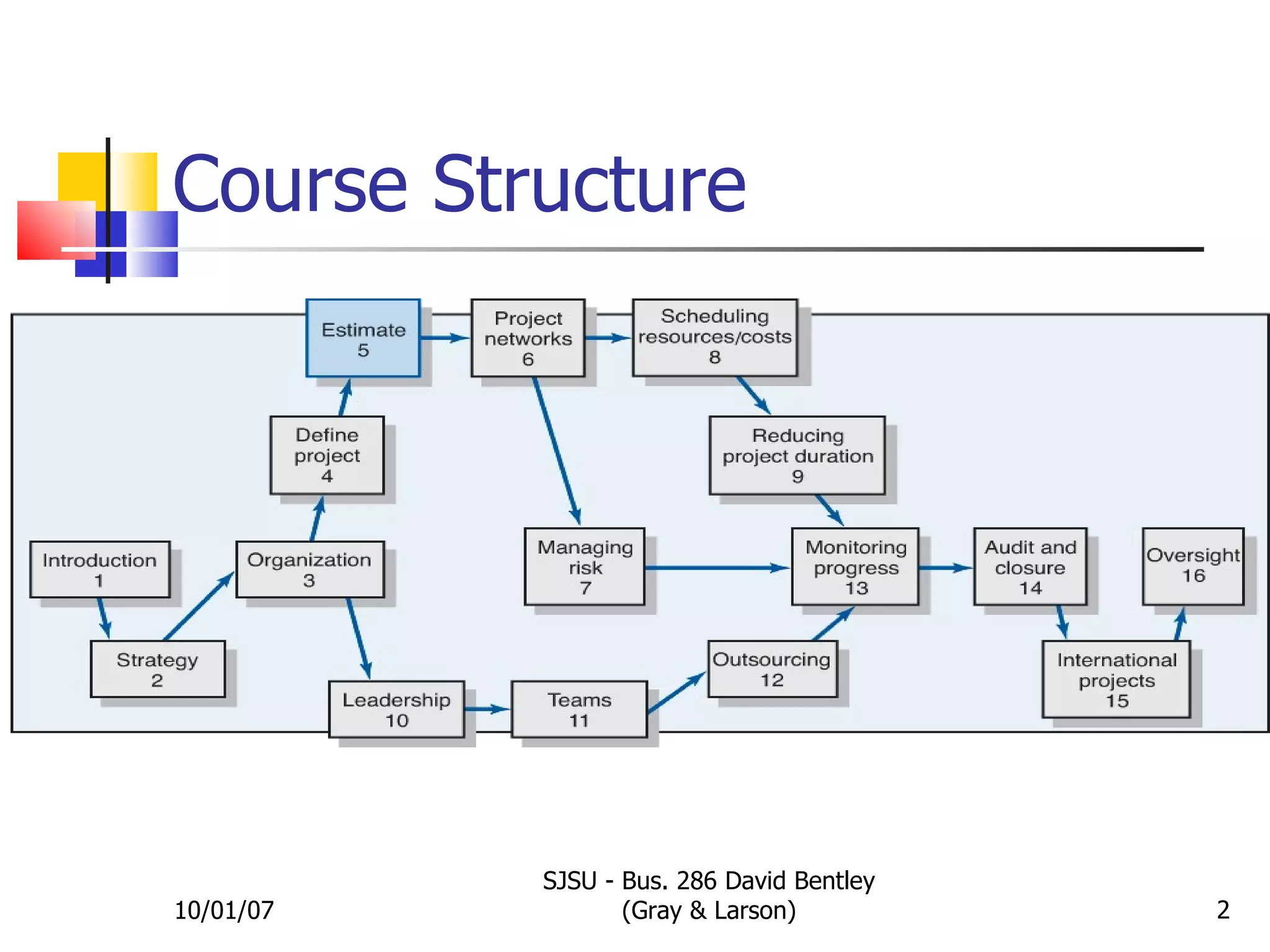
Course Structure 10/01/07 SJSU - Bus. 286 David Bentley (Gray & Larson)
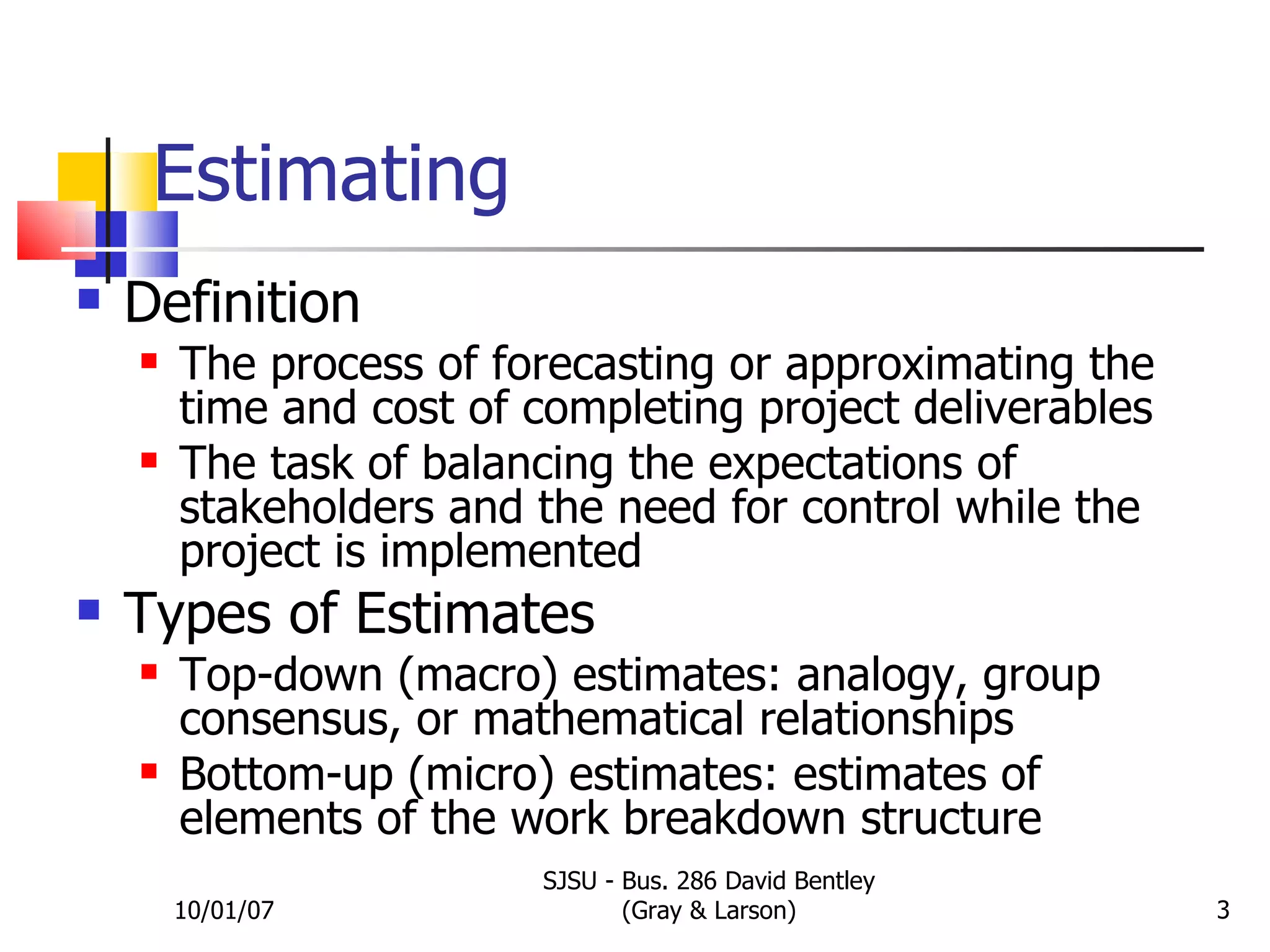
Estimating Definition The process of forecasting or approximating the time and cost of completing project deliverables The task of balancing the expectations of stakeholders and the need for control while the project is implemented Types of Estimates Top-down (macro) estimates: analogy, group consensus, or mathematical relationships Bottom-up (micro) estimates: estimates of elements of the work breakdown structure 10/01/07 SJSU - Bus. 286 David Bentley (Gray & Larson)
Estimates Are Needed to …   (1) 10/01/07 SJSU - Bus. 286 David Bentley (Gray & Larson) EXHIBIT 5.1 Support good decisions. Schedule work. Determine how long the project should take  and its cost. Determine whether the project is worth  doing.
Estimates Are Needed to …   (2) 10/01/07 SJSU - Bus. 286 David Bentley (Gray & Larson) EXHIBIT 5.1 Develop cash flow needs. Determine how well the project is progressing. Develop time-phased budgets and establish the project baseline.
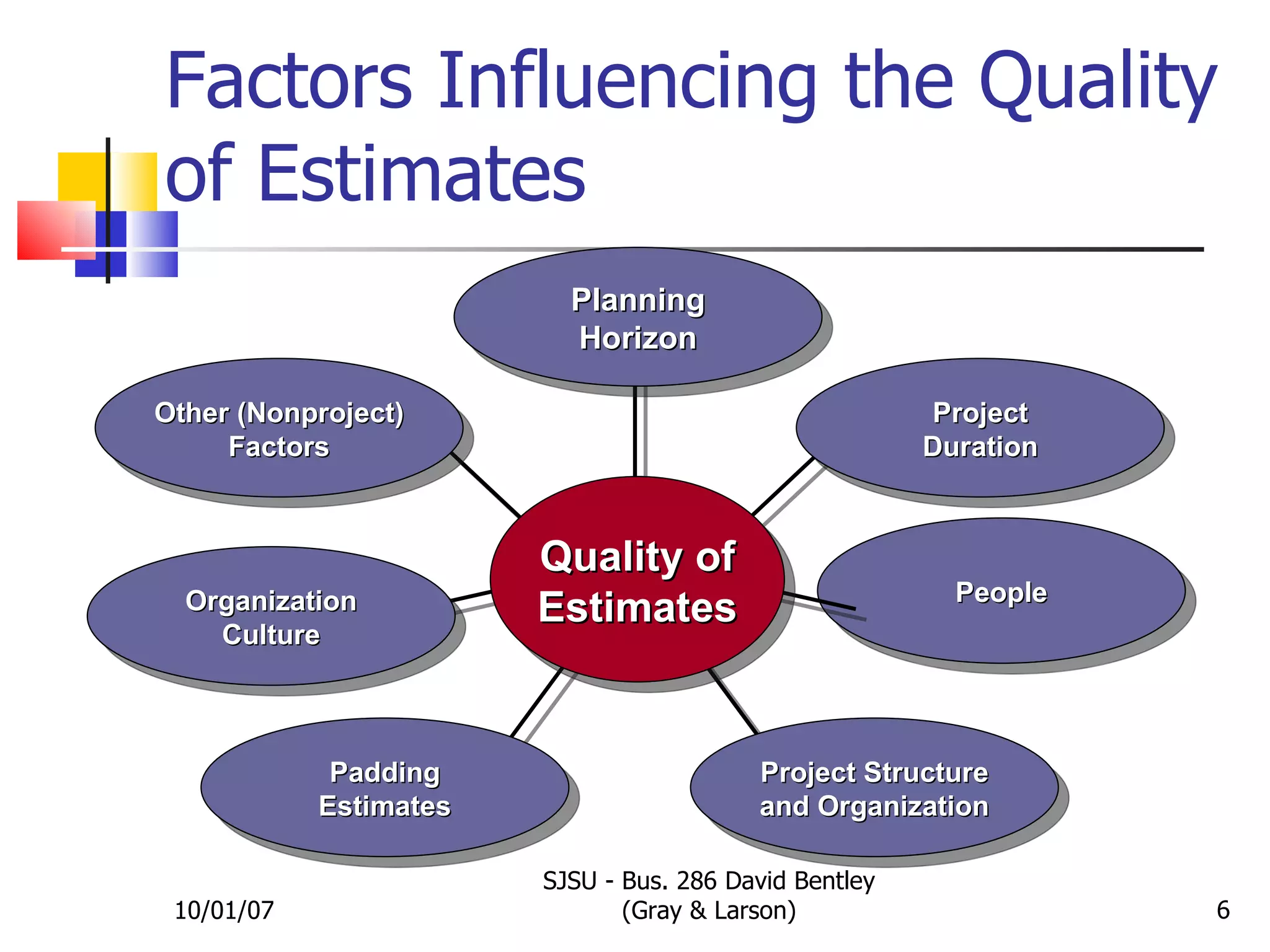
Factors Influencing the Quality of Estimates 10/01/07 SJSU - Bus. 286 David Bentley (Gray & Larson) People Quality of Estimates Project Duration Project Structure and Organization Padding Estimates Organization Culture Other (Nonproject) Factors Planning Horizon
Estimating Guidelines for Times, Costs, and Resources  (1) Have people familiar with the tasks make the estimate. Use several people to make estimates. Base estimates on normal conditions, efficient methods, and a normal level of resources. Use consistent time units in estimating task times. 10/01/07 SJSU - Bus. 286 David Bentley (Gray & Larson)
Estimating Guidelines for  Times, Costs, and Resources  (2) Treat each task as independent, don’t aggregate. Don’t make allowances for contingencies. Adding a risk assessment helps avoid surprises to stakeholders. Consider 3-time estimates (O = optimistic, P = pessimistic, M = most likely) 10/01/07 SJSU - Bus. 286 David Bentley (Gray & Larson)
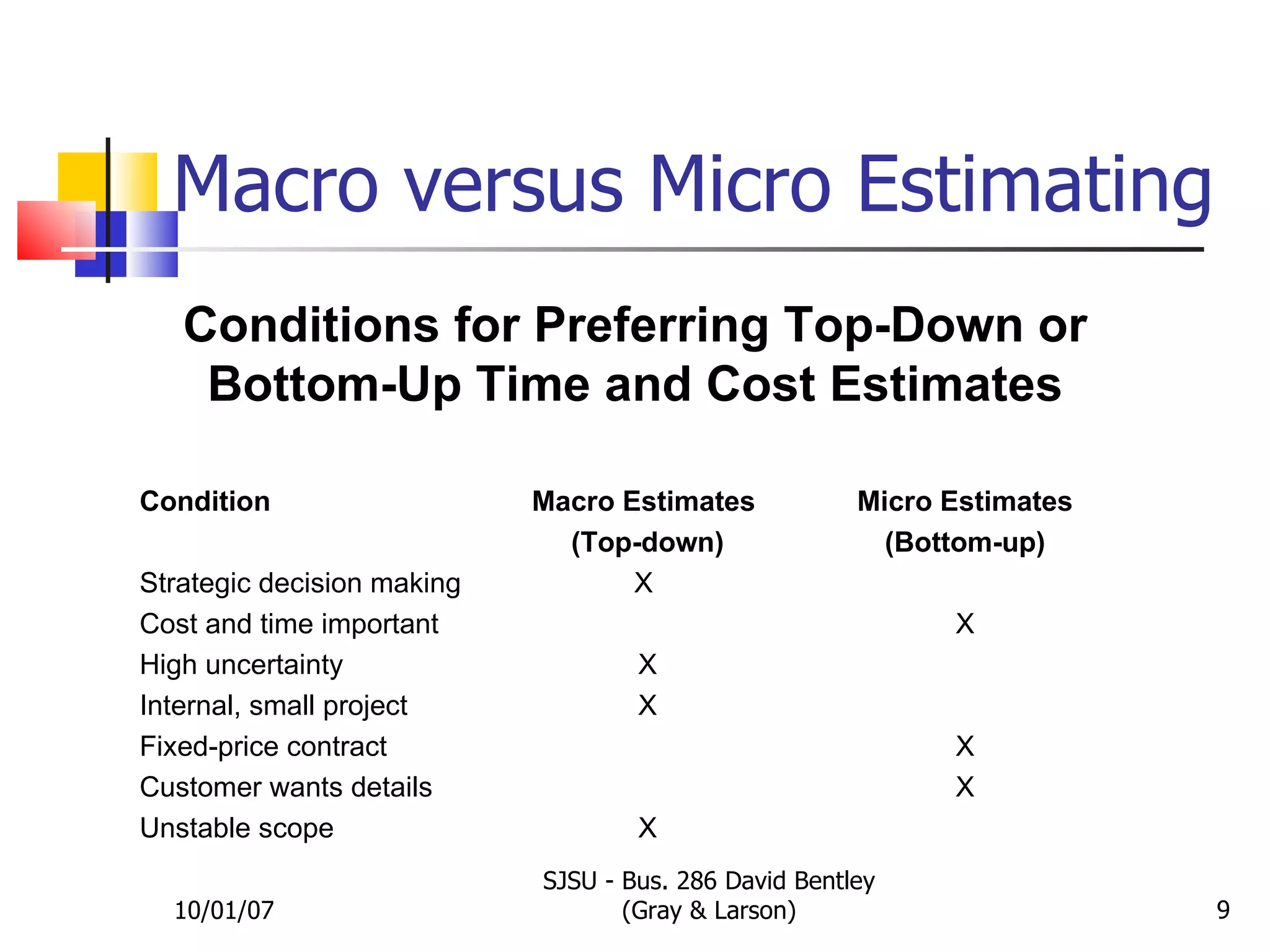
Macro versus Micro Estimating 10/01/07 SJSU - Bus. 286 David Bentley (Gray & Larson) TABLE 5.1 Conditions for Preferring Top-Down or Bottom-Up Time and Cost Estimates Condition  Macro Estimates  Micro Estimates (Top-down) (Bottom-up) Strategic decision making  X  Cost and time important  X High uncertainty  X Internal, small project  X Fixed-price contract  X Customer wants details  X Unstable scope  X
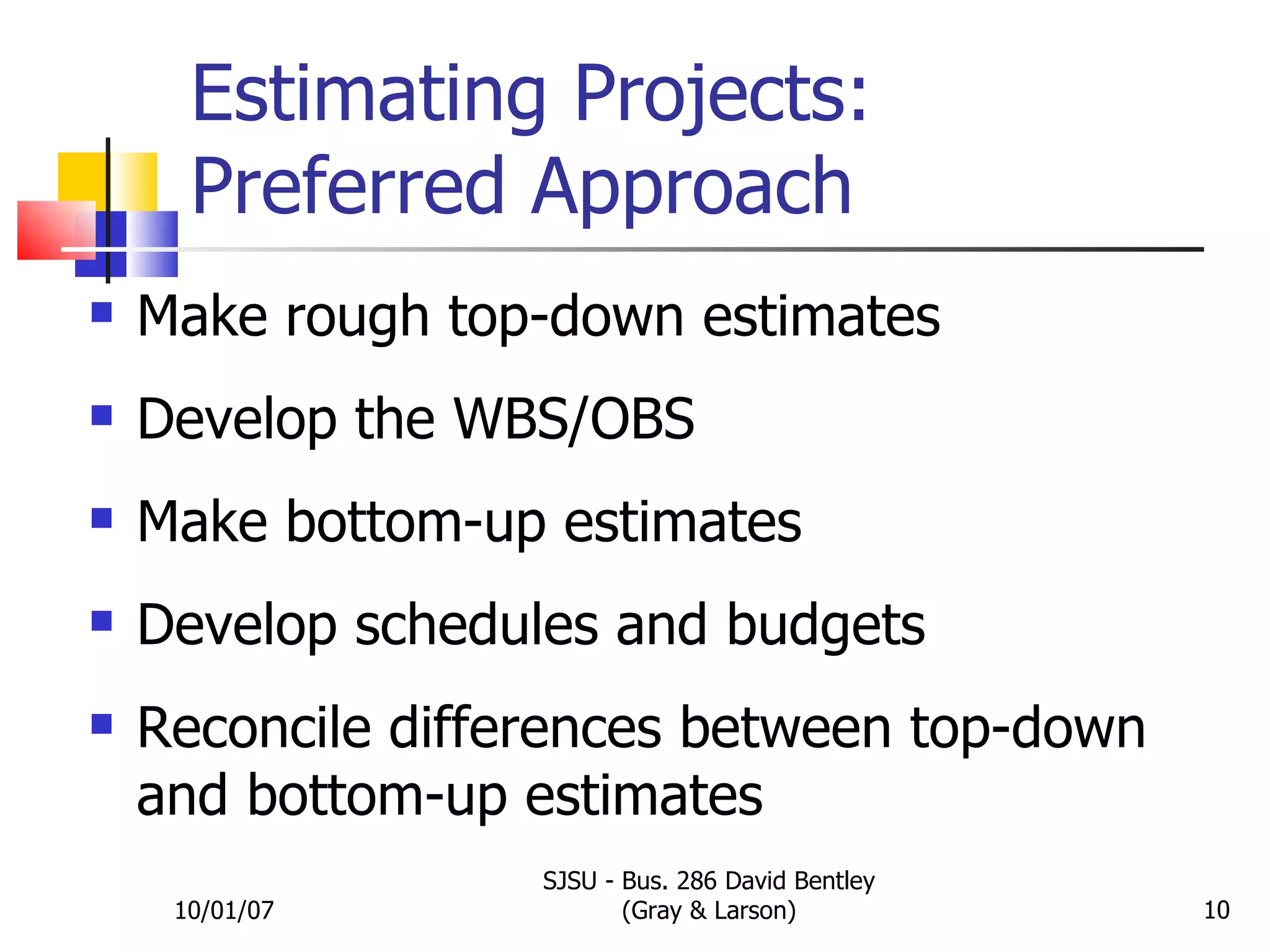
Estimating Projects: Preferred Approach Make rough top-down estimates Develop the WBS/OBS Make bottom-up estimates Develop schedules and budgets Reconcile differences between top-down and bottom-up estimates 10/01/07 SJSU - Bus. 286 David Bentley (Gray & Larson)
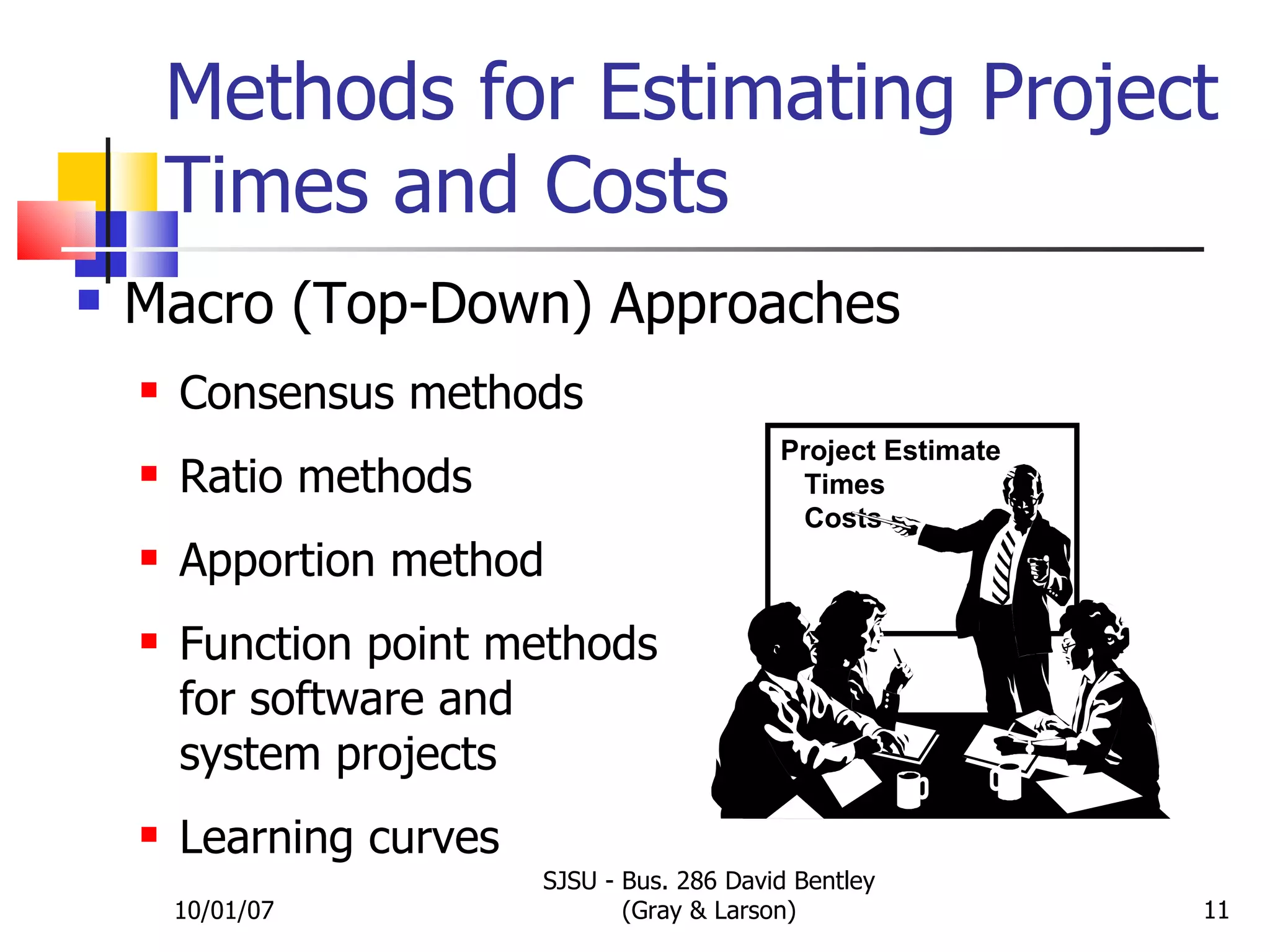
Methods for Estimating Project Times and Costs Macro (Top-Down) Approaches Consensus methods Ratio methods Apportion method Function point methods for software and  system projects Learning curves 10/01/07 SJSU - Bus. 286 David Bentley (Gray & Larson) Project Estimate Times Costs
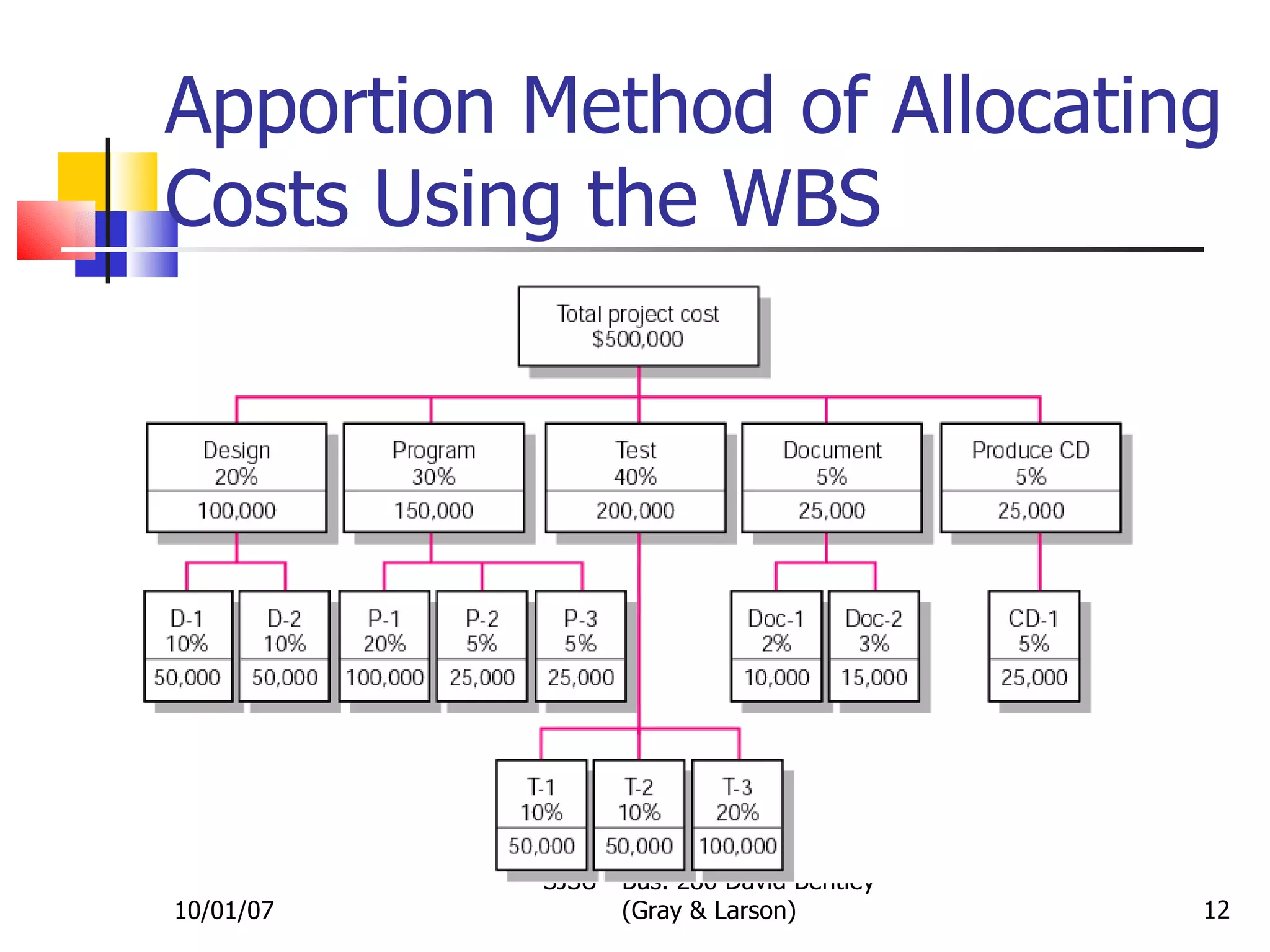
Apportion Method of Allocating Costs Using the WBS 10/01/07 SJSU - Bus. 286 David Bentley (Gray & Larson) FIGURE 5.1
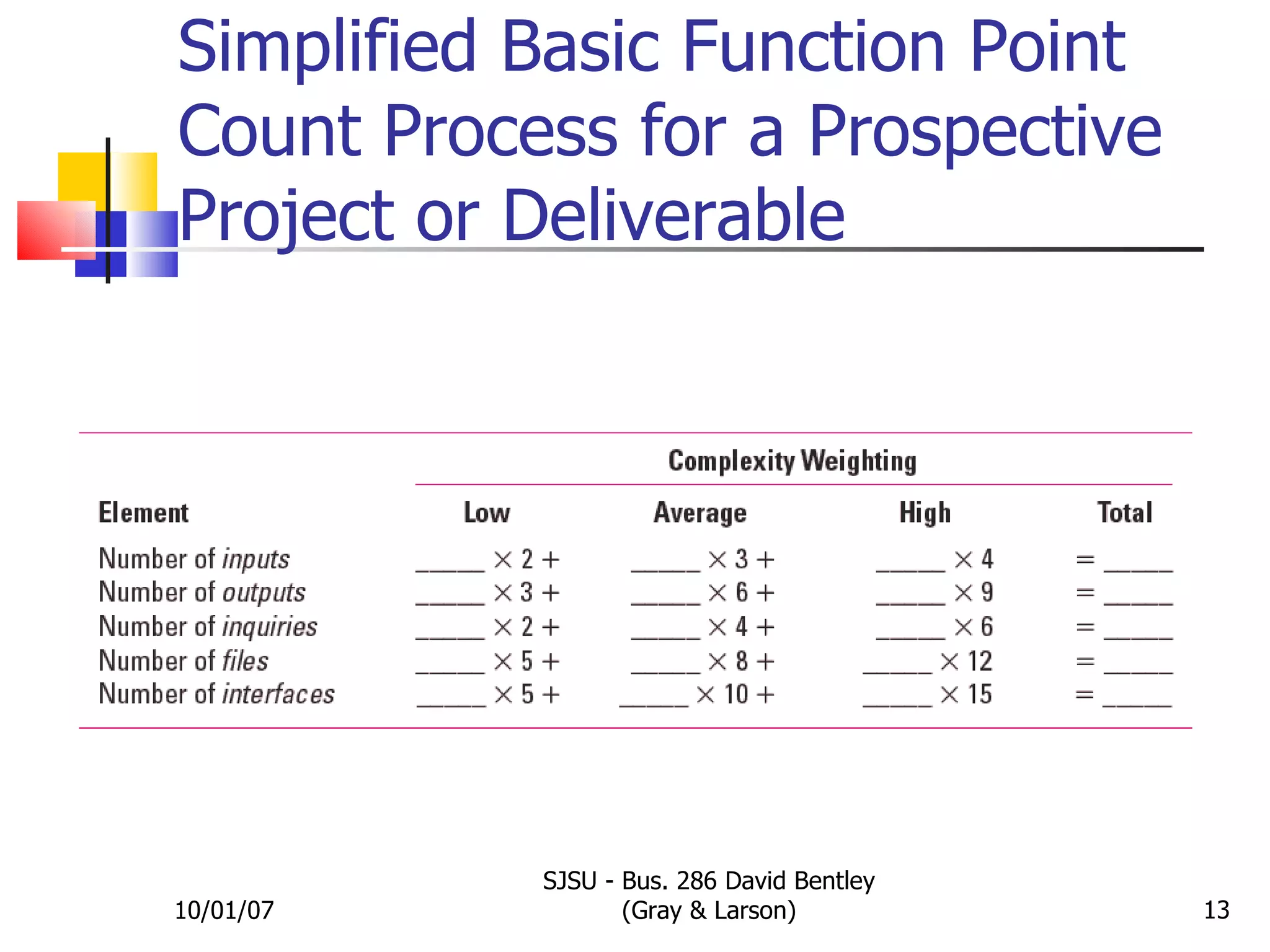
Simplified Basic Function Point Count Process for a Prospective Project or Deliverable 10/01/07 SJSU - Bus. 286 David Bentley (Gray & Larson) TABLE 5.2
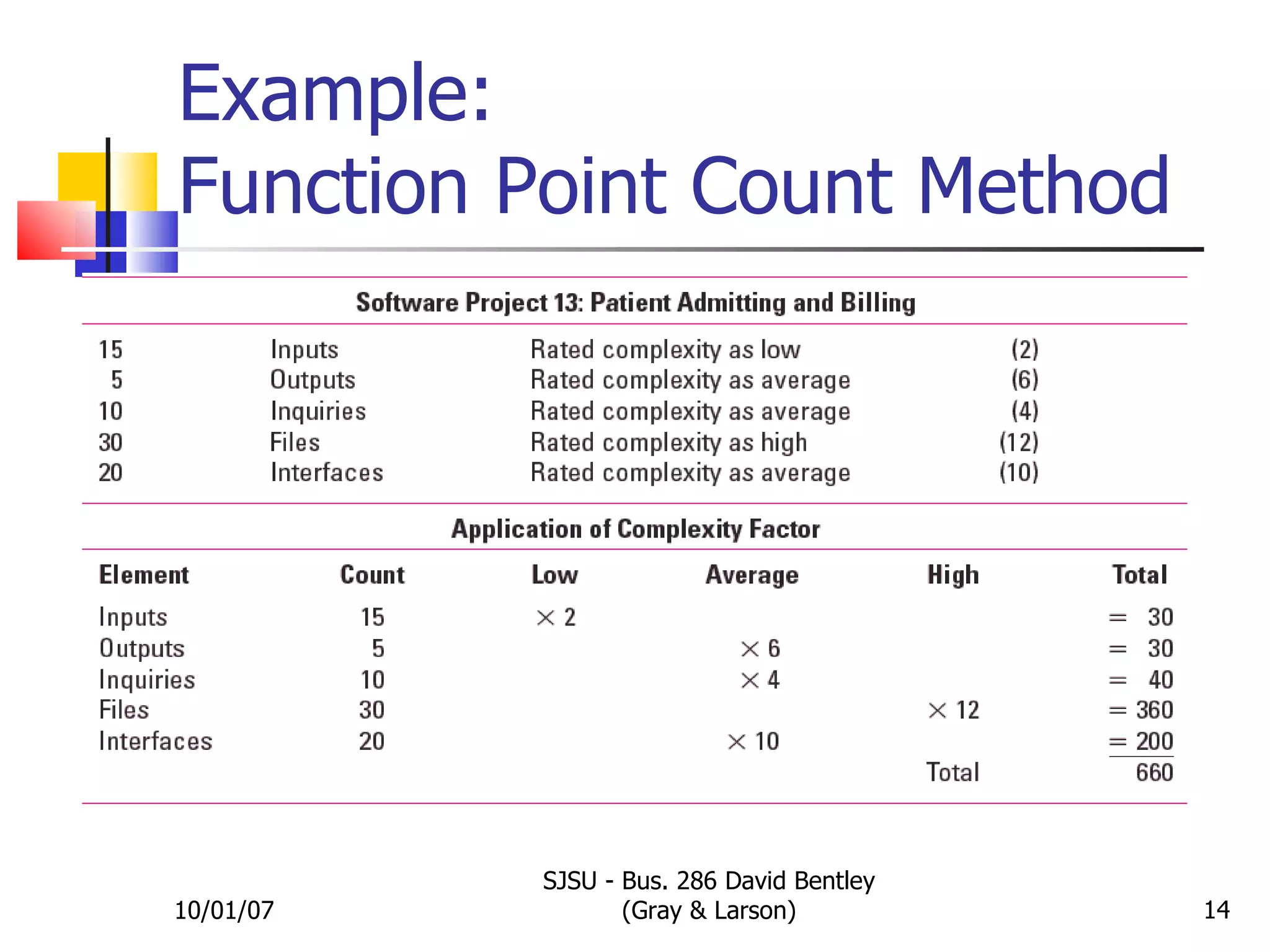
Example: Function Point Count Method 10/01/07 SJSU - Bus. 286 David Bentley (Gray & Larson) TABLE 5.3
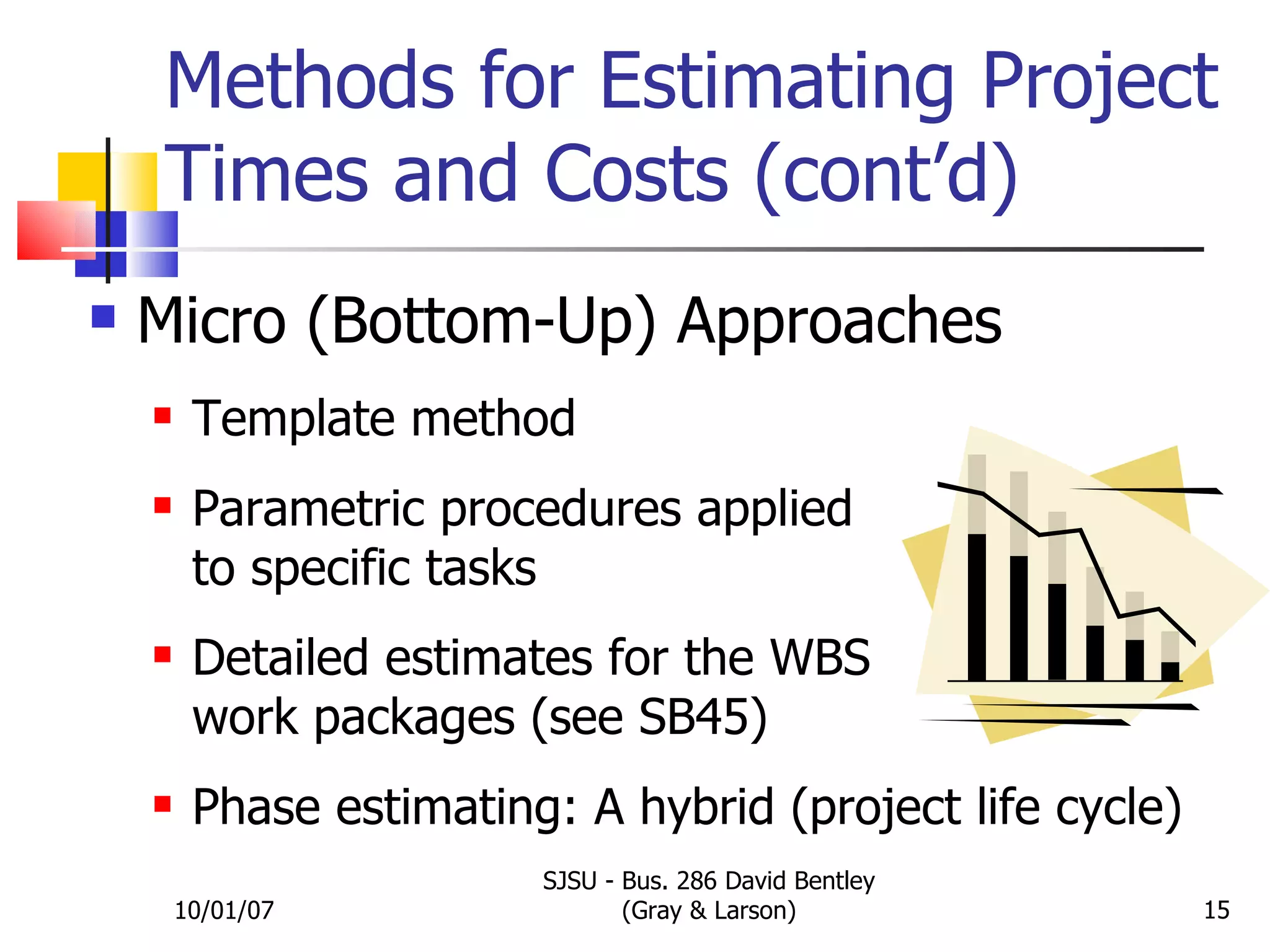
Methods for Estimating Project  Times and Costs (cont’d) Micro (Bottom-Up) Approaches Template method Parametric procedures applied to specific tasks Detailed estimates for the WBS  work packages (see SB45) Phase estimating: A hybrid (project life cycle) 10/01/07 SJSU - Bus. 286 David Bentley (Gray & Larson)
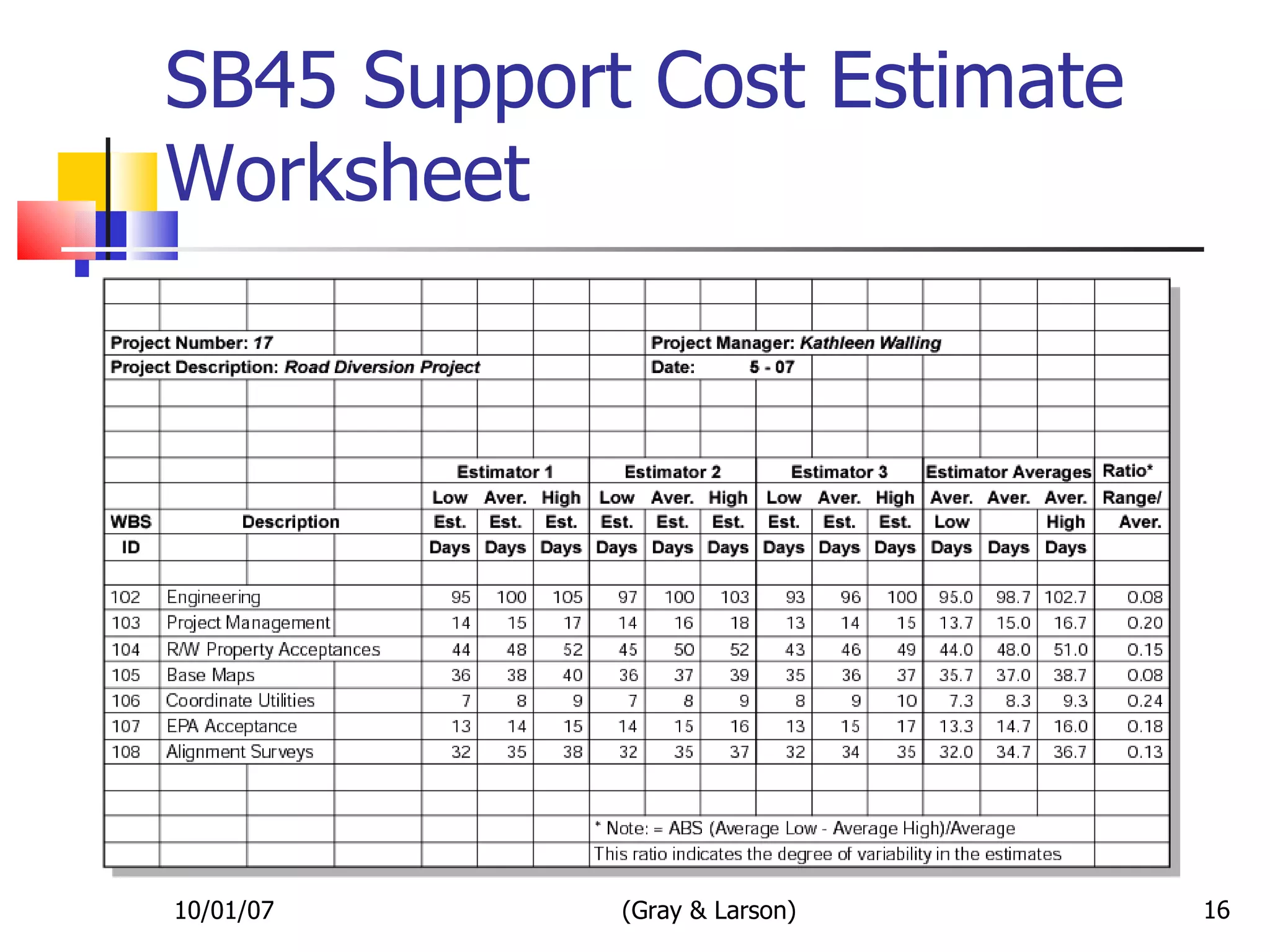
SB45 Support Cost Estimate Worksheet 10/01/07 SJSU - Bus. 286 David Bentley (Gray & Larson) FIGURE 5.2
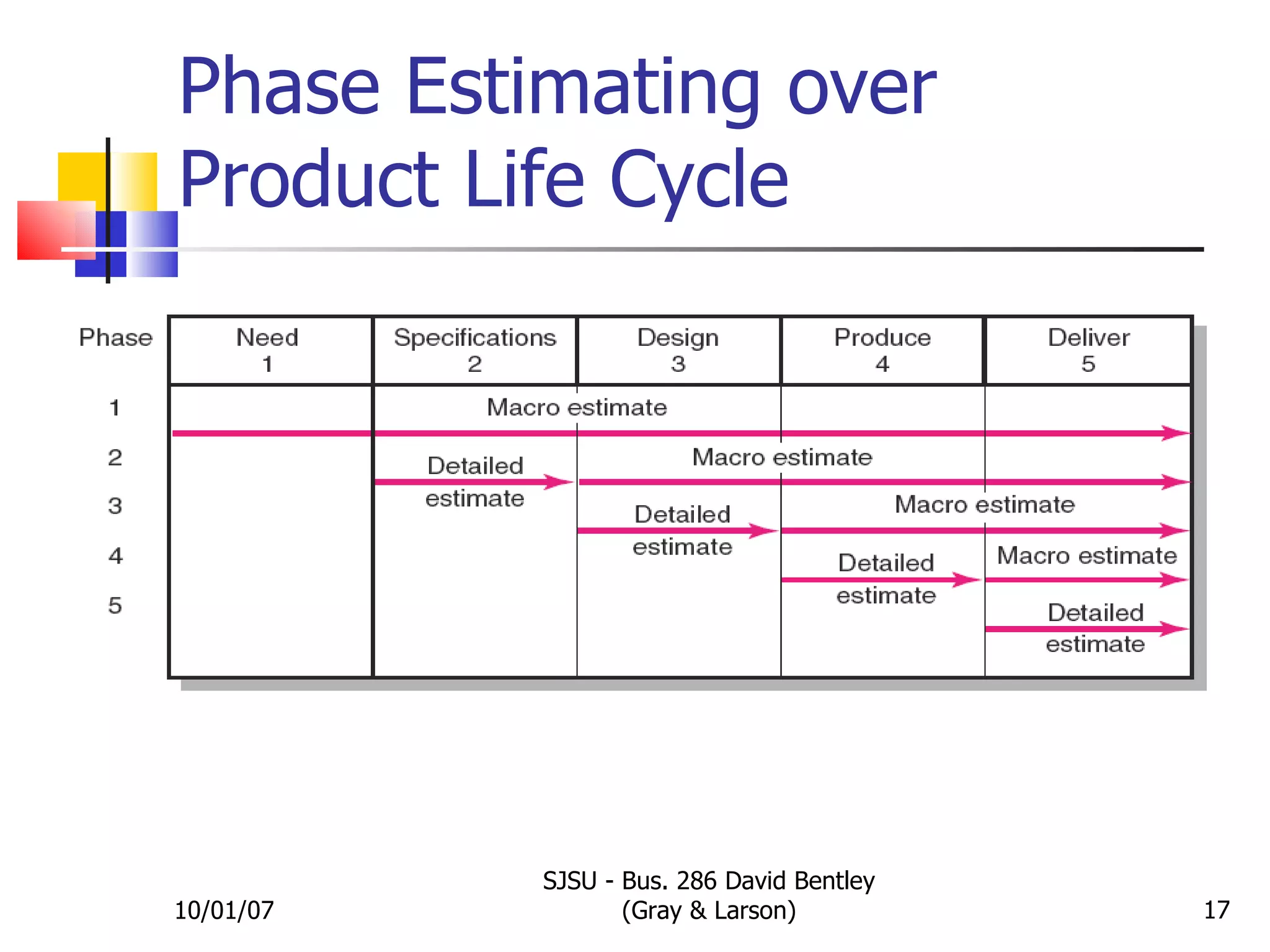
Phase Estimating over Product Life Cycle 10/01/07 SJSU - Bus. 286 David Bentley (Gray & Larson) FIGURE 5.3
Level of Detail -  (1) Level of detail is different for different levels of management. Level of detail in the WBS varies with the complexity of the project. 10/01/07 SJSU - Bus. 286 David Bentley (Gray & Larson)
Level of Detail -  (2) Excessive detail is costly. Fosters a focus on departmental outcomes Creates unproductive paperwork Insufficient detail is costly. Lack of focus on goals Wasted effort on nonessential activities 10/01/07 SJSU - Bus. 286 David Bentley (Gray & Larson)
Types of Costs Direct Costs Project Overhead Costs General & Administrative Overhead Costs 10/01/07 SJSU - Bus. 286 David Bentley (Gray & Larson)
Direct Costs Costs that are clearly chargeable to a specific work package. Labor, materials, equipment, and other 10/01/07 SJSU - Bus. 286 David Bentley (Gray & Larson)
Direct (Project) Overhead Costs Costs incurred that are directly tied to an identifiable project deliverable or work package. Salary, rents, supplies, specialized machinery 10/01/07 SJSU - Bus. 286 David Bentley (Gray & Larson)
General and Administrative Overhead Costs Organization costs indirectly linked to a specific package that are apportioned to the project 10/01/07 SJSU - Bus. 286 David Bentley (Gray & Larson)
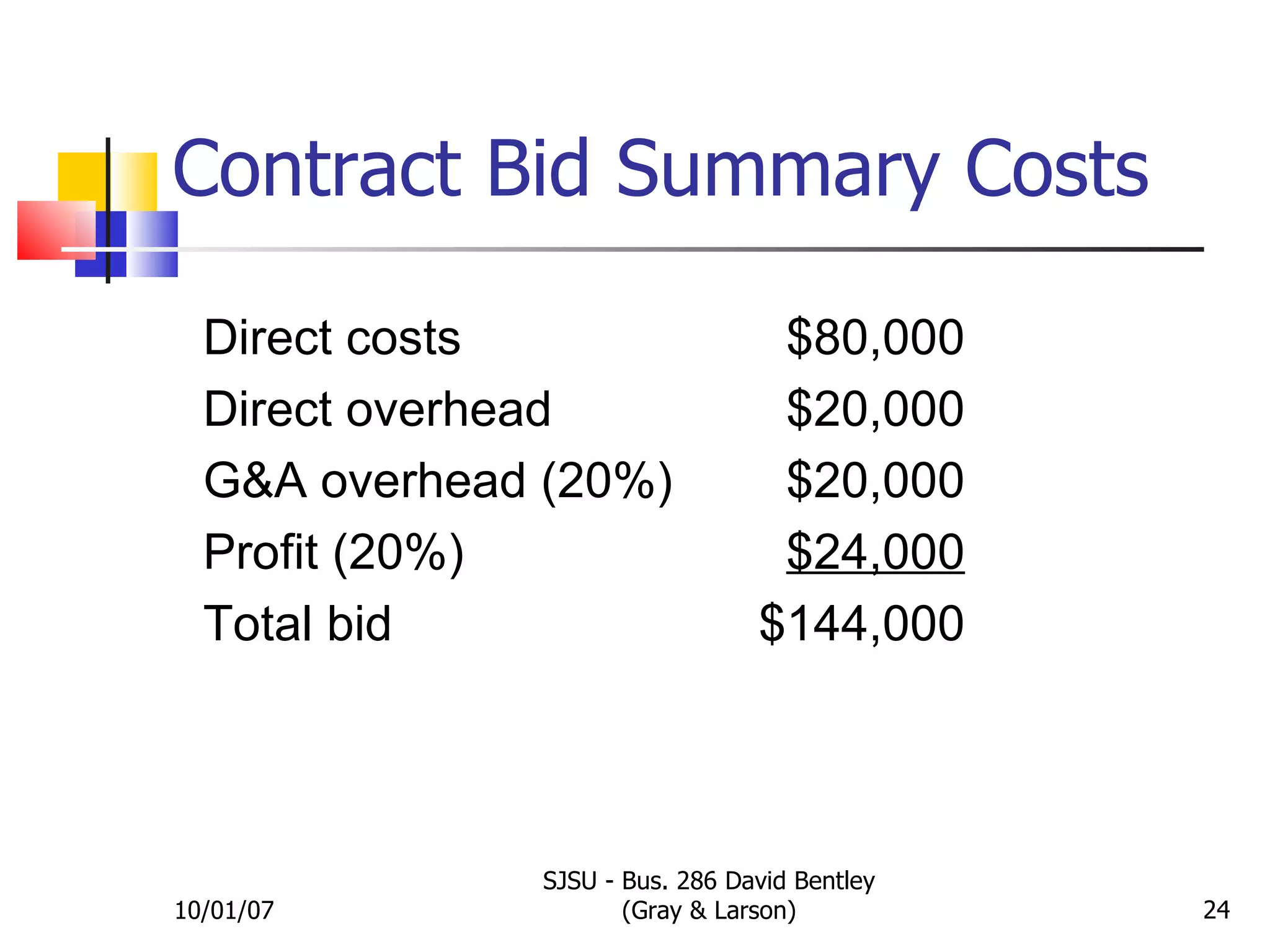
Contract Bid Summary Costs 10/01/07 SJSU - Bus. 286 David Bentley (Gray & Larson) FIGURE 5.6 Direct costs  $80,000 Direct overhead  $20,000 G&A overhead (20%)  $20,000 Profit (20%)  $24,000 Total bid  $144,000
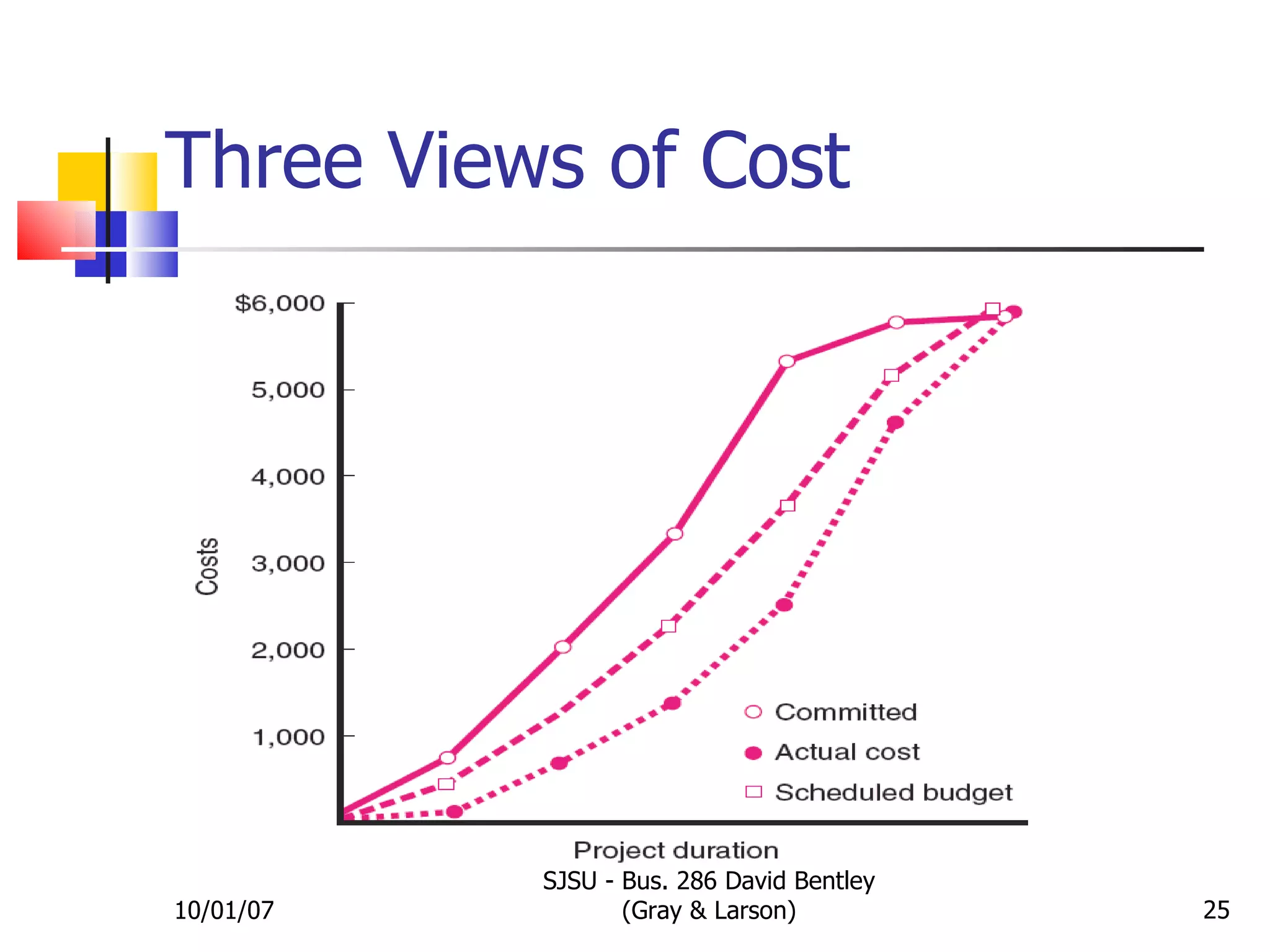
Three Views of Cost 10/01/07 SJSU - Bus. 286 David Bentley (Gray & Larson) FIGURE 5.5
Refining Estimates -  (1) Reasons for Adjusting Estimates Interaction costs are hidden in estimates. Normal conditions do not apply. Things go wrong on projects. Changes in project scope and plans. Adjusting Estimates Time and cost estimates of specific activities are adjusted as the risks, resources, and situation particulars become more clearly defined. 10/01/07 SJSU - Bus. 286 David Bentley (Gray & Larson)
Refining Estimates -  (2) Contingency Funds and Time Buffers Are created independently to offset uncertainty Reduce the likelihood of cost and completion time overruns for a project Can be added to the overall project or to specific activities or work packages Can be determined from previous similar projects 10/01/07 SJSU - Bus. 286 David Bentley (Gray & Larson)
Refining Estimates -  (3) Changing Baseline Schedule and Budget Unforeseen events may dictate a reformulation of the budget and schedule. 10/01/07 SJSU - Bus. 286 David Bentley (Gray & Larson)
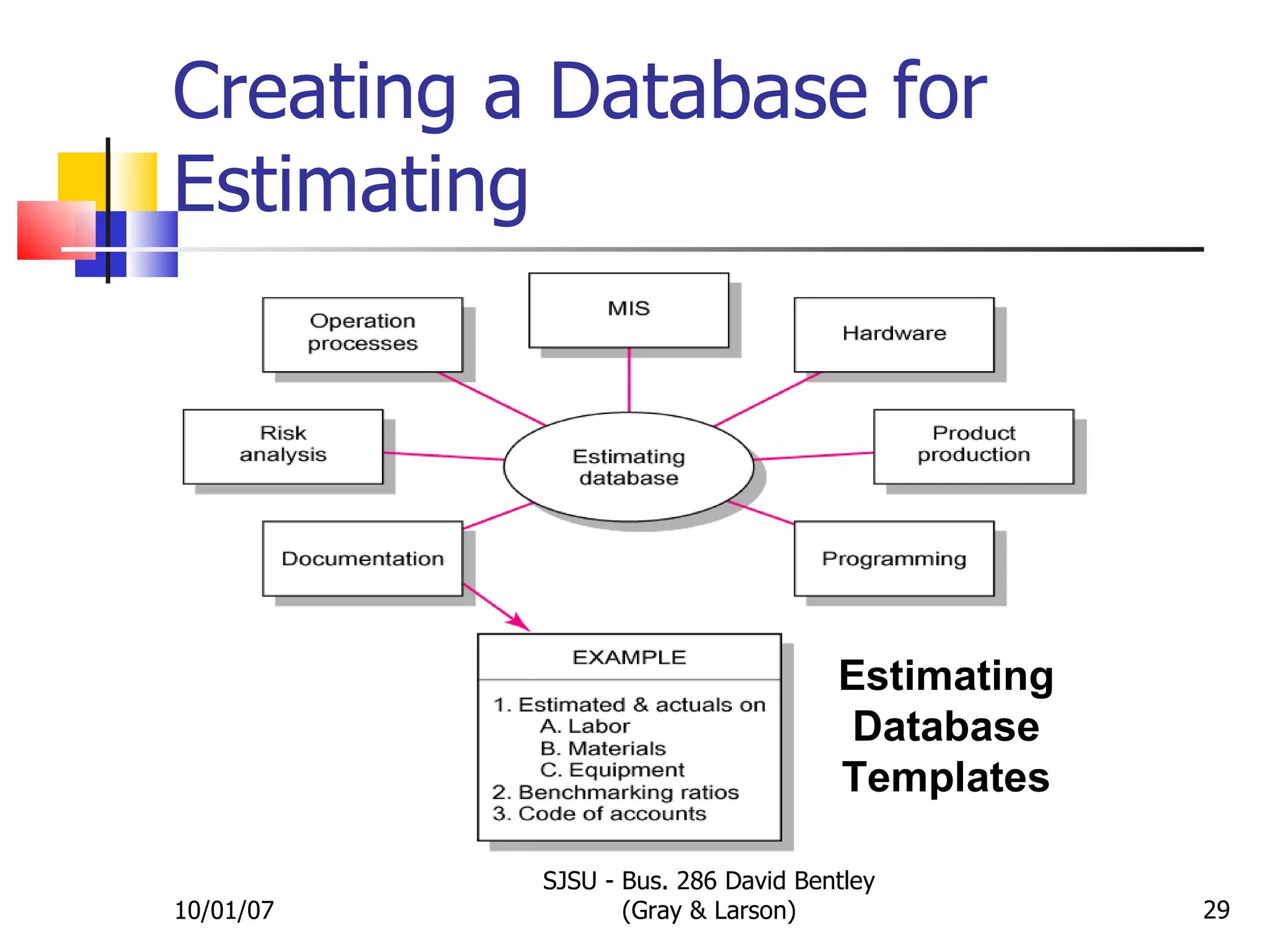
Creating a Database for Estimating 10/01/07 SJSU - Bus. 286 David Bentley (Gray & Larson) FIGURE 5.7 Estimating Database Templates
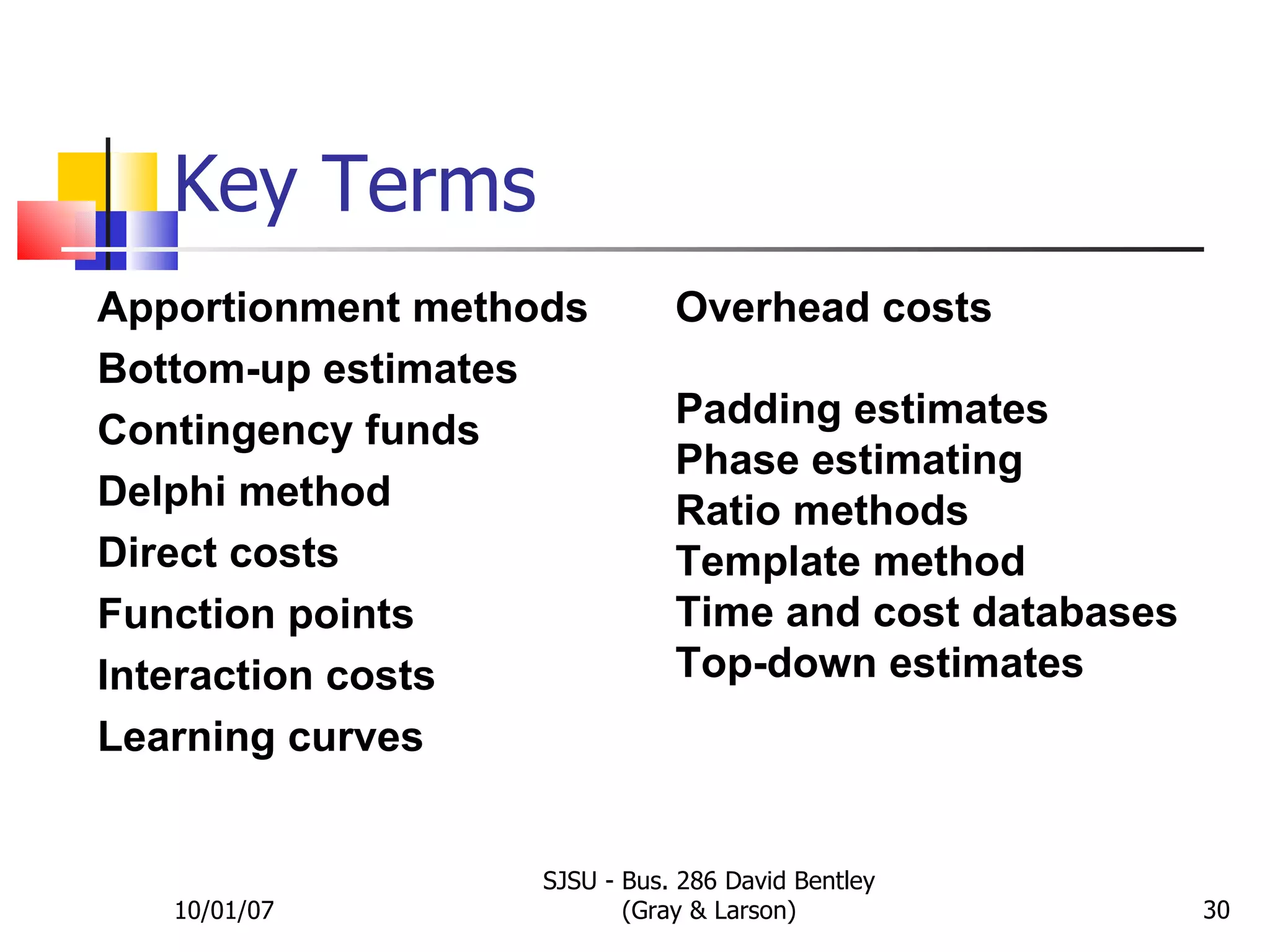
Key Terms 10/01/07 SJSU - Bus. 286 David Bentley (Gray & Larson) Apportionment methods Bottom-up estimates Contingency funds Delphi method Direct costs Function points Interaction costs Learning curves Overhead costs  Padding estimates Phase estimating Ratio methods Template method Time and cost databases Top-down estimates

Estimating Time & Costs

  • 1.
    Chapter 5 – Estimating Project Times and Costs Definition, Types, Influencing factors, Guidelines, Macro vs. Micro, Methods, Cost types 10/27/07 SJSU - Bus. 286 David Bentley (Gray & Larson)
  • 2.
    Course Structure 10/01/07SJSU - Bus. 286 David Bentley (Gray & Larson)
  • 3.
    Estimating Definition Theprocess of forecasting or approximating the time and cost of completing project deliverables The task of balancing the expectations of stakeholders and the need for control while the project is implemented Types of Estimates Top-down (macro) estimates: analogy, group consensus, or mathematical relationships Bottom-up (micro) estimates: estimates of elements of the work breakdown structure 10/01/07 SJSU - Bus. 286 David Bentley (Gray & Larson)
  • 4.
    Estimates Are Neededto … (1) 10/01/07 SJSU - Bus. 286 David Bentley (Gray & Larson) EXHIBIT 5.1 Support good decisions. Schedule work. Determine how long the project should take and its cost. Determine whether the project is worth doing.
  • 5.
    Estimates Are Neededto … (2) 10/01/07 SJSU - Bus. 286 David Bentley (Gray & Larson) EXHIBIT 5.1 Develop cash flow needs. Determine how well the project is progressing. Develop time-phased budgets and establish the project baseline.
  • 6.
    Factors Influencing theQuality of Estimates 10/01/07 SJSU - Bus. 286 David Bentley (Gray & Larson) People Quality of Estimates Project Duration Project Structure and Organization Padding Estimates Organization Culture Other (Nonproject) Factors Planning Horizon
  • 7.
    Estimating Guidelines forTimes, Costs, and Resources (1) Have people familiar with the tasks make the estimate. Use several people to make estimates. Base estimates on normal conditions, efficient methods, and a normal level of resources. Use consistent time units in estimating task times. 10/01/07 SJSU - Bus. 286 David Bentley (Gray & Larson)
  • 8.
    Estimating Guidelines for Times, Costs, and Resources (2) Treat each task as independent, don’t aggregate. Don’t make allowances for contingencies. Adding a risk assessment helps avoid surprises to stakeholders. Consider 3-time estimates (O = optimistic, P = pessimistic, M = most likely) 10/01/07 SJSU - Bus. 286 David Bentley (Gray & Larson)
  • 9.
    Macro versus MicroEstimating 10/01/07 SJSU - Bus. 286 David Bentley (Gray & Larson) TABLE 5.1 Conditions for Preferring Top-Down or Bottom-Up Time and Cost Estimates Condition Macro Estimates Micro Estimates (Top-down) (Bottom-up) Strategic decision making X Cost and time important X High uncertainty X Internal, small project X Fixed-price contract X Customer wants details X Unstable scope X
  • 10.
    Estimating Projects: PreferredApproach Make rough top-down estimates Develop the WBS/OBS Make bottom-up estimates Develop schedules and budgets Reconcile differences between top-down and bottom-up estimates 10/01/07 SJSU - Bus. 286 David Bentley (Gray & Larson)
  • 11.
    Methods for EstimatingProject Times and Costs Macro (Top-Down) Approaches Consensus methods Ratio methods Apportion method Function point methods for software and system projects Learning curves 10/01/07 SJSU - Bus. 286 David Bentley (Gray & Larson) Project Estimate Times Costs
  • 12.
    Apportion Method ofAllocating Costs Using the WBS 10/01/07 SJSU - Bus. 286 David Bentley (Gray & Larson) FIGURE 5.1
  • 13.
    Simplified Basic FunctionPoint Count Process for a Prospective Project or Deliverable 10/01/07 SJSU - Bus. 286 David Bentley (Gray & Larson) TABLE 5.2
  • 14.
    Example: Function PointCount Method 10/01/07 SJSU - Bus. 286 David Bentley (Gray & Larson) TABLE 5.3
  • 15.
    Methods for EstimatingProject Times and Costs (cont’d) Micro (Bottom-Up) Approaches Template method Parametric procedures applied to specific tasks Detailed estimates for the WBS work packages (see SB45) Phase estimating: A hybrid (project life cycle) 10/01/07 SJSU - Bus. 286 David Bentley (Gray & Larson)
  • 16.
    SB45 Support CostEstimate Worksheet 10/01/07 SJSU - Bus. 286 David Bentley (Gray & Larson) FIGURE 5.2
  • 17.
    Phase Estimating overProduct Life Cycle 10/01/07 SJSU - Bus. 286 David Bentley (Gray & Larson) FIGURE 5.3
  • 18.
    Level of Detail- (1) Level of detail is different for different levels of management. Level of detail in the WBS varies with the complexity of the project. 10/01/07 SJSU - Bus. 286 David Bentley (Gray & Larson)
  • 19.
    Level of Detail- (2) Excessive detail is costly. Fosters a focus on departmental outcomes Creates unproductive paperwork Insufficient detail is costly. Lack of focus on goals Wasted effort on nonessential activities 10/01/07 SJSU - Bus. 286 David Bentley (Gray & Larson)
  • 20.
    Types of CostsDirect Costs Project Overhead Costs General & Administrative Overhead Costs 10/01/07 SJSU - Bus. 286 David Bentley (Gray & Larson)
  • 21.
    Direct Costs Coststhat are clearly chargeable to a specific work package. Labor, materials, equipment, and other 10/01/07 SJSU - Bus. 286 David Bentley (Gray & Larson)
  • 22.
    Direct (Project) OverheadCosts Costs incurred that are directly tied to an identifiable project deliverable or work package. Salary, rents, supplies, specialized machinery 10/01/07 SJSU - Bus. 286 David Bentley (Gray & Larson)
  • 23.
    General and AdministrativeOverhead Costs Organization costs indirectly linked to a specific package that are apportioned to the project 10/01/07 SJSU - Bus. 286 David Bentley (Gray & Larson)
  • 24.
    Contract Bid SummaryCosts 10/01/07 SJSU - Bus. 286 David Bentley (Gray & Larson) FIGURE 5.6 Direct costs $80,000 Direct overhead $20,000 G&A overhead (20%) $20,000 Profit (20%) $24,000 Total bid $144,000
  • 25.
    Three Views ofCost 10/01/07 SJSU - Bus. 286 David Bentley (Gray & Larson) FIGURE 5.5
  • 26.
    Refining Estimates - (1) Reasons for Adjusting Estimates Interaction costs are hidden in estimates. Normal conditions do not apply. Things go wrong on projects. Changes in project scope and plans. Adjusting Estimates Time and cost estimates of specific activities are adjusted as the risks, resources, and situation particulars become more clearly defined. 10/01/07 SJSU - Bus. 286 David Bentley (Gray & Larson)
  • 27.
    Refining Estimates - (2) Contingency Funds and Time Buffers Are created independently to offset uncertainty Reduce the likelihood of cost and completion time overruns for a project Can be added to the overall project or to specific activities or work packages Can be determined from previous similar projects 10/01/07 SJSU - Bus. 286 David Bentley (Gray & Larson)
  • 28.
    Refining Estimates - (3) Changing Baseline Schedule and Budget Unforeseen events may dictate a reformulation of the budget and schedule. 10/01/07 SJSU - Bus. 286 David Bentley (Gray & Larson)
  • 29.
    Creating a Databasefor Estimating 10/01/07 SJSU - Bus. 286 David Bentley (Gray & Larson) FIGURE 5.7 Estimating Database Templates
  • 30.
    Key Terms 10/01/07SJSU - Bus. 286 David Bentley (Gray & Larson) Apportionment methods Bottom-up estimates Contingency funds Delphi method Direct costs Function points Interaction costs Learning curves Overhead costs Padding estimates Phase estimating Ratio methods Template method Time and cost databases Top-down estimates