Several complications can occur while solving the LPP. Such
problems are:
 Tie for the key row(degeneracy)
 Tie for the key column
 Unbounded problems
 Multiple optimal solutions
 Infeasible problems
 Redundant constraints
 Unrestricted Variables
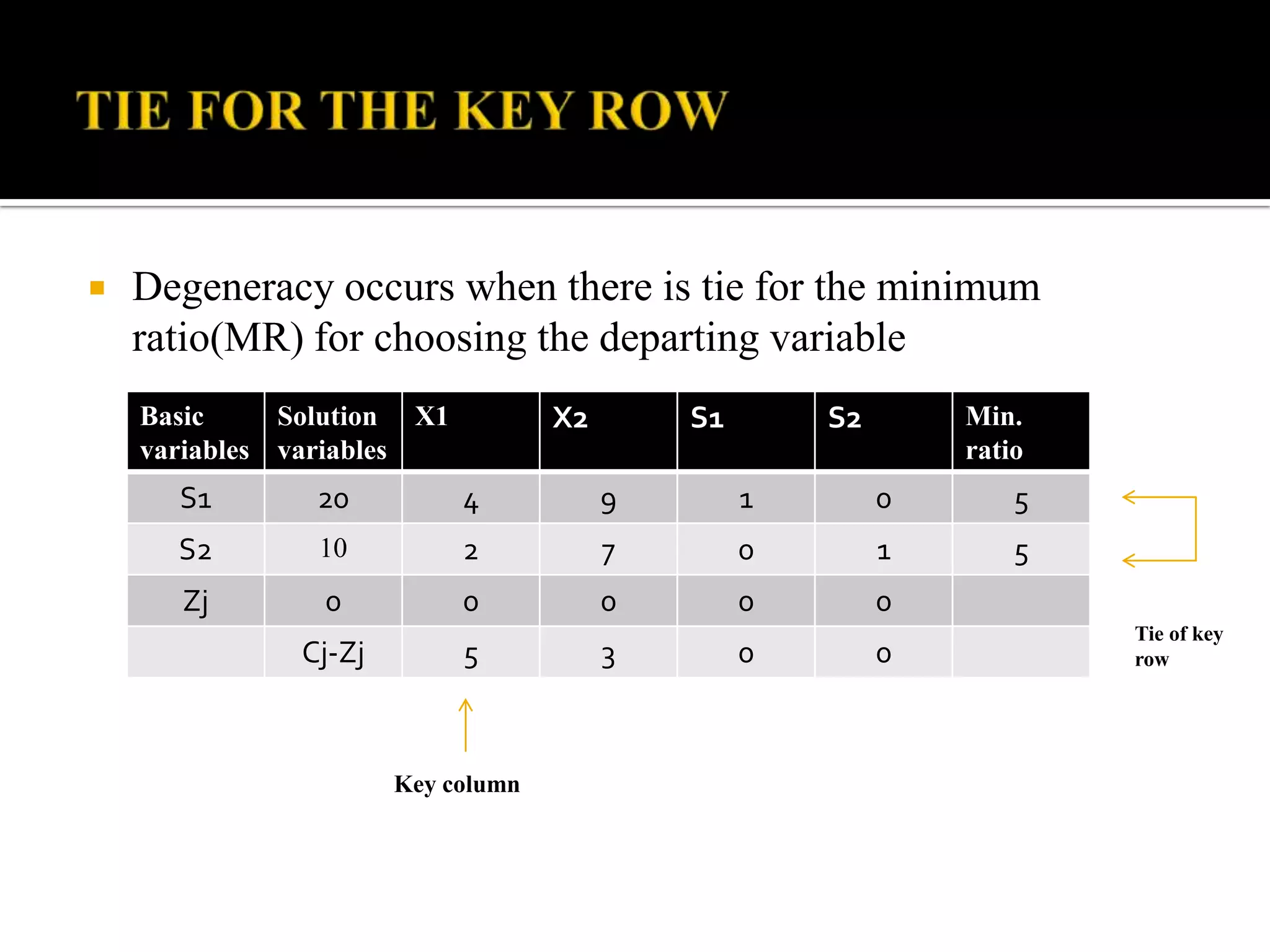
   Degeneracy occurs when there is tie for the minimum
    ratio(MR) for choosing the departing variable
    Basic     Solution X1          X2       S1       S2       Min.
    variables variables                                       ratio
      S1        20          4           9        1        0       5
      S2        10          2           7        0        1       5
      Zj        0           0           0        0        0
                                                                      Tie of key
              Cj-Zj         5           3        0        0           row


                      Key column
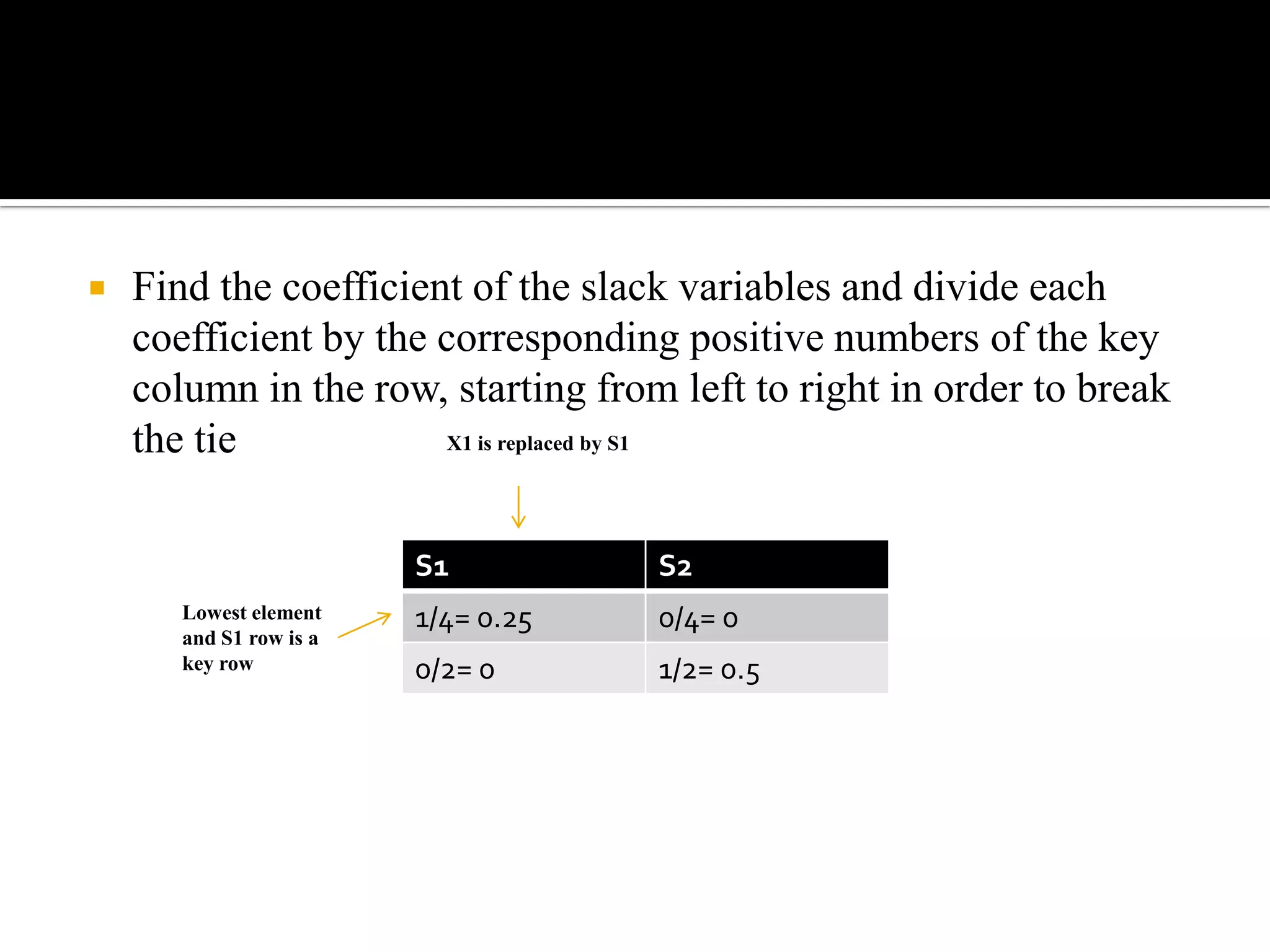
   Find the coefficient of the slack variables and divide each
    coefficient by the corresponding positive numbers of the key
    column in the row, starting from left to right in order to break
    the tie             X1 is replaced by S1


                         S1          S2
       Lowest element    1/4= 0.25   0/4= 0
       and S1 row is a
       key row           0/2= 0      1/2= 0.5
   If the ratio do not break the tie, find the similar ratio for the
    coefficient of decision variables
   Compare the resulting ratio, column by column
   Select the row which contains smallest ratio.This row
    becomes the key row
   After resolving of this tie, simplex method is applied to obtain
    the optimum solution
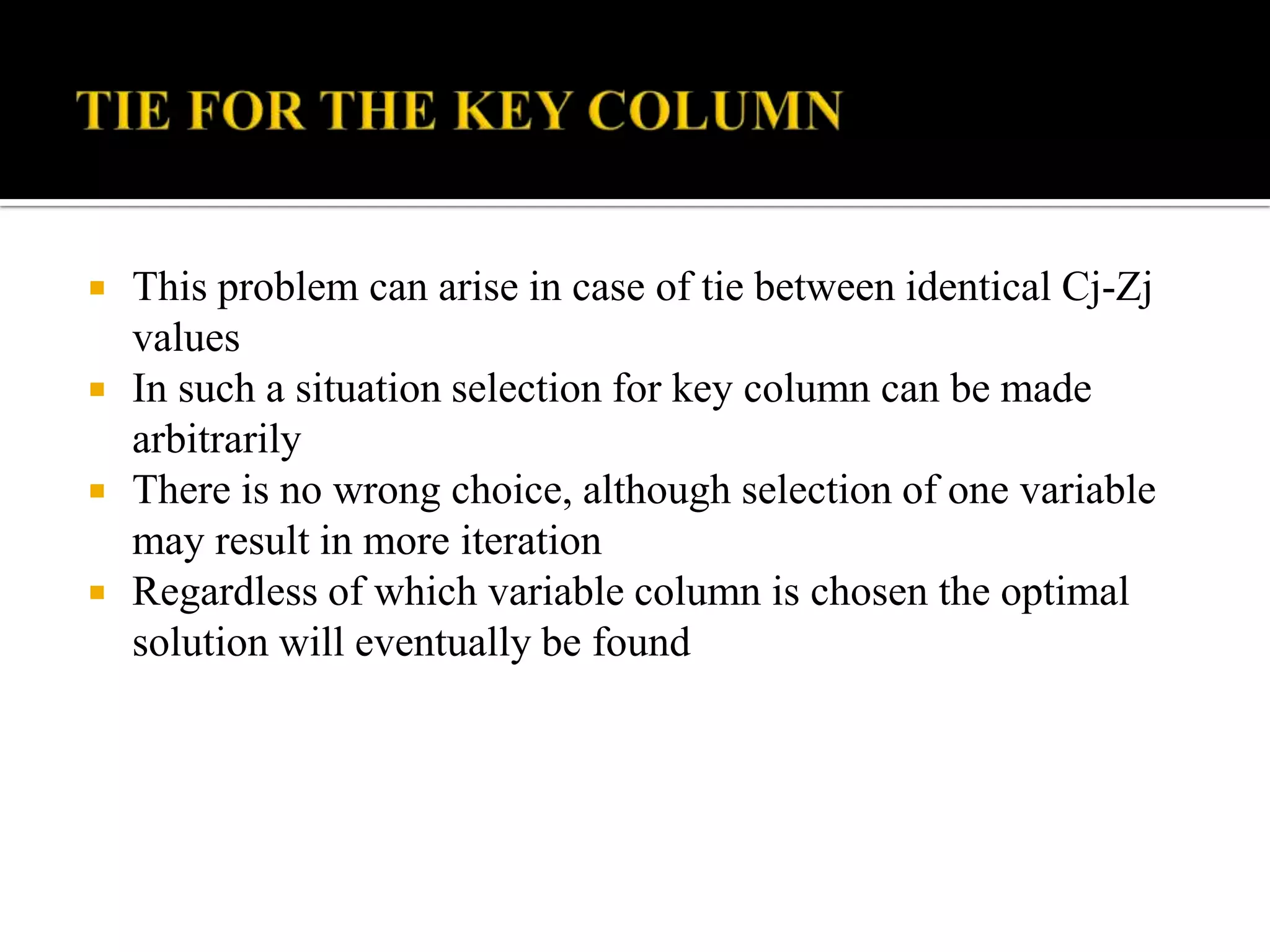
   This problem can arise in case of tie between identical Cj-Zj
    values
   In such a situation selection for key column can be made
    arbitrarily
   There is no wrong choice, although selection of one variable
    may result in more iteration
   Regardless of which variable column is chosen the optimal
    solution will eventually be found
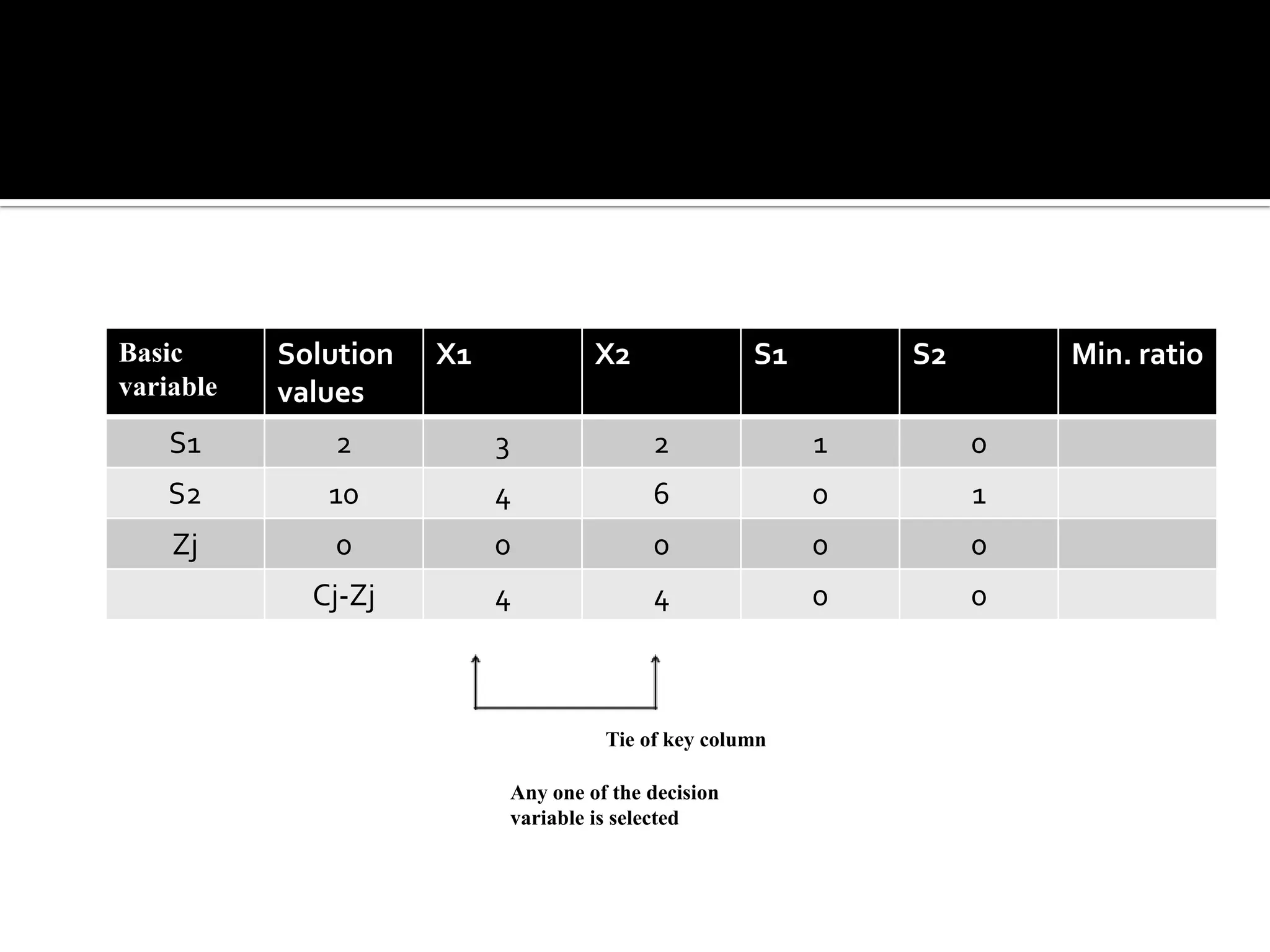
Basic      Solution   X1                X2               S1       S2       Min. ratio
variable   values
    S1         2           3                  2               1        0
    S2        10           4                  6               0        1
    Zj         0           0                  0               0        0
             Cj-Zj         4                  4               0        0


                                         Tie of key column

                               Any one of the decision
                               variable is selected
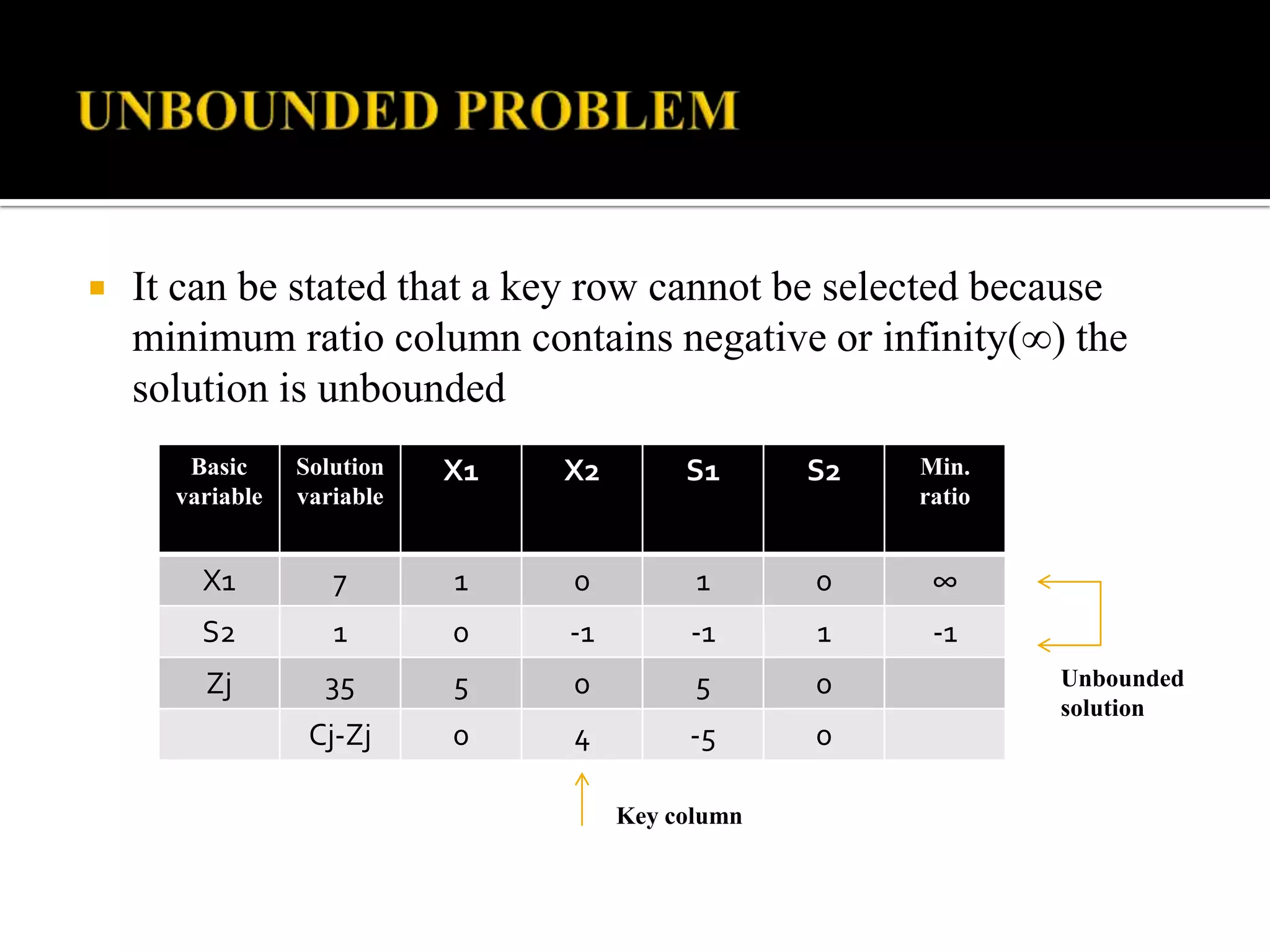
   It can be stated that a key row cannot be selected because
    minimum ratio column contains negative or infinity(∞) the
    solution is unbounded
       Basic     Solution   X1   X2        S1      S2   Min.
      variable   variable                               ratio


        X1          7       1    0          1      0     ∞
        S2          1       0    -1        -1      1     -1
        Zj         35       5    0          5      0            Unbounded
                                                                solution
                  Cj-Zj     0    4         -5      0

                                      Key column
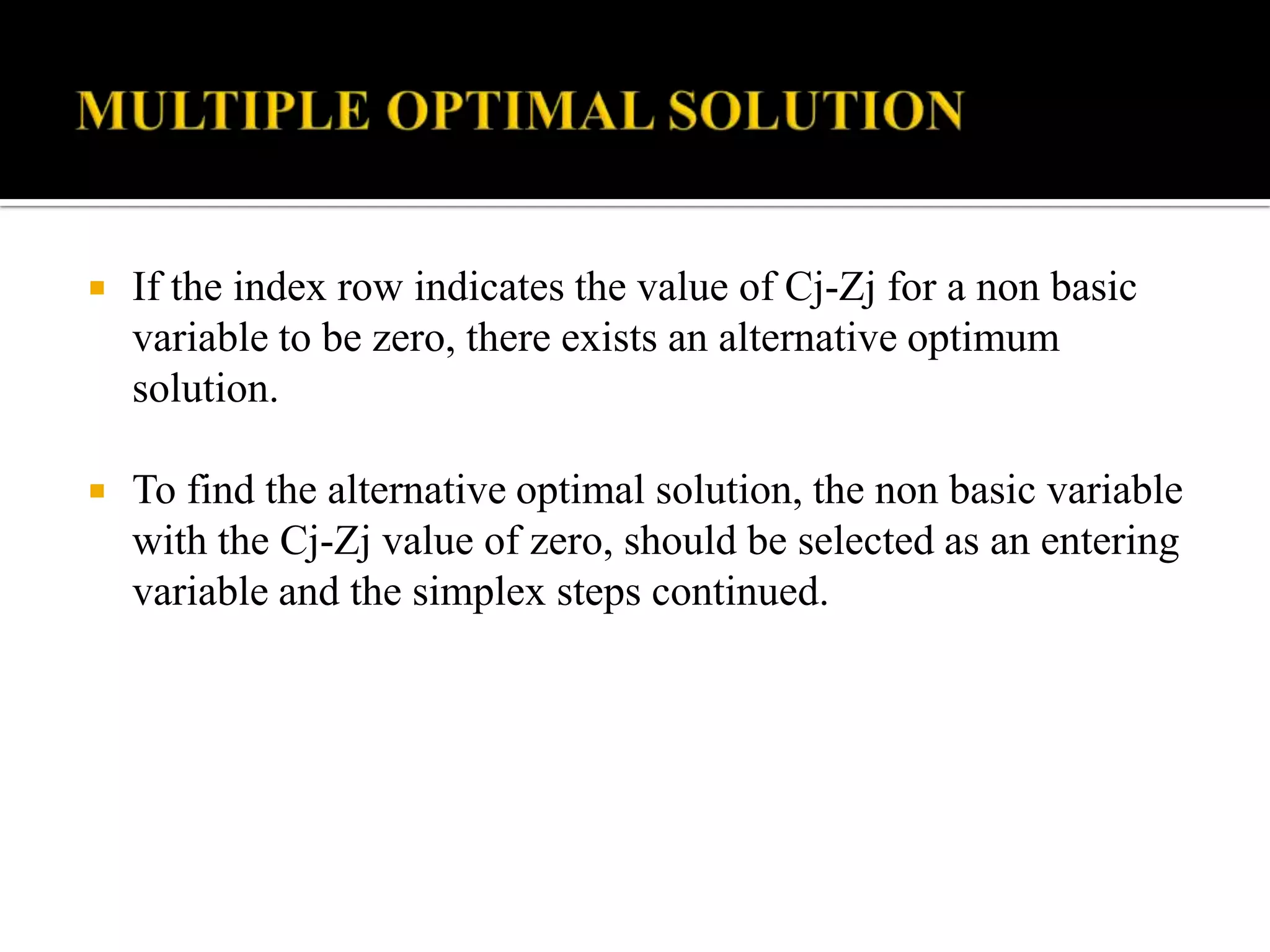
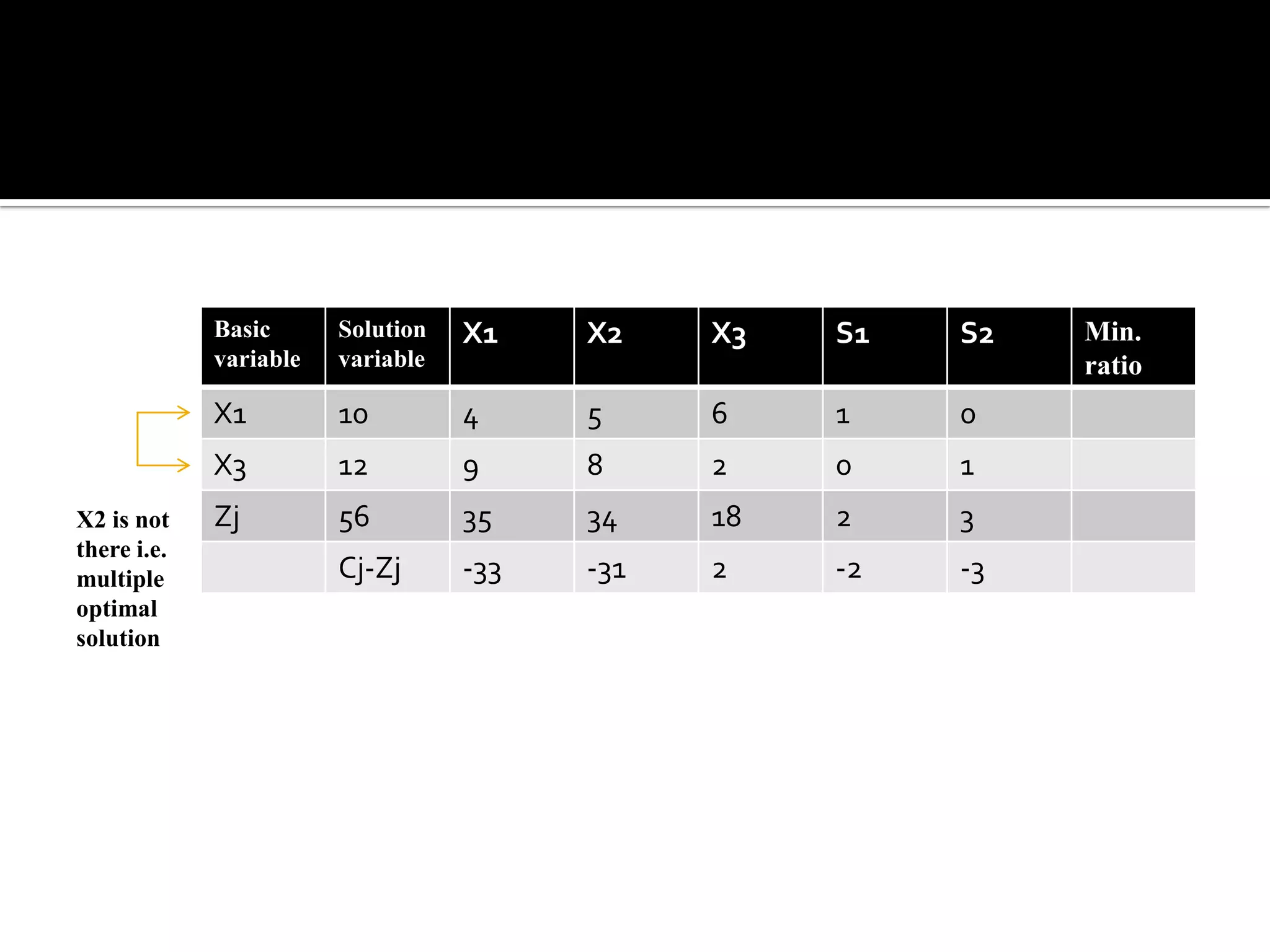
   If the index row indicates the value of Cj-Zj for a non basic
    variable to be zero, there exists an alternative optimum
    solution.

   To find the alternative optimal solution, the non basic variable
    with the Cj-Zj value of zero, should be selected as an entering
    variable and the simplex steps continued.
Basic      Solution   X1    X2    X3   S1   S2   Min.
             variable   variable                              ratio
             X1         10         4     5     6    1    0
             X3         12         9     8     2    0    1
X2 is not    Zj         56         35    34    18   2    3
there i.e.
multiple                Cj-Zj      -33   -31   2    -2   -3
optimal
solution
   This condition occurs when the problem has incompatible
    constraints
   In final simplex table, all Cj-Zj elements +ve or zero in case
    of minimization and –ve or zero in case of maximization
   And if the basic variable include artificial variable, then LPP
    got an infeasible solution
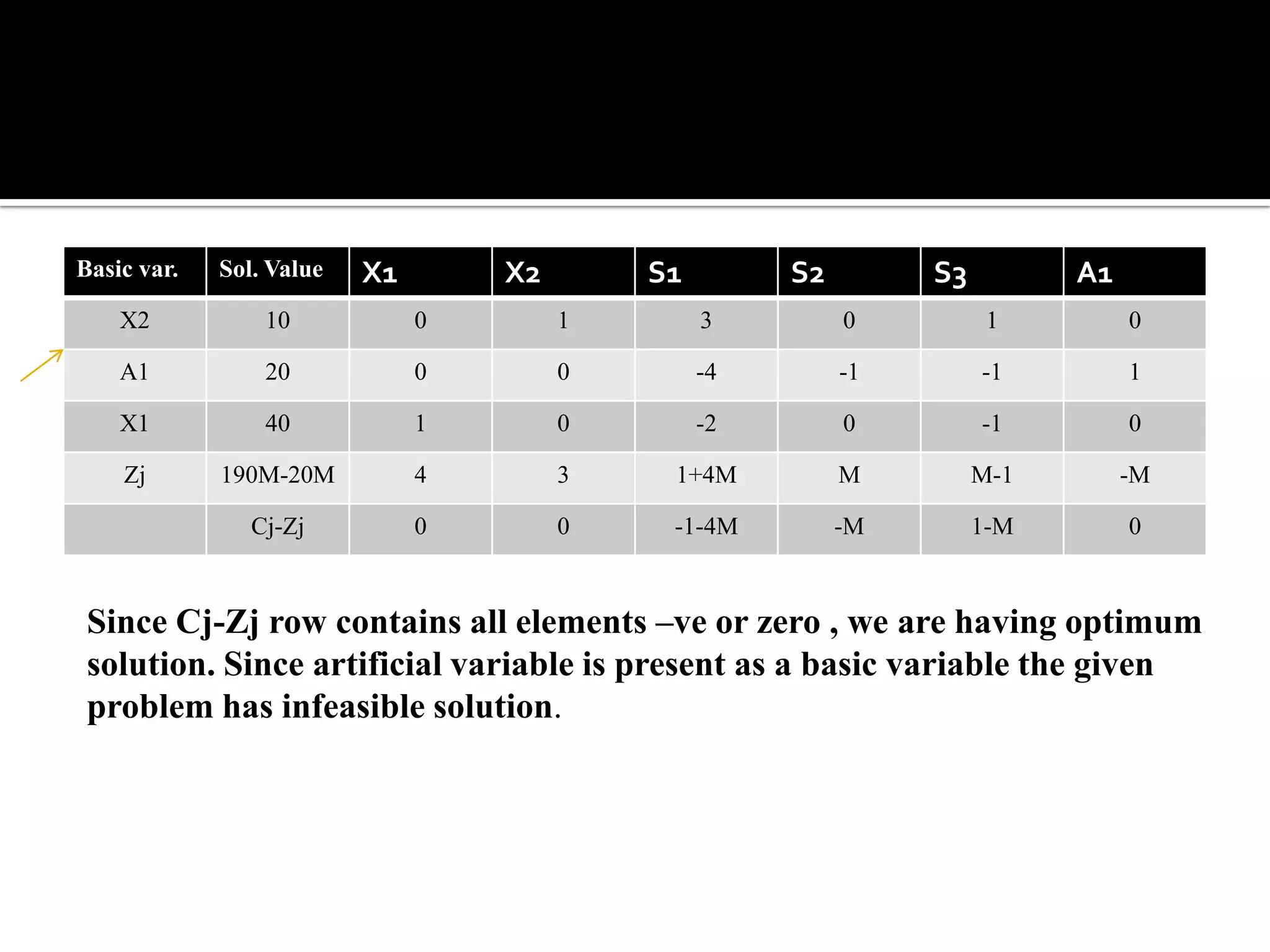
Basic var.   Sol. Value   X1       X2       S1        S2        S3         A1
    X2           10            0        1        3         0          1         0

    A1           20            0        0        -4        -1        -1         1

    X1           40            1        0        -2        0         -1         0

    Zj       190M-20M          4        3    1+4M          M         M-1        -M

                Cj-Zj          0        0    -1-4M         -M        1-M        0


 Since Cj-Zj row contains all elements –ve or zero , we are having optimum
 solution. Since artificial variable is present as a basic variable the given
 problem has infeasible solution.
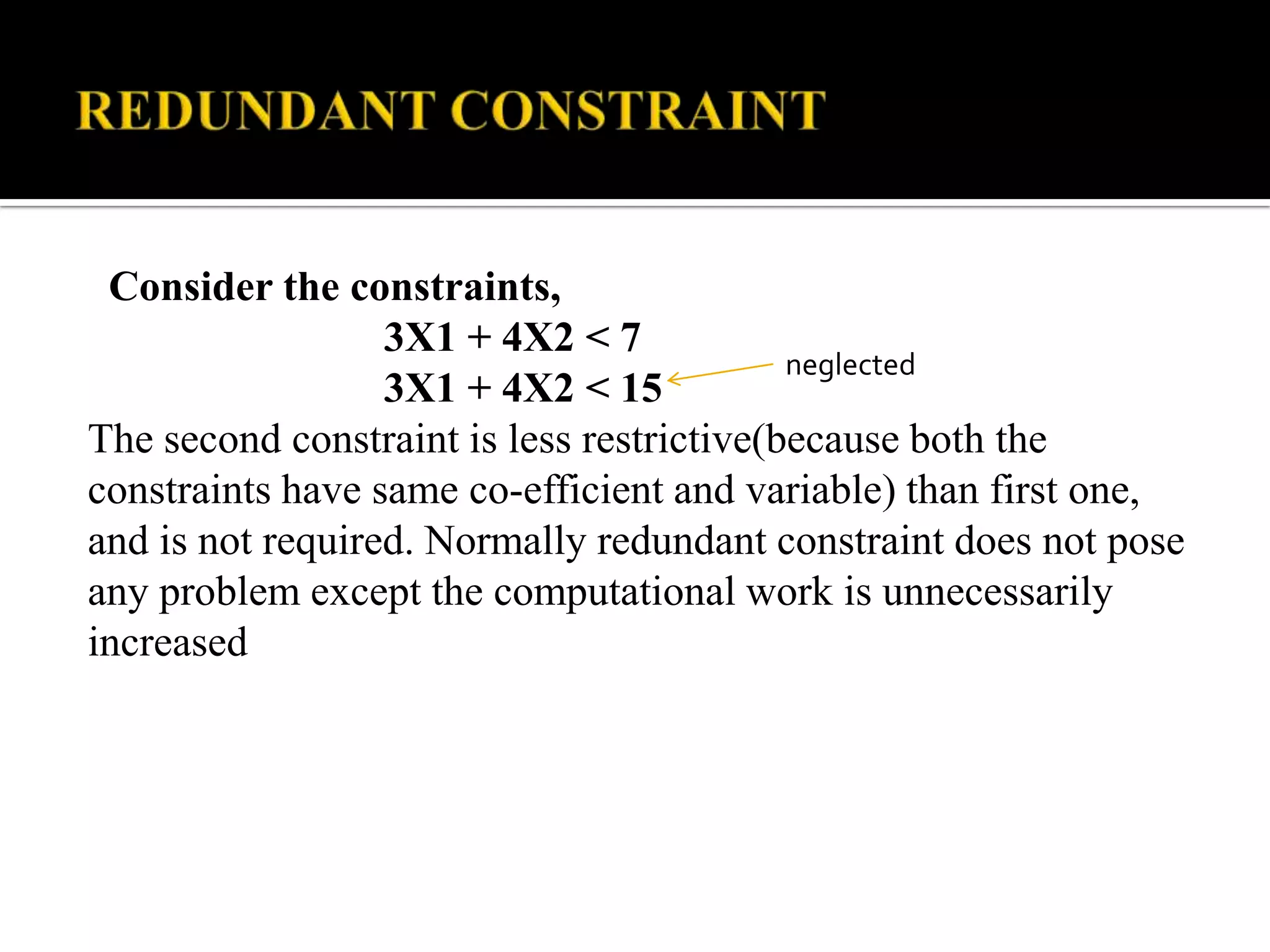
Consider the constraints,
                  3X1 + 4X2 < 7
                                           neglected
                  3X1 + 4X2 < 15
The second constraint is less restrictive(because both the
constraints have same co-efficient and variable) than first one,
and is not required. Normally redundant constraint does not pose
any problem except the computational work is unnecessarily
increased
   It is that decision variable which does not carry any value.

   To solve this problem, the variable can take two values i.e.
    one +ve & one –ve because difference between these two
    same +ve and –ve value is zero

   All variables become non-negative in the system and problem
    is solved.
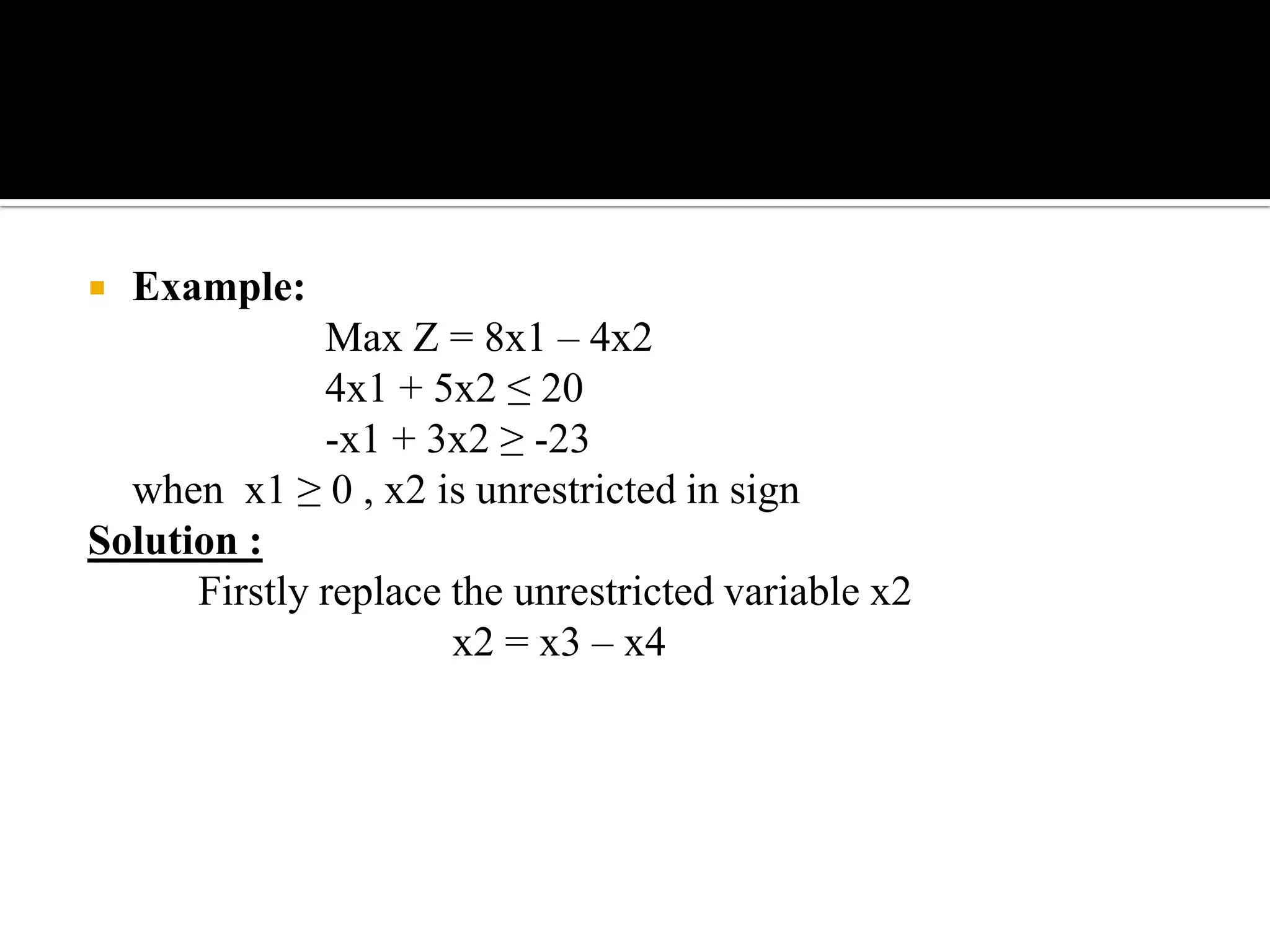
   Example:
              Max Z = 8x1 – 4x2
              4x1 + 5x2 ≤ 20
              -x1 + 3x2 ≥ -23
  when x1 ≥ 0 , x2 is unrestricted in sign
Solution :
      Firstly replace the unrestricted variable x2
                      x2 = x3 – x4
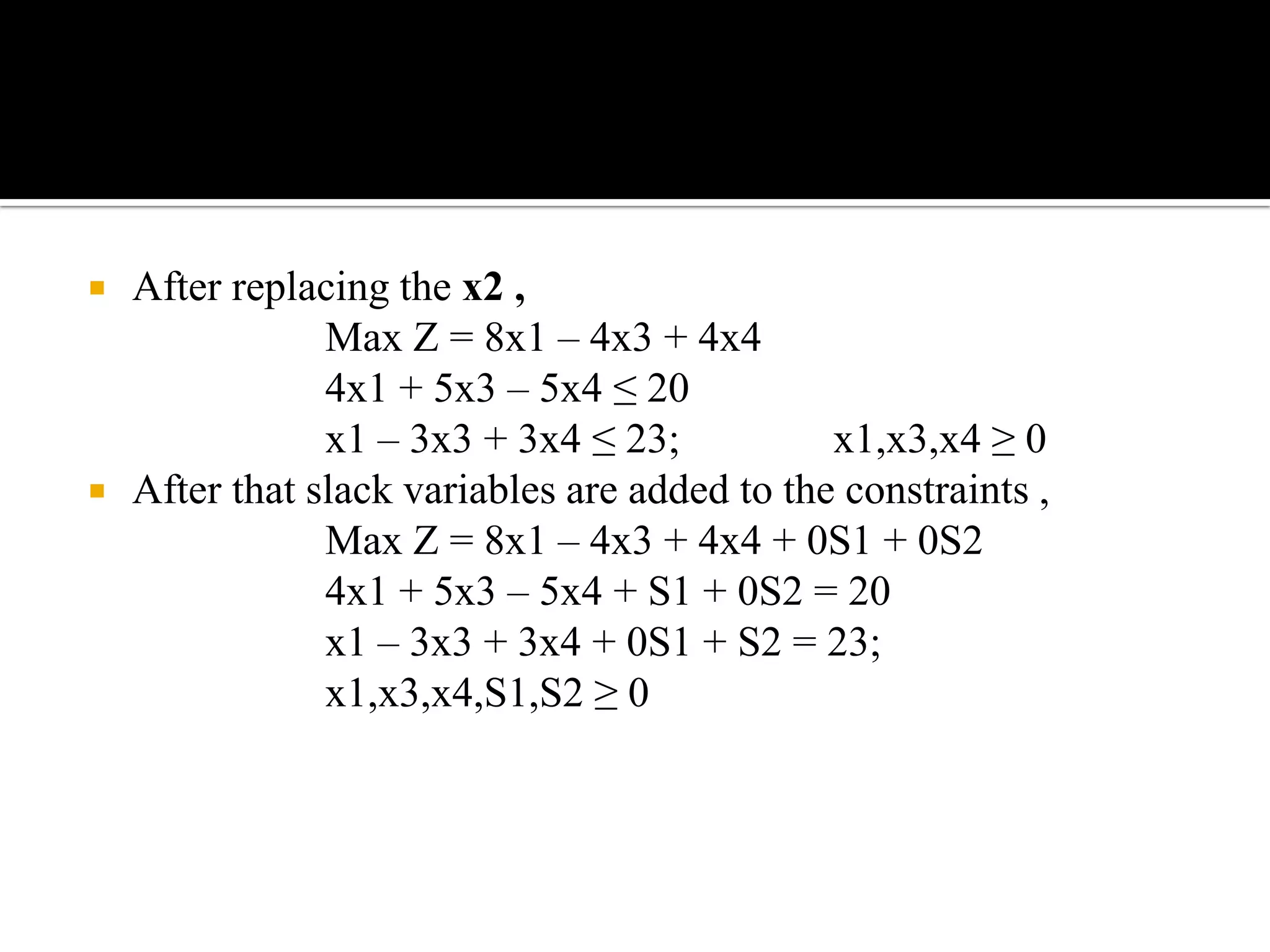
   After replacing the x2 ,
                Max Z = 8x1 – 4x3 + 4x4
                4x1 + 5x3 – 5x4 ≤ 20
                x1 – 3x3 + 3x4 ≤ 23;           x1,x3,x4 ≥ 0
   After that slack variables are added to the constraints ,
                Max Z = 8x1 – 4x3 + 4x4 + 0S1 + 0S2
                4x1 + 5x3 – 5x4 + S1 + 0S2 = 20
                x1 – 3x3 + 3x4 + 0S1 + S2 = 23;
                x1,x3,x4,S1,S2 ≥ 0
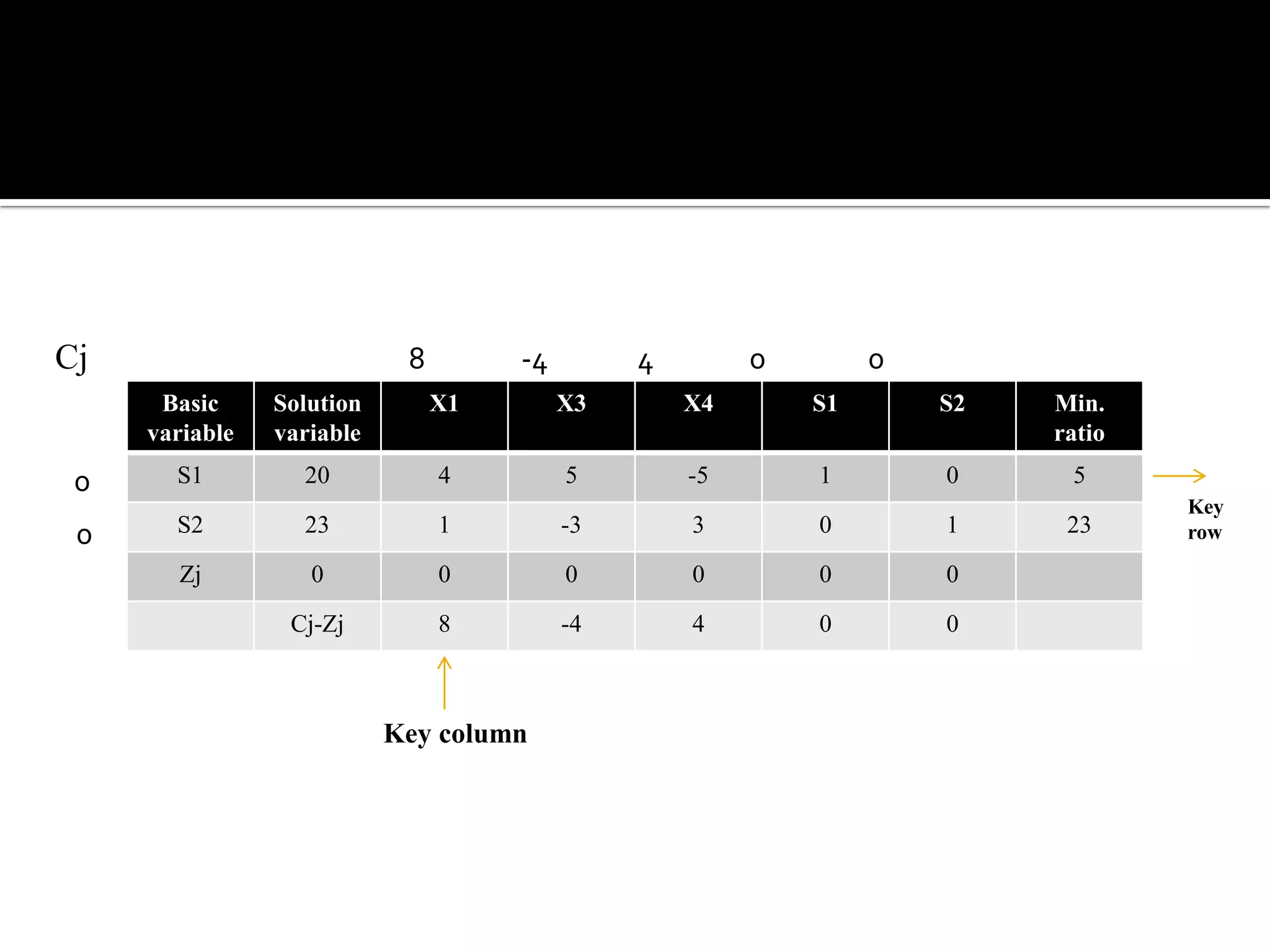
Cj                          8        -4        4        0        0
      Basic     Solution        X1        X3       X4       S1       S2   Min.
     variable   variable                                                  ratio

 0     S1         20            4         5        -5       1        0     5
                                                                                  Key
 0     S2         23            1         -3       3        0        1     23     row

        Zj         0            0         0        0        0        0

                 Cj-Zj          8         -4       4        0        0


                           Key column
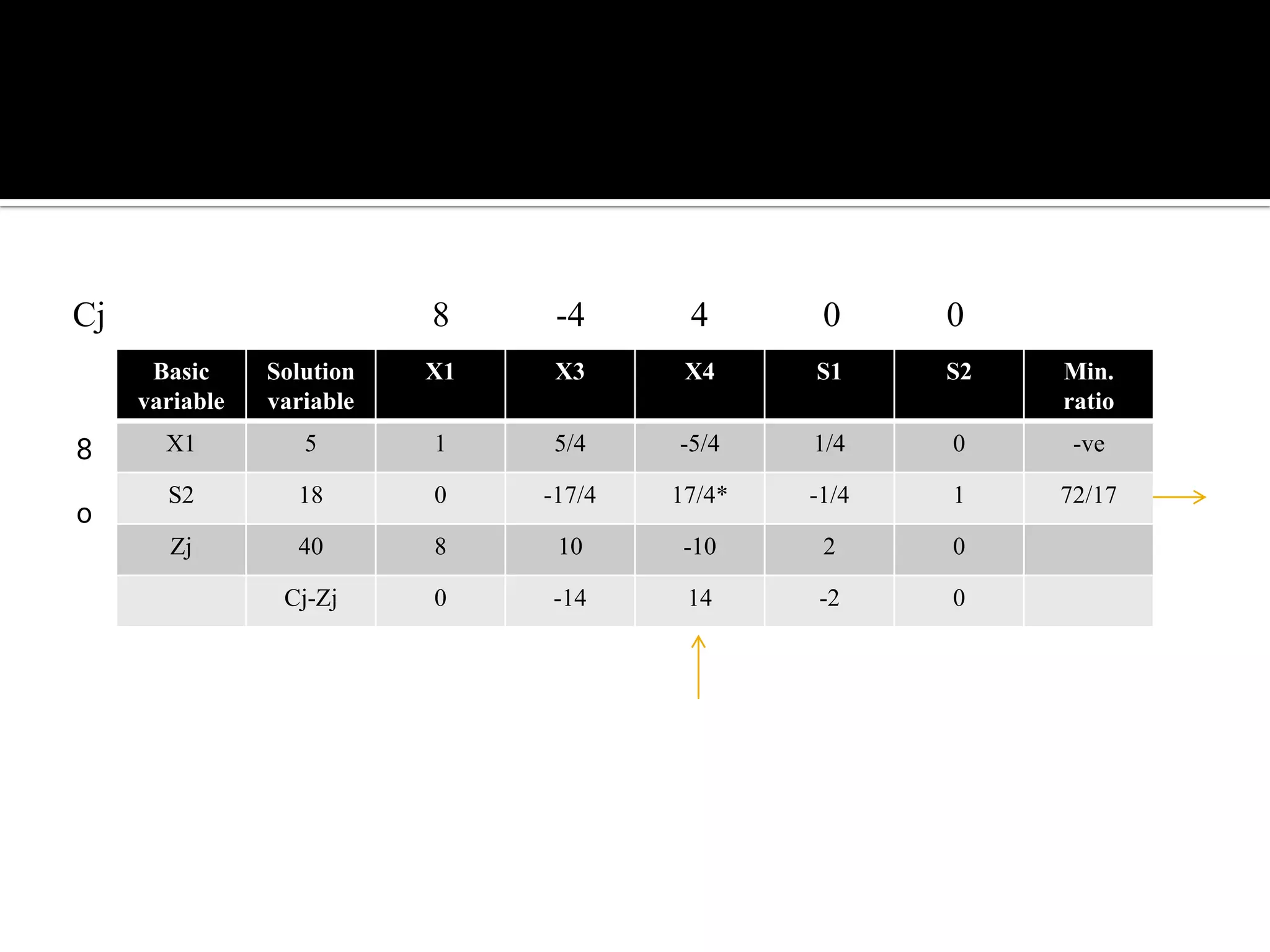
Cj                         8     -4      4       0     0
      Basic     Solution   X1    X3      X4     S1     S2   Min.
     variable   variable                                    ratio

8      X1          5       1    5/4     -5/4    1/4    0     -ve

       S2         18       0    -17/4   17/4*   -1/4   1    72/17
0
        Zj        40       8     10      -10     2     0

                 Cj-Zj     0    -14      14     -2     0
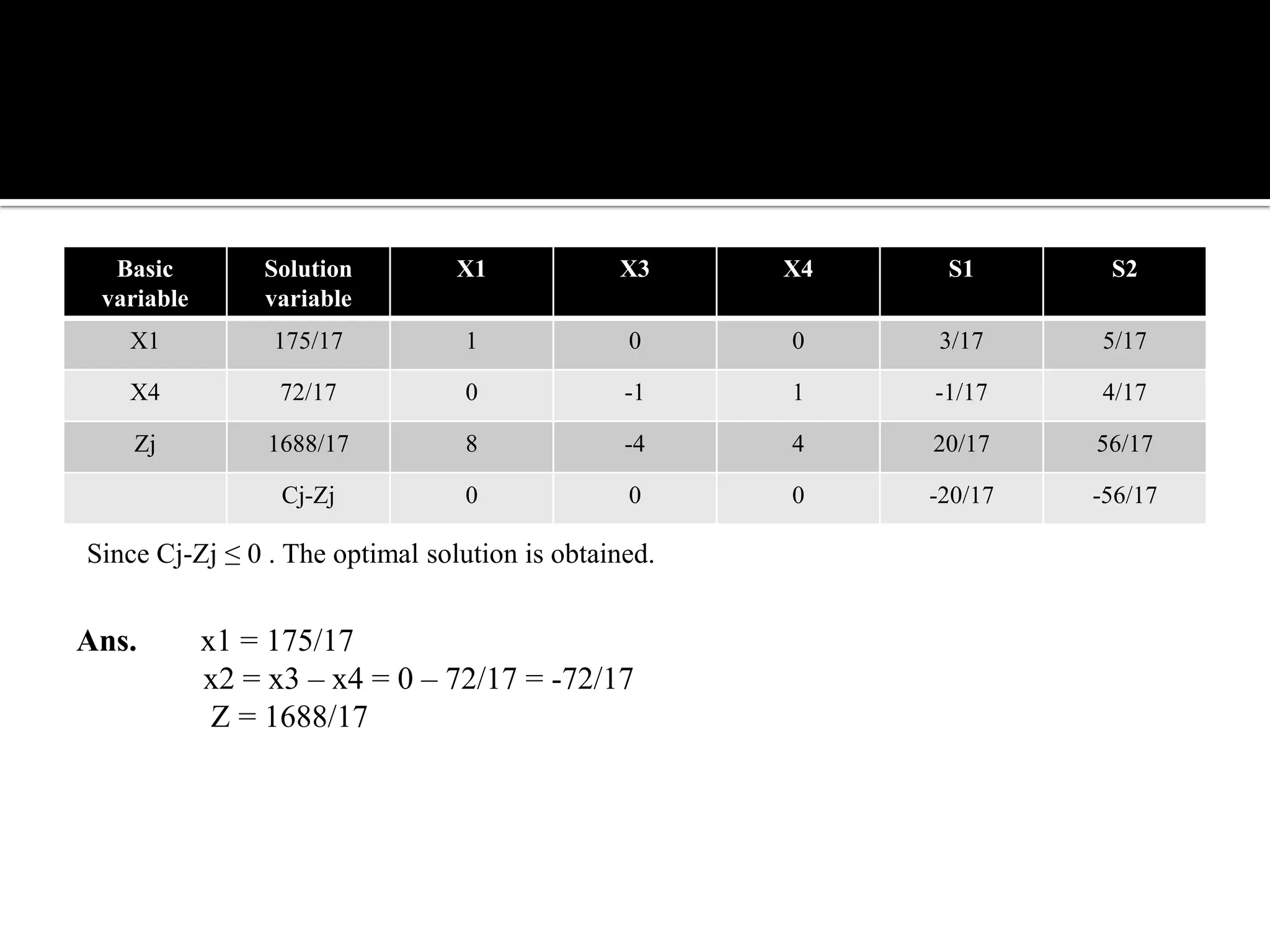
Basic         Solution         X1            X3     X4    S1       S2
 variable       variable
   X1            175/17          1              0     0    3/17     5/17

   X4             72/17          0              -1    1    -1/17    4/17

    Zj           1688/17         8              -4    4    20/17    56/17

                  Cj-Zj          0              0     0    -20/17   -56/17

Since Cj-Zj ≤ 0 . The optimal solution is obtained.


Ans.        x1 = 175/17
            x2 = x3 – x4 = 0 – 72/17 = -72/17
             Z = 1688/17
Presented by:-
Astha
Harpreet Singh
Shivani
Shweta

Operation Research (Simplex Method)

  • 2.
    Several complications canoccur while solving the LPP. Such problems are:  Tie for the key row(degeneracy)  Tie for the key column  Unbounded problems  Multiple optimal solutions  Infeasible problems  Redundant constraints  Unrestricted Variables
  • 3.
    Degeneracy occurs when there is tie for the minimum ratio(MR) for choosing the departing variable Basic Solution X1 X2 S1 S2 Min. variables variables ratio S1 20 4 9 1 0 5 S2 10 2 7 0 1 5 Zj 0 0 0 0 0 Tie of key Cj-Zj 5 3 0 0 row Key column
  • 4.
    Find the coefficient of the slack variables and divide each coefficient by the corresponding positive numbers of the key column in the row, starting from left to right in order to break the tie X1 is replaced by S1 S1 S2 Lowest element 1/4= 0.25 0/4= 0 and S1 row is a key row 0/2= 0 1/2= 0.5
  • 5.
    If the ratio do not break the tie, find the similar ratio for the coefficient of decision variables  Compare the resulting ratio, column by column  Select the row which contains smallest ratio.This row becomes the key row  After resolving of this tie, simplex method is applied to obtain the optimum solution
  • 6.
    This problem can arise in case of tie between identical Cj-Zj values  In such a situation selection for key column can be made arbitrarily  There is no wrong choice, although selection of one variable may result in more iteration  Regardless of which variable column is chosen the optimal solution will eventually be found
  • 7.
    Basic Solution X1 X2 S1 S2 Min. ratio variable values S1 2 3 2 1 0 S2 10 4 6 0 1 Zj 0 0 0 0 0 Cj-Zj 4 4 0 0 Tie of key column Any one of the decision variable is selected
  • 8.
    It can be stated that a key row cannot be selected because minimum ratio column contains negative or infinity(∞) the solution is unbounded Basic Solution X1 X2 S1 S2 Min. variable variable ratio X1 7 1 0 1 0 ∞ S2 1 0 -1 -1 1 -1 Zj 35 5 0 5 0 Unbounded solution Cj-Zj 0 4 -5 0 Key column
  • 9.
    If the index row indicates the value of Cj-Zj for a non basic variable to be zero, there exists an alternative optimum solution.  To find the alternative optimal solution, the non basic variable with the Cj-Zj value of zero, should be selected as an entering variable and the simplex steps continued.
  • 10.
    Basic Solution X1 X2 X3 S1 S2 Min. variable variable ratio X1 10 4 5 6 1 0 X3 12 9 8 2 0 1 X2 is not Zj 56 35 34 18 2 3 there i.e. multiple Cj-Zj -33 -31 2 -2 -3 optimal solution
  • 11.
    This condition occurs when the problem has incompatible constraints  In final simplex table, all Cj-Zj elements +ve or zero in case of minimization and –ve or zero in case of maximization  And if the basic variable include artificial variable, then LPP got an infeasible solution
  • 12.
    Basic var. Sol. Value X1 X2 S1 S2 S3 A1 X2 10 0 1 3 0 1 0 A1 20 0 0 -4 -1 -1 1 X1 40 1 0 -2 0 -1 0 Zj 190M-20M 4 3 1+4M M M-1 -M Cj-Zj 0 0 -1-4M -M 1-M 0 Since Cj-Zj row contains all elements –ve or zero , we are having optimum solution. Since artificial variable is present as a basic variable the given problem has infeasible solution.
  • 13.
    Consider the constraints, 3X1 + 4X2 < 7 neglected 3X1 + 4X2 < 15 The second constraint is less restrictive(because both the constraints have same co-efficient and variable) than first one, and is not required. Normally redundant constraint does not pose any problem except the computational work is unnecessarily increased
  • 14.
    It is that decision variable which does not carry any value.  To solve this problem, the variable can take two values i.e. one +ve & one –ve because difference between these two same +ve and –ve value is zero  All variables become non-negative in the system and problem is solved.
  • 15.
    Example: Max Z = 8x1 – 4x2 4x1 + 5x2 ≤ 20 -x1 + 3x2 ≥ -23 when x1 ≥ 0 , x2 is unrestricted in sign Solution : Firstly replace the unrestricted variable x2 x2 = x3 – x4
  • 16.
    After replacing the x2 , Max Z = 8x1 – 4x3 + 4x4 4x1 + 5x3 – 5x4 ≤ 20 x1 – 3x3 + 3x4 ≤ 23; x1,x3,x4 ≥ 0  After that slack variables are added to the constraints , Max Z = 8x1 – 4x3 + 4x4 + 0S1 + 0S2 4x1 + 5x3 – 5x4 + S1 + 0S2 = 20 x1 – 3x3 + 3x4 + 0S1 + S2 = 23; x1,x3,x4,S1,S2 ≥ 0
  • 17.
    Cj 8 -4 4 0 0 Basic Solution X1 X3 X4 S1 S2 Min. variable variable ratio 0 S1 20 4 5 -5 1 0 5 Key 0 S2 23 1 -3 3 0 1 23 row Zj 0 0 0 0 0 0 Cj-Zj 8 -4 4 0 0 Key column
  • 18.
    Cj 8 -4 4 0 0 Basic Solution X1 X3 X4 S1 S2 Min. variable variable ratio 8 X1 5 1 5/4 -5/4 1/4 0 -ve S2 18 0 -17/4 17/4* -1/4 1 72/17 0 Zj 40 8 10 -10 2 0 Cj-Zj 0 -14 14 -2 0
  • 19.
    Basic Solution X1 X3 X4 S1 S2 variable variable X1 175/17 1 0 0 3/17 5/17 X4 72/17 0 -1 1 -1/17 4/17 Zj 1688/17 8 -4 4 20/17 56/17 Cj-Zj 0 0 0 -20/17 -56/17 Since Cj-Zj ≤ 0 . The optimal solution is obtained. Ans. x1 = 175/17 x2 = x3 – x4 = 0 – 72/17 = -72/17 Z = 1688/17
  • 20.