Precipitation Titration
Precipitation Reactions
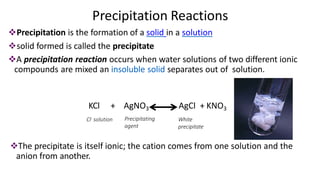
Precipitation is the formation of a solid in a solution
solid formed is called the precipitate
A precipitation reaction occurs when water solutions of two different ionic
compounds are mixed an insoluble solid separates out of solution.
The precipitate is itself ionic; the cation comes from one solution and the
anion from another.
KCl +
Cl- solution
AgNO3
Precipitating
agent
AgCl + KNO3
White
precipitate
Precipitation Titrations
Precipitation titration is a titration method based on the formation of precipitate, which is slightly soluble
The basic requirements are:
• The reaction must be sufficiently rapid and complete, lead to a product of reproducible
composition and of low solubility.
• And a method must exist to locate the end point.
Argentometric titration:
• Titrations involving silver are termed argentometric, from the Latin name for silver, argentum.
• The major precipitation reaction used is that of silver with a range of anions. These anions include:
• Halides (Cl-, Br-, I-)
• Pseudohalides (S2-, HS-, CN-, SCN-)
• The reaction rates for the silver salt precipitation is rapid.
• The reaction ratio is 1:1 and silver salts formed are generally quite insoluble.
• Argentometric methods involving precipitation titrimetry:
• Mohr’s Method
• Fajan’s Method
• Volhard’s Method
Mohr’s Method:
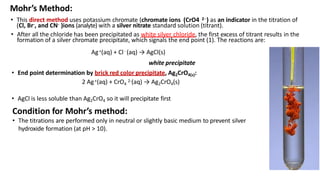
• This direct method uses potassium chromate (chromate ions (CrO4 2) as an indicator in the titration of
(Cl, Br-, and CN- )ions (analyte) with a silver nitrate standard solution (titrant).
• After all the chloride has been precipitated as white silver chloride, the first excess of titrant results in the
formation of a silver chromate precipitate, which signals the end point (1). The reactions are:
Ag+(aq) + Cl- (aq) → AgCl(s)
white precipitate
• End point determination by brick red color precipitate, Ag2CrO4(s):
2 Ag+(aq) + CrO4
2-(aq) → Ag2CrO4(s)
• AgCl is less soluble than Ag2CrO4 so it will precipitate first
Condition for Mohr’s method:
• The titrations are performed only in neutral or slightly basic medium to prevent silver
hydroxide formation (at pH > 10).
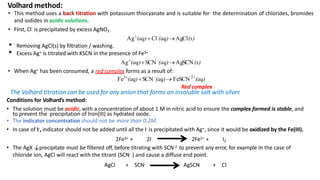
• This method uses a back titration with potassium thiocyanate and is suitable for the determination of chlorides, bromides
and iodides in acidic solutions.
• First, Cl- is precipitated by excess AgNO3
Ag
(aq) Cl-
(aq)AgCl(s)
• Removing AgCl(s) by filtration / washing.
• Excess Ag+ is titrated with KSCN in the presence of Fe3+
Ag
(aq)SCN -
(aq)AgSCN(s)
• When Ag+ has been consumed, a red complex forms as a result of:
Fe3
(aq)SCN -
(aq) FeSCN 2
(aq)
Red complex
Volhard method:
The Volhard titration can be used for any anion that forms an insoluble salt with silver.
Conditions for Volhard’s method:
• The solution must be acidic, with a concentration of about 1 M in nitric acid to ensure the complex formed is stable, and
to prevent the precipitation of Iron(III) as hydrated oxide.
• The indicator concentration should not be more than 0.2M.
• In case of I-, indicator should not be added until all the I- is precipitated with Ag+, since it would be oxidized by the Fe(III).
2Fe3+ + 2I- 2Fe2+ + I2
• The AgX ↓precipitate must be filtered off, before titrating with SCN-2 to prevent any error, for example in the case of
chloride ion, AgCl will react with the titrant (SCN- ) and cause a diffuse end point.
AgCl + SCN- AgSCN + Cl-
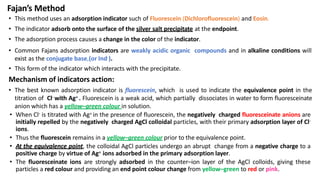
Fajan’s Method
• This method uses an adsorption indicator such of Fluorescein (Dichlorofluorescein) and Eosin.
• The indicator adsorb onto the surface of the silver salt precipitate at the endpoint.
• The adsorption process causes a change in the color of the indicator.
• Common Fajans adsorption indicators are weakly acidic organic compounds and in alkaline conditions will
exist as the conjugate base,(or Ind-).
• This form of the indicator which interacts with the precipitate.
Mechanism of indicators action:
• The best known adsorption indicator is fluorescein, which is used to indicate the equivalence point in the
titration of Cl- with Ag+ . Fluorescein is a weak acid, which partially dissociates in water to form fluoresceinate
anion which has a yellow–green colour in solution.
• When Cl- is titrated with Ag+ in the presence of fluorescein, the negatively charged fluoresceinate anions are
initially repelled by the negatively charged AgCl colloidal particles, with their primary adsorption layer of Cl-
ions.
• Thus the fluorescein remains in a yellow–green colour prior to the equivalence point.
• At the equivalence point, the colloidal AgCl particles undergo an abrupt change from a negative charge to a
positive charge by virtue of Ag+ ions adsorbed in the primary adsorption layer.
• The fluoresceinate ions are strongly adsorbed in the counter–ion layer of the AgCl colloids, giving these
particles a red colour and providing an end point colour change from yellow–green to red or pink.
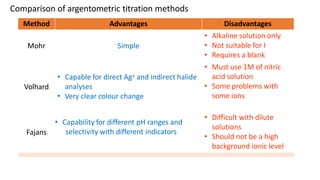
Comparison of argentometric titration methods
Method Advantages Disadvantages
Mohr Simple
• Alkaline solution only
• Not suitable for I-
• Requires a blank
Volhard
• Capable for direct Ag+ and indirect halide
analyses
• Very clear colour change
• Must use 1M of nitric
acid solution
• Some problems with
some ions
Fajans
• Capability for different pH ranges and
selectivity with different indicators
• Difficult with dilute
solutions
• Should not be a high
background ionic level

PRECIPITATION TITRATION IN PHARM ANALYSIS

  • 1.
  • 2.
    Precipitation Reactions Precipitation isthe formation of a solid in a solution solid formed is called the precipitate A precipitation reaction occurs when water solutions of two different ionic compounds are mixed an insoluble solid separates out of solution. The precipitate is itself ionic; the cation comes from one solution and the anion from another. KCl + Cl- solution AgNO3 Precipitating agent AgCl + KNO3 White precipitate
  • 3.
    Precipitation Titrations Precipitation titrationis a titration method based on the formation of precipitate, which is slightly soluble The basic requirements are: • The reaction must be sufficiently rapid and complete, lead to a product of reproducible composition and of low solubility. • And a method must exist to locate the end point. Argentometric titration: • Titrations involving silver are termed argentometric, from the Latin name for silver, argentum. • The major precipitation reaction used is that of silver with a range of anions. These anions include: • Halides (Cl-, Br-, I-) • Pseudohalides (S2-, HS-, CN-, SCN-) • The reaction rates for the silver salt precipitation is rapid. • The reaction ratio is 1:1 and silver salts formed are generally quite insoluble. • Argentometric methods involving precipitation titrimetry: • Mohr’s Method • Fajan’s Method • Volhard’s Method
  • 4.
    Mohr’s Method: • Thisdirect method uses potassium chromate (chromate ions (CrO4 2) as an indicator in the titration of (Cl, Br-, and CN- )ions (analyte) with a silver nitrate standard solution (titrant). • After all the chloride has been precipitated as white silver chloride, the first excess of titrant results in the formation of a silver chromate precipitate, which signals the end point (1). The reactions are: Ag+(aq) + Cl- (aq) → AgCl(s) white precipitate • End point determination by brick red color precipitate, Ag2CrO4(s): 2 Ag+(aq) + CrO4 2-(aq) → Ag2CrO4(s) • AgCl is less soluble than Ag2CrO4 so it will precipitate first Condition for Mohr’s method: • The titrations are performed only in neutral or slightly basic medium to prevent silver hydroxide formation (at pH > 10).
  • 5.
    • This methoduses a back titration with potassium thiocyanate and is suitable for the determination of chlorides, bromides and iodides in acidic solutions. • First, Cl- is precipitated by excess AgNO3 Ag (aq) Cl- (aq)AgCl(s) • Removing AgCl(s) by filtration / washing. • Excess Ag+ is titrated with KSCN in the presence of Fe3+ Ag (aq)SCN - (aq)AgSCN(s) • When Ag+ has been consumed, a red complex forms as a result of: Fe3 (aq)SCN - (aq) FeSCN 2 (aq) Red complex Volhard method: The Volhard titration can be used for any anion that forms an insoluble salt with silver. Conditions for Volhard’s method: • The solution must be acidic, with a concentration of about 1 M in nitric acid to ensure the complex formed is stable, and to prevent the precipitation of Iron(III) as hydrated oxide. • The indicator concentration should not be more than 0.2M. • In case of I-, indicator should not be added until all the I- is precipitated with Ag+, since it would be oxidized by the Fe(III). 2Fe3+ + 2I- 2Fe2+ + I2 • The AgX ↓precipitate must be filtered off, before titrating with SCN-2 to prevent any error, for example in the case of chloride ion, AgCl will react with the titrant (SCN- ) and cause a diffuse end point. AgCl + SCN- AgSCN + Cl-
  • 6.
    Fajan’s Method • Thismethod uses an adsorption indicator such of Fluorescein (Dichlorofluorescein) and Eosin. • The indicator adsorb onto the surface of the silver salt precipitate at the endpoint. • The adsorption process causes a change in the color of the indicator. • Common Fajans adsorption indicators are weakly acidic organic compounds and in alkaline conditions will exist as the conjugate base,(or Ind-). • This form of the indicator which interacts with the precipitate. Mechanism of indicators action: • The best known adsorption indicator is fluorescein, which is used to indicate the equivalence point in the titration of Cl- with Ag+ . Fluorescein is a weak acid, which partially dissociates in water to form fluoresceinate anion which has a yellow–green colour in solution. • When Cl- is titrated with Ag+ in the presence of fluorescein, the negatively charged fluoresceinate anions are initially repelled by the negatively charged AgCl colloidal particles, with their primary adsorption layer of Cl- ions. • Thus the fluorescein remains in a yellow–green colour prior to the equivalence point. • At the equivalence point, the colloidal AgCl particles undergo an abrupt change from a negative charge to a positive charge by virtue of Ag+ ions adsorbed in the primary adsorption layer. • The fluoresceinate ions are strongly adsorbed in the counter–ion layer of the AgCl colloids, giving these particles a red colour and providing an end point colour change from yellow–green to red or pink.
  • 7.
    Comparison of argentometrictitration methods Method Advantages Disadvantages Mohr Simple • Alkaline solution only • Not suitable for I- • Requires a blank Volhard • Capable for direct Ag+ and indirect halide analyses • Very clear colour change • Must use 1M of nitric acid solution • Some problems with some ions Fajans • Capability for different pH ranges and selectivity with different indicators • Difficult with dilute solutions • Should not be a high background ionic level