DIAZOTIZATION TITRTIONS
.
PRESENTED BY: SHWETHA M
1ST M. PHARMACY.
INTRODUCTION:
The process of forming diazonium salts or compound is called as
diazotization.
Diazonium compounds are group of organic compounds sharing a common
functional group with the characteristic structure of R-N2+X, where R can be
any organic group residue such as alkyl or aryl group and X is inorganic or
organic anion such as halogen.
In diazotization titration primary aromatic amine reacts with the sodium
nitrite in acidic solution to form diazonium salts.
Ex:
Diazonium complex
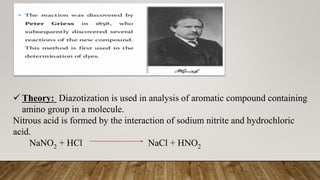
 Theory: Diazotization is used in analysis of aromatic compound containing
amino group in a molecule.
Nitrous acid is formed by the interaction of sodium nitrite and hydrochloric
acid.
NaNO2 + HCl NaCl + HNO2
When all aromatic amine has reacted with nitrous acid then excess of
nitrous acid that remains in the solution and can be detected by using starch-
iodide paper as external indicator. The appearance of free HNO2 indicates the
completion of reaction.
(It is important to check the acidity at the end point of the titration. If there is no
excess acid present, starch-iodide paper will not detect the end point).
This reaction act as both qualitative and quantitative, under controlled condition
it can be used for estimation of many compound containing free aromatic amino
group.
 Determination of end point: -
 Visual end point method:
KI + HCl HI + KCl
2HI + 2 HNO2 I2+ 2NO+ 2H2O
 Potentiometry:
 Conditions for diazotization: -
 Rate of titration: Different amino compound reacts with HNO2 at different
rate.
Based on their rate they are classified as;
 Slowly diazotisable: Sulphanilic acid
 Fast diazotisable: Aniline , Toluidine
 Amperometry:
 Dead stop end point method:
 Temperature: -
The diazonium compound so formed are instable and readily decompose at
elevated temperature.
This can lead to side reaction and give wrong results to eliminate this
titration is carried out at low temperature (0-50c). optimum temperature
is 10-150c
 Compounds that can be assayed by diazotization titrations: -
 Dapsone
 Benzocaine
 Calcium amino salicylate
 Phthalylsulphathiazole
 Sulphadoxine
 Titrant used: - 0.1 M sodium nitrite
 Preparation: - Weigh accurately about 7.5g of sodium nitrite and add
sufficient distilled water to produce 1L in 1000mL volumetric flask.
 Standardisation of 0.1 m sodium nitrite: -
 Materials required:
1. Sulphanilamide
2. Hydrochloric acid
3. 0.1M sodium nitrite.
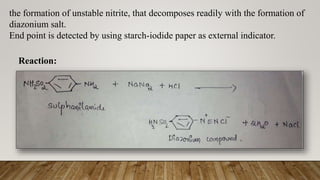
Principle:
Nitrous acid is which is generated upon the interaction of sodium nitrite and
hydrochloric acid reacts with primary amino group of sulphanilamide, results in
the formation of unstable nitrite, that decomposes readily with the formation of
diazonium salt.
End point is detected by using starch-iodide paper as external indicator.
Reaction:
 Procedure:
Dissolve 0.5g of sulphanilamide and transfer it into a beaker and add 20mL of
hydrochloric acid and 50mL of distilled water, cool the content of the flask in an
ice bath and titrated with sodium nitrite solution and determine the end point by
using starch-iodide paper as an external indicator.
Each mL of 0.1 M sodium nitrite is equivalent to 0.01722 g of sulphanilamide
Assay of Dapsone: -
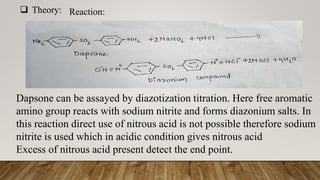
 Theory: Reaction:
Dapsone can be assayed by diazotization titration. Here free aromatic
amino group reacts with sodium nitrite and forms diazonium salts. In
this reaction direct use of nitrous acid is not possible therefore sodium
nitrite is used which in acidic condition gives nitrous acid
Excess of nitrous acid present detect the end point.
 Procedure:
 weigh accurately about 0.5g of Dapsone and dissolve in a mixture of
20mL of water and 20mL of HCl
 Cool the solution to about 150c and carry out the titration with sodium
nitrite.
 The contents of the flask are shaken thoroughly and continuously until
blue colour is appeared when a drop of solution is placed on starch-
iodide paper.
 Each mL of 0.1 M sodium nitrite is equivalent to 0.01242g of dapsone.
 Assay of Sulphamethoxazole: -
Sulphamethoxazole
Sulphamethoxazole can be titrated by using diazotization method being a
primary amine it will reacts with the sodium nitrite in acidic solution and forms
diazonium salt. Under the controlled condition reaction is quantitative and it
can be used for determination of various compound containing free aromatic
amino group.
 Theory:
End point can be detected by using starch-iodide paper.
 Procedure:
 Weigh accurately about 0.5g Sulphamethoxazole sample and dissolve in 50
mL of 2 M HCl. Cool it in ice bath
 Add 2g of KI to it and dissolve completely and titrate against 0.1 M sodium
nitrite by using starch-iodide paper as external indicator.
 Each mL of 0.1 M sodium nitrite is equivalent to 0.02528g of
Sulphamethoxazole.
Application of diazotization titration: -
Diazonium salts are used to produce water-fast dyed fabrics.
It is also applicable in Nano technology.
It is also used in the preparation of hydrocarbons, aryl halide, aryl
cyanide and aryl hydrazine.
It is used in the assay of sulpha drugs like dapsone, sulphonamide
and etc...
It is used in assay of various drugs like benzocaine, procainamide,
procaine, suramin, sodium salicylate, primaquine sulphate.
Diazotization titrtions

Diazotization titrtions

  • 1.
    DIAZOTIZATION TITRTIONS . PRESENTED BY:SHWETHA M 1ST M. PHARMACY.
  • 2.
    INTRODUCTION: The process offorming diazonium salts or compound is called as diazotization. Diazonium compounds are group of organic compounds sharing a common functional group with the characteristic structure of R-N2+X, where R can be any organic group residue such as alkyl or aryl group and X is inorganic or organic anion such as halogen. In diazotization titration primary aromatic amine reacts with the sodium nitrite in acidic solution to form diazonium salts.
  • 3.
  • 4.
     Theory: Diazotizationis used in analysis of aromatic compound containing amino group in a molecule. Nitrous acid is formed by the interaction of sodium nitrite and hydrochloric acid. NaNO2 + HCl NaCl + HNO2
  • 5.
    When all aromaticamine has reacted with nitrous acid then excess of nitrous acid that remains in the solution and can be detected by using starch- iodide paper as external indicator. The appearance of free HNO2 indicates the completion of reaction. (It is important to check the acidity at the end point of the titration. If there is no excess acid present, starch-iodide paper will not detect the end point). This reaction act as both qualitative and quantitative, under controlled condition it can be used for estimation of many compound containing free aromatic amino group.
  • 6.
     Determination ofend point: -  Visual end point method: KI + HCl HI + KCl 2HI + 2 HNO2 I2+ 2NO+ 2H2O  Potentiometry:
  • 7.
     Conditions fordiazotization: -  Rate of titration: Different amino compound reacts with HNO2 at different rate. Based on their rate they are classified as;  Slowly diazotisable: Sulphanilic acid  Fast diazotisable: Aniline , Toluidine  Amperometry:  Dead stop end point method:
  • 8.
     Temperature: - Thediazonium compound so formed are instable and readily decompose at elevated temperature. This can lead to side reaction and give wrong results to eliminate this titration is carried out at low temperature (0-50c). optimum temperature is 10-150c  Compounds that can be assayed by diazotization titrations: -  Dapsone  Benzocaine  Calcium amino salicylate  Phthalylsulphathiazole  Sulphadoxine
  • 9.
     Titrant used:- 0.1 M sodium nitrite  Preparation: - Weigh accurately about 7.5g of sodium nitrite and add sufficient distilled water to produce 1L in 1000mL volumetric flask.  Standardisation of 0.1 m sodium nitrite: -  Materials required: 1. Sulphanilamide 2. Hydrochloric acid 3. 0.1M sodium nitrite. Principle: Nitrous acid is which is generated upon the interaction of sodium nitrite and hydrochloric acid reacts with primary amino group of sulphanilamide, results in
  • 10.
    the formation ofunstable nitrite, that decomposes readily with the formation of diazonium salt. End point is detected by using starch-iodide paper as external indicator. Reaction:
  • 11.
     Procedure: Dissolve 0.5gof sulphanilamide and transfer it into a beaker and add 20mL of hydrochloric acid and 50mL of distilled water, cool the content of the flask in an ice bath and titrated with sodium nitrite solution and determine the end point by using starch-iodide paper as an external indicator. Each mL of 0.1 M sodium nitrite is equivalent to 0.01722 g of sulphanilamide Assay of Dapsone: -
  • 12.
     Theory: Reaction: Dapsonecan be assayed by diazotization titration. Here free aromatic amino group reacts with sodium nitrite and forms diazonium salts. In this reaction direct use of nitrous acid is not possible therefore sodium nitrite is used which in acidic condition gives nitrous acid Excess of nitrous acid present detect the end point.
  • 13.
     Procedure:  weighaccurately about 0.5g of Dapsone and dissolve in a mixture of 20mL of water and 20mL of HCl  Cool the solution to about 150c and carry out the titration with sodium nitrite.  The contents of the flask are shaken thoroughly and continuously until blue colour is appeared when a drop of solution is placed on starch- iodide paper.  Each mL of 0.1 M sodium nitrite is equivalent to 0.01242g of dapsone.
  • 14.
     Assay ofSulphamethoxazole: - Sulphamethoxazole
  • 15.
    Sulphamethoxazole can betitrated by using diazotization method being a primary amine it will reacts with the sodium nitrite in acidic solution and forms diazonium salt. Under the controlled condition reaction is quantitative and it can be used for determination of various compound containing free aromatic amino group.  Theory:
  • 16.
    End point canbe detected by using starch-iodide paper.  Procedure:  Weigh accurately about 0.5g Sulphamethoxazole sample and dissolve in 50 mL of 2 M HCl. Cool it in ice bath  Add 2g of KI to it and dissolve completely and titrate against 0.1 M sodium nitrite by using starch-iodide paper as external indicator.  Each mL of 0.1 M sodium nitrite is equivalent to 0.02528g of Sulphamethoxazole.
  • 17.
    Application of diazotizationtitration: - Diazonium salts are used to produce water-fast dyed fabrics. It is also applicable in Nano technology. It is also used in the preparation of hydrocarbons, aryl halide, aryl cyanide and aryl hydrazine. It is used in the assay of sulpha drugs like dapsone, sulphonamide and etc... It is used in assay of various drugs like benzocaine, procainamide, procaine, suramin, sodium salicylate, primaquine sulphate.