Welcome
to
My presentation
Name: MD. Zahirul Isalam
Roll:333
Batch:12th
Department of Pharmacy
World University of Bangladesh
Presentation
of
Non Aqueous Acid base
titration
Non Aqueous acid base titration
Non aqueous titration are those in
which titration of weakly acidic or
basic substances are carried out
using non aqueous solvents so as to
get sharp end point
It is the most common titrimetric
procedure used in pharmacopoeial
assays and serves a double purpose:
Types of solvents
The solvents are divided into 4 groups
1. Aprotic solvents
2. Protophilic solvents
3. Protogenic solvents
4. Amphiprotic solvents
Aprotic solvents
Aprotic solvents are neutral, chemically inert substances
such as benzene and chloroform.
They have a low dielectric constant, do not react with
either acids or bases and therefore do not favor
ionaization.
This type of solvents neither accept or donate protons
Ex:-Benzene , dioxan , chlprobenene,chloroform,ethyl
acetate, carbon tetra chloride.
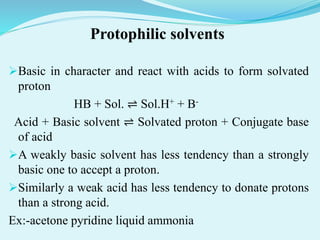
Protophilic solvents
Basic in character and react with acids to form solvated
proton
HB + Sol. ⇌ Sol.H+ + B-
Acid + Basic solvent ⇌ Solvated proton + Conjugate base
of acid
A weakly basic solvent has less tendency than a strongly
basic one to accept a proton.
Similarly a weak acid has less tendency to donate protons
than a strong acid.
Ex:-acetone pyridine liquid ammonia
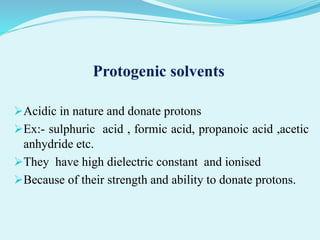
Protogenic solvents
Acidic in nature and donate protons
Ex:- sulphuric acid , formic acid, propanoic acid ,acetic
anhydride etc.
They have high dielectric constant and ionised
Because of their strength and ability to donate protons.
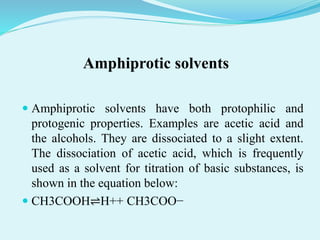
Amphiprotic solvents
 Amphiprotic solvents have both protophilic and
protogenic properties. Examples are acetic acid and
the alcohols. They are dissociated to a slight extent.
The dissociation of acetic acid, which is frequently
used as a solvent for titration of basic substances, is
shown in the equation below:
 CH3COOH⇌H++ CH3COO−
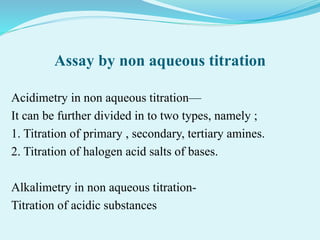
Assay by non aqueous titration
Acidimetry in non aqueous titration—
It can be further divided in to two types, namely ;
1. Titration of primary , secondary, tertiary amines.
2. Titration of halogen acid salts of bases.
Alkalimetry in non aqueous titration-
Titration of acidic substances
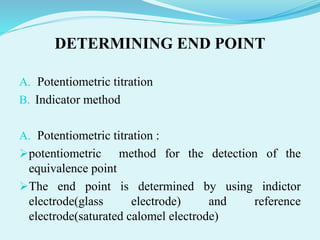
DETERMINING END POINT
A. Potentiometric titration
B. Indicator method
A. Potentiometric titration :
potentiometric method for the detection of the
equivalence point
The end point is determined by using indictor
electrode(glass electrode) and reference
electrode(saturated calomel electrode)
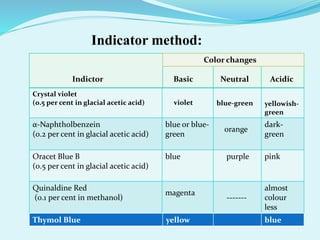
Indicator method:
Crystal violet
(0.5 per cent in glacial acetic acid) violet blue-green yellowish-
green
α-Naphtholbenzein
(0.2 per cent in glacial acetic acid)
blue or blue-
green
orange
dark-
green
Oracet Blue B
(0.5 per cent in glacial acetic acid)
blue purple pink
Quinaldine Red
(0.1 per cent in methanol)
magenta
-------
almost
colour
less
Indictor Basic Neutral Acidic
Color changes
Thymol Blue yellow blue
Non Aqueous Titration of weak Bases
 Solvents used in the titration of weak bases;
 Neutral solvents :
Ex: - alcohol,chloroform,benzene,chlorobenzene
Acidic solvents:
Ex:-formic acid,glacial acetic acid,propionic acids
 Titrant used in the titration of weak basess:
Ex:-Perchloric acid
 Indicatores used in the titration of weak bases
Ex:-oracat blue ,crystal violet,1-naphtholbenzein(weak
bases)
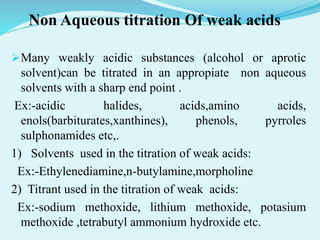
Non Aqueous titration Of weak acids
Many weakly acidic substances (alcohol or aprotic
solvent)can be titrated in an appropiate non aqueous
solvents with a sharp end point .
Ex:-acidic halides, acids,amino acids,
enols(barbiturates,xanthines), phenols, pyrroles
sulphonamides etc,.
1) Solvents used in the titration of weak acids:
Ex:-Ethylenediamine,n-butylamine,morpholine
2) Titrant used in the titration of weak acids:
Ex:-sodium methoxide, lithium methoxide, potasium
methoxide ,tetrabutyl ammonium hydroxide etc.
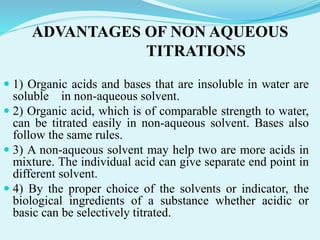
ADVANTAGES OF NON AQUEOUS
TITRATIONS
 1) Organic acids and bases that are insoluble in water are
soluble in non-aqueous solvent.
 2) Organic acid, which is of comparable strength to water,
can be titrated easily in non-aqueous solvent. Bases also
follow the same rules.
 3) A non-aqueous solvent may help two are more acids in
mixture. The individual acid can give separate end point in
different solvent.
 4) By the proper choice of the solvents or indicator, the
biological ingredients of a substance whether acidic or
basic can be selectively titrated.
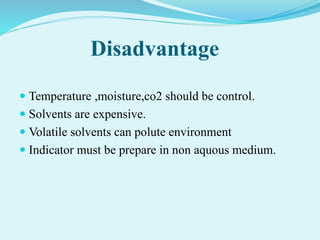
Disadvantage
 Temperature ,moisture,co2 should be control.
 Solvents are expensive.
 Volatile solvents can polute environment
 Indicator must be prepare in non aquous medium.
Thanks
To
All

Non Aqueous Acid Base Titration

  • 1.
  • 2.
    Name: MD. ZahirulIsalam Roll:333 Batch:12th Department of Pharmacy World University of Bangladesh
  • 3.
  • 4.
    Non Aqueous acidbase titration Non aqueous titration are those in which titration of weakly acidic or basic substances are carried out using non aqueous solvents so as to get sharp end point It is the most common titrimetric procedure used in pharmacopoeial assays and serves a double purpose:
  • 5.
    Types of solvents Thesolvents are divided into 4 groups 1. Aprotic solvents 2. Protophilic solvents 3. Protogenic solvents 4. Amphiprotic solvents
  • 6.
    Aprotic solvents Aprotic solventsare neutral, chemically inert substances such as benzene and chloroform. They have a low dielectric constant, do not react with either acids or bases and therefore do not favor ionaization. This type of solvents neither accept or donate protons Ex:-Benzene , dioxan , chlprobenene,chloroform,ethyl acetate, carbon tetra chloride.
  • 7.
    Protophilic solvents Basic incharacter and react with acids to form solvated proton HB + Sol. ⇌ Sol.H+ + B- Acid + Basic solvent ⇌ Solvated proton + Conjugate base of acid A weakly basic solvent has less tendency than a strongly basic one to accept a proton. Similarly a weak acid has less tendency to donate protons than a strong acid. Ex:-acetone pyridine liquid ammonia
  • 8.
    Protogenic solvents Acidic innature and donate protons Ex:- sulphuric acid , formic acid, propanoic acid ,acetic anhydride etc. They have high dielectric constant and ionised Because of their strength and ability to donate protons.
  • 9.
    Amphiprotic solvents  Amphiproticsolvents have both protophilic and protogenic properties. Examples are acetic acid and the alcohols. They are dissociated to a slight extent. The dissociation of acetic acid, which is frequently used as a solvent for titration of basic substances, is shown in the equation below:  CH3COOH⇌H++ CH3COO−
  • 10.
    Assay by nonaqueous titration Acidimetry in non aqueous titration— It can be further divided in to two types, namely ; 1. Titration of primary , secondary, tertiary amines. 2. Titration of halogen acid salts of bases. Alkalimetry in non aqueous titration- Titration of acidic substances
  • 11.
    DETERMINING END POINT A.Potentiometric titration B. Indicator method A. Potentiometric titration : potentiometric method for the detection of the equivalence point The end point is determined by using indictor electrode(glass electrode) and reference electrode(saturated calomel electrode)
  • 12.
    Indicator method: Crystal violet (0.5per cent in glacial acetic acid) violet blue-green yellowish- green α-Naphtholbenzein (0.2 per cent in glacial acetic acid) blue or blue- green orange dark- green Oracet Blue B (0.5 per cent in glacial acetic acid) blue purple pink Quinaldine Red (0.1 per cent in methanol) magenta ------- almost colour less Indictor Basic Neutral Acidic Color changes Thymol Blue yellow blue
  • 13.
    Non Aqueous Titrationof weak Bases  Solvents used in the titration of weak bases;  Neutral solvents : Ex: - alcohol,chloroform,benzene,chlorobenzene Acidic solvents: Ex:-formic acid,glacial acetic acid,propionic acids  Titrant used in the titration of weak basess: Ex:-Perchloric acid  Indicatores used in the titration of weak bases Ex:-oracat blue ,crystal violet,1-naphtholbenzein(weak bases)
  • 14.
    Non Aqueous titrationOf weak acids Many weakly acidic substances (alcohol or aprotic solvent)can be titrated in an appropiate non aqueous solvents with a sharp end point . Ex:-acidic halides, acids,amino acids, enols(barbiturates,xanthines), phenols, pyrroles sulphonamides etc,. 1) Solvents used in the titration of weak acids: Ex:-Ethylenediamine,n-butylamine,morpholine 2) Titrant used in the titration of weak acids: Ex:-sodium methoxide, lithium methoxide, potasium methoxide ,tetrabutyl ammonium hydroxide etc.
  • 15.
    ADVANTAGES OF NONAQUEOUS TITRATIONS  1) Organic acids and bases that are insoluble in water are soluble in non-aqueous solvent.  2) Organic acid, which is of comparable strength to water, can be titrated easily in non-aqueous solvent. Bases also follow the same rules.  3) A non-aqueous solvent may help two are more acids in mixture. The individual acid can give separate end point in different solvent.  4) By the proper choice of the solvents or indicator, the biological ingredients of a substance whether acidic or basic can be selectively titrated.
  • 16.
    Disadvantage  Temperature ,moisture,co2should be control.  Solvents are expensive.  Volatile solvents can polute environment  Indicator must be prepare in non aquous medium.
  • 17.