TITRATIONINVOLVING IODINE (REDOX
TITRATION)
RENJITHA J R
ASSISTANT PROFESSOR
MOUNT ZION COLLEGE OF PHARMACEUTICAL
SCIENCES & RESEARCH, ADOOR
 The oxidizing ability of Iodine is relatively less than
Kmno4, Ceric ammonium sulphate etc.. hence iodine is
considered as mild oxidizing agent.
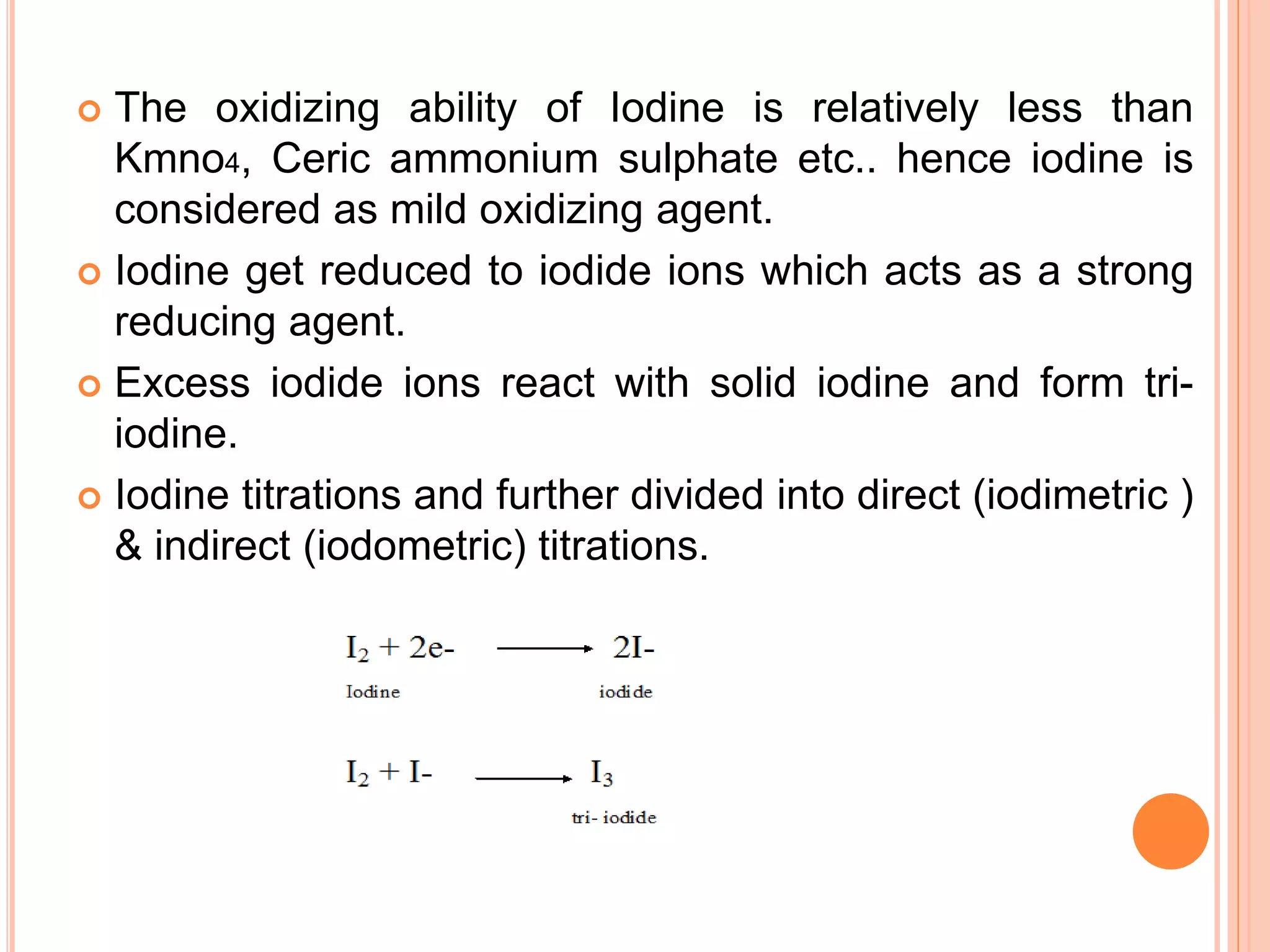
 Iodine get reduced to iodide ions which acts as a strong
reducing agent.
 Excess iodide ions react with solid iodine and form tri-
iodine.
 Iodine titrations and further divided into direct (iodimetric )
& indirect (iodometric) titrations.
INDICATORS FOR IODINE TITRATIONS
1) Iodine ; Iodine act as a self indicator in colourless
solution, as iodine solution itself possesses an
intense yellow- brown colour.
2) Starch; starch is made of two fractions known as
amylose & amylopectin. Blue colour is formed
when amylose react with iodine & red purple
colour when amylopectin reacts with iodine.
IODIMETRIC TITRATIONS
 Titrations using standard solutions of iodine are referred
to as direct (iodimetric ) titrations. In these titrations,
iodine act as an oxidant which tends to react with strong
reductants.
 pH plays a major role in the titration of the analyte .
Titrations usually give fairly good results at neutral Ph ,
mildly alkaline ph /weakly acidic solution.
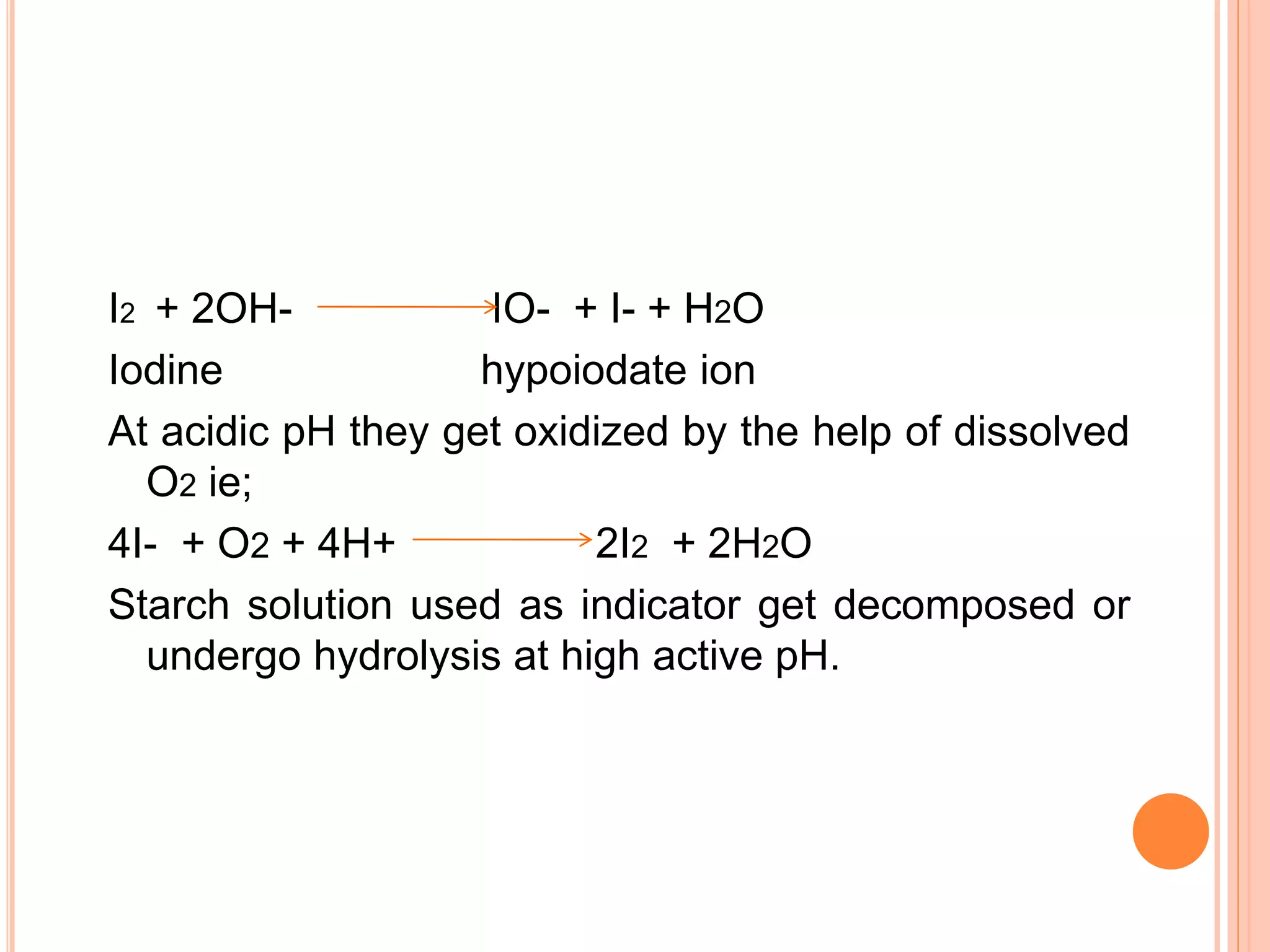
 At very alkaline solution, the iodine will eventually
disproportionate into two fragmental chemical entities,
hypoiodate (IO-) & Iodide (I-)
I2 + 2OH- IO- + I- + H2O
Iodine hypoiodate ion
At acidic pH they get oxidized by the help of dissolved
O2 ie;
4I- + O2 + 4H+ 2I2 + 2H2O
Starch solution used as indicator get decomposed or
undergo hydrolysis at high active pH.
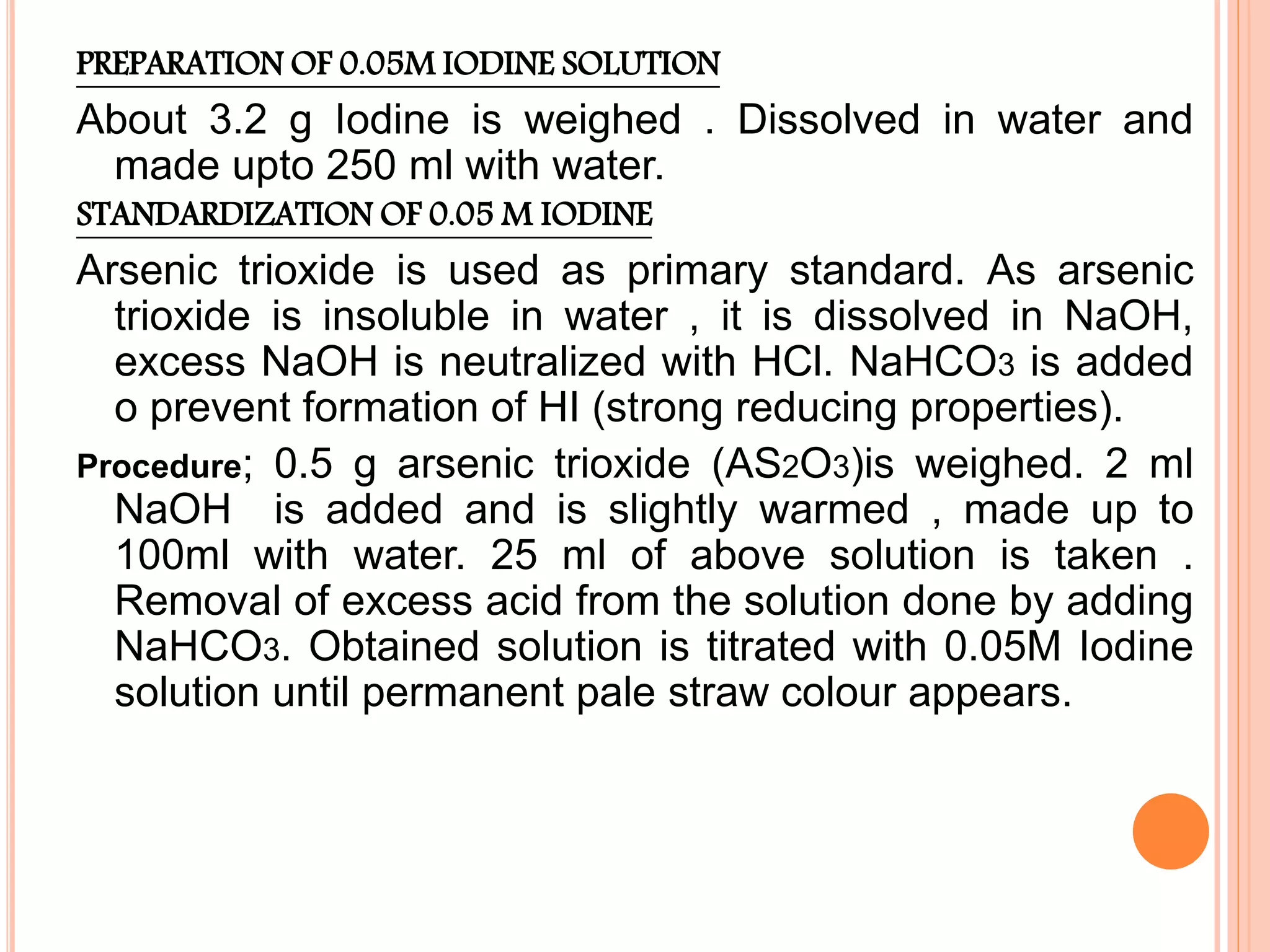
PREPARATION OF 0.05M IODINE SOLUTION
About 3.2 g Iodine is weighed . Dissolved in water and
made upto 250 ml with water.
STANDARDIZATION OF 0.05 M IODINE
Arsenic trioxide is used as primary standard. As arsenic
trioxide is insoluble in water , it is dissolved in NaOH,
excess NaOH is neutralized with HCl. NaHCO3 is added
o prevent formation of HI (strong reducing properties).
Procedure; 0.5 g arsenic trioxide (AS2O3)is weighed. 2 ml
NaOH is added and is slightly warmed , made up to
100ml with water. 25 ml of above solution is taken .
Removal of excess acid from the solution done by adding
NaHCO3. Obtained solution is titrated with 0.05M Iodine
solution until permanent pale straw colour appears.
Assay;
0.2 g ascorbic acid is weighed , transferred to a beaker
containing 80 ml freshly boiled & and cooled. Add 10 ml
sulphuric acid . Resultant solution is titrated with iodine
using starch solution as indicator.
Applications;
To determine the percentage purity of ascorbic acid ,
antimony trichloride, sodium tartarate etc…
IODOMETRICTITRATIONS
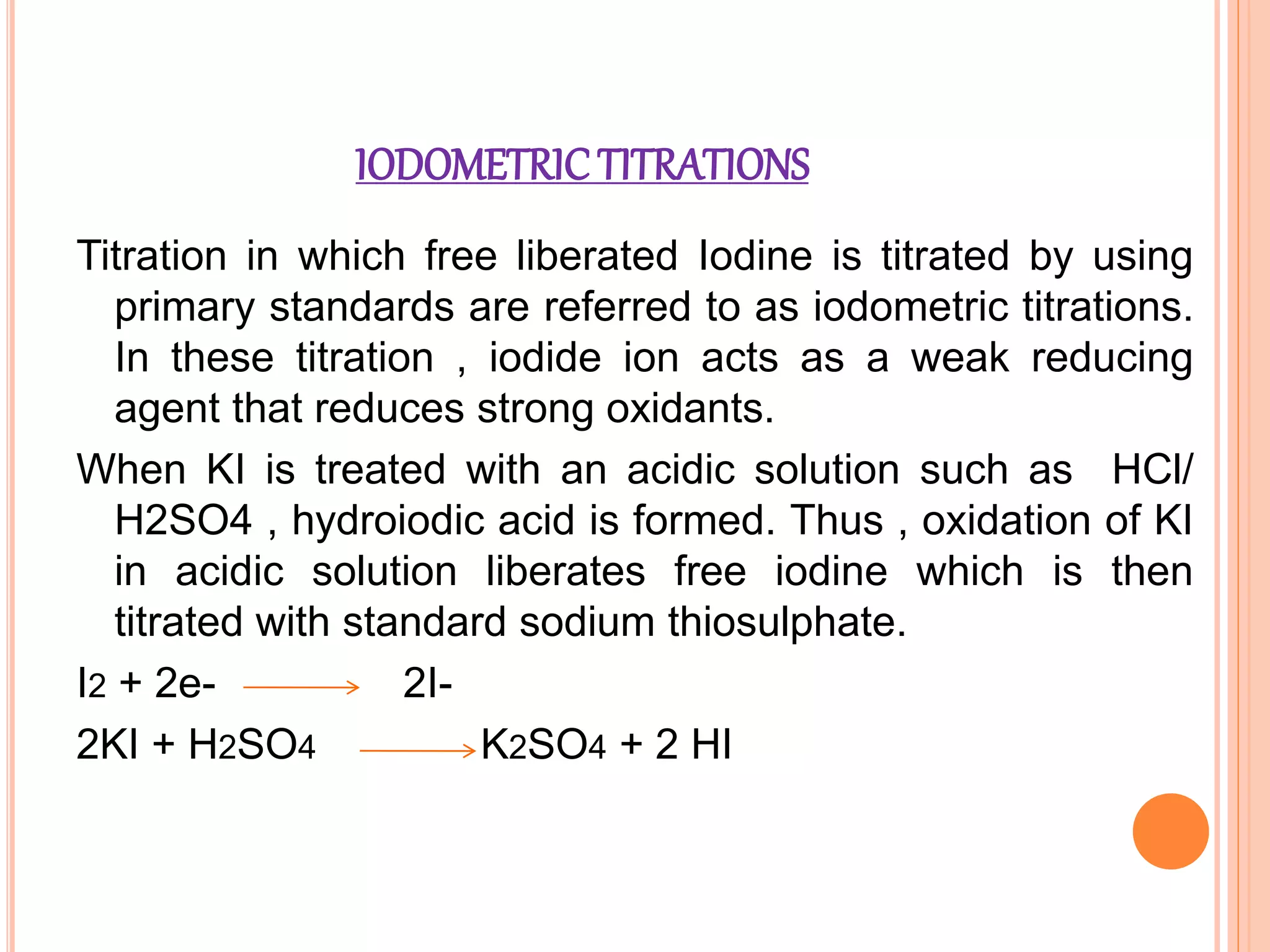
Titration in which free liberated Iodine is titrated by using
primary standards are referred to as iodometric titrations.
In these titration , iodide ion acts as a weak reducing
agent that reduces strong oxidants.
When KI is treated with an acidic solution such as HCl/
H2SO4 , hydroiodic acid is formed. Thus , oxidation of KI
in acidic solution liberates free iodine which is then
titrated with standard sodium thiosulphate.
I2 + 2e- 2I-
2KI + H2SO4 K2SO4 + 2 HI
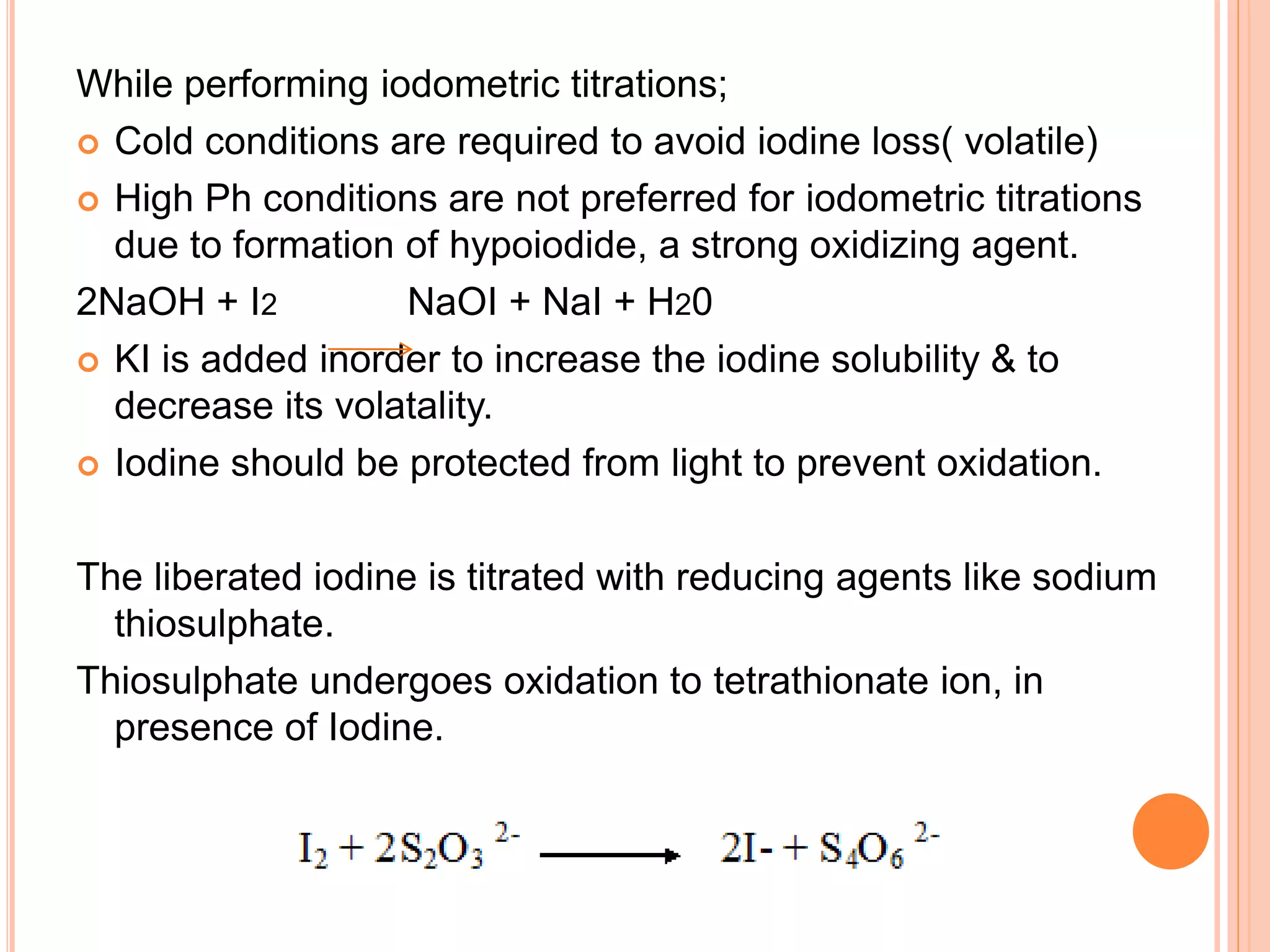
While performing iodometric titrations;
 Cold conditions are required to avoid iodine loss( volatile)
 High Ph conditions are not preferred for iodometric titrations
due to formation of hypoiodide, a strong oxidizing agent.
2NaOH + I2 NaOI + NaI + H20
 KI is added inorder to increase the iodine solubility & to
decrease its volatality.
 Iodine should be protected from light to prevent oxidation.
The liberated iodine is titrated with reducing agents like sodium
thiosulphate.
Thiosulphate undergoes oxidation to tetrathionate ion, in
presence of Iodine.
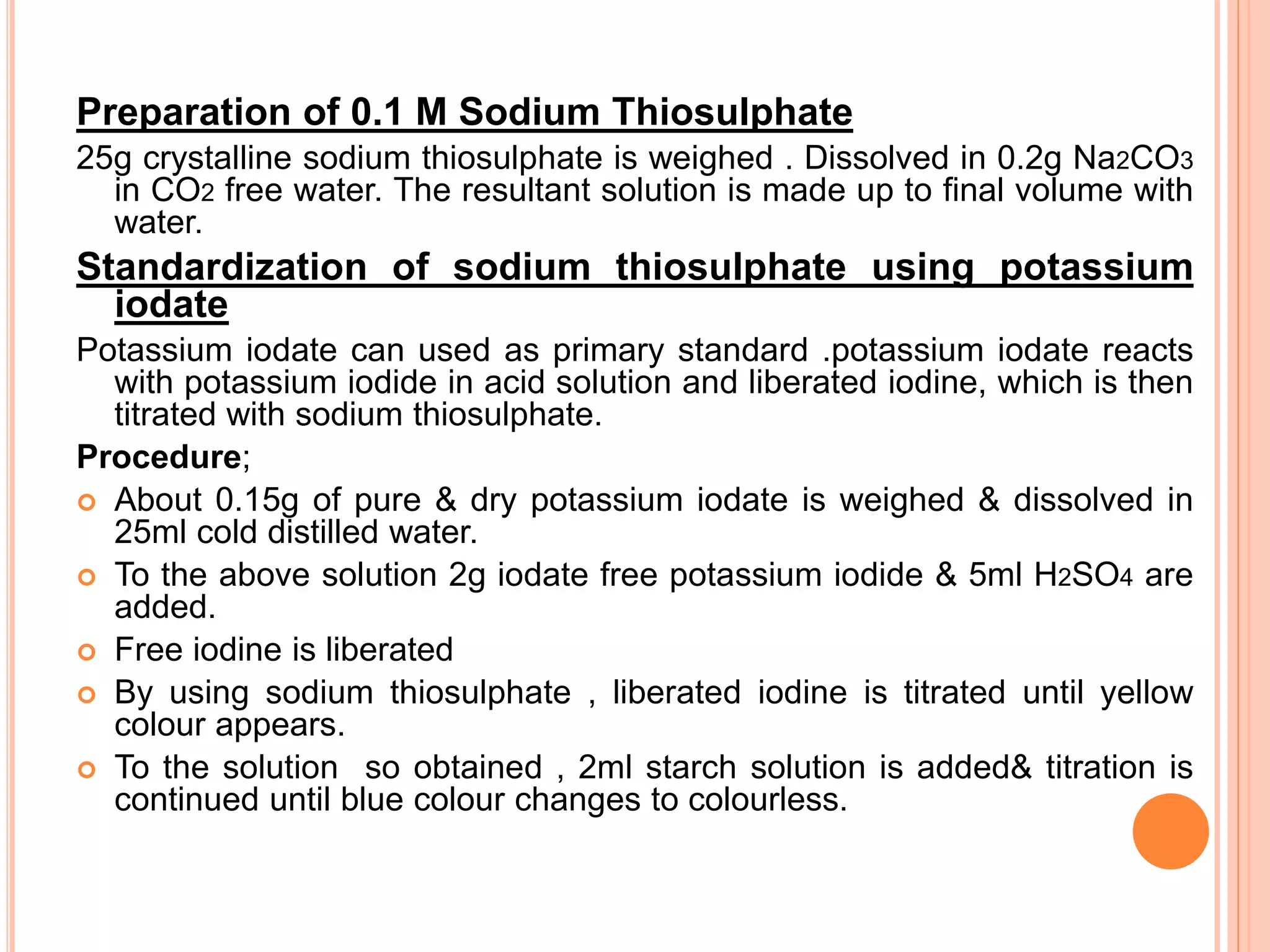
Preparation of 0.1 M Sodium Thiosulphate
25g crystalline sodium thiosulphate is weighed . Dissolved in 0.2g Na2CO3
in CO2 free water. The resultant solution is made up to final volume with
water.
Standardization of sodium thiosulphate using potassium
iodate
Potassium iodate can used as primary standard .potassium iodate reacts
with potassium iodide in acid solution and liberated iodine, which is then
titrated with sodium thiosulphate.
Procedure;
 About 0.15g of pure & dry potassium iodate is weighed & dissolved in
25ml cold distilled water.
 To the above solution 2g iodate free potassium iodide & 5ml H2SO4 are
added.
 Free iodine is liberated
 By using sodium thiosulphate , liberated iodine is titrated until yellow
colour appears.
 To the solution so obtained , 2ml starch solution is added& titration is
continued until blue colour changes to colourless.
THANK YOU

Iodimetry & iodometry

  • 1.
    TITRATIONINVOLVING IODINE (REDOX TITRATION) RENJITHAJ R ASSISTANT PROFESSOR MOUNT ZION COLLEGE OF PHARMACEUTICAL SCIENCES & RESEARCH, ADOOR
  • 2.
     The oxidizingability of Iodine is relatively less than Kmno4, Ceric ammonium sulphate etc.. hence iodine is considered as mild oxidizing agent.  Iodine get reduced to iodide ions which acts as a strong reducing agent.  Excess iodide ions react with solid iodine and form tri- iodine.  Iodine titrations and further divided into direct (iodimetric ) & indirect (iodometric) titrations.
  • 3.
    INDICATORS FOR IODINETITRATIONS 1) Iodine ; Iodine act as a self indicator in colourless solution, as iodine solution itself possesses an intense yellow- brown colour. 2) Starch; starch is made of two fractions known as amylose & amylopectin. Blue colour is formed when amylose react with iodine & red purple colour when amylopectin reacts with iodine.
  • 4.
    IODIMETRIC TITRATIONS  Titrationsusing standard solutions of iodine are referred to as direct (iodimetric ) titrations. In these titrations, iodine act as an oxidant which tends to react with strong reductants.  pH plays a major role in the titration of the analyte . Titrations usually give fairly good results at neutral Ph , mildly alkaline ph /weakly acidic solution.  At very alkaline solution, the iodine will eventually disproportionate into two fragmental chemical entities, hypoiodate (IO-) & Iodide (I-)
  • 5.
    I2 + 2OH-IO- + I- + H2O Iodine hypoiodate ion At acidic pH they get oxidized by the help of dissolved O2 ie; 4I- + O2 + 4H+ 2I2 + 2H2O Starch solution used as indicator get decomposed or undergo hydrolysis at high active pH.
  • 6.
    PREPARATION OF 0.05MIODINE SOLUTION About 3.2 g Iodine is weighed . Dissolved in water and made upto 250 ml with water. STANDARDIZATION OF 0.05 M IODINE Arsenic trioxide is used as primary standard. As arsenic trioxide is insoluble in water , it is dissolved in NaOH, excess NaOH is neutralized with HCl. NaHCO3 is added o prevent formation of HI (strong reducing properties). Procedure; 0.5 g arsenic trioxide (AS2O3)is weighed. 2 ml NaOH is added and is slightly warmed , made up to 100ml with water. 25 ml of above solution is taken . Removal of excess acid from the solution done by adding NaHCO3. Obtained solution is titrated with 0.05M Iodine solution until permanent pale straw colour appears.
  • 7.
    Assay; 0.2 g ascorbicacid is weighed , transferred to a beaker containing 80 ml freshly boiled & and cooled. Add 10 ml sulphuric acid . Resultant solution is titrated with iodine using starch solution as indicator. Applications; To determine the percentage purity of ascorbic acid , antimony trichloride, sodium tartarate etc…
  • 8.
    IODOMETRICTITRATIONS Titration in whichfree liberated Iodine is titrated by using primary standards are referred to as iodometric titrations. In these titration , iodide ion acts as a weak reducing agent that reduces strong oxidants. When KI is treated with an acidic solution such as HCl/ H2SO4 , hydroiodic acid is formed. Thus , oxidation of KI in acidic solution liberates free iodine which is then titrated with standard sodium thiosulphate. I2 + 2e- 2I- 2KI + H2SO4 K2SO4 + 2 HI
  • 9.
    While performing iodometrictitrations;  Cold conditions are required to avoid iodine loss( volatile)  High Ph conditions are not preferred for iodometric titrations due to formation of hypoiodide, a strong oxidizing agent. 2NaOH + I2 NaOI + NaI + H20  KI is added inorder to increase the iodine solubility & to decrease its volatality.  Iodine should be protected from light to prevent oxidation. The liberated iodine is titrated with reducing agents like sodium thiosulphate. Thiosulphate undergoes oxidation to tetrathionate ion, in presence of Iodine.
  • 10.
    Preparation of 0.1M Sodium Thiosulphate 25g crystalline sodium thiosulphate is weighed . Dissolved in 0.2g Na2CO3 in CO2 free water. The resultant solution is made up to final volume with water. Standardization of sodium thiosulphate using potassium iodate Potassium iodate can used as primary standard .potassium iodate reacts with potassium iodide in acid solution and liberated iodine, which is then titrated with sodium thiosulphate. Procedure;  About 0.15g of pure & dry potassium iodate is weighed & dissolved in 25ml cold distilled water.  To the above solution 2g iodate free potassium iodide & 5ml H2SO4 are added.  Free iodine is liberated  By using sodium thiosulphate , liberated iodine is titrated until yellow colour appears.  To the solution so obtained , 2ml starch solution is added& titration is continued until blue colour changes to colourless.
  • 11.