Complexation Titration
Department of physical sciences & technology
university of sabaragamuwa srilanka
(PST-Group 11)
1) What is a Titration?
2) What are the equipment Using Titration
3) Equipment cleaning technique
4) Titration type
5) How Complexation Titration differ from normal Titration
6) Indicators
7) EDTA Titration
8) Analyzing
 The process of adding standard solution until the
reaction completes, it’s called a titration.
 The reaction completion is identified by the colour
change of the indicator.
Main equipment when using titration
1. Titration flask
2. Pipette
3. Pipette bulb
4. Burette
Titration flask is only washed using distilled water.
Burette is first washed by using distilled water, then
it is washed by using titrant(solution having known
concentration).
Pipette is first washed by using distilled water, then
it is washed by using the analyte(solution
concentration that has to be checked).
1) Neutralization titrations
2) Complex formation titrations
3) Precipitation titrations
4) Oxidation-Reduction Titrations
Complexometric titration is a form of volumetric analysis in which
the formation of a coloured complex is used to indicate the end
point of a titration. Complexometric titrations are particularly
useful for the determination of a mixture of different metal ions in
a solution
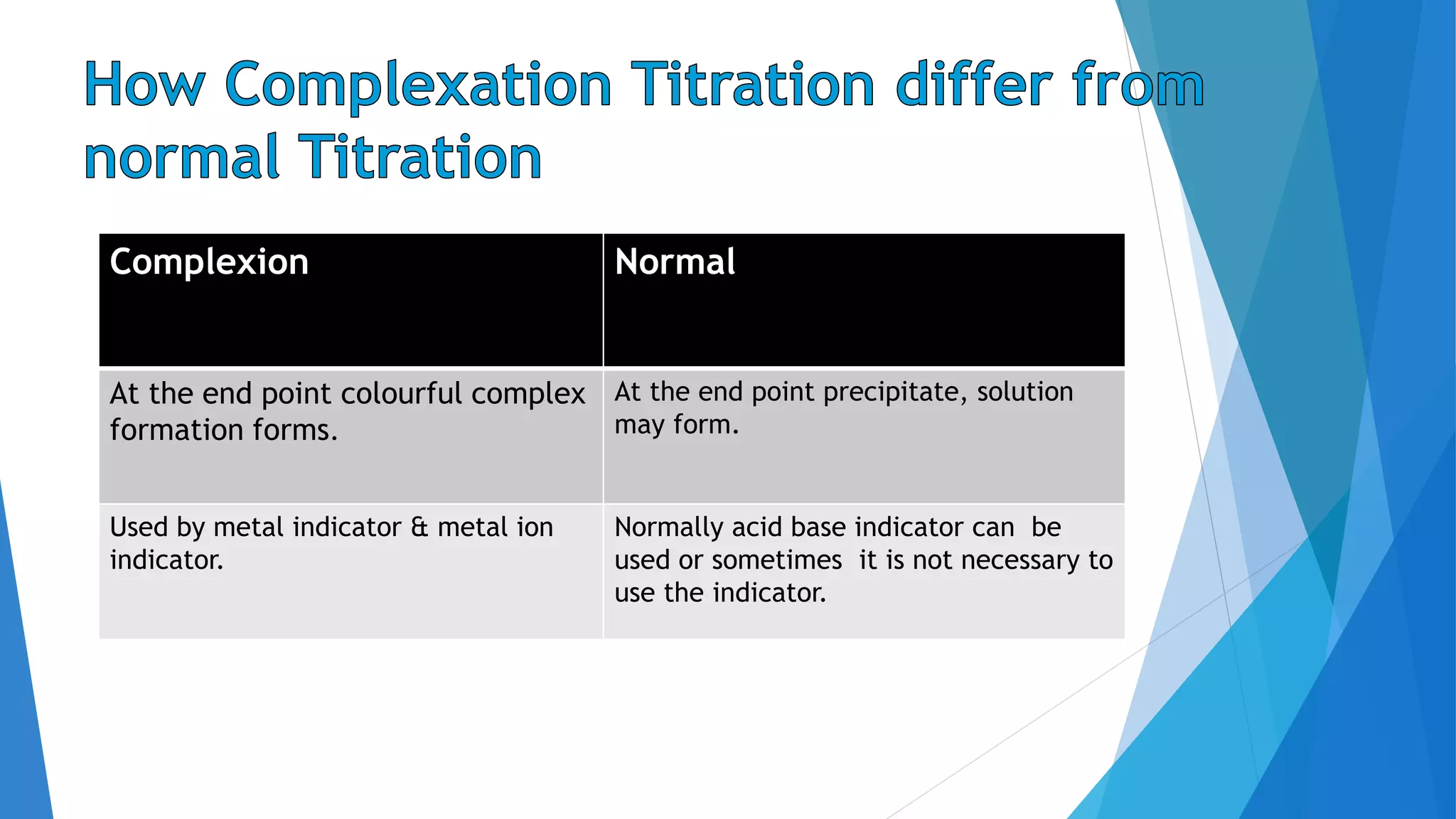
Complexion Normal
At the end point colourful complex
formation forms.
At the end point precipitate, solution
may form.
Used by metal indicator & metal ion
indicator.
Normally acid base indicator can be
used or sometimes it is not necessary to
use the indicator.
 Complex: metal + ligand
 Ligand: has at least one pair of unshared electrons available for
bond formation.
 Complex formation has a specific colour.
(electron donor) Ex: H2O, NH3, Cl-, Br-, I-……
~ ~ An ion or a molecule that forms a covalent bond with a cation or
a neutral metal atom by donating a pair of electrons, which is
then shared by the two atoms.
Ex: [Cu(NH3)4]2+, [CuCl4]2-, [Cr(NH3)6]3+
Metal ligand Complexes
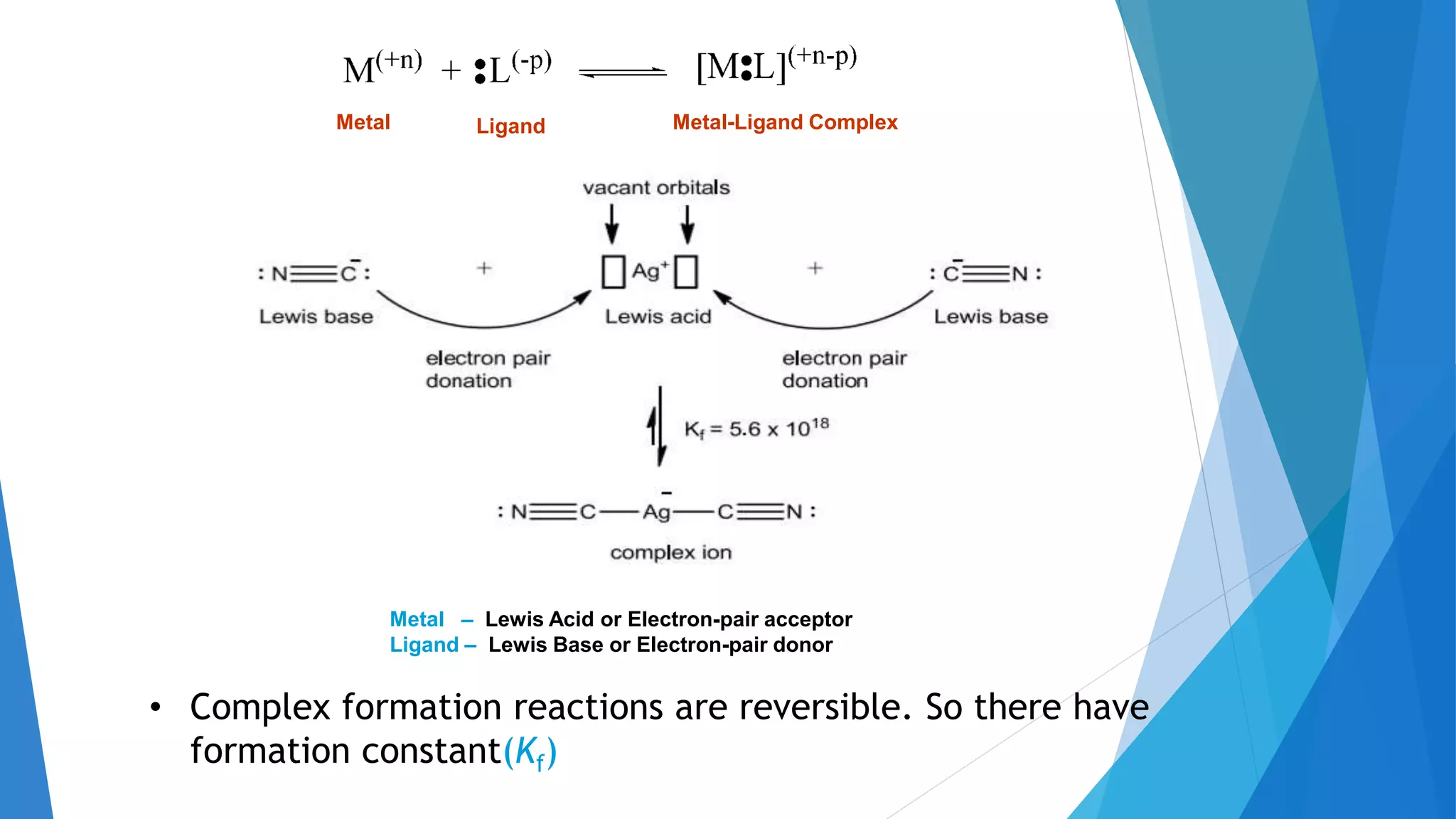
 Complexation Titrations are based on the reaction of a metal ion
with a chemical agent to form a metal-ligand complex.
 Complexation Titrations are essentially Lewis acid-base reactions,
in which an electron pair is donated from one chemical to
another.
 The ligands used in complexometric titrations are also known as
chelating agents.
- Ligand that attaches to a metal ion through more than one
ligand atom
 Most chelating agents contain N or O
- Elements that contain free electron pairs that may be donated
to a metal
Metal Ligand Metal-Ligand Complex
Metal – Lewis Acid or Electron-pair acceptor
Ligand – Lewis Base or Electron-pair donor
• Complex formation reactions are reversible. So there have
formation constant(Kf)
The equilibrium constant for the reaction between a
metal ion (M+n) and a chelating agent (L-P) is known as
a formation constant or stability constant.
][Y][M
]Y[M
K
YMYM
b
ab
f
ab
b




a
a
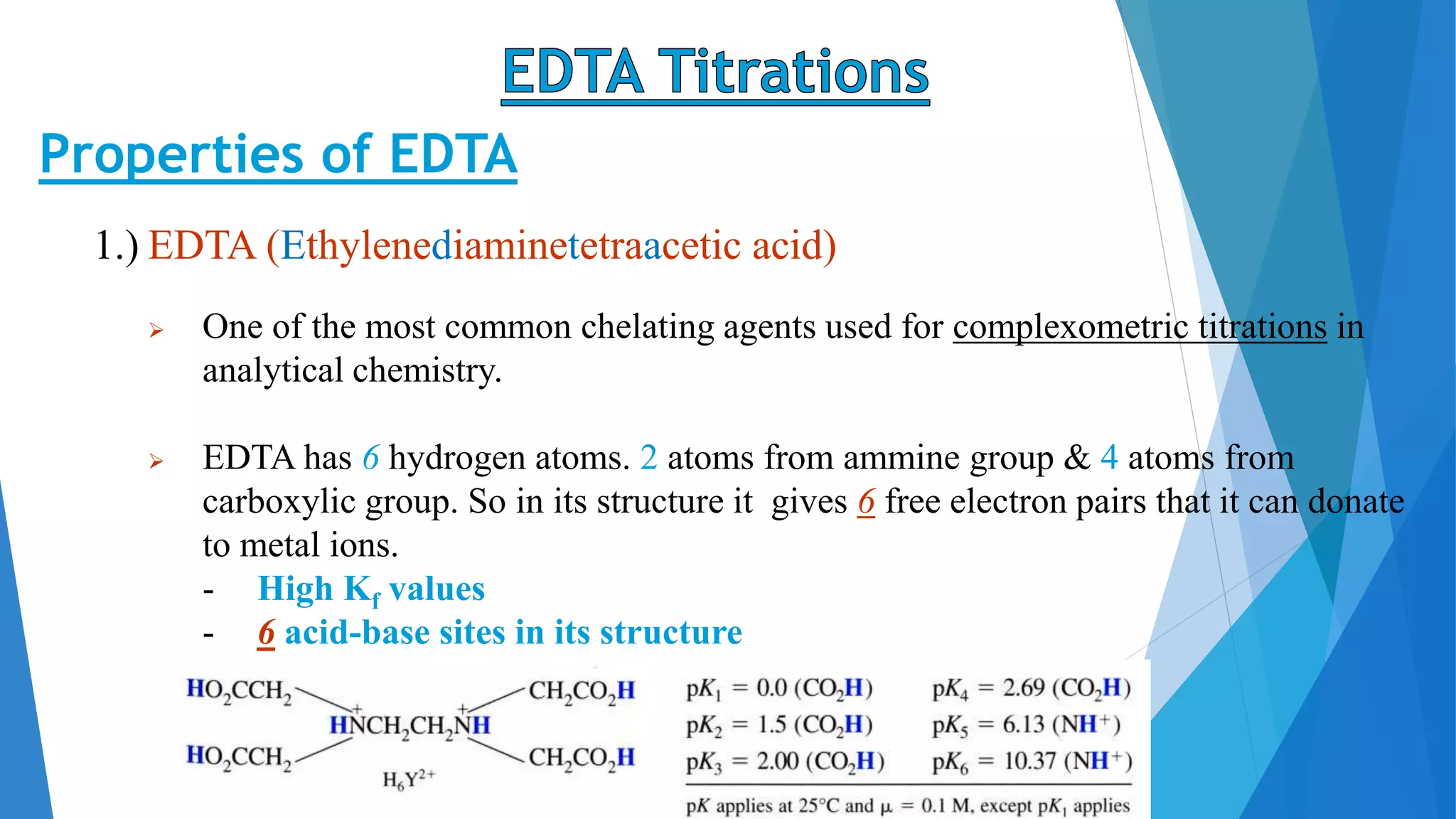
Properties of EDTA
1.) EDTA (Ethylenediaminetetraacetic acid)
 One of the most common chelating agents used for complexometric titrations in
analytical chemistry.
 EDTA has 6 hydrogen atoms. 2 atoms from ammine group & 4 atoms from
carboxylic group. So in its structure it gives 6 free electron pairs that it can donate
to metal ions.
- High Kf values
- 6 acid-base sites in its structure
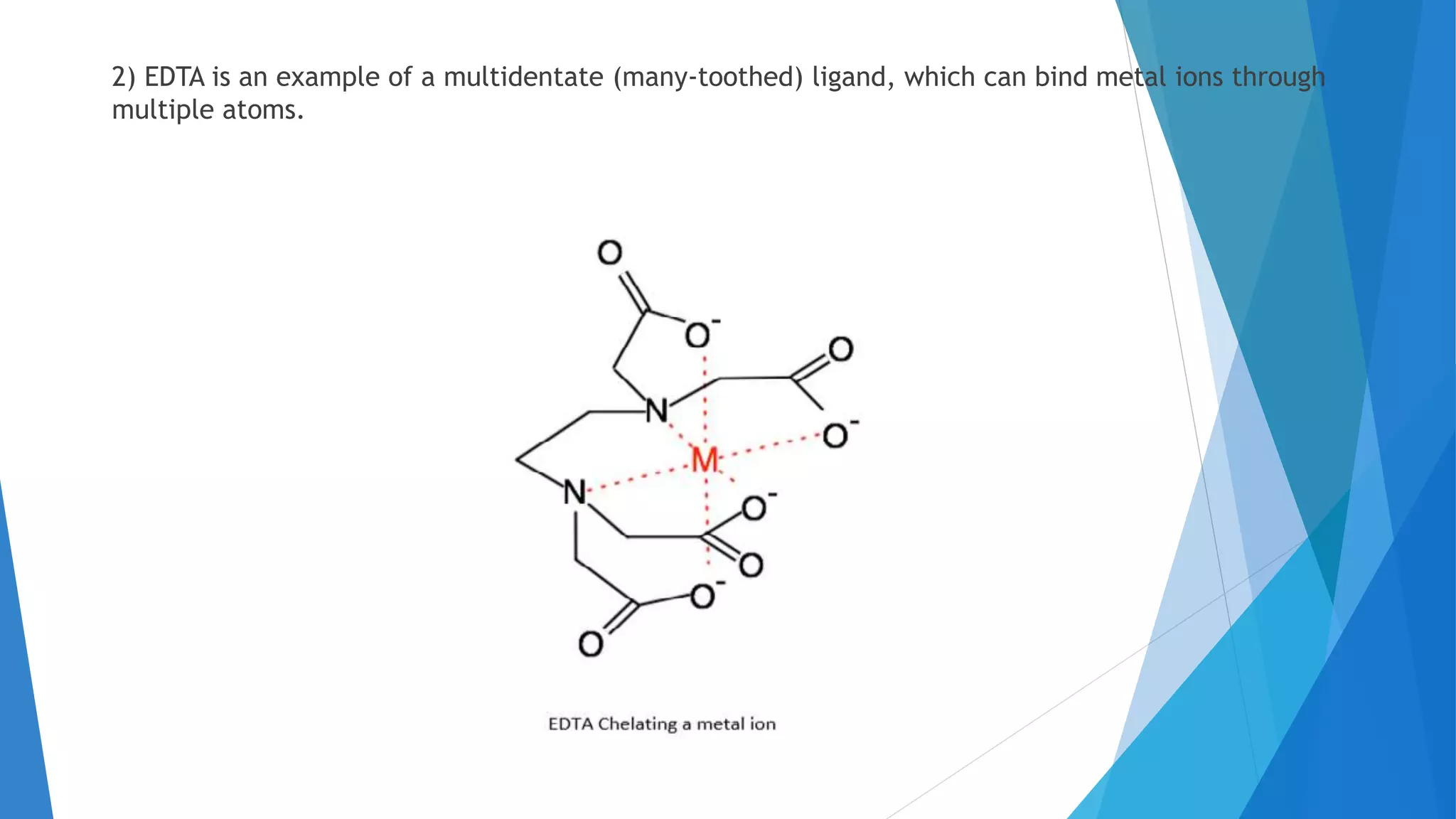
2) EDTA is an example of a multidentate (many-toothed) ligand, which can bind metal ions through
multiple atoms.
3) EDTA is an amphoteric substance.
4) It can both donate and accept protons.
5)The four hydrogen atoms shown in the above line structure are acidic.
6) Because of this, the formula of EDTA is often abbreviated H4Y, where H4
represents the four acidic hydrogen atoms and Y represents the
remaining structure.
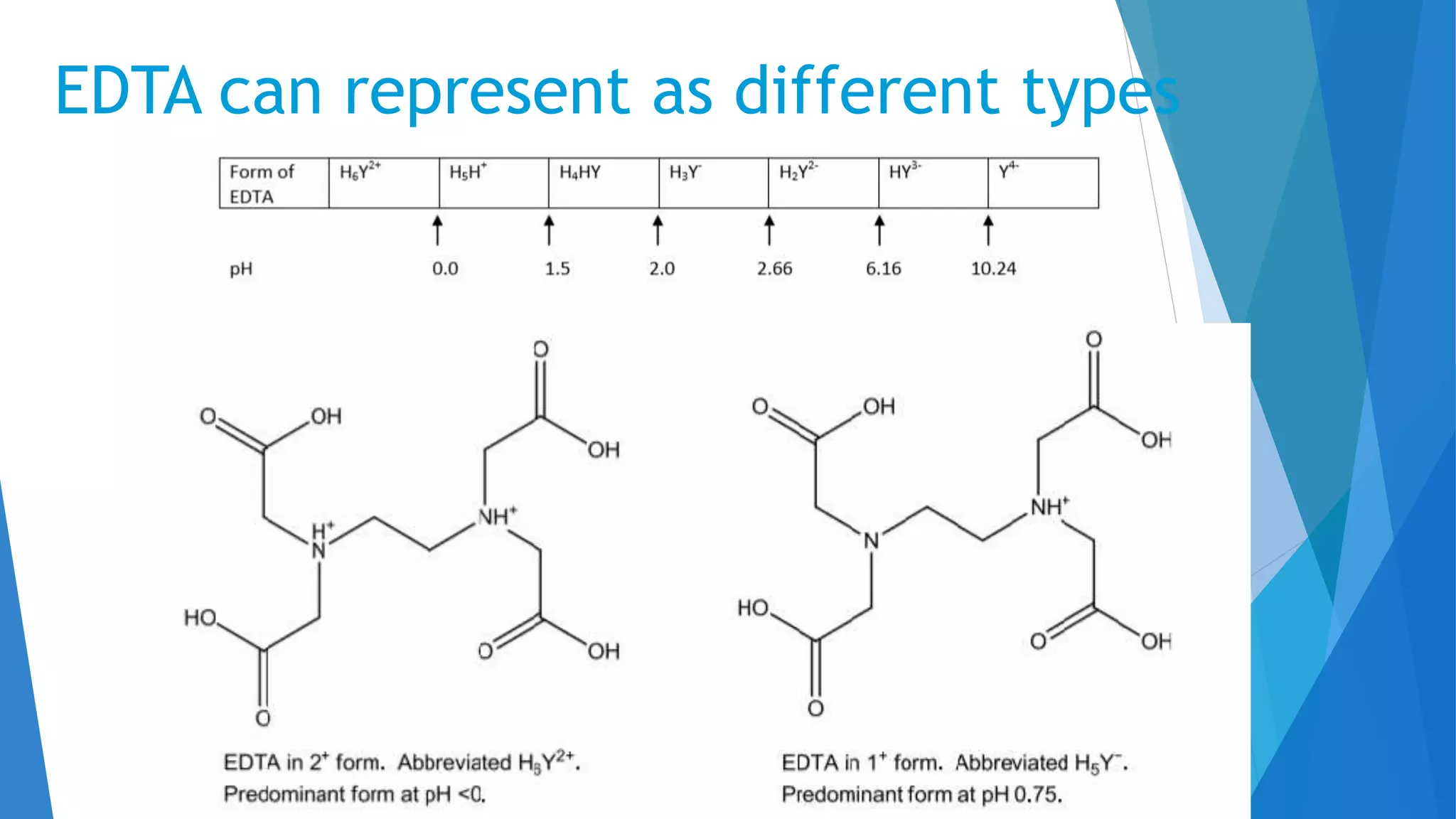
7)At very low pH, EDTA will be present in its completely protonated form
H6Y2+.
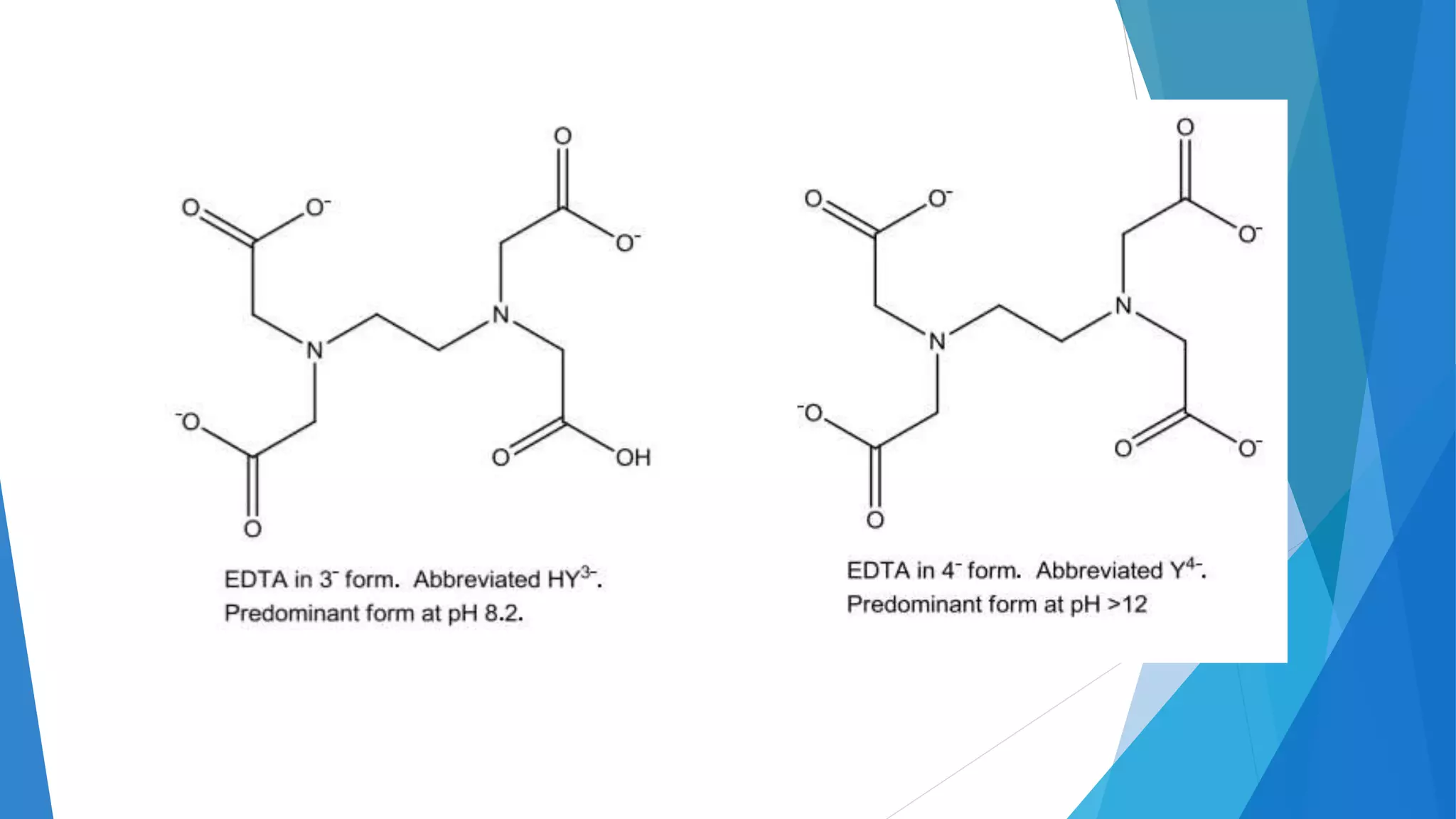
8)At very high pH, EDTA will be present in its completely deprotonated
form, Y4-.
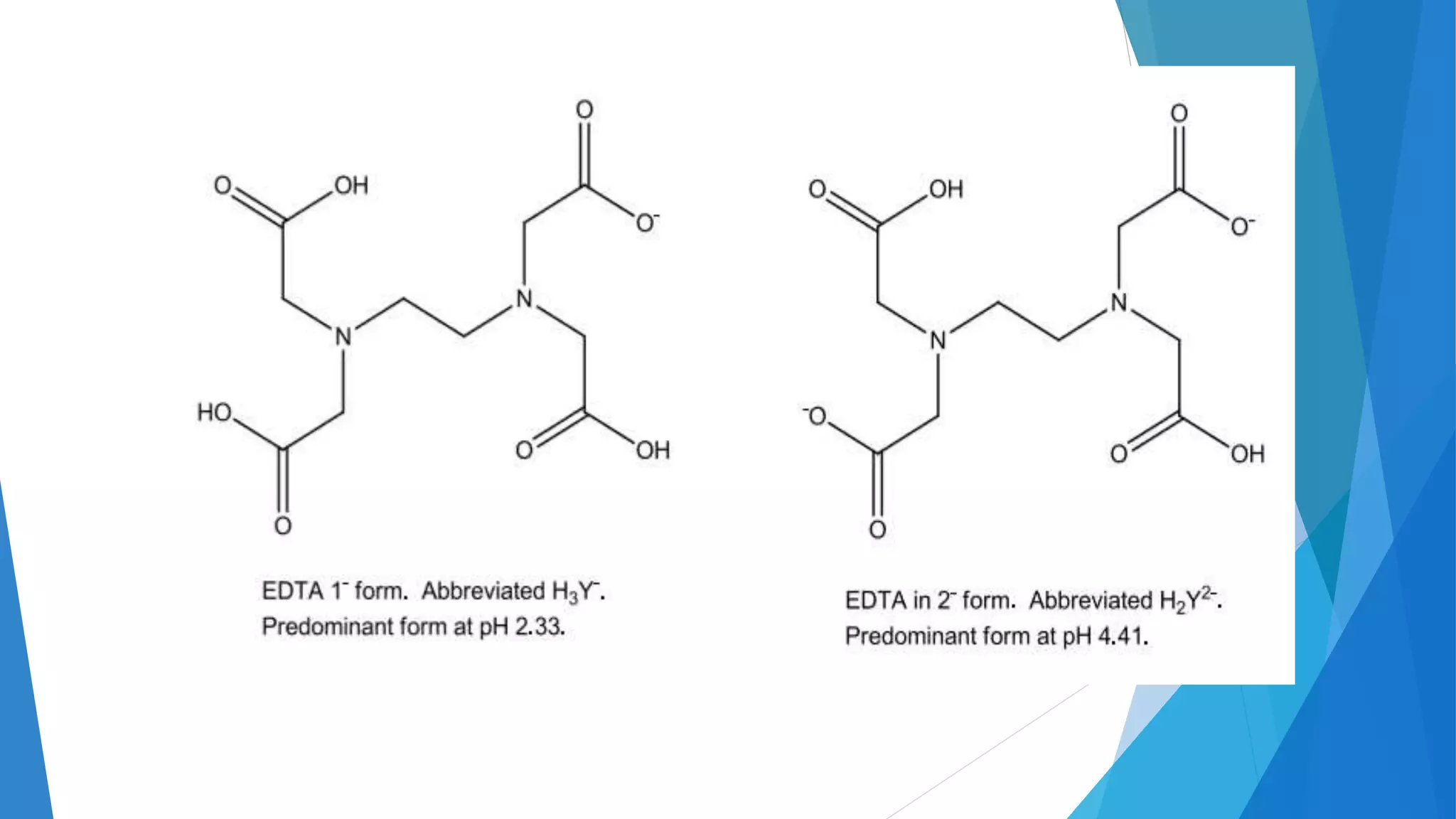
EDTA can represent as different types
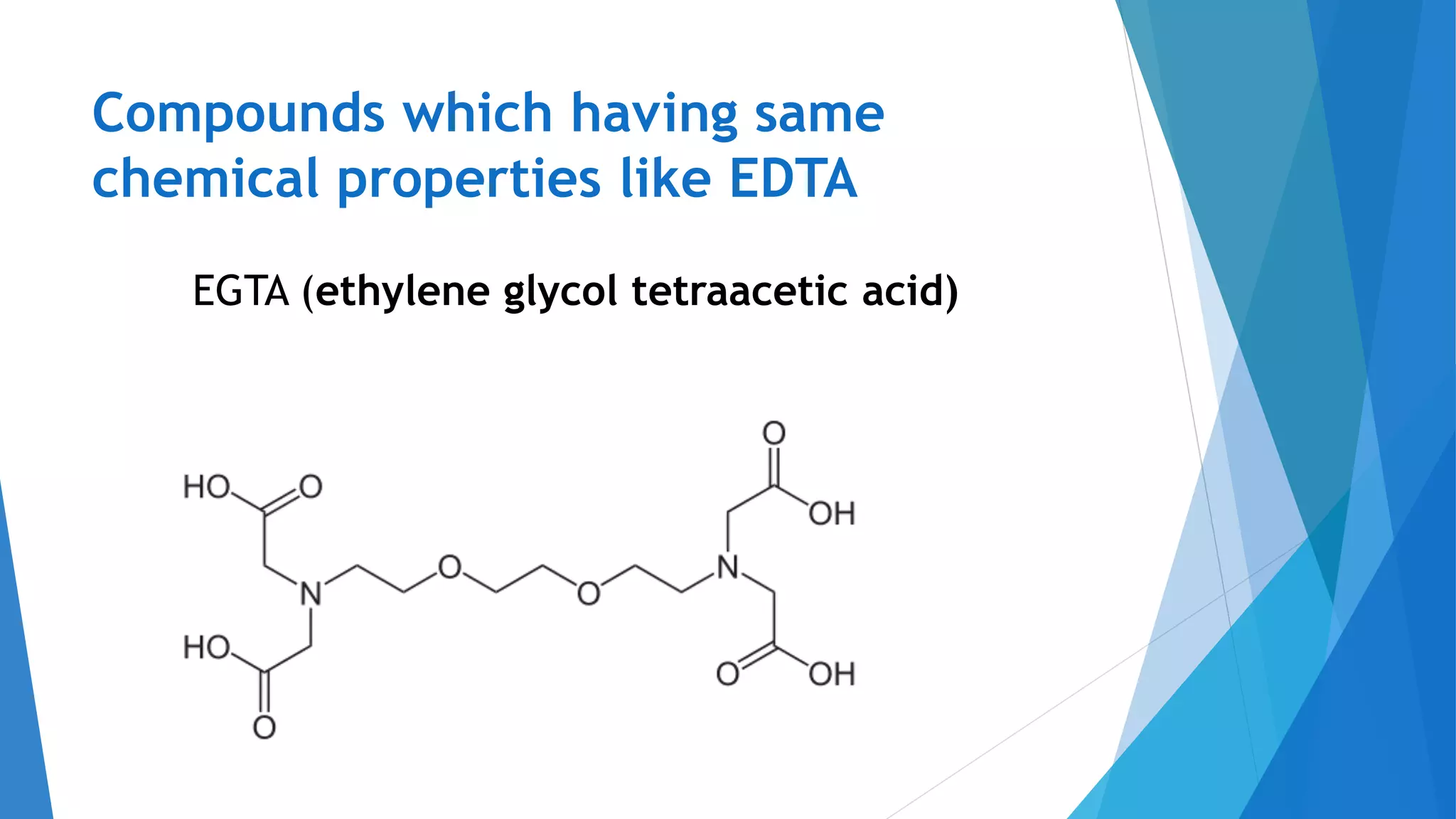
Compounds which having same
chemical properties like EDTA
EGTA (ethylene glycol tetraacetic acid)
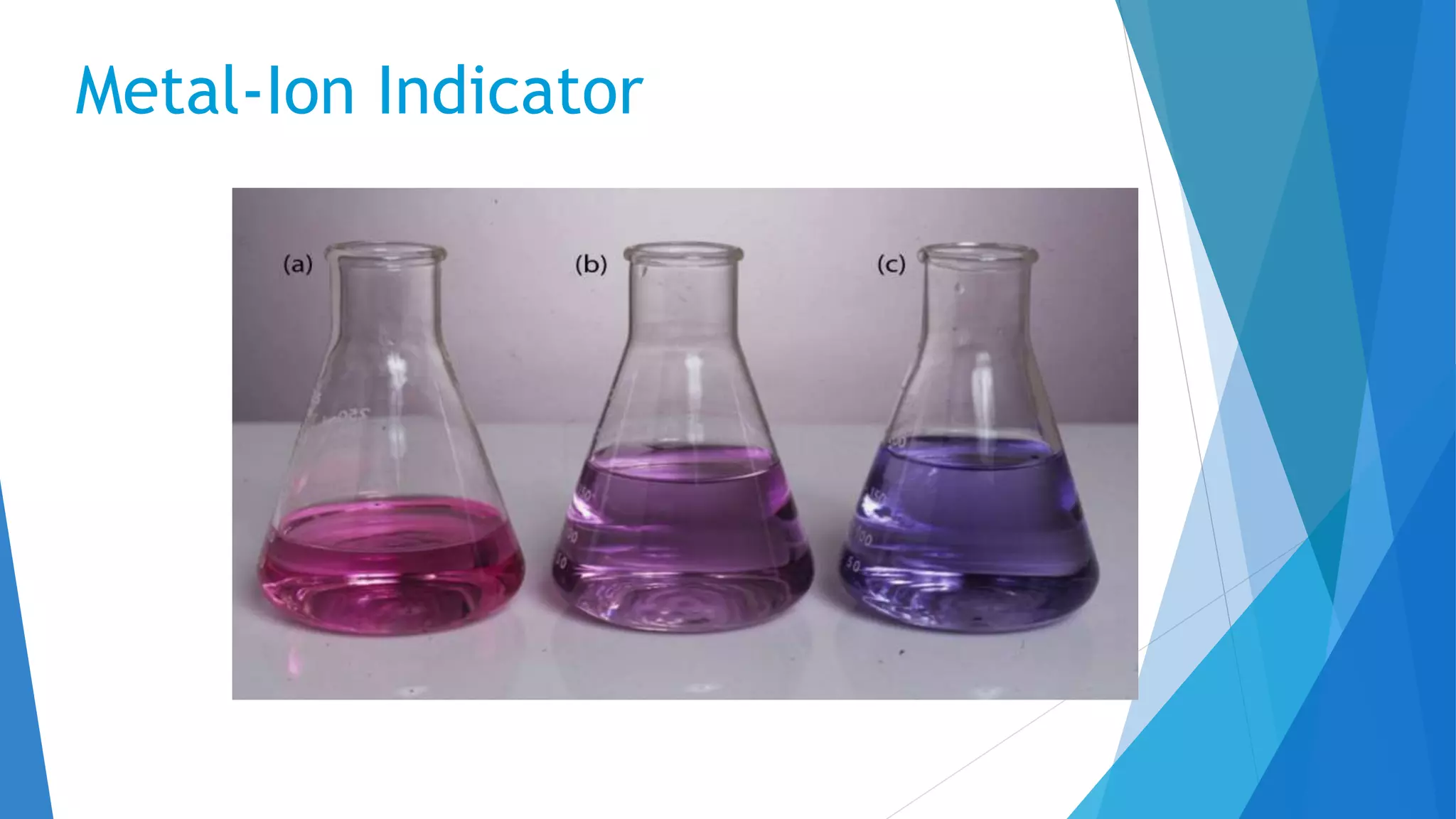
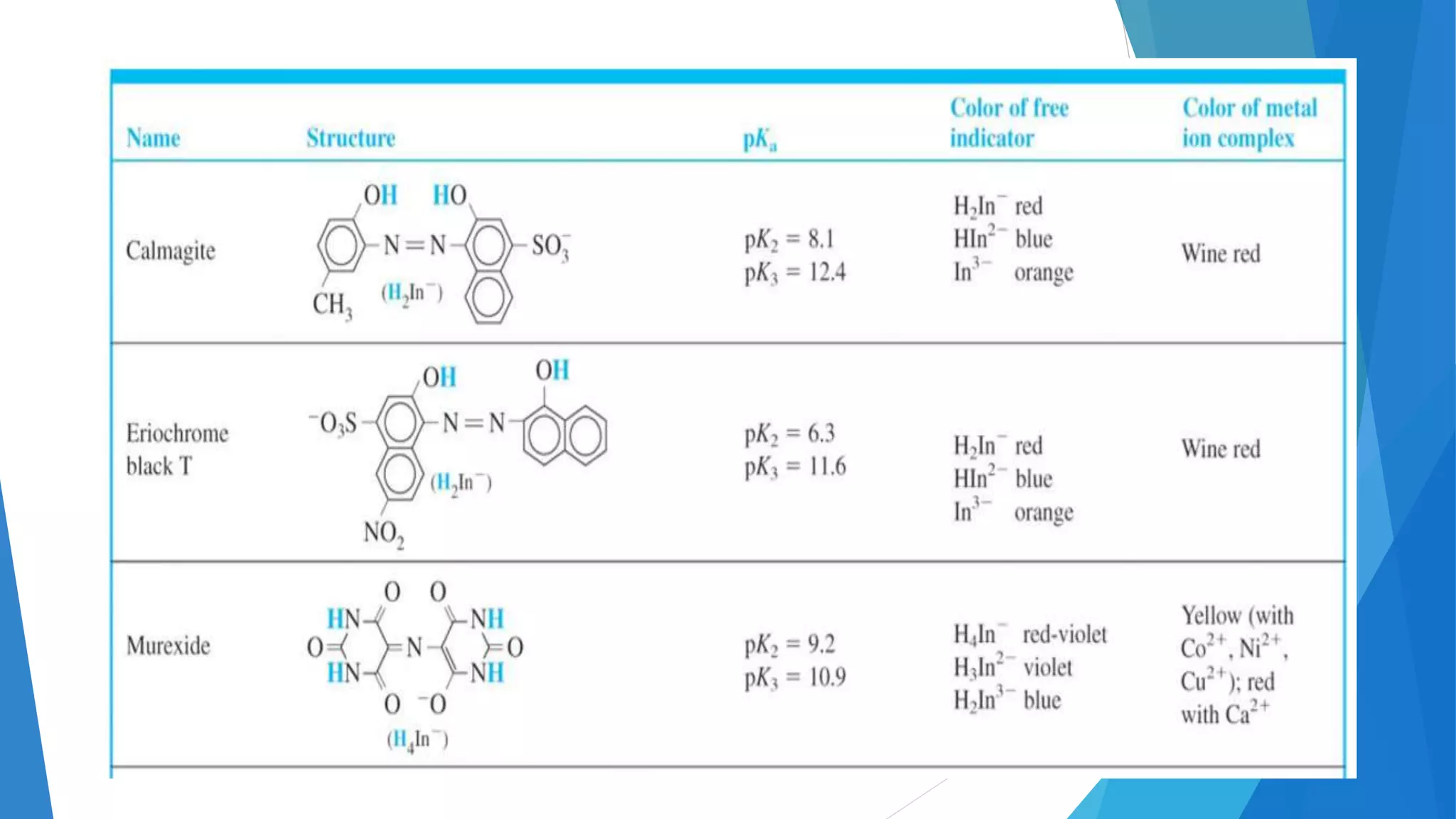
Metal-Ion Indicator
Objective of using metal ion indicator
1) Detect the end point of EDTA titration.
2) Generally in an EDTA titration a pH meter with pH electrode is
necessary. But using an EDTA indicator ,the end point of a
titration can be detected.
3) Metal ion indicators change colour when they bind to a metal
ion. Useful indicators must bind to the metal. (must give up
their metal ions to EDTA) So the indicator change its colour
with different pH values.
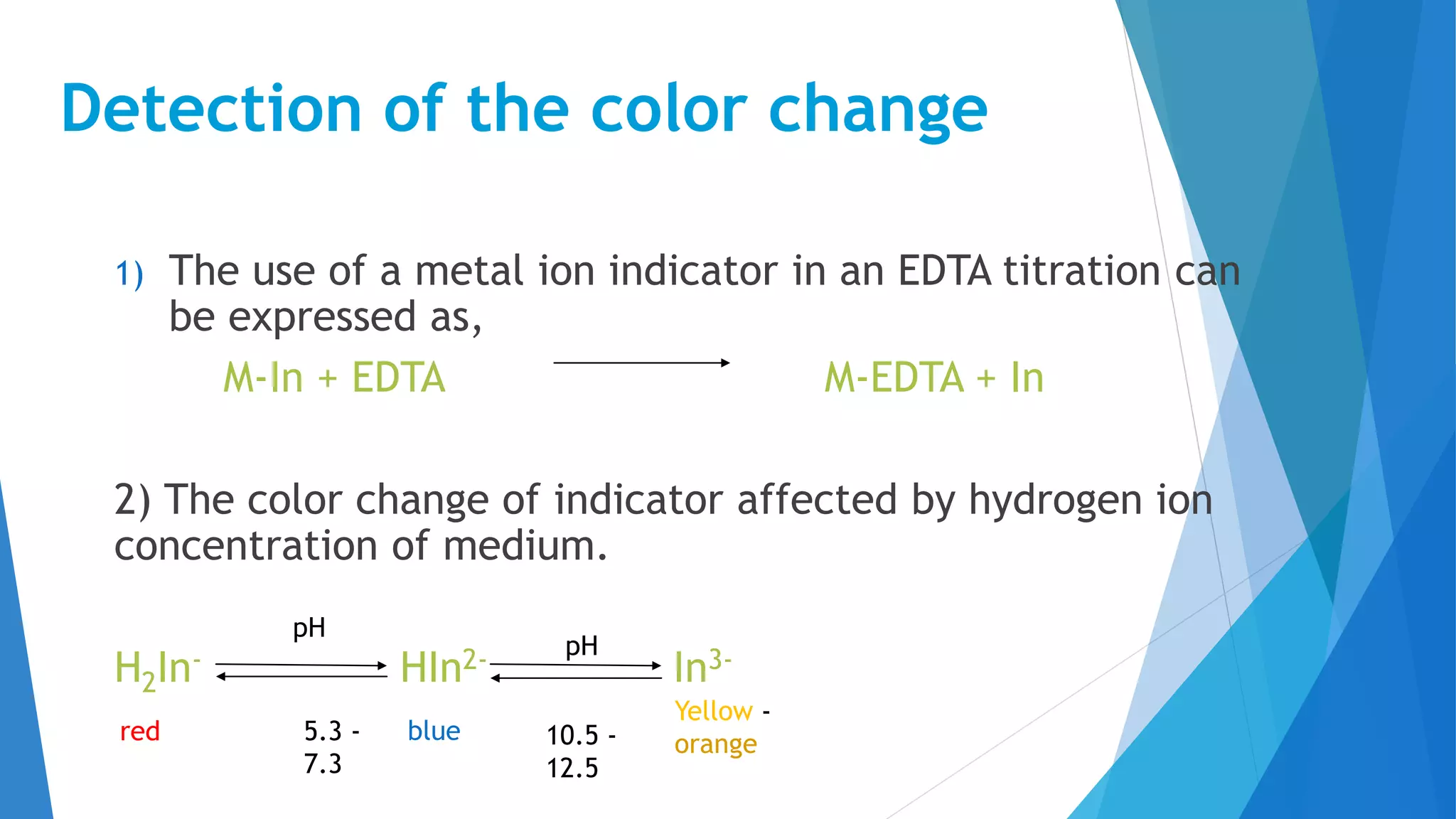
Detection of the color change
1) The use of a metal ion indicator in an EDTA titration can
be expressed as,
M-In + EDTA M-EDTA + In
2) The color change of indicator affected by hydrogen ion
concentration of medium.
H2In- HIn2- In3-pH
pH
5.3 -
7.3
10.5 -
12.5
Yellow -
orangered blue
Type of EDTA titrations
 Direct titration
 Indirect titration
 Back titration
 Displacement titration
Types of EDTA titrations
 Direct Titration
Simply add an indicator to the solution of the metal ion and titrate
with EDTA. Before starting the titration, it is needed to check the
pH of the solution.
 Indirect titration
EDTA can be used as titrant for anions. Anions can be
precipitated with suitable metal ion. Filter and wash the ppt with
proper solution. Then boil in excess EDTA to complex the metal
ion(ppt).
 Back Titration
An excess of EDTA is added to the metal ion solution, and the excess EDTA is
titrated with a known concentration of a second metal ion. The second metal ion
must form a weaker complex with EDTA than the analyte ion.
 Displacement titration
The analyte is treated with an excess of a second metal bound to EDTA. The
analyte ion displaces the second metal from the EDTA complex, and then the
second metal is titrated with EDTA.
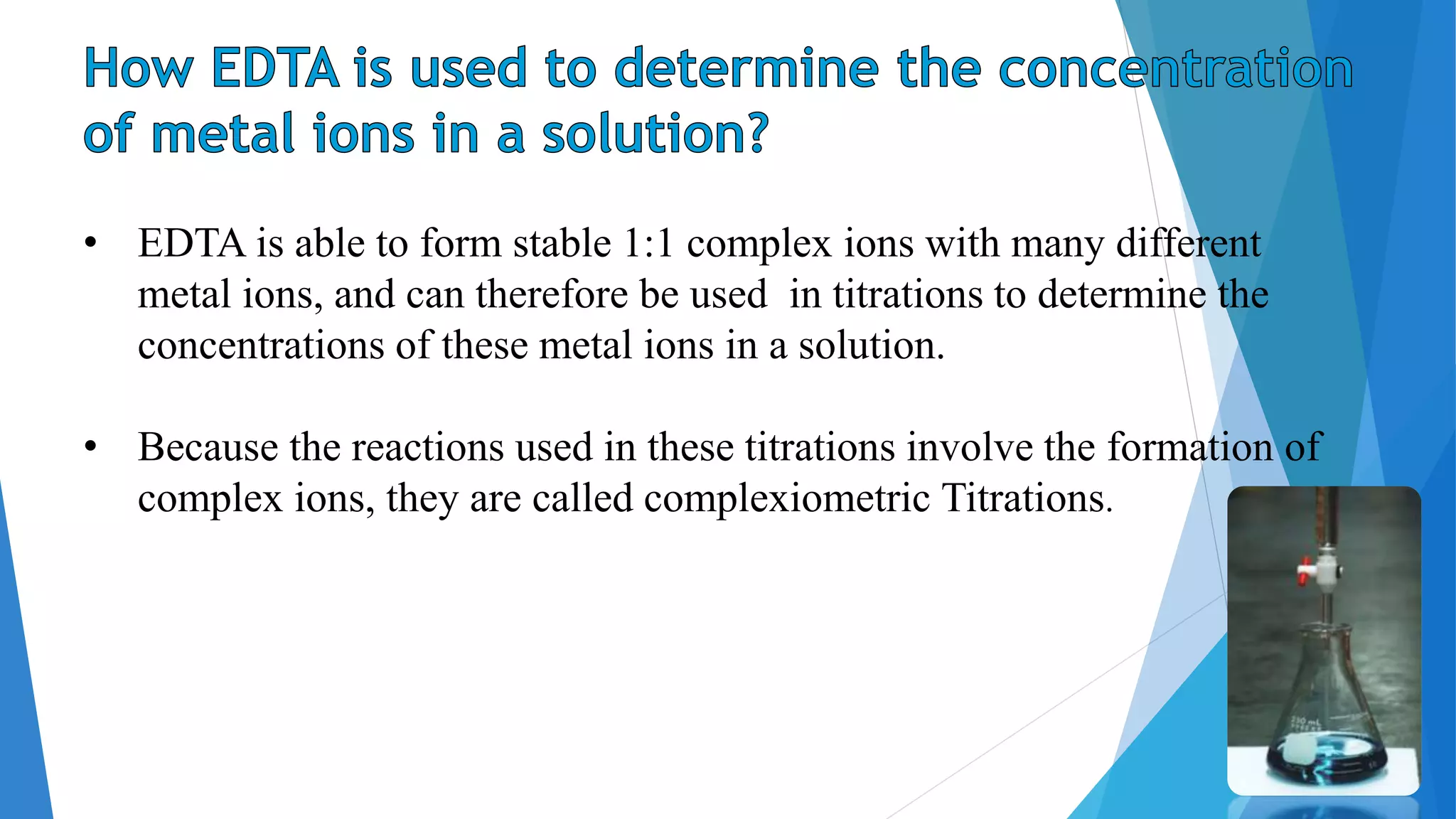
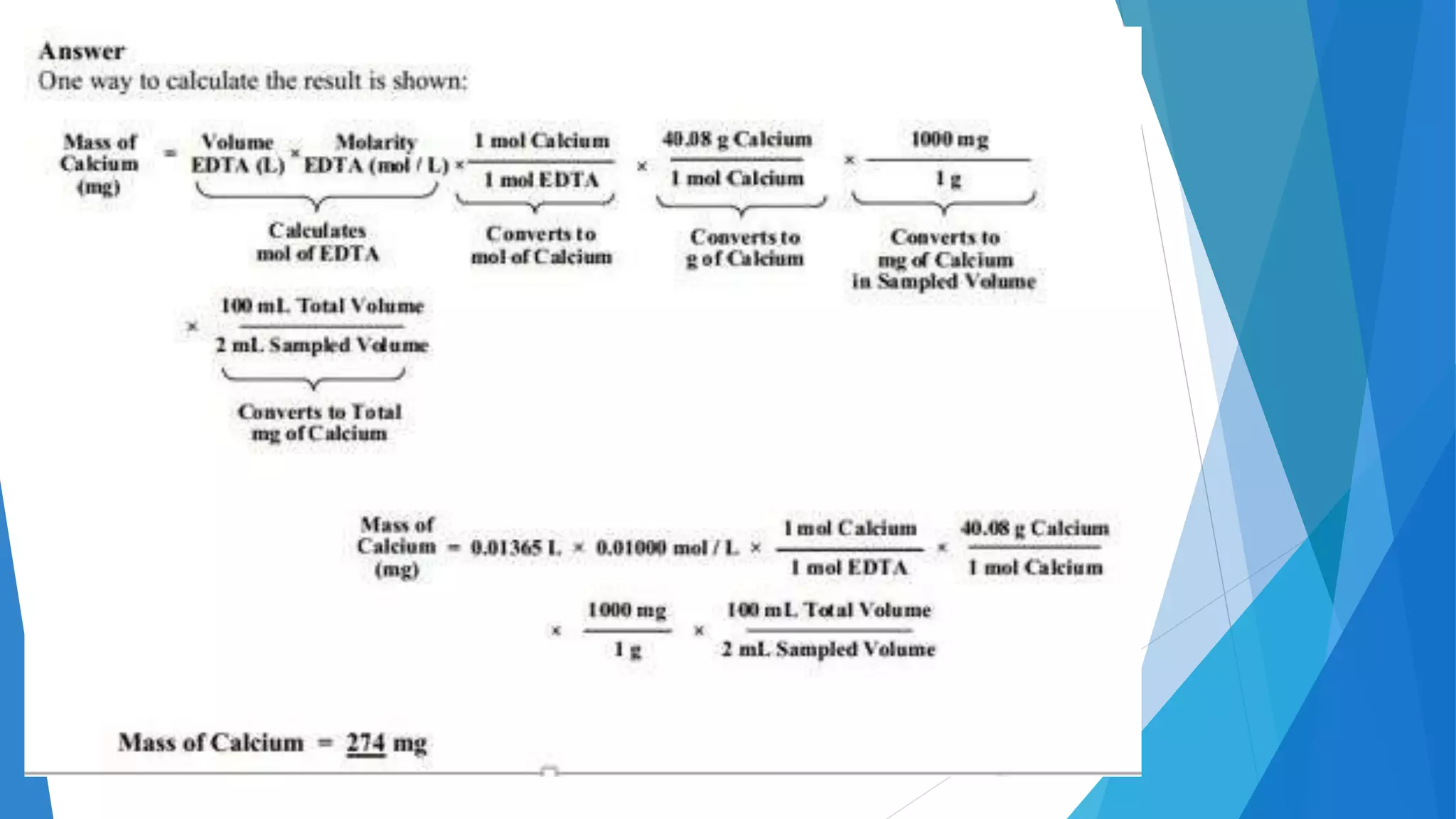
• EDTA is able to form stable 1:1 complex ions with many different
metal ions, and can therefore be used in titrations to determine the
concentrations of these metal ions in a solution.
• Because the reactions used in these titrations involve the formation of
complex ions, they are called complexiometric Titrations.
1. L.P. Usgodaarachchi
2. M.H.K. Madushani
3. D.D.J.C.Thilakasiri
4. A.P.N.M.Pathirana
5. T.M. Perera
6. M.K. Perera
Complexation titration (1) (1)

Complexation titration (1) (1)

  • 1.
    Complexation Titration Department ofphysical sciences & technology university of sabaragamuwa srilanka (PST-Group 11)
  • 3.
    1) What isa Titration? 2) What are the equipment Using Titration 3) Equipment cleaning technique 4) Titration type 5) How Complexation Titration differ from normal Titration 6) Indicators 7) EDTA Titration 8) Analyzing
  • 4.
     The processof adding standard solution until the reaction completes, it’s called a titration.  The reaction completion is identified by the colour change of the indicator.
  • 5.
    Main equipment whenusing titration 1. Titration flask 2. Pipette 3. Pipette bulb 4. Burette
  • 6.
    Titration flask isonly washed using distilled water. Burette is first washed by using distilled water, then it is washed by using titrant(solution having known concentration). Pipette is first washed by using distilled water, then it is washed by using the analyte(solution concentration that has to be checked).
  • 7.
    1) Neutralization titrations 2)Complex formation titrations 3) Precipitation titrations 4) Oxidation-Reduction Titrations
  • 8.
    Complexometric titration isa form of volumetric analysis in which the formation of a coloured complex is used to indicate the end point of a titration. Complexometric titrations are particularly useful for the determination of a mixture of different metal ions in a solution
  • 9.
    Complexion Normal At theend point colourful complex formation forms. At the end point precipitate, solution may form. Used by metal indicator & metal ion indicator. Normally acid base indicator can be used or sometimes it is not necessary to use the indicator.
  • 10.
     Complex: metal+ ligand  Ligand: has at least one pair of unshared electrons available for bond formation.  Complex formation has a specific colour. (electron donor) Ex: H2O, NH3, Cl-, Br-, I-…… ~ ~ An ion or a molecule that forms a covalent bond with a cation or a neutral metal atom by donating a pair of electrons, which is then shared by the two atoms. Ex: [Cu(NH3)4]2+, [CuCl4]2-, [Cr(NH3)6]3+
  • 11.
    Metal ligand Complexes Complexation Titrations are based on the reaction of a metal ion with a chemical agent to form a metal-ligand complex.  Complexation Titrations are essentially Lewis acid-base reactions, in which an electron pair is donated from one chemical to another.  The ligands used in complexometric titrations are also known as chelating agents. - Ligand that attaches to a metal ion through more than one ligand atom  Most chelating agents contain N or O - Elements that contain free electron pairs that may be donated to a metal
  • 12.
    Metal Ligand Metal-LigandComplex Metal – Lewis Acid or Electron-pair acceptor Ligand – Lewis Base or Electron-pair donor • Complex formation reactions are reversible. So there have formation constant(Kf)
  • 13.
    The equilibrium constantfor the reaction between a metal ion (M+n) and a chelating agent (L-P) is known as a formation constant or stability constant. ][Y][M ]Y[M K YMYM b ab f ab b     a a
  • 14.
    Properties of EDTA 1.)EDTA (Ethylenediaminetetraacetic acid)  One of the most common chelating agents used for complexometric titrations in analytical chemistry.  EDTA has 6 hydrogen atoms. 2 atoms from ammine group & 4 atoms from carboxylic group. So in its structure it gives 6 free electron pairs that it can donate to metal ions. - High Kf values - 6 acid-base sites in its structure
  • 15.
    2) EDTA isan example of a multidentate (many-toothed) ligand, which can bind metal ions through multiple atoms.
  • 16.
    3) EDTA isan amphoteric substance. 4) It can both donate and accept protons. 5)The four hydrogen atoms shown in the above line structure are acidic. 6) Because of this, the formula of EDTA is often abbreviated H4Y, where H4 represents the four acidic hydrogen atoms and Y represents the remaining structure. 7)At very low pH, EDTA will be present in its completely protonated form H6Y2+. 8)At very high pH, EDTA will be present in its completely deprotonated form, Y4-.
  • 17.
    EDTA can representas different types
  • 20.
    Compounds which havingsame chemical properties like EDTA EGTA (ethylene glycol tetraacetic acid)
  • 21.
  • 22.
    Objective of usingmetal ion indicator 1) Detect the end point of EDTA titration. 2) Generally in an EDTA titration a pH meter with pH electrode is necessary. But using an EDTA indicator ,the end point of a titration can be detected. 3) Metal ion indicators change colour when they bind to a metal ion. Useful indicators must bind to the metal. (must give up their metal ions to EDTA) So the indicator change its colour with different pH values.
  • 24.
    Detection of thecolor change 1) The use of a metal ion indicator in an EDTA titration can be expressed as, M-In + EDTA M-EDTA + In 2) The color change of indicator affected by hydrogen ion concentration of medium. H2In- HIn2- In3-pH pH 5.3 - 7.3 10.5 - 12.5 Yellow - orangered blue
  • 25.
    Type of EDTAtitrations  Direct titration  Indirect titration  Back titration  Displacement titration
  • 26.
    Types of EDTAtitrations  Direct Titration Simply add an indicator to the solution of the metal ion and titrate with EDTA. Before starting the titration, it is needed to check the pH of the solution.  Indirect titration EDTA can be used as titrant for anions. Anions can be precipitated with suitable metal ion. Filter and wash the ppt with proper solution. Then boil in excess EDTA to complex the metal ion(ppt).
  • 27.
     Back Titration Anexcess of EDTA is added to the metal ion solution, and the excess EDTA is titrated with a known concentration of a second metal ion. The second metal ion must form a weaker complex with EDTA than the analyte ion.  Displacement titration The analyte is treated with an excess of a second metal bound to EDTA. The analyte ion displaces the second metal from the EDTA complex, and then the second metal is titrated with EDTA.
  • 28.
    • EDTA isable to form stable 1:1 complex ions with many different metal ions, and can therefore be used in titrations to determine the concentrations of these metal ions in a solution. • Because the reactions used in these titrations involve the formation of complex ions, they are called complexiometric Titrations.
  • 32.
    1. L.P. Usgodaarachchi 2.M.H.K. Madushani 3. D.D.J.C.Thilakasiri 4. A.P.N.M.Pathirana 5. T.M. Perera 6. M.K. Perera