Redox Titrations
Archana.K
Introduction
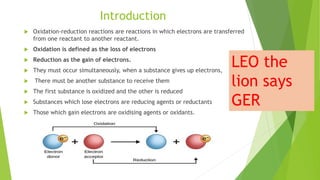
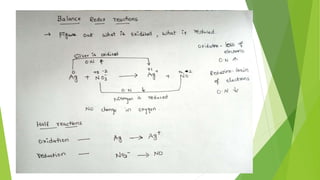
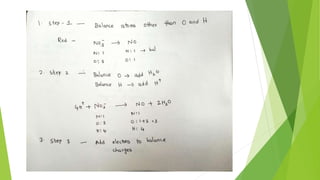
 Oxidation-reduction reactions are reactions in which electrons are transferred
from one reactant to another reactant.
 Oxidation is defined as the loss of electrons
 Reduction as the gain of electrons.
 They must occur simultaneously, when a substance gives up electrons,
 There must be another substance to receive them
 The first substance is oxidized and the other is reduced
 Substances which lose electrons are reducing agents or reductants
 Those which gain electrons are oxidising agents or oxidants.
LEO the
lion says
GER
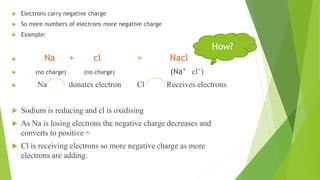
 Electrons carry negative charge
 So more numbers of electrons more negative charge
 Example:
 Na + cl = Nacl
 (no charge) (no charge) (Na⁺ cl⁻)
 Na donates electron Cl Receives electrons
 Sodium is reducing and cl is oxidising
 As Na is losing electrons the negative charge decreases and
converts to positive +
 Cl is receiving electrons so more negative charge as more
electrons are adding.
How?
 No reaction can happen in half
 If there is reduction there should be oxidation.
 Half reactions:
 Na + cl = Nacl
 How to write half reactions…let’s see..
 For chloride
Cl + e⁻ = cl⁻
 For sodium can we write like this. Let’s see..
 Na - e⁻ = Na⁺
Something is not
right here…can
you guess?
 Exactly…….
 Is there any “-” symbol in a reaction phase…
 No…..
 So how to write the half reaction then?
 Ok here we go…..
 Na Na⁺ + e⁻
 Here the reaction conveys the same information as it is donating electrons.
 Na Na⁺ + e⁻
 cl + e⁻ cl⁻
 Na + cl Na⁺cl⁻ (Nacl)
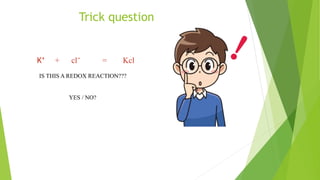
Trick question
K⁺ + cl⁻ = Kcl
IS THIS A REDOX REACTION???
YES / NO?
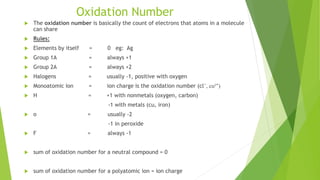
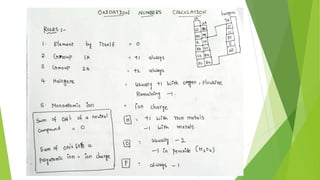
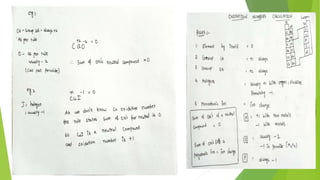
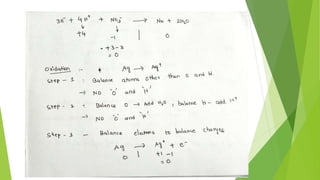
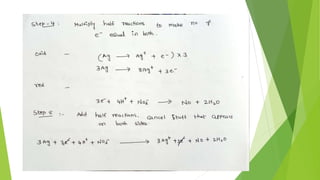
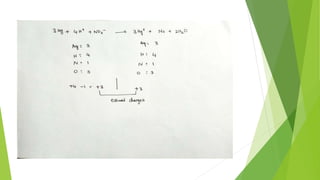
Oxidation Number
 The oxidation number is basically the count of electrons that atoms in a molecule
can share
 Rules:
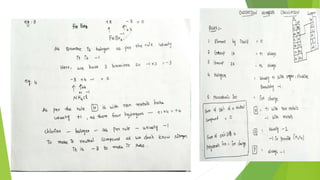
 Elements by itself = 0 eg: Ag
 Group 1A = always +1
 Group 2A = always +2
 Halogens = usually -1, positive with oxygen
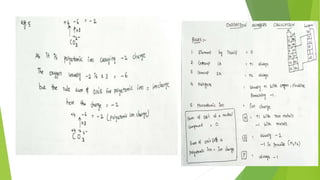
 Monoatomic ion = ion charge is the oxidation number (cl⁻, cu²⁺)
 H = +1 with nonmetals (oxygen, carbon)
-1 with metals (cu, iron)
 o = usually -2
-1 in peroxide
 F = always -1
 sum of oxidation number for a neutral compound = 0
 sum of oxidation number for a polyatomic ion = ion charge
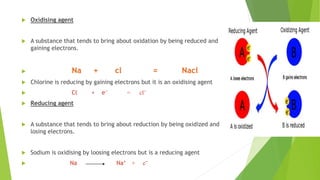
 Oxidising agent
 A substance that tends to bring about oxidation by being reduced and
gaining electrons.
 Na + cl = Nacl
 Chlorine is reducing by gaining electrons but it is an oxidising agent
 Cl + e⁻ = cl⁻
 Reducing agent
 A substance that tends to bring about reduction by being oxidized and
losing electrons.
 Sodium is oxidising by loosing electrons but is a reducing agent
 Na Na⁺ + e⁻
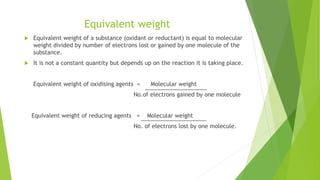
Equivalent weight
 Equivalent weight of a substance (oxidant or reductant) is equal to molecular
weight divided by number of electrons lost or gained by one molecule of the
substance.
 It is not a constant quantity but depends up on the reaction it is taking place.
Equivalent weight of oxidising agents = Molecular weight
No.of electrons gained by one molecule
Equivalent weight of reducing agents = Molecular weight
No. of electrons lost by one molecule.
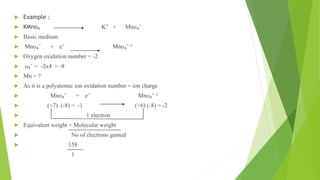
 Example :
 KMno₄ K⁺ + Mno₄⁻
 Basic medium
 Mno₄⁻ + e⁻ Mno₄⁻ ²
 Oxygen oxidation number = -2
 o₄⁻ = -2x4 = -8
 Mn = ?
 As it is a polyatomic ion oxidation number = ion charge
 Mno₄⁻ + e⁻ Mno₄⁻ ²
 (+7) (-8) = -1 (+6) (-8) = -2
 1 electron
 Equivalent weight = Molecular weight
 No of electrons gained
 158
1
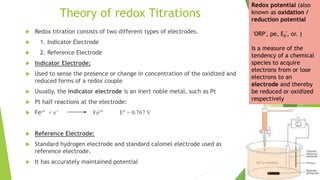
Theory of redox Titrations
 Redox titration consists of two different types of electrodes.
 1. Indicator Electrode
 2. Reference Electrode
 Indicator Electrode:
 Used to sense the presence or change in concentration of the oxidized and
reduced forms of a redox couple
 Usually, the indicator electrode is an inert noble metal, such as Pt
 Pt half reactions at the electrode:
 Fe³⁺ + e⁻ Fe²⁺ Eº = 0.767 V
 Reference Electrode:
 Standard hydrogen electrode and standard calomel electrode used as
reference electrode.
 It has accurately maintained potential
Redox potential (also
known as oxidation /
reduction potential
'ORP', pe, E0', or. )
Is a measure of the
tendency of a chemical
species to acquire
electrons from or lose
electrons to an
electrode and thereby
be reduced or oxidized
respectively
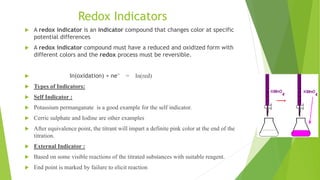
Redox Indicators
 A redox indicator is an indicator compound that changes color at specific
potential differences
 A redox indicator compound must have a reduced and oxidized form with
different colors and the redox process must be reversible.
 In(oxidation) + ne⁻ = In(red)
 Types of Indicators:
 Self Indicator :
 Potassium permanganate is a good example for the self indicator.
 Cerric sulphate and Iodine are other examples
 After equivalence point, the titrant will impart a definite pink color at the end of the
titration.
 External Indicator :
 Based on some visible reactions of the titrated substances with suitable reagent.
 End point is marked by failure to elicit reaction
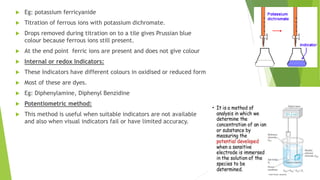
 Eg: potassium ferricyanide
 Titration of ferrous ions with potassium dichromate.
 Drops removed during titration on to a tile gives Prussian blue
colour because ferrous ions still present.
 At the end point ferric ions are present and does not give colour
 Internal or redox Indicators:
 These Indicators have different colours in oxidised or reduced form
 Most of these are dyes.
 Eg: Diphenylamine, Diphenyl Benzidine
 Potentiometric method:
 This method is useful when suitable indicators are not available
and also when visual indicators fail or have limited accuracy.
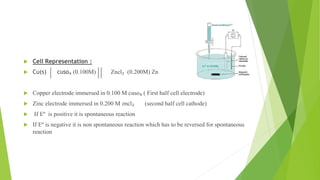
 Cell Representation :
 Cu(s) cuso₄ (0.100M) Zncl₂ (0.200M) Zn
 Copper electrode immersed in 0.100 M cuso₄ ( First half cell electrode)
 Zinc electrode immersed in 0.200 M zncl₂ (second half cell cathode)
 If Eº is positive it is spontaneous reaction
 If Eº is negative it is non spontaneous reaction which has to be reversed for spontaneous
reaction
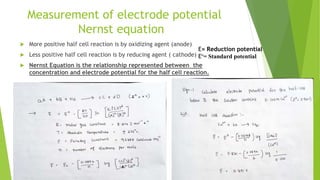
Measurement of electrode potential
Nernst equation
 More positive half cell reaction is by oxidizing agent (anode)
 Less positive half cell reaction is by reducing agent ( cathode)
 Nernst Equation is the relationship represented between the
concentration and electrode potential for the half cell reaction.
E= Reduction potential
Eº= Standard potential
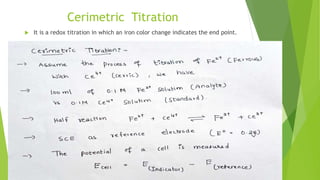
Cerimetric Titration
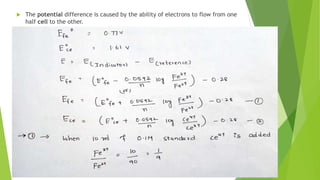
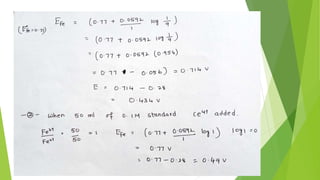
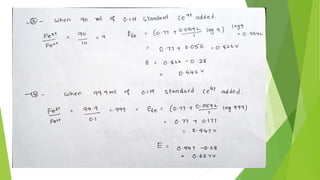
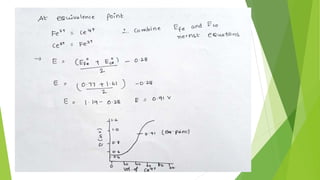
 It is a redox titration in which an iron color change indicates the end point.
 The potential difference is caused by the ability of electrons to flow from one
half cell to the other.
Iodimetry and Iodometry
 Iodimetry:
 Principle:
 Standard Iodine solution is used as standard.
 Iodine is a weak oxidant and it can be reduced by reductants to Iodide ions
 I₂ ↔ 2I⁻
 Strong reducing agents examples
 Stannous chloride, sodium thiosulphate
 Sn²⁺ +I₂ Sn⁴⁺ + 2I⁻ (stannous)
 2S₂O₃ +I₂ S₄O₆²⁻ + 2I⁻ (sodium thiosulphate)
 Weak reducing agents
 Arsenic
 As³⁺ + I₂ As⁵⁺ +2I⁻
 This method is used to quantify oxidising agnets
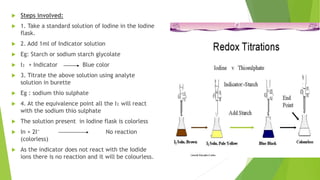
 Steps involved:
 1. Take a standard solution of Iodine in the Iodine
flask.
 2. Add 1ml of Indicator solution
 Eg: Starch or sodium starch glycolate
 I₂ + Indicator Blue color
 3. Titrate the above solution using analyte
solution in burette
 Eg : sodium thio sulphate
 4. At the equivalence point all the I₂ will react
with the sodium thio sulphate
 The solution present in Iodine flask is colorless
 In + 2I⁻ No reaction
(colorless)
 As the indicator does not react with the Iodide
ions there is no reaction and it will be colourless.
 Iodometry : principle:
 A redox titration where the appearance or disappearance of elementary
iodine indicates the end point.
 Liberated Iodine from Iodide is used for titration and the method is
considered as Indirect titration.
 KI ↔ K⁺ + I⁻
 2I⁻↔ I₂ ↑ + 2e⁻
 When we have solutions of strong oxidant CuSO4, KMnO₄ add excess KI solution
in acidic medium so that Iodide ions are oxidized to Iodine ions.
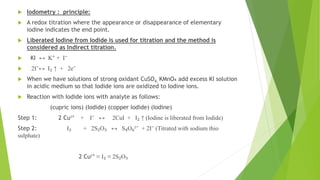
 Reaction with Iodide ions with analyte as follows:
(cupric ions) (Iodide) (copper Iodide) (Iodine)
Step 1: 2 Cu²⁺ + I⁻ ↔ 2CuI + I₂ ↑ (Iodine is liberated from Iodide)
Step 2: I₂ + 2S₂O₃ ↔ S₄O₆²⁻ + 2I⁻ (Titrated with sodium thio
sulphate)
2 Cu²⁺ ≡ I₂ ≡ 2S₂O₃
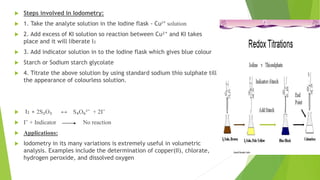
 Steps involved in Iodometry:
 1. Take the analyte solution in the Iodine flask - Cu²⁺ solution
 2. Add excess of KI solution so reaction between Cu²⁺ and KI takes
place and it will liberate I₂
 3. Add indicator solution in to the Iodine flask which gives blue colour
 Starch or Sodium starch glycolate
 4. Titrate the above solution by using standard sodium thio sulphate till
the appearance of colourless solution.
 I₂ + 2S₂O₃ ↔ S₄O₆²⁻ + 2I⁻
 I⁻ + Indicator No reaction
 Applications:
 Iodometry in its many variations is extremely useful in volumetric
analysis. Examples include the determination of copper(II), chlorate,
hydrogen peroxide, and dissolved oxygen
Bromatometry
 Principle: Potassium bromate is a strong oxidizing agent in acidic medium.
Bromatometry is a titration process in which the bromination of a chemical
indicator is observed.
 Reaction takes place generally in presence of acidic medium 1M Hcl.
 The liberated Bro₃⁻(bromate ions) reacts with analyte directly which is a direct
titration.
 KBro₃ ↔ K⁺ + Bro₃⁻
 Arsenite
 3AsO₃³⁻ ( Analyte example) + Bro₃⁻ 3AsO₄³⁻ + Br⁻
 This liberated Br⁻ (bromine ion) further reacts with Bro₃⁻ in presence of acidic medium
H⁺ ions.
 5 Br⁻ + Bro₃⁻ + 6H⁺ 3 Br₂ + 3 H2O
 Br₂ reacts with indicator which is methyl orange, methyl red
 This Br₂ oxidizes indicator and solution is colorless.
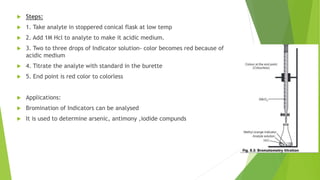
 Steps:
 1. Take analyte in stoppered conical flask at low temp
 2. Add 1M Hcl to analyte to make it acidic medium.
 3. Two to three drops of Indicator solution- color becomes red because of
acidic medium
 4. Titrate the analyte with standard in the burette
 5. End point is red color to colorless
 Applications:
 Bromination of Indicators can be analysed
 It is used to determine arsenic, antimony ,iodide compunds
Dichromatometry
 Potassium Dichromate is used as standard K2Cr2O7
 It is an Oxidizing agent in presence of acidic medium and used as primary
standard
 K2Cr2O₇ is used only in acidic medium Cr₂O₇²⁻(dichromate) is rapidly reduced to
Cr³⁺(chromium) which is green in colour.
 K ₂Cr₂ O₇ 2K⁺ + Cr₂O₇²⁻
 Cr₂O₇²⁻ +14 H⁺ 6e⁻ 2 Cr³⁺ +7H₂O
 Iron II salt is used as analyte
 6Fe²⁺ + Cr₂O₇²⁻ + 14H⁺ 2 Cr³⁺ + 6Fe³⁺ + 7H₂O
 Cr³⁺ is green in color after reduction of Cr₂O₇²⁻ ions
 By using simple indicator method end point can’t be determined so we need to use
external indicator method.
 Eg: potassium ferricyanide
 Steps involved in dichromatometry:
 1.Take sample solution in conical flask Fe²⁺
 2. Add sulphuric acid for acidic medium
 Titrate with the potassium dichromate in burette.
 Take one drop of solution from the conical flask near the end point and put it
in the external indicator
 Before the ed point the ferrous ions reacts with potassium ferricyanide and
converts to ferric so Prussian blue colour will appear
 At the end point this reaction will not occur so the colour will not change.
 Applications:
 Used to determine Iron II salt.

Redox titrations in pharmaceutical analysis

  • 1.
  • 2.
    Introduction  Oxidation-reduction reactionsare reactions in which electrons are transferred from one reactant to another reactant.  Oxidation is defined as the loss of electrons  Reduction as the gain of electrons.  They must occur simultaneously, when a substance gives up electrons,  There must be another substance to receive them  The first substance is oxidized and the other is reduced  Substances which lose electrons are reducing agents or reductants  Those which gain electrons are oxidising agents or oxidants. LEO the lion says GER
  • 3.
     Electrons carrynegative charge  So more numbers of electrons more negative charge  Example:  Na + cl = Nacl  (no charge) (no charge) (Na⁺ cl⁻)  Na donates electron Cl Receives electrons  Sodium is reducing and cl is oxidising  As Na is losing electrons the negative charge decreases and converts to positive +  Cl is receiving electrons so more negative charge as more electrons are adding. How?
  • 4.
     No reactioncan happen in half  If there is reduction there should be oxidation.  Half reactions:  Na + cl = Nacl  How to write half reactions…let’s see..  For chloride Cl + e⁻ = cl⁻  For sodium can we write like this. Let’s see..  Na - e⁻ = Na⁺ Something is not right here…can you guess?
  • 5.
     Exactly…….  Isthere any “-” symbol in a reaction phase…  No…..  So how to write the half reaction then?  Ok here we go…..  Na Na⁺ + e⁻  Here the reaction conveys the same information as it is donating electrons.  Na Na⁺ + e⁻  cl + e⁻ cl⁻  Na + cl Na⁺cl⁻ (Nacl)
  • 6.
    Trick question K⁺ +cl⁻ = Kcl IS THIS A REDOX REACTION??? YES / NO?
  • 7.
    Oxidation Number  Theoxidation number is basically the count of electrons that atoms in a molecule can share  Rules:  Elements by itself = 0 eg: Ag  Group 1A = always +1  Group 2A = always +2  Halogens = usually -1, positive with oxygen  Monoatomic ion = ion charge is the oxidation number (cl⁻, cu²⁺)  H = +1 with nonmetals (oxygen, carbon) -1 with metals (cu, iron)  o = usually -2 -1 in peroxide  F = always -1  sum of oxidation number for a neutral compound = 0  sum of oxidation number for a polyatomic ion = ion charge
  • 17.
     Oxidising agent A substance that tends to bring about oxidation by being reduced and gaining electrons.  Na + cl = Nacl  Chlorine is reducing by gaining electrons but it is an oxidising agent  Cl + e⁻ = cl⁻  Reducing agent  A substance that tends to bring about reduction by being oxidized and losing electrons.  Sodium is oxidising by loosing electrons but is a reducing agent  Na Na⁺ + e⁻
  • 18.
    Equivalent weight  Equivalentweight of a substance (oxidant or reductant) is equal to molecular weight divided by number of electrons lost or gained by one molecule of the substance.  It is not a constant quantity but depends up on the reaction it is taking place. Equivalent weight of oxidising agents = Molecular weight No.of electrons gained by one molecule Equivalent weight of reducing agents = Molecular weight No. of electrons lost by one molecule.
  • 19.
     Example : KMno₄ K⁺ + Mno₄⁻  Basic medium  Mno₄⁻ + e⁻ Mno₄⁻ ²  Oxygen oxidation number = -2  o₄⁻ = -2x4 = -8  Mn = ?  As it is a polyatomic ion oxidation number = ion charge  Mno₄⁻ + e⁻ Mno₄⁻ ²  (+7) (-8) = -1 (+6) (-8) = -2  1 electron  Equivalent weight = Molecular weight  No of electrons gained  158 1
  • 20.
    Theory of redoxTitrations  Redox titration consists of two different types of electrodes.  1. Indicator Electrode  2. Reference Electrode  Indicator Electrode:  Used to sense the presence or change in concentration of the oxidized and reduced forms of a redox couple  Usually, the indicator electrode is an inert noble metal, such as Pt  Pt half reactions at the electrode:  Fe³⁺ + e⁻ Fe²⁺ Eº = 0.767 V  Reference Electrode:  Standard hydrogen electrode and standard calomel electrode used as reference electrode.  It has accurately maintained potential Redox potential (also known as oxidation / reduction potential 'ORP', pe, E0', or. ) Is a measure of the tendency of a chemical species to acquire electrons from or lose electrons to an electrode and thereby be reduced or oxidized respectively
  • 21.
    Redox Indicators  Aredox indicator is an indicator compound that changes color at specific potential differences  A redox indicator compound must have a reduced and oxidized form with different colors and the redox process must be reversible.  In(oxidation) + ne⁻ = In(red)  Types of Indicators:  Self Indicator :  Potassium permanganate is a good example for the self indicator.  Cerric sulphate and Iodine are other examples  After equivalence point, the titrant will impart a definite pink color at the end of the titration.  External Indicator :  Based on some visible reactions of the titrated substances with suitable reagent.  End point is marked by failure to elicit reaction
  • 22.
     Eg: potassiumferricyanide  Titration of ferrous ions with potassium dichromate.  Drops removed during titration on to a tile gives Prussian blue colour because ferrous ions still present.  At the end point ferric ions are present and does not give colour  Internal or redox Indicators:  These Indicators have different colours in oxidised or reduced form  Most of these are dyes.  Eg: Diphenylamine, Diphenyl Benzidine  Potentiometric method:  This method is useful when suitable indicators are not available and also when visual indicators fail or have limited accuracy.
  • 23.
     Cell Representation:  Cu(s) cuso₄ (0.100M) Zncl₂ (0.200M) Zn  Copper electrode immersed in 0.100 M cuso₄ ( First half cell electrode)  Zinc electrode immersed in 0.200 M zncl₂ (second half cell cathode)  If Eº is positive it is spontaneous reaction  If Eº is negative it is non spontaneous reaction which has to be reversed for spontaneous reaction
  • 24.
    Measurement of electrodepotential Nernst equation  More positive half cell reaction is by oxidizing agent (anode)  Less positive half cell reaction is by reducing agent ( cathode)  Nernst Equation is the relationship represented between the concentration and electrode potential for the half cell reaction. E= Reduction potential Eº= Standard potential
  • 25.
    Cerimetric Titration  Itis a redox titration in which an iron color change indicates the end point.
  • 26.
     The potentialdifference is caused by the ability of electrons to flow from one half cell to the other.
  • 30.
    Iodimetry and Iodometry Iodimetry:  Principle:  Standard Iodine solution is used as standard.  Iodine is a weak oxidant and it can be reduced by reductants to Iodide ions  I₂ ↔ 2I⁻  Strong reducing agents examples  Stannous chloride, sodium thiosulphate  Sn²⁺ +I₂ Sn⁴⁺ + 2I⁻ (stannous)  2S₂O₃ +I₂ S₄O₆²⁻ + 2I⁻ (sodium thiosulphate)  Weak reducing agents  Arsenic  As³⁺ + I₂ As⁵⁺ +2I⁻  This method is used to quantify oxidising agnets
  • 31.
     Steps involved: 1. Take a standard solution of Iodine in the Iodine flask.  2. Add 1ml of Indicator solution  Eg: Starch or sodium starch glycolate  I₂ + Indicator Blue color  3. Titrate the above solution using analyte solution in burette  Eg : sodium thio sulphate  4. At the equivalence point all the I₂ will react with the sodium thio sulphate  The solution present in Iodine flask is colorless  In + 2I⁻ No reaction (colorless)  As the indicator does not react with the Iodide ions there is no reaction and it will be colourless.
  • 32.
     Iodometry :principle:  A redox titration where the appearance or disappearance of elementary iodine indicates the end point.  Liberated Iodine from Iodide is used for titration and the method is considered as Indirect titration.  KI ↔ K⁺ + I⁻  2I⁻↔ I₂ ↑ + 2e⁻  When we have solutions of strong oxidant CuSO4, KMnO₄ add excess KI solution in acidic medium so that Iodide ions are oxidized to Iodine ions.  Reaction with Iodide ions with analyte as follows: (cupric ions) (Iodide) (copper Iodide) (Iodine) Step 1: 2 Cu²⁺ + I⁻ ↔ 2CuI + I₂ ↑ (Iodine is liberated from Iodide) Step 2: I₂ + 2S₂O₃ ↔ S₄O₆²⁻ + 2I⁻ (Titrated with sodium thio sulphate) 2 Cu²⁺ ≡ I₂ ≡ 2S₂O₃
  • 33.
     Steps involvedin Iodometry:  1. Take the analyte solution in the Iodine flask - Cu²⁺ solution  2. Add excess of KI solution so reaction between Cu²⁺ and KI takes place and it will liberate I₂  3. Add indicator solution in to the Iodine flask which gives blue colour  Starch or Sodium starch glycolate  4. Titrate the above solution by using standard sodium thio sulphate till the appearance of colourless solution.  I₂ + 2S₂O₃ ↔ S₄O₆²⁻ + 2I⁻  I⁻ + Indicator No reaction  Applications:  Iodometry in its many variations is extremely useful in volumetric analysis. Examples include the determination of copper(II), chlorate, hydrogen peroxide, and dissolved oxygen
  • 34.
    Bromatometry  Principle: Potassiumbromate is a strong oxidizing agent in acidic medium. Bromatometry is a titration process in which the bromination of a chemical indicator is observed.  Reaction takes place generally in presence of acidic medium 1M Hcl.  The liberated Bro₃⁻(bromate ions) reacts with analyte directly which is a direct titration.  KBro₃ ↔ K⁺ + Bro₃⁻  Arsenite  3AsO₃³⁻ ( Analyte example) + Bro₃⁻ 3AsO₄³⁻ + Br⁻  This liberated Br⁻ (bromine ion) further reacts with Bro₃⁻ in presence of acidic medium H⁺ ions.  5 Br⁻ + Bro₃⁻ + 6H⁺ 3 Br₂ + 3 H2O  Br₂ reacts with indicator which is methyl orange, methyl red  This Br₂ oxidizes indicator and solution is colorless.
  • 35.
     Steps:  1.Take analyte in stoppered conical flask at low temp  2. Add 1M Hcl to analyte to make it acidic medium.  3. Two to three drops of Indicator solution- color becomes red because of acidic medium  4. Titrate the analyte with standard in the burette  5. End point is red color to colorless  Applications:  Bromination of Indicators can be analysed  It is used to determine arsenic, antimony ,iodide compunds
  • 36.
    Dichromatometry  Potassium Dichromateis used as standard K2Cr2O7  It is an Oxidizing agent in presence of acidic medium and used as primary standard  K2Cr2O₇ is used only in acidic medium Cr₂O₇²⁻(dichromate) is rapidly reduced to Cr³⁺(chromium) which is green in colour.  K ₂Cr₂ O₇ 2K⁺ + Cr₂O₇²⁻  Cr₂O₇²⁻ +14 H⁺ 6e⁻ 2 Cr³⁺ +7H₂O  Iron II salt is used as analyte  6Fe²⁺ + Cr₂O₇²⁻ + 14H⁺ 2 Cr³⁺ + 6Fe³⁺ + 7H₂O  Cr³⁺ is green in color after reduction of Cr₂O₇²⁻ ions  By using simple indicator method end point can’t be determined so we need to use external indicator method.  Eg: potassium ferricyanide
  • 37.
     Steps involvedin dichromatometry:  1.Take sample solution in conical flask Fe²⁺  2. Add sulphuric acid for acidic medium  Titrate with the potassium dichromate in burette.  Take one drop of solution from the conical flask near the end point and put it in the external indicator  Before the ed point the ferrous ions reacts with potassium ferricyanide and converts to ferric so Prussian blue colour will appear  At the end point this reaction will not occur so the colour will not change.  Applications:  Used to determine Iron II salt.