Oxidation - Reduction Titrations
By:
Prof. Suvarna Sharad Vanjari
Department of Pharmaceutical Analysis
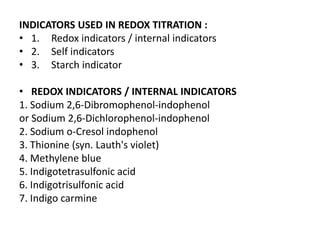
INDICATORS USED IN REDOX TITRATION :
• 1. Redox indicators / internal indicators
• 2. Self indicators
• 3. Starch indicator
• REDOX INDICATORS / INTERNAL INDICATORS
1. Sodium 2,6-Dibromophenol-indophenol
or Sodium 2,6-Dichlorophenol-indophenol
2. Sodium o-Cresol indophenol
3. Thionine (syn. Lauth's violet)
4. Methylene blue
5. Indigotetrasulfonic acid
6. Indigotrisulfonic acid
7. Indigo carmine
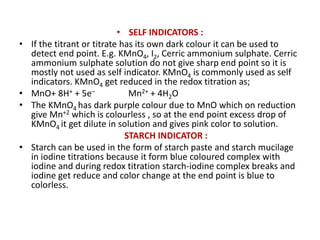
• SELF INDICATORS :
• If the titrant or titrate has its own dark colour it can be used to
detect end point. E.g. KMnO4, I2, Cerric ammonium sulphate. Cerric
ammonium sulphate solution do not give sharp end point so it is
mostly not used as self indicator. KMnO4 is commonly used as self
indicators. KMnO4 get reduced in the redox titration as;
• MnO+ 8H+ + 5e– Mn2+ + 4H2O
• The KMnO4 has dark purple colour due to MnO which on reduction
give Mn+2 which is colourless , so at the end point excess drop of
KMnO4 it get dilute in solution and gives pink color to solution.
STARCH INDICATOR :
• Starch can be used in the form of starch paste and starch mucilage
in iodine titrations because it form blue coloured complex with
iodine and during redox titration starch-iodine complex breaks and
iodine get reduce and color change at the end point is blue to
colorless.
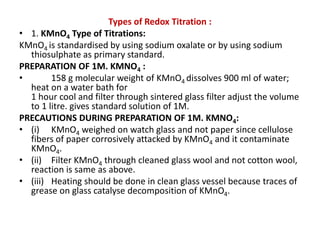
Types of Redox Titration :
• 1. KMnO4 Type of Titrations:
KMnO4 is standardised by using sodium oxalate or by using sodium
thiosulphate as primary standard.
PREPARATION OF 1M. KMNO4 :
• 158 g molecular weight of KMnO4 dissolves 900 ml of water;
heat on a water bath for
1 hour cool and filter through sintered glass filter adjust the volume
to 1 litre. gives standard solution of 1M.
PRECAUTIONS DURING PREPARATION OF 1M. KMNO4:
• (i) KMnO4 weighed on watch glass and not paper since cellulose
fibers of paper corrosively attacked by KMnO4 and it contaminate
KMnO4.
• (ii) Filter KMnO4 through cleaned glass wool and not cotton wool,
reaction is same as above.
• (iii) Heating should be done in clean glass vessel because traces of
grease on glass catalyse decomposition of KMnO4.
Standardisation of KMnO4 With sodium oxalate
• Method : Dissolve accurately weighed 6.7 g of sodium oxalate previously dried at
110oC in water and then make up volume to 1 litre. Pipette out 20 ml of this
solution in conical flask, add 5 ml of concentration H2SO4 and then warm upto
70C. Titrate against KMnO4 until pink colour persist for 30 s.
PRECAUTIONS DURING STANDARDISATION OF KMNO4:
1. Clean the flask with concern H2SO4 or hydrogen peroxide after each titration.
2. To high temperature leads to formation of brown color solution due
decomposition of KMnO4 into MnO2.
3. Insufficient acid leads to formation of MnO2 which again gives brown color to
solution.
REACTION FOR SODIUM OXALATE :
• Oxidising agent : 2[MnO + 8H+ + 5e– –– Mn+2]
• Reducing agent : 5[(COONa)2 (COOH)2 –– 2CO2 + 2H+ + 2e–]
Overall redox balance reaction is :
2KMnO4 + 5Na2C2O4 + 5H2SO4 –– K2SO4 + 2MnSO4 + 10 CO2 + 5Na2SO4 + 8H2O.
2KMnO4 = 5Na2C2O4= 10e–
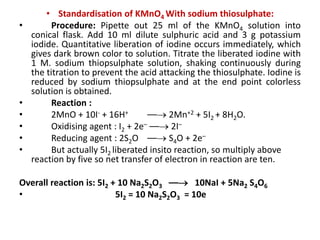
• Standardisation of KMnO4 With sodium thiosulphate:
• Procedure: Pipette out 25 ml of the KMnO4 solution into
conical flask. Add 10 ml dilute sulphuric acid and 3 g potassium
iodide. Quantitative liberation of iodine occurs immediately, which
gives dark brown color to solution. Titrate the liberated iodine with
1 M. sodium thiopsulphate solution, shaking continuously during
the titration to prevent the acid attacking the thiosulphate. Iodine is
reduced by sodium thiopsulphate and at the end point colorless
solution is obtained.
• Reaction :
• 2MnO + 10I- + 16H+ –– 2Mn+2 + 5I2 + 8H2O.
• Oxidising agent : I2 + 2e– –– 2I–
• Reducing agent : 2S2O –– S4O + 2e–
• But actually 5I2 liberated insito reaction, so multiply above
reaction by five so net transfer of electron in reaction are ten.
Overall reaction is: 5I2 + 10 Na2S2O3 –– 10NaI + 5Na2 S4O6
• 5I2 = 10 Na2S2O3 = 10e
• Standardisation of KMnO4 with arsenic trioxide :
• A sample of pure arsenic trioxide is titrated in
acidic medium with KMnO4solution. KMnO4 act as self
indicator. Arsenic trioxide is dissolved in water to give
arsenious acid which is oxidised by KMnO4 solution.
The oxidation of arsenious oxide by KMnO4 does not
proceed rapidly at room temperature so catalyst like
iodide, iodate or iodine is used so reaction occur
quickly and titration is possible at room temperature.
• Reaction : As2O3 + 3H2O –– 2H3AsO3
• Oxidising agent : 2[MnO4 + 8H+ + 5e––– Mn+2]
• Reducing agent : 5 [H3AsO3 + H2O –– H3AsO4 + 2H+
+ 2e]
2KMnO4=5H3AsO3= 10 e–
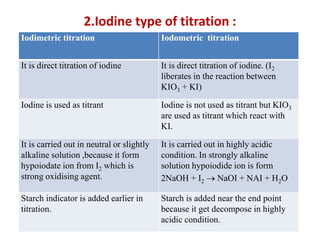
2.Iodine type of titration :
Iodimetric titration Iodometric titration
It is direct titration of iodine It is direct titration of iodine. (I2
liberates in the reaction between
KIO3 + KI)
Iodine is used as titrant Iodine is not used as titrant but KIO3
are used as titrant which react with
KI.
It is carried out in neutral or slightly
alkaline solution ,because it form
hypoiodate ion from I2 which is
strong oxidising agent.
It is carried out in highly acidic
condition. In strongly alkaline
solution hypoiodide ion is form
2NaOH + I2  NaOI + NAI + H2O
Starch indicator is added earlier in
titration.
Starch is added near the end point
because it get decompose in highly
acidic condition.
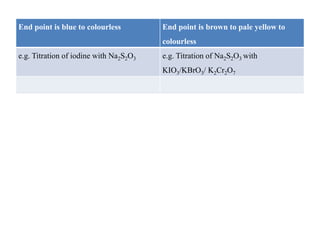
End point is blue to colourless End point is brown to pale yellow to
colourless
e.g. Titration of iodine with Na2S2O3 e.g. Titration of Na2S2O3 with
KIO3/KBrO3/ K2Cr2O7
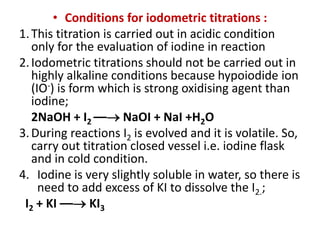
• Conditions for iodometric titrations :
1.This titration is carried out in acidic condition
only for the evaluation of iodine in reaction
2.Iodometric titrations should not be carried out in
highly alkaline conditions because hypoiodide ion
(IO-) is form which is strong oxidising agent than
iodine;
2NaOH + I2 –– NaOI + NaI +H2O
3.During reactions I2 is evolved and it is volatile. So,
carry out titration closed vessel i.e. iodine flask
and in cold condition.
4. Iodine is very slightly soluble in water, so there is
need to add excess of KI to dissolve the I2.;
I2 + KI –– KI3
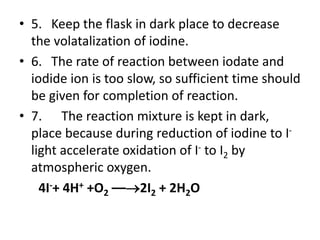
• 5. Keep the flask in dark place to decrease
the volatalization of iodine.
• 6. The rate of reaction between iodate and
iodide ion is too slow, so sufficient time should
be given for completion of reaction.
• 7. The reaction mixture is kept in dark,
place because during reduction of iodine to I-
light accelerate oxidation of I- to I2 by
atmospheric oxygen.
4I-+ 4H+ +O2 ––2I2 + 2H2O
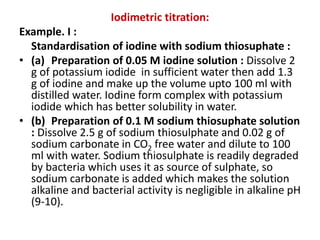
Iodimetric titration:
Example. I :
Standardisation of iodine with sodium thiosuphate :
• (a) Preparation of 0.05 M iodine solution : Dissolve 2
g of potassium iodide in sufficient water then add 1.3
g of iodine and make up the volume upto 100 ml with
distilled water. Iodine form complex with potassium
iodide which has better solubility in water.
• (b) Preparation of 0.1 M sodium thiosuphate solution
: Dissolve 2.5 g of sodium thiosulphate and 0.02 g of
sodium carbonate in CO2 free water and dilute to 100
ml with water. Sodium thiosulphate is readily degraded
by bacteria which uses it as source of sulphate, so
sodium carbonate is added which makes the solution
alkaline and bacterial activity is negligible in alkaline pH
(9-10).
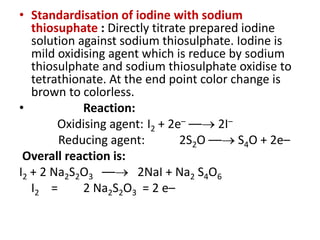
• Standardisation of iodine with sodium
thiosuphate : Directly titrate prepared iodine
solution against sodium thiosulphate. Iodine is
mild oxidising agent which is reduce by sodium
thiosulphate and sodium thiosulphate oxidise to
tetrathionate. At the end point color change is
brown to colorless.
• Reaction:
Oxidising agent: I2 + 2e– –– 2I–
Reducing agent: 2S2O –– S4O + 2e–
Overall reaction is:
I2 + 2 Na2S2O3 –– 2NaI + Na2 S4O6
I2 = 2 Na2S2O3 = 2 e–
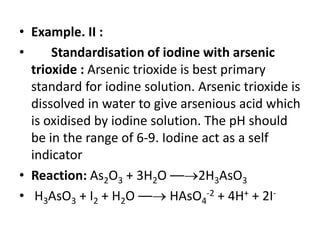
• Example. II :
• Standardisation of iodine with arsenic
trioxide : Arsenic trioxide is best primary
standard for iodine solution. Arsenic trioxide is
dissolved in water to give arsenious acid which
is oxidised by iodine solution. The pH should
be in the range of 6-9. Iodine act as a self
indicator
• Reaction: As2O3 + 3H2O ––2H3AsO3
• H3AsO3 + I2 + H2O –– HAsO4
-2 + 4H+ + 2I-
• Example. I : Iodometry
Standardisation of sodium thiosuphate with potassium iodate :
Dissolve accurately weighed 1.3 g of pure and dry potassium iodate
into 250 ml distilled water. Pipette out 25 ml of solution into conical
flask, add 2 g potassium iodide and dilute sulphuric acid 4 ml iodine
liberate in reaction, titrate the liberated iodine with 0.1 M sodium
thiosuphate solution. When the colour of the solution becomes
pale yellow (near to end point) add starch paste as an indicator.
Continue titration until the solution become colourless.
• Reaction :
• IO + 5I– + 6H+ –– 3I2 + 3H2O
• Oxidising agent: 3[I2 + 2e– –– 2I–]
• Reducing agent: 3 [2S2O –– 2e– + S4O]
• Overall reaction is: 3[I2 + 2 Na2S2O3 –– 2 NaI + Na2 S4O6]
• 3I2 = 6 Na2S2O3 = 6e–
Potassium Dichromate Titration :
(a) Preparation of 1N K2Cr2O7 : Dissolve 49.036 g equivalent K2Cr2O7 of in 1000
ml of water to prepare 1 N solution of K2Cr2O7.
(b) Method: Accurately weighted 0.21 g potassium dichromate (K2Cr2O7) is
dissolved in 100 ml water, add 3 g Potassium iodide and acidify the solution
with 5 ml sulphuric acid. The reaction between iodide and potassium
dichromate in acidic condition liberate iodine, which is then titrated with
sodium thiosulphate using starch paste as an indicator. End point is Blue to
colourless.
Reaction :
• K2Cr2O7 + 6KI + 7H2SO4 –– Cr2 (SO4)3 + 3I2 + 4K2SO4 + 7H2O
• Oxidising agent: 3[I2 + 2e– –– 2I–]
• Reducing agent: 3 [2S2O3  2e– + S4O6]
Overall reaction is: 3[I2 + 2 Na2S2O3 –– 2 NaI + Na2 S4O6]
3I2 = 6 Na2S2O3 = 6e–
• Potassium Bromate Titration :
Sodium thiosuphate is standardised by using potassium bromate as
primary standard. It is a type of iodometric titration.
• Method:
Accurately weighted 1.3 g of KBrO3 is dissolved in water, add
hydroiodic acid in solution it react with KBrO3 and form IO3
-. Add in
above solution 2 g of Potassium iodide and acidify the solution with
4 ml dil. HCl and titrate with Na2S2O3 using starch paste as an
indicator.
Reaction :
KBrO3 + HI –– HIO3 + KBr
6H+ + IO3
- + 5I– –– 3I2 + 3H2O
Oxidising agent: 3[I2 + 2e– –– 2I–]
Reducing agent: 3 [2S2O –– 2e– + S4O]
Overall reaction is: 3[I2 + 2 Na2S2O3 –– 2 NaI + Na2 S4O6]
3I2 = 6 Na2S2O3 = 6e–
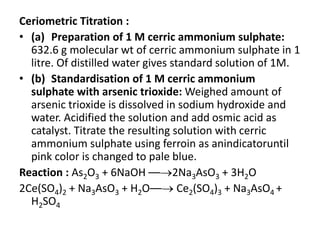
Ceriometric Titration :
• (a) Preparation of 1 M cerric ammonium sulphate:
632.6 g molecular wt of cerric ammonium sulphate in 1
litre. Of distilled water gives standard solution of 1M.
• (b) Standardisation of 1 M cerric ammonium
sulphate with arsenic trioxide: Weighed amount of
arsenic trioxide is dissolved in sodium hydroxide and
water. Acidified the solution and add osmic acid as
catalyst. Titrate the resulting solution with cerric
ammonium sulphate using ferroin as anindicatoruntil
pink color is changed to pale blue.
Reaction : As2O3 + 6NaOH ––2Na3AsO3 + 3H2O
2Ce(SO4)2 + Na3AsO3 + H2O–– Ce2(SO4)3 + Na3AsO4 +
H2SO4
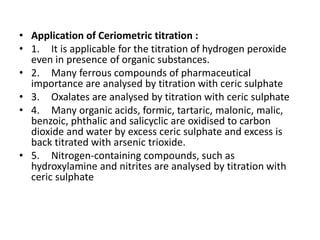
• Application of Ceriometric titration :
• 1. It is applicable for the titration of hydrogen peroxide
even in presence of organic substances.
• 2. Many ferrous compounds of pharmaceutical
importance are analysed by titration with ceric sulphate
• 3. Oxalates are analysed by titration with ceric sulphate
• 4. Many organic acids, formic, tartaric, malonic, malic,
benzoic, phthalic and salicyclic are oxidised to carbon
dioxide and water by excess ceric sulphate and excess is
back titrated with arsenic trioxide.
• 5. Nitrogen-containing compounds, such as
hydroxylamine and nitrites are analysed by titration with
ceric sulphate
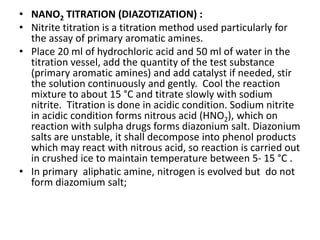
• NANO2 TITRATION (DIAZOTIZATION) :
• Nitrite titration is a titration method used particularly for
the assay of primary aromatic amines.
• Place 20 ml of hydrochloric acid and 50 ml of water in the
titration vessel, add the quantity of the test substance
(primary aromatic amines) and add catalyst if needed, stir
the solution continuously and gently. Cool the reaction
mixture to about 15 °C and titrate slowly with sodium
nitrite. Titration is done in acidic condition. Sodium nitrite
in acidic condition forms nitrous acid (HNO2), which on
reaction with sulpha drugs forms diazonium salt. Diazonium
salts are unstable, it shall decompose into phenol products
which may react with nitrous acid, so reaction is carried out
in crushed ice to maintain temperature between 5- 15 °C .
• In primary aliphatic amine, nitrogen is evolved but do not
form diazomium salt;
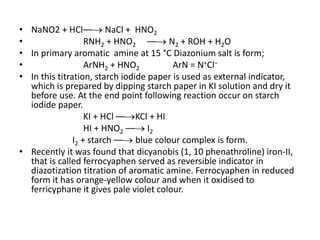
• NaNO2 + HCl–– NaCl + HNO2
• RNH2 + HNO2 –– N2 + ROH + H2O
• In primary aromatic amine at 15 °C Diazonium salt is form;
• ArNH2 + HNO2 ArN = N+Cl–
• In this titration, starch iodide paper is used as external indicator,
which is prepared by dipping starch paper in KI solution and dry it
before use. At the end point following reaction occur on starch
iodide paper.
KI + HCl ––KCl + HI
HI + HNO2 –– I2
I2 + starch –– blue colour complex is form.
• Recently it was found that dicyanobis (1, 10 phenathroline) iron-II,
that is called ferrocyaphen served as reversible indicator in
diazotization titration of aromatic amine. Ferrocyaphen in reduced
form it has orange-yellow colour and when it oxidised to
ferricyphane it gives pale violet colour.
Preparation and standardisation of sodium nitrite
with sulphanilamide :
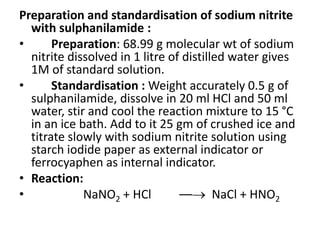
• Preparation: 68.99 g molecular wt of sodium
nitrite dissolved in 1 litre of distilled water gives
1M of standard solution.
• Standardisation : Weight accurately 0.5 g of
sulphanilamide, dissolve in 20 ml HCl and 50 ml
water, stir and cool the reaction mixture to 15 °C
in an ice bath. Add to it 25 gm of crushed ice and
titrate slowly with sodium nitrite solution using
starch iodide paper as external indicator or
ferrocyaphen as internal indicator.
• Reaction:
• NaNO2 + HCl –– NaCl + HNO2
TITANUS CHLORIDE TITRATION :
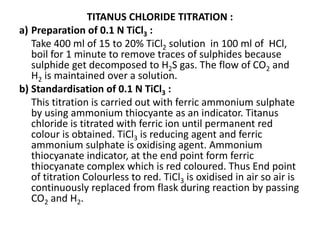
a) Preparation of 0.1 N TiCl3 :
Take 400 ml of 15 to 20% TiCl2 solution in 100 ml of HCl,
boil for 1 minute to remove traces of sulphides because
sulphide get decomposed to H2S gas. The flow of CO2 and
H2 is maintained over a solution.
b) Standardisation of 0.1 N TiCl3 :
This titration is carried out with ferric ammonium sulphate
by using ammonium thiocyante as an indicator. Titanus
chloride is titrated with ferric ion until permanent red
colour is obtained. TiCl3 is reducing agent and ferric
ammonium sulphate is oxidising agent. Ammonium
thiocyanate indicator, at the end point form ferric
thiocyanate complex which is red coloured. Thus End point
of titration Colourless to red. TiCl3 is oxidised in air so air is
continuously replaced from flask during reaction by passing
CO2 and H2.
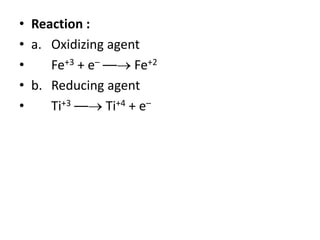
• Reaction :
• a. Oxidizing agent
• Fe+3 + e– –– Fe+2
• b. Reducing agent
• Ti+3 –– Ti+4 + e–
THANK YOU

Oxidation reduction titration

  • 1.
    Oxidation - ReductionTitrations By: Prof. Suvarna Sharad Vanjari Department of Pharmaceutical Analysis
  • 2.
    INDICATORS USED INREDOX TITRATION : • 1. Redox indicators / internal indicators • 2. Self indicators • 3. Starch indicator • REDOX INDICATORS / INTERNAL INDICATORS 1. Sodium 2,6-Dibromophenol-indophenol or Sodium 2,6-Dichlorophenol-indophenol 2. Sodium o-Cresol indophenol 3. Thionine (syn. Lauth's violet) 4. Methylene blue 5. Indigotetrasulfonic acid 6. Indigotrisulfonic acid 7. Indigo carmine
  • 3.
    • SELF INDICATORS: • If the titrant or titrate has its own dark colour it can be used to detect end point. E.g. KMnO4, I2, Cerric ammonium sulphate. Cerric ammonium sulphate solution do not give sharp end point so it is mostly not used as self indicator. KMnO4 is commonly used as self indicators. KMnO4 get reduced in the redox titration as; • MnO+ 8H+ + 5e– Mn2+ + 4H2O • The KMnO4 has dark purple colour due to MnO which on reduction give Mn+2 which is colourless , so at the end point excess drop of KMnO4 it get dilute in solution and gives pink color to solution. STARCH INDICATOR : • Starch can be used in the form of starch paste and starch mucilage in iodine titrations because it form blue coloured complex with iodine and during redox titration starch-iodine complex breaks and iodine get reduce and color change at the end point is blue to colorless.
  • 4.
    Types of RedoxTitration : • 1. KMnO4 Type of Titrations: KMnO4 is standardised by using sodium oxalate or by using sodium thiosulphate as primary standard. PREPARATION OF 1M. KMNO4 : • 158 g molecular weight of KMnO4 dissolves 900 ml of water; heat on a water bath for 1 hour cool and filter through sintered glass filter adjust the volume to 1 litre. gives standard solution of 1M. PRECAUTIONS DURING PREPARATION OF 1M. KMNO4: • (i) KMnO4 weighed on watch glass and not paper since cellulose fibers of paper corrosively attacked by KMnO4 and it contaminate KMnO4. • (ii) Filter KMnO4 through cleaned glass wool and not cotton wool, reaction is same as above. • (iii) Heating should be done in clean glass vessel because traces of grease on glass catalyse decomposition of KMnO4.
  • 5.
    Standardisation of KMnO4With sodium oxalate • Method : Dissolve accurately weighed 6.7 g of sodium oxalate previously dried at 110oC in water and then make up volume to 1 litre. Pipette out 20 ml of this solution in conical flask, add 5 ml of concentration H2SO4 and then warm upto 70C. Titrate against KMnO4 until pink colour persist for 30 s. PRECAUTIONS DURING STANDARDISATION OF KMNO4: 1. Clean the flask with concern H2SO4 or hydrogen peroxide after each titration. 2. To high temperature leads to formation of brown color solution due decomposition of KMnO4 into MnO2. 3. Insufficient acid leads to formation of MnO2 which again gives brown color to solution. REACTION FOR SODIUM OXALATE : • Oxidising agent : 2[MnO + 8H+ + 5e– –– Mn+2] • Reducing agent : 5[(COONa)2 (COOH)2 –– 2CO2 + 2H+ + 2e–] Overall redox balance reaction is : 2KMnO4 + 5Na2C2O4 + 5H2SO4 –– K2SO4 + 2MnSO4 + 10 CO2 + 5Na2SO4 + 8H2O. 2KMnO4 = 5Na2C2O4= 10e–
  • 6.
    • Standardisation ofKMnO4 With sodium thiosulphate: • Procedure: Pipette out 25 ml of the KMnO4 solution into conical flask. Add 10 ml dilute sulphuric acid and 3 g potassium iodide. Quantitative liberation of iodine occurs immediately, which gives dark brown color to solution. Titrate the liberated iodine with 1 M. sodium thiopsulphate solution, shaking continuously during the titration to prevent the acid attacking the thiosulphate. Iodine is reduced by sodium thiopsulphate and at the end point colorless solution is obtained. • Reaction : • 2MnO + 10I- + 16H+ –– 2Mn+2 + 5I2 + 8H2O. • Oxidising agent : I2 + 2e– –– 2I– • Reducing agent : 2S2O –– S4O + 2e– • But actually 5I2 liberated insito reaction, so multiply above reaction by five so net transfer of electron in reaction are ten. Overall reaction is: 5I2 + 10 Na2S2O3 –– 10NaI + 5Na2 S4O6 • 5I2 = 10 Na2S2O3 = 10e
  • 7.
    • Standardisation ofKMnO4 with arsenic trioxide : • A sample of pure arsenic trioxide is titrated in acidic medium with KMnO4solution. KMnO4 act as self indicator. Arsenic trioxide is dissolved in water to give arsenious acid which is oxidised by KMnO4 solution. The oxidation of arsenious oxide by KMnO4 does not proceed rapidly at room temperature so catalyst like iodide, iodate or iodine is used so reaction occur quickly and titration is possible at room temperature. • Reaction : As2O3 + 3H2O –– 2H3AsO3 • Oxidising agent : 2[MnO4 + 8H+ + 5e––– Mn+2] • Reducing agent : 5 [H3AsO3 + H2O –– H3AsO4 + 2H+ + 2e] 2KMnO4=5H3AsO3= 10 e–
  • 8.
    2.Iodine type oftitration : Iodimetric titration Iodometric titration It is direct titration of iodine It is direct titration of iodine. (I2 liberates in the reaction between KIO3 + KI) Iodine is used as titrant Iodine is not used as titrant but KIO3 are used as titrant which react with KI. It is carried out in neutral or slightly alkaline solution ,because it form hypoiodate ion from I2 which is strong oxidising agent. It is carried out in highly acidic condition. In strongly alkaline solution hypoiodide ion is form 2NaOH + I2  NaOI + NAI + H2O Starch indicator is added earlier in titration. Starch is added near the end point because it get decompose in highly acidic condition.
  • 9.
    End point isblue to colourless End point is brown to pale yellow to colourless e.g. Titration of iodine with Na2S2O3 e.g. Titration of Na2S2O3 with KIO3/KBrO3/ K2Cr2O7
  • 10.
    • Conditions foriodometric titrations : 1.This titration is carried out in acidic condition only for the evaluation of iodine in reaction 2.Iodometric titrations should not be carried out in highly alkaline conditions because hypoiodide ion (IO-) is form which is strong oxidising agent than iodine; 2NaOH + I2 –– NaOI + NaI +H2O 3.During reactions I2 is evolved and it is volatile. So, carry out titration closed vessel i.e. iodine flask and in cold condition. 4. Iodine is very slightly soluble in water, so there is need to add excess of KI to dissolve the I2.; I2 + KI –– KI3
  • 11.
    • 5. Keepthe flask in dark place to decrease the volatalization of iodine. • 6. The rate of reaction between iodate and iodide ion is too slow, so sufficient time should be given for completion of reaction. • 7. The reaction mixture is kept in dark, place because during reduction of iodine to I- light accelerate oxidation of I- to I2 by atmospheric oxygen. 4I-+ 4H+ +O2 ––2I2 + 2H2O
  • 12.
    Iodimetric titration: Example. I: Standardisation of iodine with sodium thiosuphate : • (a) Preparation of 0.05 M iodine solution : Dissolve 2 g of potassium iodide in sufficient water then add 1.3 g of iodine and make up the volume upto 100 ml with distilled water. Iodine form complex with potassium iodide which has better solubility in water. • (b) Preparation of 0.1 M sodium thiosuphate solution : Dissolve 2.5 g of sodium thiosulphate and 0.02 g of sodium carbonate in CO2 free water and dilute to 100 ml with water. Sodium thiosulphate is readily degraded by bacteria which uses it as source of sulphate, so sodium carbonate is added which makes the solution alkaline and bacterial activity is negligible in alkaline pH (9-10).
  • 13.
    • Standardisation ofiodine with sodium thiosuphate : Directly titrate prepared iodine solution against sodium thiosulphate. Iodine is mild oxidising agent which is reduce by sodium thiosulphate and sodium thiosulphate oxidise to tetrathionate. At the end point color change is brown to colorless. • Reaction: Oxidising agent: I2 + 2e– –– 2I– Reducing agent: 2S2O –– S4O + 2e– Overall reaction is: I2 + 2 Na2S2O3 –– 2NaI + Na2 S4O6 I2 = 2 Na2S2O3 = 2 e–
  • 14.
    • Example. II: • Standardisation of iodine with arsenic trioxide : Arsenic trioxide is best primary standard for iodine solution. Arsenic trioxide is dissolved in water to give arsenious acid which is oxidised by iodine solution. The pH should be in the range of 6-9. Iodine act as a self indicator • Reaction: As2O3 + 3H2O ––2H3AsO3 • H3AsO3 + I2 + H2O –– HAsO4 -2 + 4H+ + 2I-
  • 15.
    • Example. I: Iodometry Standardisation of sodium thiosuphate with potassium iodate : Dissolve accurately weighed 1.3 g of pure and dry potassium iodate into 250 ml distilled water. Pipette out 25 ml of solution into conical flask, add 2 g potassium iodide and dilute sulphuric acid 4 ml iodine liberate in reaction, titrate the liberated iodine with 0.1 M sodium thiosuphate solution. When the colour of the solution becomes pale yellow (near to end point) add starch paste as an indicator. Continue titration until the solution become colourless. • Reaction : • IO + 5I– + 6H+ –– 3I2 + 3H2O • Oxidising agent: 3[I2 + 2e– –– 2I–] • Reducing agent: 3 [2S2O –– 2e– + S4O] • Overall reaction is: 3[I2 + 2 Na2S2O3 –– 2 NaI + Na2 S4O6] • 3I2 = 6 Na2S2O3 = 6e–
  • 16.
    Potassium Dichromate Titration: (a) Preparation of 1N K2Cr2O7 : Dissolve 49.036 g equivalent K2Cr2O7 of in 1000 ml of water to prepare 1 N solution of K2Cr2O7. (b) Method: Accurately weighted 0.21 g potassium dichromate (K2Cr2O7) is dissolved in 100 ml water, add 3 g Potassium iodide and acidify the solution with 5 ml sulphuric acid. The reaction between iodide and potassium dichromate in acidic condition liberate iodine, which is then titrated with sodium thiosulphate using starch paste as an indicator. End point is Blue to colourless. Reaction : • K2Cr2O7 + 6KI + 7H2SO4 –– Cr2 (SO4)3 + 3I2 + 4K2SO4 + 7H2O • Oxidising agent: 3[I2 + 2e– –– 2I–] • Reducing agent: 3 [2S2O3  2e– + S4O6] Overall reaction is: 3[I2 + 2 Na2S2O3 –– 2 NaI + Na2 S4O6] 3I2 = 6 Na2S2O3 = 6e–
  • 17.
    • Potassium BromateTitration : Sodium thiosuphate is standardised by using potassium bromate as primary standard. It is a type of iodometric titration. • Method: Accurately weighted 1.3 g of KBrO3 is dissolved in water, add hydroiodic acid in solution it react with KBrO3 and form IO3 -. Add in above solution 2 g of Potassium iodide and acidify the solution with 4 ml dil. HCl and titrate with Na2S2O3 using starch paste as an indicator. Reaction : KBrO3 + HI –– HIO3 + KBr 6H+ + IO3 - + 5I– –– 3I2 + 3H2O Oxidising agent: 3[I2 + 2e– –– 2I–] Reducing agent: 3 [2S2O –– 2e– + S4O] Overall reaction is: 3[I2 + 2 Na2S2O3 –– 2 NaI + Na2 S4O6] 3I2 = 6 Na2S2O3 = 6e–
  • 18.
    Ceriometric Titration : •(a) Preparation of 1 M cerric ammonium sulphate: 632.6 g molecular wt of cerric ammonium sulphate in 1 litre. Of distilled water gives standard solution of 1M. • (b) Standardisation of 1 M cerric ammonium sulphate with arsenic trioxide: Weighed amount of arsenic trioxide is dissolved in sodium hydroxide and water. Acidified the solution and add osmic acid as catalyst. Titrate the resulting solution with cerric ammonium sulphate using ferroin as anindicatoruntil pink color is changed to pale blue. Reaction : As2O3 + 6NaOH ––2Na3AsO3 + 3H2O 2Ce(SO4)2 + Na3AsO3 + H2O–– Ce2(SO4)3 + Na3AsO4 + H2SO4
  • 19.
    • Application ofCeriometric titration : • 1. It is applicable for the titration of hydrogen peroxide even in presence of organic substances. • 2. Many ferrous compounds of pharmaceutical importance are analysed by titration with ceric sulphate • 3. Oxalates are analysed by titration with ceric sulphate • 4. Many organic acids, formic, tartaric, malonic, malic, benzoic, phthalic and salicyclic are oxidised to carbon dioxide and water by excess ceric sulphate and excess is back titrated with arsenic trioxide. • 5. Nitrogen-containing compounds, such as hydroxylamine and nitrites are analysed by titration with ceric sulphate
  • 20.
    • NANO2 TITRATION(DIAZOTIZATION) : • Nitrite titration is a titration method used particularly for the assay of primary aromatic amines. • Place 20 ml of hydrochloric acid and 50 ml of water in the titration vessel, add the quantity of the test substance (primary aromatic amines) and add catalyst if needed, stir the solution continuously and gently. Cool the reaction mixture to about 15 °C and titrate slowly with sodium nitrite. Titration is done in acidic condition. Sodium nitrite in acidic condition forms nitrous acid (HNO2), which on reaction with sulpha drugs forms diazonium salt. Diazonium salts are unstable, it shall decompose into phenol products which may react with nitrous acid, so reaction is carried out in crushed ice to maintain temperature between 5- 15 °C . • In primary aliphatic amine, nitrogen is evolved but do not form diazomium salt;
  • 21.
    • NaNO2 +HCl–– NaCl + HNO2 • RNH2 + HNO2 –– N2 + ROH + H2O • In primary aromatic amine at 15 °C Diazonium salt is form; • ArNH2 + HNO2 ArN = N+Cl– • In this titration, starch iodide paper is used as external indicator, which is prepared by dipping starch paper in KI solution and dry it before use. At the end point following reaction occur on starch iodide paper. KI + HCl ––KCl + HI HI + HNO2 –– I2 I2 + starch –– blue colour complex is form. • Recently it was found that dicyanobis (1, 10 phenathroline) iron-II, that is called ferrocyaphen served as reversible indicator in diazotization titration of aromatic amine. Ferrocyaphen in reduced form it has orange-yellow colour and when it oxidised to ferricyphane it gives pale violet colour.
  • 22.
    Preparation and standardisationof sodium nitrite with sulphanilamide : • Preparation: 68.99 g molecular wt of sodium nitrite dissolved in 1 litre of distilled water gives 1M of standard solution. • Standardisation : Weight accurately 0.5 g of sulphanilamide, dissolve in 20 ml HCl and 50 ml water, stir and cool the reaction mixture to 15 °C in an ice bath. Add to it 25 gm of crushed ice and titrate slowly with sodium nitrite solution using starch iodide paper as external indicator or ferrocyaphen as internal indicator. • Reaction: • NaNO2 + HCl –– NaCl + HNO2
  • 23.
    TITANUS CHLORIDE TITRATION: a) Preparation of 0.1 N TiCl3 : Take 400 ml of 15 to 20% TiCl2 solution in 100 ml of HCl, boil for 1 minute to remove traces of sulphides because sulphide get decomposed to H2S gas. The flow of CO2 and H2 is maintained over a solution. b) Standardisation of 0.1 N TiCl3 : This titration is carried out with ferric ammonium sulphate by using ammonium thiocyante as an indicator. Titanus chloride is titrated with ferric ion until permanent red colour is obtained. TiCl3 is reducing agent and ferric ammonium sulphate is oxidising agent. Ammonium thiocyanate indicator, at the end point form ferric thiocyanate complex which is red coloured. Thus End point of titration Colourless to red. TiCl3 is oxidised in air so air is continuously replaced from flask during reaction by passing CO2 and H2.
  • 24.
    • Reaction : •a. Oxidizing agent • Fe+3 + e– –– Fe+2 • b. Reducing agent • Ti+3 –– Ti+4 + e–
  • 25.