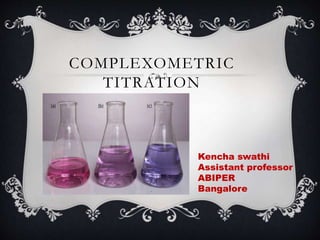
COMPLEXOMETRIC
TITRATION
Kencha swathi
Assistant professor
ABIPER
Bangalore
INTRODUCTION
 The reaction in which simple metal ion is converted into
complex ion by the addition of the reagent.
 The complex formed is stable and is water soluble.
 In complexometric titration ,metal ion accepts electrons and
ligand donates electron.
 The ligand molecule is having atleast one lone pair of electrons
and forms a linkage with metal ion.
LIGAND: A species which donates
lone pair of electrons and forms a
coordinate linkage with metal ion.
CLASSIFICATION OF LIGANDS
1.UNIDENTATE: If a single site is present in ligand to form a
complex. Eg: Cyanide ion (CN-)
2.BIDENTATE: Two sites are present in a ligand
Eg: Glycine and oxalic acid
3. MULTIDENTATE: When more than 2 or 3 sites are present.
Eg: EDTA
EDTA
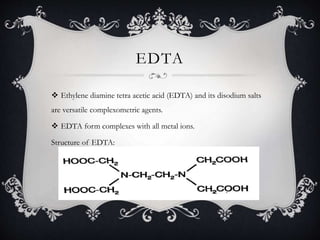
 Ethylene diamine tetra acetic acid (EDTA) and its disodium salts
are versatile complexometric agents.
 EDTA form complexes with all metal ions.
Structure of EDTA:
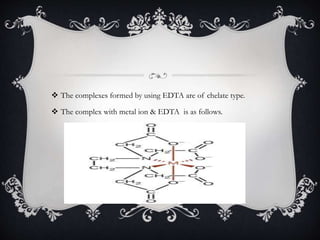
 The complexes formed by using EDTA are of chelate type.
 The complex with metal ion & EDTA is as follows.
 Alkaline medium is required for complex ions becoz EDTA will
ionize more in an alkali solution.
TYPES OF
COMPLEXOMETRIC
TITRATIONS:
1. Direct titration
2. Back titration
3. Displacement or substitution titration
4. Indirect titration
5. Alkalimetric titration
6. Miscellaneous titration
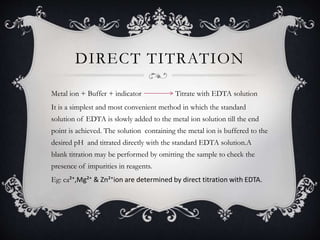
DIRECT TITRATION
Metal ion + Buffer + indicator Titrate with EDTA solution
It is a simplest and most convenient method in which the standard
solution of EDTA is slowly added to the metal ion solution till the end
point is achieved. The solution containing the metal ion is buffered to the
desired pH and titrated directly with the standard EDTA solution.A
blank titration may be performed by omitting the sample to check the
presence of impurities in reagents.
Eg: ca²⁺,Mg²⁺ & Zn²⁺ion are determined by direct titration with EDTA.
BACK TITRATION
 A measured amount of EDTA is added in excess to react with the
metal to be titrated. An indicator is added and the excess of EDTA is
back titrated with a suitable salt solution.
Eg: A solution of ZnSO₄ or MgSO₄ is used for back titration.
SUBSTITUTION &
DISPLACEMENT TITRATION
 This type of titration is used for metal ions which form EDTA
complexes which are more stable than other metals such as Mg²⁺ and
Ca²⁺.
Eg: To the calcium salt solution,ammonia-ammonium buffer is
added.To this, a standard known volume of Mg-EDTA solution is added.
In the rection,stable Ca-EDTA complex is formed and Mg ions are
liberated which may be titrated with a standard EDTA solution.
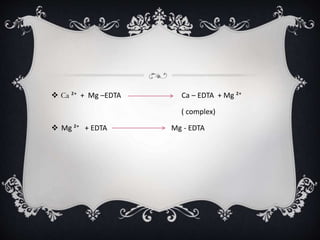
 Ca ²⁺ + Mg –EDTA Ca – EDTA + Mg ²⁺
( complex)
 Mg ²⁺ + EDTA Mg - EDTA
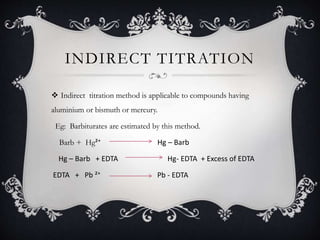
INDIRECT TITRATION
 Indirect titration method is applicable to compounds having
aluminium or bismuth or mercury.
Eg: Barbiturates are estimated by this method.
Barb + Hg²⁺ Hg – Barb
Hg – Barb + EDTA Hg- EDTA + Excess of EDTA
EDTA + Pb ²⁺ Pb - EDTA
ALKALIMETRIC TITRATION
 The solution of disodium EDTA is added to a solution
containing metallic ions ,complexes are formed with liberation of
hydrogen ions.The Hydrogen ions are titrated against alkali
solution (standard) using an acid indicator.
MISCELLANEOUS METHODS
 A number of anions have been determined indirectly with EDTA
by reactions based upon complex formation with selected cations.
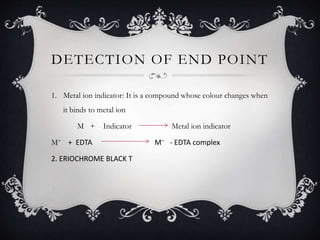
DETECTION OF END POINT
1. Metal ion indicator: It is a compound whose colour changes when
it binds to metal ion
M + Indicator Metal ion indicator
M⁻ + EDTA M⁻ - EDTA complex
2. ERIOCHROME BLACK T
APPLICATIONS
 Hardness of water : The hardness is due to both Ca & Mg salts
but the two are determined together in the titration.
 To determine the concentration of metal ions in solution.
 To determine calcium present in a food product.
 To determine concentration of bad metals in the environment.
MASKING
 Masking prevents one element from interfering in the analysis of
another element
Al ᶾ⁺ + Mg²⁺ + F⁻ Al F₆ᶾ⁺ + Mg ²⁺
Only Mg²⁺ can be react with EDTA
Note: Masking Al ᶾ⁺ with F ⁻
 Masking agent : CN⁻ , F ⁻
DEMASKING
 It is a reagent that release of a metal ion from a masking agent.
Complexometric titration

Complexometric titration

  • 1.
  • 2.
    INTRODUCTION  The reactionin which simple metal ion is converted into complex ion by the addition of the reagent.  The complex formed is stable and is water soluble.  In complexometric titration ,metal ion accepts electrons and ligand donates electron.  The ligand molecule is having atleast one lone pair of electrons and forms a linkage with metal ion.
  • 3.
    LIGAND: A specieswhich donates lone pair of electrons and forms a coordinate linkage with metal ion.
  • 4.
    CLASSIFICATION OF LIGANDS 1.UNIDENTATE:If a single site is present in ligand to form a complex. Eg: Cyanide ion (CN-) 2.BIDENTATE: Two sites are present in a ligand Eg: Glycine and oxalic acid 3. MULTIDENTATE: When more than 2 or 3 sites are present. Eg: EDTA
  • 5.
    EDTA  Ethylene diaminetetra acetic acid (EDTA) and its disodium salts are versatile complexometric agents.  EDTA form complexes with all metal ions. Structure of EDTA:
  • 6.
     The complexesformed by using EDTA are of chelate type.  The complex with metal ion & EDTA is as follows.
  • 7.
     Alkaline mediumis required for complex ions becoz EDTA will ionize more in an alkali solution.
  • 8.
    TYPES OF COMPLEXOMETRIC TITRATIONS: 1. Directtitration 2. Back titration 3. Displacement or substitution titration 4. Indirect titration 5. Alkalimetric titration 6. Miscellaneous titration
  • 9.
    DIRECT TITRATION Metal ion+ Buffer + indicator Titrate with EDTA solution It is a simplest and most convenient method in which the standard solution of EDTA is slowly added to the metal ion solution till the end point is achieved. The solution containing the metal ion is buffered to the desired pH and titrated directly with the standard EDTA solution.A blank titration may be performed by omitting the sample to check the presence of impurities in reagents. Eg: ca²⁺,Mg²⁺ & Zn²⁺ion are determined by direct titration with EDTA.
  • 10.
    BACK TITRATION  Ameasured amount of EDTA is added in excess to react with the metal to be titrated. An indicator is added and the excess of EDTA is back titrated with a suitable salt solution. Eg: A solution of ZnSO₄ or MgSO₄ is used for back titration.
  • 11.
    SUBSTITUTION & DISPLACEMENT TITRATION This type of titration is used for metal ions which form EDTA complexes which are more stable than other metals such as Mg²⁺ and Ca²⁺. Eg: To the calcium salt solution,ammonia-ammonium buffer is added.To this, a standard known volume of Mg-EDTA solution is added. In the rection,stable Ca-EDTA complex is formed and Mg ions are liberated which may be titrated with a standard EDTA solution.
  • 12.
     Ca ²⁺+ Mg –EDTA Ca – EDTA + Mg ²⁺ ( complex)  Mg ²⁺ + EDTA Mg - EDTA
  • 13.
    INDIRECT TITRATION  Indirecttitration method is applicable to compounds having aluminium or bismuth or mercury. Eg: Barbiturates are estimated by this method. Barb + Hg²⁺ Hg – Barb Hg – Barb + EDTA Hg- EDTA + Excess of EDTA EDTA + Pb ²⁺ Pb - EDTA
  • 14.
    ALKALIMETRIC TITRATION  Thesolution of disodium EDTA is added to a solution containing metallic ions ,complexes are formed with liberation of hydrogen ions.The Hydrogen ions are titrated against alkali solution (standard) using an acid indicator.
  • 15.
    MISCELLANEOUS METHODS  Anumber of anions have been determined indirectly with EDTA by reactions based upon complex formation with selected cations.
  • 16.
    DETECTION OF ENDPOINT 1. Metal ion indicator: It is a compound whose colour changes when it binds to metal ion M + Indicator Metal ion indicator M⁻ + EDTA M⁻ - EDTA complex 2. ERIOCHROME BLACK T
  • 17.
    APPLICATIONS  Hardness ofwater : The hardness is due to both Ca & Mg salts but the two are determined together in the titration.  To determine the concentration of metal ions in solution.  To determine calcium present in a food product.  To determine concentration of bad metals in the environment.
  • 18.
    MASKING  Masking preventsone element from interfering in the analysis of another element Al ᶾ⁺ + Mg²⁺ + F⁻ Al F₆ᶾ⁺ + Mg ²⁺ Only Mg²⁺ can be react with EDTA Note: Masking Al ᶾ⁺ with F ⁻  Masking agent : CN⁻ , F ⁻
  • 19.
    DEMASKING  It isa reagent that release of a metal ion from a masking agent.