Contents
1. Dissolved oxygen
2. Determination by
Winkler’s Method
3. Model calculations
BY
Arun & Amal
– Oxygen is one of the most common dissolved gases in the water.
– DO is vital for survival of aquatic life in water bodies.
Oxygen can become dissolved in three ways
1. Introduced into water by algae, through photosynthesis.
2. Introduced by mechanical equipment
3. Enters water directly from atmosphere
– DO is a fundamental requirement for maintenance of life for aquatic
population
– Important parameter to the extent of water purity or extent of pollution
associated with it.
– Concentration of DO varies with waters
– The amount of DO depends on the solubility of oxygen in each type of
water which, in turn, is greatly influenced by temperature, pressure,
salinity etc…
– Expressed in terms of mg/L or ppm
– DO for good water quality is 4-6 mg/L
– When the level of DO falls below the minimum critical value required to
ensure healthy aquatic life, it indicates pollution.
– Principle:
– Interference:
– Reagents Required:
– Procedure
1. Standardization of sodium thiosulphate solution
2. Titration with the water samples
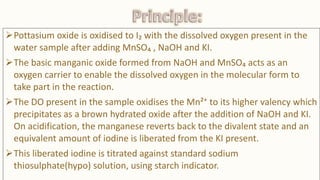
Pottasium oxide is oxidised to I₂ with the dissolved oxygen present in the
water sample after adding MnSO₄ , NaOH and KI.
The basic manganic oxide formed from NaOH and MnSO₄ acts as an
oxygen carrier to enable the dissolved oxygen in the molecular form to
take part in the reaction.
The DO present in the sample oxidises the Mn²⁺ to its higher valency which
precipitates as a brown hydrated oxide after the addition of NaOH and KI.
On acidification, the manganese reverts back to the divalent state and an
equivalent amount of iodine is liberated from the KI present.
This liberated iodine is titrated against standard sodium
thiosulphate(hypo) solution, using starch indicator.
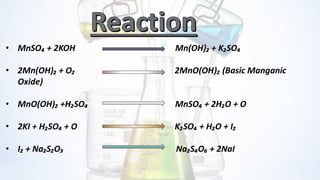
• MnSO₄ + 2KOH Mn(OH)₂ + K₂SO₄
• 2Mn(OH)₂ + O₂ 2MnO(OH)₂ (Basic Manganic
Oxide)
• MnO(OH)₂ +H₂SO₄ MnSO₄ + 2H₂O + O
• 2KI + H₂SO₄ + O K₂SO₄ + H₂O + I₂
• I₂ + Na₂S₂O₃ Na₂S₄O₆ + 2NaI
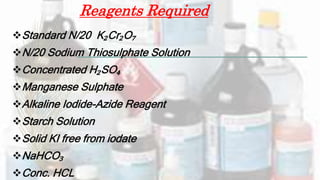
Reagents Required
Standard N/20 K₂Cr₂O₇
N/20 Sodium Thiosulphate Solution
Concentrated H₂SO₄
Manganese Sulphate
Alkaline Iodide-Azide Reagent
Starch Solution
Solid KI free from iodate
NaHCO₃
Conc. HCL
Procedure
A. Standardization of Sodium Thiosulphate solution:
B. Titration with the water samples:

Dissolved Oxygen [DO]

  • 1.
    Contents 1. Dissolved oxygen 2.Determination by Winkler’s Method 3. Model calculations BY Arun & Amal
  • 2.
    – Oxygen isone of the most common dissolved gases in the water. – DO is vital for survival of aquatic life in water bodies. Oxygen can become dissolved in three ways 1. Introduced into water by algae, through photosynthesis. 2. Introduced by mechanical equipment 3. Enters water directly from atmosphere
  • 3.
    – DO isa fundamental requirement for maintenance of life for aquatic population – Important parameter to the extent of water purity or extent of pollution associated with it. – Concentration of DO varies with waters – The amount of DO depends on the solubility of oxygen in each type of water which, in turn, is greatly influenced by temperature, pressure, salinity etc… – Expressed in terms of mg/L or ppm – DO for good water quality is 4-6 mg/L – When the level of DO falls below the minimum critical value required to ensure healthy aquatic life, it indicates pollution.
  • 5.
    – Principle: – Interference: –Reagents Required: – Procedure 1. Standardization of sodium thiosulphate solution 2. Titration with the water samples
  • 6.
    Pottasium oxide isoxidised to I₂ with the dissolved oxygen present in the water sample after adding MnSO₄ , NaOH and KI. The basic manganic oxide formed from NaOH and MnSO₄ acts as an oxygen carrier to enable the dissolved oxygen in the molecular form to take part in the reaction. The DO present in the sample oxidises the Mn²⁺ to its higher valency which precipitates as a brown hydrated oxide after the addition of NaOH and KI. On acidification, the manganese reverts back to the divalent state and an equivalent amount of iodine is liberated from the KI present. This liberated iodine is titrated against standard sodium thiosulphate(hypo) solution, using starch indicator.
  • 7.
    • MnSO₄ +2KOH Mn(OH)₂ + K₂SO₄ • 2Mn(OH)₂ + O₂ 2MnO(OH)₂ (Basic Manganic Oxide) • MnO(OH)₂ +H₂SO₄ MnSO₄ + 2H₂O + O • 2KI + H₂SO₄ + O K₂SO₄ + H₂O + I₂ • I₂ + Na₂S₂O₃ Na₂S₄O₆ + 2NaI
  • 8.
    Reagents Required Standard N/20K₂Cr₂O₇ N/20 Sodium Thiosulphate Solution Concentrated H₂SO₄ Manganese Sulphate Alkaline Iodide-Azide Reagent Starch Solution Solid KI free from iodate NaHCO₃ Conc. HCL
  • 9.
    Procedure A. Standardization ofSodium Thiosulphate solution: B. Titration with the water samples: