

1
2
Oxidation
Original definition:
When substances combined with oxygen.
Ex:
All combustion (burning) reactions
CH4(g) + 2O2(g) CO2(g) + 2H2O(l)
All “rusting” reactions
4Fe(s) + 3O2(g) 2Fe2O3(s)
3
Reduction
Original Definition:
Reaction where a substance “gave up” oxygen
is called “reductions” because they produced
products that were “reduced” in mass because gas
escaped.
Ex:
2Fe2O3(l) + 3C(s) 4Fe(l) + 3CO2(g)
4
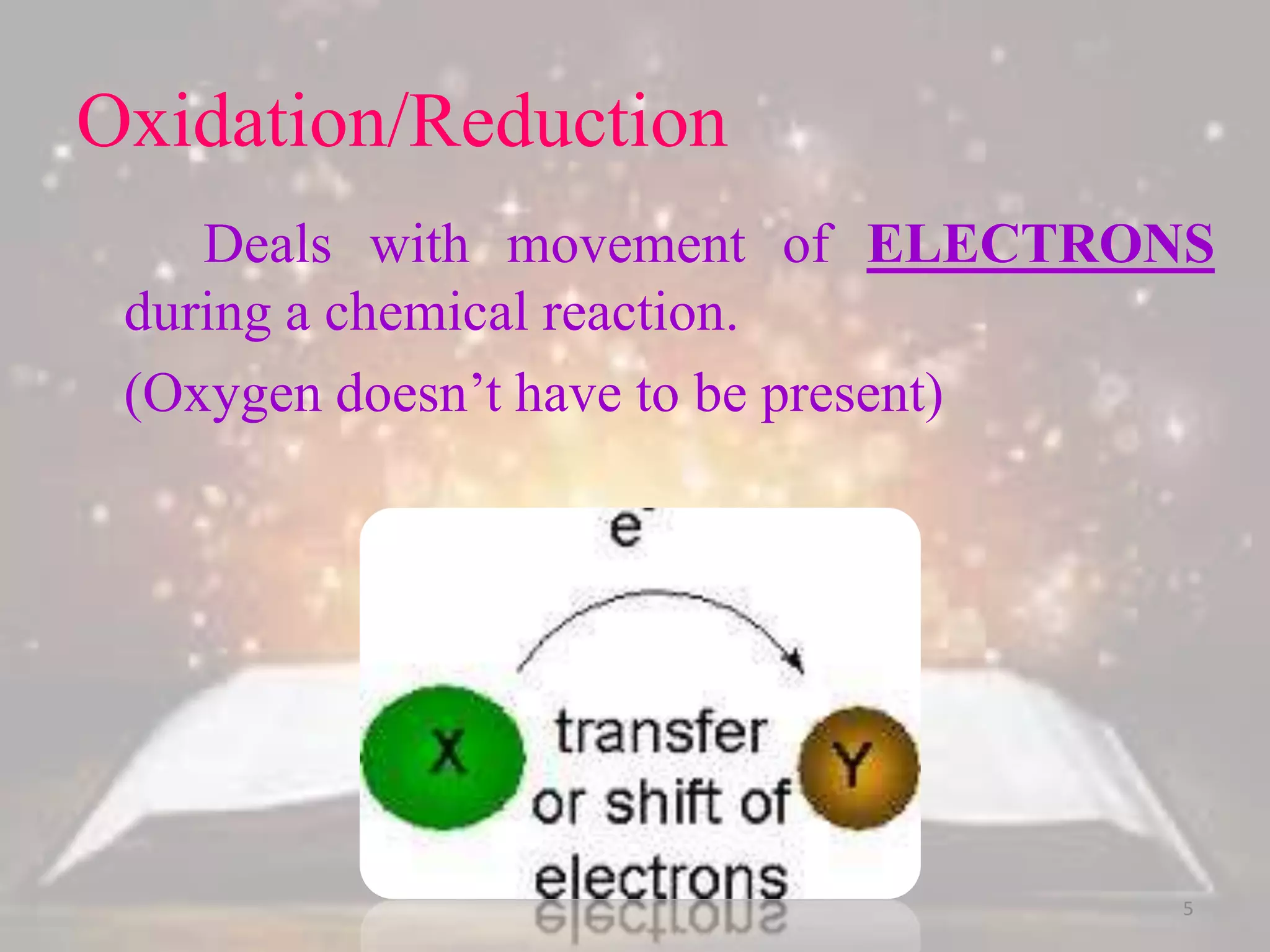
Oxidation/Reduction
Deals with movement of ELECTRONS
during a chemical reaction.
(Oxygen doesn’t have to be present)
5
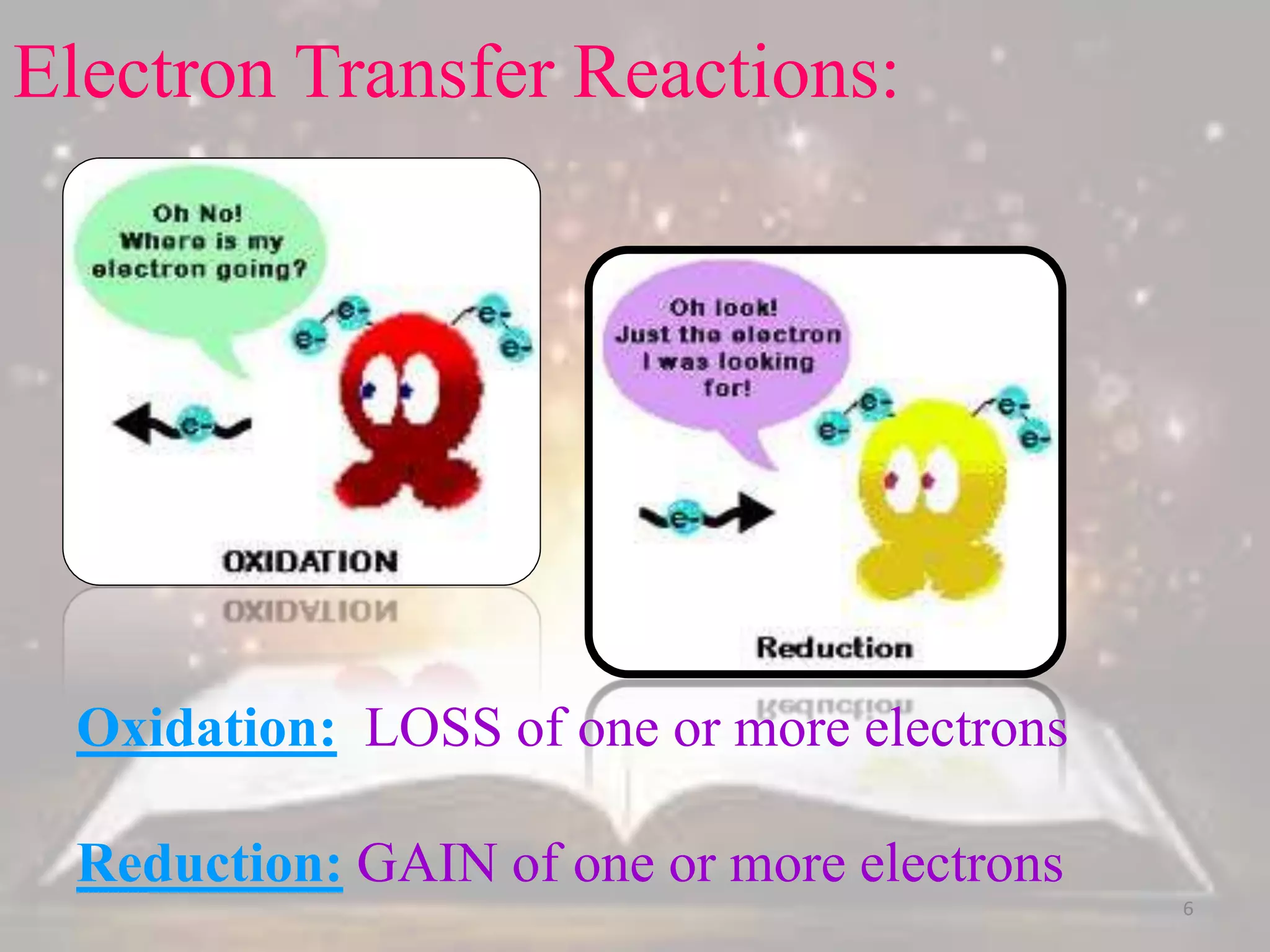
Electron Transfer Reactions:
Oxidation: LOSS of one or more electrons
Reduction: GAIN of one or more electrons
6
Electron Transfer Reactions
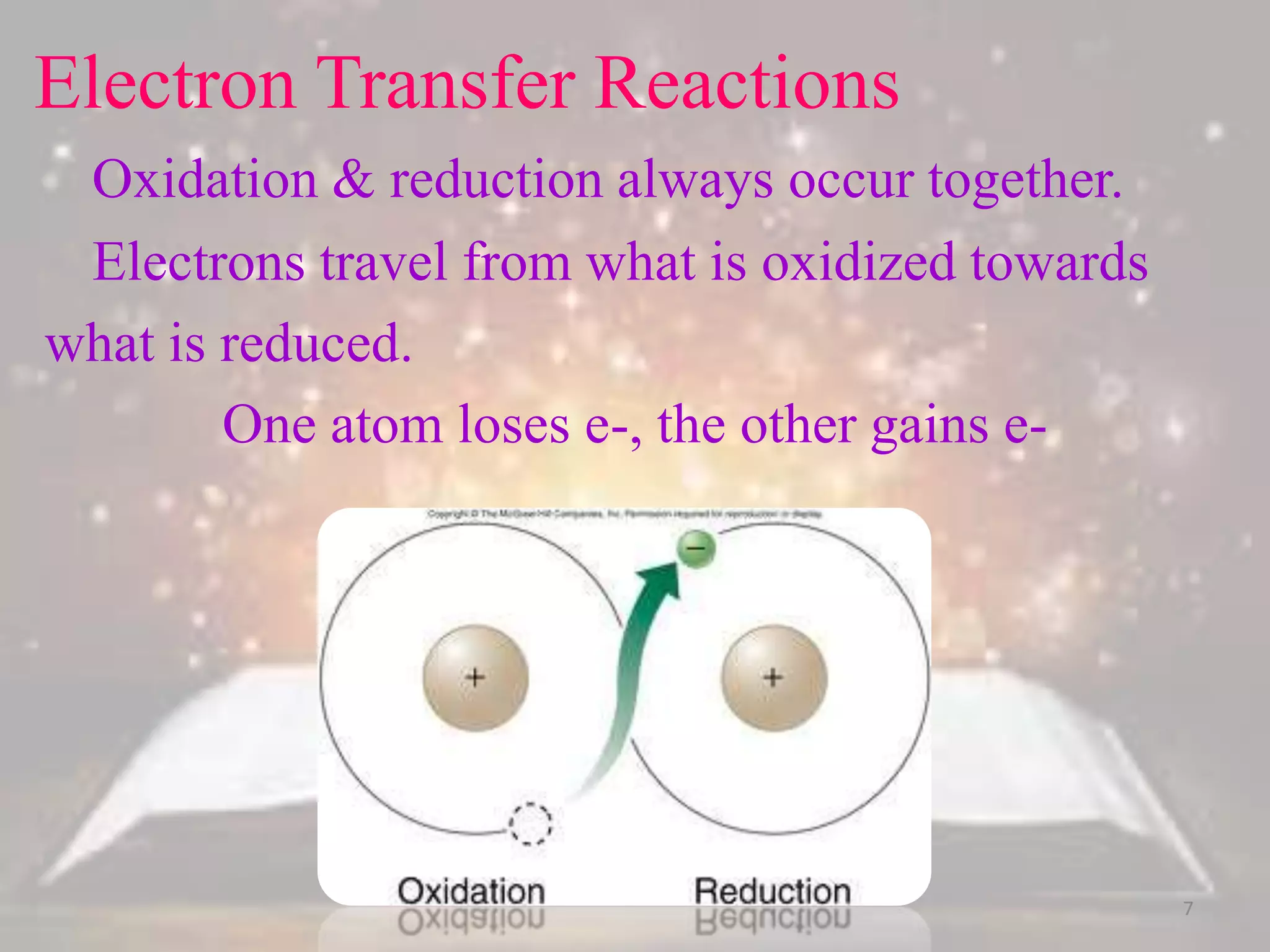
Oxidation & reduction always occur together.
Electrons travel from what is oxidized towards
what is reduced.
One atom loses e-, the other gains e-
7
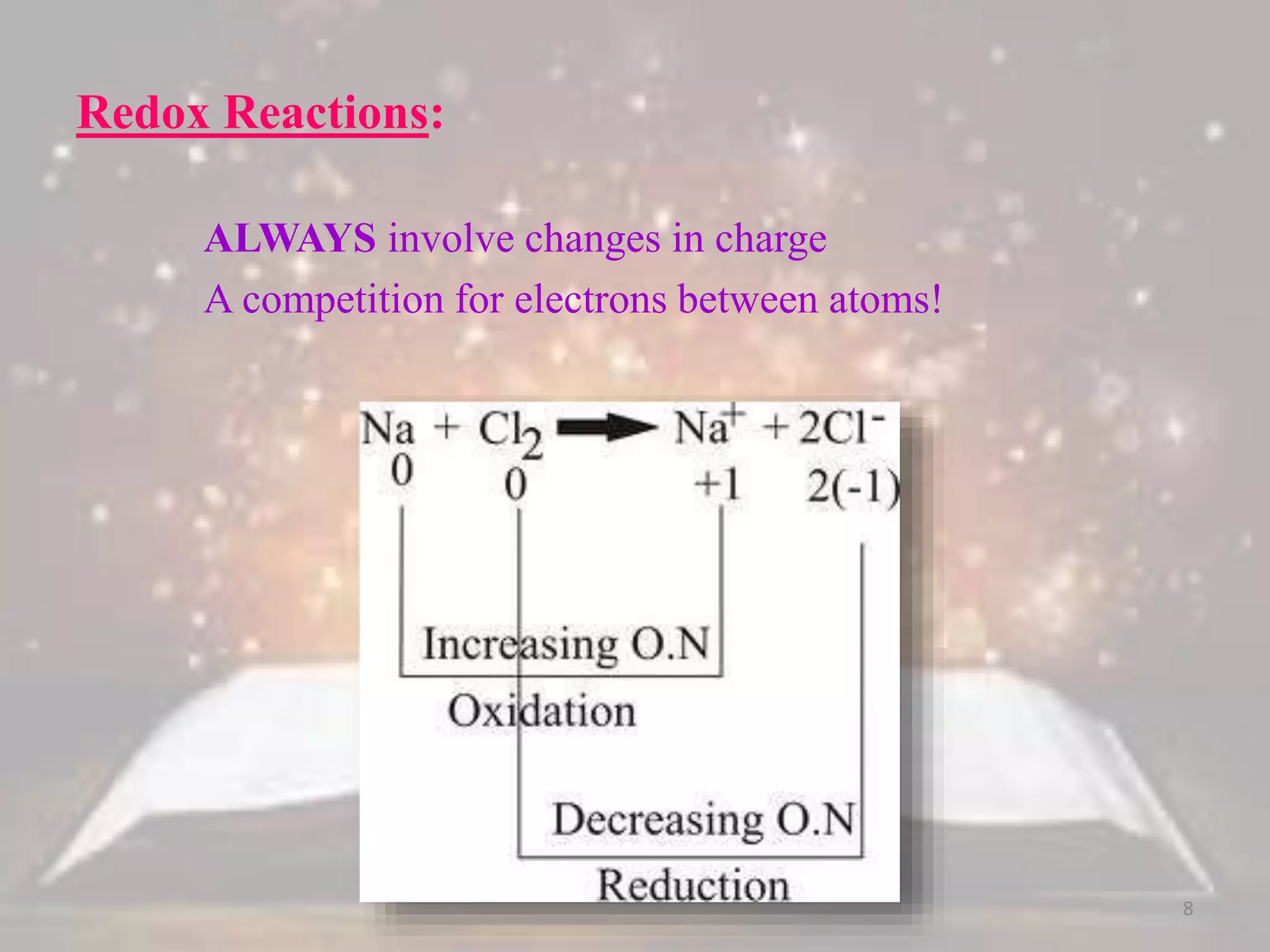
Redox Reactions:
ALWAYS involve changes in charge
A competition for electrons between atoms!
8
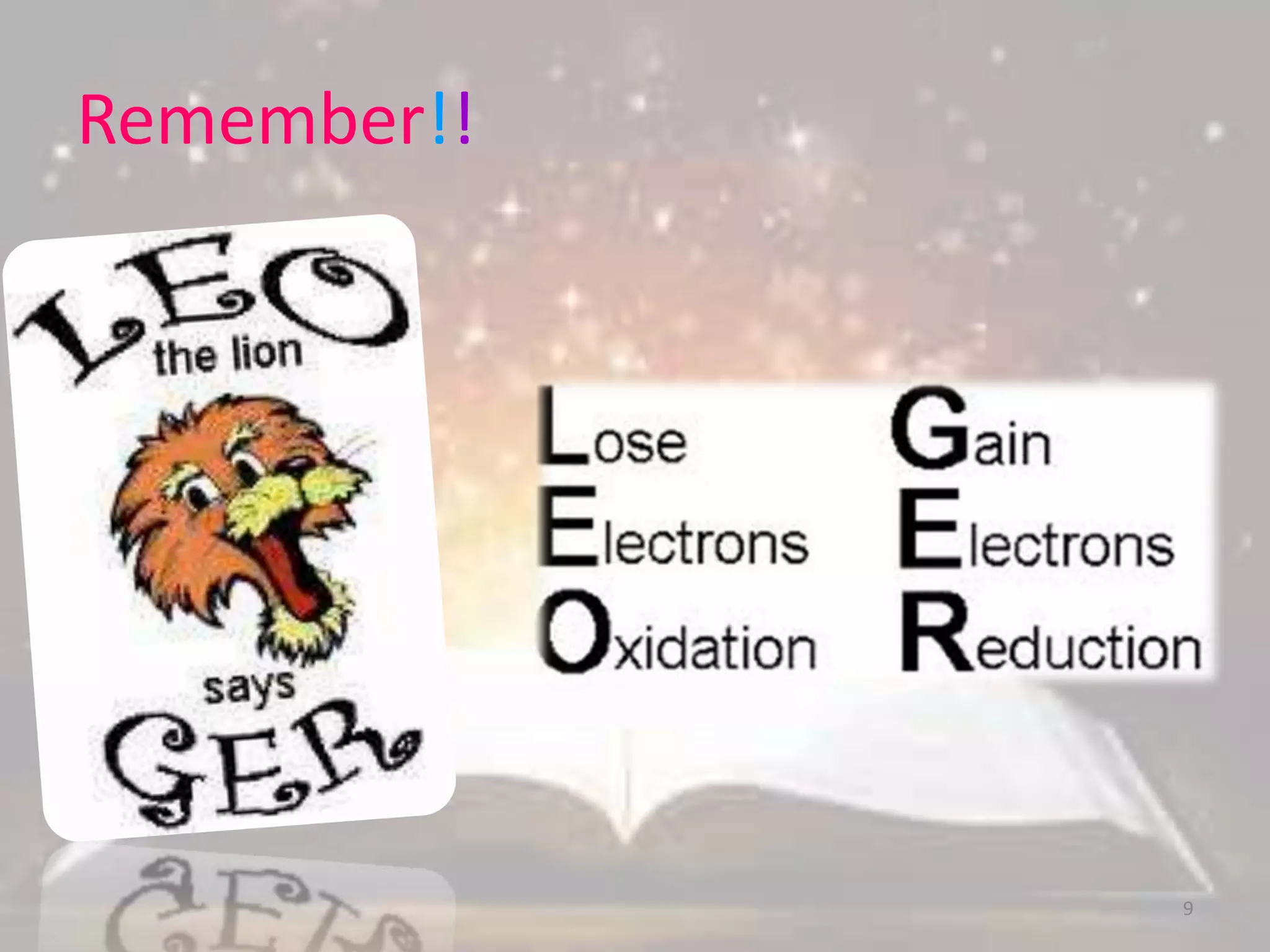
Remember!!
9
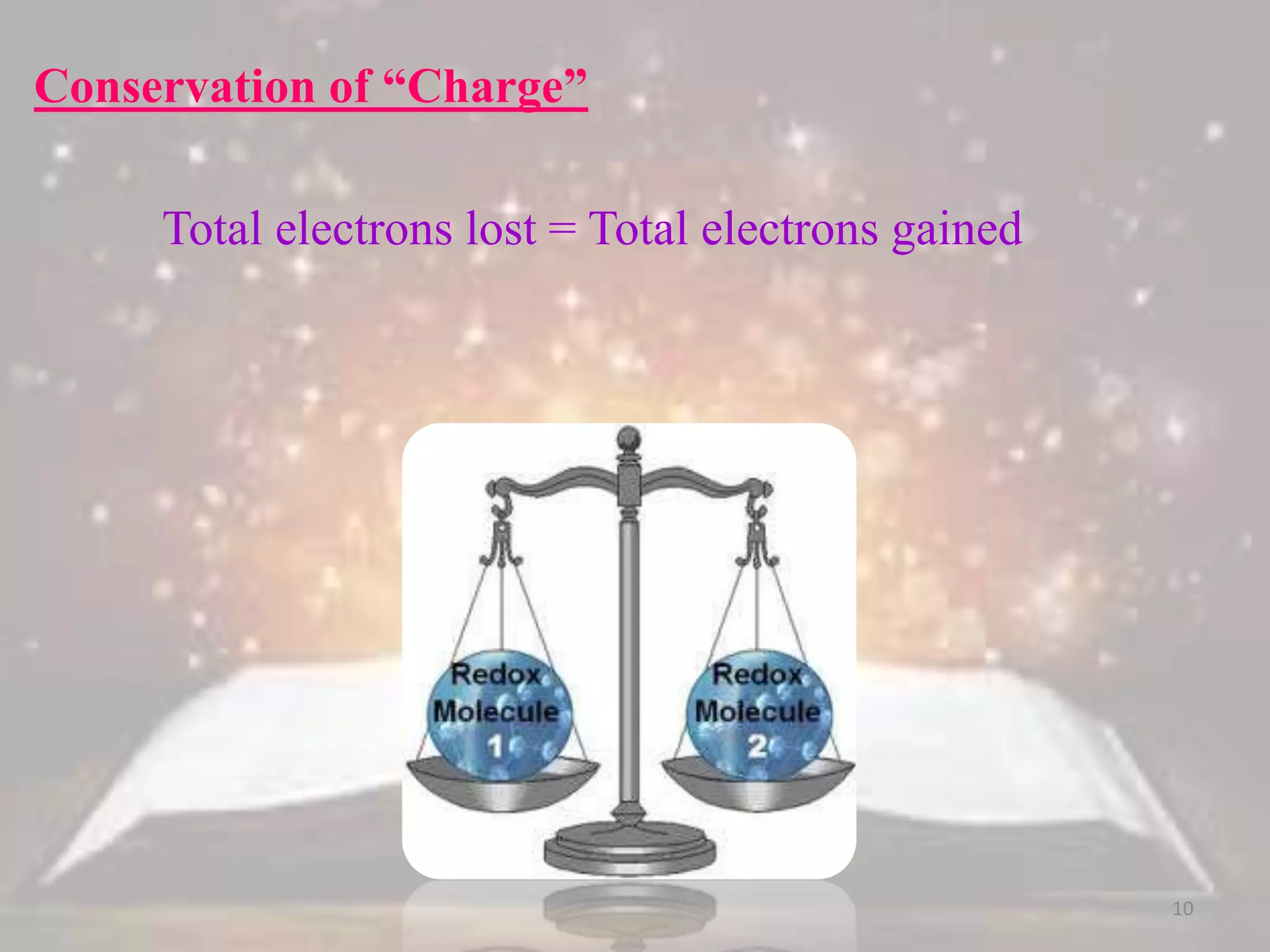
Conservation of “Charge”
Total electrons lost = Total electrons gained
10
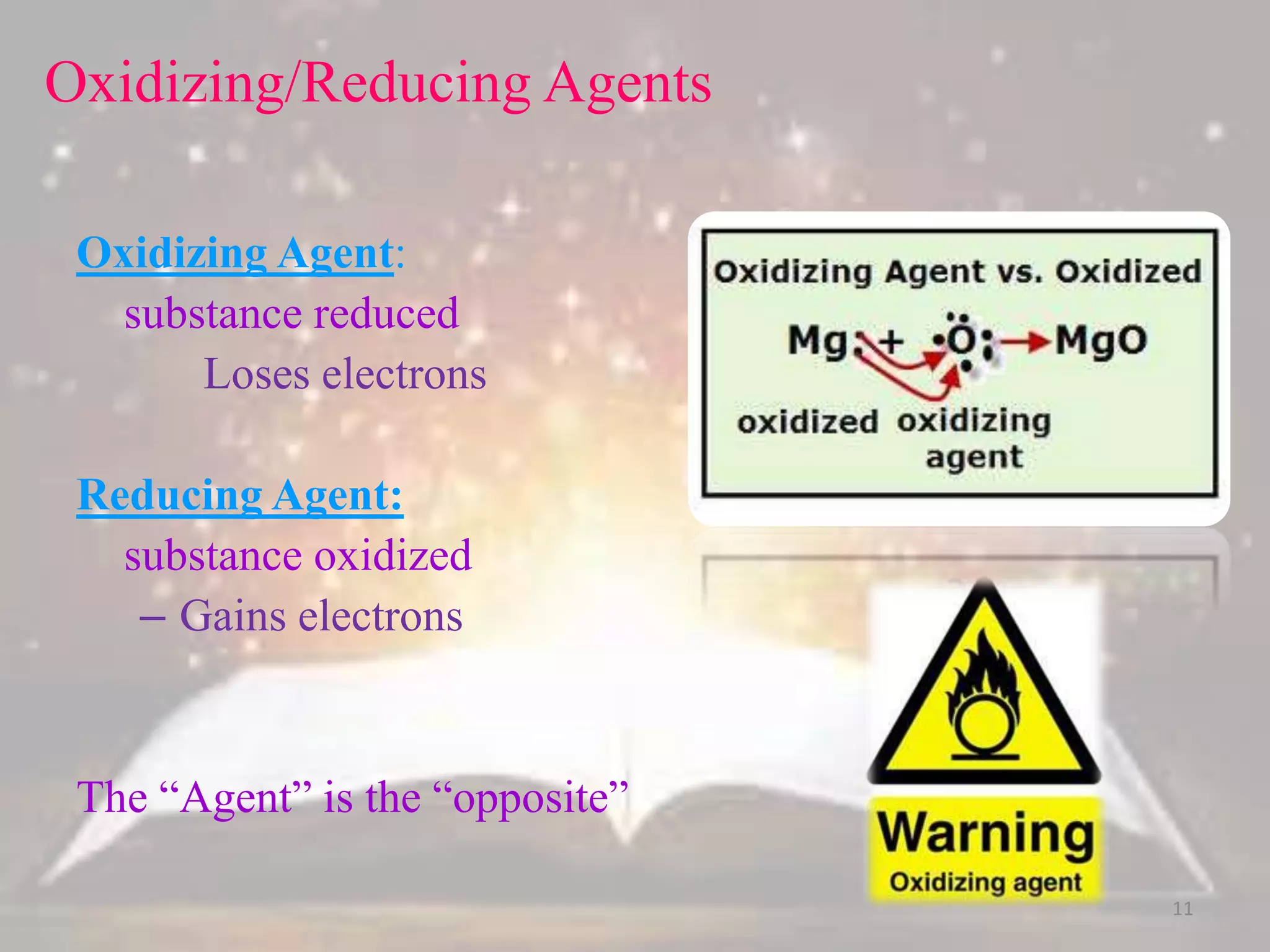
Oxidizing/Reducing Agents
Oxidizing Agent:
substance reduced
Loses electrons
Reducing Agent:
substance oxidized
– Gains electrons
The “Agent” is the “opposite”
11
Redox or Not Redox
(that is the question…)
Redox Reactions: must have atoms changing in charge.
Not all reactions are redox.
Easy way to spot a redox reaction!!!
Look for elements entering and leaving compounds.
12
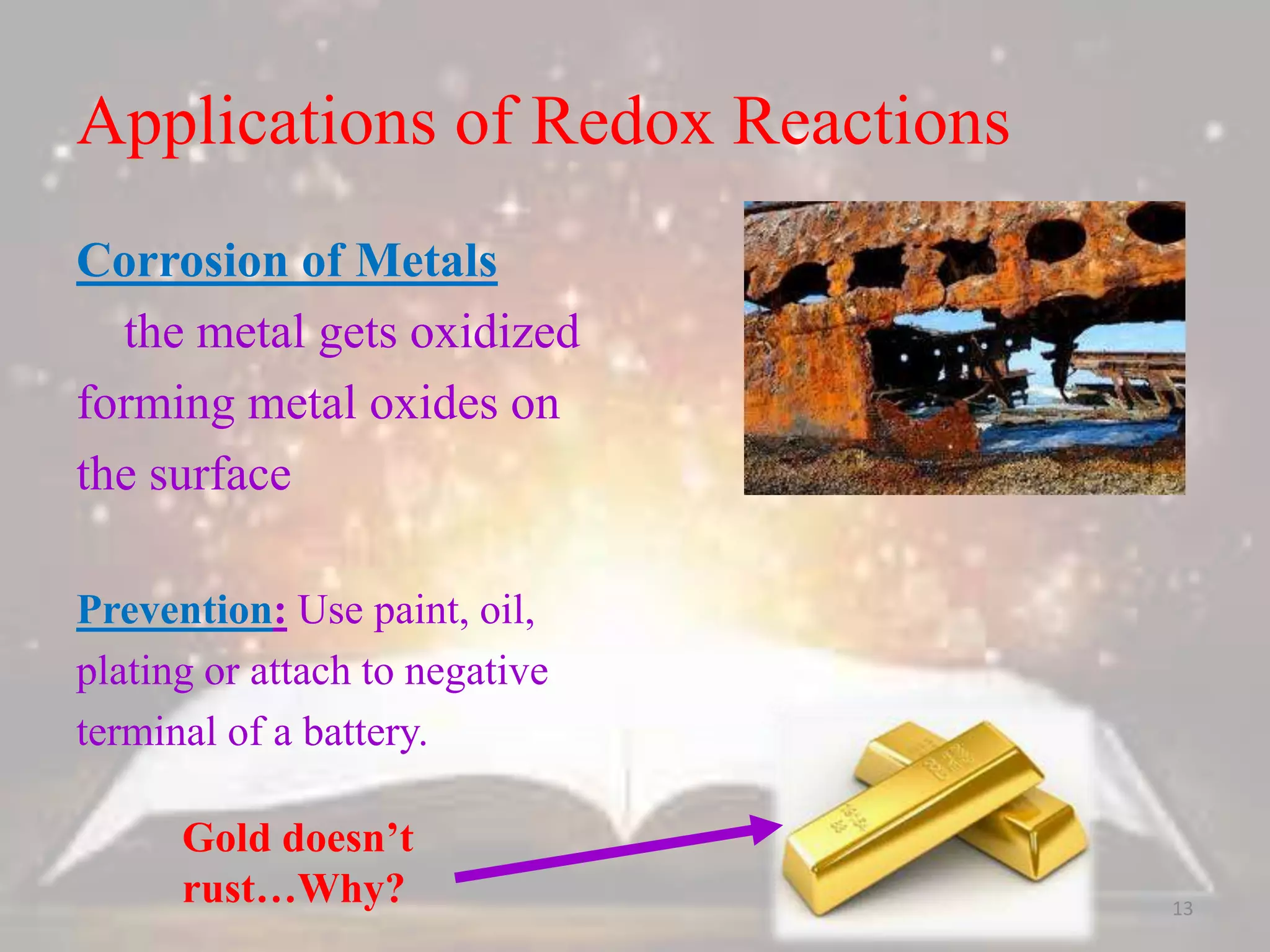
Applications of Redox Reactions
Corrosion of Metals
the metal gets oxidized
forming metal oxides on
the surface
Prevention: Use paint, oil,
plating or attach to negative
terminal of a battery.
Gold doesn’t
rust…Why? 13
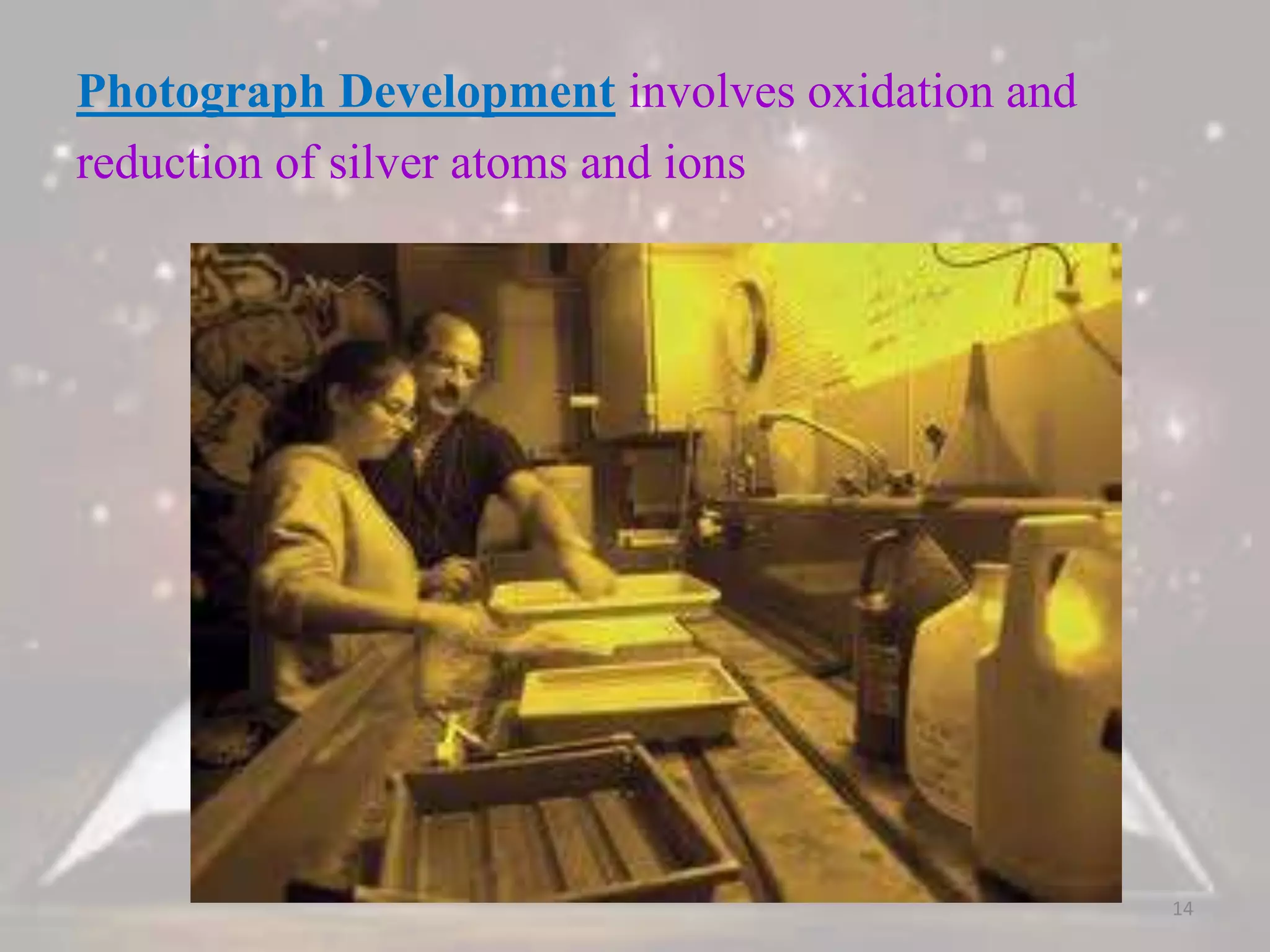
Photograph Development involves oxidation and
reduction of silver atoms and ions
14
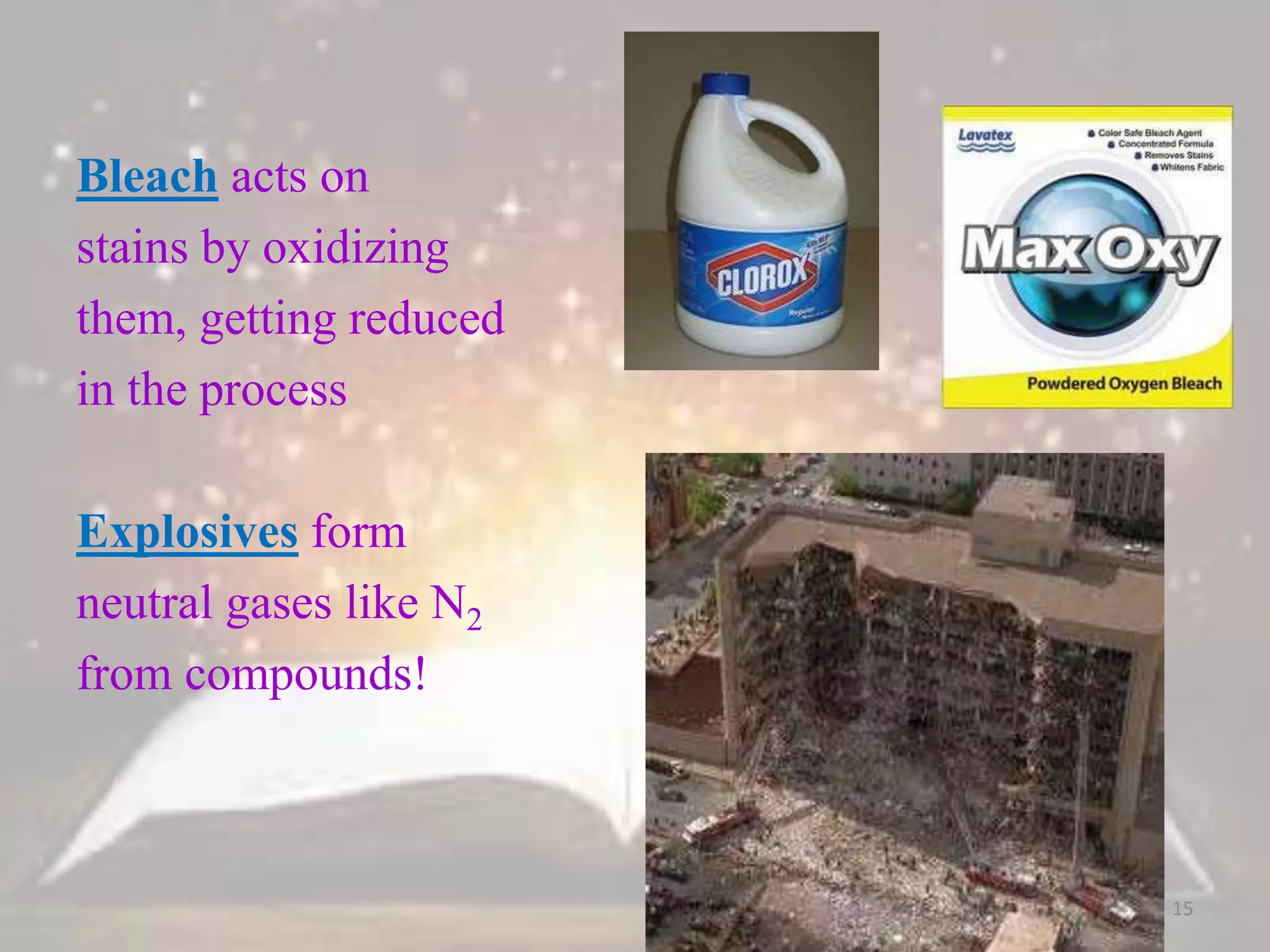
Bleach acts on
stains by oxidizing
them, getting reduced
in the process
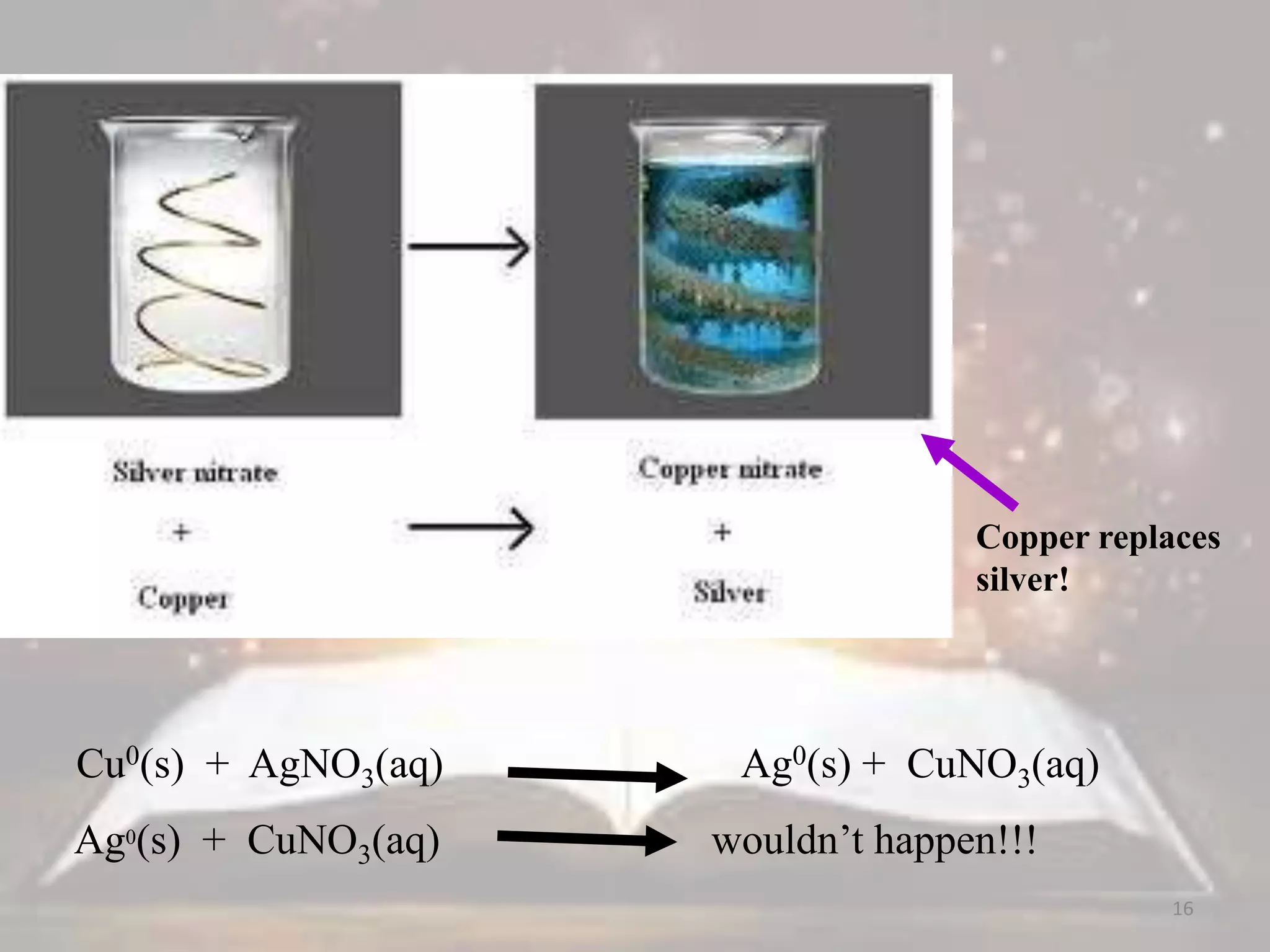
Explosives form
neutral gases like N2
from compounds!
15
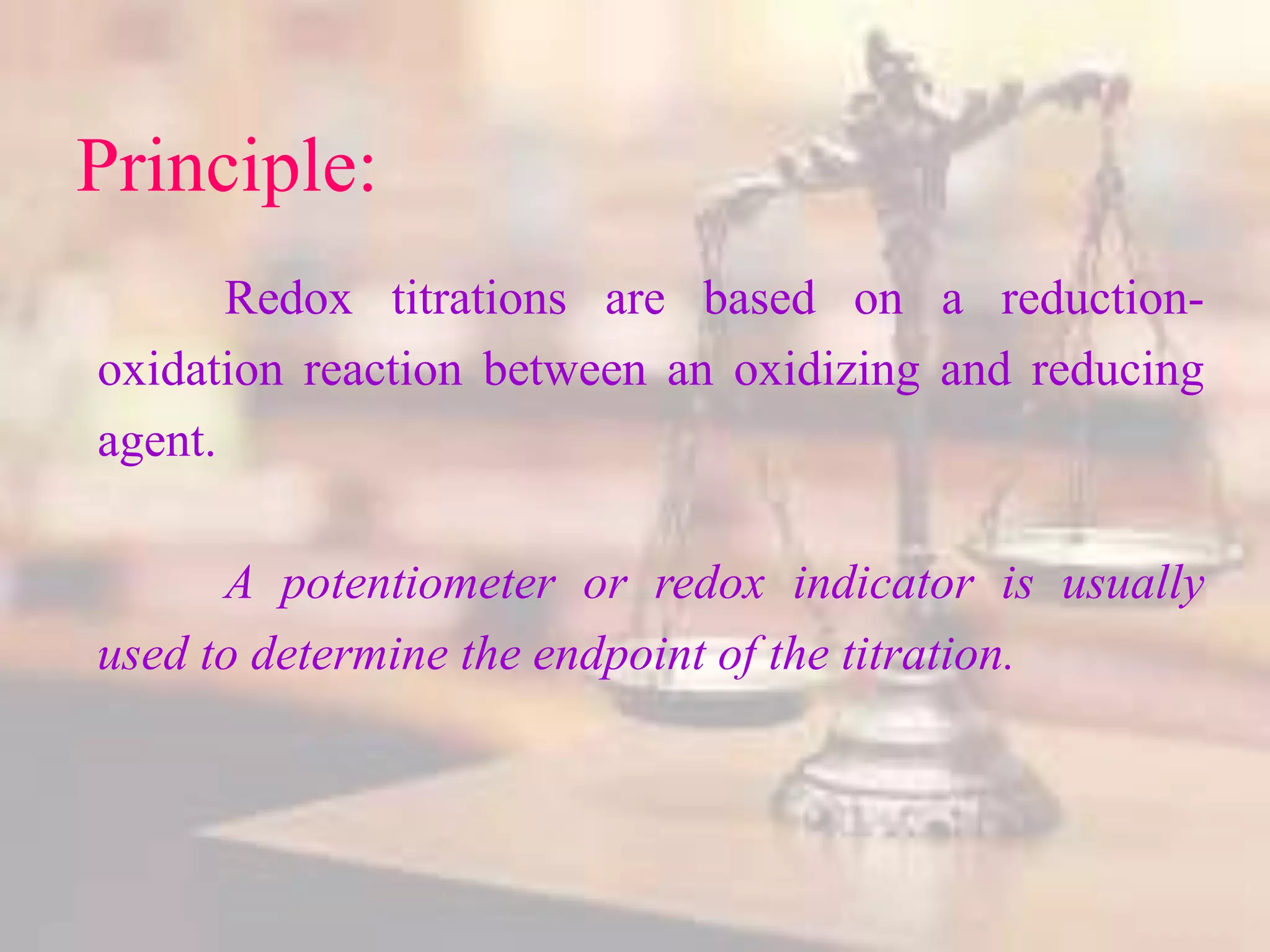
Copper replaces
silver!
Cu0(s) + AgNO3(aq) Ag0(s) + CuNO3(aq)
Ag0(s) + CuNO3(aq) wouldn’t happen!!!
16
Principle:
Redox titrations are based on a reduction-
oxidation reaction between an oxidizing and reducing
agent.
A potentiometer or redox indicator is usually
used to determine the endpoint of the titration.
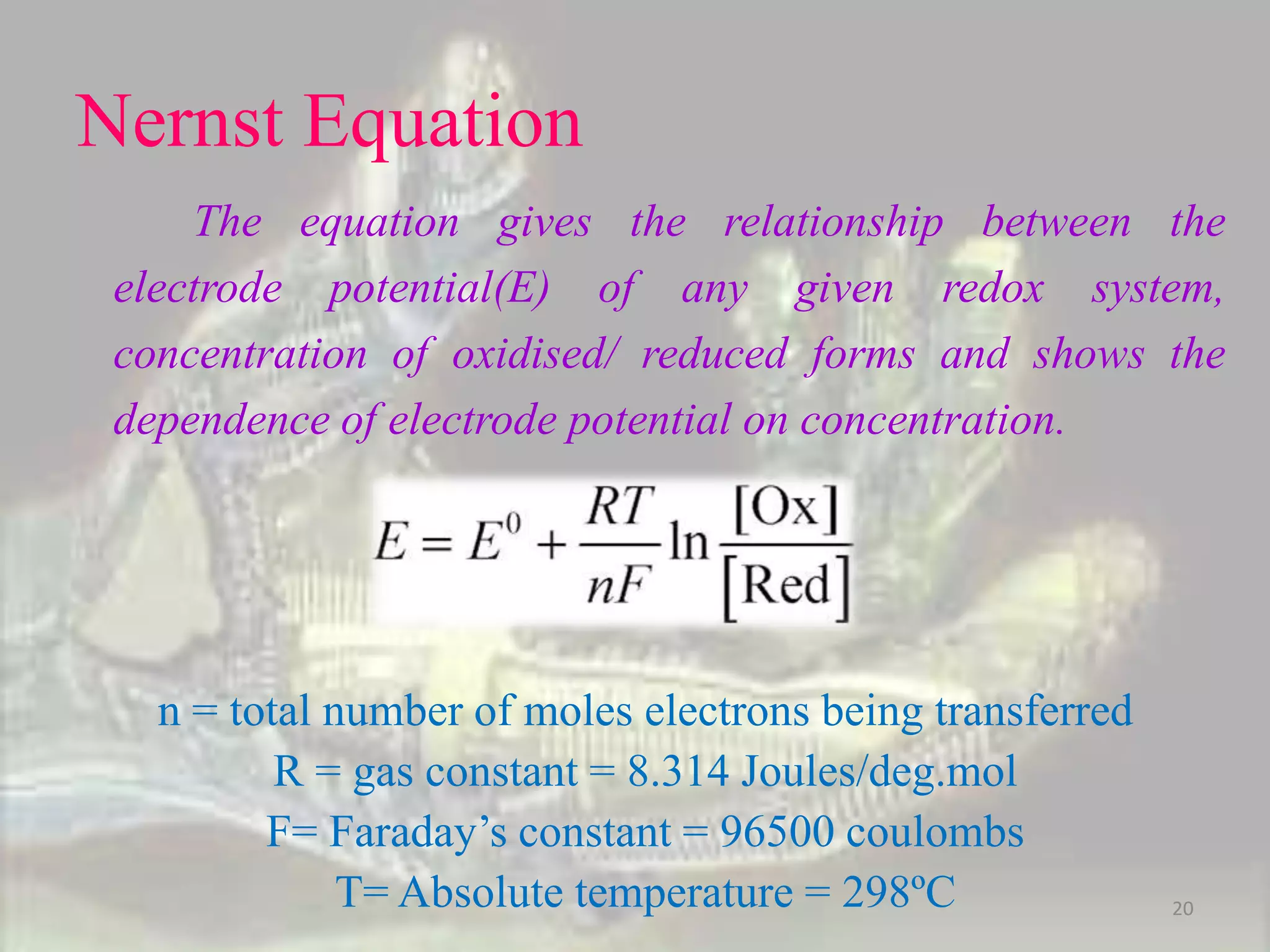
Nernst Equation
The equation gives the relationship between the
electrode potential(E) of any given redox system,
concentration of oxidised/ reduced forms and shows the
dependence of electrode potential on concentration.
n = total number of moles electrons being transferred
R = gas constant = 8.314 Joules/deg.mol
F= Faraday’s constant = 96500 coulombs
T= Absolute temperature = 298ºC 20
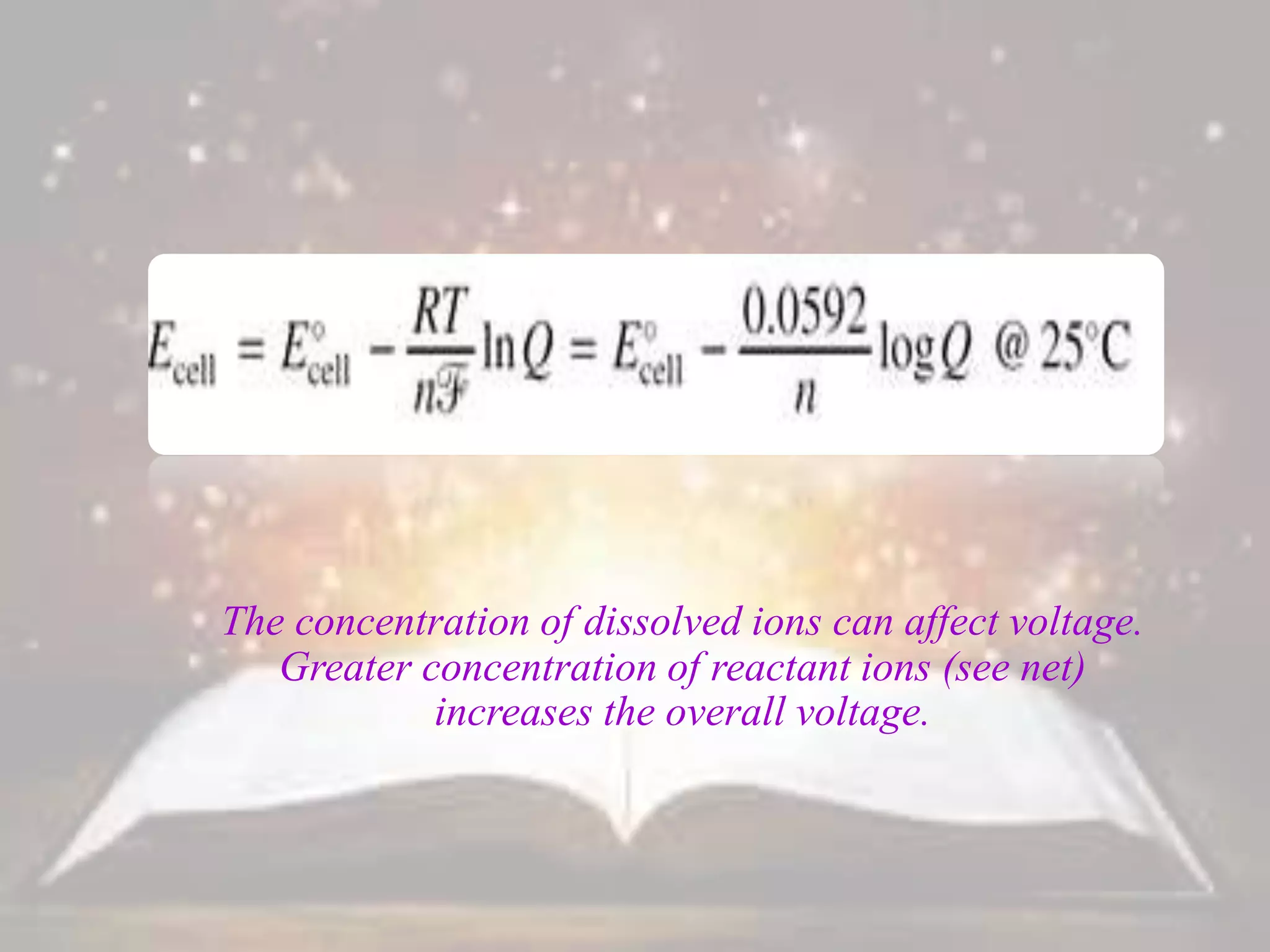
The concentration of dissolved ions can affect voltage.
Greater concentration of reactant ions (see net)
increases the overall voltage.
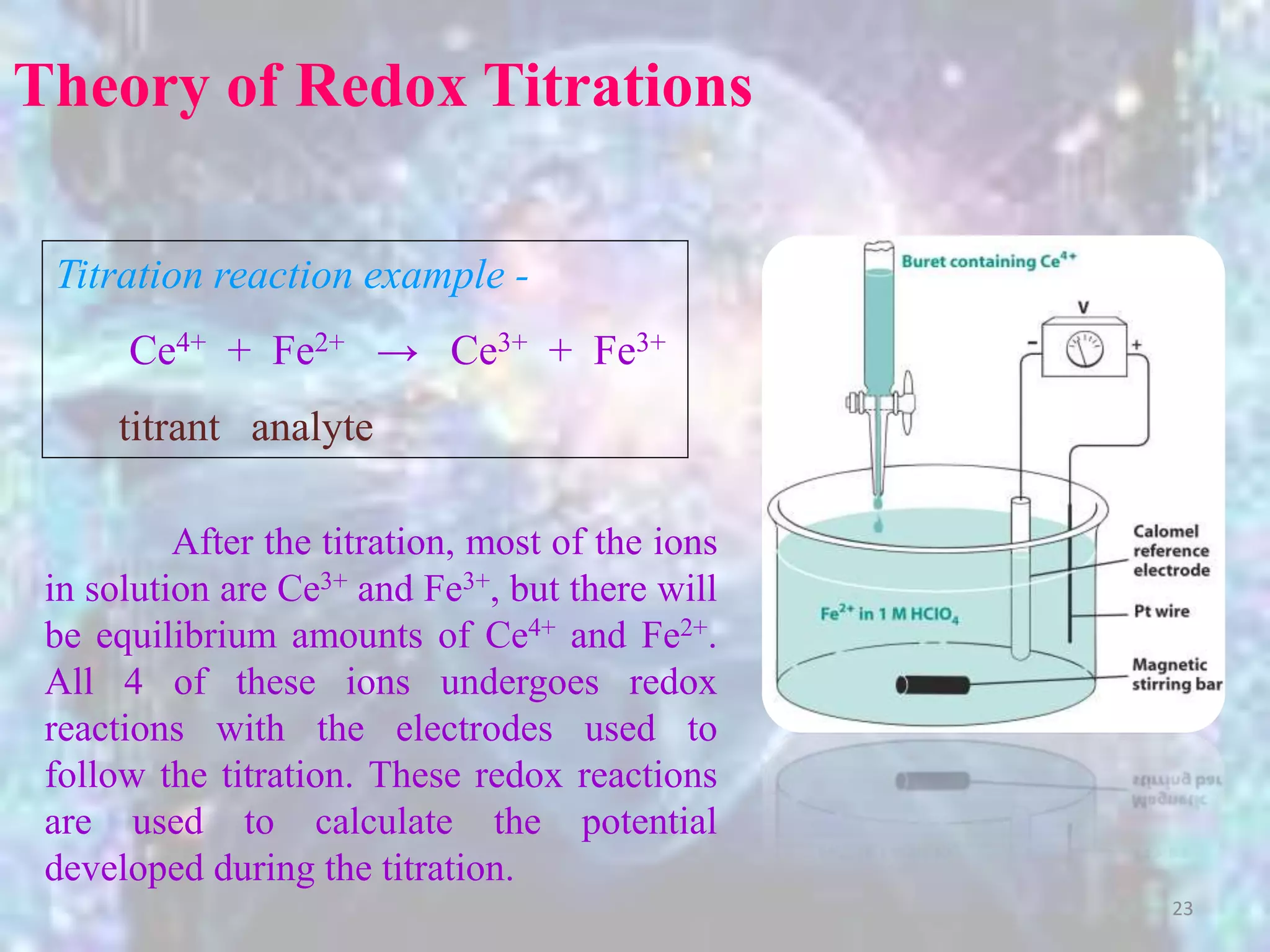
Theory of Redox Titrations
Titration reaction example -
Ce4+ + Fe2+ → Ce3+ + Fe3+
titrant analyte
After the titration, most of the ions
in solution are Ce3+ and Fe3+, but there will
be equilibrium amounts of Ce4+ and Fe2+.
All 4 of these ions undergoes redox
reactions with the electrodes used to
follow the titration. These redox reactions
are used to calculate the potential
developed during the titration.
23
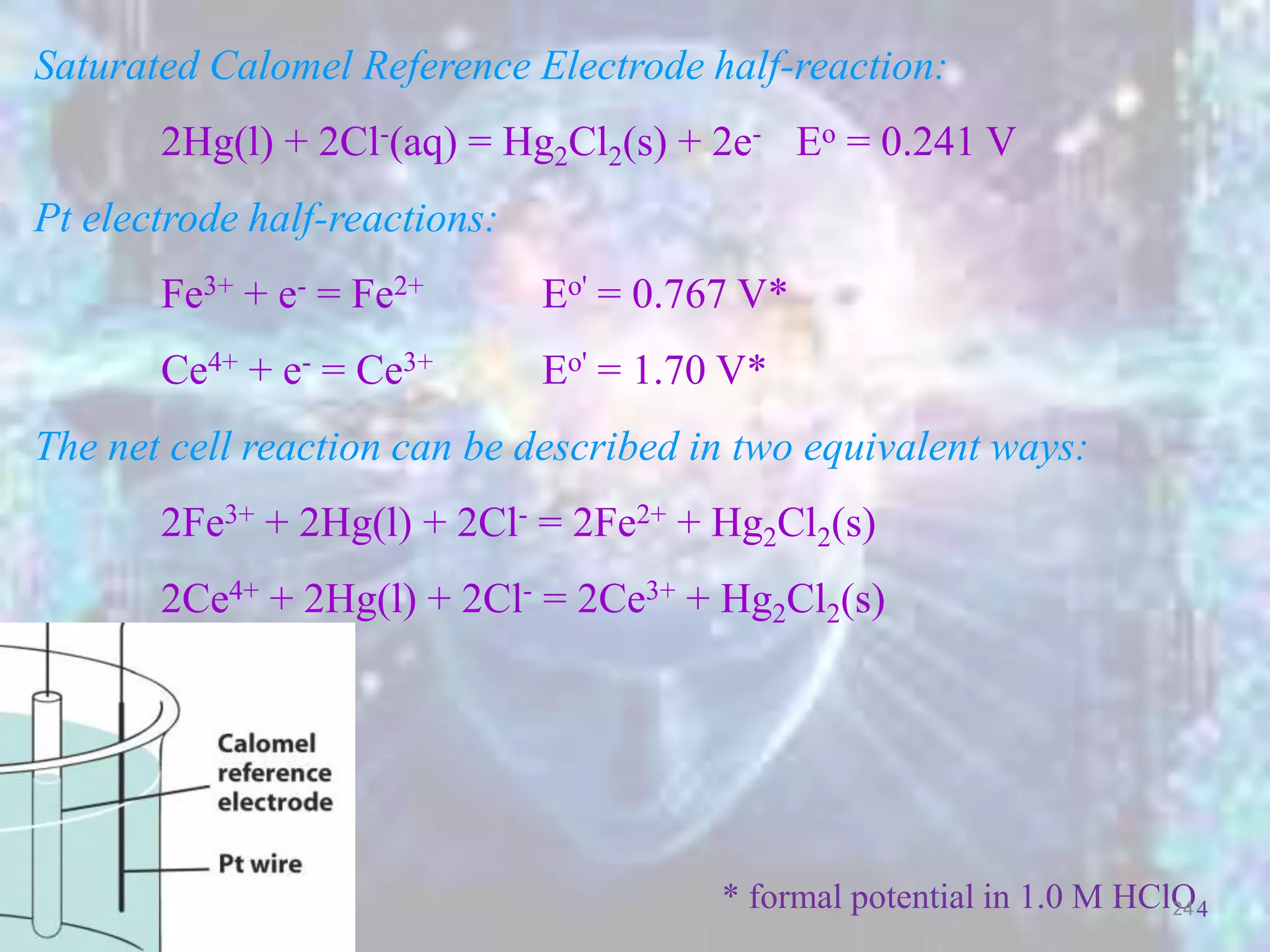
Saturated Calomel Reference Electrode half-reaction:
2Hg(l) + 2Cl-(aq) = Hg2Cl2(s) + 2e- Eo = 0.241 V
Pt electrode half-reactions:
Fe3+ + e- = Fe2+ Eo' = 0.767 V*
Ce4+ + e- = Ce3+ Eo' = 1.70 V*
The net cell reaction can be described in two equivalent ways:
2Fe3+ + 2Hg(l) + 2Cl- = 2Fe2+ + Hg2Cl2(s)
2Ce4+ + 2Hg(l) + 2Cl- = 2Ce3+ + Hg2Cl2(s)
* formal potential in 1.0 M HClO424
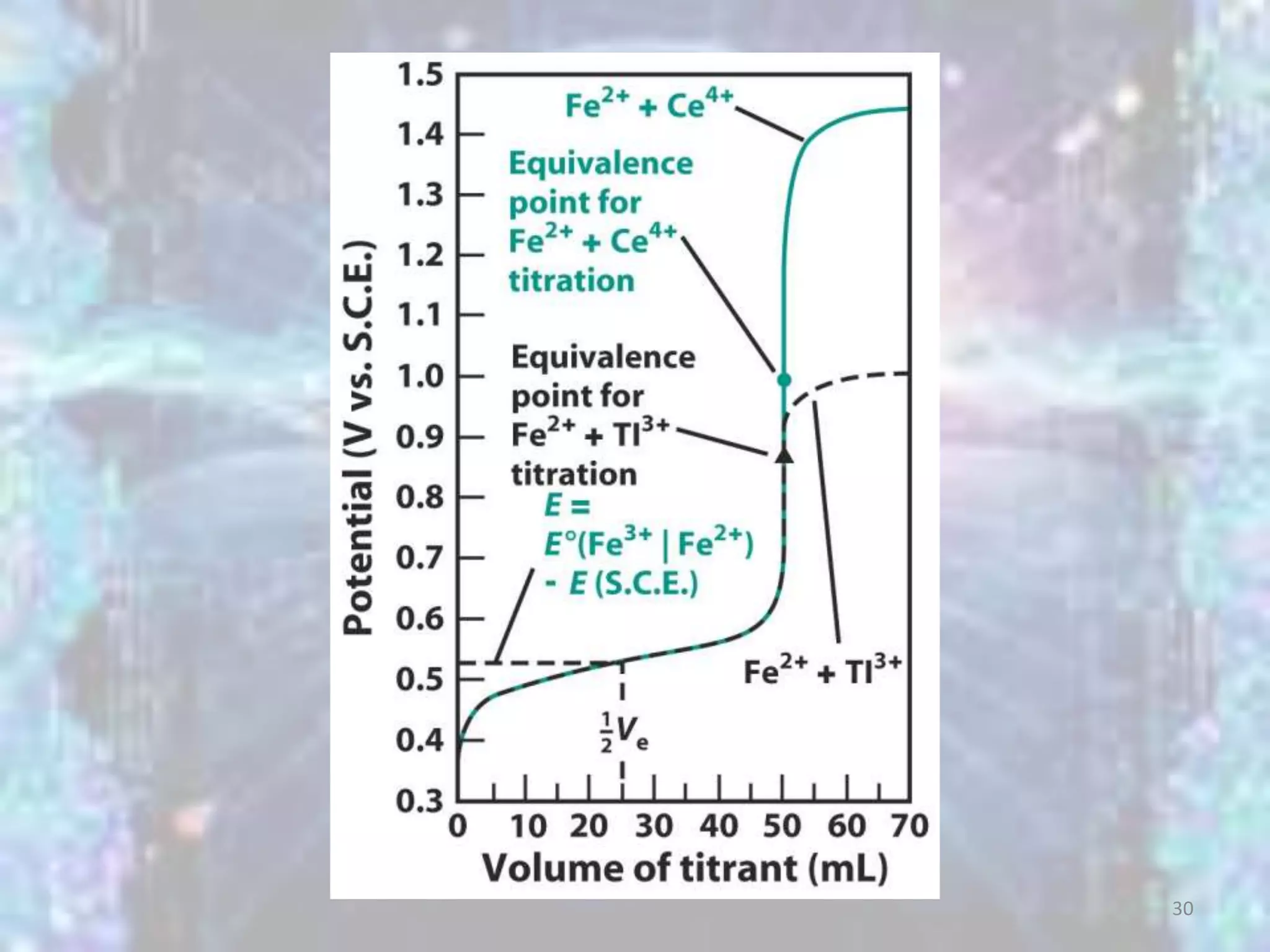
E = E+ - E-
0.241V
][Fe
][Fe
log0.0592-0.767V 3
2






 

Nernst equation for
Fe3+ + e- = Fe2+ (n=1)
Eo = 0.767V
E- = Sat'd
Calomel
Electrode voltag
(ESCE)
][Fe
][Fe
log0.0592-0.526V 3
2



Before the Equivalence Point
It's easier to use the Fe half-reaction because we know how
much was originally present and how much remains for each aliquot of
added titrant (otherwise, using Ce would require a complicated
equilibrium to solve for).
25
We're only going to calculate the potential at the half-
equivalence point where [Fe2+] = [Fe3+]:
][Fe
][Fe
log0.0592-0.526VE 3
2
1/2 


0
E1/2 = 0.526V or more generally for the half-equivalence point:
E1/2 = E+ - E- where E+ = Eo (since the log term went to zero)
and E- = ESCE
E1/2 = Eo - ESCE
26
At the Equivalence Point
Ce3+ + Fe3+ = Ce4+ + Fe2+ (reverse of the titration reaction)
titrant analyte
from the reaction stoichiometry, at the eq. pt. -
[Ce3+] = [Fe3+]
[Ce4+] = [Fe2+]
the two ½ reactions are at equilibrium with the Pt electrode -
Fe3+ + e- = Fe2+
Ce4+ + e- = Ce3+
so the Nernst equations are -
][Fe
][Fe
log0.0592-EE 3
2
0
Fe 



][Ce
][Ce
log0.0592-EE 4
3
o
Ce 



27
adding the two equations
together gives -
][Ce
][Ce
log0.0592-
][Fe
][Fe
log0.0592-EE2E 4
3
3
2
o
Ce
o
Fe 





][Fe
][Fe
log0.0592-EE 3
2
0
Fe 



][Ce
][Ce
log0.0592-EE 4
3
o
Ce 



][Ce
][Ce
][Fe
][Fe
log0.0592-EE2E 4
3
3
2
o
Ce
o
Fe 





and since [Ce3+] = [Fe3+] and [Ce4+] = [Fe2+]
][Fe
][Fe
][Fe
][Fe
log0.0592-EE2E 2
3
3
2
o
Ce
o
Fe 





28
][Fe
][Fe
][Fe
][Fe
log0.0592-EE2E 2
3
3
2
o
Ce
o
Fe 





o
Ce
o
Fe
EE2E 
1.23V
2
2.467
2
1.700.767
2
EE
E
o
Ce
o
Fe





More generally, this is the cathode
potential at the eq. pt. for any redox reaction
where the number of electrons in each half
reaction is equal.
2
EE
E
00
analytetitrant


Ee.p. = E+ - E- = E+ - ESCE = 1.23 - 0.241 = 0.99V
29
30
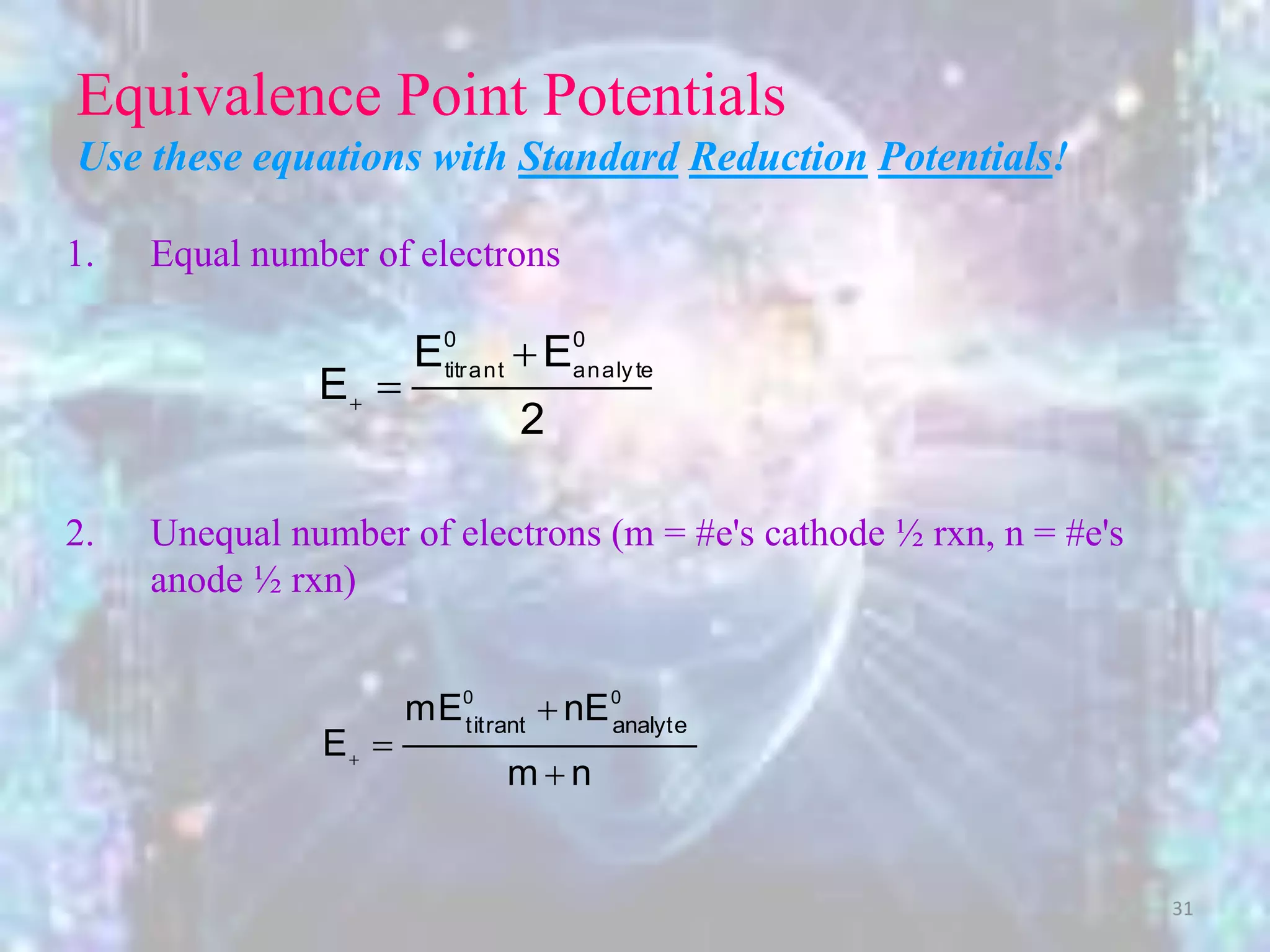
Equivalence Point Potentials
Use these equations with Standard Reduction Potentials!
1. Equal number of electrons
2. Unequal number of electrons (m = #e's cathode ½ rxn, n = #e's
anode ½ rxn)
2
EE
E
0
analyte
0
titrant


nm
nEmE
E
00
analytetitrant



31
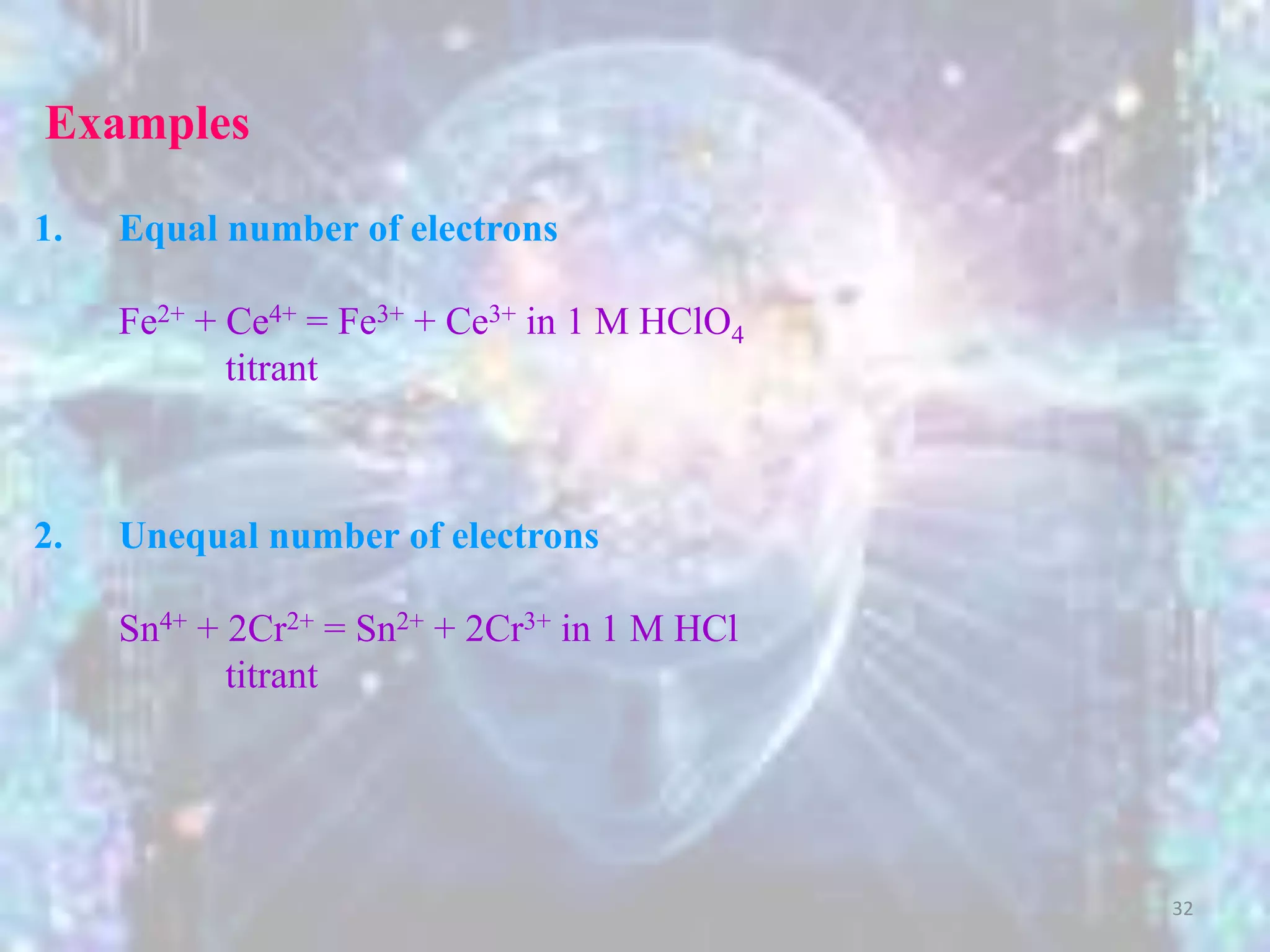
Examples
1. Equal number of electrons
Fe2+ + Ce4+ = Fe3+ + Ce3+ in 1 M HClO4
titrant
2. Unequal number of electrons
Sn4+ + 2Cr2+ = Sn2+ + 2Cr3+ in 1 M HCl
titrant
32
33
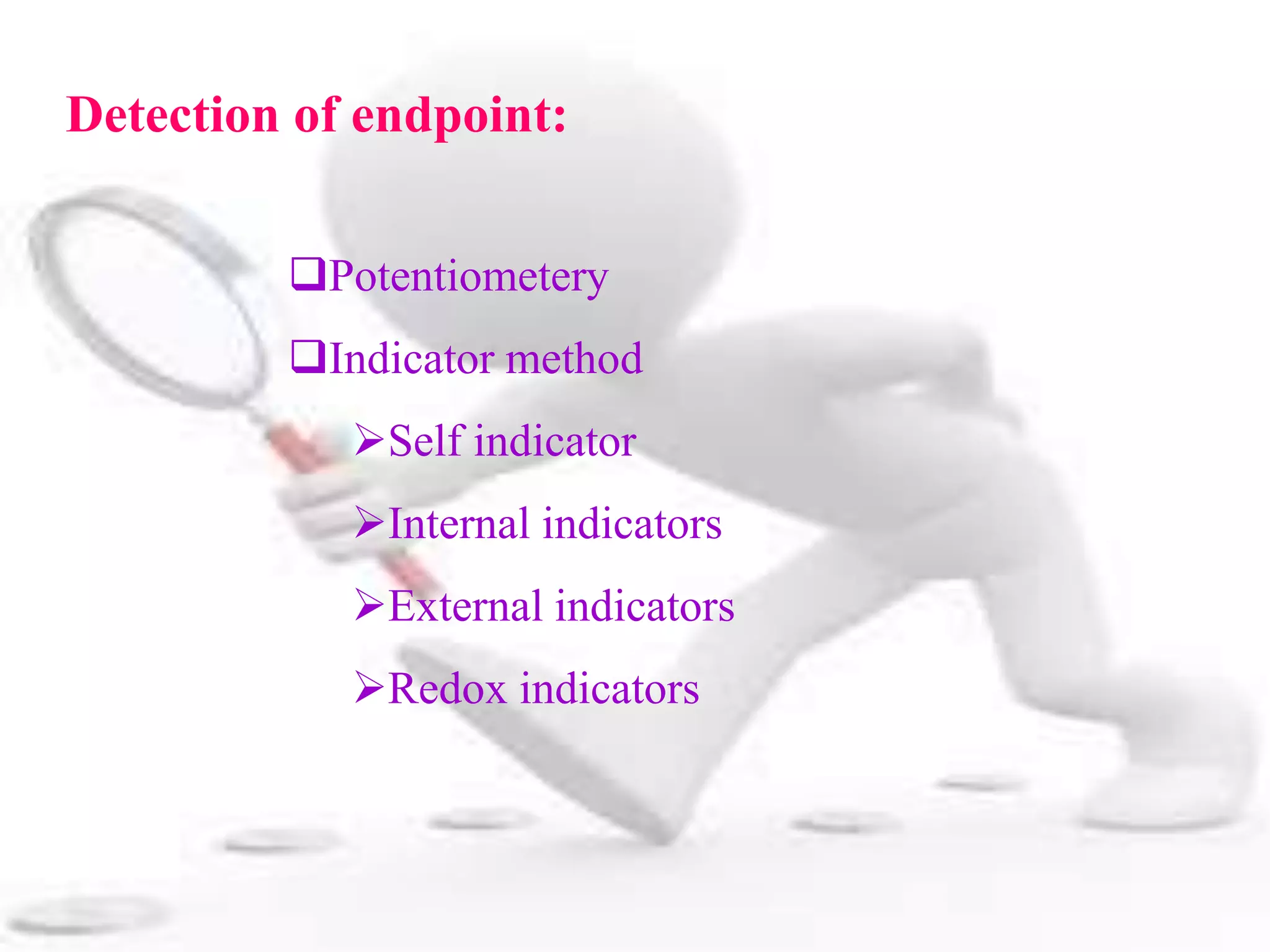
Detection of endpoint:
Potentiometery
Indicator method
Self indicator
Internal indicators
External indicators
Redox indicators
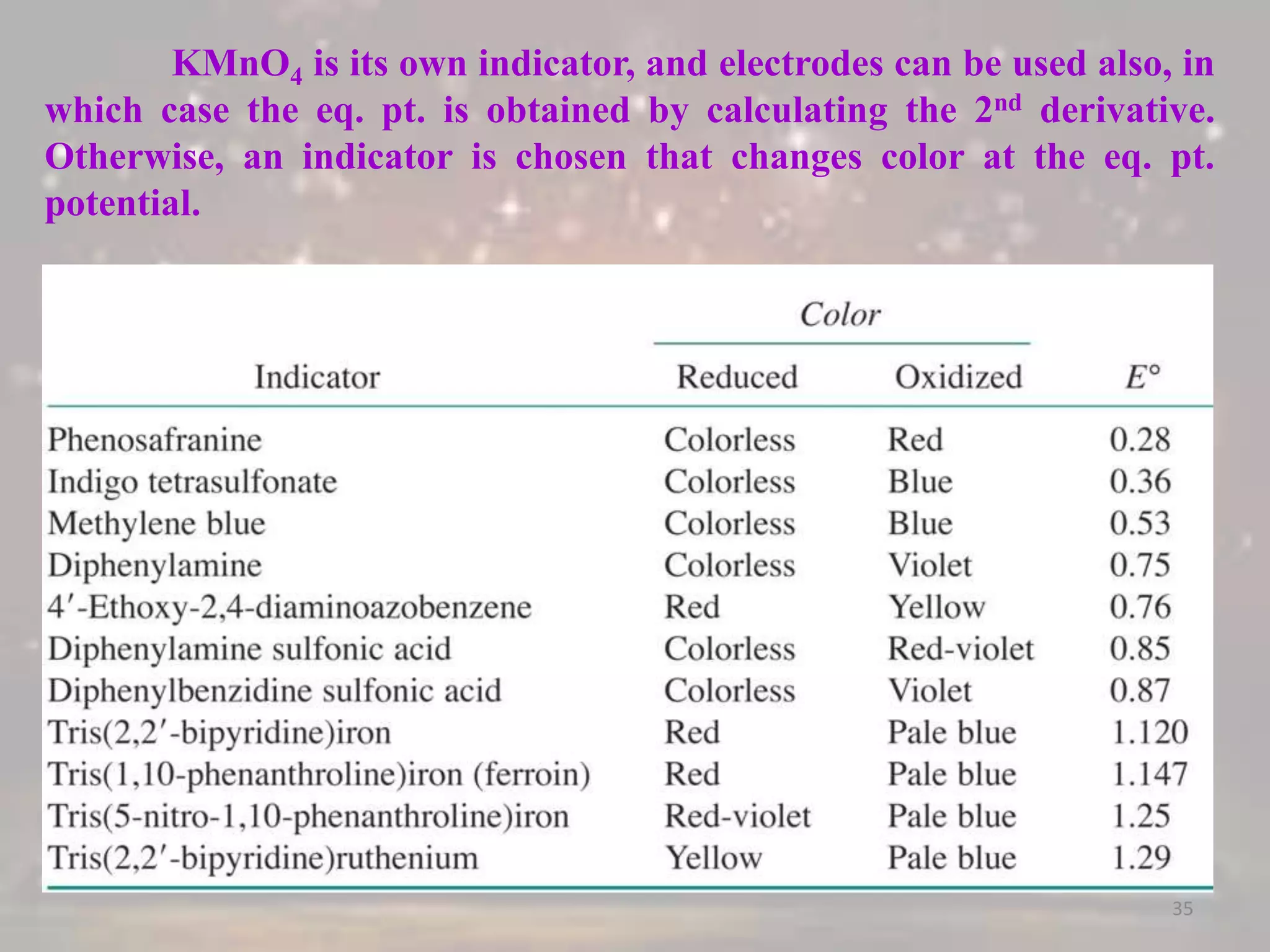
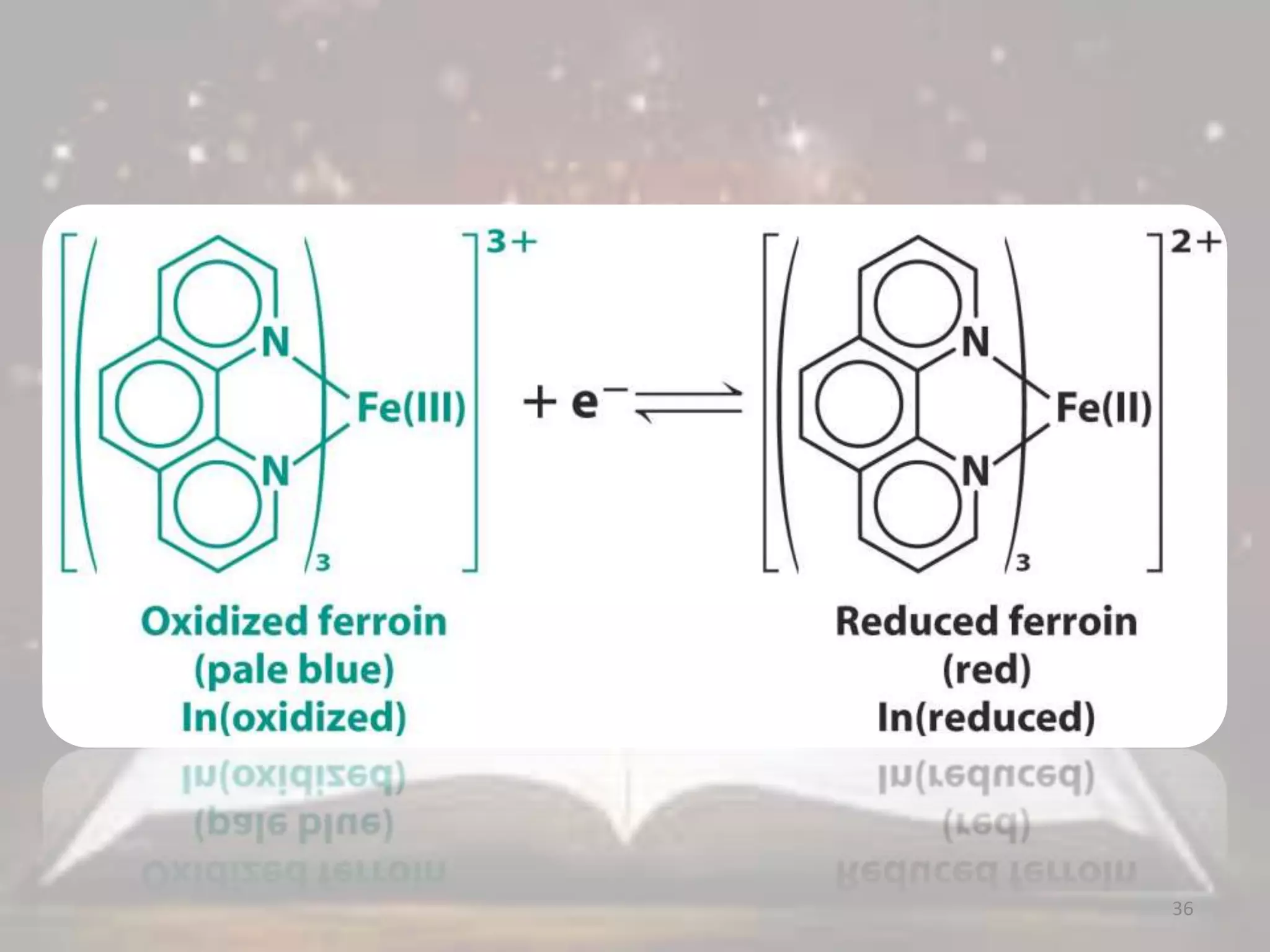
KMnO4 is its own indicator, and electrodes can be used also, in
which case the eq. pt. is obtained by calculating the 2nd derivative.
Otherwise, an indicator is chosen that changes color at the eq. pt.
potential.
35
36
Oxidation and reduction titration

Oxidation and reduction titration

  • 1.
  • 2.
  • 3.
    Oxidation Original definition: When substancescombined with oxygen. Ex: All combustion (burning) reactions CH4(g) + 2O2(g) CO2(g) + 2H2O(l) All “rusting” reactions 4Fe(s) + 3O2(g) 2Fe2O3(s) 3
  • 4.
    Reduction Original Definition: Reaction wherea substance “gave up” oxygen is called “reductions” because they produced products that were “reduced” in mass because gas escaped. Ex: 2Fe2O3(l) + 3C(s) 4Fe(l) + 3CO2(g) 4
  • 5.
    Oxidation/Reduction Deals with movementof ELECTRONS during a chemical reaction. (Oxygen doesn’t have to be present) 5
  • 6.
    Electron Transfer Reactions: Oxidation:LOSS of one or more electrons Reduction: GAIN of one or more electrons 6
  • 7.
    Electron Transfer Reactions Oxidation& reduction always occur together. Electrons travel from what is oxidized towards what is reduced. One atom loses e-, the other gains e- 7
  • 8.
    Redox Reactions: ALWAYS involvechanges in charge A competition for electrons between atoms! 8
  • 9.
  • 10.
    Conservation of “Charge” Totalelectrons lost = Total electrons gained 10
  • 11.
    Oxidizing/Reducing Agents Oxidizing Agent: substancereduced Loses electrons Reducing Agent: substance oxidized – Gains electrons The “Agent” is the “opposite” 11
  • 12.
    Redox or NotRedox (that is the question…) Redox Reactions: must have atoms changing in charge. Not all reactions are redox. Easy way to spot a redox reaction!!! Look for elements entering and leaving compounds. 12
  • 13.
    Applications of RedoxReactions Corrosion of Metals the metal gets oxidized forming metal oxides on the surface Prevention: Use paint, oil, plating or attach to negative terminal of a battery. Gold doesn’t rust…Why? 13
  • 14.
    Photograph Development involvesoxidation and reduction of silver atoms and ions 14
  • 15.
    Bleach acts on stainsby oxidizing them, getting reduced in the process Explosives form neutral gases like N2 from compounds! 15
  • 16.
    Copper replaces silver! Cu0(s) +AgNO3(aq) Ag0(s) + CuNO3(aq) Ag0(s) + CuNO3(aq) wouldn’t happen!!! 16
  • 18.
    Principle: Redox titrations arebased on a reduction- oxidation reaction between an oxidizing and reducing agent. A potentiometer or redox indicator is usually used to determine the endpoint of the titration.
  • 20.
    Nernst Equation The equationgives the relationship between the electrode potential(E) of any given redox system, concentration of oxidised/ reduced forms and shows the dependence of electrode potential on concentration. n = total number of moles electrons being transferred R = gas constant = 8.314 Joules/deg.mol F= Faraday’s constant = 96500 coulombs T= Absolute temperature = 298ºC 20
  • 21.
    The concentration ofdissolved ions can affect voltage. Greater concentration of reactant ions (see net) increases the overall voltage.
  • 23.
    Theory of RedoxTitrations Titration reaction example - Ce4+ + Fe2+ → Ce3+ + Fe3+ titrant analyte After the titration, most of the ions in solution are Ce3+ and Fe3+, but there will be equilibrium amounts of Ce4+ and Fe2+. All 4 of these ions undergoes redox reactions with the electrodes used to follow the titration. These redox reactions are used to calculate the potential developed during the titration. 23
  • 24.
    Saturated Calomel ReferenceElectrode half-reaction: 2Hg(l) + 2Cl-(aq) = Hg2Cl2(s) + 2e- Eo = 0.241 V Pt electrode half-reactions: Fe3+ + e- = Fe2+ Eo' = 0.767 V* Ce4+ + e- = Ce3+ Eo' = 1.70 V* The net cell reaction can be described in two equivalent ways: 2Fe3+ + 2Hg(l) + 2Cl- = 2Fe2+ + Hg2Cl2(s) 2Ce4+ + 2Hg(l) + 2Cl- = 2Ce3+ + Hg2Cl2(s) * formal potential in 1.0 M HClO424
  • 25.
    E = E+- E- 0.241V ][Fe ][Fe log0.0592-0.767V 3 2          Nernst equation for Fe3+ + e- = Fe2+ (n=1) Eo = 0.767V E- = Sat'd Calomel Electrode voltag (ESCE) ][Fe ][Fe log0.0592-0.526V 3 2    Before the Equivalence Point It's easier to use the Fe half-reaction because we know how much was originally present and how much remains for each aliquot of added titrant (otherwise, using Ce would require a complicated equilibrium to solve for). 25
  • 26.
    We're only goingto calculate the potential at the half- equivalence point where [Fe2+] = [Fe3+]: ][Fe ][Fe log0.0592-0.526VE 3 2 1/2    0 E1/2 = 0.526V or more generally for the half-equivalence point: E1/2 = E+ - E- where E+ = Eo (since the log term went to zero) and E- = ESCE E1/2 = Eo - ESCE 26
  • 27.
    At the EquivalencePoint Ce3+ + Fe3+ = Ce4+ + Fe2+ (reverse of the titration reaction) titrant analyte from the reaction stoichiometry, at the eq. pt. - [Ce3+] = [Fe3+] [Ce4+] = [Fe2+] the two ½ reactions are at equilibrium with the Pt electrode - Fe3+ + e- = Fe2+ Ce4+ + e- = Ce3+ so the Nernst equations are - ][Fe ][Fe log0.0592-EE 3 2 0 Fe     ][Ce ][Ce log0.0592-EE 4 3 o Ce     27
  • 28.
    adding the twoequations together gives - ][Ce ][Ce log0.0592- ][Fe ][Fe log0.0592-EE2E 4 3 3 2 o Ce o Fe       ][Fe ][Fe log0.0592-EE 3 2 0 Fe     ][Ce ][Ce log0.0592-EE 4 3 o Ce     ][Ce ][Ce ][Fe ][Fe log0.0592-EE2E 4 3 3 2 o Ce o Fe       and since [Ce3+] = [Fe3+] and [Ce4+] = [Fe2+] ][Fe ][Fe ][Fe ][Fe log0.0592-EE2E 2 3 3 2 o Ce o Fe       28
  • 29.
    ][Fe ][Fe ][Fe ][Fe log0.0592-EE2E 2 3 3 2 o Ce o Fe       o Ce o Fe EE2E 1.23V 2 2.467 2 1.700.767 2 EE E o Ce o Fe      More generally, this is the cathode potential at the eq. pt. for any redox reaction where the number of electrons in each half reaction is equal. 2 EE E 00 analytetitrant   Ee.p. = E+ - E- = E+ - ESCE = 1.23 - 0.241 = 0.99V 29
  • 30.
  • 31.
    Equivalence Point Potentials Usethese equations with Standard Reduction Potentials! 1. Equal number of electrons 2. Unequal number of electrons (m = #e's cathode ½ rxn, n = #e's anode ½ rxn) 2 EE E 0 analyte 0 titrant   nm nEmE E 00 analytetitrant    31
  • 32.
    Examples 1. Equal numberof electrons Fe2+ + Ce4+ = Fe3+ + Ce3+ in 1 M HClO4 titrant 2. Unequal number of electrons Sn4+ + 2Cr2+ = Sn2+ + 2Cr3+ in 1 M HCl titrant 32
  • 33.
  • 34.
    Detection of endpoint: Potentiometery Indicatormethod Self indicator Internal indicators External indicators Redox indicators
  • 35.
    KMnO4 is itsown indicator, and electrodes can be used also, in which case the eq. pt. is obtained by calculating the 2nd derivative. Otherwise, an indicator is chosen that changes color at the eq. pt. potential. 35
  • 36.