Overview of Instructional Design
Models
Course Title: Designing and Delivering Successful Training Programs
Module 2:
Adult Learners and ID Models
2
What is
Instructional Design?
2
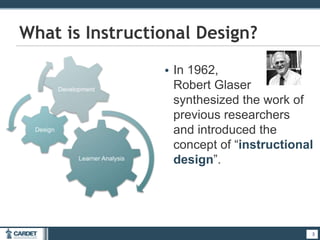
• In 1962,
Robert Glaser
synthesized the work of
previous researchers
and introduced the
concept of “instructional
design”.
3
What is Instructional Design?
3
• The systematic development of instructional
specifications using learning and instructional
theory to ensure the quality of instruction.
• The entire process of analysis of learning needs
and goals and the development of a delivery
system to meet those needs.
• Includes development of instructional materials
and activities, and tryout and evaluation of all
instruction and learner activities.
4
Instructional Design as a Process
4
• Branch of knowledge concerned with research
and theory about instructional strategies and
the process of developing and implementing
those strategies.
5
Instructional Design as a Discipline
5
• Instructional Design models or theories may
be defined as frameworks for developing
modules or lessons that:
1. Increase and/or enhance the possibility of
learning.
2. Encourage the engagement of learners so that
they learn faster and gain deeper levels of
understanding.
6
Instructional Design Models
6
7
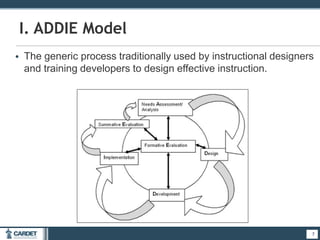
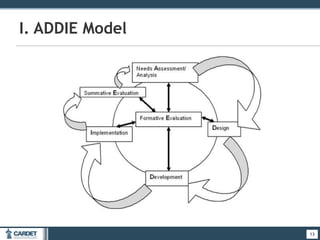
I. ADDIE Model
• The generic process traditionally used by instructional designers
and training developers to design effective instruction.
7
8
I. ADDIE Model
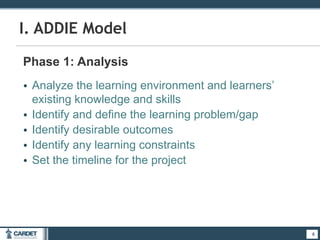
Phase 1: Analysis
• Analyze the learning environment and learners’
existing knowledge and skills
• Identify and define the learning problem/gap
• Identify desirable outcomes
• Identify any learning constraints
• Set the timeline for the project
8
9
I. ADDIE Model
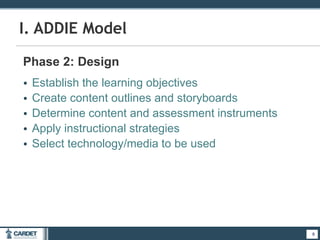
Phase 2: Design
• Establish the learning objectives
• Create content outlines and storyboards
• Determine content and assessment instruments
• Apply instructional strategies
• Select technology/media to be used
9
10
I. ADDIE Model
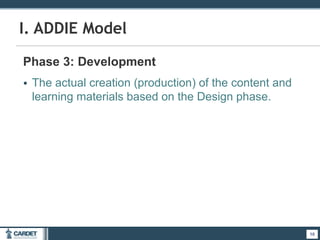
Phase 3: Development
• The actual creation (production) of the content and
learning materials based on the Design phase.
10
11
I. ADDIE Model
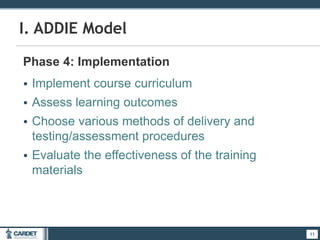
Phase 4: Implementation
• Implement course curriculum
• Assess learning outcomes
• Choose various methods of delivery and
testing/assessment procedures
• Evaluate the effectiveness of the training
materials
11
12
I. ADDIE Model
Phase 5: Evaluation
• Formative and Summative Evaluation
• Formative Evaluation is present in each stage of the
ADDIE process
• Summative Evaluation consists of tests designed for
domain specific criterion-related referenced items and
providing opportunities for feedback from the users
12
13
I. ADDIE Model
13
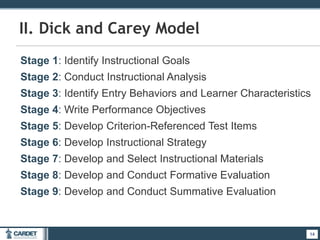
Stage 1: Identify Instructional Goals
Stage 2: Conduct Instructional Analysis
Stage 3: Identify Entry Behaviors and Learner Characteristics
Stage 4: Write Performance Objectives
Stage 5: Develop Criterion-Referenced Test Items
Stage 6: Develop Instructional Strategy
Stage 7: Develop and Select Instructional Materials
Stage 8: Develop and Conduct Formative Evaluation
Stage 9: Develop and Conduct Summative Evaluation
14
II. Dick and Carey Model
14
15
II. Dick and Carey Model
15
• Involves learners and/or subject matter experts (SMEs)
interacting with prototypes and instructional designers in
a continuous review/revision cycle.
• Developing a prototype is practically the first step, while
front-end analysis is generally reduced or converted into
an on-going, interactive process between subject-matter,
objectives, and materials.
• The process of quickly generating mock-ups of products,
such as a website.
• The process of quickly turning product designs into
physical samples.
16
III. Rapid Prototyping (Tripp & Bichelmeyer)
16
• Most effective learning environments are those
that are problem-based and involve the learner
in four distinct phases of the learning process:
1. Activation of prior experience
2. Demonstration of skills
3. Application of skills
4. Integration of these skills into real-world
activities
17
IV. First Principles of Instruction (David Merrill)
17
18
IV. First Principles of Instruction (David Merrill)
18
19
Do you know of other
ID Models or Theories?
19

Overview of Instructional Design Models

  • 1.
    Overview of InstructionalDesign Models Course Title: Designing and Delivering Successful Training Programs Module 2: Adult Learners and ID Models
  • 2.
  • 3.
    • In 1962, RobertGlaser synthesized the work of previous researchers and introduced the concept of “instructional design”. 3 What is Instructional Design? 3
  • 4.
    • The systematicdevelopment of instructional specifications using learning and instructional theory to ensure the quality of instruction. • The entire process of analysis of learning needs and goals and the development of a delivery system to meet those needs. • Includes development of instructional materials and activities, and tryout and evaluation of all instruction and learner activities. 4 Instructional Design as a Process 4
  • 5.
    • Branch ofknowledge concerned with research and theory about instructional strategies and the process of developing and implementing those strategies. 5 Instructional Design as a Discipline 5
  • 6.
    • Instructional Designmodels or theories may be defined as frameworks for developing modules or lessons that: 1. Increase and/or enhance the possibility of learning. 2. Encourage the engagement of learners so that they learn faster and gain deeper levels of understanding. 6 Instructional Design Models 6
  • 7.
    7 I. ADDIE Model •The generic process traditionally used by instructional designers and training developers to design effective instruction. 7
  • 8.
    8 I. ADDIE Model Phase1: Analysis • Analyze the learning environment and learners’ existing knowledge and skills • Identify and define the learning problem/gap • Identify desirable outcomes • Identify any learning constraints • Set the timeline for the project 8
  • 9.
    9 I. ADDIE Model Phase2: Design • Establish the learning objectives • Create content outlines and storyboards • Determine content and assessment instruments • Apply instructional strategies • Select technology/media to be used 9
  • 10.
    10 I. ADDIE Model Phase3: Development • The actual creation (production) of the content and learning materials based on the Design phase. 10
  • 11.
    11 I. ADDIE Model Phase4: Implementation • Implement course curriculum • Assess learning outcomes • Choose various methods of delivery and testing/assessment procedures • Evaluate the effectiveness of the training materials 11
  • 12.
    12 I. ADDIE Model Phase5: Evaluation • Formative and Summative Evaluation • Formative Evaluation is present in each stage of the ADDIE process • Summative Evaluation consists of tests designed for domain specific criterion-related referenced items and providing opportunities for feedback from the users 12
  • 13.
  • 14.
    Stage 1: IdentifyInstructional Goals Stage 2: Conduct Instructional Analysis Stage 3: Identify Entry Behaviors and Learner Characteristics Stage 4: Write Performance Objectives Stage 5: Develop Criterion-Referenced Test Items Stage 6: Develop Instructional Strategy Stage 7: Develop and Select Instructional Materials Stage 8: Develop and Conduct Formative Evaluation Stage 9: Develop and Conduct Summative Evaluation 14 II. Dick and Carey Model 14
  • 15.
    15 II. Dick andCarey Model 15
  • 16.
    • Involves learnersand/or subject matter experts (SMEs) interacting with prototypes and instructional designers in a continuous review/revision cycle. • Developing a prototype is practically the first step, while front-end analysis is generally reduced or converted into an on-going, interactive process between subject-matter, objectives, and materials. • The process of quickly generating mock-ups of products, such as a website. • The process of quickly turning product designs into physical samples. 16 III. Rapid Prototyping (Tripp & Bichelmeyer) 16
  • 17.
    • Most effectivelearning environments are those that are problem-based and involve the learner in four distinct phases of the learning process: 1. Activation of prior experience 2. Demonstration of skills 3. Application of skills 4. Integration of these skills into real-world activities 17 IV. First Principles of Instruction (David Merrill) 17
  • 18.
    18 IV. First Principlesof Instruction (David Merrill) 18
  • 19.
    19 Do you knowof other ID Models or Theories? 19

Editor's Notes

  • #3 Instructor allows 2-3 minutes for participants to respond.
  • #4 He submitted a model which links learner analysis to the design and development of instruction. Image Source: http://pbd.lbl.gov/images/people/glaeser.jpg
  • #6 Image Source: http://www.squidoomarketingstrategies.com/worldbooksdiscs-strategy.gif
  • #8 Image Source: http://www.csc.noaa.gov/wcde/module06/lesson01/0601.htm
  • #14 Image Source: http://www.csc.noaa.gov/wcde/module06/lesson01/0601.htm
  • #18 Many current instructional models suggest that