Instructional Design ModelInstructional Design Model
ADDIE MODELADDIE MODEL
Brief Background of the FieldBrief Background of the Field
 Education in Early AmericaEducation in Early America- family, church,- family, church,
& community& community
 Age of Industrialism-Age of Industrialism- advancements in scienceadvancements in science
and technology impact schoolsand technology impact schools
 Educational PsychologyEducational Psychology becomes morebecomes more
popular- testing students on contentpopular- testing students on content
 Instructional DesignInstructional Design born when teachersborn when teachers
questioned how they should teach, organize, &questioned how they should teach, organize, &
present content based on student abilities.present content based on student abilities.
What is I.D?What is I.D?
 Instructional DesignInstructional Design is “a discipline in whichis “a discipline in which
practitioners constantly look to the findings ofpractitioners constantly look to the findings of
other disciplines (e.g., cognitive psychology,other disciplines (e.g., cognitive psychology,
communication) to study and improve methodscommunication) to study and improve methods
of developing, delivering, and evaluatingof developing, delivering, and evaluating
instruction and instructional practices.” (Browninstruction and instructional practices.” (Brown
& Green, 2006)& Green, 2006)
Factors to Consider BeforeFactors to Consider Before
Designing Instruction:Designing Instruction:
 ObjectivesObjectives
 Learning Perspectives & StylesLearning Perspectives & Styles
 Needs AnalysisNeeds Analysis
ObjectivesObjectives
 ObjectivesObjectives- statements that define what the- statements that define what the
learners will be able to do at the end of anlearners will be able to do at the end of an
instructional lesson.instructional lesson.
 Needed to develop a plan of action and createNeeded to develop a plan of action and create
instructional materialsinstructional materials
 Help establish where instruction should startHelp establish where instruction should start
 Ensure instruction is effective by measuring ifEnsure instruction is effective by measuring if
they are metthey are met
How do I create effectiveHow do I create effective
objectives?objectives?
 3 Questions to ask:3 Questions to ask:
1.1. What are my instructional goals?What are my instructional goals?
2.2. How do I make sure my goals are met?How do I make sure my goals are met?
3.3. How can I ensure learner acquisition?How can I ensure learner acquisition?
What Are My Instructional Goals?What Are My Instructional Goals?
 Determine what you want to see accomplishedDetermine what you want to see accomplished
from the instructionfrom the instruction
How Do I Make Sure My GoalsHow Do I Make Sure My Goals
Are Met?Are Met?
 Conduct an analysis to see what behaviors, skillsConduct an analysis to see what behaviors, skills
and tasks you want the learners to follow orand tasks you want the learners to follow or
adhere toadhere to
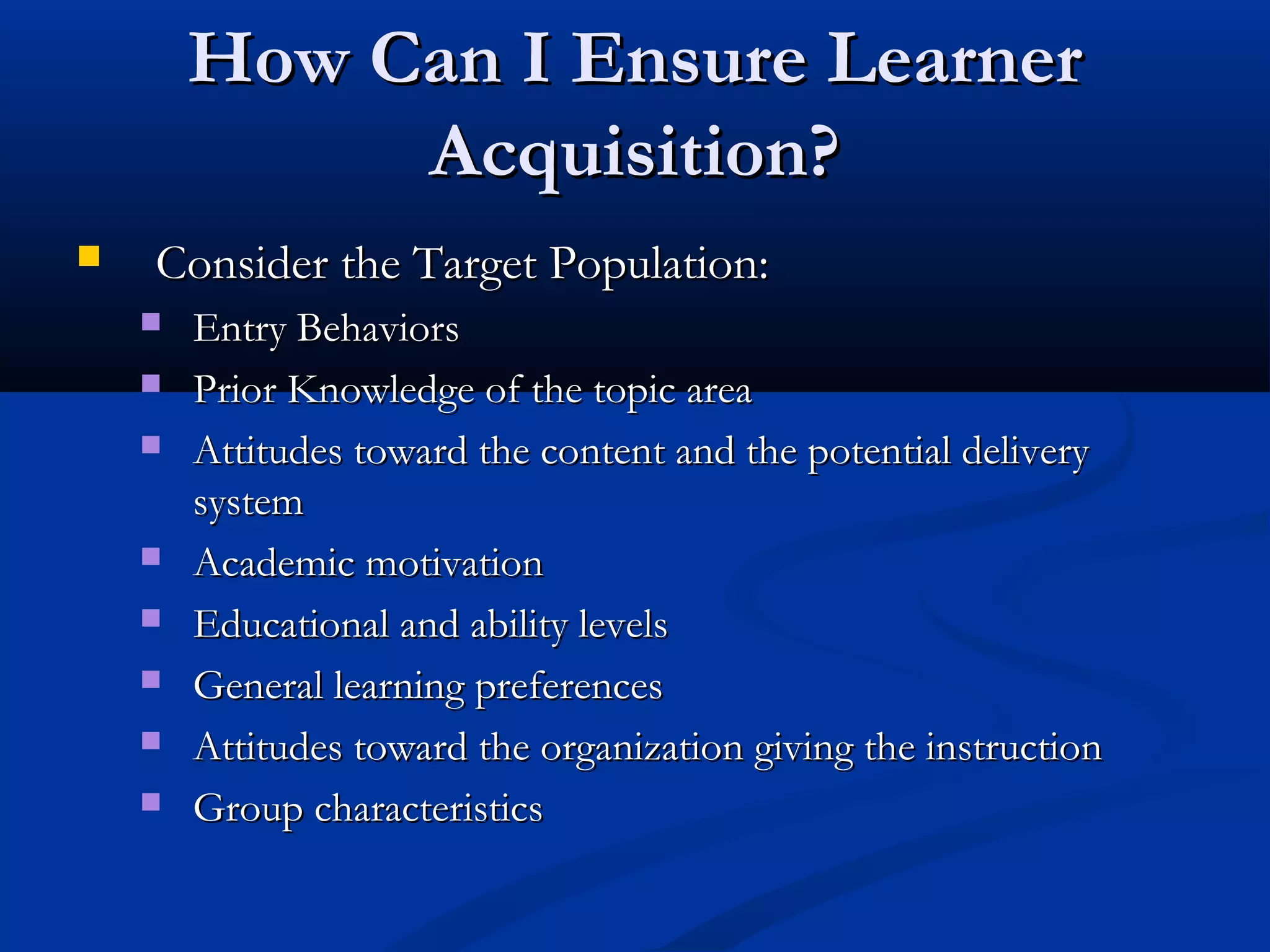
How Can I Ensure LearnerHow Can I Ensure Learner
Acquisition?Acquisition?
 Consider the Target Population:Consider the Target Population:
 Entry BehaviorsEntry Behaviors
 Prior Knowledge of the topic areaPrior Knowledge of the topic area
 Attitudes toward the content and the potential deliveryAttitudes toward the content and the potential delivery
systemsystem
 Academic motivationAcademic motivation
 Educational and ability levelsEducational and ability levels
 General learning preferencesGeneral learning preferences
 Attitudes toward the organization giving the instructionAttitudes toward the organization giving the instruction
 Group characteristicsGroup characteristics
Models of IDModels of ID
 40+ models40+ models
 Establish criteria to follow to achieve quality andEstablish criteria to follow to achieve quality and
uniformity.uniformity.
 Tools of comparison for peopleTools of comparison for people
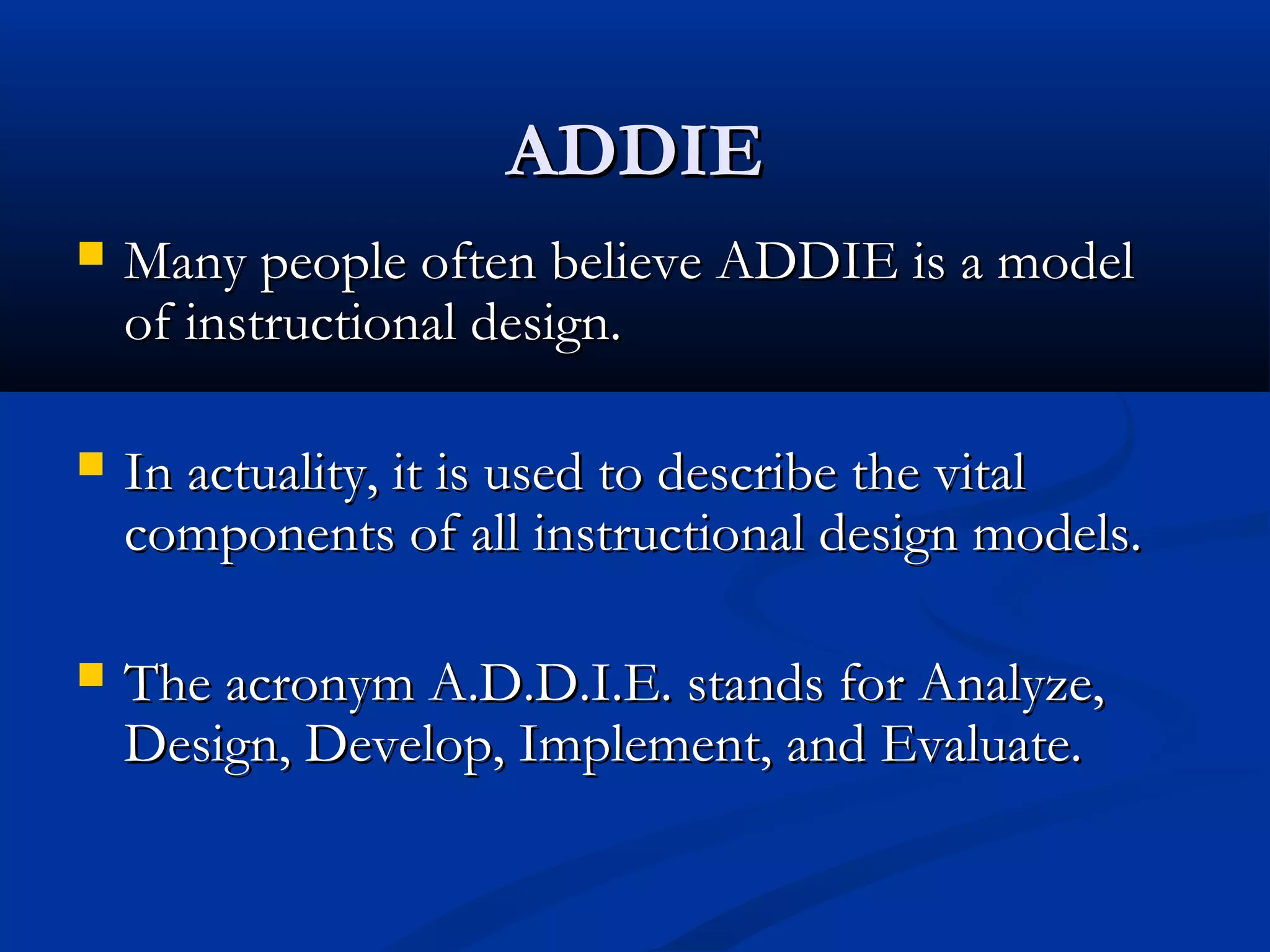
ADDIEADDIE
 Many people often believe ADDIE is a modelMany people often believe ADDIE is a model
of instructional design.of instructional design.
 In actuality, it is used to describe the vitalIn actuality, it is used to describe the vital
components of all instructional design models.components of all instructional design models.
 The acronym A.D.D.I.E. stands for Analyze,The acronym A.D.D.I.E. stands for Analyze,
Design, Develop, Implement, and Evaluate.Design, Develop, Implement, and Evaluate.
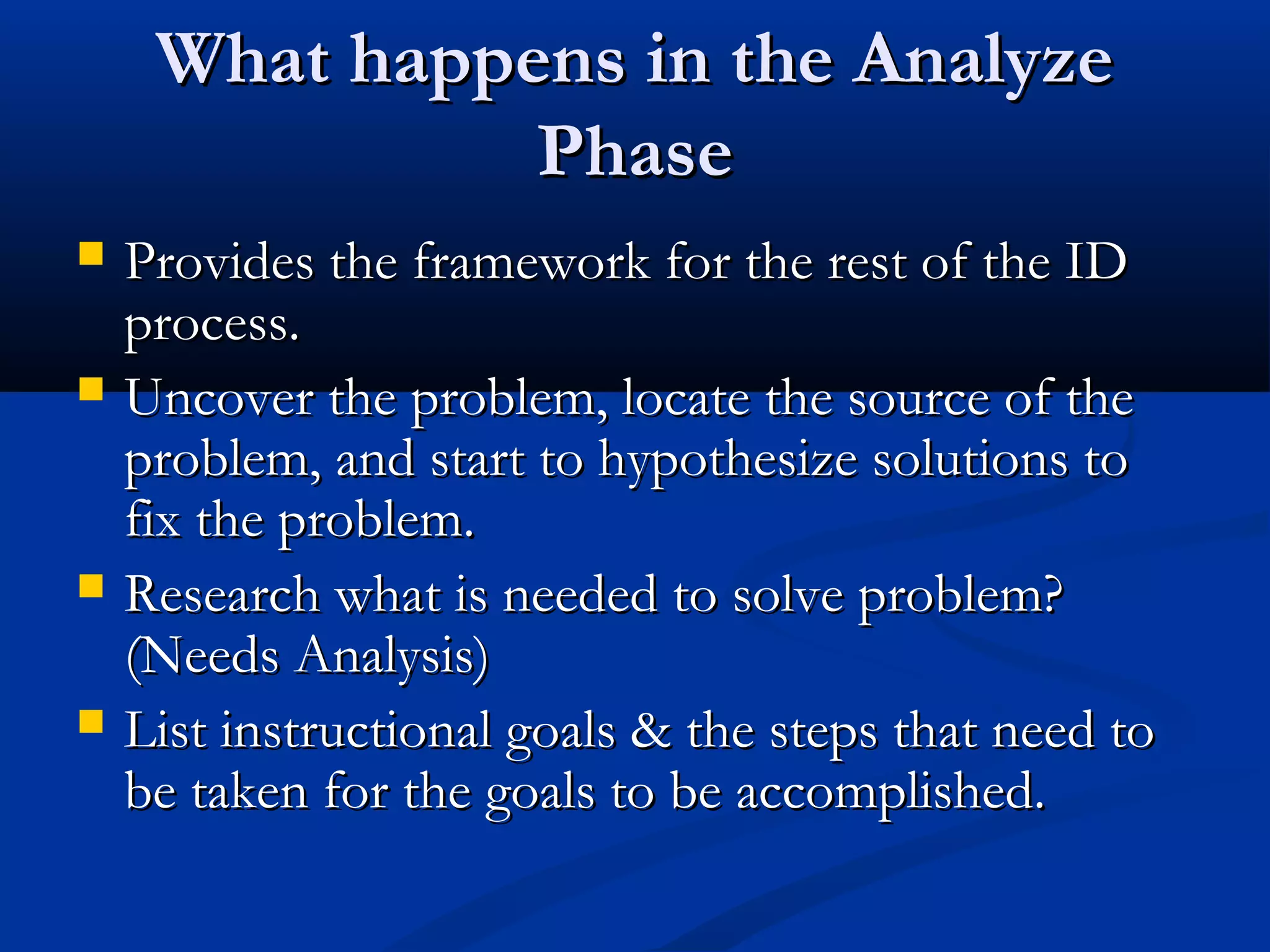
What happens in the AnalyzeWhat happens in the Analyze
PhasePhase
 Provides the framework for the rest of the IDProvides the framework for the rest of the ID
process.process.
 Uncover the problem, locate the source of theUncover the problem, locate the source of the
problem, and start to hypothesize solutions toproblem, and start to hypothesize solutions to
fix the problem.fix the problem.
 Research what is needed to solve problem?Research what is needed to solve problem?
(Needs Analysis)(Needs Analysis)
 List instructional goals & the steps that need toList instructional goals & the steps that need to
be taken for the goals to be accomplished.be taken for the goals to be accomplished.
What happens in the DesignWhat happens in the Design
Phase?Phase?
 Use the research findings obtained from analysisUse the research findings obtained from analysis
phase to plan for the developing of thephase to plan for the developing of the
instruction.instruction.
 Create detailed outlines illustrating how learnersCreate detailed outlines illustrating how learners
will complete instructional goals set out in thewill complete instructional goals set out in the
analysis phaseanalysis phase
What Happens in the DesignWhat Happens in the Design
Phase?Phase?
 Investigate your learners- Learning AnalysisInvestigate your learners- Learning Analysis
 What is best way to reach audience?What is best way to reach audience?
 Consider the target populationConsider the target population
 Consider different learning perspectivesConsider different learning perspectives
 Write out Objectives, testing strategies, selectWrite out Objectives, testing strategies, select
how the instruction will be administered, andhow the instruction will be administered, and
ultimately decide how instruction will beultimately decide how instruction will be
organized.organized.
What Happens in the DevelopWhat Happens in the Develop
Phase?Phase?
 Apply all information from the analysis andApply all information from the analysis and
design phases to produce lesson plans anddesign phases to produce lesson plans and
materials.materials.
 Actual instruction is created.Actual instruction is created.
 Develop any media that will be employed in theDevelop any media that will be employed in the
instruction (hardware and software).instruction (hardware and software).
 Generate supplementary materials to enhanceGenerate supplementary materials to enhance
instruction (reference guides, manuals,instruction (reference guides, manuals,
worksheets, etc.).worksheets, etc.).
What Happens in the ImplementWhat Happens in the Implement
Phase?Phase?
 Essentially this phase describes the method inEssentially this phase describes the method in
which the instruction will be delivered.which the instruction will be delivered.
 Use findings from learning analysis to determineUse findings from learning analysis to determine
best environment for the learner (face to face,best environment for the learner (face to face,
online, etc.).online, etc.).
 This part of the process is where learners mustThis part of the process is where learners must
obtain the content that is needed to accomplishobtain the content that is needed to accomplish
the instructional goals.the instructional goals.
What Happens in the EvaluateWhat Happens in the Evaluate
Phase?Phase?
 Measure the effectiveness and the efficiency of theMeasure the effectiveness and the efficiency of the
overall instruction.overall instruction.
 Formative EvaluationFormative Evaluation: evaluation that is present in all: evaluation that is present in all
phases of the process in order to catch errors andphases of the process in order to catch errors and
enrich the instruction.enrich the instruction.
 Summative EvaluationSummative Evaluation: evaluation that takes place: evaluation that takes place
after the finalized instruction is presented.after the finalized instruction is presented.
Recommendations provided to determine if theRecommendations provided to determine if the
instruction will be adopted or rejected based on itsinstruction will be adopted or rejected based on its
overall effectiveness and efficiency.overall effectiveness and efficiency.
ConclusionsConclusions
 The important thing to remember is to considerThe important thing to remember is to consider
all of the factors that need to go into designingall of the factors that need to go into designing
effective instruction.effective instruction.
 It doesn’t matter what model you use, but someIt doesn’t matter what model you use, but some
models are better suited to certain personalitiesmodels are better suited to certain personalities
and instructions.and instructions.

Addie model

  • 1.
    Instructional Design ModelInstructionalDesign Model ADDIE MODELADDIE MODEL
  • 2.
    Brief Background ofthe FieldBrief Background of the Field  Education in Early AmericaEducation in Early America- family, church,- family, church, & community& community  Age of Industrialism-Age of Industrialism- advancements in scienceadvancements in science and technology impact schoolsand technology impact schools  Educational PsychologyEducational Psychology becomes morebecomes more popular- testing students on contentpopular- testing students on content  Instructional DesignInstructional Design born when teachersborn when teachers questioned how they should teach, organize, &questioned how they should teach, organize, & present content based on student abilities.present content based on student abilities.
  • 3.
    What is I.D?Whatis I.D?  Instructional DesignInstructional Design is “a discipline in whichis “a discipline in which practitioners constantly look to the findings ofpractitioners constantly look to the findings of other disciplines (e.g., cognitive psychology,other disciplines (e.g., cognitive psychology, communication) to study and improve methodscommunication) to study and improve methods of developing, delivering, and evaluatingof developing, delivering, and evaluating instruction and instructional practices.” (Browninstruction and instructional practices.” (Brown & Green, 2006)& Green, 2006)
  • 4.
    Factors to ConsiderBeforeFactors to Consider Before Designing Instruction:Designing Instruction:  ObjectivesObjectives  Learning Perspectives & StylesLearning Perspectives & Styles  Needs AnalysisNeeds Analysis
  • 5.
    ObjectivesObjectives  ObjectivesObjectives- statementsthat define what the- statements that define what the learners will be able to do at the end of anlearners will be able to do at the end of an instructional lesson.instructional lesson.  Needed to develop a plan of action and createNeeded to develop a plan of action and create instructional materialsinstructional materials  Help establish where instruction should startHelp establish where instruction should start  Ensure instruction is effective by measuring ifEnsure instruction is effective by measuring if they are metthey are met
  • 6.
    How do Icreate effectiveHow do I create effective objectives?objectives?  3 Questions to ask:3 Questions to ask: 1.1. What are my instructional goals?What are my instructional goals? 2.2. How do I make sure my goals are met?How do I make sure my goals are met? 3.3. How can I ensure learner acquisition?How can I ensure learner acquisition?
  • 7.
    What Are MyInstructional Goals?What Are My Instructional Goals?  Determine what you want to see accomplishedDetermine what you want to see accomplished from the instructionfrom the instruction
  • 8.
    How Do IMake Sure My GoalsHow Do I Make Sure My Goals Are Met?Are Met?  Conduct an analysis to see what behaviors, skillsConduct an analysis to see what behaviors, skills and tasks you want the learners to follow orand tasks you want the learners to follow or adhere toadhere to
  • 9.
    How Can IEnsure LearnerHow Can I Ensure Learner Acquisition?Acquisition?  Consider the Target Population:Consider the Target Population:  Entry BehaviorsEntry Behaviors  Prior Knowledge of the topic areaPrior Knowledge of the topic area  Attitudes toward the content and the potential deliveryAttitudes toward the content and the potential delivery systemsystem  Academic motivationAcademic motivation  Educational and ability levelsEducational and ability levels  General learning preferencesGeneral learning preferences  Attitudes toward the organization giving the instructionAttitudes toward the organization giving the instruction  Group characteristicsGroup characteristics
  • 10.
    Models of IDModelsof ID  40+ models40+ models  Establish criteria to follow to achieve quality andEstablish criteria to follow to achieve quality and uniformity.uniformity.  Tools of comparison for peopleTools of comparison for people
  • 11.
    ADDIEADDIE  Many peopleoften believe ADDIE is a modelMany people often believe ADDIE is a model of instructional design.of instructional design.  In actuality, it is used to describe the vitalIn actuality, it is used to describe the vital components of all instructional design models.components of all instructional design models.  The acronym A.D.D.I.E. stands for Analyze,The acronym A.D.D.I.E. stands for Analyze, Design, Develop, Implement, and Evaluate.Design, Develop, Implement, and Evaluate.
  • 12.
    What happens inthe AnalyzeWhat happens in the Analyze PhasePhase  Provides the framework for the rest of the IDProvides the framework for the rest of the ID process.process.  Uncover the problem, locate the source of theUncover the problem, locate the source of the problem, and start to hypothesize solutions toproblem, and start to hypothesize solutions to fix the problem.fix the problem.  Research what is needed to solve problem?Research what is needed to solve problem? (Needs Analysis)(Needs Analysis)  List instructional goals & the steps that need toList instructional goals & the steps that need to be taken for the goals to be accomplished.be taken for the goals to be accomplished.
  • 13.
    What happens inthe DesignWhat happens in the Design Phase?Phase?  Use the research findings obtained from analysisUse the research findings obtained from analysis phase to plan for the developing of thephase to plan for the developing of the instruction.instruction.  Create detailed outlines illustrating how learnersCreate detailed outlines illustrating how learners will complete instructional goals set out in thewill complete instructional goals set out in the analysis phaseanalysis phase
  • 14.
    What Happens inthe DesignWhat Happens in the Design Phase?Phase?  Investigate your learners- Learning AnalysisInvestigate your learners- Learning Analysis  What is best way to reach audience?What is best way to reach audience?  Consider the target populationConsider the target population  Consider different learning perspectivesConsider different learning perspectives  Write out Objectives, testing strategies, selectWrite out Objectives, testing strategies, select how the instruction will be administered, andhow the instruction will be administered, and ultimately decide how instruction will beultimately decide how instruction will be organized.organized.
  • 15.
    What Happens inthe DevelopWhat Happens in the Develop Phase?Phase?  Apply all information from the analysis andApply all information from the analysis and design phases to produce lesson plans anddesign phases to produce lesson plans and materials.materials.  Actual instruction is created.Actual instruction is created.  Develop any media that will be employed in theDevelop any media that will be employed in the instruction (hardware and software).instruction (hardware and software).  Generate supplementary materials to enhanceGenerate supplementary materials to enhance instruction (reference guides, manuals,instruction (reference guides, manuals, worksheets, etc.).worksheets, etc.).
  • 16.
    What Happens inthe ImplementWhat Happens in the Implement Phase?Phase?  Essentially this phase describes the method inEssentially this phase describes the method in which the instruction will be delivered.which the instruction will be delivered.  Use findings from learning analysis to determineUse findings from learning analysis to determine best environment for the learner (face to face,best environment for the learner (face to face, online, etc.).online, etc.).  This part of the process is where learners mustThis part of the process is where learners must obtain the content that is needed to accomplishobtain the content that is needed to accomplish the instructional goals.the instructional goals.
  • 17.
    What Happens inthe EvaluateWhat Happens in the Evaluate Phase?Phase?  Measure the effectiveness and the efficiency of theMeasure the effectiveness and the efficiency of the overall instruction.overall instruction.  Formative EvaluationFormative Evaluation: evaluation that is present in all: evaluation that is present in all phases of the process in order to catch errors andphases of the process in order to catch errors and enrich the instruction.enrich the instruction.  Summative EvaluationSummative Evaluation: evaluation that takes place: evaluation that takes place after the finalized instruction is presented.after the finalized instruction is presented. Recommendations provided to determine if theRecommendations provided to determine if the instruction will be adopted or rejected based on itsinstruction will be adopted or rejected based on its overall effectiveness and efficiency.overall effectiveness and efficiency.
  • 18.
    ConclusionsConclusions  The importantthing to remember is to considerThe important thing to remember is to consider all of the factors that need to go into designingall of the factors that need to go into designing effective instruction.effective instruction.  It doesn’t matter what model you use, but someIt doesn’t matter what model you use, but some models are better suited to certain personalitiesmodels are better suited to certain personalities and instructions.and instructions.