ADDIE ModelADDIE Model
Presented by :Presented by :
IntroductionIntroduction
 TheThe ADDIEADDIE instructional design model isinstructional design model is
the most common instrument use by thethe most common instrument use by the
instructional designers. It is a model thatinstructional designers. It is a model that
teach step-by step the whole process ofteach step-by step the whole process of
any training program, it is use in theany training program, it is use in the
framework to create new ideas.framework to create new ideas.
 ADDIE was developed at Florida State
University in 1975. ADDIE was selected by the
Armed Services as the primary means for
developing training. The United States Military
faced the need to train large numbers of people
to perform complex technical task. At the time,
the term “ADDIE” was not used, but rather “SAT”
(Systems Approach to Training) and later “ISD”
(Instructional Systems Development). As a
general rule, the military used SAT, while their
civilian counterparts began using ISD. The “D” in
“ISD” first stood for “Development” but now
normally means “Design”.
 The ADDIE Process Instructional Design
Model used to maximize the effectiveness,
efficiency, and appeal of training and the
learning experience. A step-by-step
process that helps training specialists plan
and create training programs. the ADDIE
model was used in the framework for
helping create new research topics in
learning technology.
 Answers the Questions – “What do people
need to learn?” “Did people learn what
they needed?”
The 5 ComponentsThe 5 Components
TheThe ADDIEADDIE design model has 5design model has 5
components:components:
 AnalysisAnalysis
 DesignDesign
 DevelopmentDevelopment
 ImplementationImplementation
 EvaluationEvaluation
AnalysisAnalysis
 During analysis , the designer identifiesDuring analysis , the designer identifies
the learning problems.the learning problems.
 Consider the learning environments.Consider the learning environments.
 The delivery optionsThe delivery options
 The timeline for the projectThe timeline for the project
DesignDesign
 Design phase deals with learningDesign phase deals with learning
objectives:objectives:
a. terminal objectives
b. enabling objectives
 Apply visual designApply visual design
 The project reviewed and revisedThe project reviewed and revised
according to the feedback receivedaccording to the feedback received
 Determine program duration andDetermine program duration and
sequencesequence
DevelopmentDevelopment
 Developed training and on the job aidsDeveloped training and on the job aids
 Develop coaching/mentoring guides andDevelop coaching/mentoring guides and
resourcesresources
 Develop participants assessmentsDevelop participants assessments
 Conduct pilot program to test that programConduct pilot program to test that program
meets client requirementsmeets client requirements
ImplementationImplementation
 Implement trainings, transfer strategiesImplement trainings, transfer strategies
 Produce program, materials and aidsProduce program, materials and aids
 Cover the course curriculumCover the course curriculum
 Collect participants feedbackCollect participants feedback
IMPLEMENTATIONIMPLEMENTATION
((ProductionProduction))
 Create and Assemble the Content Assets.
Storyboards and Graphics are Designed.
E-learning: Programmers develop/
integrate technologies. Testers perform
debugging procedures. The project is
reviewed/revised according to the
feedback received .
EVALUATIONEVALUATION
 Consists of two parts: formative and
summative.
 Formative evaluation is present in each
stage of the ADDIE process.
 Summative evaluation consists of tests
designed for domain specific criterion-
related referenced items and providing
opportunities for feedback from the users
which were identified
Evaluation (continue)Evaluation (continue)
 Collect training program evaluationCollect training program evaluation
 Collect project evaluation dataCollect project evaluation data
 Review training programReview training program
 Review project performanceReview project performance
 Report program and project performanceReport program and project performance
resultsresults
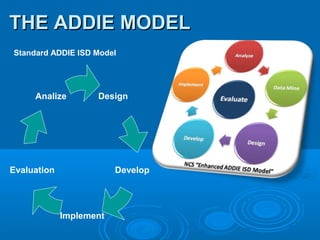
THE ADDIE MODELTHE ADDIE MODEL
Evaluation
Analize Design
Implement
Develop
Standard ADDIE ISD Model
AdvantagesAdvantages
 Cost effectiveCost effective
 Saves time and troubleSaves time and trouble
 Promotes effective learningPromotes effective learning
 SystematicSystematic
DisadvantagesDisadvantages
 AnalyzingAnalyzing  may be lengthy and time-may be lengthy and time-
consumingconsuming
 DesigningDesigning  None of the design processNone of the design process
may take much time, especially if it ismay take much time, especially if it is
evaluated and revisedevaluated and revised
 DevelopingDeveloping  depending on thedepending on the
materials, cost or availability may affectmaterials, cost or availability may affect
productionproduction
 ImplementationImplementation  will not know outcomewill not know outcome
unless implemented. If there was a flaw inunless implemented. If there was a flaw in
the process, it will be exposed in thisthe process, it will be exposed in this
stage. As a result, a revision must occurstage. As a result, a revision must occur
which may mean more time and moneywhich may mean more time and money
 EvaluationEvaluation  this evaluation process canthis evaluation process can
significantly increase the time to create asignificantly increase the time to create a
suitable design, which can be difficultsuitable design, which can be difficult
especially if time is limited.especially if time is limited.
ConclusionConclusion
The ADDIE model helps to instructionalThe ADDIE model helps to instructional
designers with a step-by-step guideline fordesigners with a step-by-step guideline for
building effective training and performancebuilding effective training and performance
support tools .support tools .
This model consists of five phases: AnalysisThis model consists of five phases: Analysis
Design, Development, Implementation,Design, Development, Implementation,
and Evaluationand Evaluation

ADDIE Model

  • 1.
  • 2.
    IntroductionIntroduction  TheThe ADDIEADDIEinstructional design model isinstructional design model is the most common instrument use by thethe most common instrument use by the instructional designers. It is a model thatinstructional designers. It is a model that teach step-by step the whole process ofteach step-by step the whole process of any training program, it is use in theany training program, it is use in the framework to create new ideas.framework to create new ideas.
  • 3.
     ADDIE wasdeveloped at Florida State University in 1975. ADDIE was selected by the Armed Services as the primary means for developing training. The United States Military faced the need to train large numbers of people to perform complex technical task. At the time, the term “ADDIE” was not used, but rather “SAT” (Systems Approach to Training) and later “ISD” (Instructional Systems Development). As a general rule, the military used SAT, while their civilian counterparts began using ISD. The “D” in “ISD” first stood for “Development” but now normally means “Design”.
  • 4.
     The ADDIEProcess Instructional Design Model used to maximize the effectiveness, efficiency, and appeal of training and the learning experience. A step-by-step process that helps training specialists plan and create training programs. the ADDIE model was used in the framework for helping create new research topics in learning technology.  Answers the Questions – “What do people need to learn?” “Did people learn what they needed?”
  • 5.
    The 5 ComponentsThe5 Components TheThe ADDIEADDIE design model has 5design model has 5 components:components:  AnalysisAnalysis  DesignDesign  DevelopmentDevelopment  ImplementationImplementation  EvaluationEvaluation
  • 6.
    AnalysisAnalysis  During analysis, the designer identifiesDuring analysis , the designer identifies the learning problems.the learning problems.  Consider the learning environments.Consider the learning environments.  The delivery optionsThe delivery options  The timeline for the projectThe timeline for the project
  • 7.
    DesignDesign  Design phasedeals with learningDesign phase deals with learning objectives:objectives: a. terminal objectives b. enabling objectives  Apply visual designApply visual design  The project reviewed and revisedThe project reviewed and revised according to the feedback receivedaccording to the feedback received  Determine program duration andDetermine program duration and sequencesequence
  • 8.
    DevelopmentDevelopment  Developed trainingand on the job aidsDeveloped training and on the job aids  Develop coaching/mentoring guides andDevelop coaching/mentoring guides and resourcesresources  Develop participants assessmentsDevelop participants assessments  Conduct pilot program to test that programConduct pilot program to test that program meets client requirementsmeets client requirements
  • 9.
    ImplementationImplementation  Implement trainings,transfer strategiesImplement trainings, transfer strategies  Produce program, materials and aidsProduce program, materials and aids  Cover the course curriculumCover the course curriculum  Collect participants feedbackCollect participants feedback
  • 10.
    IMPLEMENTATIONIMPLEMENTATION ((ProductionProduction))  Create andAssemble the Content Assets. Storyboards and Graphics are Designed. E-learning: Programmers develop/ integrate technologies. Testers perform debugging procedures. The project is reviewed/revised according to the feedback received .
  • 11.
    EVALUATIONEVALUATION  Consists oftwo parts: formative and summative.  Formative evaluation is present in each stage of the ADDIE process.  Summative evaluation consists of tests designed for domain specific criterion- related referenced items and providing opportunities for feedback from the users which were identified
  • 12.
    Evaluation (continue)Evaluation (continue) Collect training program evaluationCollect training program evaluation  Collect project evaluation dataCollect project evaluation data  Review training programReview training program  Review project performanceReview project performance  Report program and project performanceReport program and project performance resultsresults
  • 13.
    THE ADDIE MODELTHEADDIE MODEL Evaluation Analize Design Implement Develop Standard ADDIE ISD Model
  • 14.
    AdvantagesAdvantages  Cost effectiveCosteffective  Saves time and troubleSaves time and trouble  Promotes effective learningPromotes effective learning  SystematicSystematic
  • 15.
    DisadvantagesDisadvantages  AnalyzingAnalyzing may be lengthy and time-may be lengthy and time- consumingconsuming  DesigningDesigning  None of the design processNone of the design process may take much time, especially if it ismay take much time, especially if it is evaluated and revisedevaluated and revised  DevelopingDeveloping  depending on thedepending on the materials, cost or availability may affectmaterials, cost or availability may affect productionproduction
  • 16.
     ImplementationImplementation will not know outcomewill not know outcome unless implemented. If there was a flaw inunless implemented. If there was a flaw in the process, it will be exposed in thisthe process, it will be exposed in this stage. As a result, a revision must occurstage. As a result, a revision must occur which may mean more time and moneywhich may mean more time and money  EvaluationEvaluation  this evaluation process canthis evaluation process can significantly increase the time to create asignificantly increase the time to create a suitable design, which can be difficultsuitable design, which can be difficult especially if time is limited.especially if time is limited.
  • 17.
    ConclusionConclusion The ADDIE modelhelps to instructionalThe ADDIE model helps to instructional designers with a step-by-step guideline fordesigners with a step-by-step guideline for building effective training and performancebuilding effective training and performance support tools .support tools . This model consists of five phases: AnalysisThis model consists of five phases: Analysis Design, Development, Implementation,Design, Development, Implementation, and Evaluationand Evaluation

Editor's Notes

  • #7 Analyze performance environment to determine business outcome. Analyze organizational systems to gain an understanding of it. Compile a task inventory of all tasks associated with each job. Select tasks that people need to learn to become performers - needs analysis. Build performance measures needed in order to correct any performance deficiencies. Choose instructional setting for the tasks to be learned, Estimate cost and compare to benefits gained. Identify the training requirements.
  • #8 Develop the learning objectives: a. terminal objectives b. enabling objectives -identify and list the learning steps required to perform the task. -Develop performance tests to show mastery and test the development. -List the entry behaviors that the learner must demonstrate prior to entering the learning program. -Sequence and structure the learning objectives. Selection of strategies
  • #9 -List activities that will help the students learn the task. -Select the method of media delivery. Review the existing material so work is not duplicated. -Develop the instructional course materials and user manuals. -Synthesize the course materials into a viable learning program. -Test the prototype and validate the instruction to ensure it accomplishes all goals and objectives.
  • #10 -Procedure for training the facilitators / learners is developed. -Facilitators' training should cover the course curriculum, learning outcomes, method of delivery, and testing procedures. -Preparation of the learners includes training them on new tools (software or hardware) and student registration. -This is also the phase where the project manager ensures that the books, hands-on equipment, tools, CD-ROMs and software are in place, and that the learning application or website is functional.
  • #18 =Save Time and Money =Flexible and has Many Routes =Catch Problems while they are Still Easy to Fix =Instructional Theories -Important Role in the Design of Instructional Materials