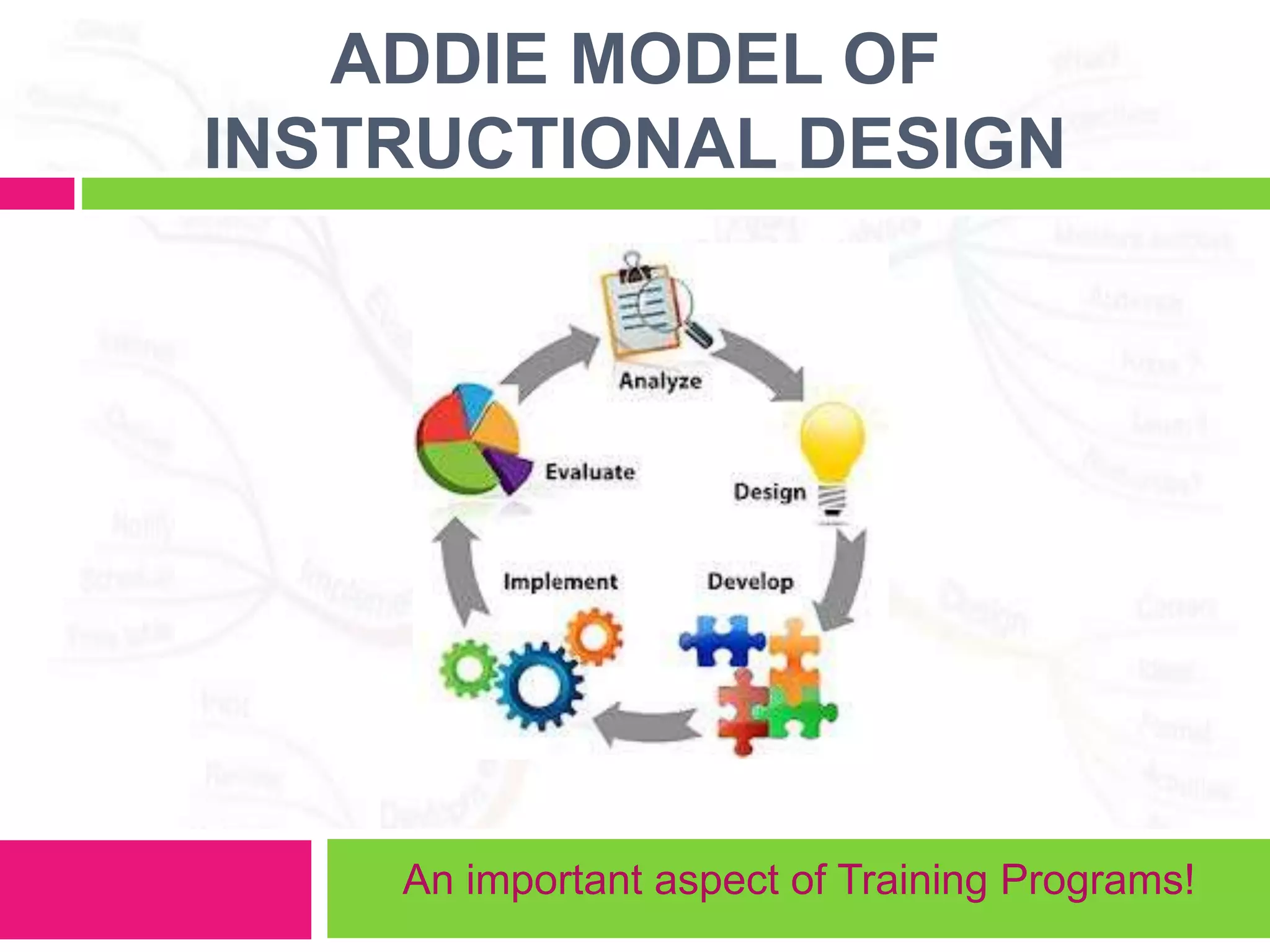
ADDIE MODEL OF
INSTRUCTIONAL DESIGN
An important aspect of Training Programs!
Session Objectives
 Upon completing this session, the audience
should be able to:
 Name the 5 phases of the ADDIE Model.
 Identify the types of activities that occur in each
phase.
 Explain why ADDIE Model is useful for training
programs.
Introduction to ADDIE Model
 The ADDIE instructional design model is the
most common instrument used by the
instructional designers.
 It is a model that teaches, step-by step, the
whole process of any training program.
 It is used in the framework to create new ideas
and to cater to specific needs as identified.
Phases of ADDIE
Phase1. Analysis
 Analysis consists of 4 sub-phases:
 Instructional goals
 Goals for instruction
 Instructional Analysis
 Learning environments (departments at the workplace etc)
 Learning problems
 Learner Analysis
 Learner skills
 Characteristics of the target audience
 Learner Objectives
 Need for instruction (Select tasks that need to be trained)
 The timeline and cost for the project
 Build performance measures for the tasks to be
trained.
Phase 2. Design
 What are the learning objectives as identified?
 What will be the instructor materials that will be
needed?
 Requirements:
 Examples and non-examples to be shown to learners
(lesson planning)
 Practice activities and feedback mechanisms
 Testing and evaluation strategies (assessment
instruments)
 Motivational strategies that will be incorporated into
the instruction
Phase 3. Development
 What is the most appropriate medium for
instruction?
 How can the visual design of the instructional
materials, support and facilitate learning?
 Are the materials "usable" or do they actually
get in the way of learning?
 Are the instructional materials affordable given
the budget of the project?
Phase 4. Implementation
 Implement trainings, transfer strategies
 Produce program, materials and aids
 Cover the course curriculum
 Collect participants feedback
Phase 5. Evaluation
This phase consists of two parts:
 Formative evaluation is present in each stage of
the ADDIE process.
 Summative evaluation consists of tests designed
for domain specific criterion-related referenced
items and providing opportunities for feedback
from the users which were identified.
Activity
 Let’s test our knowledge after we have learnt
the ADDIE Model!!
CAREER GUIDANCE!!
Let’s try to develop a training program for high school
students (11th and 12th standard) for their career
guidance.
Session Outcomes
 Audience should be able to apply the ADDIE
Model to a given need of training.
 This model is very flexible and can be adopted
for various types of training sessions. Hence,
we expect our audience to make use of this
model wherever required.

ADDIE MODEL

  • 1.
    ADDIE MODEL OF INSTRUCTIONALDESIGN An important aspect of Training Programs!
  • 2.
    Session Objectives  Uponcompleting this session, the audience should be able to:  Name the 5 phases of the ADDIE Model.  Identify the types of activities that occur in each phase.  Explain why ADDIE Model is useful for training programs.
  • 3.
    Introduction to ADDIEModel  The ADDIE instructional design model is the most common instrument used by the instructional designers.  It is a model that teaches, step-by step, the whole process of any training program.  It is used in the framework to create new ideas and to cater to specific needs as identified.
  • 4.
  • 5.
    Phase1. Analysis  Analysisconsists of 4 sub-phases:  Instructional goals  Goals for instruction  Instructional Analysis  Learning environments (departments at the workplace etc)  Learning problems  Learner Analysis  Learner skills  Characteristics of the target audience  Learner Objectives  Need for instruction (Select tasks that need to be trained)  The timeline and cost for the project  Build performance measures for the tasks to be trained.
  • 6.
    Phase 2. Design What are the learning objectives as identified?  What will be the instructor materials that will be needed?  Requirements:  Examples and non-examples to be shown to learners (lesson planning)  Practice activities and feedback mechanisms  Testing and evaluation strategies (assessment instruments)  Motivational strategies that will be incorporated into the instruction
  • 7.
    Phase 3. Development What is the most appropriate medium for instruction?  How can the visual design of the instructional materials, support and facilitate learning?  Are the materials "usable" or do they actually get in the way of learning?  Are the instructional materials affordable given the budget of the project?
  • 8.
    Phase 4. Implementation Implement trainings, transfer strategies  Produce program, materials and aids  Cover the course curriculum  Collect participants feedback
  • 9.
    Phase 5. Evaluation Thisphase consists of two parts:  Formative evaluation is present in each stage of the ADDIE process.  Summative evaluation consists of tests designed for domain specific criterion-related referenced items and providing opportunities for feedback from the users which were identified.
  • 10.
    Activity  Let’s testour knowledge after we have learnt the ADDIE Model!! CAREER GUIDANCE!! Let’s try to develop a training program for high school students (11th and 12th standard) for their career guidance.
  • 11.
    Session Outcomes  Audienceshould be able to apply the ADDIE Model to a given need of training.  This model is very flexible and can be adopted for various types of training sessions. Hence, we expect our audience to make use of this model wherever required.