


Developing Learning Outcomes
Anne Olsen
Linda Mostert
Outcomes
• AT the end of this workshop you should be
able to
– Develop learning outcomes that adhere to the
SMART principles
– Critique learning outcomes that have already been
developed
– Demonstrate the constructive alignment of
module outcomes, teaching strategies and
associated assessment
Curriculum defined
Curriculum is the planned process, the actual
implementation of the teaching and the
students’ ‘experiences’ of the learning process”
Plan Implement Student
experience
Learning
(RU Curriculum Policy).
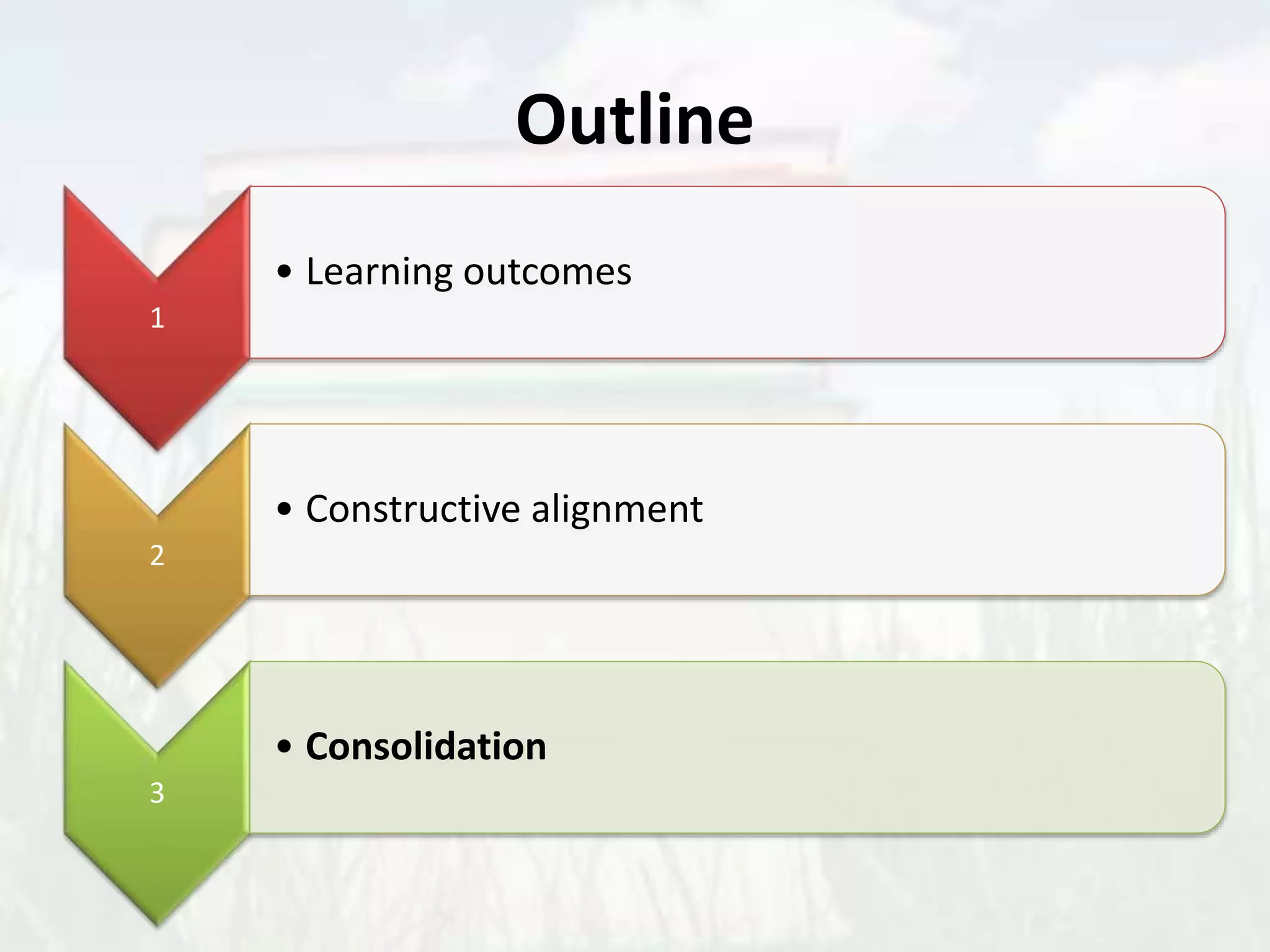
Outline
1
• Learning outcomes
2
• Constructive alignment
3
• Consolidation
All about learning Outcomes
Learning Outcomes
• Associated with the purpose of the module
• E.g. The students will meet the purpose of the
module when they are able to demonstrate the
outcomes.
• Focus on what students need to be able to do (not
just what they need to know, i.e. content)
• Enables transparency in terms of outcomes &
assessment criteria
Why use Outcomes?
They are useful because they :
• provide students with a clear understanding of the
goals they are expected to achieve.
• provide teachers with a framework around which to
build their instruction, and a clear method for
assessing student success.
(Oakland University, 2015)
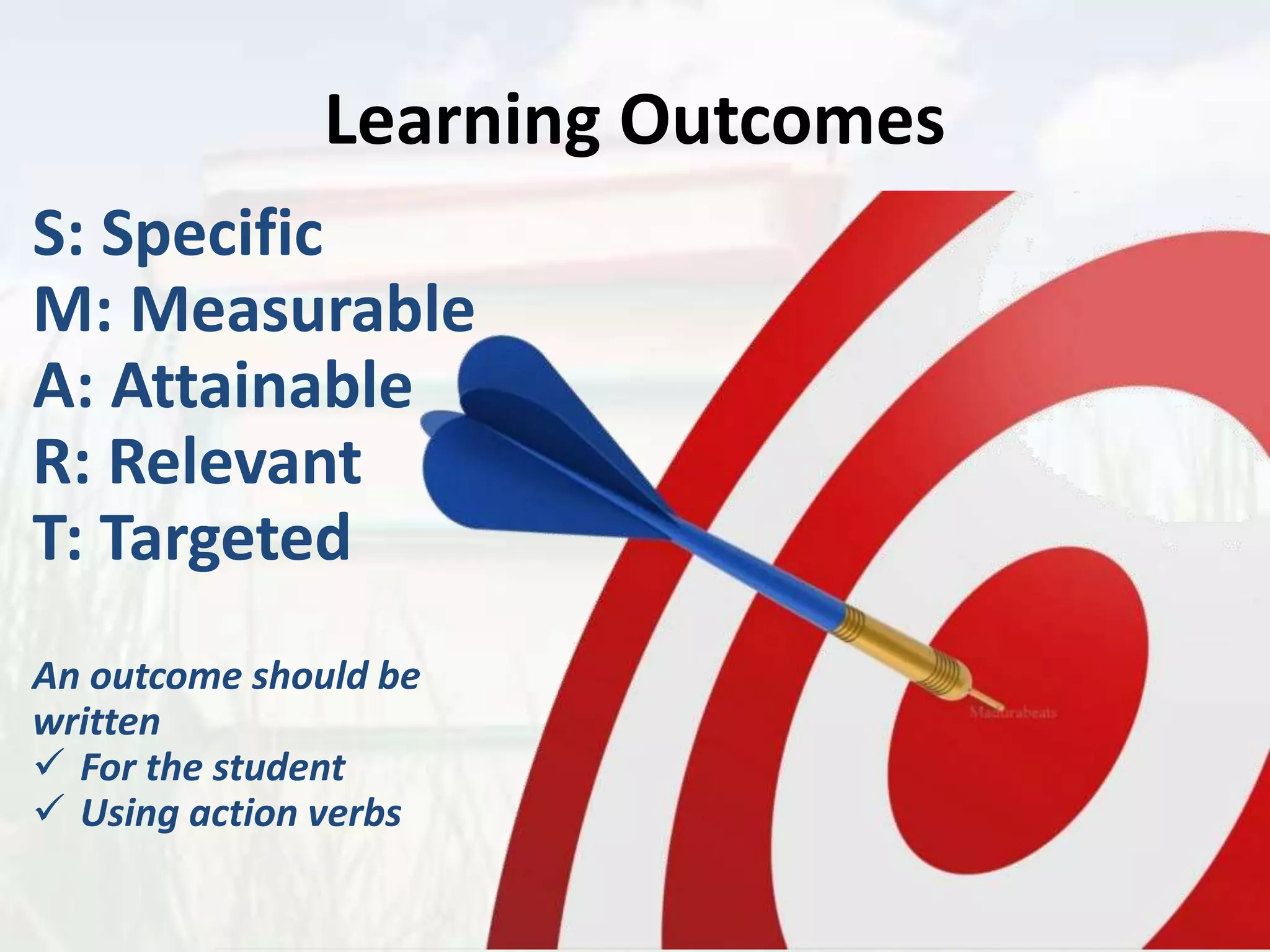
S: Specific
M: Measurable
A: Attainable
R: Relevant
T: Targeted
An outcome should be
written
 For the student
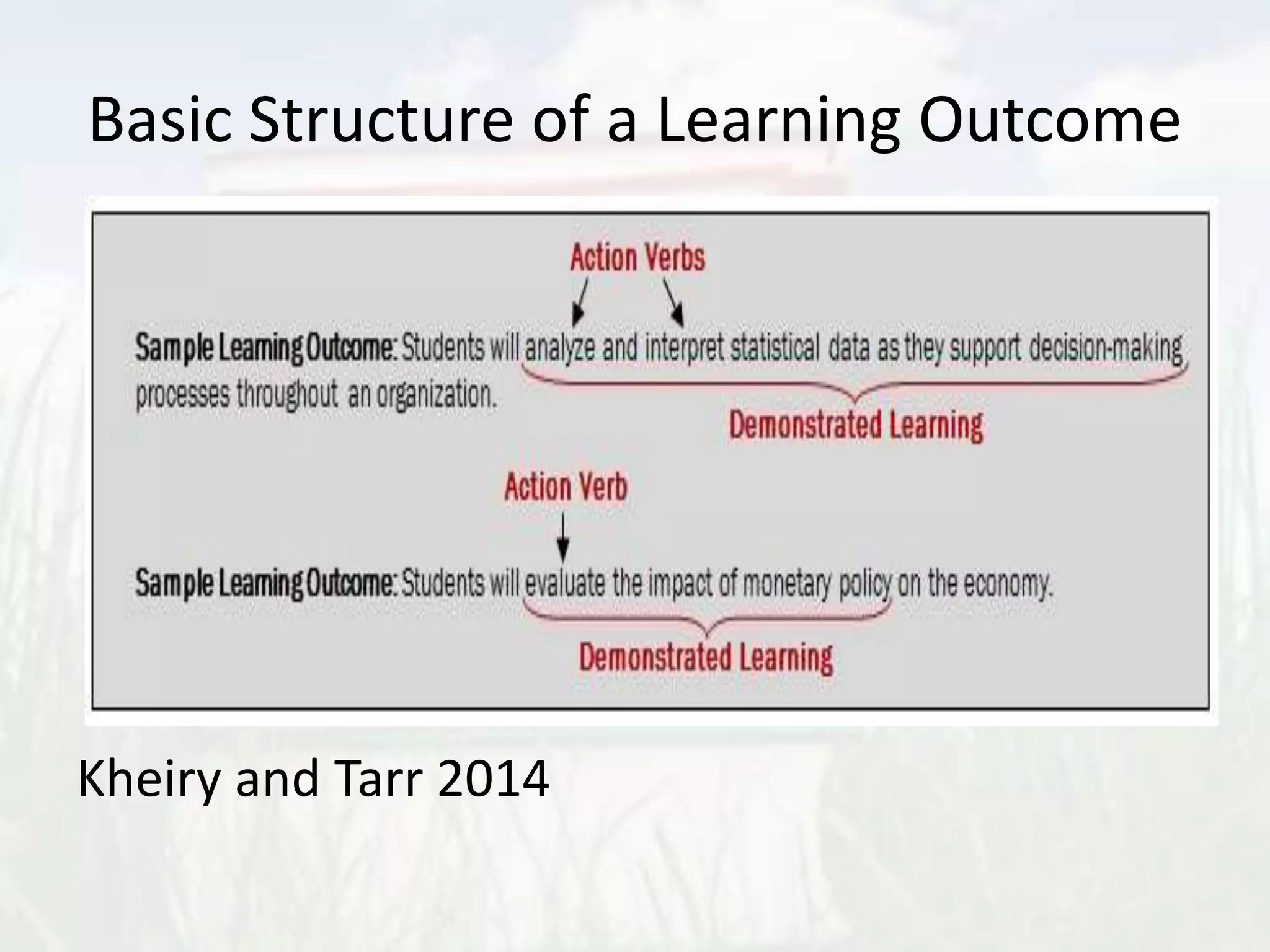
 Using action verbs
Learning Outcomes
Video Link
Writing Student Learning Outcomes
https://www.youtube.com/watch?v=HUSMFd6FLlA
Learning Outcomes
We cannot measure
knowledge or
understanding, only how it
is demonstrated
Understan
d know
Subjective and
open to
interpretation.
How will students
demonstrate their
understanding and
knowledge?
Think, pair, share
Discuss and comment on the following learning
outcomes
1. Know the difference between astronomical objects
2. Appreciate astronomical distance
3. Understand the requirements of a screenplay
4. Show knowledge about obtaining professional
feedback.
5. Students will be able to identify at least three
different methods for obtaining feedback on their
screenplay from peers and/or industry professionals.
Bloom’s Domains
(Harapnuik, 2015)
Scaffolding learning
Level Descriptors
Level Descriptors
Level descriptors are designed to act as a guide
and a starting point for, inter alia:
• Writing learning outcomes and associated
assessment criteria for qualifications and part
qualifications
(SAQA, 2012)
S: Specific
M: Measurable
A: Attainable
R: Relevant
T: Targeted
An outcome should be
written
 For the student
 Using action verbs
Writing learning outcomes
Basic Structure of a Learning Outcome
Kheiry and Tarr 2014
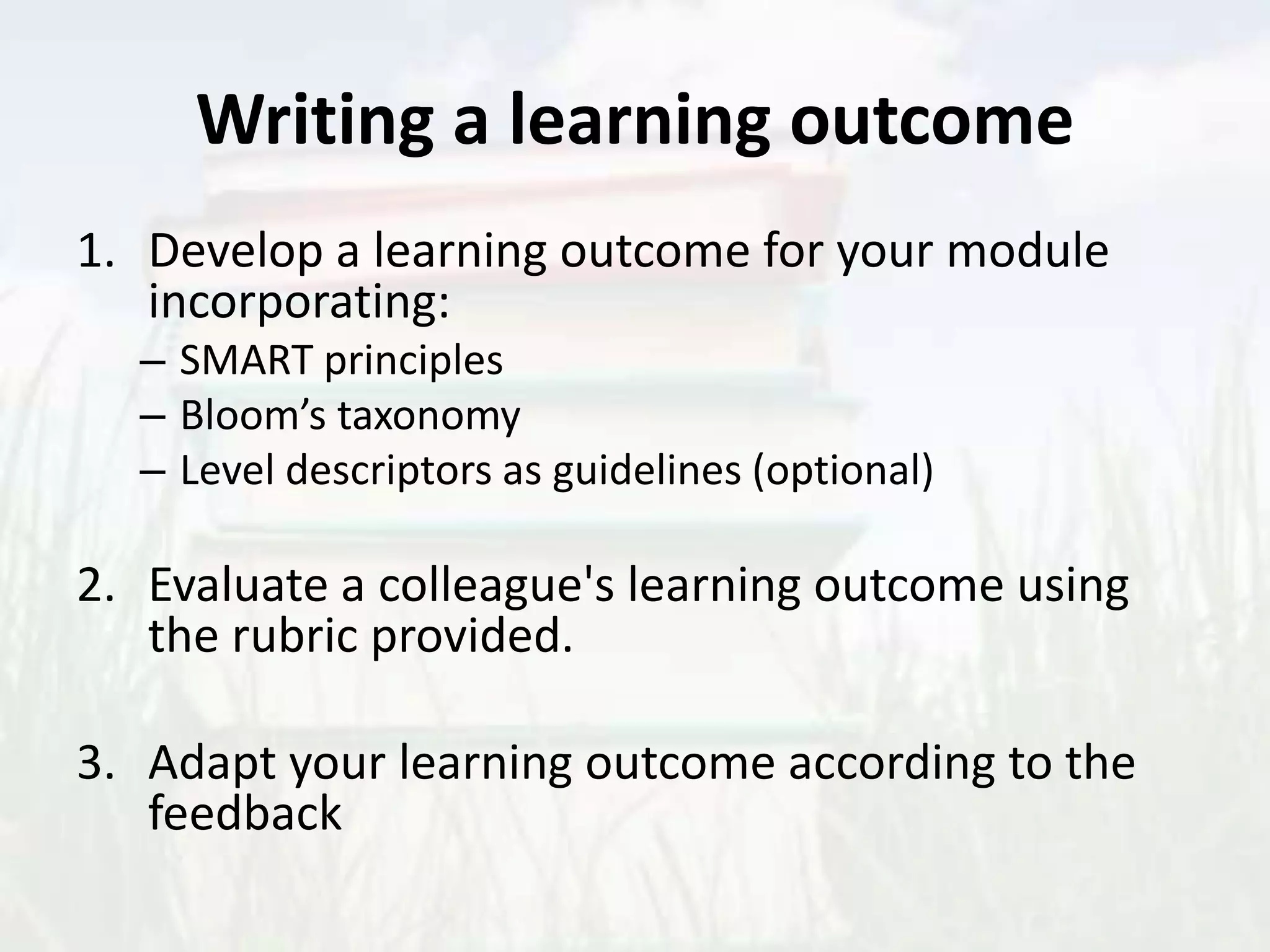
Writing a learning outcome
1. Develop a learning outcome for your module
incorporating:
– SMART principles
– Bloom’s taxonomy
– Level descriptors as guidelines (optional)
2. Evaluate a colleague's learning outcome using
the rubric provided.
3. Adapt your learning outcome according to the
feedback
Outline
1
• Learning outcomes
2
• Constructive alignment
3
• Consolidation
What if I told you…
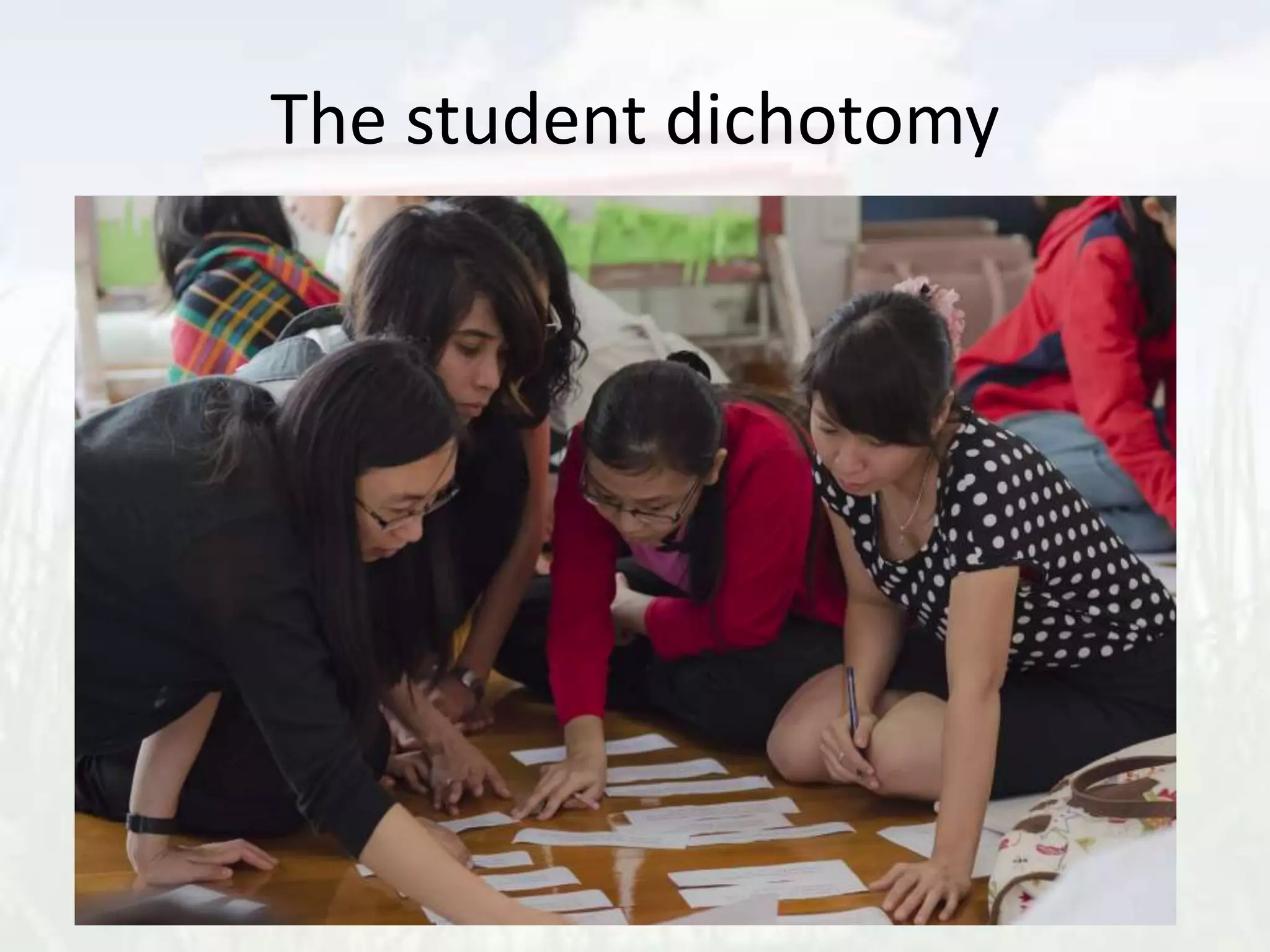
The student dichotomy
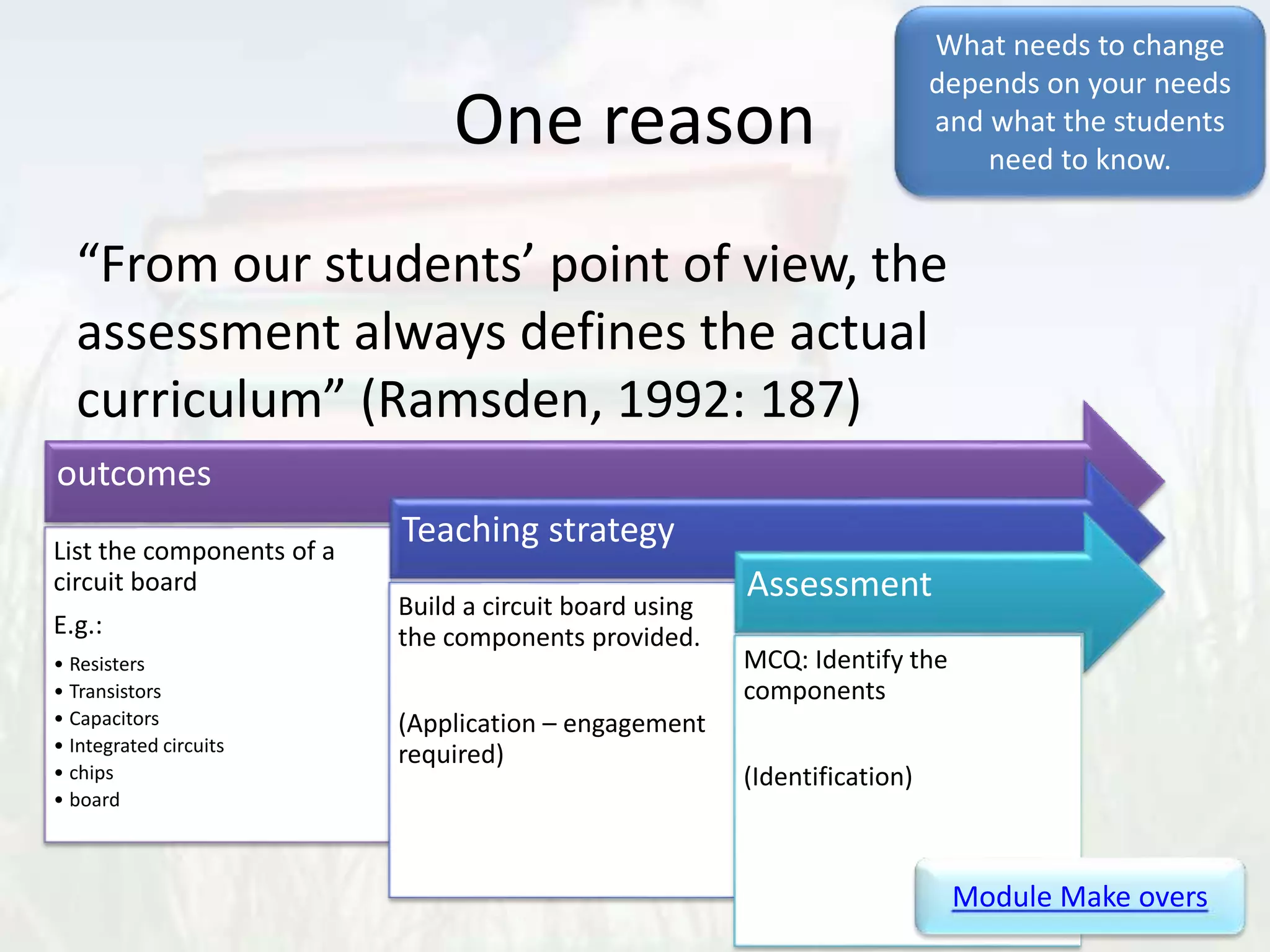
One reason
“From our students’ point of view, the
assessment always defines the actual
curriculum” (Ramsden, 1992: 187)
outcomes
List the components of a
circuit board
E.g.:
• Resisters
• Transistors
• Capacitors
• Integrated circuits
• chips
• board
Teaching strategy
Build a circuit board using
the components provided.
(Application – engagement
required)
Assessment
MCQ: Identify the
components
(Identification)
What needs to change
depends on your needs
and what the students
need to know.
Module Make overs
Constructive alignment
• Underlying the outcomes approach is a theory of learning
known as constructive alignment (Biggs 1999)
• Constructivist principles of learning
• Aligning all the elements of teaching, learning and assessment
Content
Learning
outcomes
Teaching &
Learning
activities
Assessmen
t activities
Teaching strategy
• Write a teaching strategy that is aligned
to the outcome you wrote previously.
• How would you assess this outcome?
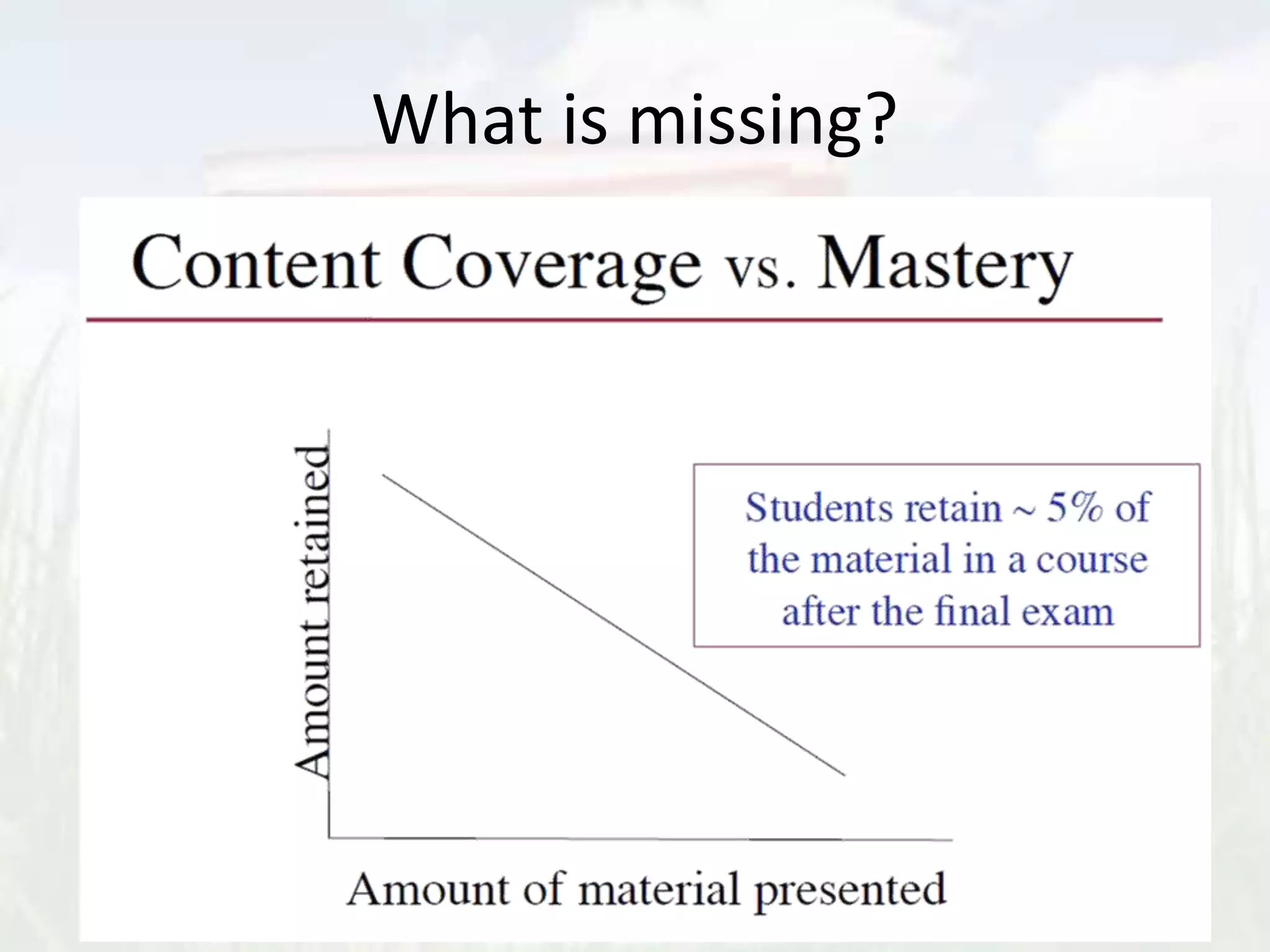
What is missing?
Outline
1
• Learning outcomes
2
• Constructive alignment
3
• Consolidation
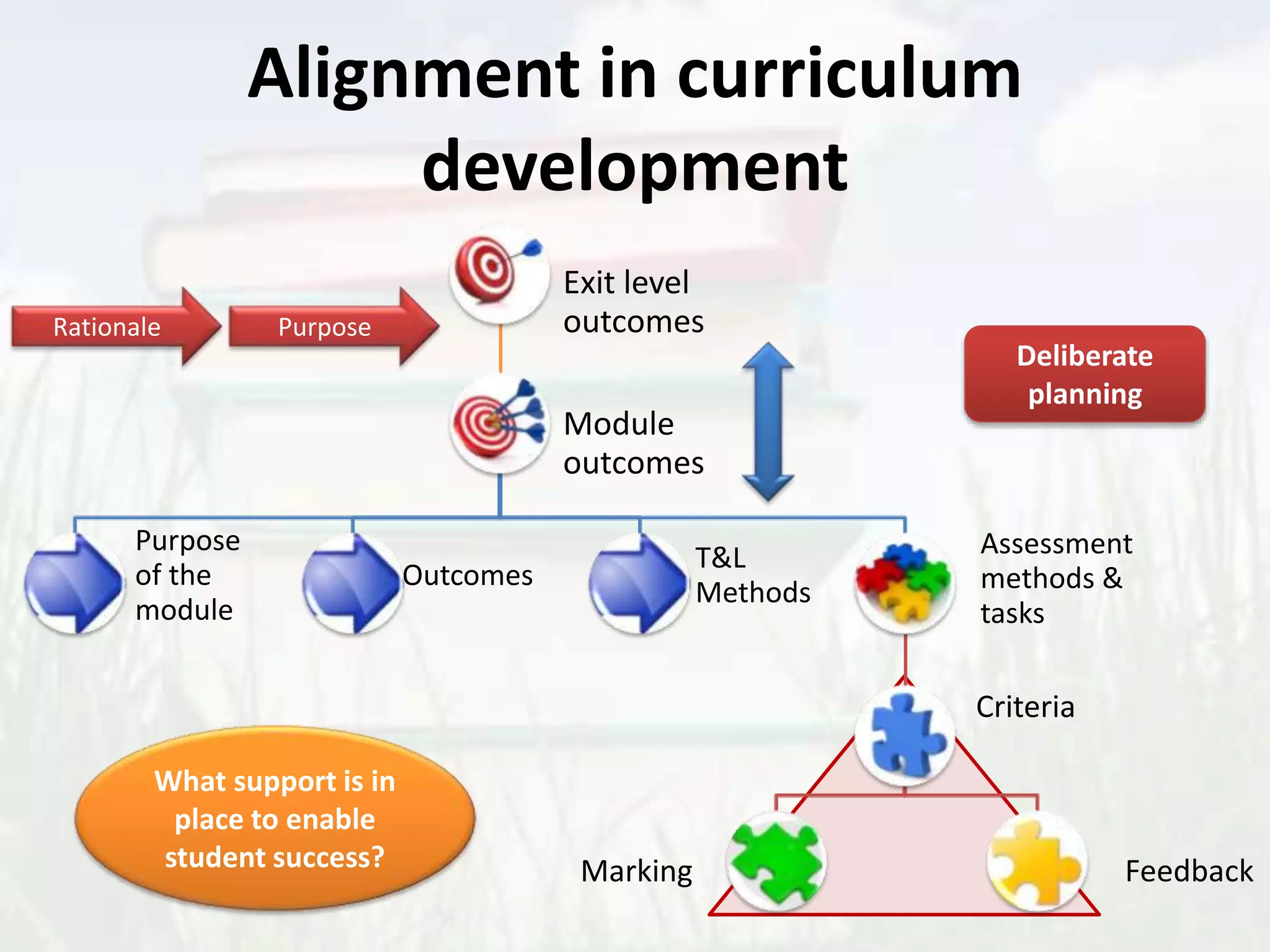
Exit level
outcomes
Module
outcomes
Purpose
of the
module
Outcomes
T&L
Methods
Assessment
methods &
tasks
Criteria
Marking Feedback
Alignment in curriculum
development
Rationale Purpose
What support is in
place to enable
student success?
Deliberate
planning
Module purpose, outcomes & content
• Purpose:
– Why should the students want to do the module?
– Short sentence summarising the module
• Outcomes:
– Is it clear what the students should be able to do at the
end of the module?
• Content:
– How will the content assist the students to meet the
outcomes?
• Assessment:
– Will the assessment tasks enable the students to achieve
the outcomes?
Purpose, outcomes & content
The purpose of this module is to enable students to make a strong
cup of filter coffee.
Outcomes:
• Identify the different ingredients and tools required to make a
cup of coffee.
• Select the correct ingredients to make a strong cup of filter
coffee
• Demonstrate how to make a strong cup of coffee using a
peculator.
Content:
• Coffee and its ingredients
• Principles of making coffee
• Choosing the correct coffee bean for its properties regarding
coffee strength
• Insight into the tools required to make filter coffee
Teaching & Learning Strategies
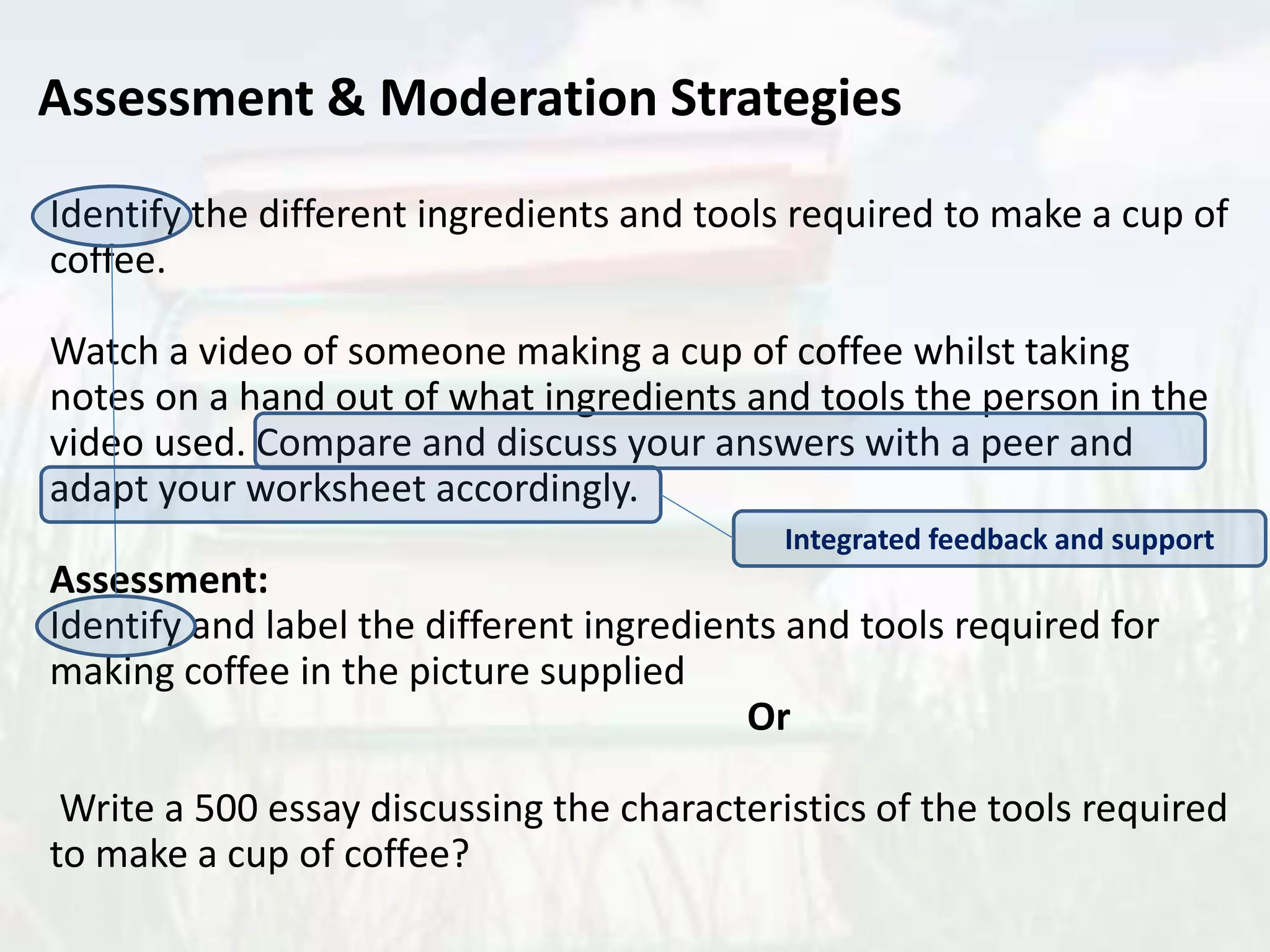
Identify the different ingredients and tools required to make a
cup of coffee.
Aligning the teaching strategy to the learning outcome
• A 35min lecture on the theory associated with the
ingredients of coffee and the tools required to make a cup
of coffee.
Or
• Watch a video of someone making a cup of coffee whilst
taking notes on a hand out of what ingredients and tools
the person in the video used. Compare and discuss your
answers with a peer and adapt your worksheet accordingly.
Identify the different ingredients and tools required to make a cup of
coffee.
Watch a video of someone making a cup of coffee whilst taking
notes on a hand out of what ingredients and tools the person in the
video used. Compare and discuss your answers with a peer and
adapt your worksheet accordingly.
Assessment:
Identify and label the different ingredients and tools required for
making coffee in the picture supplied
Or
Write a 500 essay discussing the characteristics of the tools required
to make a cup of coffee?
Assessment & Moderation Strategies
Integrated feedback and support
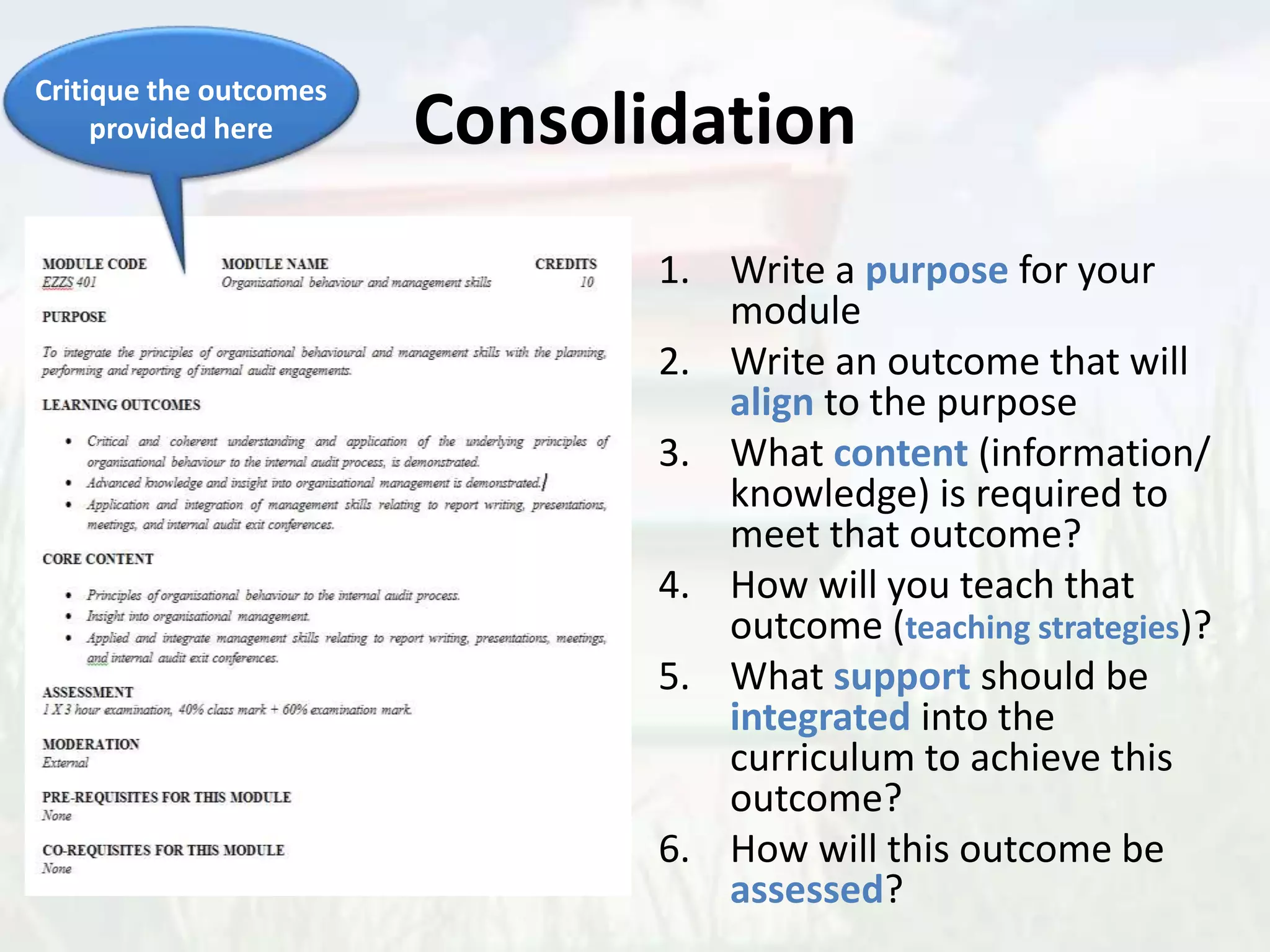
Consolidation
1. Write a purpose for your
module
2. Write an outcome that will
align to the purpose
3. What content (information/
knowledge) is required to
meet that outcome?
4. How will you teach that
outcome (teaching strategies)?
5. What support should be
integrated into the
curriculum to achieve this
outcome?
6. How will this outcome be
assessed?
Critique the outcomes
provided here
Bibliography
• Harapnuik, D. (2015).It’s about learning: creating significant learning
environments. Available: http://www.harapnuik.org/?tag=psychomotor
• Oakland University, E-Learning and Instructional Support. (2015). Learning
outcomes: An overview. Available:
http://www2.oakland.edu/elis/bestpractices_learning_outcomes.cm
• South African Qualifications Authority. (2012). Level descriptors for the
South African national qualifications framework. Available:
http://www.saqa.org.za/docs/misc/2012/level_descriptors.pdf
• University of Arkansas, Teaching Innovation and Pedagogical Support.
(2013). Available: http://tips.uark.edu/using-blooms-taxonomy/
• University of Limerick. (2008). Writing learning outcomes: A guide for
academics. Available:
http://www3.ul.ie/ctl/sites/default/files/Learning%20outcomes%202008.
pdf

Presentation on writing outcomes

  • 1.
  • 2.
    Outcomes • AT theend of this workshop you should be able to – Develop learning outcomes that adhere to the SMART principles – Critique learning outcomes that have already been developed – Demonstrate the constructive alignment of module outcomes, teaching strategies and associated assessment
  • 3.
    Curriculum defined Curriculum isthe planned process, the actual implementation of the teaching and the students’ ‘experiences’ of the learning process” Plan Implement Student experience Learning (RU Curriculum Policy).
  • 4.
    Outline 1 • Learning outcomes 2 •Constructive alignment 3 • Consolidation
  • 5.
  • 6.
    Learning Outcomes • Associatedwith the purpose of the module • E.g. The students will meet the purpose of the module when they are able to demonstrate the outcomes. • Focus on what students need to be able to do (not just what they need to know, i.e. content) • Enables transparency in terms of outcomes & assessment criteria
  • 7.
    Why use Outcomes? Theyare useful because they : • provide students with a clear understanding of the goals they are expected to achieve. • provide teachers with a framework around which to build their instruction, and a clear method for assessing student success. (Oakland University, 2015)
  • 8.
    S: Specific M: Measurable A:Attainable R: Relevant T: Targeted An outcome should be written  For the student  Using action verbs Learning Outcomes
  • 9.
    Video Link Writing StudentLearning Outcomes https://www.youtube.com/watch?v=HUSMFd6FLlA
  • 10.
    Learning Outcomes We cannotmeasure knowledge or understanding, only how it is demonstrated Understan d know Subjective and open to interpretation. How will students demonstrate their understanding and knowledge?
  • 11.
    Think, pair, share Discussand comment on the following learning outcomes 1. Know the difference between astronomical objects 2. Appreciate astronomical distance 3. Understand the requirements of a screenplay 4. Show knowledge about obtaining professional feedback. 5. Students will be able to identify at least three different methods for obtaining feedback on their screenplay from peers and/or industry professionals.
  • 12.
  • 14.
  • 15.
  • 16.
    Level Descriptors Level descriptorsare designed to act as a guide and a starting point for, inter alia: • Writing learning outcomes and associated assessment criteria for qualifications and part qualifications (SAQA, 2012)
  • 17.
    S: Specific M: Measurable A:Attainable R: Relevant T: Targeted An outcome should be written  For the student  Using action verbs Writing learning outcomes
  • 18.
    Basic Structure ofa Learning Outcome Kheiry and Tarr 2014
  • 19.
    Writing a learningoutcome 1. Develop a learning outcome for your module incorporating: – SMART principles – Bloom’s taxonomy – Level descriptors as guidelines (optional) 2. Evaluate a colleague's learning outcome using the rubric provided. 3. Adapt your learning outcome according to the feedback
  • 20.
    Outline 1 • Learning outcomes 2 •Constructive alignment 3 • Consolidation
  • 21.
    What if Itold you…
  • 22.
  • 23.
  • 24.
  • 25.
  • 26.
    One reason “From ourstudents’ point of view, the assessment always defines the actual curriculum” (Ramsden, 1992: 187) outcomes List the components of a circuit board E.g.: • Resisters • Transistors • Capacitors • Integrated circuits • chips • board Teaching strategy Build a circuit board using the components provided. (Application – engagement required) Assessment MCQ: Identify the components (Identification) What needs to change depends on your needs and what the students need to know. Module Make overs
  • 27.
    Constructive alignment • Underlyingthe outcomes approach is a theory of learning known as constructive alignment (Biggs 1999) • Constructivist principles of learning • Aligning all the elements of teaching, learning and assessment Content Learning outcomes Teaching & Learning activities Assessmen t activities
  • 28.
    Teaching strategy • Writea teaching strategy that is aligned to the outcome you wrote previously. • How would you assess this outcome?
  • 29.
  • 30.
    Outline 1 • Learning outcomes 2 •Constructive alignment 3 • Consolidation
  • 31.
    Exit level outcomes Module outcomes Purpose of the module Outcomes T&L Methods Assessment methods& tasks Criteria Marking Feedback Alignment in curriculum development Rationale Purpose What support is in place to enable student success? Deliberate planning
  • 32.
    Module purpose, outcomes& content • Purpose: – Why should the students want to do the module? – Short sentence summarising the module • Outcomes: – Is it clear what the students should be able to do at the end of the module? • Content: – How will the content assist the students to meet the outcomes? • Assessment: – Will the assessment tasks enable the students to achieve the outcomes?
  • 33.
    Purpose, outcomes &content The purpose of this module is to enable students to make a strong cup of filter coffee. Outcomes: • Identify the different ingredients and tools required to make a cup of coffee. • Select the correct ingredients to make a strong cup of filter coffee • Demonstrate how to make a strong cup of coffee using a peculator. Content: • Coffee and its ingredients • Principles of making coffee • Choosing the correct coffee bean for its properties regarding coffee strength • Insight into the tools required to make filter coffee
  • 34.
    Teaching & LearningStrategies Identify the different ingredients and tools required to make a cup of coffee. Aligning the teaching strategy to the learning outcome • A 35min lecture on the theory associated with the ingredients of coffee and the tools required to make a cup of coffee. Or • Watch a video of someone making a cup of coffee whilst taking notes on a hand out of what ingredients and tools the person in the video used. Compare and discuss your answers with a peer and adapt your worksheet accordingly.
  • 35.
    Identify the differentingredients and tools required to make a cup of coffee. Watch a video of someone making a cup of coffee whilst taking notes on a hand out of what ingredients and tools the person in the video used. Compare and discuss your answers with a peer and adapt your worksheet accordingly. Assessment: Identify and label the different ingredients and tools required for making coffee in the picture supplied Or Write a 500 essay discussing the characteristics of the tools required to make a cup of coffee? Assessment & Moderation Strategies Integrated feedback and support
  • 36.
    Consolidation 1. Write apurpose for your module 2. Write an outcome that will align to the purpose 3. What content (information/ knowledge) is required to meet that outcome? 4. How will you teach that outcome (teaching strategies)? 5. What support should be integrated into the curriculum to achieve this outcome? 6. How will this outcome be assessed? Critique the outcomes provided here
  • 37.
    Bibliography • Harapnuik, D.(2015).It’s about learning: creating significant learning environments. Available: http://www.harapnuik.org/?tag=psychomotor • Oakland University, E-Learning and Instructional Support. (2015). Learning outcomes: An overview. Available: http://www2.oakland.edu/elis/bestpractices_learning_outcomes.cm • South African Qualifications Authority. (2012). Level descriptors for the South African national qualifications framework. Available: http://www.saqa.org.za/docs/misc/2012/level_descriptors.pdf • University of Arkansas, Teaching Innovation and Pedagogical Support. (2013). Available: http://tips.uark.edu/using-blooms-taxonomy/ • University of Limerick. (2008). Writing learning outcomes: A guide for academics. Available: http://www3.ul.ie/ctl/sites/default/files/Learning%20outcomes%202008. pdf

Editor's Notes

  • #3 Possible associations with racecourse? Horse racing Elitist Race Winners and losers External motivation Being driven to do something like a jokey flogging a horse
  • #4 (RU Curriculum Policy).
  • #6 Refer to hand-out 3
  • #7 Outcomes enable assessment to be transparent and enables us to prioritise what content we would like to include in the module. If formulated appropriately outcomes may guide our assessment practices, methods and strategies, which will impact student learning. For that purpose formulating appropriate outcomes is crucial to the curriculum development process. I have been assisting with developing and reformulating outcomes as part of the curriculum development process at NMMU. A learning outcome is a statement describing what a student is expected to learn from any unit of instruction. Learning outcomes can be applied to specific activities, lessons, courses, or even entire curricula.
  • #9 Refer to hand-out 3
  • #12 Answers on hand-out 2
  • #13 Hand-out 4
  • #16 Level descriptors – To ensure coherence in learning achievement to facilitate assessment at the appropriate levels. Credit totals are the mimumin
  • #17 Please note that the level descriptors does not limit you to the levels of blooms verbs – you can use different levels of difficulty Difference between a model vs building the real thing… simulation vs real life … case study vs actual project management
  • #18 Refer to hand-out 3
  • #20 Anyone want to share? In groups of 3 or 4
  • #27 Student will focus on what is “relevant” for assessment purposes – The dreaded, will this be in the exam question! Students are masters in figuring out how they will be assessed. Where does this fit into blooms? List (remember) * Build (create) * Identify (remember maybe Understand) UVS – Module make over – uses Blackboard where we use Moodle.
  • #28 The process of aligning all the content, teaching, learning and assessment activities to learning outcomes is known as Bigg’s constructive alignment.
  • #29 In same groups – continue on the same flipchart page Open to the floor for feedback… Each group
  • #32 As demonstrated by the slide every aspect on the curriculum development process is aligned – from the rationale to the assessment tasks provided to students. This alignment also includes what support structures are included in the curriculum in order to enable student success. The module outcomes can be considered building blocks to achieving the more holistic exit level outcomes at programme level, which is why the alignment is crucial. The module purpose, outcomes, content and teaching, learning and assessment methods need to be aligned in order to holistically develop students that will meet the exit level outcomes. CTLM is able to assist with the writing of the purpose and outcomes and then to align the teaching, learning and assessment methods the outcomes. Furthermore we are able to suggest potential support initiatives, such as academic literacies that can be embedded into the curriculum in order to assist with enabling student success. As demonstrated by the slide, the alignment of the module purpose, outcomes and teaching, learning and assessment methods should assist with identifying the necessary assessment criteria, marking tools, such as rubrics and how to provide students with feedback.
  • #34 How does it all fit together? Based on the last page for Form 2 Note how the purpose, outcomes and content is aligned. Assists with prioritising the selection and sequencing of the content For example, in the content I don’t have a section on the history of coffee or slavery or even how to grow a coffee bean. That is interesting information, potentially something we would like to teach or our students to know, however, there is no outcomes that is aligned to the content. Ideally we should choose our outcomes first and then align the content to the outcome. However, if you strongly believe that there is content that should be there that is not covered by the outcomes, an outcome should be added to accommodate the content, otherwise it is unclear to the students and the lecturer how that content will be assessed. Also, it should be clear how the content is then aligned to the purpose of the module. I have also assisted with aligning outcomes and content with the purpose of the module.
  • #35 Once we have an outcome we need to identify the best strategies to teach the outcome. This is also a section of the document we have been commenting on. An example would include looking at how the proposed teaching strategy will or will not meet the outcomes associated with the module. If the teaching and learning strategy does not meet the outcome we could discuss alterative teaching and learning strategies to enable constructive alignment.
  • #36 NMMU Moderation policy The same is true for assessment, as the outcome and teaching strategy indicate how the module (or content) will be assessed. Biggs argues that if these (outcome, teaching strategy and assessment is aligned) students will be more motivated to engage with teaching and learning and potentially realise the benefit of attending class. Once again this is an aspect of the process where we are able to assist.
  • #37 This activity is based on the information required for Form 2