Instructional Design for
Active Learning
What do we DO?
 Understand the meaning of instructional design
 Obtain an overview of the ADDIE model
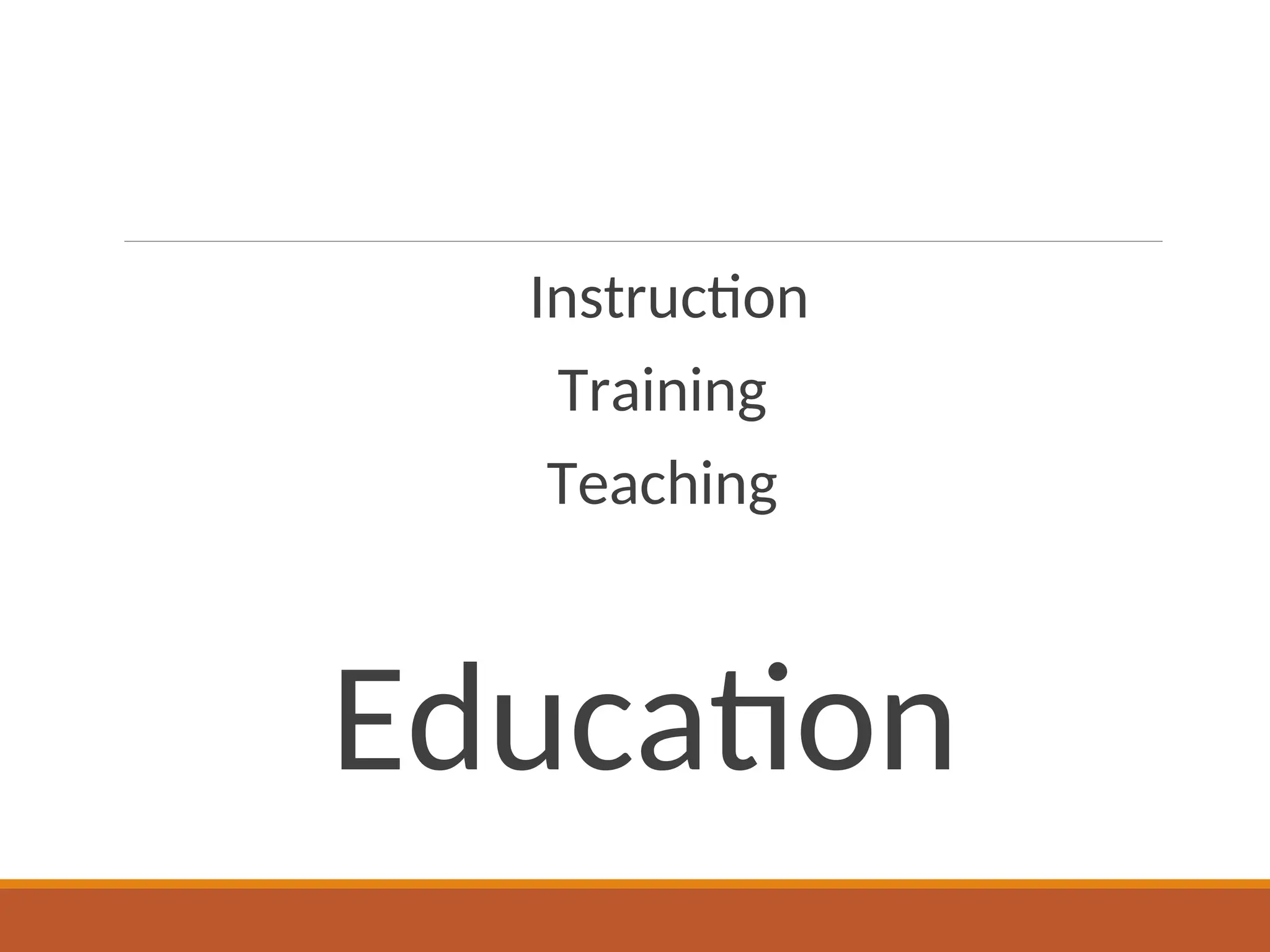
Instruction
Training
Teaching
Education
Instruction
 Instruction is the intentional facilitation of
learning toward identified learning goals.
 Driscoll (1994) defines instruction from a
similar perspective: "the deliberate
arrangement of learning conditions to promote
the attainment of some intended goal" (p. 332).
 “ Purposeful activity intended to cause ,
guide or support learning”
Training
Instructional experiences are focused upon
individuals acquiring very specific skills that
they will normally apply almost immediately.
https://dixieching.wordpress.com/
2010/02/03/instructional-design-ch-1-smith-
ragan/
Teaching
Learning experiences that are facilitated by a
human being – not a videotape, textbook,
or computer program, but a live teacher.
Difference between Training and Teaching
 Training usually has a more specific focus
than teaching, which seeks to in still a
deeper knowledge over a longer period of
time.
 Training, on the other hand, seeks to help
people master a specific skill or skill set,
until they are able to execute it efficiently .
 Training is usually a one-time or short-term
event, as with job training.

Difference between Training and Teaching
 Teaching is usually broader in focus than
training .
 It generally is theoretical, while training is
the practical application of knowledge.
 Teaching seeks to impart new knowledge,
while training equips the already
knowledgeable with tools and techniques to
develop a specific skill set .
Difference between Training and
Teaching
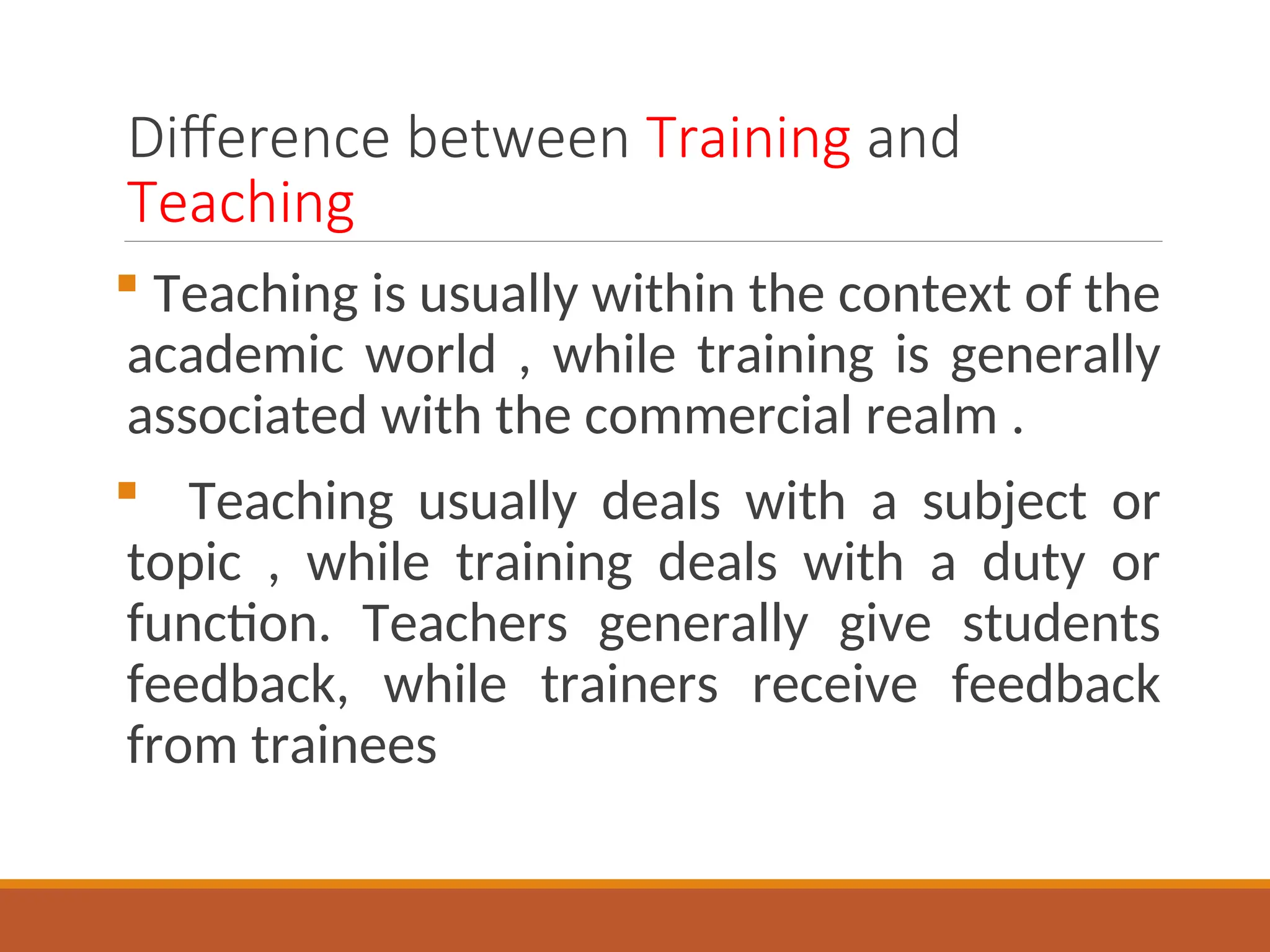
 Teaching is usually within the context of the
academic world , while training is generally
associated with the commercial realm .
 Teaching usually deals with a subject or
topic , while training deals with a duty or
function. Teachers generally give students
feedback, while trainers receive feedback
from trainees
Difference between Training and Teaching
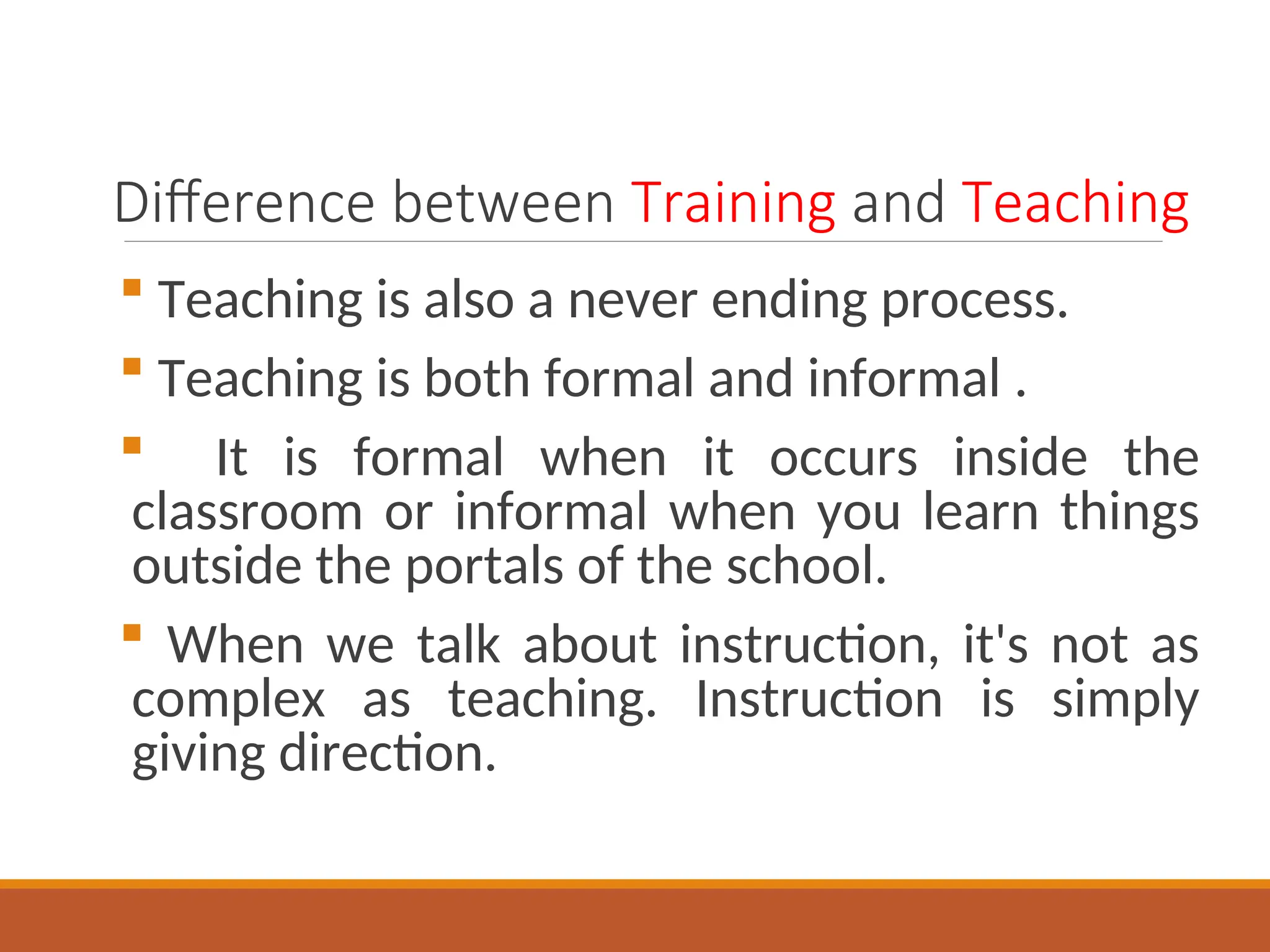
 Teaching is also a never ending process.
 Teaching is both formal and informal .
 It is formal when it occurs inside the
classroom or informal when you learn things
outside the portals of the school.
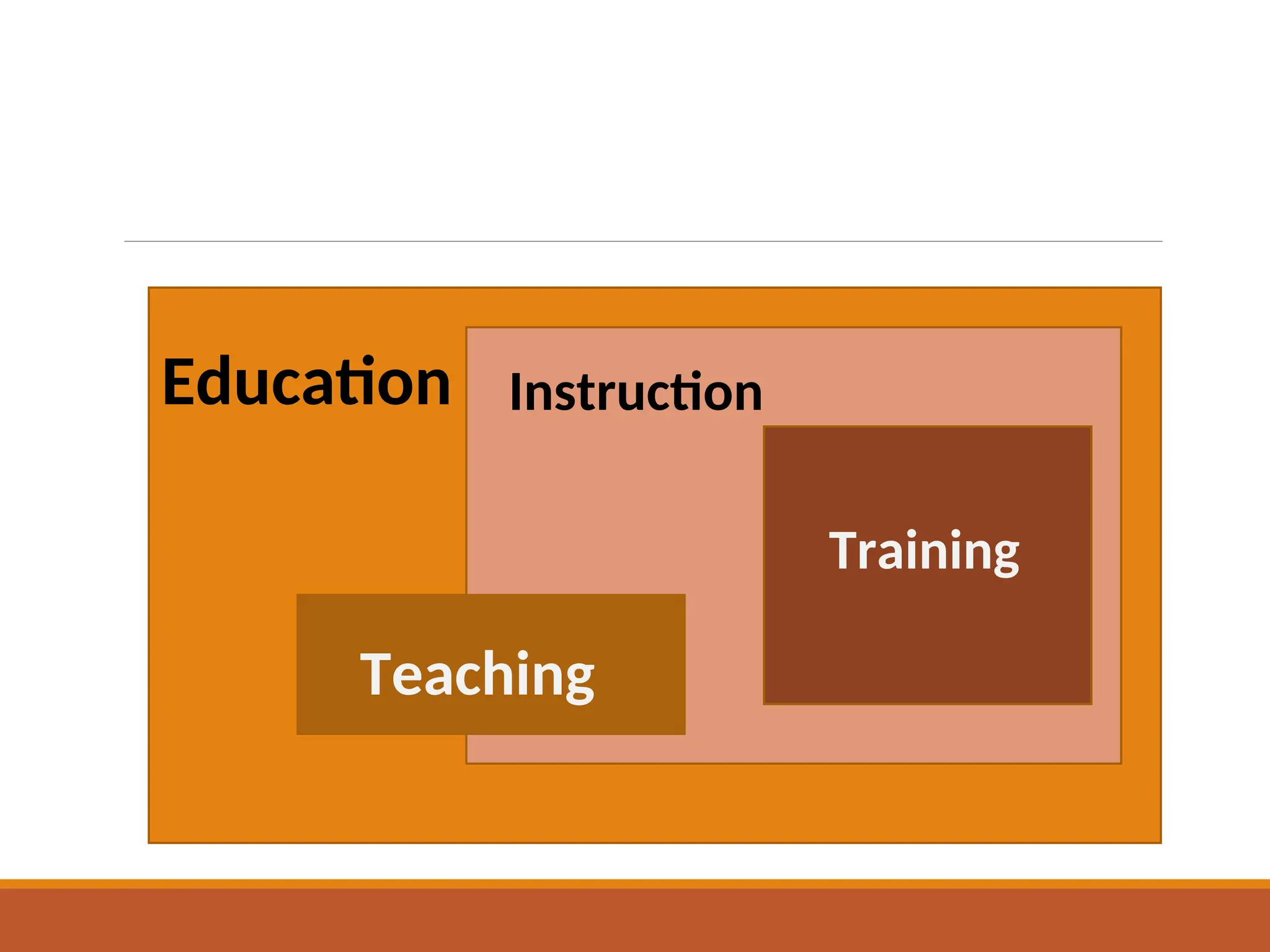
 When we talk about instruction, it's not as
complex as teaching. Instruction is simply
giving direction.
Education Instruction
Training
Teaching
Design
“...a plan or drawing produced to show the look
and function or workings of something“
Design implies a systematic or intensive planning
and ideation process prior to the development of
something or the execution of some plan in order
to solve a problem.
Instructional Design
Instructional Design is a systematic process by
which the instructional materials are designed,
developed and delivered
 Instructional Design is the entire process of
analysis of learning needs and goals and the
development of delivery system to meet the needs.
It includes development of instructional materials
and activities and try out all instruction and learner
activities
Key elements of Instructional
Design
 There is a genuine need for learning
 The learning events are well designed.
 Quality learning materials are developed
 Learning events are implemented using the
appropriate strategies and approaches
 Learning events are evaluated to ensure
learning has actually taken place.
The Instructional Design Process
The process involved in the systematic planning of
instruction. The instructional designer’s job is to
answer -
1.Where are we going? (What are the goals of the
instruction?)
2.How will we get there? (What is the instructional
strategy and the instructional medium?)
3.How will we know when we have arrived? (What
should our tests look like? How will we evaluate and
revise the instructional materials?)
The Instructional Design
Process
Major activities that an instructional designer
completes during the design and development
process:
 Perform an instructional analysis to determine
"where we’re going.“
 Develop an instructional strategy to determine
"how we’ll get there.“
 Develop and conduct an evaluation to determine
"how we’ll know when we’re there."
The Instructional Design Process
 Instructional designers insist on creating instruction
in which the goals, the instructional strategy, and the
evaluation all match.
 By "match," we mean that the strategy
(instructional method) that is used is appropriate for
the learning task (goals) and that the tests measure
how well the learners have achieved the learning task
(assessment).
Instructional method <=> goals <=> assessment
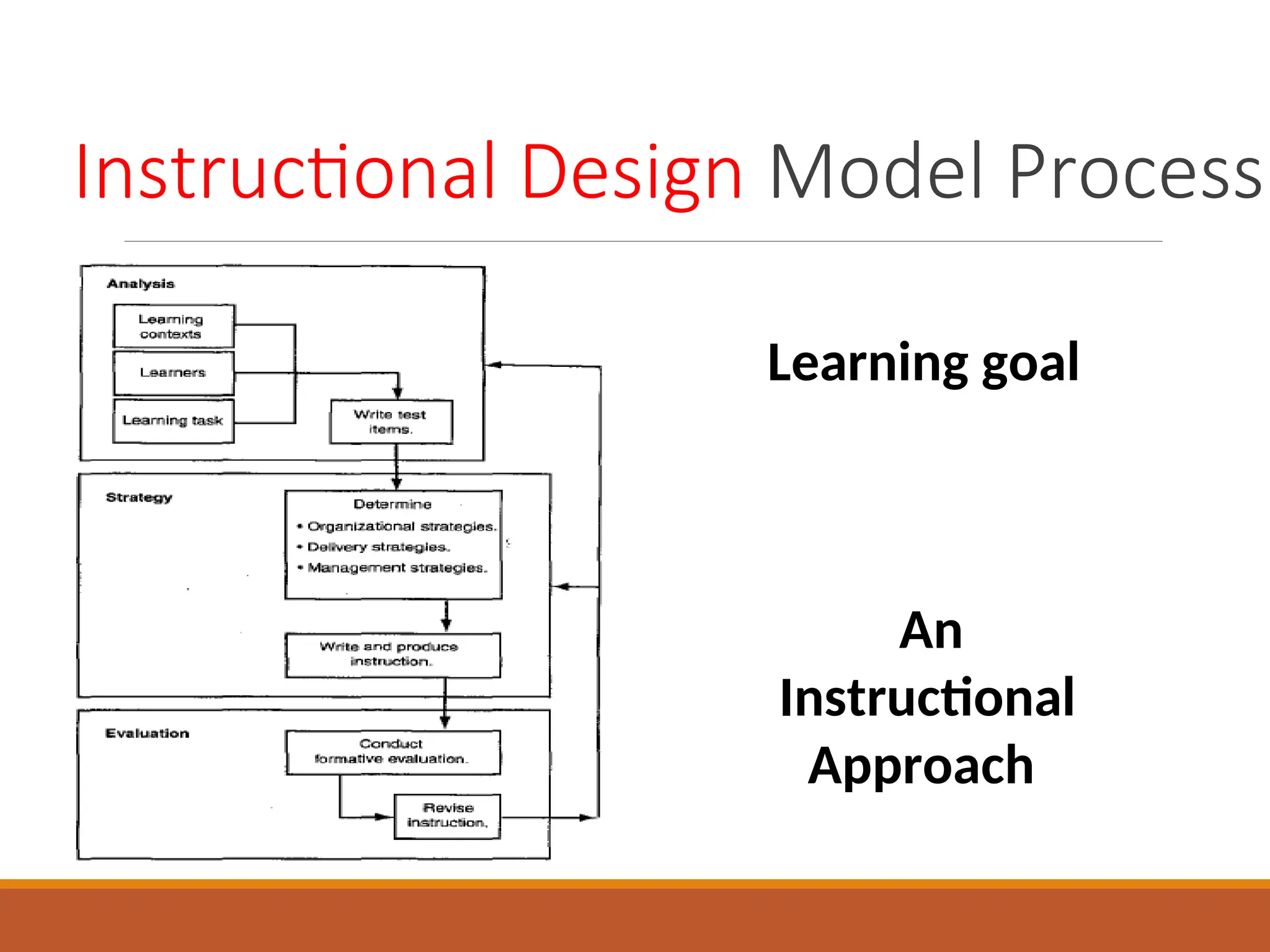
Instructional Design Model Process
Learning goal
An
Instructional
Approach
Different Instructional Design
Model
 ADDIE Model
 Dick and Carey Model
Kemp's Instructional Design Model
 Kirkpatrick's 4 Levels of Training Evaluation
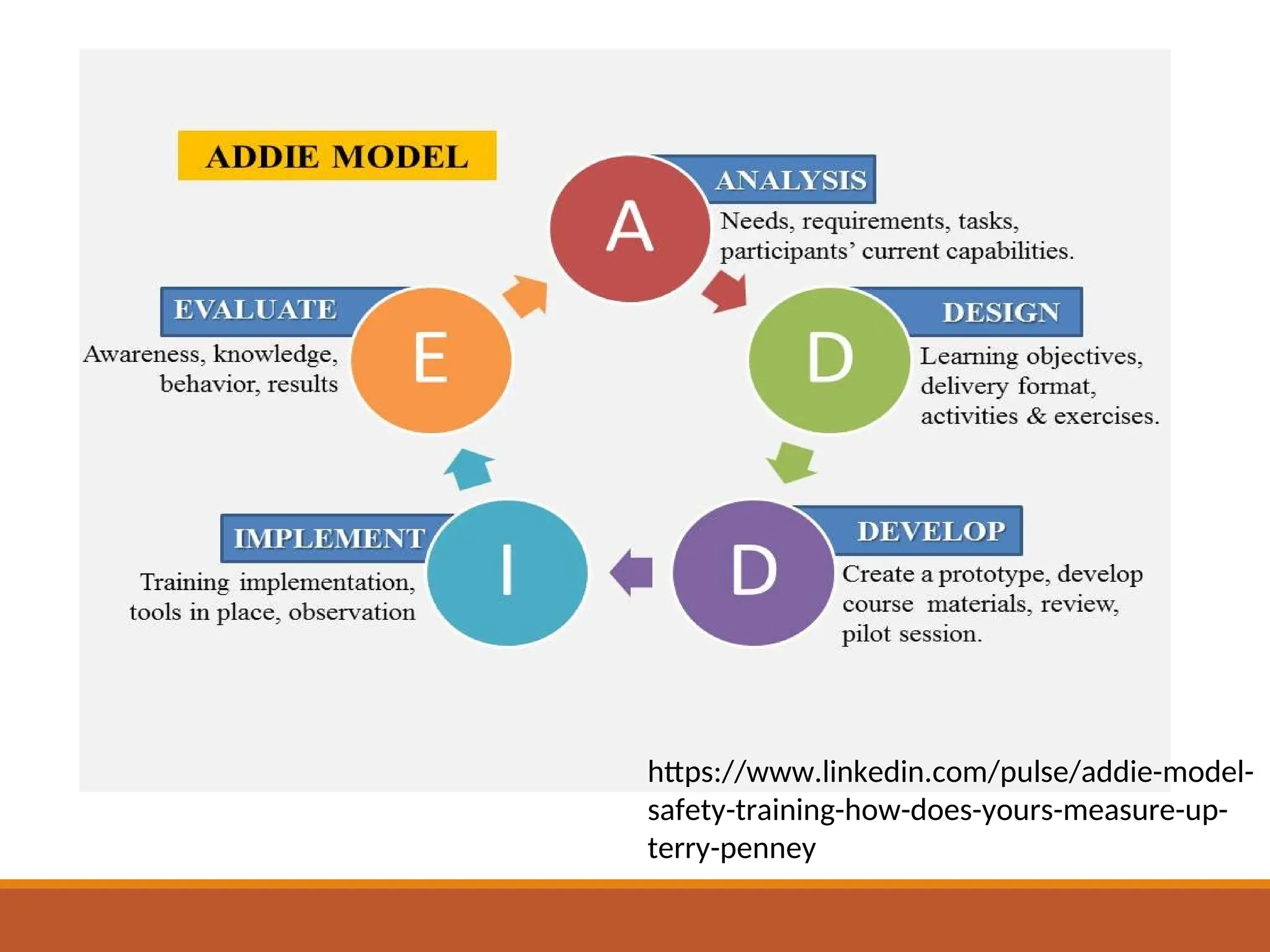
ADDIE
 ADDIE is the traditional and systematic ID model
that consists of 5 phases – Analysis, Design,
Development, Implementation, and Evaluation. The
outcome of each step is critical for one after in the
sequence.
 ADDIE’s main characteristic is that it is a linear
approach.
 It provides a clear-cut step by step sequence of
events in teaching a lesson.
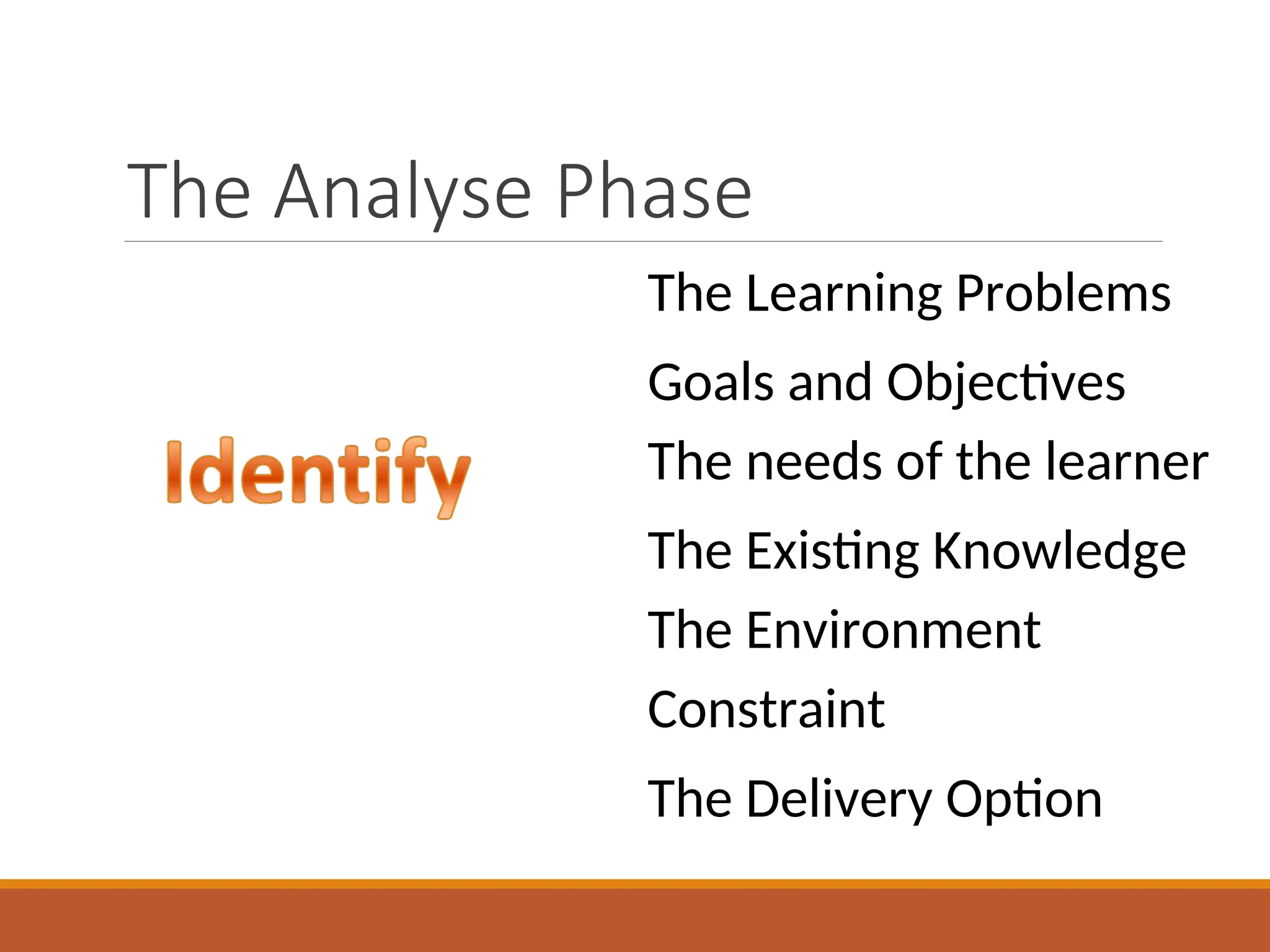
The Analyse Phase
The Learning Problems
Goals and Objectives
The needs of the learner
The Existing Knowledge
The Environment
Constraint
The Delivery Option
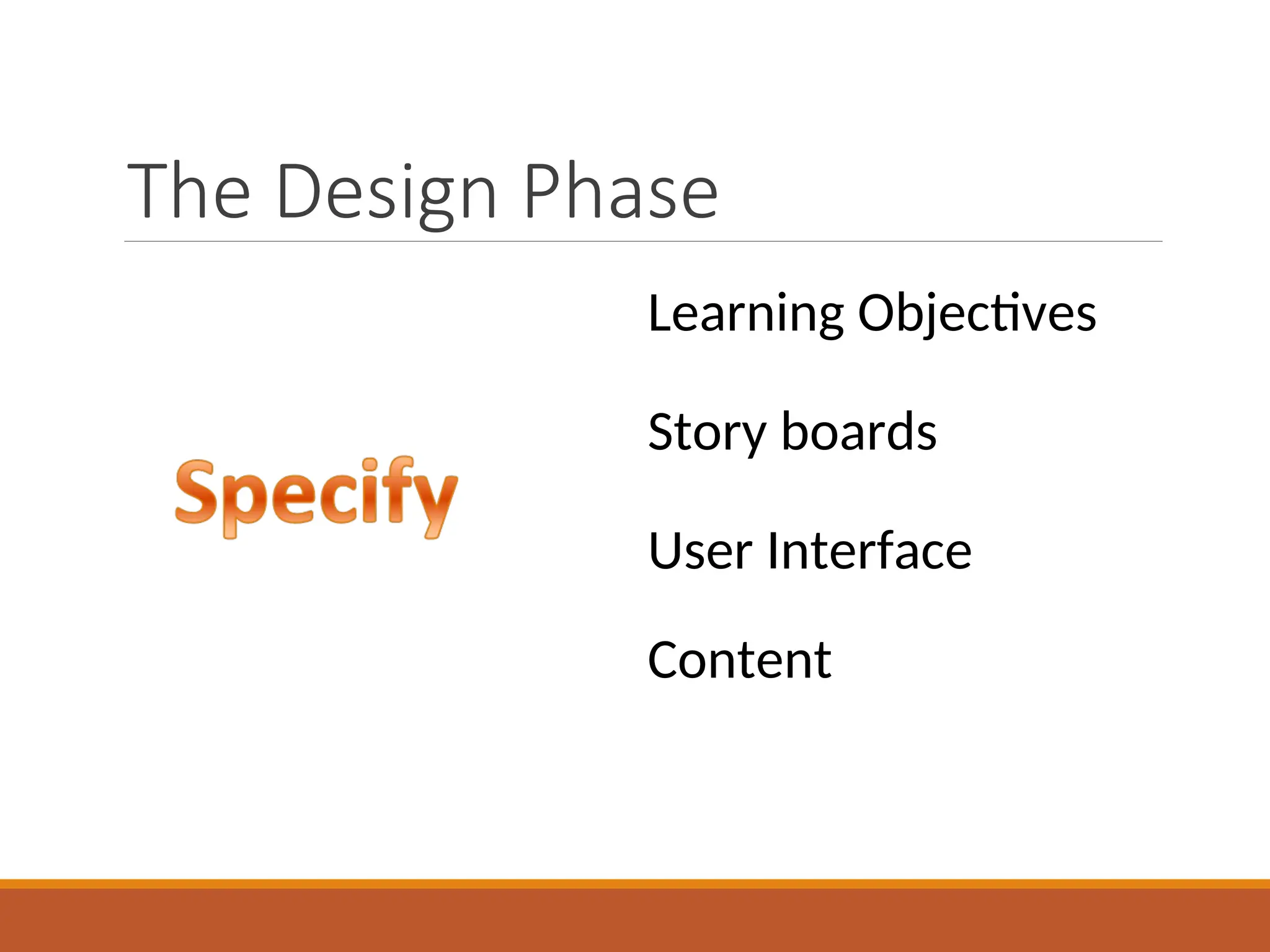
The Design Phase
Learning Objectives
Story boards
User Interface
Content
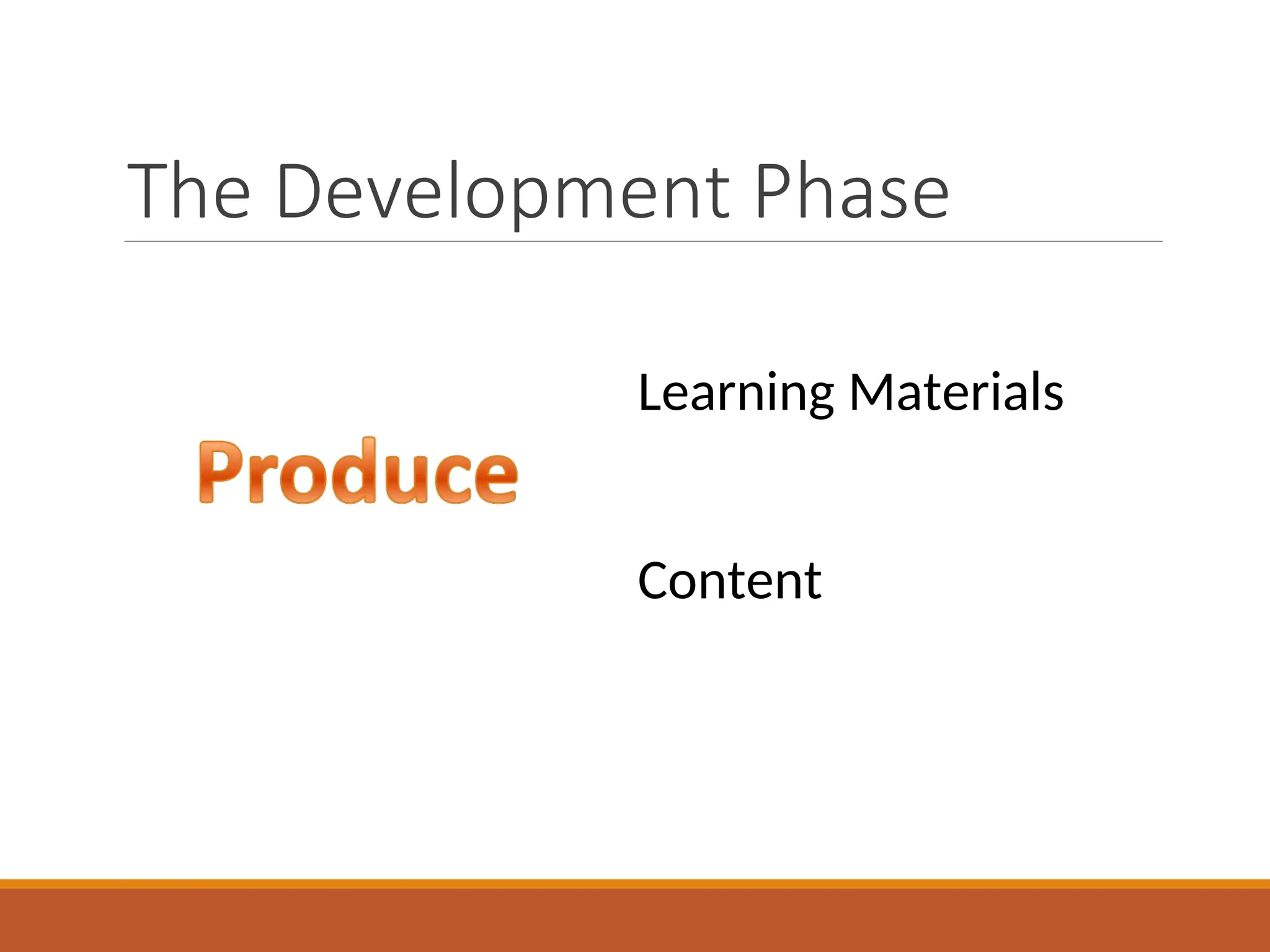
The Development Phase
Learning Materials
Content
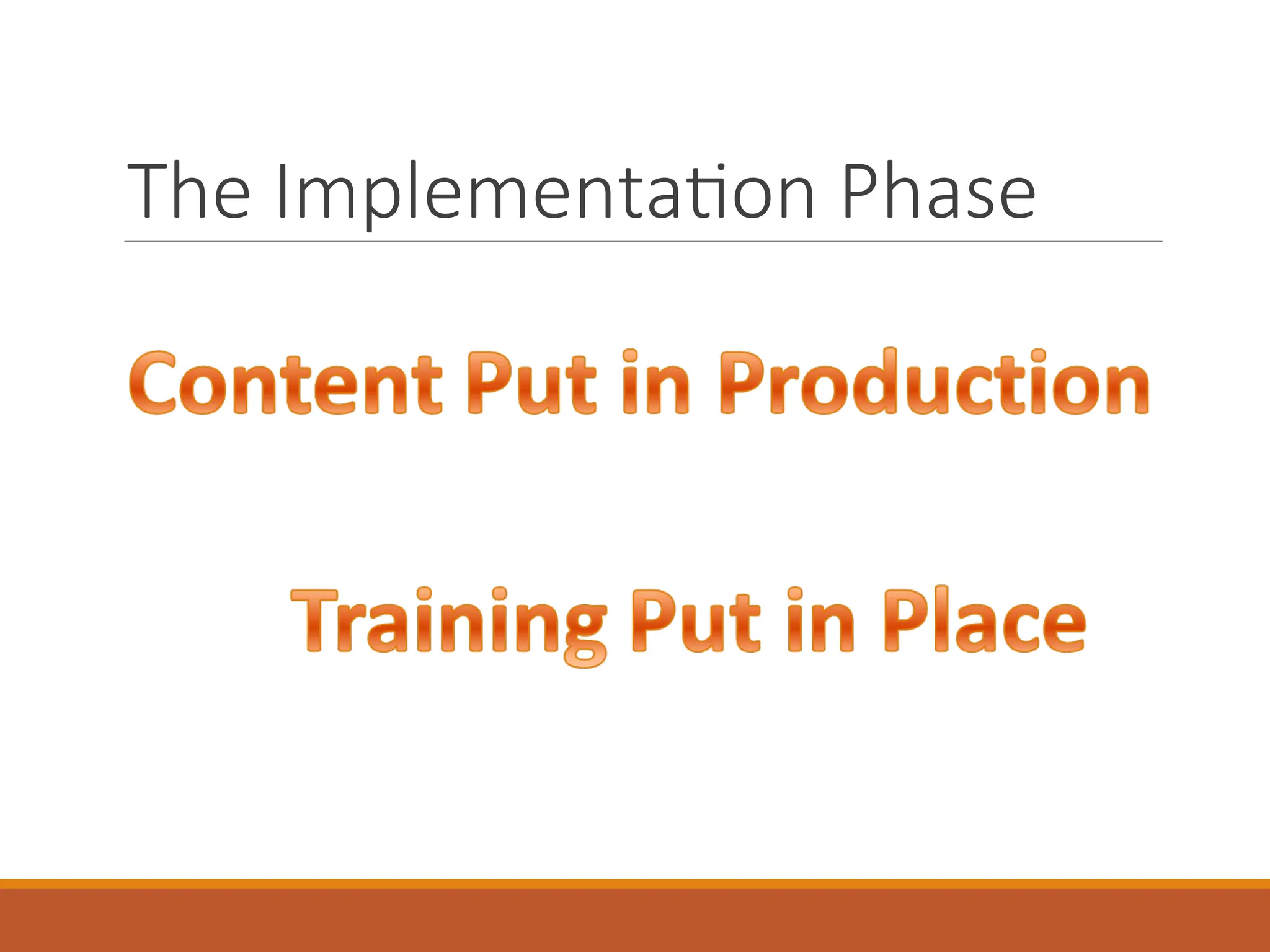
The Implementation Phase
The Evaluation Phase
Assess Criteria Used
Gather Learner Feedback
 Formative evaluation is present in each stage of
the ADDIE process
 Summative evaluation is conducted on finished
instructional programs or products.
ADDIE Model
https://www.linkedin.com/pulse/addie-model-
safety-training-how-does-yours-measure-up-
terry-penney
Strengths of ADDIE
 Most widely used model and is the foundation for other ID
models.
 It is flexible and can be used for traditional instruction and
across many industries.
 Is most effective when testing for easily measurable criteria
 Allows for collaboration at each level and at any and every
stage
 Evaluation is a key component built into ADDIE
 Structured guidance for design
Weaknesses of ADDIE
 ADDIE is linear model, which is not amenable to
accommodating user generated content
 You cant get to the next phase without addressing the one
before it.
 It is time consuming and costly
 Evaluation is a key component built into ADDIE
 Does not allow for designer creativity.
 Furthermore, storyboards are not always effective in creating
and conveying good design. Because the process is so detailed,
it sometimes deters the creative process
http://sarwathusain.weebly.com/ci--5921/addie-vs-dick-and-carey-model
Dick and Carey Model
 The Dick and Carey Systems Approach Model
(published in 1978) promotes a “systems” view of
instruction instead of viewing instruction as a sum
of isolated parts.
 In other words, the model engages instruction as
an entire system, including the interrelationships
between context, content, learning and instruction.
 The Dick and Carey Model is widely known and
forms the base-line for many other system models.
Dick and Carey Model
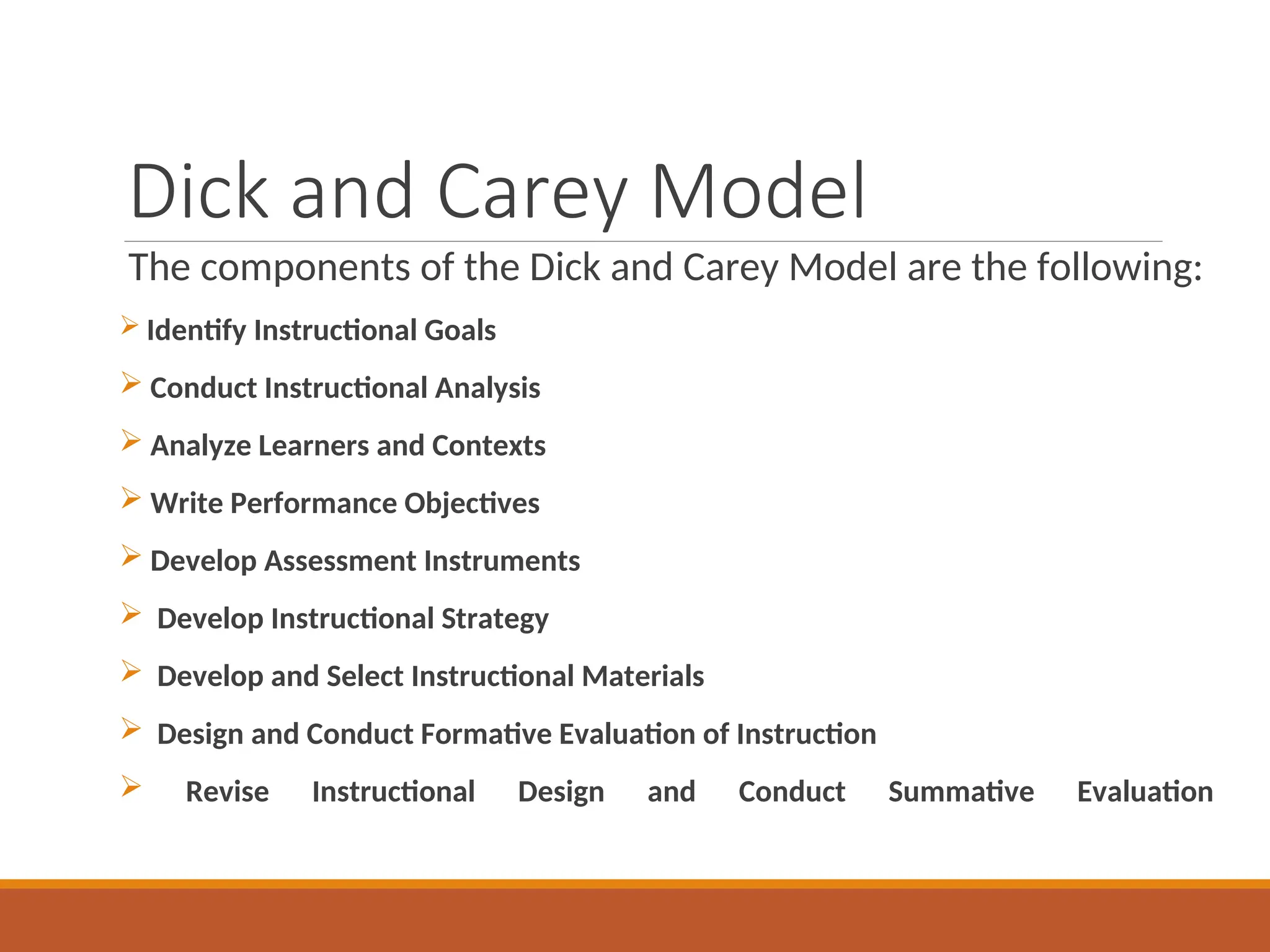
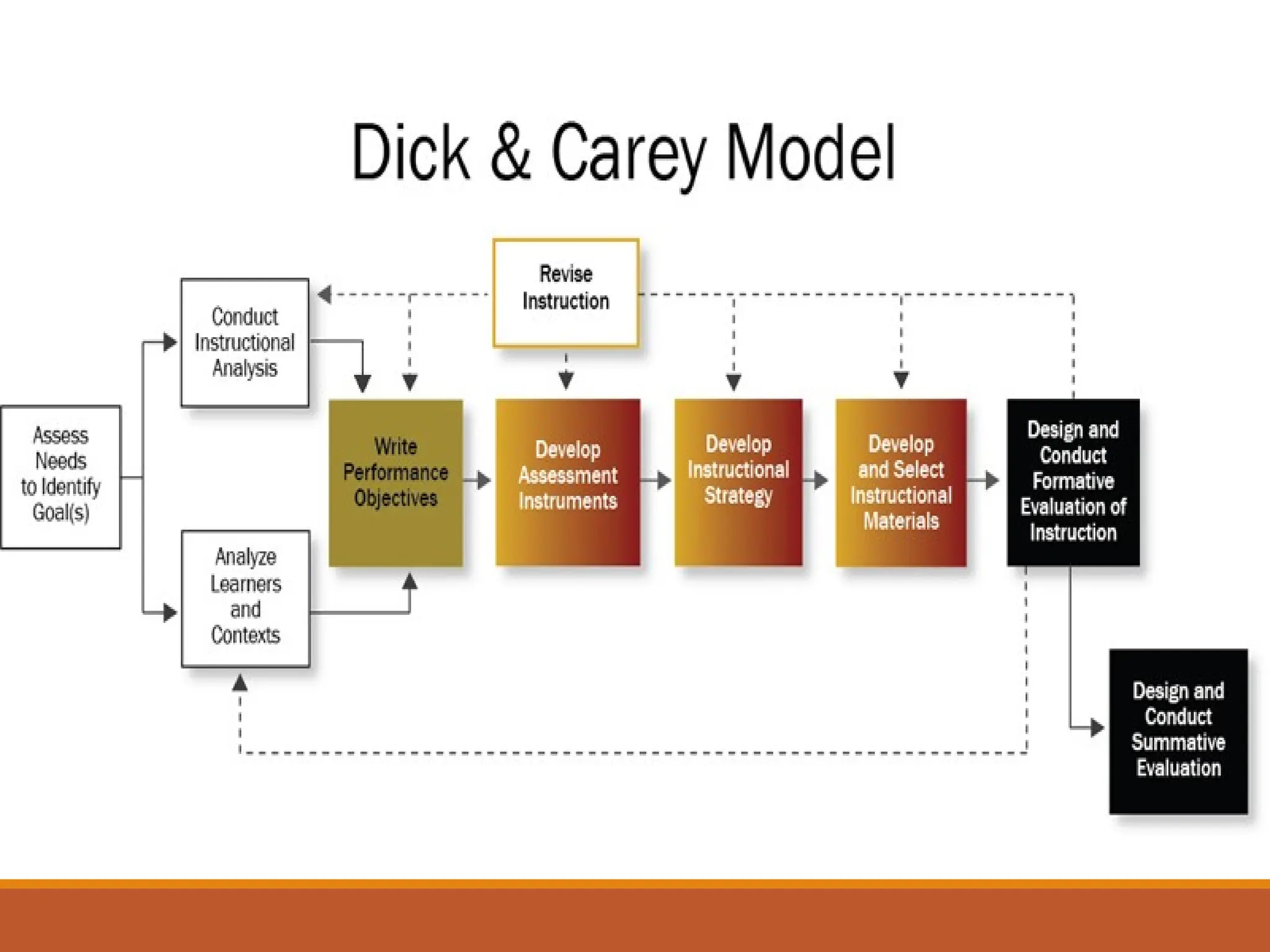
The components of the Dick and Carey Model are the following:
 Identify Instructional Goals
 Conduct Instructional Analysis
 Analyze Learners and Contexts
 Write Performance Objectives
 Develop Assessment Instruments
 Develop Instructional Strategy
 Develop and Select Instructional Materials
 Design and Conduct Formative Evaluation of Instruction
 Revise Instructional Design and Conduct Summative Evaluation
Dick and Carey Model
Strengths
The main strength of the model is that the designer
requires clear and measurable learning objectives,
thereby developing instruction as a systematic
process.
Weakness
It is base on the premise that every one of its
components are essential, and therefore none can be
skipped.
ADDIE model and The Dick and Carey
model (Differences)
(1). The ADDIE model has five phases, while the Dick and
Carey model has ten phases that are more detail.
(2) The ADDIE model has an evaluation at the last phases of
the model, while the Dick and Carey model has two big parts
of evaluations.
- First is the evaluations that are done in every steps that
have purpose to revise the instruction in every each steps.
-Second is the last evaluation that evaluates the instructions
that have been evaluated formatively and sufficiently revised
to meet the standards of the design.
ADDIE model and The Dick and Carey
model (Similarity)
It is the system approaches that are focus on
both models. The system approaches that
are focused by both models are on the input,
the output and the process of designing the
curriculum.
Thank You

OBE workshop materialWeek 1 Lecture 6.ppt

  • 1.
  • 2.
    What do weDO?  Understand the meaning of instructional design  Obtain an overview of the ADDIE model
  • 3.
  • 4.
    Instruction  Instruction isthe intentional facilitation of learning toward identified learning goals.  Driscoll (1994) defines instruction from a similar perspective: "the deliberate arrangement of learning conditions to promote the attainment of some intended goal" (p. 332).  “ Purposeful activity intended to cause , guide or support learning”
  • 5.
    Training Instructional experiences arefocused upon individuals acquiring very specific skills that they will normally apply almost immediately. https://dixieching.wordpress.com/ 2010/02/03/instructional-design-ch-1-smith- ragan/
  • 6.
    Teaching Learning experiences thatare facilitated by a human being – not a videotape, textbook, or computer program, but a live teacher.
  • 7.
    Difference between Trainingand Teaching  Training usually has a more specific focus than teaching, which seeks to in still a deeper knowledge over a longer period of time.  Training, on the other hand, seeks to help people master a specific skill or skill set, until they are able to execute it efficiently .  Training is usually a one-time or short-term event, as with job training.
  • 8.
    Difference between Trainingand Teaching  Teaching is usually broader in focus than training .  It generally is theoretical, while training is the practical application of knowledge.  Teaching seeks to impart new knowledge, while training equips the already knowledgeable with tools and techniques to develop a specific skill set .
  • 9.
    Difference between Trainingand Teaching  Teaching is usually within the context of the academic world , while training is generally associated with the commercial realm .  Teaching usually deals with a subject or topic , while training deals with a duty or function. Teachers generally give students feedback, while trainers receive feedback from trainees
  • 10.
    Difference between Trainingand Teaching  Teaching is also a never ending process.  Teaching is both formal and informal .  It is formal when it occurs inside the classroom or informal when you learn things outside the portals of the school.  When we talk about instruction, it's not as complex as teaching. Instruction is simply giving direction.
  • 11.
  • 12.
    Design “...a plan ordrawing produced to show the look and function or workings of something“ Design implies a systematic or intensive planning and ideation process prior to the development of something or the execution of some plan in order to solve a problem.
  • 13.
    Instructional Design Instructional Designis a systematic process by which the instructional materials are designed, developed and delivered  Instructional Design is the entire process of analysis of learning needs and goals and the development of delivery system to meet the needs. It includes development of instructional materials and activities and try out all instruction and learner activities
  • 14.
    Key elements ofInstructional Design  There is a genuine need for learning  The learning events are well designed.  Quality learning materials are developed  Learning events are implemented using the appropriate strategies and approaches  Learning events are evaluated to ensure learning has actually taken place.
  • 15.
    The Instructional DesignProcess The process involved in the systematic planning of instruction. The instructional designer’s job is to answer - 1.Where are we going? (What are the goals of the instruction?) 2.How will we get there? (What is the instructional strategy and the instructional medium?) 3.How will we know when we have arrived? (What should our tests look like? How will we evaluate and revise the instructional materials?)
  • 16.
    The Instructional Design Process Majoractivities that an instructional designer completes during the design and development process:  Perform an instructional analysis to determine "where we’re going.“  Develop an instructional strategy to determine "how we’ll get there.“  Develop and conduct an evaluation to determine "how we’ll know when we’re there."
  • 17.
    The Instructional DesignProcess  Instructional designers insist on creating instruction in which the goals, the instructional strategy, and the evaluation all match.  By "match," we mean that the strategy (instructional method) that is used is appropriate for the learning task (goals) and that the tests measure how well the learners have achieved the learning task (assessment). Instructional method <=> goals <=> assessment
  • 18.
    Instructional Design ModelProcess Learning goal An Instructional Approach
  • 19.
    Different Instructional Design Model ADDIE Model  Dick and Carey Model Kemp's Instructional Design Model  Kirkpatrick's 4 Levels of Training Evaluation
  • 20.
    ADDIE  ADDIE isthe traditional and systematic ID model that consists of 5 phases – Analysis, Design, Development, Implementation, and Evaluation. The outcome of each step is critical for one after in the sequence.  ADDIE’s main characteristic is that it is a linear approach.  It provides a clear-cut step by step sequence of events in teaching a lesson.
  • 21.
    The Analyse Phase TheLearning Problems Goals and Objectives The needs of the learner The Existing Knowledge The Environment Constraint The Delivery Option
  • 22.
    The Design Phase LearningObjectives Story boards User Interface Content
  • 23.
  • 24.
  • 25.
    The Evaluation Phase AssessCriteria Used Gather Learner Feedback  Formative evaluation is present in each stage of the ADDIE process  Summative evaluation is conducted on finished instructional programs or products.
  • 26.
  • 27.
    Strengths of ADDIE Most widely used model and is the foundation for other ID models.  It is flexible and can be used for traditional instruction and across many industries.  Is most effective when testing for easily measurable criteria  Allows for collaboration at each level and at any and every stage  Evaluation is a key component built into ADDIE  Structured guidance for design
  • 28.
    Weaknesses of ADDIE ADDIE is linear model, which is not amenable to accommodating user generated content  You cant get to the next phase without addressing the one before it.  It is time consuming and costly  Evaluation is a key component built into ADDIE  Does not allow for designer creativity.  Furthermore, storyboards are not always effective in creating and conveying good design. Because the process is so detailed, it sometimes deters the creative process http://sarwathusain.weebly.com/ci--5921/addie-vs-dick-and-carey-model
  • 29.
    Dick and CareyModel  The Dick and Carey Systems Approach Model (published in 1978) promotes a “systems” view of instruction instead of viewing instruction as a sum of isolated parts.  In other words, the model engages instruction as an entire system, including the interrelationships between context, content, learning and instruction.  The Dick and Carey Model is widely known and forms the base-line for many other system models.
  • 30.
    Dick and CareyModel The components of the Dick and Carey Model are the following:  Identify Instructional Goals  Conduct Instructional Analysis  Analyze Learners and Contexts  Write Performance Objectives  Develop Assessment Instruments  Develop Instructional Strategy  Develop and Select Instructional Materials  Design and Conduct Formative Evaluation of Instruction  Revise Instructional Design and Conduct Summative Evaluation
  • 32.
    Dick and CareyModel Strengths The main strength of the model is that the designer requires clear and measurable learning objectives, thereby developing instruction as a systematic process. Weakness It is base on the premise that every one of its components are essential, and therefore none can be skipped.
  • 33.
    ADDIE model andThe Dick and Carey model (Differences) (1). The ADDIE model has five phases, while the Dick and Carey model has ten phases that are more detail. (2) The ADDIE model has an evaluation at the last phases of the model, while the Dick and Carey model has two big parts of evaluations. - First is the evaluations that are done in every steps that have purpose to revise the instruction in every each steps. -Second is the last evaluation that evaluates the instructions that have been evaluated formatively and sufficiently revised to meet the standards of the design.
  • 34.
    ADDIE model andThe Dick and Carey model (Similarity) It is the system approaches that are focus on both models. The system approaches that are focused by both models are on the input, the output and the process of designing the curriculum.
  • 35.