Dick and Carey Model  Presentation by Alan Ledford
 
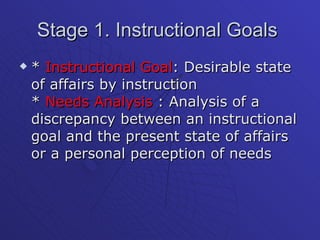
Stage 1. Instructional Goals  *  Instructional Goal : Desirable state of affairs by instruction *  Needs Analysis  : Analysis of a discrepancy between an instructional goal and the present state of affairs or a personal perception of needs
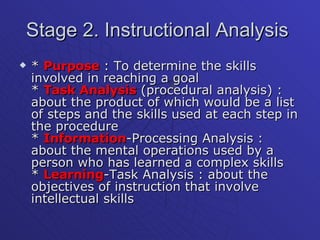
Stage 2. Instructional Analysis  *  Purpose  : To determine the skills involved in reaching a goal *  Task Analysis  (procedural analysis) : about the product of which would be a list of steps and the skills used at each step in the procedure *  Information -Processing Analysis : about the mental operations used by a person who has learned a complex skills *  Learning -Task Analysis : about the objectives of instruction that involve intellectual skills
Stage 3. Entry Behaviors and Learner Characteristics  *  Purpose  : To determine which of the required enabling skills the learners bring to the learning task *  Intellectual skills *  Abilities  such as verbal comprehension and spatial orientation *  Traits of personality
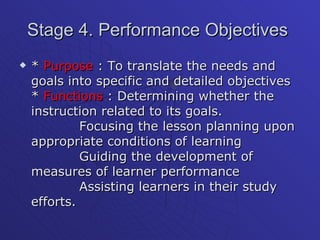
Stage 4. Performance Objectives  *  Purpose  : To translate the needs and goals into specific and detailed objectives *  Functions  : Determining whether the instruction related to its goals.            Focusing the lesson planning upon appropriate conditions of learning            Guiding the development of measures of learner performance            Assisting learners in their study efforts.
Stage 5. Criterion-Referenced Test Items  *To  diagnose  an individual possessions of the necessary prerequisites for learning new skills *To  check  the results of student learning during the process of a lesson *To  provide  document of students progress for parents or administrators *Useful in  evaluating  the instructional system itself (Formative/ Summative evaluation) *Early  determination  of performance measures before development of lesson plan and instructional materials
Stage 6. Instructional Strategy  *  Purpose  : To outline how instructional activities will relate to the accomplishment of the objectives *The best lesson design : Demonstrating knowledge about the learners, tasks reflected in the objectives, and effectiveness of teaching strategies     e.g. Choice of delivering system.            Teacher-led, Group-paced vs. Learner-centered, Learner-paced
Stage 7. Instructional Meterials  *  Purpose  : To select printed or other media intended to convey events of instruction. * Use of  existing materials  when it is possible * Need for  development  of new materials, otherwise *  Role  of teacher : It depends on the choice of delivery system
Stage 8. Formative Evaluation  *  Purpose  : To provide data for revising and improving instructional materials * To  revise  the instruction so as to make it as effective as possible for larger number of students *  One on One  : One evaluator sitting with one learner to interview *  Small Group *  Field Trial
Stage 9. Summative Evaluation  *  Purpose  : To study the effectiveness of system as a whole * Conducted after the system has passed through its  formative stage *  Small scale/ Large Scale *  Short period/ Long period
THE END

Dick And Carey ID Model

  • 1.
    Dick and CareyModel Presentation by Alan Ledford
  • 2.
  • 3.
    Stage 1. InstructionalGoals * Instructional Goal : Desirable state of affairs by instruction * Needs Analysis : Analysis of a discrepancy between an instructional goal and the present state of affairs or a personal perception of needs
  • 4.
    Stage 2. InstructionalAnalysis * Purpose : To determine the skills involved in reaching a goal * Task Analysis (procedural analysis) : about the product of which would be a list of steps and the skills used at each step in the procedure * Information -Processing Analysis : about the mental operations used by a person who has learned a complex skills * Learning -Task Analysis : about the objectives of instruction that involve intellectual skills
  • 5.
    Stage 3. EntryBehaviors and Learner Characteristics * Purpose : To determine which of the required enabling skills the learners bring to the learning task * Intellectual skills * Abilities such as verbal comprehension and spatial orientation * Traits of personality
  • 6.
    Stage 4. PerformanceObjectives * Purpose : To translate the needs and goals into specific and detailed objectives * Functions : Determining whether the instruction related to its goals.            Focusing the lesson planning upon appropriate conditions of learning            Guiding the development of measures of learner performance            Assisting learners in their study efforts.
  • 7.
    Stage 5. Criterion-ReferencedTest Items *To diagnose an individual possessions of the necessary prerequisites for learning new skills *To check the results of student learning during the process of a lesson *To provide document of students progress for parents or administrators *Useful in evaluating the instructional system itself (Formative/ Summative evaluation) *Early determination of performance measures before development of lesson plan and instructional materials
  • 8.
    Stage 6. InstructionalStrategy * Purpose : To outline how instructional activities will relate to the accomplishment of the objectives *The best lesson design : Demonstrating knowledge about the learners, tasks reflected in the objectives, and effectiveness of teaching strategies     e.g. Choice of delivering system.            Teacher-led, Group-paced vs. Learner-centered, Learner-paced
  • 9.
    Stage 7. InstructionalMeterials * Purpose : To select printed or other media intended to convey events of instruction. * Use of existing materials when it is possible * Need for development of new materials, otherwise * Role of teacher : It depends on the choice of delivery system
  • 10.
    Stage 8. FormativeEvaluation * Purpose : To provide data for revising and improving instructional materials * To revise the instruction so as to make it as effective as possible for larger number of students * One on One : One evaluator sitting with one learner to interview * Small Group * Field Trial
  • 11.
    Stage 9. SummativeEvaluation * Purpose : To study the effectiveness of system as a whole * Conducted after the system has passed through its formative stage * Small scale/ Large Scale * Short period/ Long period
  • 12.