

April Jasso
CUR/516
Joan Beckner
March 30, 2015
Course Title: Building Rapport
Course Description : This training is a prevention program to
strengthen academic advising and mentoring to contribute to
successful retention and graduation. This program is intended for all
staff members who are employed with the Student Support Services
Program where student interaction is key. Activities covered in this
training include: ice breakers, role-play and trust exercises.
Two Critical Elements of this Instructional Design
Plan:
• Evaluation
• Planning
The Instructional Design Plan requires careful
planning.
The Instructional Design has 4 different phases.
Phase I, Phase II, Phase III and Phase IV.
What is the need and who is requesting it?
Phase I is the starting point for the design.
Information included in this phase are:
• Title
• Course Description
Continuing with Phase I
• Target Audience
• Modality and Duration
• Goals
Phase II is the next step in the Instructional Design
Plan. Information included in this phase are:
• Goals followed by the objectives
• Objectives Explanation
• Instructional Technologies
Following Phase II is Phase III. Information
included in this phase are:
• Course Length and Anticipated Start Date
• Individuals Involved
• Instructional Resources
Continuing with Phase III.
• Implementation Plan
• Formative Assessments
The Importance of formative assessments:
• Gather data
• Include accurate facts
• Provide feedback
The last phase is phase IV. Information in this
phase include:
Criteria for Determining whether the goals,
objectives, and overall outcomes were met
Evaluation Instruments
Phase IV continued.
Evaluation Overview
The importance of a summative evaluation
• The determining factor of what was learned
• Determines whether or not the learners needs
were met
• Takes place after the instructional design has
been implemented
The importance of the Building Rapport Training
• Training has never been implemented
• Assist with the success of the program
• Ensure that student needs are met
• Contribute to student success
In conclusion
Building Rapport is essential for the success of the
Student Support Services Program.
Green, A. B. (2011). The Essentials of Instructional Design: Connecting Fundamental
Principles with Process and Practice. In A. Brown, & G. D. Timothy, the Essentials of
Instructional Design: Connecting Fundamental Principles with Process and Practice
(pp. 118 – 119). Pearson Education, Inc.

Instructional Design Plan PowerPoint

  • 1.
  • 2.
    Course Title: BuildingRapport Course Description : This training is a prevention program to strengthen academic advising and mentoring to contribute to successful retention and graduation. This program is intended for all staff members who are employed with the Student Support Services Program where student interaction is key. Activities covered in this training include: ice breakers, role-play and trust exercises.
  • 3.
    Two Critical Elementsof this Instructional Design Plan: • Evaluation • Planning
  • 4.
    The Instructional DesignPlan requires careful planning. The Instructional Design has 4 different phases. Phase I, Phase II, Phase III and Phase IV. What is the need and who is requesting it?
  • 5.
    Phase I isthe starting point for the design. Information included in this phase are: • Title • Course Description
  • 6.
    Continuing with PhaseI • Target Audience • Modality and Duration • Goals
  • 7.
    Phase II isthe next step in the Instructional Design Plan. Information included in this phase are: • Goals followed by the objectives • Objectives Explanation • Instructional Technologies
  • 8.
    Following Phase IIis Phase III. Information included in this phase are: • Course Length and Anticipated Start Date • Individuals Involved • Instructional Resources
  • 9.
    Continuing with PhaseIII. • Implementation Plan • Formative Assessments
  • 10.
    The Importance offormative assessments: • Gather data • Include accurate facts • Provide feedback
  • 11.
    The last phaseis phase IV. Information in this phase include: Criteria for Determining whether the goals, objectives, and overall outcomes were met Evaluation Instruments
  • 12.
  • 14.
    The importance ofa summative evaluation • The determining factor of what was learned • Determines whether or not the learners needs were met • Takes place after the instructional design has been implemented
  • 15.
    The importance ofthe Building Rapport Training • Training has never been implemented • Assist with the success of the program • Ensure that student needs are met • Contribute to student success
  • 16.
    In conclusion Building Rapportis essential for the success of the Student Support Services Program.
  • 17.
    Green, A. B.(2011). The Essentials of Instructional Design: Connecting Fundamental Principles with Process and Practice. In A. Brown, & G. D. Timothy, the Essentials of Instructional Design: Connecting Fundamental Principles with Process and Practice (pp. 118 – 119). Pearson Education, Inc.

Editor's Notes

  • #3 The Student Support Services Program provides academic support to the low-income/first-generation students who demonstrate an academic need. In order for the program to be successful, staff must know how to meet with those students and provide adequate direction and resources to those students.
  • #4 Before I go through the different phases and present the information to you, I assure you that I have done extensive planning and evaluating to create this Instructional Design Plan. Through evaluation, data has been collected and I will now go on to speak about the training I would like to implement for the Student Support Services Staff.
  • #5 The Instructional Design Plan requires careful planning as money and time are invested in each Design Plans. In order to establish an effective and efficient Instructional Design Plan, I have generated my plan based on 4 different phases to ensure that I am not wasting your time. The Student Support Services Staff have never been trained how to effectively meet with students. I started with establishing the need, the need for this training is needing to know how to effectively meet with students to help contribute student success to the university. April Jasso, Director, of the Student Support Services Program is requesting the training.
  • #6 The Student Support Services Staff have never been trained on how to effectively meet with students or Building Rapport I should say. After evaluating that there is a need and determining that the need is effectively meeting with students, I concluded that the title of this training will be Building Rapport. Evaluation is included in this phase as it is necessary in all phases. Based on the title and need I have concluded that this training is a prevention program to strengthen academic advising and mentoring to contribute to successful retention and graduation. This program is intended for all staff members who are employed with the Student Support Services Program where student interaction is key. Activities covered in this training include: ice breakers, role-play and trust exercises.
  • #7 In determining who the target audience is, I evaluated all the staff that are employed with the program and their roles. Each staff member is required to meet with students; therefore, all staff has been selected to be apart of this training. All staff to include: Director, Intervention Specialists and Support Staff. The Modality and Duration was selected based on the activities that would take place. The goals were selected to reflect what staff are required to meet with students and assist them with.
  • #8 Goals were established to reflect what staff is responsible for as far as meeting with students. The goals are set in place to align with the universities mission for being successful and being able to measure if the program is successful. The objectives were established to reflect the goals and to help the staff understand what their purpose is. Instructional Technologies are a critical component of the design plan to ensure that the training is successful at being delivered.
  • #9 Looking at the calendar at everyone’s availability, I determined that June 15-17 would be the most appropriate time to hold this training and the student traffic will be slow as it is slow in the summer time. All staff members employed with the Student Support Services Program to include the Director, Intervention Specialist and Support Staff will be present along with the experienced Academic Advisor who will be the trainer. Instructional resources have been determined based on the type of delivery of the training.
  • #10 As this Instructional Design Plan is a very big deal, it is imperative to get the message across to all staff members at once during a meeting so that I can clarify the importance of it, explain what the staff can expect and what will happen if they should miss the training. This meeting will take place so that no-one is left out and everyone is included as a team. Formative assessments are critical for providing a learning environment. Learners will be asked to write 3 questions and share with the others on the first day, they will be asked to write 3 things they learned and 3 things they found interesting on day 3.
  • #11 Formative evaluations take place at all phases of the instructional design to gather data and provide feedback (Green, 2011). The formative evaluation is a way of omitting the unnecessary elements that will waste time and money. The formative evaluation is a way for ensuring that this process has been well thought out and assisting the design with running smoothly.
  • #12 It is critical to determine whether the goals and objectives were met. On the last day of the training, learners will be asked to participate in a mock meeting where the facilitator can evaluate how a staff member will handle any scenario and provide feedback. A summative evaluation will be used at the end of the training to determine the success or failure of the training.
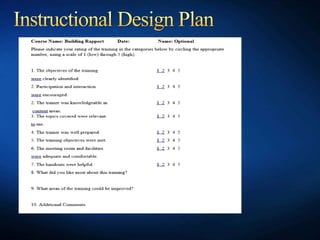
  • #13 The ratings from the evaluation will determine the success or failure of the training.
  • #14 Determining the success of the training is very critical to me as it is you. I have provided a sample of the evaluation I plan to use on the last day to determine the success or failure of the training so that I will know what works and what does not work. I will know what elements can be kept and what will need to be changed.
  • #15 Summative evaluations are very important, they determine what was learned, determines whether or not the learners needs were met and they take place after the instructional design has been implemented to determine if changes need to be made and determine whether goals have been met (Green, 2011).
  • #16 The importance of the Building Rapport Training is because training has never been implemented, it will assist with the success of the program, it will ensure that student needs are met and it help staff to contribute to student success.
  • #17 Building Rapport is essential for the success of the Student Support Services Program. The students are what makes the program, if they are unhappy with the staff and do not come in for services, then the program has no need for existence and has failed. The training will help staff learn how to meet with students and how effectively assist them so they receive adequate information that will lead them to success.