Writing Effective Learning
Objectives
Module 3:
Training Analysis & Learning Objects
Course Title:Designing and Delivering Successful Training Programs
2
What are Learning Objectives?
• Statements that describe what the learner
is expected to achieve as a result of
instruction.
• Intended resultsof instruction
▫ NOTthe processof instruction
3
What are Learning Objectives?
• Define factors of success of the
proposed solution
• Communicate an intended learning
outcome
• Guide the design, development,
implementation, and evaluation of training
4
Significance
5
How can we Write
Effective Learning Objectives?
6
How to Write Effective Learning Objectives
1. Based on the SMART Criteria
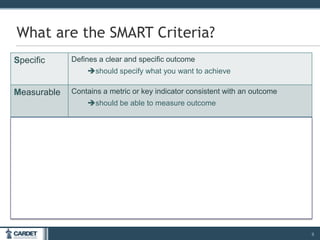
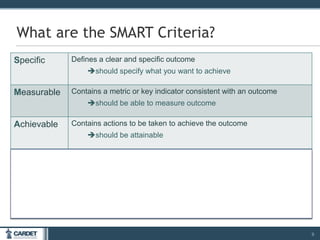
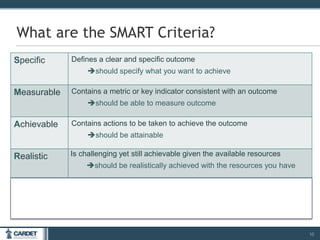
Specific Defines a clear and specific outcome
should specify what you want to achieve
Measurable Contains a metric or key indicator consistent with an outcome
should be able to measure outcome
Achievable Contains actions to be taken to achieve the outcome
should be attainable
Realistic Is challenging yet still achievable given the available resources
should be realistically achieved with the resources you have
Time-
specific
Has a specific timeframe or deadline for when the outcome will be
achieved
should be able to be achieved within the specified timeframe
7
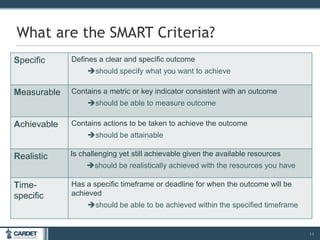
What are the SMART Criteria?
Specific Defines a clear and specific outcome
should specify what you want to achieve
Measurable Contains a metric or key indicator consistent with an outcome
should be able to measure outcome
Achievable Contains actions to be taken to achieve the outcome
should be attainable
Realistic Is challenging yet still achievable given the available resources
should be realistically achieved with the resources you have
Time-
specific
Has a specific timeframe or deadline for when the outcome will be
achieved
should be able to be achieved within the specified timeframe
8
What are the SMART Criteria?
Specific Defines a clear and specific outcome
should specify what you want to achieve
Measurable Contains a metric or key indicator consistent with an outcome
should be able to measure outcome
Achievable Contains actions to be taken to achieve the outcome
should be attainable
Realistic Is challenging yet still achievable given the available resources
should be realistically achieved with the resources you have
Time-
specific
Has a specific timeframe or deadline for when the outcome will be
achieved
should be able to be achieved within the specified timeframe
9
What are the SMART Criteria?
Specific Defines a clear and specific outcome
should specify what you want to achieve
Measurable Contains a metric or key indicator consistent with an outcome
should be able to measure outcome
Achievable Contains actions to be taken to achieve the outcome
should be attainable
Realistic Is challenging yet still achievable given the available resources
should be realistically achieved with the resources you have
Time-
specific
Has a specific timeframe or deadline for when the outcome will be
achieved
should be able to be achieved within the specified timeframe
10
What are the SMART Criteria?
Specific Defines a clear and specific outcome
should specify what you want to achieve
Measurable Contains a metric or key indicator consistent with an outcome
should be able to measure outcome
Achievable Contains actions to be taken to achieve the outcome
should be attainable
Realistic Is challenging yet still achievable given the available resources
should be realistically achieved with the resources you have
Time-
specific
Has a specific timeframe or deadline for when the outcome will be
achieved
should be able to be achieved within the specified timeframe
11
What are the SMART Criteria?
12
How to Write Effective Learning Objectives
1. Based on the SMART Criteria
2. Using Bloom’s Taxonomy
13
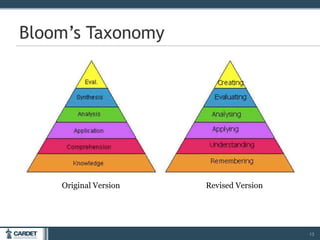
Bloom’s Taxonomy
Original Version Revised Version
14
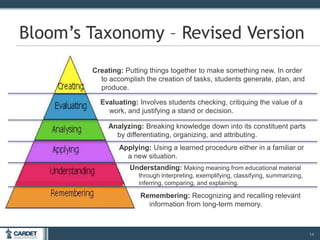
Bloom’s Taxonomy – Revised Version
Creating: Putting things together to make something new. In order
to accomplish the creation of tasks, students generate, plan, and
produce.
Evaluating: Involves students checking, critiquing the value of a
work, and justifying a stand or decision.
Analyzing: Breaking knowledge down into its constituent parts
by differentiating, organizing, and attributing.
Understanding: Making meaning from educational material
through interpreting, exemplifying, classifying, summarizing,
inferring, comparing, and explaining.
Applying: Using a learned procedure either in a familiar or
a new situation.
Remembering: Recognizing and recalling relevant
information from long-term memory.
15
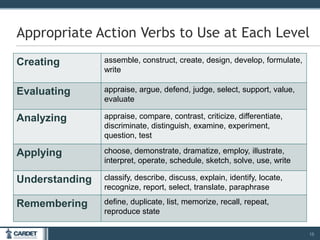
Creating assemble, construct, create, design, develop, formulate,
write
Evaluating appraise, argue, defend, judge, select, support, value,
evaluate
Analyzing appraise, compare, contrast, criticize, differentiate,
discriminate, distinguish, examine, experiment,
question, test
Applying choose, demonstrate, dramatize, employ, illustrate,
interpret, operate, schedule, sketch, solve, use, write
Understanding classify, describe, discuss, explain, identify, locate,
recognize, report, select, translate, paraphrase
Remembering define, duplicate, list, memorize, recall, repeat,
reproduce state
Appropriate Action Verbs to Use at Each Level
16
How to Write Effective Learning Objectives
1. Based on the SMART Criteria
2. Using Bloom’s Taxonomy
3. Using Mager’s Theory
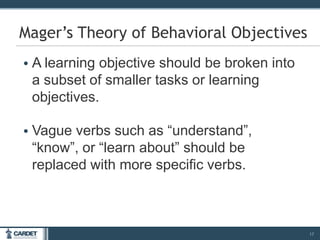
• A learning objective should be broken into
a subset of smaller tasks or learning
objectives.
• Vague verbs such as “understand”,
“know”, or “learn about” should be
replaced with more specific verbs.
17
Mager’s Theory of Behavioral Objectives
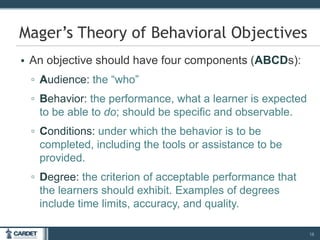
• An objective should have four components (ABCDs):
▫ Audience: the “who”
▫ Behavior: the performance, what a learner is expected
to be able to do; should be specific and observable.
▫ Conditions: under which the behavior is to be
completed, including the tools or assistance to be
provided.
▫ Degree: the criterion of acceptable performance that
the learners should exhibit. Examples of degrees
include time limits, accuracy, and quality.
18
Mager’s Theory of Behavioral Objectives
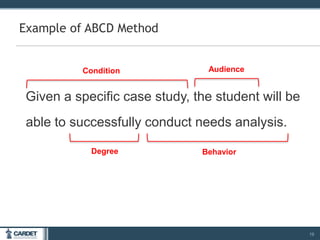
Given a specific case study, the student will be
able to successfully conduct needs analysis.
19
Example of ABCD Method
Condition Audience
Degree Behavior

Writing Effective Learning Objectives

  • 1.
    Writing Effective Learning Objectives Module3: Training Analysis & Learning Objects Course Title:Designing and Delivering Successful Training Programs
  • 2.
  • 3.
    • Statements thatdescribe what the learner is expected to achieve as a result of instruction. • Intended resultsof instruction ▫ NOTthe processof instruction 3 What are Learning Objectives?
  • 4.
    • Define factorsof success of the proposed solution • Communicate an intended learning outcome • Guide the design, development, implementation, and evaluation of training 4 Significance
  • 5.
    5 How can weWrite Effective Learning Objectives?
  • 6.
    6 How to WriteEffective Learning Objectives 1. Based on the SMART Criteria
  • 7.
    Specific Defines aclear and specific outcome should specify what you want to achieve Measurable Contains a metric or key indicator consistent with an outcome should be able to measure outcome Achievable Contains actions to be taken to achieve the outcome should be attainable Realistic Is challenging yet still achievable given the available resources should be realistically achieved with the resources you have Time- specific Has a specific timeframe or deadline for when the outcome will be achieved should be able to be achieved within the specified timeframe 7 What are the SMART Criteria?
  • 8.
    Specific Defines aclear and specific outcome should specify what you want to achieve Measurable Contains a metric or key indicator consistent with an outcome should be able to measure outcome Achievable Contains actions to be taken to achieve the outcome should be attainable Realistic Is challenging yet still achievable given the available resources should be realistically achieved with the resources you have Time- specific Has a specific timeframe or deadline for when the outcome will be achieved should be able to be achieved within the specified timeframe 8 What are the SMART Criteria?
  • 9.
    Specific Defines aclear and specific outcome should specify what you want to achieve Measurable Contains a metric or key indicator consistent with an outcome should be able to measure outcome Achievable Contains actions to be taken to achieve the outcome should be attainable Realistic Is challenging yet still achievable given the available resources should be realistically achieved with the resources you have Time- specific Has a specific timeframe or deadline for when the outcome will be achieved should be able to be achieved within the specified timeframe 9 What are the SMART Criteria?
  • 10.
    Specific Defines aclear and specific outcome should specify what you want to achieve Measurable Contains a metric or key indicator consistent with an outcome should be able to measure outcome Achievable Contains actions to be taken to achieve the outcome should be attainable Realistic Is challenging yet still achievable given the available resources should be realistically achieved with the resources you have Time- specific Has a specific timeframe or deadline for when the outcome will be achieved should be able to be achieved within the specified timeframe 10 What are the SMART Criteria?
  • 11.
    Specific Defines aclear and specific outcome should specify what you want to achieve Measurable Contains a metric or key indicator consistent with an outcome should be able to measure outcome Achievable Contains actions to be taken to achieve the outcome should be attainable Realistic Is challenging yet still achievable given the available resources should be realistically achieved with the resources you have Time- specific Has a specific timeframe or deadline for when the outcome will be achieved should be able to be achieved within the specified timeframe 11 What are the SMART Criteria?
  • 12.
    12 How to WriteEffective Learning Objectives 1. Based on the SMART Criteria 2. Using Bloom’s Taxonomy
  • 13.
  • 14.
    14 Bloom’s Taxonomy –Revised Version Creating: Putting things together to make something new. In order to accomplish the creation of tasks, students generate, plan, and produce. Evaluating: Involves students checking, critiquing the value of a work, and justifying a stand or decision. Analyzing: Breaking knowledge down into its constituent parts by differentiating, organizing, and attributing. Understanding: Making meaning from educational material through interpreting, exemplifying, classifying, summarizing, inferring, comparing, and explaining. Applying: Using a learned procedure either in a familiar or a new situation. Remembering: Recognizing and recalling relevant information from long-term memory.
  • 15.
    15 Creating assemble, construct,create, design, develop, formulate, write Evaluating appraise, argue, defend, judge, select, support, value, evaluate Analyzing appraise, compare, contrast, criticize, differentiate, discriminate, distinguish, examine, experiment, question, test Applying choose, demonstrate, dramatize, employ, illustrate, interpret, operate, schedule, sketch, solve, use, write Understanding classify, describe, discuss, explain, identify, locate, recognize, report, select, translate, paraphrase Remembering define, duplicate, list, memorize, recall, repeat, reproduce state Appropriate Action Verbs to Use at Each Level
  • 16.
    16 How to WriteEffective Learning Objectives 1. Based on the SMART Criteria 2. Using Bloom’s Taxonomy 3. Using Mager’s Theory
  • 17.
    • A learningobjective should be broken into a subset of smaller tasks or learning objectives. • Vague verbs such as “understand”, “know”, or “learn about” should be replaced with more specific verbs. 17 Mager’s Theory of Behavioral Objectives
  • 18.
    • An objectiveshould have four components (ABCDs): ▫ Audience: the “who” ▫ Behavior: the performance, what a learner is expected to be able to do; should be specific and observable. ▫ Conditions: under which the behavior is to be completed, including the tools or assistance to be provided. ▫ Degree: the criterion of acceptable performance that the learners should exhibit. Examples of degrees include time limits, accuracy, and quality. 18 Mager’s Theory of Behavioral Objectives
  • 19.
    Given a specificcase study, the student will be able to successfully conduct needs analysis. 19 Example of ABCD Method Condition Audience Degree Behavior

Editor's Notes

  • #2 Part II, Activity 2
  • #3 The instructor asks this questions and allows participants to discuss for 2-3 minutes.Image source: http://carpentier.files.wordpress.com/2009/04/question_mark.jpg
  • #4 What are Learning Objectives?Objectives are statements which describe what the learner is expected to achieve as a result of instruction.An objective describes an intended result of instruction, rather than the process of instruction itself.
  • #5 Significance of Writing Learning ObjectivesTo define factors of success of the proposed solutionTo communicate an intended learning outcomeTo guide the design, development, implementation, and evaluation of training
  • #6 The instructor allows 1-2 minutes for participants to respond to the above question.Image Source: http://www.pace.edu/pace/media/prospective-students/Writing%20Center.jpg
  • #16 Remembering: define, duplicate, list, memorize, recall, repeat, reproduce stateUnderstanding: classify, describe, discuss, explain, identify, locate, recognize, report, select, translate, paraphrase Applying: choose, demonstrate, dramatize, employ, illustrate, interpret, operate, schedule, sketch, solve, use, write Analyzing: appraise, compare, contrast, criticize, differentiate, discriminate, distinguish, examine, experiment, question, test Evaluating: appraise, argue, defend, judge, select, support, value, evaluate Creating: assemble, construct, create, design, develop, formulate, write
  • #20 The instructor first asks participants to identify the 4 components and then reveals the answer.