

Instructional Design Concepts
ADDIE Modelhttp://www.learning-theories.com/addie-model.htmlThe generic term for the five-phase instructional design model consisting of Analysis, Design, Development, Implementation, and Evaluation.  Each step has an outcome that feeds into the next step in the sequence.  There are probably over 100+ different variations of the generic ADDIE model.
ADDIE ModelThe five phases of ADDIE are as follows: AnalysisDesignDevelopImplementationEvaluation
AnalysisDuring analysis, the designer identifies the learning problem, the goals and objectives, the audience’s needs, existing knowledge, and any other relevant characteristics.  Analysis also considers the learning environment, any constraints, the delivery options, and the timeline for the project.
DesignA systematic process of specifying learning objectives.  Detailed storyboards and prototypes are often made, and the look and feel, graphic design, user-interface and content is determined here.
DevelopmentThe actual creation (production) of the content and learning materials based on the Design phase.
ImplementationDuring implementation, the plan is put into action and a procedure for training the learner and teacher is developed.  Materials are delivered or distributed to the student group. After delivery, the effectiveness of the training materials is evaluated.
EvaluationThis phase consists of (1) formative and (2) summative evaluation. Formative evaluation is present in each stage of the ADDIE process. Summative evaluation consists of tests designed for criterion-related referenced items and providing opportunities for feedback from the users.  Revisions are made as necessary.
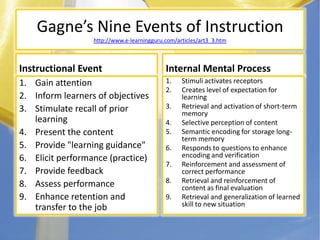
Gagne’s Nine Events of Instructionhttp://www.e-learningguru.com/articles/art3_3.htmInstructional EventGain attention Inform learners of objectives Stimulate recall of prior learning Present the content Provide "learning guidance" Elicit performance (practice) Provide feedback Assess performance Enhance retention and transfer to the job Internal Mental ProcessStimuli activates receptors Creates level of expectation for learning Retrieval and activation of short-term memory Selective perception of content Semantic encoding for storage long-term memory Responds to questions to enhance encoding and verification Reinforcement and assessment of correct performance Retrieval and reinforcement of content as final evaluation Retrieval and generalization of learned skill to new situation
Story BoardingWhatWhoHowWhereWhen

Instructional Design Concepts

  • 1.
  • 2.
    ADDIE Modelhttp://www.learning-theories.com/addie-model.htmlThe genericterm for the five-phase instructional design model consisting of Analysis, Design, Development, Implementation, and Evaluation.  Each step has an outcome that feeds into the next step in the sequence.  There are probably over 100+ different variations of the generic ADDIE model.
  • 3.
    ADDIE ModelThe fivephases of ADDIE are as follows: AnalysisDesignDevelopImplementationEvaluation
  • 4.
    AnalysisDuring analysis, thedesigner identifies the learning problem, the goals and objectives, the audience’s needs, existing knowledge, and any other relevant characteristics.  Analysis also considers the learning environment, any constraints, the delivery options, and the timeline for the project.
  • 5.
    DesignA systematic processof specifying learning objectives.  Detailed storyboards and prototypes are often made, and the look and feel, graphic design, user-interface and content is determined here.
  • 6.
    DevelopmentThe actual creation(production) of the content and learning materials based on the Design phase.
  • 7.
    ImplementationDuring implementation, theplan is put into action and a procedure for training the learner and teacher is developed.  Materials are delivered or distributed to the student group. After delivery, the effectiveness of the training materials is evaluated.
  • 8.
    EvaluationThis phase consistsof (1) formative and (2) summative evaluation. Formative evaluation is present in each stage of the ADDIE process. Summative evaluation consists of tests designed for criterion-related referenced items and providing opportunities for feedback from the users.  Revisions are made as necessary.
  • 9.
    Gagne’s Nine Eventsof Instructionhttp://www.e-learningguru.com/articles/art3_3.htmInstructional EventGain attention Inform learners of objectives Stimulate recall of prior learning Present the content Provide "learning guidance" Elicit performance (practice) Provide feedback Assess performance Enhance retention and transfer to the job Internal Mental ProcessStimuli activates receptors Creates level of expectation for learning Retrieval and activation of short-term memory Selective perception of content Semantic encoding for storage long-term memory Responds to questions to enhance encoding and verification Reinforcement and assessment of correct performance Retrieval and reinforcement of content as final evaluation Retrieval and generalization of learned skill to new situation
  • 10.