ADDIE Model (For
Instructional Design)
Jane Dell P. Caparo
Learning Objectives
Obtain an overview of the ADDIE
Model
Acquire detailed knowledge of the
Five-Step ADDIE process for
instructional design
Content
Overview of the ADDIE Model
The Five Phases of ADDIE for instructional design
Analyze
Design
Develop
Implement
Evaluate
The ADDIE Model
Developed by the Florida State University in 1975 and
has evolved over time
It is an approach used by instructional designers and
content developers to create instructional course
materials
This has been adopted as the standard method
by many instructional designers because of its
flexibility
The ADDIE Model
Represents a lean, dynamic, flexible guidelines
for building effective training and performance
support tools
Helps to save time and money by catching
problems while they are still easy to fix
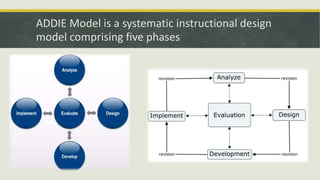
ADDIE Model is a systematic instructional design
model comprising five phases
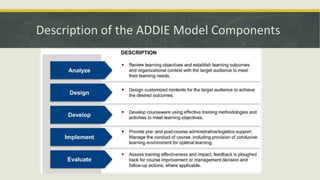
Description of the ADDIE Model Components
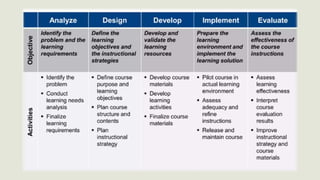
The Five Phases of
ADDIE
-Corresponding Objectives and Activities
Phase 1- Analyze
The Analysis phase can be considered as the “Goal-Setting Stage.”
It is also here that the program matches the level of skill and
intelligence that each student/participant shows.
Several key components are to be utilized to make sure analysis is
thorough. Course texts and documents, syllabi and the internet are
to be employed. With the help of online materials such as web
courses, a structure can be determined as the primary guide for the
syllabus. At the end of the program, instructional analysis will be
conducted to determine what subjects or topics are to be included.
Phase 2-Design
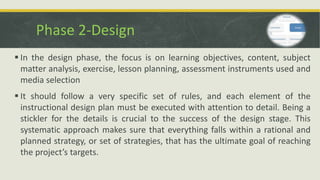
 In the design phase, the focus is on learning objectives, content, subject
matter analysis, exercise, lesson planning, assessment instruments used and
media selection
 It should follow a very specific set of rules, and each element of the
instructional design plan must be executed with attention to detail. Being a
stickler for the details is crucial to the success of the design stage. This
systematic approach makes sure that everything falls within a rational and
planned strategy, or set of strategies, that has the ultimate goal of reaching
the project’s targets.
Phase 3-Development
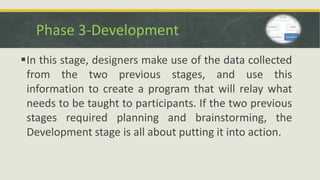
In this stage, designers make use of the data collected
from the two previous stages, and use this
information to create a program that will relay what
needs to be taught to participants. If the two previous
stages required planning and brainstorming, the
Development stage is all about putting it into action.
Phase 4-Implementation
The implementation stage reflects the program's continuous
modification to ensure maximum efficiency and positive
results are obtained. Here is where IDs strive to redesign,
update, and edit the course to ensure it can be delivered
effectively. “Procedure” is the keyword here. Much of the
real work is done here as IDs and students work hand in
hand to train on new tools so that the design can be
continuously evaluated for further improvement.
Phase 5-Evaluation
This is the stage in which the project is subjected to meticulous
final testing regarding the what, how, why, and when of the
things that were accomplished (or not accomplished) of the
entire project.
This phase can be broken down into two parts: Formative and
Summative.
The Formative phase happens while students and IDs are
conducting the study, while the Summative portion occurs at the
end of the program.
How is ADDIE Model applied in
teaching/learning process
 ADDIE helps identify the learning needs
in a structured way and ensures all
learning activities serve that goal,
offering an integrated learning
approach. It also guides measuring
learning effectiveness because job
behaviors, knowledge, and skills are
clearly defined within the framework
Resources
*https://educationaltechnology.net/the-addie-model-
instructional-design/
*https://www.slideshare.net/oeconsulting/addie-model-for-
instructional-design-by-operational-excellence-consulting
*https://blog.zipboard.co/the-basics-of-instructional-design-
processes-270e010e35f6

ADDIE-Model-For-Instructional-Design_Caparo.pptx

  • 1.
    ADDIE Model (For InstructionalDesign) Jane Dell P. Caparo
  • 2.
    Learning Objectives Obtain anoverview of the ADDIE Model Acquire detailed knowledge of the Five-Step ADDIE process for instructional design
  • 3.
    Content Overview of theADDIE Model The Five Phases of ADDIE for instructional design Analyze Design Develop Implement Evaluate
  • 4.
    The ADDIE Model Developedby the Florida State University in 1975 and has evolved over time It is an approach used by instructional designers and content developers to create instructional course materials This has been adopted as the standard method by many instructional designers because of its flexibility
  • 5.
    The ADDIE Model Representsa lean, dynamic, flexible guidelines for building effective training and performance support tools Helps to save time and money by catching problems while they are still easy to fix
  • 6.
    ADDIE Model isa systematic instructional design model comprising five phases
  • 7.
    Description of theADDIE Model Components
  • 8.
    The Five Phasesof ADDIE -Corresponding Objectives and Activities
  • 10.
    Phase 1- Analyze TheAnalysis phase can be considered as the “Goal-Setting Stage.” It is also here that the program matches the level of skill and intelligence that each student/participant shows. Several key components are to be utilized to make sure analysis is thorough. Course texts and documents, syllabi and the internet are to be employed. With the help of online materials such as web courses, a structure can be determined as the primary guide for the syllabus. At the end of the program, instructional analysis will be conducted to determine what subjects or topics are to be included.
  • 11.
    Phase 2-Design  Inthe design phase, the focus is on learning objectives, content, subject matter analysis, exercise, lesson planning, assessment instruments used and media selection  It should follow a very specific set of rules, and each element of the instructional design plan must be executed with attention to detail. Being a stickler for the details is crucial to the success of the design stage. This systematic approach makes sure that everything falls within a rational and planned strategy, or set of strategies, that has the ultimate goal of reaching the project’s targets.
  • 12.
    Phase 3-Development In thisstage, designers make use of the data collected from the two previous stages, and use this information to create a program that will relay what needs to be taught to participants. If the two previous stages required planning and brainstorming, the Development stage is all about putting it into action.
  • 13.
    Phase 4-Implementation The implementationstage reflects the program's continuous modification to ensure maximum efficiency and positive results are obtained. Here is where IDs strive to redesign, update, and edit the course to ensure it can be delivered effectively. “Procedure” is the keyword here. Much of the real work is done here as IDs and students work hand in hand to train on new tools so that the design can be continuously evaluated for further improvement.
  • 14.
    Phase 5-Evaluation This isthe stage in which the project is subjected to meticulous final testing regarding the what, how, why, and when of the things that were accomplished (or not accomplished) of the entire project. This phase can be broken down into two parts: Formative and Summative. The Formative phase happens while students and IDs are conducting the study, while the Summative portion occurs at the end of the program.
  • 15.
    How is ADDIEModel applied in teaching/learning process  ADDIE helps identify the learning needs in a structured way and ensures all learning activities serve that goal, offering an integrated learning approach. It also guides measuring learning effectiveness because job behaviors, knowledge, and skills are clearly defined within the framework
  • 16.