EDUCATIONAL TECHNOLOGY 2:
AN INSTRUCTIONAL DESIGN
the
ADDIE
model
WHAT MAKES IT A SYSTEMATIC
INSTRUCTIONAL DESIGN ?
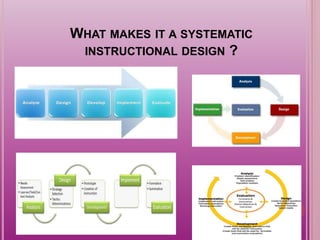
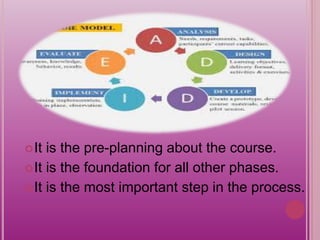
The diagrams shows that ADDIE
model follows phases systematically
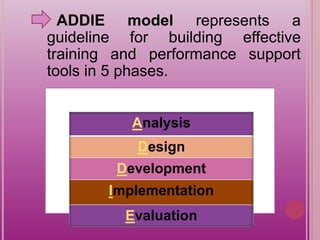
ADDIE model represents a
guideline for building effective
training and performance support
tools in 5 phases.
Analysis
Design
Development
Implementation
Evaluation
WHAT IS ABOUT ANALYSIS PHASE ?
During analysis, the designer identifies
the learning problem, the goals and
objectives, the audience’s needs,
existing knowledge, and any other
relevant characteristics.
It is the pre-planning about the course.
It is the foundation for all other phases.
It is the most important step in the process.
QUESTIONS THAT ARE ADDRESSED IN THE
ANALYSIS PHASE
Who are the audience and their
characteristic?
Identify the new behavioral outcome.
What type of learning constraint exist?
What are the delivery option?
What are the online pedagogical
consideration?
What is the timeline for the project
completion?
WHAT IS ABOUT DESIGN PHASE ?
It is systematic process of specifying
learning objectives. In here, detailed
storyboards and prototypes are often
made, and the look and feel, graphic
design, user-interface and content are
determined.
ADDIE MODEL
The design phase endeavors to
identify specific learning objectives,
assessment instruments, exercises,
content, subject matter analysis,
lesson planning and media selection.
It involves the output from the analyze
phase to plan a strategy for developing
the instruction.
It is the brainstorming phase.
ADDIE MODEL
In this phase, the developers:
 Document the instructional, visual, and
technical design strategy.
 Apply instructional strategies according to
intended behavioral outcomes by domain.
 Design the user interface and user
experience.
 Create a prototype
 Apply visual designs.
ADDIE MODEL
Steps used in the Design Phase
* Documentation of the project’s
instructional, visual and technical
design strategy.
* Create story boards.
* Design the user interface and
user experience.
ADDIE MODEL
* Prototype creation.
* Apply visual designs (graphic designs).
*Apply the instructional strategies
according to the intended behavioral outcomes
by domain (cognitive, affective, psychomotor).
WHAT IS ABOUT
DEVELOPMENT PHASE ?
It is the actual creation (production)
of the content and the learning
materials based on the design phase.
ADDIE MODEL
It is where the developers create and
assemble the content assets that were
created in the design phase.
The purpose of this phase is to
generate the lesson plan and lesson
materials.
WHAT IS ABOUT
IMPLEMENTATION PHASE ?
During implementation, the plan is put
into action and a procedure for training
the learner and the teacher developed.
The materials are delivered or
distributed to the student group. After
delivery, the effectiveness of the
training materials are evaluated.
ADDIE MODEL
Refers to the actual delivery of the
instruction, whether it’s classroom-
based, lab-based, or computer-based.
Includes more processes than simply
presenting the materials developed.
The preparation of the learners include
training them on new tools.
WHAT IS ABOUT EVALUATION PHASE ?
Assesses the effectiveness of the topic
content and training materials utilized
in the training program and makes
improvement changes for the next
implementation or presentation.
ADDIE MODEL
A systematic process, considers as
feedback from learners.
Measurement of how well the
performance solution achieve the
objective.
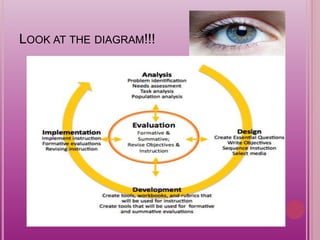
LOOK AT THE DIAGRAM!!!
The diagrams shows that
evaluation could be
conducted every after the
ADDIE models phase
EVALUATION COULD BE . . .
 Formative evaluation
 Summative Evaluation
Formative evaluation involves
gathering information during the
analysis stages of the design process
with the focus on finding out whether
efforts are relating as planned,
uncovering any obstacle, barriers or
unexpected opportunities that may
have emerged, and identity mid-
project adjustment and corrections
which can help insure the success of
the project.
Summative evaluation is the process
of collecting data following the
implementation of the project in order
to determine its effectiveness and
satisfies the instructional objectives.
SEVEN COMMON WEAKNESSES OF THE
ADDIE PROCESS
Typical processes require unrealistically
comprehensive up-front analysis. Most
teams respond by doing very little at all
and fail to access critical elements.
Ignores some political realities.
Opportunities are misses, vital
resources aren't made available,
support is lacking, and targets shift.
Storyboards are ineffective tools for
creating, communicating and
evaluating design alternatives. Poor
designs aren't recognized as such until
too late.
Detailed processes become so set that
creativity becomes a nuisance.
No accommodation for dealing with
faults or good ideas to put the process.
Learning programs are designed to
meet criteria that are measured and
fail to focus on identifying behavioral
changes.
Posttest provide little useful
information to asset in improving
instruction.
KEVIN “DICK” CAREY
PRESENTED BY
Ryo Emmary A. Gonzales
MTh 7:30-9:00
Melanie Garcia
Mth 2:30-4:00
Novi Mae Garcia
TFri 7:30-9:00
Ricardo A. Galang
Tfri 2:30-4:00
Presented by:
Ryo Emmary A. Gonzales
MTh 7:30-9:00

The ADDIE Model

  • 1.
    EDUCATIONAL TECHNOLOGY 2: ANINSTRUCTIONAL DESIGN the ADDIE model
  • 3.
    WHAT MAKES ITA SYSTEMATIC INSTRUCTIONAL DESIGN ?
  • 4.
    The diagrams showsthat ADDIE model follows phases systematically
  • 5.
    ADDIE model representsa guideline for building effective training and performance support tools in 5 phases. Analysis Design Development Implementation Evaluation
  • 6.
    WHAT IS ABOUTANALYSIS PHASE ? During analysis, the designer identifies the learning problem, the goals and objectives, the audience’s needs, existing knowledge, and any other relevant characteristics.
  • 7.
    It is thepre-planning about the course. It is the foundation for all other phases. It is the most important step in the process.
  • 8.
    QUESTIONS THAT AREADDRESSED IN THE ANALYSIS PHASE Who are the audience and their characteristic? Identify the new behavioral outcome. What type of learning constraint exist? What are the delivery option? What are the online pedagogical consideration? What is the timeline for the project completion?
  • 9.
    WHAT IS ABOUTDESIGN PHASE ? It is systematic process of specifying learning objectives. In here, detailed storyboards and prototypes are often made, and the look and feel, graphic design, user-interface and content are determined.
  • 10.
    ADDIE MODEL The designphase endeavors to identify specific learning objectives, assessment instruments, exercises, content, subject matter analysis, lesson planning and media selection. It involves the output from the analyze phase to plan a strategy for developing the instruction. It is the brainstorming phase.
  • 11.
    ADDIE MODEL In thisphase, the developers:  Document the instructional, visual, and technical design strategy.  Apply instructional strategies according to intended behavioral outcomes by domain.  Design the user interface and user experience.  Create a prototype  Apply visual designs.
  • 12.
    ADDIE MODEL Steps usedin the Design Phase * Documentation of the project’s instructional, visual and technical design strategy. * Create story boards. * Design the user interface and user experience.
  • 13.
    ADDIE MODEL * Prototypecreation. * Apply visual designs (graphic designs). *Apply the instructional strategies according to the intended behavioral outcomes by domain (cognitive, affective, psychomotor).
  • 14.
    WHAT IS ABOUT DEVELOPMENTPHASE ? It is the actual creation (production) of the content and the learning materials based on the design phase.
  • 15.
    ADDIE MODEL It iswhere the developers create and assemble the content assets that were created in the design phase. The purpose of this phase is to generate the lesson plan and lesson materials.
  • 16.
    WHAT IS ABOUT IMPLEMENTATIONPHASE ? During implementation, the plan is put into action and a procedure for training the learner and the teacher developed. The materials are delivered or distributed to the student group. After delivery, the effectiveness of the training materials are evaluated.
  • 17.
    ADDIE MODEL Refers tothe actual delivery of the instruction, whether it’s classroom- based, lab-based, or computer-based. Includes more processes than simply presenting the materials developed. The preparation of the learners include training them on new tools.
  • 18.
    WHAT IS ABOUTEVALUATION PHASE ? Assesses the effectiveness of the topic content and training materials utilized in the training program and makes improvement changes for the next implementation or presentation.
  • 19.
    ADDIE MODEL A systematicprocess, considers as feedback from learners. Measurement of how well the performance solution achieve the objective.
  • 20.
    LOOK AT THEDIAGRAM!!!
  • 21.
    The diagrams showsthat evaluation could be conducted every after the ADDIE models phase
  • 22.
    EVALUATION COULD BE. . .  Formative evaluation  Summative Evaluation
  • 23.
    Formative evaluation involves gatheringinformation during the analysis stages of the design process with the focus on finding out whether efforts are relating as planned, uncovering any obstacle, barriers or unexpected opportunities that may have emerged, and identity mid- project adjustment and corrections which can help insure the success of the project.
  • 24.
    Summative evaluation isthe process of collecting data following the implementation of the project in order to determine its effectiveness and satisfies the instructional objectives.
  • 26.
    SEVEN COMMON WEAKNESSESOF THE ADDIE PROCESS Typical processes require unrealistically comprehensive up-front analysis. Most teams respond by doing very little at all and fail to access critical elements. Ignores some political realities. Opportunities are misses, vital resources aren't made available, support is lacking, and targets shift.
  • 27.
    Storyboards are ineffectivetools for creating, communicating and evaluating design alternatives. Poor designs aren't recognized as such until too late. Detailed processes become so set that creativity becomes a nuisance. No accommodation for dealing with faults or good ideas to put the process.
  • 28.
    Learning programs aredesigned to meet criteria that are measured and fail to focus on identifying behavioral changes. Posttest provide little useful information to asset in improving instruction.
  • 29.
  • 30.
    PRESENTED BY Ryo EmmaryA. Gonzales MTh 7:30-9:00 Melanie Garcia Mth 2:30-4:00 Novi Mae Garcia TFri 7:30-9:00 Ricardo A. Galang Tfri 2:30-4:00 Presented by: Ryo Emmary A. Gonzales MTh 7:30-9:00