UNIT 1.
HYDROCARBONS
 DERIVATIVES
Organic Compounds
 Organic compounds are compounds
  containing C, H, O, N, P, S
 These six elements comprise 99% of the
  mass of all living things.
 Organic Chemistry is know as chemistry of
  living things.
 Are divided into two main classes:

    hydrocarbons and
    hydrocarbon derivatives
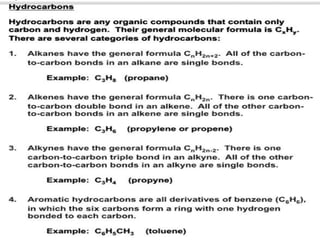
Hydrocarbons

 Are the simplest type of organic compounds
 Containing only carbon and hydrogen, they
  can be straight-chain, branched chain, or
  cyclic molecules.
 Carbon tends to form four bonds in a
  tetrahedral geometry
Carbon structure

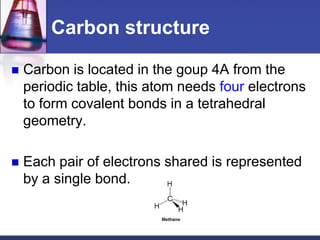
   Carbon is located in the goup 4A from the
    periodic table, this atom needs four electrons
    to form covalent bonds in a tetrahedral
    geometry.

   Each pair of electrons shared is represented
    by a single bond.
Hydrocarbon Nomenclature

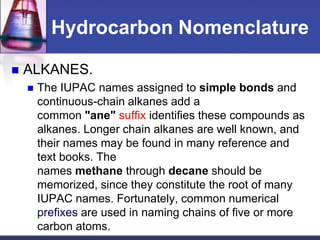
   ALKANES.
       The IUPAC names assigned to simple bonds and
        continuous-chain alkanes add a
        common "ane" suffix identifies these compounds as
        alkanes. Longer chain alkanes are well known, and
        their names may be found in many reference and
        text books. The
        names methane through decane should be
        memorized, since they constitute the root of many
        IUPAC names. Fortunately, common numerical
        prefixes are used in naming chains of five or more
        carbon atoms.
Activity #1 Alkanes, Alkenes
       and Alkynes Nomenclature
Portfolio.


Complete the following charts in your
 notebook (classwork)
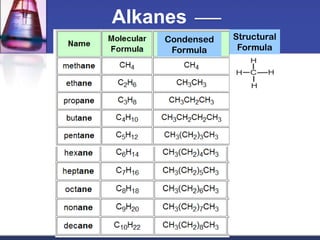
Alkanes
    Condensed   Structural
     Formula     Formula
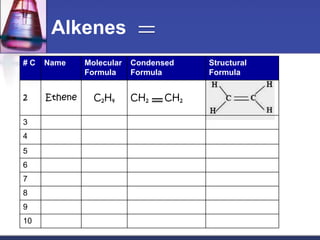
Alkenes
#C   Name     Molecular   Condensed    Structural
              Formula     Formula      Formula


2    Ethene     C2 H4     CH2    CH2

3
4
5
6
7
8
9
10
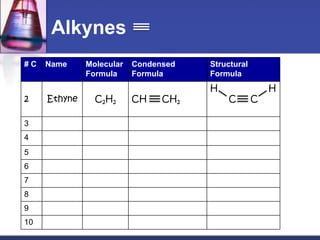
Alkynes
#C   Name     Molecular   Condensed   Structural
              Formula     Formula     Formula
                                      H                H
2    Ethyne     C2 H2     CH    CH2       C        C

3
4
5
6
7
8
9
10
Branched Hydrocarbons

   Beginning with butane (C4H10), and
    becoming more numerous with larger
    alkanes, we note the existence of alkane
    isomers.

   Somers are hydrocarbons with the same
    molecular formula (# of H and C) but
    different structure
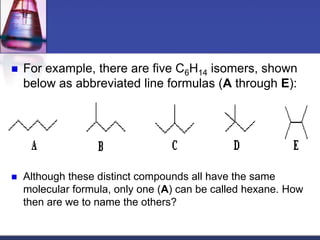
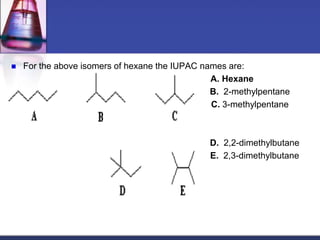
   For example, there are five C6H14 isomers, shown
    below as abbreviated line formulas (A through E):


   Although these distinct compounds all have the same
    molecular formula, only one (A) can be called hexane. How
    then are we to name the others?
   The IUPAC system requires first that we have
    names for simple unbranched chains, as noted
    above, and second that we have names for simple
    alkyl groups that may be attached to the chains.

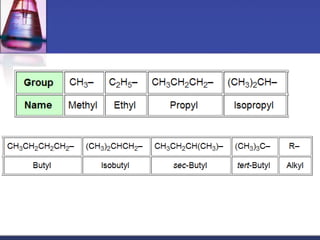
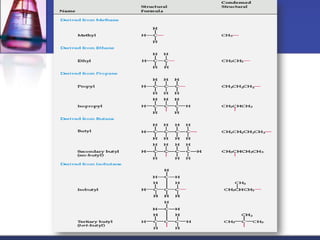
   Examples of some common alkyl groups are
    given in the following table. Note that the "ane"
    suffix is replaced by "yl" in naming groups. The
    symbol R is used to designate a generic
    (unspecified) alkyl group.
Nomenclature of Branched
        Hydrocarbons
IUPAC Rules for Alkane Nomenclature
   1. Find and name the longest continuous carbon chain.
   2. Identify and name groups attached to this chain.
   3. Number the chain consecutively, starting at the end
  nearest a substituent group.
   4. Designate the location of each substituent group by an
  appropriate number and name.
   5. Assemble the name, listing groups in alphabetical
  order using the full name (e.g. cyclopropyl before isobutyl).
     The prefixes di, tri, tetra etc., used to designate several
  groups of the same kind, are not considered when
  alphabetizing.
   For the above isomers of hexane the IUPAC names are:
                                                A. Hexane
                                                B. 2-methylpentane
                                                C. 3-methylpentane


                                               D. 2,2-dimethylbutane
                                               E. 2,3-dimethylbutane
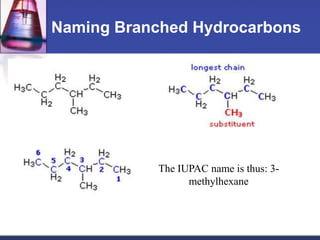
Naming Branched Hydrocarbons


            The IUPAC name is thus: 3-
                  methylhexane
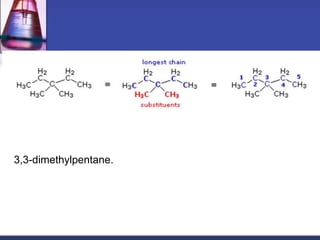
3,3-dimethylpentane.
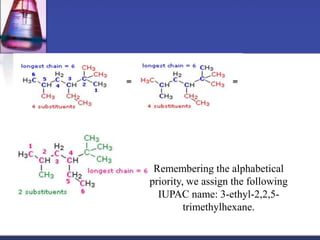
Remembering the alphabetical
priority, we assign the following
  IUPAC name: 3-ethyl-2,2,5-
         trimethylhexane.
Activity #2. Hydrocarbon
      Derivatives
 Investigate the General Formula, Functional
  Group, Chemical properties and Physical
  Properties of the following Hydrocarbon
  Derivates:
 Halides
 Alcohols
 Ethers


Portfolio in your notebook (homework)
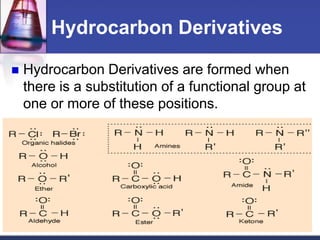
Hydrocarbon Derivatives

   Hydrocarbon Derivatives are formed when
    there is a substitution of a functional group at
    one or more of these positions.

Organic chemistry

  • 1.
  • 2.
    Organic Compounds  Organiccompounds are compounds containing C, H, O, N, P, S  These six elements comprise 99% of the mass of all living things.  Organic Chemistry is know as chemistry of living things.  Are divided into two main classes: hydrocarbons and hydrocarbon derivatives
  • 3.
    Hydrocarbons  Are thesimplest type of organic compounds  Containing only carbon and hydrogen, they can be straight-chain, branched chain, or cyclic molecules.  Carbon tends to form four bonds in a tetrahedral geometry
  • 4.
    Carbon structure  Carbon is located in the goup 4A from the periodic table, this atom needs four electrons to form covalent bonds in a tetrahedral geometry.  Each pair of electrons shared is represented by a single bond.
  • 6.
    Hydrocarbon Nomenclature  ALKANES.  The IUPAC names assigned to simple bonds and continuous-chain alkanes add a common "ane" suffix identifies these compounds as alkanes. Longer chain alkanes are well known, and their names may be found in many reference and text books. The names methane through decane should be memorized, since they constitute the root of many IUPAC names. Fortunately, common numerical prefixes are used in naming chains of five or more carbon atoms.
  • 7.
    Activity #1 Alkanes,Alkenes and Alkynes Nomenclature Portfolio. Complete the following charts in your notebook (classwork)
  • 8.
    Alkanes Condensed Structural Formula Formula
  • 9.
    Alkenes #C Name Molecular Condensed Structural Formula Formula Formula 2 Ethene C2 H4 CH2 CH2 3 4 5 6 7 8 9 10
  • 10.
    Alkynes #C Name Molecular Condensed Structural Formula Formula Formula H H 2 Ethyne C2 H2 CH CH2 C C 3 4 5 6 7 8 9 10
  • 11.
    Branched Hydrocarbons  Beginning with butane (C4H10), and becoming more numerous with larger alkanes, we note the existence of alkane isomers.  Somers are hydrocarbons with the same molecular formula (# of H and C) but different structure
  • 12.
    For example, there are five C6H14 isomers, shown below as abbreviated line formulas (A through E):  Although these distinct compounds all have the same molecular formula, only one (A) can be called hexane. How then are we to name the others?
  • 13.
    The IUPAC system requires first that we have names for simple unbranched chains, as noted above, and second that we have names for simple alkyl groups that may be attached to the chains.  Examples of some common alkyl groups are given in the following table. Note that the "ane" suffix is replaced by "yl" in naming groups. The symbol R is used to designate a generic (unspecified) alkyl group.
  • 16.
    Nomenclature of Branched Hydrocarbons IUPAC Rules for Alkane Nomenclature 1. Find and name the longest continuous carbon chain. 2. Identify and name groups attached to this chain. 3. Number the chain consecutively, starting at the end nearest a substituent group. 4. Designate the location of each substituent group by an appropriate number and name. 5. Assemble the name, listing groups in alphabetical order using the full name (e.g. cyclopropyl before isobutyl). The prefixes di, tri, tetra etc., used to designate several groups of the same kind, are not considered when alphabetizing.
  • 17.
    For the above isomers of hexane the IUPAC names are: A. Hexane B. 2-methylpentane C. 3-methylpentane D. 2,2-dimethylbutane E. 2,3-dimethylbutane
  • 18.
    Naming Branched Hydrocarbons The IUPAC name is thus: 3- methylhexane
  • 19.
  • 20.
    Remembering the alphabetical priority,we assign the following IUPAC name: 3-ethyl-2,2,5- trimethylhexane.
  • 21.
    Activity #2. Hydrocarbon Derivatives  Investigate the General Formula, Functional Group, Chemical properties and Physical Properties of the following Hydrocarbon Derivates:  Halides  Alcohols  Ethers Portfolio in your notebook (homework)
  • 22.
    Hydrocarbon Derivatives  Hydrocarbon Derivatives are formed when there is a substitution of a functional group at one or more of these positions.