Oxidation and Reduction
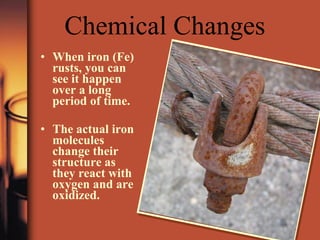
Chemical Changes When iron (Fe) rusts, you can see it happen over a long period of time. The actual iron molecules change their structure as they react with oxygen and are oxidized.
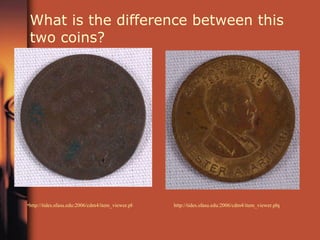
What is the difference between this two coins? http://tides.sfasu.edu:2006/cdm4/item_viewer.php?CISOROOT=/StoneFort&CISOPTR=206&CISOBOX=1&REC=1 http://tides.sfasu.edu:2006/cdm4/item_viewer.php?CISOROOT=/StoneFort&CISOPTR=207&CISOBOX=1&REC=17
Corrosion Is the primary means by which metals deteriorate on contact with water (and moisture in the air), acids, bases, salts, oils, aggressive metal polishes, and other solid and liquid chemicals. The best known case is rusting (oxidation) Corrosion processes are usually electrochemical in nature, having the essential features of a battery (gain and lose electrons).
Oxidation - Reduction Oxidation  : Lose electrons to produce positive ions Example all metals oxidate  Fe  ->  Fe 2+   Cu  ->  Cu + Reduction : gain electrons to produce negative ions Example non-metals reduce  O  ->   O 2-   Cl  ->   Cl
How to prevent corrosion? By the process of  Electroplating   Electroplating:  "elctrodeposition of an adherent metallic coating upon an electrode for the purpose of securing a surface with properties or dimensions different from those of the basis material.“  Other words:  the ability to deposit very thin multilayers of a metal like  Copper, Nickel, Chromium, Zinc.
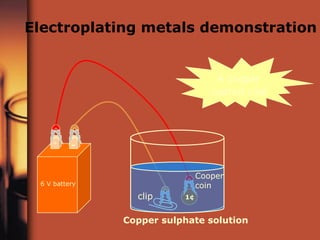
Electroplating metals demonstration 6 V battery +  -  Copper sulphate solution Cooper coin clip 1¢   A cooper coated clip !
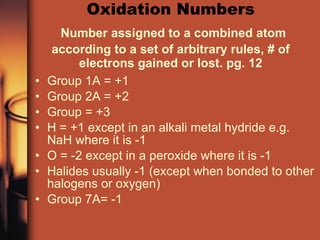
Oxidation Numbers   Number assigned to a combined atom according to a set of arbitrary rules, # of electrons gained or lost. pg. 12 Group 1A = +1 Group 2A = +2 Group = +3 H = +1 except in an alkali metal hydride e.g. NaH where it is -1 O = -2 except in a peroxide where it is -1 Halides usually -1 (except when bonded to other halogens or oxygen) Group 7A= -1
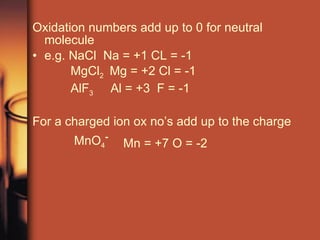
Oxidation numbers add up to 0 for neutral molecule e.g. NaCl  Na = +1 CL = -1 MgCl 2  Mg = +2 Cl = -1 AlF 3   Al = +3  F = -1 For a charged ion ox no’s add up to the charge MnO 4 - Mn = +7 O = -2
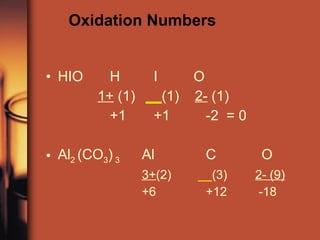
HIO H   I   O   1+  (1)   __ (1)  2-  (1) +1  +1 -2  = 0 Al 2  (CO 3 )  3  Al C   O 3+ (2)   __ (3)   2- (9) +6 +12   -18 Oxidation Numbers
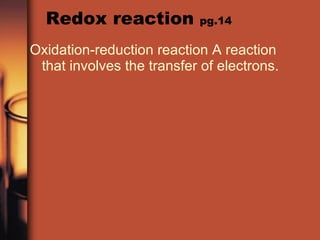
Oxidation-reduction reaction A reaction that involves the transfer of electrons. Redox reaction  pg.14
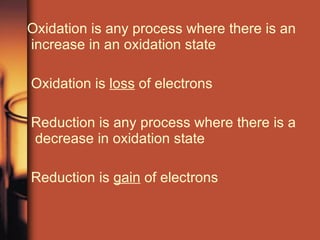
Oxidation is any process where there is an increase in an oxidation state Oxidation is  loss  of electrons Reduction is any process where there is a  decrease in oxidation state Reduction is  gain  of electrons
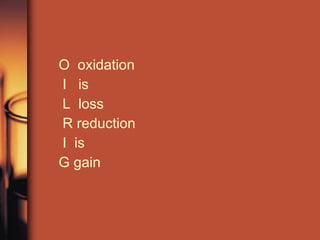
O  oxidation I  is  L  loss R reduction  I  is G gain
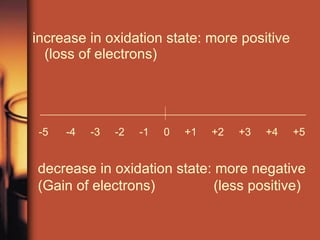
increase in oxidation state: more positive (loss of electrons) ____________________________________________________________ -5  -4  -3  -2  -1  0  +1  +2  +3  +4  +5 decrease in oxidation state: more negative  (Gain of electrons)   (less positive)
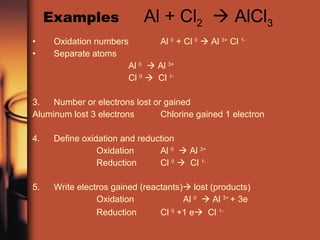
Examples   Al + Cl 2     AlCl 3 Oxidation numbers Al  0  + Cl  0     Al  3+  Cl  1- Separate atoms Al  0     Al  3+ Cl  0      Cl  1- 3. Number or electrons lost or gained Aluminum lost 3 electrons Chlorine gained 1 electron 4. Define oxidation and reduction Oxidation Al  0     Al  3+ Reduction Cl  0      Cl  1- 5. Write electros gained (reactants)   lost (products) Oxidation  Al  0     Al  3+  + 3e Reduction Cl  0  +1 e    Cl  1-
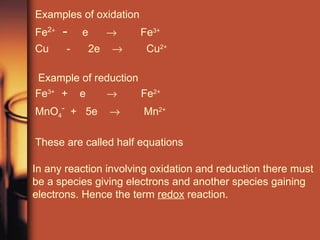
Examples of oxidation Fe 2 +  -   e     Fe 3+   Cu  -  2e     Cu 2+ Example of reduction Fe 3+  +  e     Fe 2+ MnO 4 -   +  5e     Mn 2+ These are called half equations In any reaction involving oxidation and reduction there must be a species giving electrons and another species gaining electrons. Hence the term  redox  reaction.
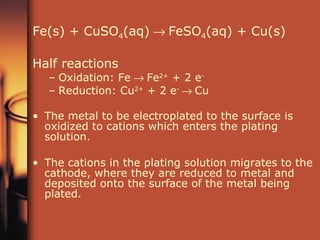
Fe(s) + CuSO 4 (aq)    FeSO 4 (aq) + Cu(s) Half reactions Oxidation: Fe    Fe 2+  + 2 e -  Reduction: Cu 2+  + 2 e -   Cu The metal to be electroplated to the surface is oxidized to cations which enters the plating solution. The cations in the plating solution migrates to the cathode, where they are reduced to metal and deposited onto the surface of the metal being plated.
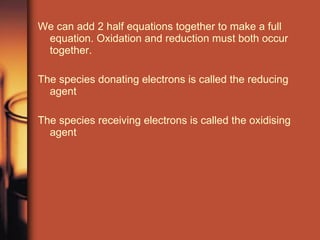
We can add 2 half equations together to make a full equation. Oxidation and reduction must both occur together.  The species donating electrons is called the reducing agent The species receiving electrons is called the oxidising agent
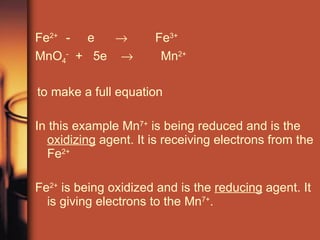
Fe 2+  -  e     Fe 3+  MnO 4 -   +  5e     Mn 2+ to make a full equation In this example Mn 7+  is being reduced and is the  oxidizing  agent. It is receiving electrons from the Fe 2+ Fe 2+  is being oxidized and is the  reducing  agent. It is giving electrons to the Mn 7+ .
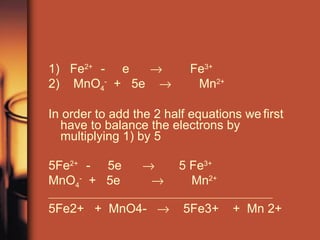
1)  Fe 2+  -  e     Fe 3+  2)  MnO 4 -   +  5e     Mn 2+ In order to add the 2 half equations we   first have to balance the electrons by multiplying 1) by 5 5Fe 2+  -  5e     5 Fe 3+ MnO 4 -   +  5e     Mn 2+ ________________________________________________________ 5Fe2+  +  MnO4-     5Fe3+  +  Mn 2+

Redox Rxn

  • 1.
  • 2.
    Chemical Changes Wheniron (Fe) rusts, you can see it happen over a long period of time. The actual iron molecules change their structure as they react with oxygen and are oxidized.
  • 3.
    What is thedifference between this two coins? http://tides.sfasu.edu:2006/cdm4/item_viewer.php?CISOROOT=/StoneFort&CISOPTR=206&CISOBOX=1&REC=1 http://tides.sfasu.edu:2006/cdm4/item_viewer.php?CISOROOT=/StoneFort&CISOPTR=207&CISOBOX=1&REC=17
  • 4.
    Corrosion Is theprimary means by which metals deteriorate on contact with water (and moisture in the air), acids, bases, salts, oils, aggressive metal polishes, and other solid and liquid chemicals. The best known case is rusting (oxidation) Corrosion processes are usually electrochemical in nature, having the essential features of a battery (gain and lose electrons).
  • 5.
    Oxidation - ReductionOxidation : Lose electrons to produce positive ions Example all metals oxidate Fe -> Fe 2+ Cu -> Cu + Reduction : gain electrons to produce negative ions Example non-metals reduce O -> O 2- Cl -> Cl
  • 6.
    How to preventcorrosion? By the process of Electroplating Electroplating: "elctrodeposition of an adherent metallic coating upon an electrode for the purpose of securing a surface with properties or dimensions different from those of the basis material.“ Other words: the ability to deposit very thin multilayers of a metal like Copper, Nickel, Chromium, Zinc.
  • 7.
    Electroplating metals demonstration6 V battery + - Copper sulphate solution Cooper coin clip 1¢ A cooper coated clip !
  • 8.
    Oxidation Numbers Number assigned to a combined atom according to a set of arbitrary rules, # of electrons gained or lost. pg. 12 Group 1A = +1 Group 2A = +2 Group = +3 H = +1 except in an alkali metal hydride e.g. NaH where it is -1 O = -2 except in a peroxide where it is -1 Halides usually -1 (except when bonded to other halogens or oxygen) Group 7A= -1
  • 9.
    Oxidation numbers addup to 0 for neutral molecule e.g. NaCl Na = +1 CL = -1 MgCl 2 Mg = +2 Cl = -1 AlF 3 Al = +3 F = -1 For a charged ion ox no’s add up to the charge MnO 4 - Mn = +7 O = -2
  • 10.
    HIO H I O 1+ (1) __ (1) 2- (1) +1 +1 -2 = 0 Al 2 (CO 3 ) 3 Al C O 3+ (2) __ (3) 2- (9) +6 +12 -18 Oxidation Numbers
  • 11.
    Oxidation-reduction reaction Areaction that involves the transfer of electrons. Redox reaction pg.14
  • 12.
    Oxidation is anyprocess where there is an increase in an oxidation state Oxidation is loss of electrons Reduction is any process where there is a decrease in oxidation state Reduction is gain of electrons
  • 13.
    O oxidationI is L loss R reduction I is G gain
  • 14.
    increase in oxidationstate: more positive (loss of electrons) ____________________________________________________________ -5 -4 -3 -2 -1 0 +1 +2 +3 +4 +5 decrease in oxidation state: more negative (Gain of electrons) (less positive)
  • 15.
    Examples Al + Cl 2  AlCl 3 Oxidation numbers Al 0 + Cl 0  Al 3+ Cl 1- Separate atoms Al 0  Al 3+ Cl 0  Cl 1- 3. Number or electrons lost or gained Aluminum lost 3 electrons Chlorine gained 1 electron 4. Define oxidation and reduction Oxidation Al 0  Al 3+ Reduction Cl 0  Cl 1- 5. Write electros gained (reactants)  lost (products) Oxidation Al 0  Al 3+ + 3e Reduction Cl 0 +1 e  Cl 1-
  • 16.
    Examples of oxidationFe 2 + - e  Fe 3+ Cu - 2e  Cu 2+ Example of reduction Fe 3+ + e  Fe 2+ MnO 4 - + 5e  Mn 2+ These are called half equations In any reaction involving oxidation and reduction there must be a species giving electrons and another species gaining electrons. Hence the term redox reaction.
  • 17.
    Fe(s) + CuSO4 (aq)  FeSO 4 (aq) + Cu(s) Half reactions Oxidation: Fe  Fe 2+ + 2 e - Reduction: Cu 2+ + 2 e -  Cu The metal to be electroplated to the surface is oxidized to cations which enters the plating solution. The cations in the plating solution migrates to the cathode, where they are reduced to metal and deposited onto the surface of the metal being plated.
  • 18.
    We can add2 half equations together to make a full equation. Oxidation and reduction must both occur together. The species donating electrons is called the reducing agent The species receiving electrons is called the oxidising agent
  • 19.
    Fe 2+ - e  Fe 3+ MnO 4 - + 5e  Mn 2+ to make a full equation In this example Mn 7+ is being reduced and is the oxidizing agent. It is receiving electrons from the Fe 2+ Fe 2+ is being oxidized and is the reducing agent. It is giving electrons to the Mn 7+ .
  • 20.
    1) Fe2+ - e  Fe 3+ 2) MnO 4 - + 5e  Mn 2+ In order to add the 2 half equations we first have to balance the electrons by multiplying 1) by 5 5Fe 2+ - 5e  5 Fe 3+ MnO 4 - + 5e  Mn 2+ ________________________________________________________ 5Fe2+ + MnO4-  5Fe3+ + Mn 2+