CHEMISTRY II UNIT I Chemical Equations. The language of reactions
CHEMISTRY The branch of science that deals with the characteristics and composition of all materials and with the reactions they can undergo
The Chemistry and its relation with other sciences. BIOLOGY PHYSICS MATHEMATICS SOCIAL SCIENCES
Physical Changes Physical changes are about  energy and states of matter changes. A physical change does not produce a new substance. Changes in state or phase (melting, freezing, vaporization, condensation, sublimation) are physical changes.  Examples of physical changes include crushing a can, melting an ice cube, and breaking a bottle.
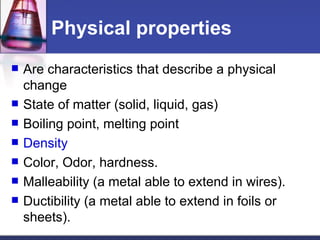
Physical properties Are characteristics that describe a physical change State of matter (solid, liquid, gas) Boiling point, melting point Density Color, Odor, hardness. Malleability (a metal able to extend in wires). Ductibility (a metal able to extend in foils or sheets).
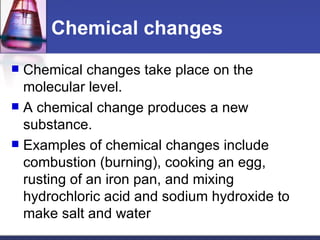
Chemical changes Chemical changes take place on the molecular level.  A chemical change produces a new substance.  Examples of chemical changes include combustion (burning), cooking an egg, rusting of an iron pan, and mixing hydrochloric acid and sodium hydroxide to make salt and water
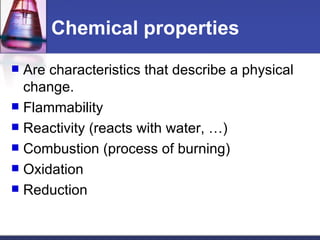
Chemical properties Are characteristics that describe a physical change. Flammability Reactivity (reacts with water, …) Combustion (process of burning)  Oxidation Reduction
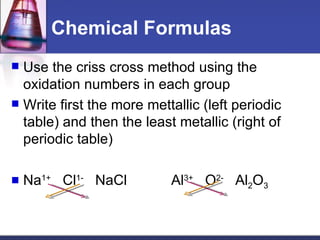
Chemical Formulas Use the criss cross method using the oxidation numbers in each group Write first the more mettallic (left periodic table) and then the least metallic (right of periodic table) Na 1+   Cl 1-   NaCl Al 3+   O 2-   Al 2 O 3
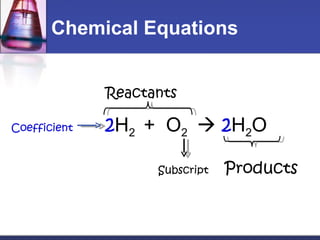
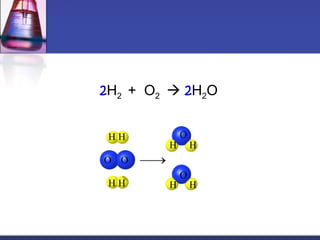
Chemical Equations Reactants Coefficient  2 H 2  +  O 2     2 H 2 O Subscript  Products
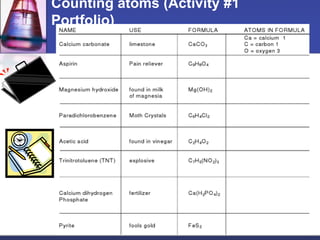
Counting atoms  (Activity #1 Portfolio)
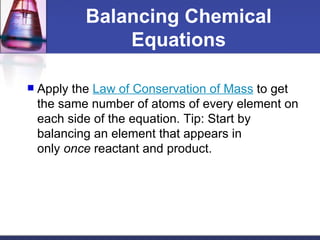
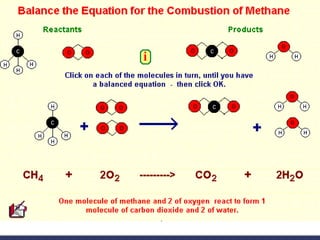
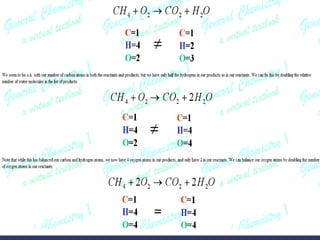
Balancing Chemical Equations Apply the  Law of Conservation of Mass  to get the same number of atoms of every element on each side of the equation. Tip: Start by balancing an element that appears in only  once  reactant and product.
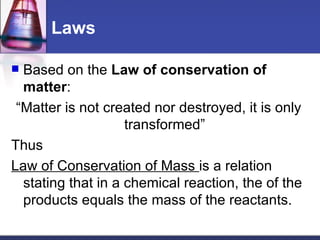
Laws Based on the  Law of conservation of matter : “ Matter is not created nor destroyed, it is only transformed” Thus Law of Conservation of Mass  is a relation stating that in a chemical reaction, the of the products equals the mass of the reactants.
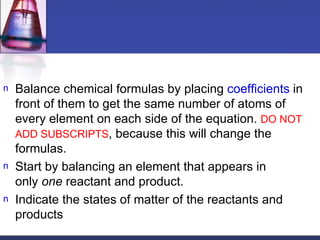
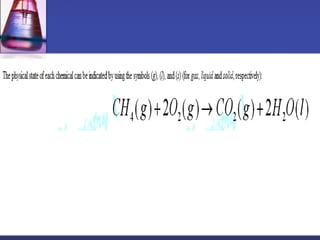
Balance chemical formulas by placing  coefficients  in front of them to get the same number of atoms of every element on each side of the equation.  DO NOT ADD SUBSCRIPTS , because this will change the formulas. Start by balancing an element that appears in only  one  reactant and product.  Indicate the states of matter of the reactants and products
2 H 2  +  O 2     2 H 2 O


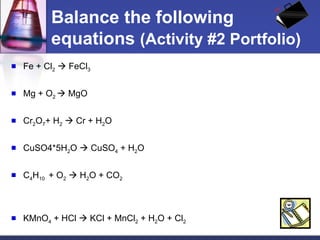
Balance the following equations  (Activity #2 Portfolio)  Fe + Cl 2     FeCl 3   Mg + O 2    MgO Cr 2 O 7 + H 2     Cr + H 2 O CuSO4*5H 2 O    CuSO 4  + H 2 O C 4 H 10  + O 2     H 2 O + CO 2 KMnO 4  + HCl    KCl + MnCl 2  + H 2 O + Cl 2

chemical equations

  • 1.
    CHEMISTRY II UNITI Chemical Equations. The language of reactions
  • 2.
    CHEMISTRY The branchof science that deals with the characteristics and composition of all materials and with the reactions they can undergo
  • 3.
    The Chemistry andits relation with other sciences. BIOLOGY PHYSICS MATHEMATICS SOCIAL SCIENCES
  • 4.
    Physical Changes Physicalchanges are about energy and states of matter changes. A physical change does not produce a new substance. Changes in state or phase (melting, freezing, vaporization, condensation, sublimation) are physical changes. Examples of physical changes include crushing a can, melting an ice cube, and breaking a bottle.
  • 5.
    Physical properties Arecharacteristics that describe a physical change State of matter (solid, liquid, gas) Boiling point, melting point Density Color, Odor, hardness. Malleability (a metal able to extend in wires). Ductibility (a metal able to extend in foils or sheets).
  • 6.
    Chemical changes Chemicalchanges take place on the molecular level. A chemical change produces a new substance. Examples of chemical changes include combustion (burning), cooking an egg, rusting of an iron pan, and mixing hydrochloric acid and sodium hydroxide to make salt and water
  • 7.
    Chemical properties Arecharacteristics that describe a physical change. Flammability Reactivity (reacts with water, …) Combustion (process of burning) Oxidation Reduction
  • 8.
    Chemical Formulas Usethe criss cross method using the oxidation numbers in each group Write first the more mettallic (left periodic table) and then the least metallic (right of periodic table) Na 1+ Cl 1- NaCl Al 3+ O 2- Al 2 O 3
  • 9.
    Chemical Equations ReactantsCoefficient 2 H 2 + O 2  2 H 2 O Subscript Products
  • 10.
    Counting atoms (Activity #1 Portfolio)
  • 11.
    Balancing Chemical EquationsApply the  Law of Conservation of Mass  to get the same number of atoms of every element on each side of the equation. Tip: Start by balancing an element that appears in only  once  reactant and product.
  • 12.
    Laws Based onthe Law of conservation of matter : “ Matter is not created nor destroyed, it is only transformed” Thus Law of Conservation of Mass is a relation stating that in a chemical reaction, the of the products equals the mass of the reactants.
  • 13.
    Balance chemical formulasby placing coefficients in front of them to get the same number of atoms of every element on each side of the equation. DO NOT ADD SUBSCRIPTS , because this will change the formulas. Start by balancing an element that appears in only  one  reactant and product. Indicate the states of matter of the reactants and products
  • 14.
    2 H 2 + O 2  2 H 2 O
  • 15.
  • 16.
  • 17.
  • 18.
    Balance the followingequations (Activity #2 Portfolio) Fe + Cl 2  FeCl 3 Mg + O 2  MgO Cr 2 O 7 + H 2  Cr + H 2 O CuSO4*5H 2 O  CuSO 4 + H 2 O C 4 H 10 + O 2  H 2 O + CO 2 KMnO 4 + HCl  KCl + MnCl 2 + H 2 O + Cl 2