PERIODIC TABLE .
Law of Triads : In 1817  Johann D ö bereiner  noticed that the atomic weight of strontium fell midway between the weights of calcium and barium, elements possessing similar chemical properties. He proposed that nature contained triads of elements the middle element had properties that were an average of the other two members when ordered by the atomic weight.  Law of Octaves: John Newlands , he classified the 56 established elements into 11 groups based on similar physical properties, noting that many pairs of similar elements existed which differed by some  multiple of eight in atomic weight . In 1864 Newlands published his version of the periodic table and proposed the Law of Octaves,this law stated that any given element will exhibit analogous behavior to the eighth element following it in the table.
Dmitri Mendeleev : He is considered the father of the periodic table, he developed a periodic table of the known elements ordered according to their  atomic mass  and letting spaces for the elements not discovered yet, predicting their properties and atomic masses. Lothar Meyer : In 1868 he developed his own version of the periodic table, unfortunately for Meyer, Mendeleev's table became available to the scientific community via publication two years before his work.
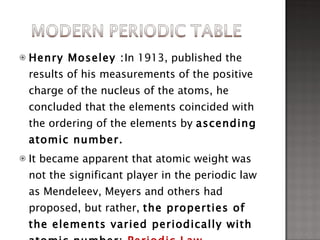
Henry Moseley : In 1913, published the results of his measurements of the positive charge of the nucleus of the atoms, he concluded that the elements coincided with the ordering of the elements by  ascending atomic number.  It became apparent that atomic weight was not the significant player in the periodic law as Mendeleev, Meyers and others had proposed, but rather,  the properties of the elements varied periodically with atomic number:  Periodic Law
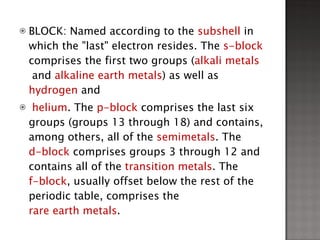
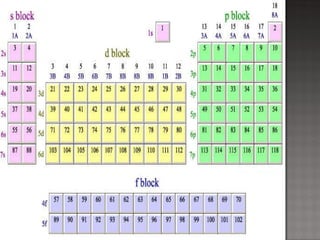
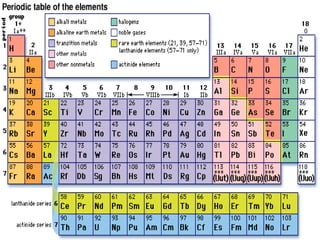
BLOCK: Named according to the  subshell  in which the "last" electron resides. The  s-block  comprises the first two groups ( alkali metals  and  alkaline earth metals ) as well as  hydrogen  and helium . The  p-block  comprises the last six groups (groups 13 through 18) and contains, among others, all of the  semimetals . The  d-block  comprises groups 3 through 12 and contains all of the  transition metals . The  f-block , usually offset below the rest of the periodic table, comprises the  rare earth metals . PERIOD: is a horizontal row in the periodic table. Indicate the outermost energy level of the elements.
 
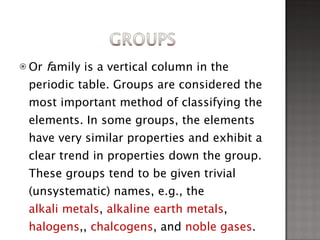
Or  f amily is a vertical column in the periodic table. Groups are considered the most important method of classifying the elements. In some groups, the elements have very similar properties and exhibit a clear trend in properties down the group. These groups tend to be given trivial (unsystematic) names, e.g., the  alkali metals ,  alkaline earth metals ,  halogens ,,  chalcogens , and  noble gases .
 
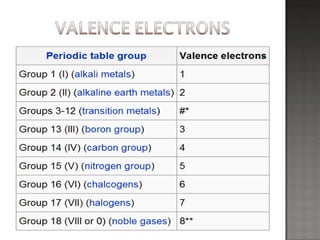
Representative elements are those label as A groups: IA – VIIIA IA: Alkali metals IIA: Alkali Earth metals IIIA:Boron family IVA: Carbon family VA: Nitrogen family VIA: Oxygen family or Chalcogens. VIIA: Halogens VIIIA: Noble gases. Group B: All are called transition metals Lanthanide and actinide series: Rare Earth metals.
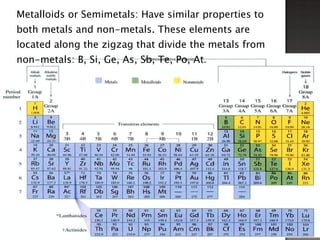
Metalloids or Semimetals: Have similar properties to both metals and non-metals. These elements are located along the zigzag that divide the metals from non-metals: B, Si, Ge, As, Sb, Te, Po, At .
Are the outermost electrons of an atom, which are important in determining how the atom reacts chemically with other atoms. They  do  show a repeating or periodic pattern. The valence electrons  increase in number as you go across a period. Valence electrons are those in the electronic shell of highest  principal quantum number . For example the electronic configuration of phosphorus (P) is 1s 2  2s 2  2p 6  3s 2  3p 3  so that are 5 valence electrons (3s 2  3p 3 ),
 
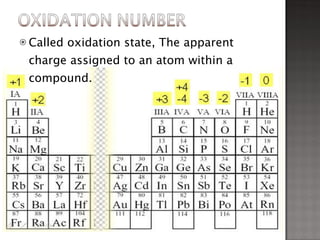
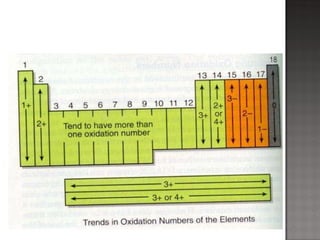
Called oxidation state, The apparent charge assigned to an atom within a compound.
 
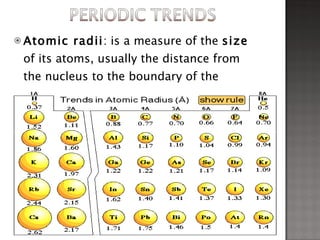
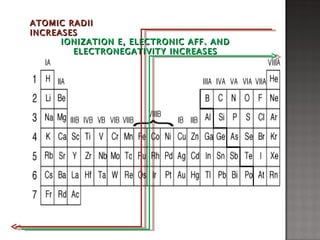
Atomic radii : is a measure of the  size  of its atoms, usually the distance from the nucleus to the boundary of the surrounding cloud of electrons.
Ionization energy:  The energy required to remove an electron from an atom or molecule in gas state. Electronic affinity : The energy absorbed or released when a gaseous atom captures an electron. Electronegativity : a chemical property that describes the ability of an atom to attract electrons from a covalent bond.
ATOMIC RADII INCREASES IONIZATION E, ELECTRONIC AFF. AND ELECTRONEGATIVITY INCREASES

The periodic table

  • 1.
  • 2.
    Law of Triads: In 1817 Johann D ö bereiner noticed that the atomic weight of strontium fell midway between the weights of calcium and barium, elements possessing similar chemical properties. He proposed that nature contained triads of elements the middle element had properties that were an average of the other two members when ordered by the atomic weight. Law of Octaves: John Newlands , he classified the 56 established elements into 11 groups based on similar physical properties, noting that many pairs of similar elements existed which differed by some multiple of eight in atomic weight . In 1864 Newlands published his version of the periodic table and proposed the Law of Octaves,this law stated that any given element will exhibit analogous behavior to the eighth element following it in the table.
  • 3.
    Dmitri Mendeleev :He is considered the father of the periodic table, he developed a periodic table of the known elements ordered according to their atomic mass and letting spaces for the elements not discovered yet, predicting their properties and atomic masses. Lothar Meyer : In 1868 he developed his own version of the periodic table, unfortunately for Meyer, Mendeleev's table became available to the scientific community via publication two years before his work.
  • 4.
    Henry Moseley :In 1913, published the results of his measurements of the positive charge of the nucleus of the atoms, he concluded that the elements coincided with the ordering of the elements by ascending atomic number. It became apparent that atomic weight was not the significant player in the periodic law as Mendeleev, Meyers and others had proposed, but rather, the properties of the elements varied periodically with atomic number: Periodic Law
  • 5.
    BLOCK: Named accordingto the subshell in which the "last" electron resides. The s-block comprises the first two groups ( alkali metals and alkaline earth metals ) as well as hydrogen and helium . The p-block comprises the last six groups (groups 13 through 18) and contains, among others, all of the semimetals . The d-block comprises groups 3 through 12 and contains all of the transition metals . The f-block , usually offset below the rest of the periodic table, comprises the rare earth metals . PERIOD: is a horizontal row in the periodic table. Indicate the outermost energy level of the elements.
  • 6.
  • 7.
    Or family is a vertical column in the periodic table. Groups are considered the most important method of classifying the elements. In some groups, the elements have very similar properties and exhibit a clear trend in properties down the group. These groups tend to be given trivial (unsystematic) names, e.g., the alkali metals , alkaline earth metals , halogens ,, chalcogens , and noble gases .
  • 8.
  • 9.
    Representative elements arethose label as A groups: IA – VIIIA IA: Alkali metals IIA: Alkali Earth metals IIIA:Boron family IVA: Carbon family VA: Nitrogen family VIA: Oxygen family or Chalcogens. VIIA: Halogens VIIIA: Noble gases. Group B: All are called transition metals Lanthanide and actinide series: Rare Earth metals.
  • 10.
    Metalloids or Semimetals:Have similar properties to both metals and non-metals. These elements are located along the zigzag that divide the metals from non-metals: B, Si, Ge, As, Sb, Te, Po, At .
  • 11.
    Are the outermostelectrons of an atom, which are important in determining how the atom reacts chemically with other atoms. They do show a repeating or periodic pattern. The valence electrons increase in number as you go across a period. Valence electrons are those in the electronic shell of highest principal quantum number . For example the electronic configuration of phosphorus (P) is 1s 2 2s 2 2p 6 3s 2 3p 3 so that are 5 valence electrons (3s 2 3p 3 ),
  • 12.
  • 13.
    Called oxidation state,The apparent charge assigned to an atom within a compound.
  • 14.
  • 15.
    Atomic radii :is a measure of the size of its atoms, usually the distance from the nucleus to the boundary of the surrounding cloud of electrons.
  • 16.
    Ionization energy: The energy required to remove an electron from an atom or molecule in gas state. Electronic affinity : The energy absorbed or released when a gaseous atom captures an electron. Electronegativity : a chemical property that describes the ability of an atom to attract electrons from a covalent bond.
  • 17.
    ATOMIC RADII INCREASESIONIZATION E, ELECTRONIC AFF. AND ELECTRONEGATIVITY INCREASES