Chemical Bonding. Unions that build
Atoms tend to gain, lose or share electrons so as to have eight electrons in their outer electron shell giving them the same electronic configuration as a  noble gas .  The rule is applicable to the main-group elements, especially  carbon ,  nitrogen ,  oxygen , and the  halogens , but also to metals such as  sodium  or  magnesium .  In simple terms, molecules or ions tend to be  most stable  when the outermost electron shells of their constituent atoms contain eight electrons.
The octet rule  does not work  for predicting the charges on  transition metals  ions. Transition metals are located on the periodic table in the ten columns between columns for the representative elements, and the groups are labeled IB to VIIIB. The transition metals typically produce ions with 1 +, 2+, 3+  and sometime  4+  charges, and unlike the representative elements many transition metals  can have more than one charge state
Valence electrons :  Electrons in the outermost electron shells, maximum 8 electrons. noble gases has 8 electrons  Ion : A charged atom. Can be either positive or negative. Positive ion : Is an atom that lost at least one electron, are called  cations . Example Na + , Mg 2+ , Al 3+   Negative ion : Is an atom that gained at least one electron, are called  anions . Cl - , O 2- , N 3-
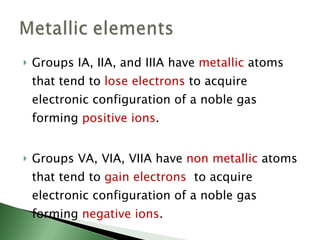
Groups IA, IIA, and IIIA have  metallic  atoms that tend to  lose electrons  to acquire electronic configuration of a noble gas forming  positive ions . Groups VA, VIA, VIIA have  non metallic  atoms that tend to  gain electrons  to acquire electronic configuration of a noble gas forming  negative ions .
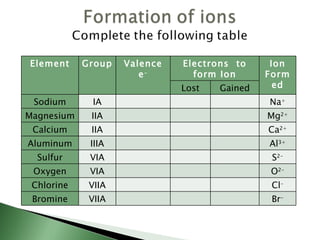
Element Group Valence e - Electrons  to form Ion Ion Formed Lost Gained Sodium IA Na + Magnesium IIA Mg 2+ Calcium IIA Ca 2+ Aluminum IIIA Al 3+ Sulfur VIA S 2- Oxygen VIA O 2- Chlorine VIIA Cl - Bromine VIIA Br -
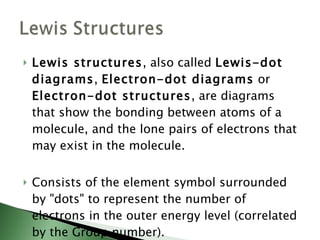
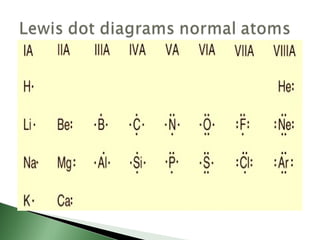
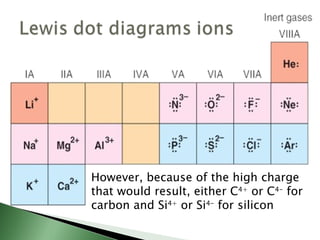
Lewis structures , also called  Lewis-dot diagrams ,  Electron-dot diagrams  or  Electron-dot structures , are diagrams that show the bonding between atoms of a molecule, and the lone pairs of electrons that may exist in the molecule. Consists of the element symbol surrounded by "dots" to represent the number of electrons in the outer energy level (correlated by the Group number).
 
However, because of the high charge that would result, either C 4+  or C 4-  for carbon and Si 4+  or Si 4-  for silicon
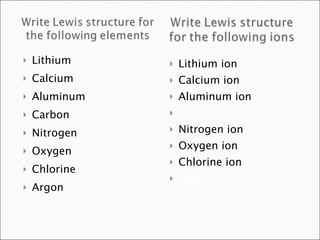
Lithium Calcium Aluminum Carbon Nitrogen Oxygen Chlorine Argon Lithium ion Calcium ion Aluminum ion Carbon Nitrogen ion Oxygen ion Chlorine ion Argon
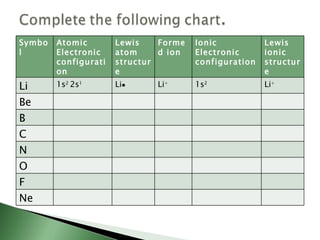
Symbol Atomic Electronic configuration Lewis atom structure Formed ion Ionic Electronic configuration Lewis ionic structure Li 1s 2  2s 1 Li  Li + 1s 2 Li + Be B C N O F Ne
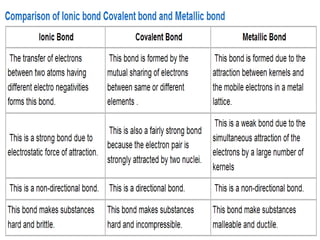
A chemical bond is the attraction caused by the electromagnetic force between opposing charges, either between electrons and nuclei or as the result of a dipole attraction.  The strength of bonds varies considerably; there are "strong bonds" such as  covalent  or  ionic bonds   and "weak bonds" such as  dipole-dipole interactions , the  London dispersion force  and  hydrogen bonding .
Type of chemical bond that involves a  metal  and a  nonmetal   ion  through  electrostatic  attraction. It is a bond formed by the attraction between two oppositely charged ions, The electrostatic attraction between the oppositely charged ions causes them to come together and form a bond like magnets . The metal donates one or more  electrons , forming a positively charged ion or  cation  with a stable  electron configuration . These electrons then enter the non metal, causing it to form a negatively charged ion or  anion  which also has a stable electron configuration.
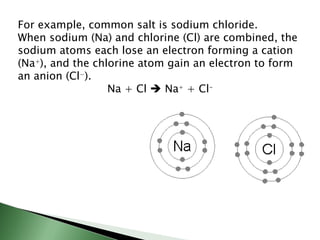
For example, common salt is sodium chloride.  When sodium (Na) and chlorine (Cl) are combined, the sodium atoms each lose an electron forming a cation (Na + ), and the chlorine atom gain an electron to form an anion (Cl − ).  Na + Cl    Na +  + Cl -
Formed between a metallic element and a non metallic element. The bonding involves  electrons transfer , the metal atom donates electrons while the non metal accept the electrons. The compounds formed are solids with a crystal lattice tridimensional structure.  Most of them dissolve in water giving solutions that conducts electricity Salts (NaCl) and acids (HCl) are ionic compounds
1. Find the total number of electrons: For each atom, read the group number. 2. Draw a first tentative structure:   The element with the least number of atoms is usually the central element. Draw a tentative molecular and electron arrangement attaching other atoms with single bonds as the first guess.  3. Add electrons as dots to get octets around atoms: When counting electrons for the octet around an atom, count both electrons in a bond for each atom and any lone pair electrons. Hydrogen, of course, gets only 2 electrons. 4. Count the total number of electrons  in the final structure to see if the total agrees with the number tabulated in step #1. If not, then move a lone pair of electrons into a double bond. Or add more lone pairs of electrons. 5. Cycle through steps 3 and 4  several times until you get it right by trial and error.
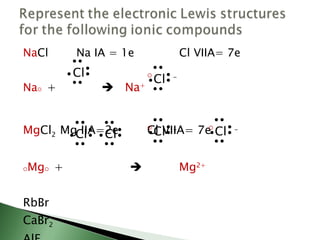
Na Cl   Na IA = 1e Cl VIIA= 7e Na    +      Na +  Mg Cl 2  Mg IIA=2e Cl VIIA= 7e  Mg    +       Mg 2+  RbBr CaBr 2 AlF 3 SrO         Cl                Cl  -                 Cl                Cl                Cl  -                 Cl  -        
Chemical bonding is characterized by the  sharing of pairs of electrons  between atoms. Is formed by at least two non-metallic elements, they can be molecules of the same atom like O 2  or different atoms like H 2 O. The atoms can share more than one pair of electrons, they can share two or even three pair of electrons, like single, double or triple bonds.
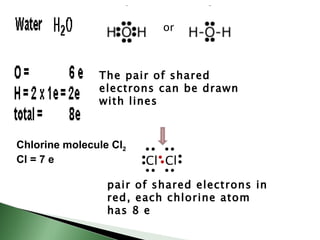
The pair of shared electrons can be drawn with lines Chlorine molecule Cl 2  Cl = 7 e   pair of shared electrons in red, each chlorine atom has 8 e or         Cl                Cl       
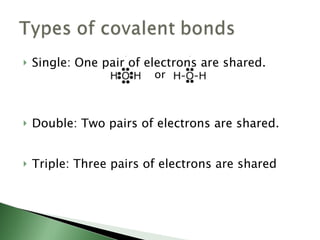
Single: One pair of electrons are shared. Double: Two pairs of electrons are shared. Triple: Three pairs of electrons are shared or
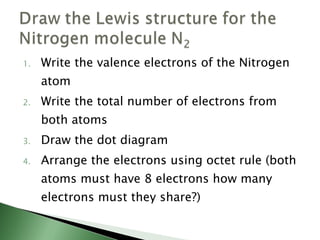
Write the valence electrons of the Nitrogen atom  Write the total number of electrons from both atoms Draw the dot diagram Arrange the electrons using octet rule (both atoms must have 8 electrons how many electrons must they share?)
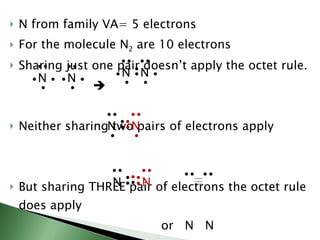
N from family VA= 5 electrons For the molecule N 2  are 10 electrons Sharing just one pair doesn’t apply the octet rule.  Neither sharing two pairs of electrons apply But sharing THREE pair of electrons the octet rule does apply or  N  N              N            N            N            N            N            N           N           N          
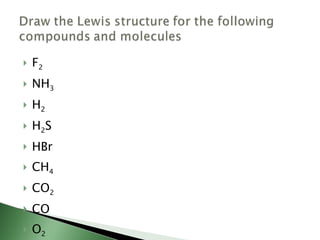
F 2  NH 3  H 2 H 2 S HBr CH 4 CO 2  CO O 2  CCl 4
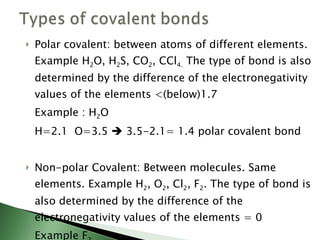
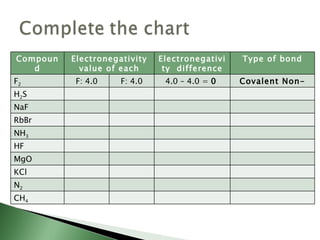
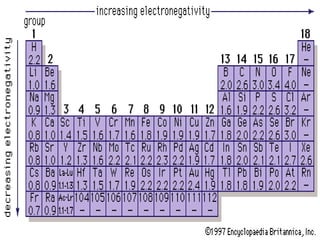
Polar covalent: between atoms of different elements. Example H 2 O, H 2 S, CO 2 , CCl 4.  The type of bond is also determined by the difference of the electronegativity values of the elements <(below)1.7 Example : H 2 O  H=2.1  O=3.5    3.5-2.1= 1.4 polar covalent bond Non-polar Covalent: Between molecules. Same elements. Example H 2 , O 2 , Cl 2 , F 2 . The type of bond is also determined by the difference of the electronegativity values of the elements = 0 Example F 2  F= 4    4-4 = 0 Non-polar Covalent bond
Compound Electronegativity value of each atom Electronegativity  difference Type of bond F 2 F: 4.0 F: 4.0 4.0 – 4.0 =  0   Covalent Non-polar H 2 S NaF RbBr NH 3 HF MgO KCl N 2 CH 4
 
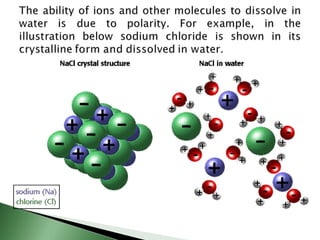
In  chemistry ,  polarity  refers to a separation of  electric charge  leading to a molecule having an electric  dipole . Polar: Is a molecule that can dissolve in water like Salts (NaCl, KF, etc) and Acids (HCl, HNO 3 , etc). Non polar: Is a molecule that can not dissolve in water like fats, oils, gasoline, methane gas (CH 4 ) carbon tetrachloride (CCl 4 ), CO 2 .
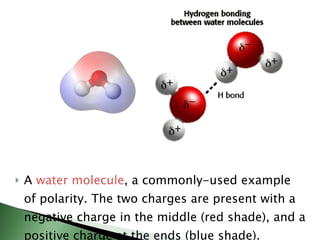
A  water molecule , a commonly-used example of polarity. The two charges are present with a negative charge in the middle (red shade), and a positive charge at the ends (blue shade).
 
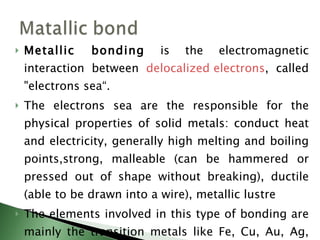
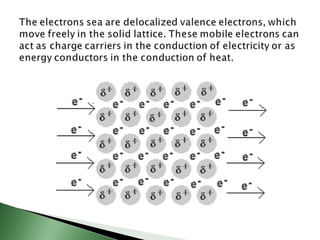
Metallic bonding  is the electromagnetic interaction between  delocalized electrons , called &quot;electrons sea“. The electrons sea are the responsible for the physical properties of solid metals: conduct heat and electricity, generally high melting and boiling points,strong, malleable (can be hammered or pressed out of shape without breaking), ductile (able to be drawn into a wire), metallic lustre  The elements involved in this type of bonding are mainly the transition metals like Fe, Cu, Au, Ag, Al, Zn, Pt, etc.
 
 
Are the forces holding molecules together Dipole-dipole forces Weak London dispersion or van der Waal's force .  Hydrogen bond Certain substances such as H 2 O, HF, NH 3  form hydrogen bonds, and the formation of which affects properties (solubility) of substance. Other compounds containing OH and NH 2  groups also form hydrogen bonds. Molecules of many organic compounds such as  alcohols, acids, amines, and aminoacids  contain these groups, and thus  hydrogen bonding  plays a important role in biological science.
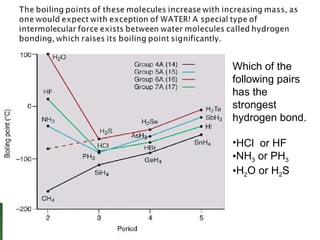
Which of the following pairs has the strongest hydrogen bond. HCl  or HF NH 3  or PH 3 H 2 O or H 2 S

Chemical bonds

  • 1.
  • 2.
    Atoms tend togain, lose or share electrons so as to have eight electrons in their outer electron shell giving them the same electronic configuration as a noble gas . The rule is applicable to the main-group elements, especially carbon , nitrogen , oxygen , and the halogens , but also to metals such as sodium or magnesium . In simple terms, molecules or ions tend to be most stable when the outermost electron shells of their constituent atoms contain eight electrons.
  • 3.
    The octet rule does not work for predicting the charges on transition metals ions. Transition metals are located on the periodic table in the ten columns between columns for the representative elements, and the groups are labeled IB to VIIIB. The transition metals typically produce ions with 1 +, 2+, 3+ and sometime 4+ charges, and unlike the representative elements many transition metals can have more than one charge state
  • 4.
    Valence electrons : Electrons in the outermost electron shells, maximum 8 electrons. noble gases has 8 electrons Ion : A charged atom. Can be either positive or negative. Positive ion : Is an atom that lost at least one electron, are called cations . Example Na + , Mg 2+ , Al 3+ Negative ion : Is an atom that gained at least one electron, are called anions . Cl - , O 2- , N 3-
  • 5.
    Groups IA, IIA,and IIIA have metallic atoms that tend to lose electrons to acquire electronic configuration of a noble gas forming positive ions . Groups VA, VIA, VIIA have non metallic atoms that tend to gain electrons to acquire electronic configuration of a noble gas forming negative ions .
  • 6.
    Element Group Valencee - Electrons to form Ion Ion Formed Lost Gained Sodium IA Na + Magnesium IIA Mg 2+ Calcium IIA Ca 2+ Aluminum IIIA Al 3+ Sulfur VIA S 2- Oxygen VIA O 2- Chlorine VIIA Cl - Bromine VIIA Br -
  • 7.
    Lewis structures ,also called Lewis-dot diagrams , Electron-dot diagrams or Electron-dot structures , are diagrams that show the bonding between atoms of a molecule, and the lone pairs of electrons that may exist in the molecule. Consists of the element symbol surrounded by &quot;dots&quot; to represent the number of electrons in the outer energy level (correlated by the Group number).
  • 8.
  • 9.
    However, because ofthe high charge that would result, either C 4+ or C 4- for carbon and Si 4+ or Si 4- for silicon
  • 10.
    Lithium Calcium AluminumCarbon Nitrogen Oxygen Chlorine Argon Lithium ion Calcium ion Aluminum ion Carbon Nitrogen ion Oxygen ion Chlorine ion Argon
  • 11.
    Symbol Atomic Electronicconfiguration Lewis atom structure Formed ion Ionic Electronic configuration Lewis ionic structure Li 1s 2 2s 1 Li  Li + 1s 2 Li + Be B C N O F Ne
  • 12.
    A chemical bondis the attraction caused by the electromagnetic force between opposing charges, either between electrons and nuclei or as the result of a dipole attraction. The strength of bonds varies considerably; there are &quot;strong bonds&quot; such as covalent or ionic bonds and &quot;weak bonds&quot; such as dipole-dipole interactions , the London dispersion force and hydrogen bonding .
  • 13.
    Type of chemicalbond that involves a metal and a nonmetal ion through electrostatic attraction. It is a bond formed by the attraction between two oppositely charged ions, The electrostatic attraction between the oppositely charged ions causes them to come together and form a bond like magnets . The metal donates one or more electrons , forming a positively charged ion or cation with a stable electron configuration . These electrons then enter the non metal, causing it to form a negatively charged ion or anion which also has a stable electron configuration.
  • 14.
    For example, commonsalt is sodium chloride. When sodium (Na) and chlorine (Cl) are combined, the sodium atoms each lose an electron forming a cation (Na + ), and the chlorine atom gain an electron to form an anion (Cl − ). Na + Cl  Na + + Cl -
  • 15.
    Formed between ametallic element and a non metallic element. The bonding involves electrons transfer , the metal atom donates electrons while the non metal accept the electrons. The compounds formed are solids with a crystal lattice tridimensional structure. Most of them dissolve in water giving solutions that conducts electricity Salts (NaCl) and acids (HCl) are ionic compounds
  • 16.
    1. Find thetotal number of electrons: For each atom, read the group number. 2. Draw a first tentative structure: The element with the least number of atoms is usually the central element. Draw a tentative molecular and electron arrangement attaching other atoms with single bonds as the first guess. 3. Add electrons as dots to get octets around atoms: When counting electrons for the octet around an atom, count both electrons in a bond for each atom and any lone pair electrons. Hydrogen, of course, gets only 2 electrons. 4. Count the total number of electrons in the final structure to see if the total agrees with the number tabulated in step #1. If not, then move a lone pair of electrons into a double bond. Or add more lone pairs of electrons. 5. Cycle through steps 3 and 4 several times until you get it right by trial and error.
  • 17.
    Na Cl Na IA = 1e Cl VIIA= 7e Na  +  Na + Mg Cl 2 Mg IIA=2e Cl VIIA= 7e  Mg  +  Mg 2+ RbBr CaBr 2 AlF 3 SrO     Cl        Cl -         Cl        Cl        Cl -         Cl -    
  • 18.
    Chemical bonding ischaracterized by the sharing of pairs of electrons between atoms. Is formed by at least two non-metallic elements, they can be molecules of the same atom like O 2 or different atoms like H 2 O. The atoms can share more than one pair of electrons, they can share two or even three pair of electrons, like single, double or triple bonds.
  • 19.
    The pair ofshared electrons can be drawn with lines Chlorine molecule Cl 2 Cl = 7 e pair of shared electrons in red, each chlorine atom has 8 e or     Cl        Cl   
  • 20.
    Single: One pairof electrons are shared. Double: Two pairs of electrons are shared. Triple: Three pairs of electrons are shared or
  • 21.
    Write the valenceelectrons of the Nitrogen atom Write the total number of electrons from both atoms Draw the dot diagram Arrange the electrons using octet rule (both atoms must have 8 electrons how many electrons must they share?)
  • 22.
    N from familyVA= 5 electrons For the molecule N 2 are 10 electrons Sharing just one pair doesn’t apply the octet rule.  Neither sharing two pairs of electrons apply But sharing THREE pair of electrons the octet rule does apply or N N        N      N      N      N      N      N     N     N    
  • 23.
    F 2 NH 3 H 2 H 2 S HBr CH 4 CO 2 CO O 2 CCl 4
  • 24.
    Polar covalent: betweenatoms of different elements. Example H 2 O, H 2 S, CO 2 , CCl 4. The type of bond is also determined by the difference of the electronegativity values of the elements <(below)1.7 Example : H 2 O H=2.1 O=3.5  3.5-2.1= 1.4 polar covalent bond Non-polar Covalent: Between molecules. Same elements. Example H 2 , O 2 , Cl 2 , F 2 . The type of bond is also determined by the difference of the electronegativity values of the elements = 0 Example F 2 F= 4  4-4 = 0 Non-polar Covalent bond
  • 25.
    Compound Electronegativity valueof each atom Electronegativity difference Type of bond F 2 F: 4.0 F: 4.0 4.0 – 4.0 = 0 Covalent Non-polar H 2 S NaF RbBr NH 3 HF MgO KCl N 2 CH 4
  • 26.
  • 27.
    In chemistry, polarity refers to a separation of electric charge leading to a molecule having an electric dipole . Polar: Is a molecule that can dissolve in water like Salts (NaCl, KF, etc) and Acids (HCl, HNO 3 , etc). Non polar: Is a molecule that can not dissolve in water like fats, oils, gasoline, methane gas (CH 4 ) carbon tetrachloride (CCl 4 ), CO 2 .
  • 28.
    A watermolecule , a commonly-used example of polarity. The two charges are present with a negative charge in the middle (red shade), and a positive charge at the ends (blue shade).
  • 29.
  • 30.
    Metallic bonding is the electromagnetic interaction between delocalized electrons , called &quot;electrons sea“. The electrons sea are the responsible for the physical properties of solid metals: conduct heat and electricity, generally high melting and boiling points,strong, malleable (can be hammered or pressed out of shape without breaking), ductile (able to be drawn into a wire), metallic lustre The elements involved in this type of bonding are mainly the transition metals like Fe, Cu, Au, Ag, Al, Zn, Pt, etc.
  • 31.
  • 32.
  • 33.
    Are the forcesholding molecules together Dipole-dipole forces Weak London dispersion or van der Waal's force . Hydrogen bond Certain substances such as H 2 O, HF, NH 3 form hydrogen bonds, and the formation of which affects properties (solubility) of substance. Other compounds containing OH and NH 2 groups also form hydrogen bonds. Molecules of many organic compounds such as alcohols, acids, amines, and aminoacids contain these groups, and thus hydrogen bonding plays a important role in biological science.
  • 34.
    Which of thefollowing pairs has the strongest hydrogen bond. HCl or HF NH 3 or PH 3 H 2 O or H 2 S