Highlights of Elimination Reaction Elimination Reactions. E1 & E2 Reactions & Mechanisms. Energy Diagrams of E1 & E2. Transition States of E1 & E2. Characteristics of E1 & E2. The Saytzeff Rule (Z-rule). Elimination with Bulky Leaving Groups and Bulky Bases -- Hofmann Rule -- E2
Elimination Reactions An  elimination reaction  is a type of  organic reaction  in which two  substituents  are removed from a molecule in either a one or two-step mechanism.  Either the  unsaturation  of the molecule increases (as in most organic elimination reactions) or the valence of an atom in the molecule decreases by two, a process known as  reductive elimination . An important class of elimination reactions are those involving  alkyl halides , or alkanes in general, with good  leaving groups , reacting with a  Lewis base  to form an  alkene  in the reverse of an  addition reaction . When the substrate is asymmetric,  regioselectivity  is determined by  Saytzeff rule . The one and two-step mechanisms are named and known as  E2 reaction  and  E1 reaction , respectively.
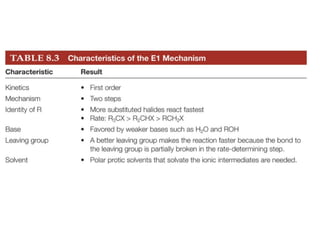
E1 Reactions  These reactions proceed under neutral conditions where a  polar  solvent helps to stabilize the carbocation intermediate.  This solvent also acts as a weak base and removes a proton in the fast step.  These types of reactions are referred to as  solvolysis  reactions.
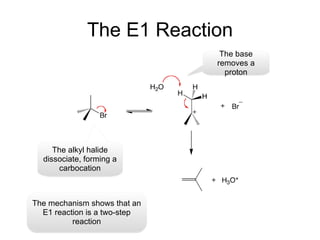
The E1 Reaction The alkyl halide dissociate, forming a carbocation The base removes a proton The mechanism shows that an E1 reaction is a two-step reaction
Alkyl Halides and Elimination Reactions An E1 reaction exhibits first-order kinetics: Mechanisms of Elimination—E1 rate = k[(CH3)3CI] The E1 reaction proceed via a two-step mechanism: the bond to the leaving group breaks first before the  bond is formed. The slow step is unimolecular, involving only the alkyl halide. The E1 and E2 mechanisms both involve the same number of bonds broken and formed. The only difference is timing. In an E1, the leaving group comes off before the  proton is removed, and the reaction occurs in two steps. In an E2 reaction, the leaving group comes off as the  proton is removed, and the reaction occurs in one step.
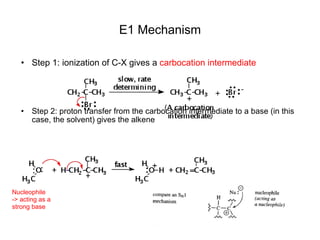
E1 Mechanism Step 1: ionization of C-X gives a  carbocation intermediate Step 2: proton transfer from the carbocation intermediate to a base (in this case, the solvent) gives the alkene Nucleophile -> acting as a strong base
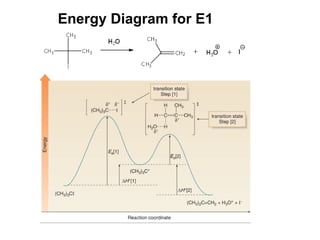
Energy Diagram for E1
Transition States Rate =  k [A] See SN1 and E1 Reaction Mechanisms And Radical Chain  Reaction
 
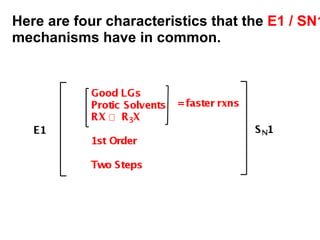
Here are four characteristics that the  E1 / SN1 mechanisms have in common.
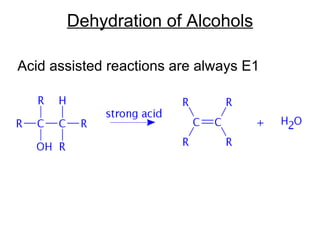
Dehydration of Alcohols Acid assisted reactions are always E1
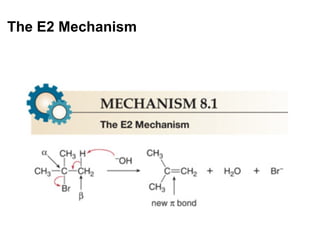
The E2 Mechanism
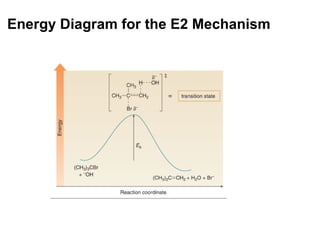
Energy Diagram for the E2 Mechanism
Transition States Rate =  k [A][B] See SN2 and E2 Reaction Mechanisms
 
Alkyl Halides and Elimination Reactions The most common mechanism for dehydrohalogenation is the E2 mechanism. It exhibits second-order kinetics, and both the alkyl halide and the base appear in the rate equation i.e. Mechanisms of Elimination—E2 rate = k[(CH3)3CBr][ ¯ OH] The reaction is  concerted —all bonds are broken and formed in a single step.
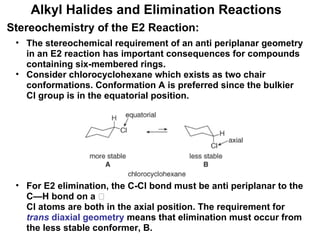
The stereochemical requirement of an anti periplanar geometry in an E2 reaction has important consequences for compounds containing six-membered rings. Consider chlorocyclohexane which exists as two chair conformations. Conformation A is preferred since the bulkier Cl group is in the equatorial position. For E2 elimination, the C-Cl bond must be anti periplanar to the C—H bond on a  carbon, and this occurs only when the H and Cl atoms are both in the axial position. The requirement for  trans  diaxial geometry  means that elimination must occur from the less stable conformer, B. Alkyl Halides and Elimination Reactions Stereochemistry of the E2 Reaction:
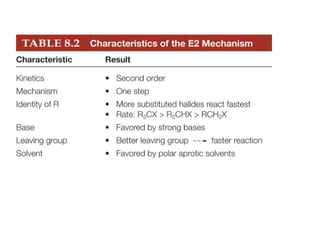
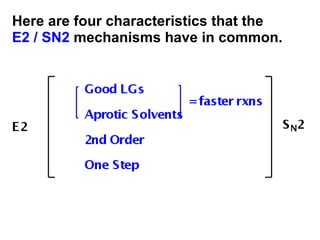
Here are four characteristics that the E2 / SN2  mechanisms have in common.
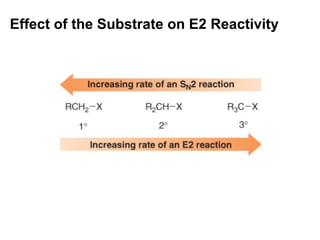
Effect of the Substrate on E2 Reactivity
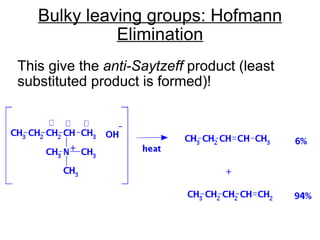
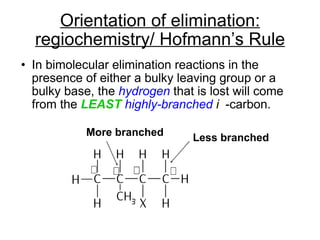
Bulky leaving groups: Hofmann Elimination This give the  anti-Saytzeff  product (least substituted product is formed)!
Orientation of elimination: regiochemistry/ Hofmann’s Rule In bimolecular elimination reactions in the presence of either a bulky leaving group or a bulky base, the  hydrogen   that is lost will come from the  LEAST  highly-branched  -carbon. Less branched More branched
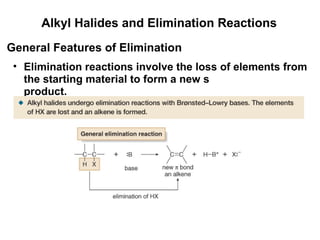
Alkyl Halides and Elimination Reactions Elimination reactions involve the loss of elements from the starting material to form a new  bond in the product. General Features of Elimination
Alkyl Halides and Elimination Reactions Equations [1] and [2] illustrate examples of elimination reactions. In both reactions a base removes the elements of an acid, HX, from the organic starting material. General Features of Elimination
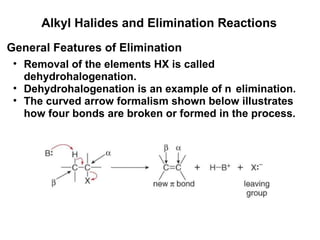
Alkyl Halides and Elimination Reactions Removal of the elements HX is called dehydrohalogenation. Dehydrohalogenation is an example of  elimination. The curved arrow formalism shown below illustrates how four bonds are broken or formed in the process. General Features of Elimination
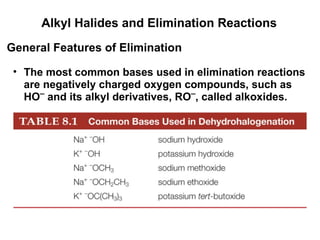
Alkyl Halides and Elimination Reactions The most common bases used in elimination reactions are negatively charged oxygen compounds, such as HO ¯  and its alkyl derivatives, RO ¯ , called alkoxides. General Features of Elimination
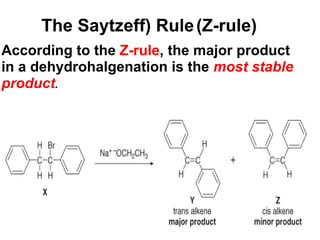
The Saytzeff) Rule   (Z-rule)  According to the  Z-rule , the major product in a dehydrohalgenation is the  most stable product .
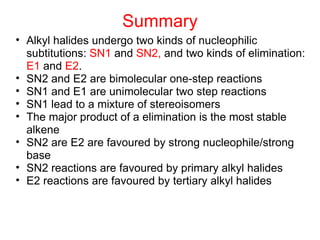
Summary Alkyl halides undergo two kinds of nucleophilic subtitutions:  SN1  and  SN2,  and two kinds of elimination:  E1  and  E2 . SN2 and E2 are bimolecular one-step reactions SN1 and E1 are unimolecular two step reactions SN1 lead to a mixture of stereoisomers The major product of a elimination is the most stable alkene SN2 are E2 are favoured by strong nucleophile/strong base SN2 reactions are favoured by primary alkyl halides E2 reactions are favoured by tertiary alkyl halides
Reference www.chem.wwu.edu  www.chem.uky.edu  wwwchem.uwimona.edu.jm  facstaff.gpc.edu  www.cliffsnotes.com  www.wikipedia.org

Advanced organic chemistry

  • 1.
    Highlights of EliminationReaction Elimination Reactions. E1 & E2 Reactions & Mechanisms. Energy Diagrams of E1 & E2. Transition States of E1 & E2. Characteristics of E1 & E2. The Saytzeff Rule (Z-rule). Elimination with Bulky Leaving Groups and Bulky Bases -- Hofmann Rule -- E2
  • 2.
    Elimination Reactions An elimination reaction is a type of organic reaction in which two substituents are removed from a molecule in either a one or two-step mechanism. Either the unsaturation of the molecule increases (as in most organic elimination reactions) or the valence of an atom in the molecule decreases by two, a process known as reductive elimination . An important class of elimination reactions are those involving alkyl halides , or alkanes in general, with good leaving groups , reacting with a Lewis base to form an alkene in the reverse of an addition reaction . When the substrate is asymmetric, regioselectivity is determined by Saytzeff rule . The one and two-step mechanisms are named and known as E2 reaction and E1 reaction , respectively.
  • 3.
    E1 Reactions These reactions proceed under neutral conditions where a polar solvent helps to stabilize the carbocation intermediate. This solvent also acts as a weak base and removes a proton in the fast step. These types of reactions are referred to as solvolysis reactions.
  • 4.
    The E1 ReactionThe alkyl halide dissociate, forming a carbocation The base removes a proton The mechanism shows that an E1 reaction is a two-step reaction
  • 5.
    Alkyl Halides andElimination Reactions An E1 reaction exhibits first-order kinetics: Mechanisms of Elimination—E1 rate = k[(CH3)3CI] The E1 reaction proceed via a two-step mechanism: the bond to the leaving group breaks first before the  bond is formed. The slow step is unimolecular, involving only the alkyl halide. The E1 and E2 mechanisms both involve the same number of bonds broken and formed. The only difference is timing. In an E1, the leaving group comes off before the  proton is removed, and the reaction occurs in two steps. In an E2 reaction, the leaving group comes off as the  proton is removed, and the reaction occurs in one step.
  • 6.
    E1 Mechanism Step1: ionization of C-X gives a carbocation intermediate Step 2: proton transfer from the carbocation intermediate to a base (in this case, the solvent) gives the alkene Nucleophile -> acting as a strong base
  • 7.
  • 8.
    Transition States Rate= k [A] See SN1 and E1 Reaction Mechanisms And Radical Chain Reaction
  • 9.
  • 10.
    Here are fourcharacteristics that the E1 / SN1 mechanisms have in common.
  • 11.
    Dehydration of AlcoholsAcid assisted reactions are always E1
  • 12.
  • 13.
    Energy Diagram forthe E2 Mechanism
  • 14.
    Transition States Rate= k [A][B] See SN2 and E2 Reaction Mechanisms
  • 15.
  • 16.
    Alkyl Halides andElimination Reactions The most common mechanism for dehydrohalogenation is the E2 mechanism. It exhibits second-order kinetics, and both the alkyl halide and the base appear in the rate equation i.e. Mechanisms of Elimination—E2 rate = k[(CH3)3CBr][ ¯ OH] The reaction is concerted —all bonds are broken and formed in a single step.
  • 17.
    The stereochemical requirementof an anti periplanar geometry in an E2 reaction has important consequences for compounds containing six-membered rings. Consider chlorocyclohexane which exists as two chair conformations. Conformation A is preferred since the bulkier Cl group is in the equatorial position. For E2 elimination, the C-Cl bond must be anti periplanar to the C—H bond on a  carbon, and this occurs only when the H and Cl atoms are both in the axial position. The requirement for trans diaxial geometry means that elimination must occur from the less stable conformer, B. Alkyl Halides and Elimination Reactions Stereochemistry of the E2 Reaction:
  • 18.
    Here are fourcharacteristics that the E2 / SN2 mechanisms have in common.
  • 19.
    Effect of theSubstrate on E2 Reactivity
  • 20.
    Bulky leaving groups:Hofmann Elimination This give the anti-Saytzeff product (least substituted product is formed)!
  • 21.
    Orientation of elimination:regiochemistry/ Hofmann’s Rule In bimolecular elimination reactions in the presence of either a bulky leaving group or a bulky base, the hydrogen that is lost will come from the LEAST highly-branched -carbon. Less branched More branched
  • 22.
    Alkyl Halides andElimination Reactions Elimination reactions involve the loss of elements from the starting material to form a new  bond in the product. General Features of Elimination
  • 23.
    Alkyl Halides andElimination Reactions Equations [1] and [2] illustrate examples of elimination reactions. In both reactions a base removes the elements of an acid, HX, from the organic starting material. General Features of Elimination
  • 24.
    Alkyl Halides andElimination Reactions Removal of the elements HX is called dehydrohalogenation. Dehydrohalogenation is an example of  elimination. The curved arrow formalism shown below illustrates how four bonds are broken or formed in the process. General Features of Elimination
  • 25.
    Alkyl Halides andElimination Reactions The most common bases used in elimination reactions are negatively charged oxygen compounds, such as HO ¯ and its alkyl derivatives, RO ¯ , called alkoxides. General Features of Elimination
  • 26.
    The Saytzeff) Rule (Z-rule) According to the Z-rule , the major product in a dehydrohalgenation is the most stable product .
  • 27.
    Summary Alkyl halidesundergo two kinds of nucleophilic subtitutions: SN1 and SN2, and two kinds of elimination: E1 and E2 . SN2 and E2 are bimolecular one-step reactions SN1 and E1 are unimolecular two step reactions SN1 lead to a mixture of stereoisomers The major product of a elimination is the most stable alkene SN2 are E2 are favoured by strong nucleophile/strong base SN2 reactions are favoured by primary alkyl halides E2 reactions are favoured by tertiary alkyl halides
  • 28.
    Reference www.chem.wwu.edu www.chem.uky.edu wwwchem.uwimona.edu.jm facstaff.gpc.edu www.cliffsnotes.com www.wikipedia.org