1
HECK REACTION
Dr. Shahid Rasool Heck reaction CHEM5128
Advanced Named Reactions
2
Key Concepts
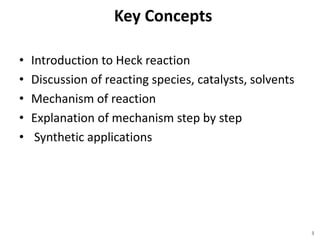
• Introduction to Heck reaction
• Discussion of reacting species, catalysts, solvents
• Mechanism of reaction
• Explanation of mechanism step by step
• Synthetic applications
3
Heck Reaction:
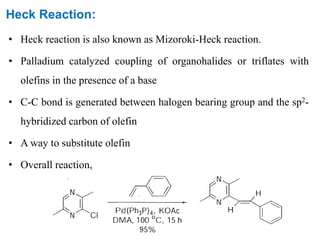
• Heck reaction is also known as Mizoroki-Heck reaction.
• Palladium catalyzed coupling of organohalides or triflates with
olefins in the presence of a base
• C-C bond is generated between halogen bearing group and the sp2-
hybridized carbon of olefin
• A way to substitute olefin
• Overall reaction,
History:
• Fujiwara (1967) - Coupling of arenes (Ar–H) & alkenes by Pd(II)
• Heck (1969) – Coupling of Arylmercuric halides (ArHgCl) &
alkenes by Pd(II)
• Mizoroki (1971) - coupling of iodobenzene & styrene
History:
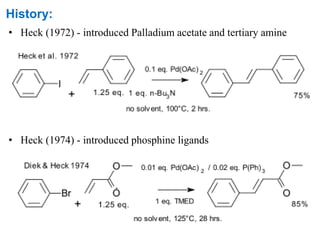
• Heck (1972) - introduced Palladium acetate and tertiary amine
• Heck (1974) - introduced phosphine ligands
Alkyl halides or Triflates (R-X):
• R = Benzyl, Vinyl, Aryl groups
• X = Cl, Br, I or Otf
• No Heck reaction with alkyl halide because
OTf = F3C S
O
O
O
Olefins:
• Olefin must have one sp2-C-H bond
• EWG activate reaction
• Acrylates are the most favorable
• Difference between terminal alkene and cyclic alkene
CH2 CH C
Acrylate group O
O
R
Catalysts and bases:
• Catalyzed by palladium salts and complexes
Typical catalysts are
• Tetrakis(triphenylphosphine)palladium(0) - Pd(PPh3)4
• Palladium chloride - PdCl2
• Palladium (II) acetate – Pd(OAc)2
Typical ligands are
• Triphenylphosphine (PPh3)
• Phosphinooxazolines (PHOX)
• 2,2′-Bis(diphenylphosphino)-1,1′-binaphthyl (BINAP)
Typical bases are
• Triethylamine (NEt3)
• Potassium carbonate (K2CO3)
• Sodium acetate (CH3COONa)
PHOX
BINAP
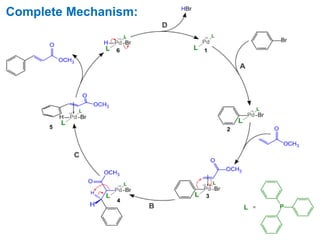
Complete Mechanism:
Step-1, Oxidative addition:
• This step is known to follow concerted mechanism of addition.
• Pd(0) is oxidized to Pd(II)
• R-X is added in concerted way
• Both ‘R’ and ‘X’ are attached to ‘Pd’ through its primary valency.
• Secondary valency ‘4’ is already justified by bidendate ligands.
Pd
L X
L2Pd(0)
R X
L2Pd(0)
R X
R LII
Step-2, Coordination:
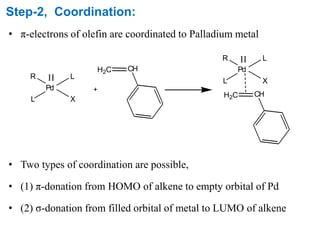
• π-electrons of olefin are coordinated to Palladium metal
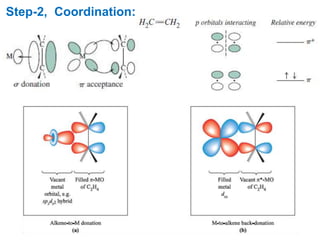
• Two types of coordination are possible,
• (1) π-donation from HOMO of alkene to empty orbital of Pd
• (2) σ-donation from filled orbital of metal to LUMO of alkene
Pd
L X
R LII
CHH2C Pd
L X
R LII
CHH2C
Step-2, Coordination:
Step-3, Insertion and internal rotation:
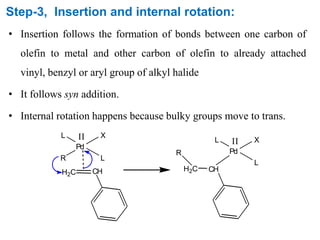
• Insertion follows the formation of bonds between one carbon of
olefin to metal and other carbon of olefin to already attached
vinyl, benzyl or aryl group of alkyl halide
• It follows syn addition.
• Internal rotation happens because bulky groups move to trans.
Pd
R L
L XII
CHH2C CHH2C
Pd
L
L XII
R
Step-4, β-hydride elimination:
• Reaction involving conversion of alkyl group bonded to a metal
centre into metal-bonded hydride and an alkene
• Alkyl group must have hydrogen on β-carbon
• Metal complex must have an empty (or vacant) site cis to alkyl
group
CHC
Pd
L
L XII
R
H
H CHC
R
H
H
Pd
L
L XII
Step-5, Reductive elimination:
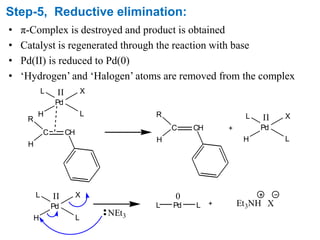
• π-Complex is destroyed and product is obtained
• Catalyst is regenerated through the reaction with base
• Pd(II) is reduced to Pd(0)
• ‘Hydrogen’ and ‘Halogen’ atoms are removed from the complex
CHC
R
H
H
Pd
L
L XII
CHC
R
H H
Pd
L
L XII
H
Pd
L
L XII
NEt3
Pd LL
0
Et3NH X
Stereo-selectivity:
• Stereoselective with tendency for trans product as palladium
halide group and bulky organic residue move away from each
other in the reaction sequence in a rotation step.
Synthesis of Naproxen (non-steroidal anti-inflammatory drug, NSAID):
Synthesis of Octyl methoxycinnamate (Sunscreens):
O
Br
O
O
Pd(0) O
O
O
Heck Oxyarylation:
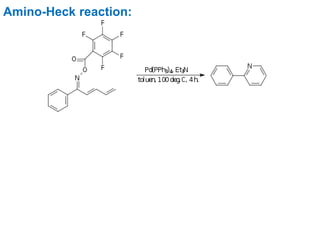
Amino-Heck reaction:

Heck cross coupling reaction

  • 1.
  • 2.
    HECK REACTION Dr. ShahidRasool Heck reaction CHEM5128 Advanced Named Reactions 2
  • 3.
    Key Concepts • Introductionto Heck reaction • Discussion of reacting species, catalysts, solvents • Mechanism of reaction • Explanation of mechanism step by step • Synthetic applications 3
  • 4.
    Heck Reaction: • Heckreaction is also known as Mizoroki-Heck reaction. • Palladium catalyzed coupling of organohalides or triflates with olefins in the presence of a base • C-C bond is generated between halogen bearing group and the sp2- hybridized carbon of olefin • A way to substitute olefin • Overall reaction,
  • 5.
    History: • Fujiwara (1967)- Coupling of arenes (Ar–H) & alkenes by Pd(II) • Heck (1969) – Coupling of Arylmercuric halides (ArHgCl) & alkenes by Pd(II) • Mizoroki (1971) - coupling of iodobenzene & styrene
  • 6.
    History: • Heck (1972)- introduced Palladium acetate and tertiary amine • Heck (1974) - introduced phosphine ligands
  • 7.
    Alkyl halides orTriflates (R-X): • R = Benzyl, Vinyl, Aryl groups • X = Cl, Br, I or Otf • No Heck reaction with alkyl halide because OTf = F3C S O O O
  • 8.
    Olefins: • Olefin musthave one sp2-C-H bond • EWG activate reaction • Acrylates are the most favorable • Difference between terminal alkene and cyclic alkene CH2 CH C Acrylate group O O R
  • 9.
    Catalysts and bases: •Catalyzed by palladium salts and complexes Typical catalysts are • Tetrakis(triphenylphosphine)palladium(0) - Pd(PPh3)4 • Palladium chloride - PdCl2 • Palladium (II) acetate – Pd(OAc)2 Typical ligands are • Triphenylphosphine (PPh3) • Phosphinooxazolines (PHOX) • 2,2′-Bis(diphenylphosphino)-1,1′-binaphthyl (BINAP) Typical bases are • Triethylamine (NEt3) • Potassium carbonate (K2CO3) • Sodium acetate (CH3COONa) PHOX BINAP
  • 10.
  • 11.
    Step-1, Oxidative addition: •This step is known to follow concerted mechanism of addition. • Pd(0) is oxidized to Pd(II) • R-X is added in concerted way • Both ‘R’ and ‘X’ are attached to ‘Pd’ through its primary valency. • Secondary valency ‘4’ is already justified by bidendate ligands. Pd L X L2Pd(0) R X L2Pd(0) R X R LII
  • 12.
    Step-2, Coordination: • π-electronsof olefin are coordinated to Palladium metal • Two types of coordination are possible, • (1) π-donation from HOMO of alkene to empty orbital of Pd • (2) σ-donation from filled orbital of metal to LUMO of alkene Pd L X R LII CHH2C Pd L X R LII CHH2C
  • 13.
  • 14.
    Step-3, Insertion andinternal rotation: • Insertion follows the formation of bonds between one carbon of olefin to metal and other carbon of olefin to already attached vinyl, benzyl or aryl group of alkyl halide • It follows syn addition. • Internal rotation happens because bulky groups move to trans. Pd R L L XII CHH2C CHH2C Pd L L XII R
  • 15.
    Step-4, β-hydride elimination: •Reaction involving conversion of alkyl group bonded to a metal centre into metal-bonded hydride and an alkene • Alkyl group must have hydrogen on β-carbon • Metal complex must have an empty (or vacant) site cis to alkyl group CHC Pd L L XII R H H CHC R H H Pd L L XII
  • 16.
    Step-5, Reductive elimination: •π-Complex is destroyed and product is obtained • Catalyst is regenerated through the reaction with base • Pd(II) is reduced to Pd(0) • ‘Hydrogen’ and ‘Halogen’ atoms are removed from the complex CHC R H H Pd L L XII CHC R H H Pd L L XII H Pd L L XII NEt3 Pd LL 0 Et3NH X
  • 17.
    Stereo-selectivity: • Stereoselective withtendency for trans product as palladium halide group and bulky organic residue move away from each other in the reaction sequence in a rotation step.
  • 18.
    Synthesis of Naproxen(non-steroidal anti-inflammatory drug, NSAID): Synthesis of Octyl methoxycinnamate (Sunscreens): O Br O O Pd(0) O O O Heck Oxyarylation:
  • 19.