1
HORNER-WADSWORTH-EMMONS REACTION
Dr. Shahid Rasool Horner-Wadsworth-Emmons reaction CHEM5128
Advanced Named Reactions
2
Key Concepts
• Introduction to Horner-Wadsworth-Emmons reaction
• Discussion of reacting species, bases, solvents
• Mechanism of reaction
• Explanation of mechanism step by step
• Synthetic applications
3
Horner-Wadsworth-Emmons (HWE) Reaction:
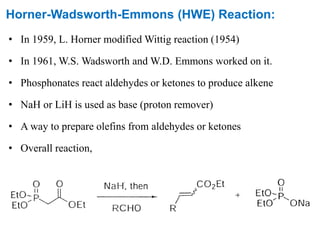
• In 1959, L. Horner modified Wittig reaction (1954)
• In 1961, W.S. Wadsworth and W.D. Emmons worked on it.
• Phosphonates react aldehydes or ketones to produce alkene
• NaH or LiH is used as base (proton remover)
• A way to prepare olefins from aldehydes or ketones
• Overall reaction,
Phosphonates:
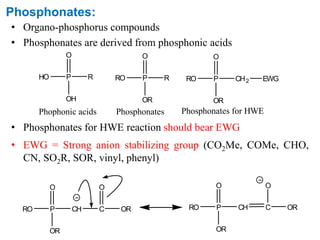
• Organo-phosphorus compounds
• Phosphonates are derived from phosphonic acids
• Phosphonates for HWE reaction should bear EWG
• EWG = Strong anion stabilizing group (CO2Me, COMe, CHO,
CN, SO2R, SOR, vinyl, phenyl)
HO P
O
OH
R RO P
O
OR
R
Phophonic acids Phosphonates
RO P
O
OR
CH2
Phosphonates for HWE
EWG
RO P
O
OR
CH C
O
OR RO P
O
OR
CH C
O
OR
Phosphonates:
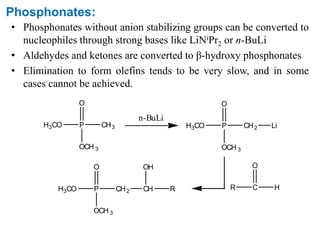
• Phosphonates without anion stabilizing groups can be converted to
nucleophiles through strong bases like LiNiPr2 or n-BuLi
• Aldehydes and ketones are converted to β-hydroxy phosphonates
• Elimination to form olefins tends to be very slow, and in some
cases cannot be achieved.
H3CO P
O
OCH 3
CH3
n-BuLi
H3CO P
O
OCH 3
CH2 Li
R C
O
HH3CO P
O
OCH 3
CH2 CH R
OH
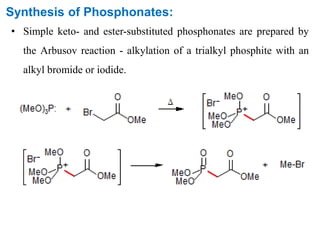
Synthesis of Phosphonates:
• Simple keto- and ester-substituted phosphonates are prepared by
the Arbusov reaction - alkylation of a trialkyl phosphite with an
alkyl bromide or iodide.
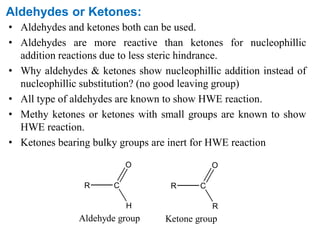
Aldehydes or Ketones:
• Aldehydes and ketones both can be used.
• Aldehydes are more reactive than ketones for nucleophillic
addition reactions due to less steric hindrance.
• Why aldehydes & ketones show nucleophillic addition instead of
nucleophillic substitution? (no good leaving group)
• All type of aldehydes are known to show HWE reaction.
• Methy ketones or ketones with small groups are known to show
HWE reaction.
• Ketones bearing bulky groups are inert for HWE reaction
R C
Aldehyde group
H
O
R C
Ketone group
R
O
Bases and Solvent:
• Lithium hydride (LiH) or Sodium hydride (NaH)
• Due to sensitivity of substrates towards these hydrides, the bases
used are lithium chloride with 1,8-diazabicyclo[5.4.0]undec-7-ene
(DBU), lithium/magnesium halide with triethylamine (NEt3)
• Potassium carbonate (K2CO3) or Cesium carbonate (Cs2CO3) are
used as bases in solvent free synthesis
• One of the liquid reactants is in excess acting as solvent.
• Different solvents have also been reported including
dimethoxyethane (DME), tetrahydrofuran (THF) etc.
DBU
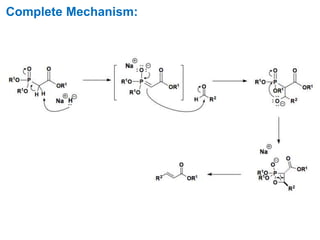
Complete Mechanism:
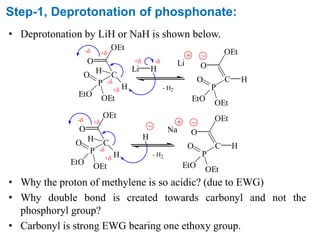
Step-1, Deprotonation of phosphonate:
• Deprotonation by LiH or NaH is shown below.
• Why the proton of methylene is so acidic? (due to EWG)
• Why double bond is created towards carbonyl and not the
phosphoryl group?
• Carbonyl is strong EWG bearing one ethoxy group.
C
H
Li H
+
-
+ -
P
H
OEt
O
O
OEtEtO
C
Li
P
H
OEt
O
O
OEt
EtO
- H2
C
H
H
+
-P
H
OEt
O
O
OEt
EtO
- +
- +
- H2
C
Na
P
H
OEt
O
O
OEtEtO
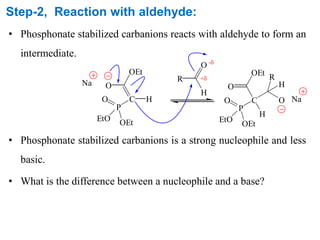
Step-2, Reaction with aldehyde:
• Phosphonate stabilized carbanions reacts with aldehyde to form an
intermediate.
• Phosphonate stabilized carbanions is a strong nucleophile and less
basic.
• What is the difference between a nucleophile and a base?
+
-
C
Na
P
H
OEt
O
O
OEtEtO
H
O
R
C
P
OEt
O
O
OEt
EtO
H
O
H
R
Na
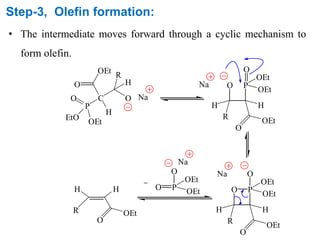
Step-3, Olefin formation:
• The intermediate moves forward through a cyclic mechanism to
form olefin.
C
P
OEt
O
O
OEtEtO
H
O
H
R
Na
O P
H
R
H
O
OEt
O
OEt
OEt
O P
H
R
H
O
OEt
O
OEt
OEt
H
R
H
O
OEt
O P
O
OEt
OEt
Na
Na
Na
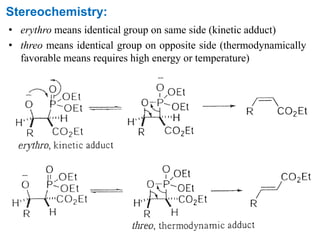
Stereochemistry:
• erythro means identical group on same side (kinetic adduct)
• threo means identical group on opposite side (thermodynamically
favorable means requires high energy or temperature)
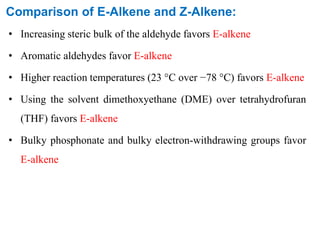
Comparison of E-Alkene and Z-Alkene:
• Increasing steric bulk of the aldehyde favors E-alkene
• Aromatic aldehydes favor E-alkene
• Higher reaction temperatures (23 °C over −78 °C) favors E-alkene
• Using the solvent dimethoxyethane (DME) over tetrahydrofuran
(THF) favors E-alkene
• Bulky phosphonate and bulky electron-withdrawing groups favor
E-alkene
Comparison of E-Alkene and Z-Alkene:
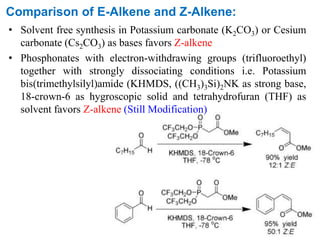
• Solvent free synthesis in Potassium carbonate (K2CO3) or Cesium
carbonate (Cs2CO3) as bases favors Z-alkene
• Phosphonates with electron-withdrawing groups (trifluoroethyl)
together with strongly dissociating conditions i.e. Potassium
bis(trimethylsilyl)amide (KHMDS, ((CH3)3Si)2NK as strong base,
18-crown-6 as hygroscopic solid and tetrahydrofuran (THF) as
solvent favors Z-alkene (Still Modification)
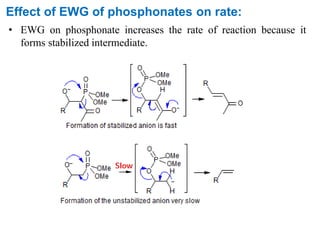
Effect of EWG of phosphonates on rate:
• EWG on phosphonate increases the rate of reaction because it
forms stabilized intermediate.
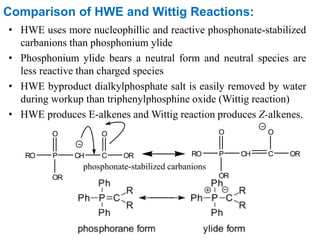
Comparison of HWE and Wittig Reactions:
• HWE uses more nucleophillic and reactive phosphonate-stabilized
carbanions than phosphonium ylide
• Phosphonium ylide bears a neutral form and neutral species are
less reactive than charged species
• HWE byproduct dialkylphosphate salt is easily removed by water
during workup than triphenylphosphine oxide (Wittig reaction)
• HWE produces E-alkenes and Wittig reaction produces Z-alkenes.
RO P
O
OR
CH C
O
OR RO P
O
OR
CH C
O
OR
phosphonate-stabilized carbanions
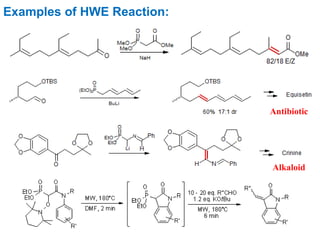
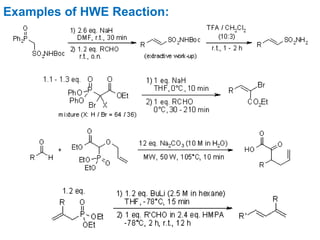
Examples of HWE Reaction:
Antibiotic
Alkaloid
Examples of HWE Reaction:

Horner-Wadsworth-Emmons reaction

  • 1.
  • 2.
    HORNER-WADSWORTH-EMMONS REACTION Dr. ShahidRasool Horner-Wadsworth-Emmons reaction CHEM5128 Advanced Named Reactions 2
  • 3.
    Key Concepts • Introductionto Horner-Wadsworth-Emmons reaction • Discussion of reacting species, bases, solvents • Mechanism of reaction • Explanation of mechanism step by step • Synthetic applications 3
  • 4.
    Horner-Wadsworth-Emmons (HWE) Reaction: •In 1959, L. Horner modified Wittig reaction (1954) • In 1961, W.S. Wadsworth and W.D. Emmons worked on it. • Phosphonates react aldehydes or ketones to produce alkene • NaH or LiH is used as base (proton remover) • A way to prepare olefins from aldehydes or ketones • Overall reaction,
  • 5.
    Phosphonates: • Organo-phosphorus compounds •Phosphonates are derived from phosphonic acids • Phosphonates for HWE reaction should bear EWG • EWG = Strong anion stabilizing group (CO2Me, COMe, CHO, CN, SO2R, SOR, vinyl, phenyl) HO P O OH R RO P O OR R Phophonic acids Phosphonates RO P O OR CH2 Phosphonates for HWE EWG RO P O OR CH C O OR RO P O OR CH C O OR
  • 6.
    Phosphonates: • Phosphonates withoutanion stabilizing groups can be converted to nucleophiles through strong bases like LiNiPr2 or n-BuLi • Aldehydes and ketones are converted to β-hydroxy phosphonates • Elimination to form olefins tends to be very slow, and in some cases cannot be achieved. H3CO P O OCH 3 CH3 n-BuLi H3CO P O OCH 3 CH2 Li R C O HH3CO P O OCH 3 CH2 CH R OH
  • 7.
    Synthesis of Phosphonates: •Simple keto- and ester-substituted phosphonates are prepared by the Arbusov reaction - alkylation of a trialkyl phosphite with an alkyl bromide or iodide.
  • 8.
    Aldehydes or Ketones: •Aldehydes and ketones both can be used. • Aldehydes are more reactive than ketones for nucleophillic addition reactions due to less steric hindrance. • Why aldehydes & ketones show nucleophillic addition instead of nucleophillic substitution? (no good leaving group) • All type of aldehydes are known to show HWE reaction. • Methy ketones or ketones with small groups are known to show HWE reaction. • Ketones bearing bulky groups are inert for HWE reaction R C Aldehyde group H O R C Ketone group R O
  • 9.
    Bases and Solvent: •Lithium hydride (LiH) or Sodium hydride (NaH) • Due to sensitivity of substrates towards these hydrides, the bases used are lithium chloride with 1,8-diazabicyclo[5.4.0]undec-7-ene (DBU), lithium/magnesium halide with triethylamine (NEt3) • Potassium carbonate (K2CO3) or Cesium carbonate (Cs2CO3) are used as bases in solvent free synthesis • One of the liquid reactants is in excess acting as solvent. • Different solvents have also been reported including dimethoxyethane (DME), tetrahydrofuran (THF) etc. DBU
  • 10.
  • 11.
    Step-1, Deprotonation ofphosphonate: • Deprotonation by LiH or NaH is shown below. • Why the proton of methylene is so acidic? (due to EWG) • Why double bond is created towards carbonyl and not the phosphoryl group? • Carbonyl is strong EWG bearing one ethoxy group. C H Li H + - + - P H OEt O O OEtEtO C Li P H OEt O O OEt EtO - H2 C H H + -P H OEt O O OEt EtO - + - + - H2 C Na P H OEt O O OEtEtO
  • 12.
    Step-2, Reaction withaldehyde: • Phosphonate stabilized carbanions reacts with aldehyde to form an intermediate. • Phosphonate stabilized carbanions is a strong nucleophile and less basic. • What is the difference between a nucleophile and a base? + - C Na P H OEt O O OEtEtO H O R C P OEt O O OEt EtO H O H R Na
  • 13.
    Step-3, Olefin formation: •The intermediate moves forward through a cyclic mechanism to form olefin. C P OEt O O OEtEtO H O H R Na O P H R H O OEt O OEt OEt O P H R H O OEt O OEt OEt H R H O OEt O P O OEt OEt Na Na Na
  • 14.
    Stereochemistry: • erythro meansidentical group on same side (kinetic adduct) • threo means identical group on opposite side (thermodynamically favorable means requires high energy or temperature)
  • 15.
    Comparison of E-Alkeneand Z-Alkene: • Increasing steric bulk of the aldehyde favors E-alkene • Aromatic aldehydes favor E-alkene • Higher reaction temperatures (23 °C over −78 °C) favors E-alkene • Using the solvent dimethoxyethane (DME) over tetrahydrofuran (THF) favors E-alkene • Bulky phosphonate and bulky electron-withdrawing groups favor E-alkene
  • 16.
    Comparison of E-Alkeneand Z-Alkene: • Solvent free synthesis in Potassium carbonate (K2CO3) or Cesium carbonate (Cs2CO3) as bases favors Z-alkene • Phosphonates with electron-withdrawing groups (trifluoroethyl) together with strongly dissociating conditions i.e. Potassium bis(trimethylsilyl)amide (KHMDS, ((CH3)3Si)2NK as strong base, 18-crown-6 as hygroscopic solid and tetrahydrofuran (THF) as solvent favors Z-alkene (Still Modification)
  • 17.
    Effect of EWGof phosphonates on rate: • EWG on phosphonate increases the rate of reaction because it forms stabilized intermediate.
  • 18.
    Comparison of HWEand Wittig Reactions: • HWE uses more nucleophillic and reactive phosphonate-stabilized carbanions than phosphonium ylide • Phosphonium ylide bears a neutral form and neutral species are less reactive than charged species • HWE byproduct dialkylphosphate salt is easily removed by water during workup than triphenylphosphine oxide (Wittig reaction) • HWE produces E-alkenes and Wittig reaction produces Z-alkenes. RO P O OR CH C O OR RO P O OR CH C O OR phosphonate-stabilized carbanions
  • 19.
    Examples of HWEReaction: Antibiotic Alkaloid
  • 20.
    Examples of HWEReaction: