ACIDS AND BASES
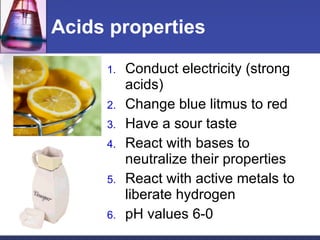
Acids   properties Conduct electricity (strong  acids) Change blue litmus to red  Have a sour taste  React with bases to  neutralize their properties  React with active metals to  liberate hydrogen pH values 6-0
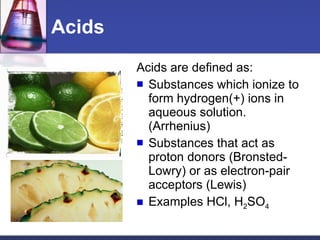
Acids Acids are defined as:  Substances which ionize to form hydrogen(+) ions in aqueous solution. (Arrhenius) Substances that act as proton donors (Bronsted-Lowry) or as electron-pair acceptors (Lewis)  Examples HCl, H 2 SO 4
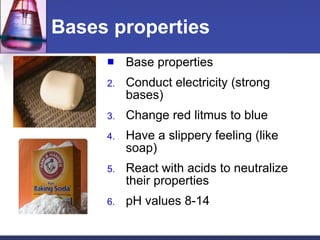
Bases  properties Base properties Conduct electricity (strong bases) Change red litmus to blue  Have a slippery feeling (like soap) React with acids to neutralize their properties pH values 8-14
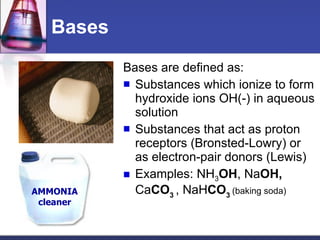
Bases Bases are defined as: Substances which ionize to form hydroxide ions OH(-) in aqueous solution Substances that act as proton receptors (Bronsted-Lowry) or as electron-pair donors (Lewis)  Examples: NH 3 OH , Na OH,  Ca CO 3   , NaH CO 3   (baking soda)   AMMONIAcleaner
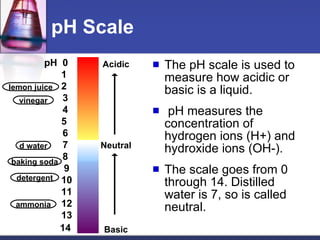
pH Scale The pH scale is used to measure how acidic or basic is a liquid.  pH measures the concentration of hydrogen ions (H+) and hydroxide ions (OH-).  The scale goes from 0 through 14. Distilled water is 7, so is called neutral. lemon juice 0  1  2  3  4  5  6  7  8  9 10 11 12 13 14   pH Acidic Neutral Basic vinegar d water baking soda ammonia detergent
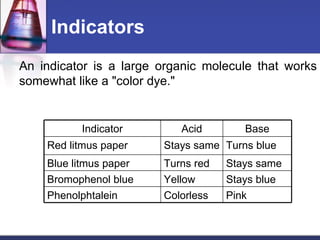
Indicators An indicator is a large organic molecule that works somewhat like a "color dye."   Turns blue Stays same Red litmus paper Base Acid Indicator Pink Colorless Phenolphtalein Stays blue Yellow Bromophenol blue Stays same Turns red Blue litmus paper
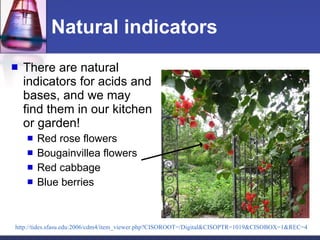
Natural  indicators There are natural indicators for acids and bases, and we may find them in our kitchen or garden!  Red rose flowers Bougainvillea flowers Red cabbage Blue berries http:// tides.sfasu.edu :2006/cdm4/ item_viewer.php?CISOROOT =/ Digital&CISOPTR =1019&CISOBOX=1&REC=4
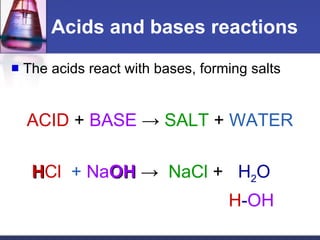
Acids and bases reactions The acids react with bases, forming salts ACID  +  BASE   ->  SALT  +  WATER H Cl   +  Na OH   ->  NaCl  +  H 2 O   H - OH
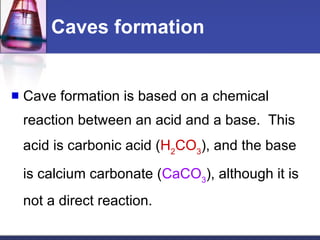
Caves formation Cave formation is based on a chemical reaction between an acid and a base.  This acid is carbonic acid ( H 2 CO 3 ), and the base is calcium carbonate ( CaCO 3 ),  although it is not a direct reaction.
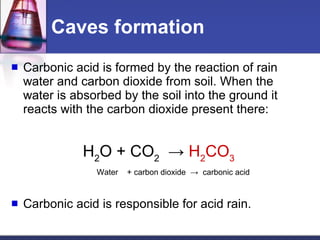
Caves formation Carbonic acid is formed by the reaction of rain water and carbon dioxide from soil. When the water is absorbed by the soil into the ground it reacts with the carbon dioxide present there: H 2 O + CO 2   ->  H 2 CO 3 Water  + carbon dioxide  ->  carbonic acid Carbonic acid is responsible for acid rain.
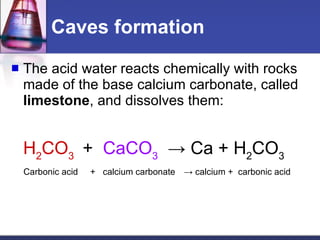
Caves formation The acid water reacts chemically with rocks made of the base calcium carbonate, called  limestone , and dissolves them: H 2 CO 3   +  CaCO 3   -> Ca + H 2 CO 3 Carbonic acid  +  calcium carbonate   -> calcium +  carbonic acid
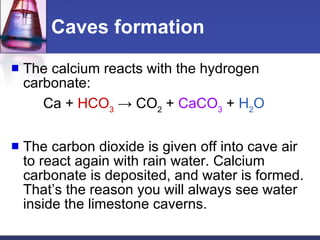
Caves formation The calcium reacts with the hydrogen carbonate:  Ca +  HCO 3   -> CO 2  +  CaCO 3  +  H 2 O The carbon dioxide is given off into cave air to react again with rain water. Calcium carbonate is deposited, and water is formed. That’s the reason you will always see water inside the limestone caverns.
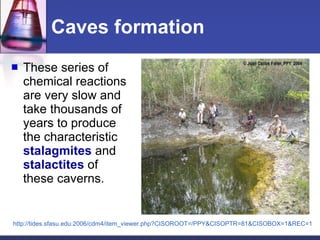
Caves formation These series of chemical reactions are very slow and take thousands of years to produce the characteristic  stalagmites  and  stalactites  of these caverns.  http://tides.sfasu.edu:2006/cdm4/item_viewer.php?CISOROOT=/PPY&CISOPTR=81&CISOBOX=1&REC=1
Resources Animation of cave formation on  Exploring Earth: http://www.classzone.com/books/earth_science/terc/content/visualizations/es1405/es1405page01.cfm?chapter_no=visualization

Acids Bases

  • 1.
  • 2.
    Acids properties Conduct electricity (strong acids) Change blue litmus to red Have a sour taste React with bases to neutralize their properties React with active metals to liberate hydrogen pH values 6-0
  • 3.
    Acids Acids aredefined as: Substances which ionize to form hydrogen(+) ions in aqueous solution. (Arrhenius) Substances that act as proton donors (Bronsted-Lowry) or as electron-pair acceptors (Lewis) Examples HCl, H 2 SO 4
  • 4.
    Bases propertiesBase properties Conduct electricity (strong bases) Change red litmus to blue Have a slippery feeling (like soap) React with acids to neutralize their properties pH values 8-14
  • 5.
    Bases Bases aredefined as: Substances which ionize to form hydroxide ions OH(-) in aqueous solution Substances that act as proton receptors (Bronsted-Lowry) or as electron-pair donors (Lewis) Examples: NH 3 OH , Na OH, Ca CO 3 , NaH CO 3 (baking soda) AMMONIAcleaner
  • 6.
    pH Scale ThepH scale is used to measure how acidic or basic is a liquid. pH measures the concentration of hydrogen ions (H+) and hydroxide ions (OH-). The scale goes from 0 through 14. Distilled water is 7, so is called neutral. lemon juice 0 1 2 3 4 5 6 7 8 9 10 11 12 13 14 pH Acidic Neutral Basic vinegar d water baking soda ammonia detergent
  • 7.
    Indicators An indicatoris a large organic molecule that works somewhat like a "color dye." Turns blue Stays same Red litmus paper Base Acid Indicator Pink Colorless Phenolphtalein Stays blue Yellow Bromophenol blue Stays same Turns red Blue litmus paper
  • 8.
    Natural indicatorsThere are natural indicators for acids and bases, and we may find them in our kitchen or garden! Red rose flowers Bougainvillea flowers Red cabbage Blue berries http:// tides.sfasu.edu :2006/cdm4/ item_viewer.php?CISOROOT =/ Digital&CISOPTR =1019&CISOBOX=1&REC=4
  • 9.
    Acids and basesreactions The acids react with bases, forming salts ACID + BASE -> SALT + WATER H Cl + Na OH -> NaCl + H 2 O H - OH
  • 10.
    Caves formation Caveformation is based on a chemical reaction between an acid and a base. This acid is carbonic acid ( H 2 CO 3 ), and the base is calcium carbonate ( CaCO 3 ), although it is not a direct reaction.
  • 11.
    Caves formation Carbonicacid is formed by the reaction of rain water and carbon dioxide from soil. When the water is absorbed by the soil into the ground it reacts with the carbon dioxide present there: H 2 O + CO 2 -> H 2 CO 3 Water + carbon dioxide -> carbonic acid Carbonic acid is responsible for acid rain.
  • 12.
    Caves formation Theacid water reacts chemically with rocks made of the base calcium carbonate, called limestone , and dissolves them: H 2 CO 3 + CaCO 3 -> Ca + H 2 CO 3 Carbonic acid + calcium carbonate -> calcium + carbonic acid
  • 13.
    Caves formation Thecalcium reacts with the hydrogen carbonate: Ca + HCO 3 -> CO 2 + CaCO 3 + H 2 O The carbon dioxide is given off into cave air to react again with rain water. Calcium carbonate is deposited, and water is formed. That’s the reason you will always see water inside the limestone caverns.
  • 14.
    Caves formation Theseseries of chemical reactions are very slow and take thousands of years to produce the characteristic stalagmites and stalactites of these caverns. http://tides.sfasu.edu:2006/cdm4/item_viewer.php?CISOROOT=/PPY&CISOPTR=81&CISOBOX=1&REC=1
  • 15.
    Resources Animation ofcave formation on Exploring Earth: http://www.classzone.com/books/earth_science/terc/content/visualizations/es1405/es1405page01.cfm?chapter_no=visualization