Chapter 3
Alkenes & Alkynes

               Elfi Susanti VH

                  SBI CLASS
       Chemistry Department
                   FKIP UNS
Slide 9 of 50
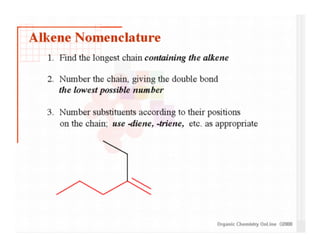
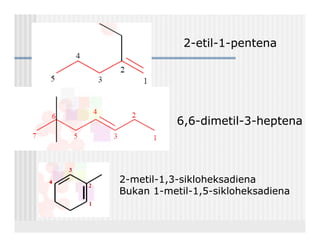
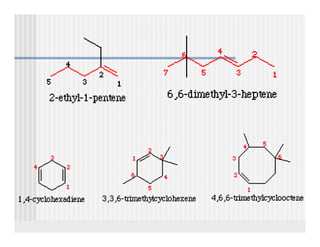
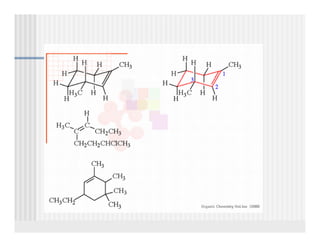
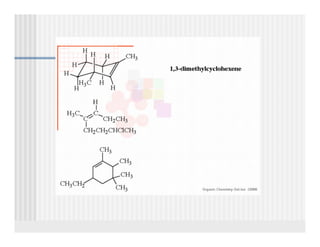
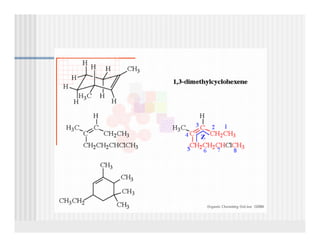
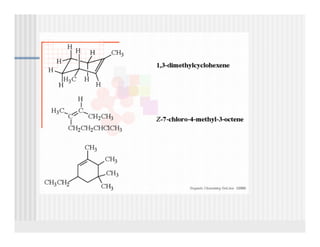
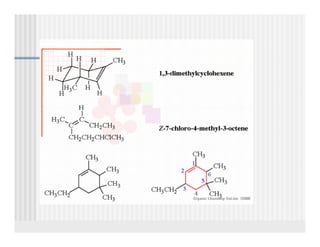
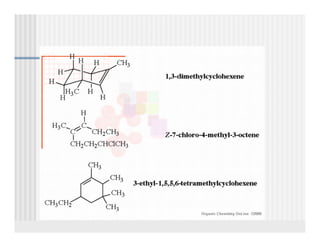
2-etil-1-pentena
              etil-


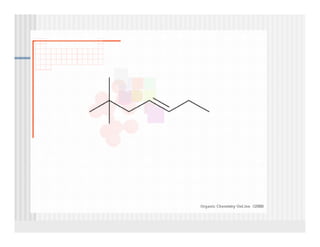
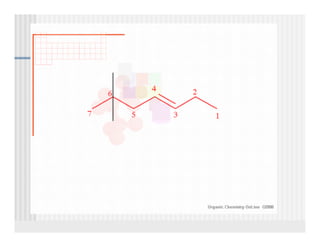
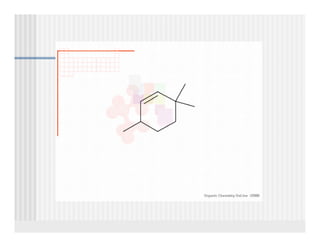
           6,6-dimetil-
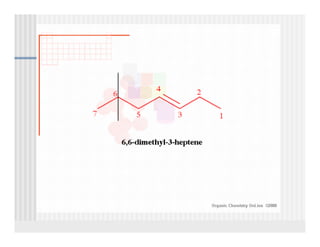
           6,6-dimetil-3-heptena


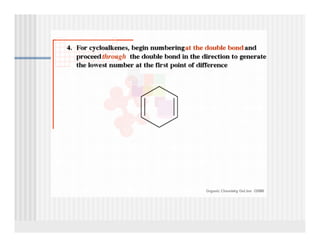
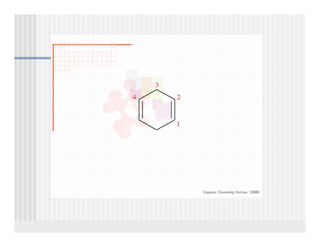
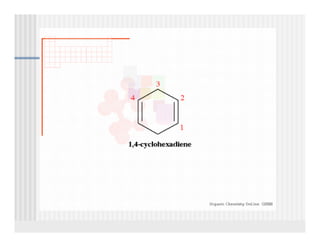
2-metil-1,3-sikloheksadiena
  metil-1,3-
Bukan 1-metil-1,5-sikloheksadiena
       1-metil-1,5-
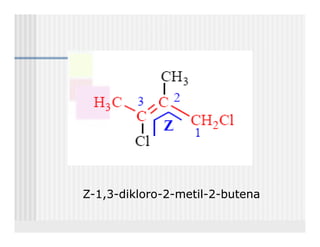
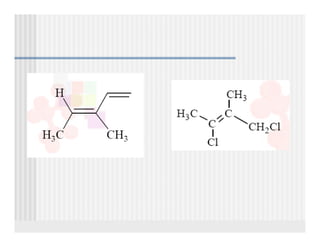
Z-1,3-dikloro-2-metil-2-butena
  1,3-dikloro- metil-
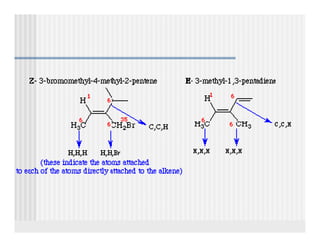
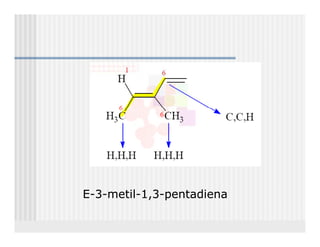
E-3-metil-1,3-pentadiena
    metil-1,3-
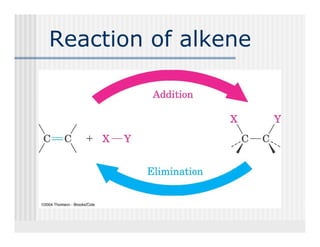
Reaction of alkene
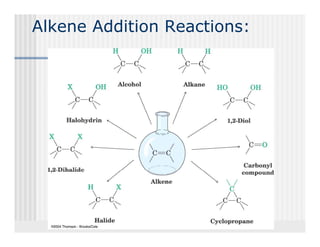
Alkene Addition Reactions:
4.1
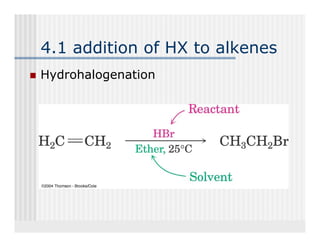
4 1 addition of HX to alkenes
Hydrohalogenation
4.2 Orientation of Alkene
          Addition Reaction
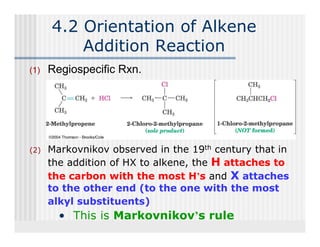
(1)   Regiospecific Rxn.


(2)   Markovnikov observed in the 19th century that in
      the addition of HX to alkene, the H attaches to
      the carbon with the most H’s and X attaches
      to the other end (to the one with the most
      alkyl substituents)
        • This is Markovnikov’s rule
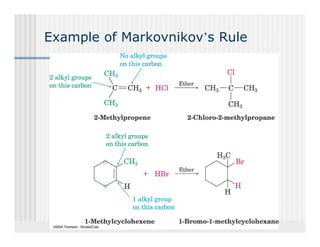
Example of Markovnikov’s Rule

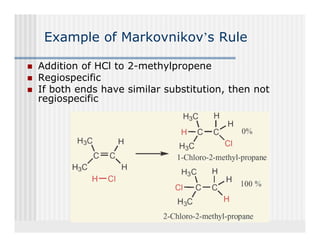
Addition of HCl to 2-methylpropene
Regiospecific
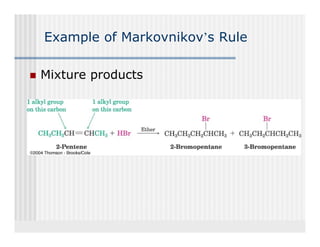
If both ends have similar substitution, then not
regiospecific
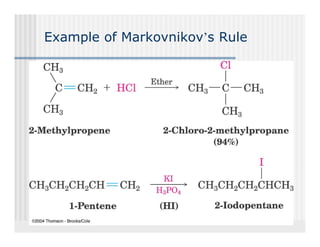
Example of Markovnikov’s Rule

Mixture products
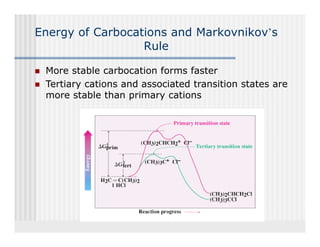
Energy of Carbocations and Markovnikov’s
                  Rule

 More stable carbocation forms faster
 Tertiary cations and associated transition states are
 more stable than primary cations
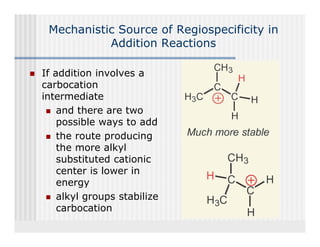
Mechanistic Source of Regiospecificity in
           Addition Reactions

If addition involves a
carbocation
intermediate
    and th
       d there are two
                   t
    possible ways to add
    the route producing
    the more alkyl
    substituted cationic
    center is lower in
    energy
    alkyl groups stabilize
       y g     p
    carbocation
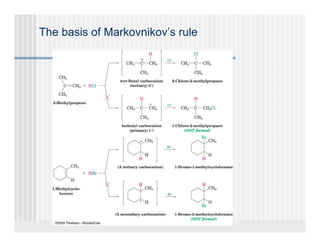
The basis of Markovnikov’s rule
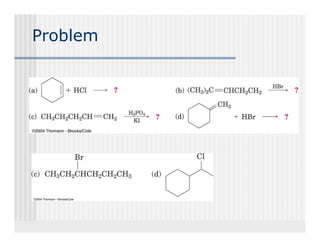
Problem
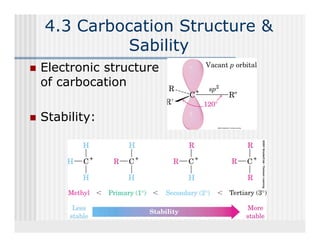
4.3 Carbocation Structure &
         Sability
Electronic structure
of carbocation

Stability:
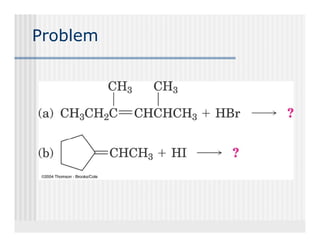
Problem
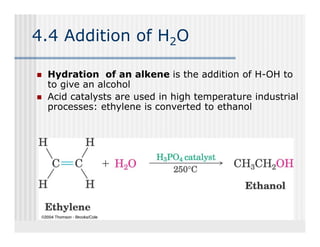
4.4 Addition of H2O

 Hydration of an alkene is the addition of H-OH to
                                             H OH
 to give an alcohol
 Acid catalysts are used in high temperature industrial
 processes: ethylene is converted to ethanol
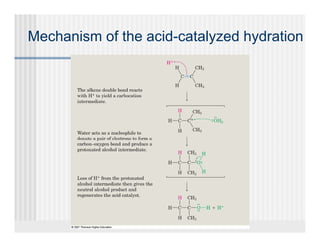
Mechanism of the acid-catalyzed hydration
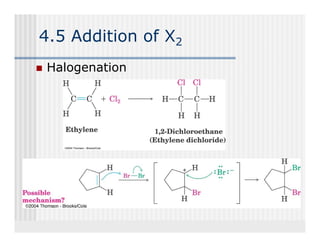
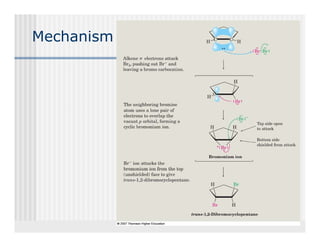
4.5 Addition of X2
Halogenation
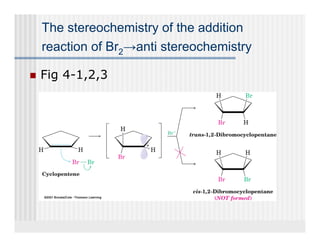
The stereochemistry of the addition
reaction of Br2→anti stereochemistry

Fig 4-1 2 3
    4 1,2,3
Mechanism
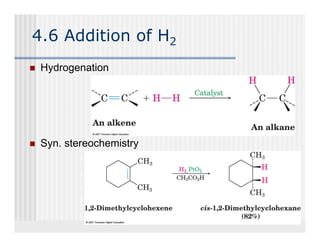
4.6 Addition of H2
 Hydrogenation


 Syn. stereochemistry
 S
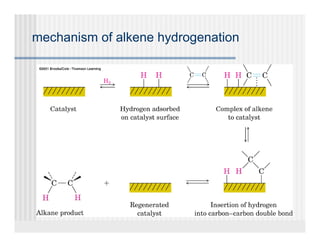
mechanism of alkene hydrogenation
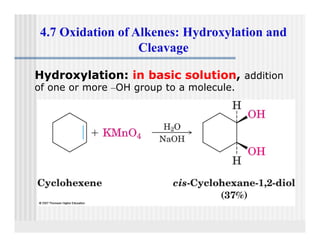
4.7 Oxidation of Alkenes: Hydroxylation and
                   Cleavage
                   Cl

Hydroxylation: in basic solution addition
                        solution,
of one or more –OH group to a molecule.
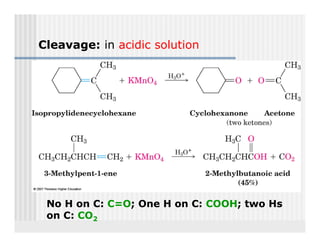
Cleavage: in acidic solution


 No H on C: C=O; O
 N       C C O; One H on C: COOH; t
            C=O          C COOH; two Hs
                                     H
 on C: CO2
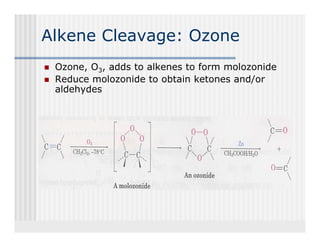
Alkene Cleavage: Ozone
 Ozone, O3, adds to alkenes to form molozonide
 Reduce molozonide t obtain k t
 R d       l    id to bt i ketones and/or
                                        d/
 aldehydes
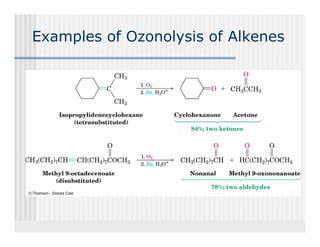
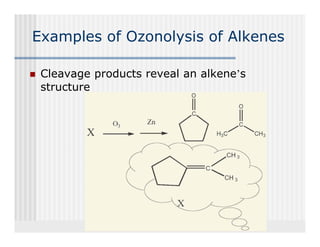
Examples of Ozonolysis of Alkenes

 Cleavage products reveal an alkene’s
                             alkene s
 structure
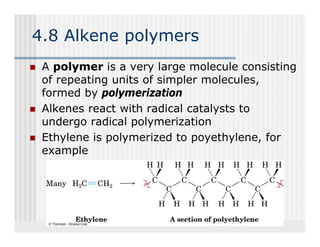
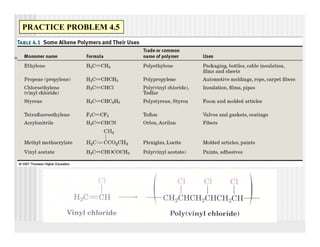
4.8 Alkene polymers
 A polymer is a very large molecule consisting
 of repeating units of simpler molecules,
  f      ti      it f i    l      l   l
 formed by polymerization
 Alkenes react with radical catalysts to
 undergo radical polymerization
 Ethylene is polymerized to poyethylene, for
                             poyethylene
 example
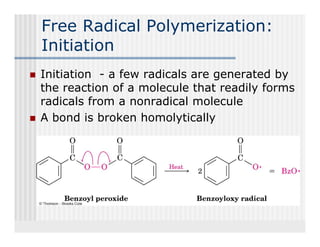
Free Radical Polymerization:
Initiation
Initiation - a few radicals are generated by
the reaction of a molecule that readily forms
radicals from a nonradical molecule
A bond is broken homolytically
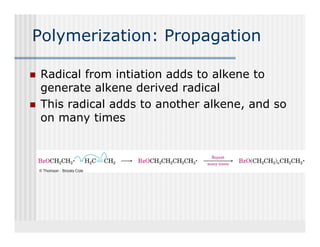
Polymerization: Propagation

Radical from intiation adds to alkene to
generate alkene derived radical
This radical adds to another alkene, and so
   s ad ca           a ot e a e e, a d
on many times
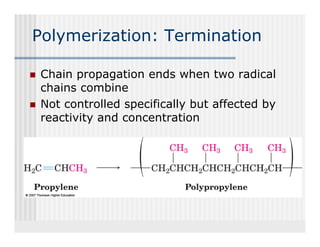
Polymerization: Termination

Chain propagation ends when two radical
chains combine
Not controlled specifically but affected by
  ot co t o ed spec ca y        a ected
reactivity and concentration
PRACTICE PROBLEM 4.5
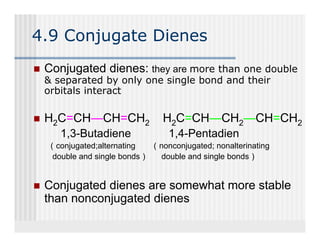
4.9 Conjugate Dienes
 Conjugated dienes: they are more than one double
 & separated by only one single bond and their
           t db    l      i l b d      d th i
 orbitals interact

 H2C=CH—CH=CH2                H2C=CH—CH2—CH=CH2
    1,3-Butadiene               1,4-Pentadien
 (conjugated;alternating   (nonconjugated; nonalterinating
  double and single bonds)  double and single bonds)


 Conjugated dienes are somewhat more stable
 than nonconjugated dienes
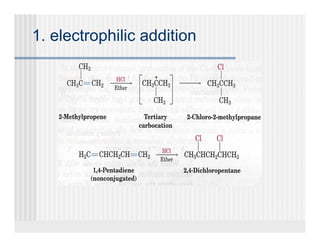
1. electrophilic addition
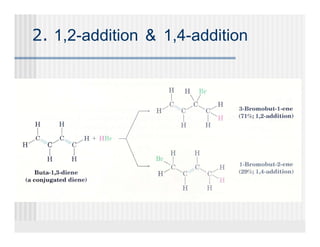
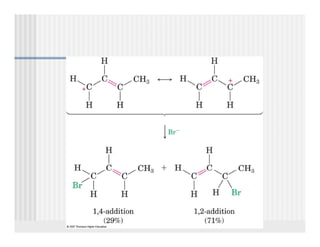
2. 1,2-addition & 1,4-addition
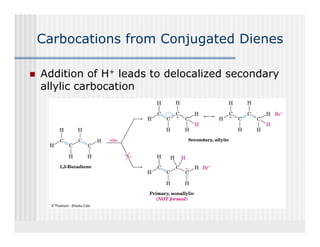
Carbocations from Conjugated Dienes
                     j g

Addition of H+ leads to delocalized secondary
allylic carbocation
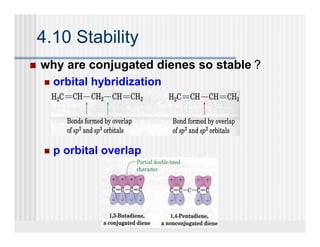
4.10 Stability
             y
why are conjugated dienes so stable?
  orbital hybridization


  p orbital overlap
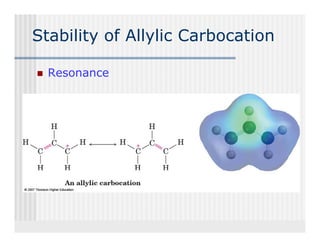
Stability of Allylic Carbocation

  Resonance
   eso a ce
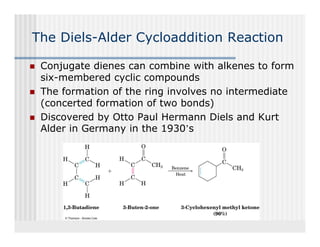
The Diels-Alder Cycloaddition Reaction

 Conjugate dienes can combine with alkenes to form
 six-membered
 six membered cyclic compounds
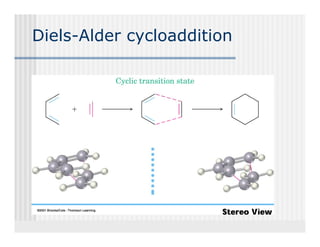
 The formation of the ring involves no intermediate
 (
 (concerted formation of two bonds) )
 Discovered by Otto Paul Hermann Diels and Kurt
 Alder in Germany in the 1930’s
Diels-Alder cycloaddition
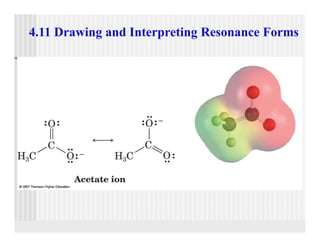
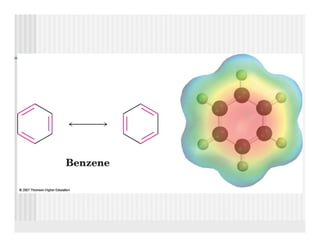
4.11 Drawing and Interpreting Resonance Forms
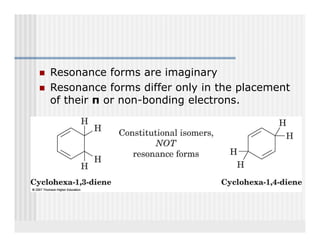
Resonance forms are imaginary
                         g     y
Resonance forms differ only in the placement
of their π or non-bonding electrons.
■
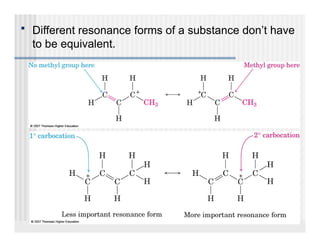
    Different resonance forms of a substance don’t have
    to be equivalent
          equivalent.
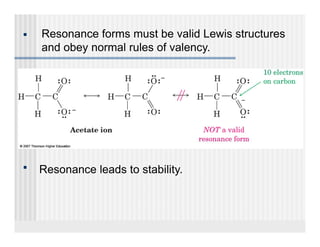
■   Resonance forms must be valid Lewis structures
    and obey normal rules of valency
                             valency.


■
    Resonance leads to stability
                       stability.
4.12 Alkynes’ Reactions

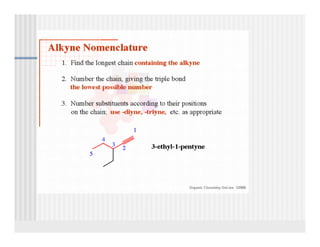
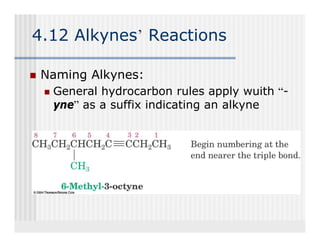
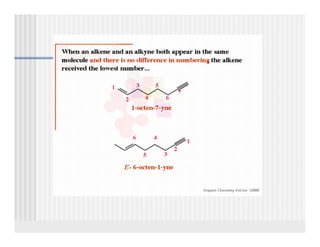
 Naming Alkynes:
  General hydrocarbon rules apply wuith “-
  yne
  yne” as a suffix indicating an alkyne
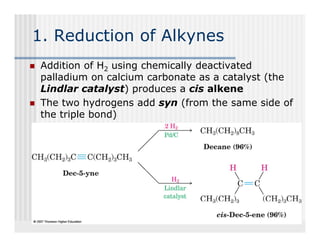
1. Reduction of Alkynes
 Addition of H2 using chemically deactivated
 palladium on calcium carbonate as a catalyst (the
 Lindlar catalyst) produces a cis alkene
 The two hydrogens add syn (from the same side of
            y   g         y (
 the triple bond)
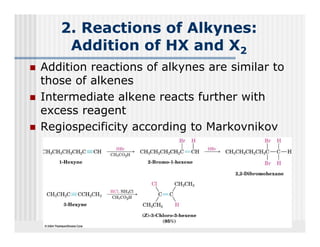
2. Reactions of Alkynes:
    Addition of HX and X2
Addition reactions of alkynes are similar to
those of alkenes
th     f lk
Intermediate alkene reacts further with
excess eagent
e cess reagent
Regiospecificity according to Markovnikov
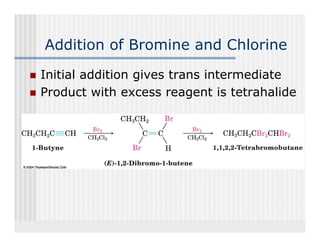
Addition of Bromine and Chlorine
Initial addition gives trans intermediate
Product with excess reagent is tetrahalide
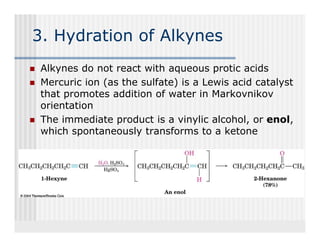
3. Hydration of Alkynes
 Alkynes do not react with aqueous protic acids
 Mercuric ion (as the sulfate) is a Lewis acid catalyst
 that promotes addition of water in Markovnikov
 orientation
 The immediate product is a vinylic alcohol, or enol,
 which spontaneously transforms to a ketone
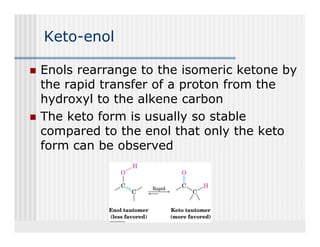
Keto-enol

Enols rearrange to the isomeric ketone by
the rapid transfer of a proton from the
hydroxyl to the alkene carbon
The keto form is usually so stable
compared to the enol that only the keto
form can be observed
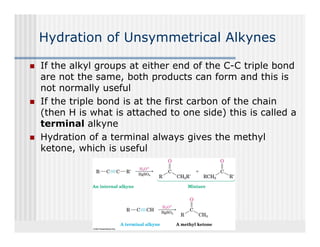
Hydration of Unsymmetrical Alkynes

If the alkyl groups at either end of the C-C triple bond
are not the same, both products can form and this is
              same
not normally useful
If the triple bond is at the first carbon of the chain
(then H is what is attached to one side) this is called a
terminal alkyne
Hydration of a terminal always gives the methyl
ketone, which is useful
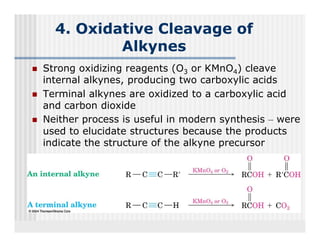
4. Oxidative Cleavage of
          Alkynes
Strong oxidizing reagents (O3 or KMnO4) cleave
internal alkynes, producing t
i t    l lk          d i     two carboxylic acids
                                    b    li   id
Terminal alkynes are oxidized to a carboxylic acid
and carbon dioxide
Neither process is useful in modern synthesis – were
used to elucidate structures because the products
indicate the structure of the alkyne precursor
i di      h             f h    lk
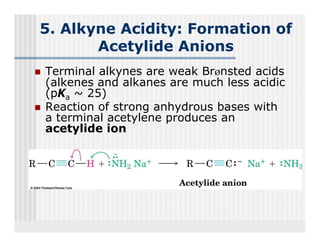
5. Alkyne Acidity: Formation of
       Acetylide Anions
Terminal alkynes are weak Brønsted acids
            y
(alkenes and alkanes are much less acidic
(pKa ~ 25)
Reaction of strong anhydrous bases with
a terminal acetylene produces an
acetylide ion
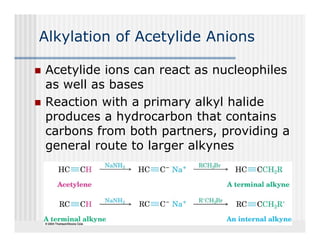
Alkylation of Acetylide Anions

Acetylide ions can react as nucleophiles
as well as bases
Reaction with a primary alkyl halide
                p      y    y
produces a hydrocarbon that contains
carbons from both partners, providing a
general route to larger alkynes

Chapter 3 Alkenes and Alkynes

  • 1.
    Chapter 3 Alkenes &Alkynes Elfi Susanti VH SBI CLASS Chemistry Department FKIP UNS
  • 2.
  • 6.
    2-etil-1-pentena etil- 6,6-dimetil- 6,6-dimetil-3-heptena 2-metil-1,3-sikloheksadiena metil-1,3- Bukan 1-metil-1,5-sikloheksadiena 1-metil-1,5-
  • 23.
  • 25.
  • 39.
  • 40.
  • 41.
    4.1 4 1 additionof HX to alkenes Hydrohalogenation
  • 42.
    4.2 Orientation ofAlkene Addition Reaction (1) Regiospecific Rxn. (2) Markovnikov observed in the 19th century that in the addition of HX to alkene, the H attaches to the carbon with the most H’s and X attaches to the other end (to the one with the most alkyl substituents) • This is Markovnikov’s rule
  • 43.
    Example of Markovnikov’sRule Addition of HCl to 2-methylpropene Regiospecific If both ends have similar substitution, then not regiospecific
  • 44.
  • 45.
  • 46.
    Example of Markovnikov’sRule Mixture products
  • 47.
    Energy of Carbocationsand Markovnikov’s Rule More stable carbocation forms faster Tertiary cations and associated transition states are more stable than primary cations
  • 48.
    Mechanistic Source ofRegiospecificity in Addition Reactions If addition involves a carbocation intermediate and th d there are two t possible ways to add the route producing the more alkyl substituted cationic center is lower in energy alkyl groups stabilize y g p carbocation
  • 49.
    The basis ofMarkovnikov’s rule
  • 50.
  • 51.
    4.3 Carbocation Structure& Sability Electronic structure of carbocation Stability:
  • 52.
  • 53.
    4.4 Addition ofH2O Hydration of an alkene is the addition of H-OH to H OH to give an alcohol Acid catalysts are used in high temperature industrial processes: ethylene is converted to ethanol
  • 54.
    Mechanism of theacid-catalyzed hydration
  • 55.
    4.5 Addition ofX2 Halogenation
  • 56.
    The stereochemistry ofthe addition reaction of Br2→anti stereochemistry Fig 4-1 2 3 4 1,2,3
  • 57.
  • 58.
    4.6 Addition ofH2 Hydrogenation Syn. stereochemistry S
  • 59.
    mechanism of alkenehydrogenation
  • 60.
    4.7 Oxidation ofAlkenes: Hydroxylation and Cleavage Cl Hydroxylation: in basic solution addition solution, of one or more –OH group to a molecule.
  • 61.
    Cleavage: in acidicsolution No H on C: C=O; O N C C O; One H on C: COOH; t C=O C COOH; two Hs H on C: CO2
  • 62.
    Alkene Cleavage: Ozone Ozone, O3, adds to alkenes to form molozonide Reduce molozonide t obtain k t R d l id to bt i ketones and/or d/ aldehydes
  • 63.
  • 64.
    Examples of Ozonolysisof Alkenes Cleavage products reveal an alkene’s alkene s structure
  • 65.
    4.8 Alkene polymers A polymer is a very large molecule consisting of repeating units of simpler molecules, f ti it f i l l l formed by polymerization Alkenes react with radical catalysts to undergo radical polymerization Ethylene is polymerized to poyethylene, for poyethylene example
  • 66.
    Free Radical Polymerization: Initiation Initiation- a few radicals are generated by the reaction of a molecule that readily forms radicals from a nonradical molecule A bond is broken homolytically
  • 67.
    Polymerization: Propagation Radical fromintiation adds to alkene to generate alkene derived radical This radical adds to another alkene, and so s ad ca a ot e a e e, a d on many times
  • 68.
    Polymerization: Termination Chain propagationends when two radical chains combine Not controlled specifically but affected by ot co t o ed spec ca y a ected reactivity and concentration
  • 69.
  • 70.
    4.9 Conjugate Dienes Conjugated dienes: they are more than one double & separated by only one single bond and their t db l i l b d d th i orbitals interact H2C=CH—CH=CH2 H2C=CH—CH2—CH=CH2 1,3-Butadiene 1,4-Pentadien (conjugated;alternating (nonconjugated; nonalterinating double and single bonds) double and single bonds) Conjugated dienes are somewhat more stable than nonconjugated dienes
  • 71.
  • 72.
    2. 1,2-addition &1,4-addition
  • 73.
    Carbocations from ConjugatedDienes j g Addition of H+ leads to delocalized secondary allylic carbocation
  • 74.
    4.10 Stability y why are conjugated dienes so stable? orbital hybridization p orbital overlap
  • 75.
    Stability of AllylicCarbocation Resonance eso a ce
  • 77.
    The Diels-Alder CycloadditionReaction Conjugate dienes can combine with alkenes to form six-membered six membered cyclic compounds The formation of the ring involves no intermediate ( (concerted formation of two bonds) ) Discovered by Otto Paul Hermann Diels and Kurt Alder in Germany in the 1930’s
  • 78.
  • 79.
    4.11 Drawing andInterpreting Resonance Forms
  • 81.
    Resonance forms areimaginary g y Resonance forms differ only in the placement of their π or non-bonding electrons.
  • 82.
    Different resonance forms of a substance don’t have to be equivalent equivalent.
  • 83.
    Resonance forms must be valid Lewis structures and obey normal rules of valency valency. ■ Resonance leads to stability stability.
  • 84.
    4.12 Alkynes’ Reactions Naming Alkynes: General hydrocarbon rules apply wuith “- yne yne” as a suffix indicating an alkyne
  • 85.
    1. Reduction ofAlkynes Addition of H2 using chemically deactivated palladium on calcium carbonate as a catalyst (the Lindlar catalyst) produces a cis alkene The two hydrogens add syn (from the same side of y g y ( the triple bond)
  • 86.
    2. Reactions ofAlkynes: Addition of HX and X2 Addition reactions of alkynes are similar to those of alkenes th f lk Intermediate alkene reacts further with excess eagent e cess reagent Regiospecificity according to Markovnikov
  • 87.
    Addition of Bromineand Chlorine Initial addition gives trans intermediate Product with excess reagent is tetrahalide
  • 88.
    3. Hydration ofAlkynes Alkynes do not react with aqueous protic acids Mercuric ion (as the sulfate) is a Lewis acid catalyst that promotes addition of water in Markovnikov orientation The immediate product is a vinylic alcohol, or enol, which spontaneously transforms to a ketone
  • 89.
    Keto-enol Enols rearrange tothe isomeric ketone by the rapid transfer of a proton from the hydroxyl to the alkene carbon The keto form is usually so stable compared to the enol that only the keto form can be observed
  • 90.
    Hydration of UnsymmetricalAlkynes If the alkyl groups at either end of the C-C triple bond are not the same, both products can form and this is same not normally useful If the triple bond is at the first carbon of the chain (then H is what is attached to one side) this is called a terminal alkyne Hydration of a terminal always gives the methyl ketone, which is useful
  • 91.
    4. Oxidative Cleavageof Alkynes Strong oxidizing reagents (O3 or KMnO4) cleave internal alkynes, producing t i t l lk d i two carboxylic acids b li id Terminal alkynes are oxidized to a carboxylic acid and carbon dioxide Neither process is useful in modern synthesis – were used to elucidate structures because the products indicate the structure of the alkyne precursor i di h f h lk
  • 92.
    5. Alkyne Acidity:Formation of Acetylide Anions Terminal alkynes are weak Brønsted acids y (alkenes and alkanes are much less acidic (pKa ~ 25) Reaction of strong anhydrous bases with a terminal acetylene produces an acetylide ion
  • 93.
    Alkylation of AcetylideAnions Acetylide ions can react as nucleophiles as well as bases Reaction with a primary alkyl halide p y y produces a hydrocarbon that contains carbons from both partners, providing a general route to larger alkynes