IUPAC nomenclature
class 11
STRUCTURAL REPRESENTATION OF
ORGANIC COMPOUNDS
Complete, condensed and bond line
structural formulas
Organic compounds structures are represented
in several ways.
1. The Lewis structure or dot structure, dash structure,
condensed structure and bond line structural formulas
are some of the specific types.
2. The Lewis structures, however, can be simplified
by representing the two-electron covalent
bond by a dash (–).
These structures can also be represented by the
following ways
CH3 CH3 H2C H2C HC HC
Ethane Ethene
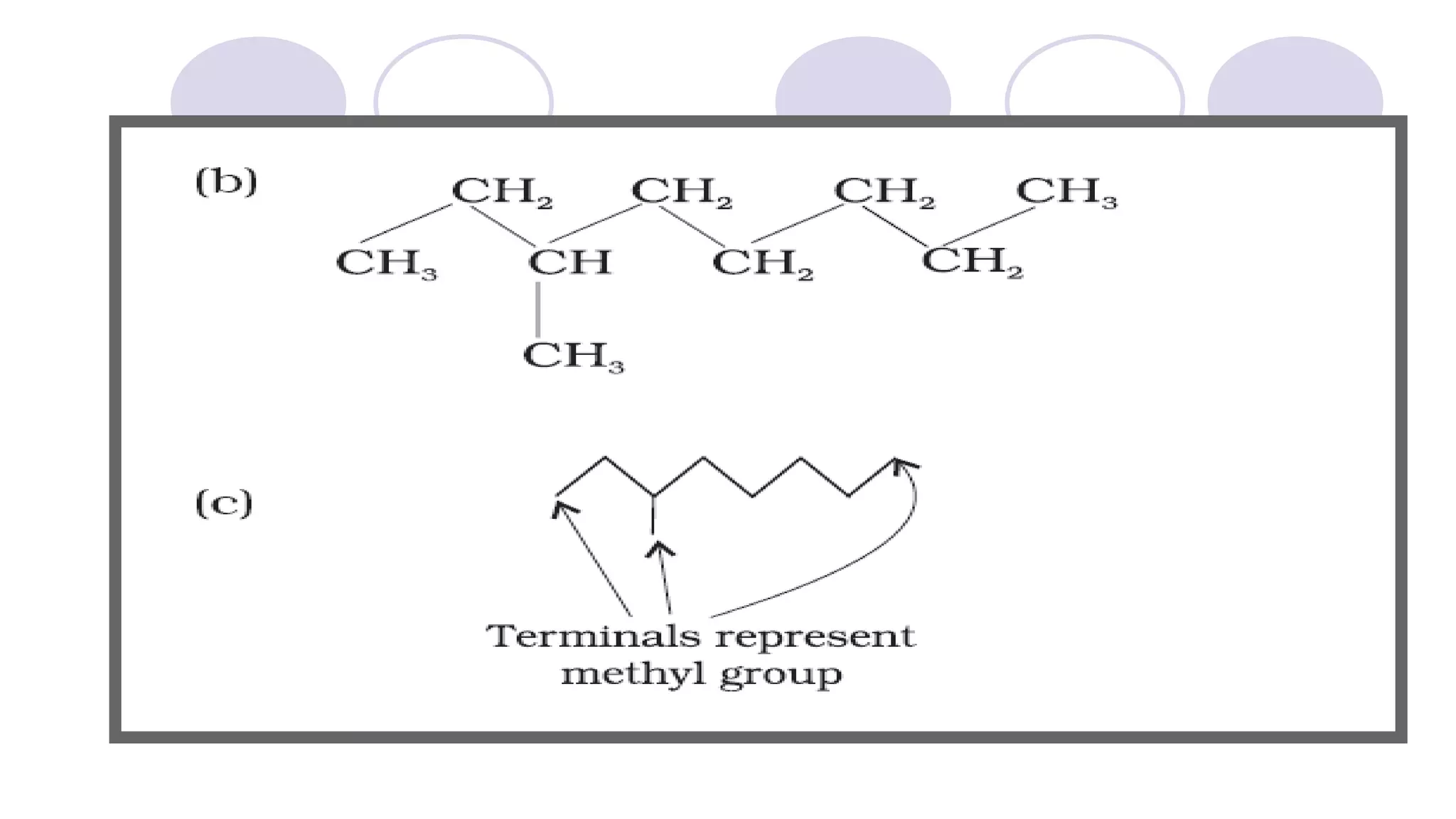
organic chemists use another way of representing the structures, in
which only lines are used. In this bond-line structural representation of
organic compounds, carbon and hydrogen atoms are not shown and
the lines representing carbon-carbon bonds are drawn in a zig-zag
fashion.
For example
i) CH3CH2CHCH2CH2CH2CH2CH3
|
CH3
3-Methyloctane can be represented in various
forms as:
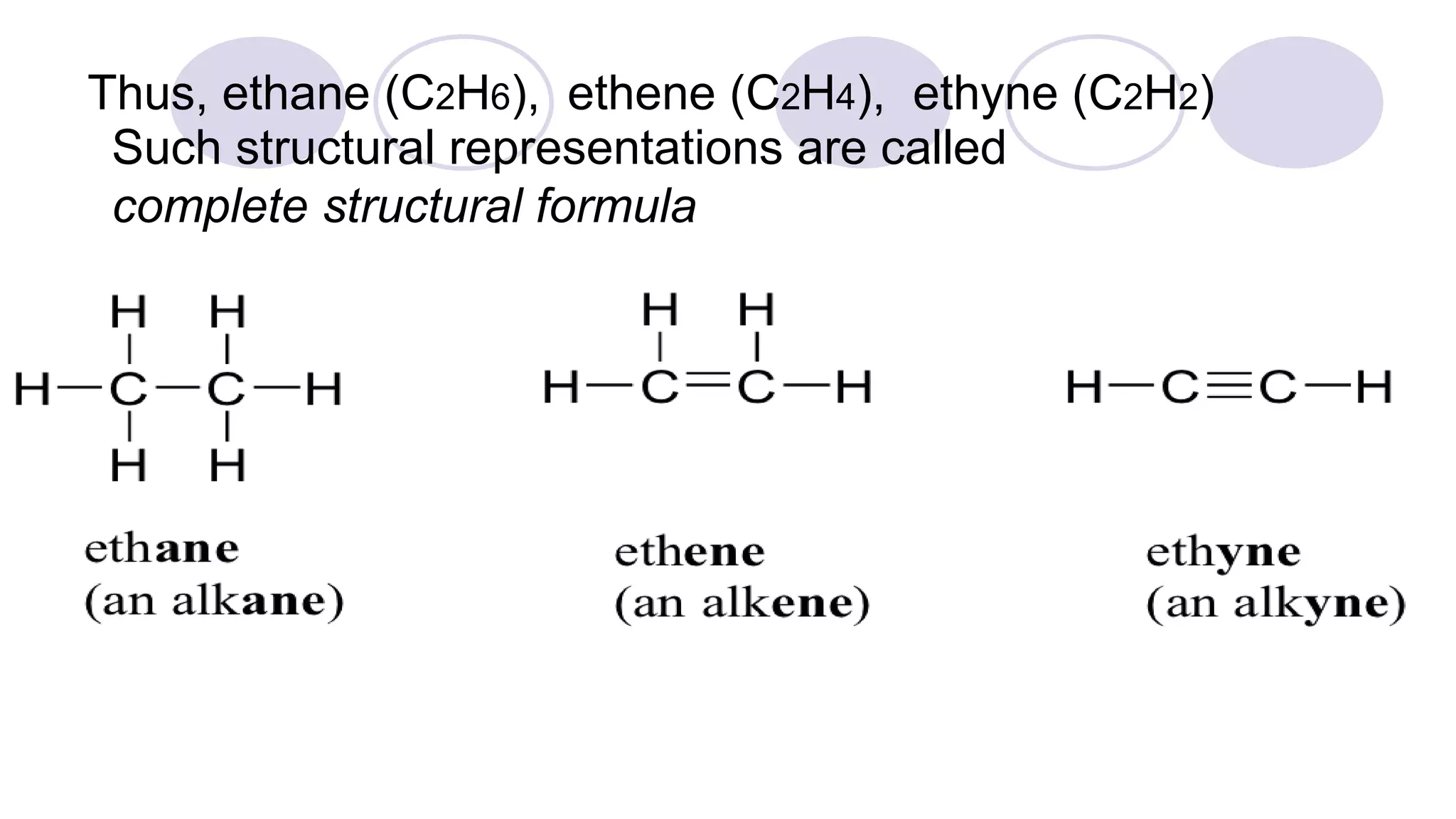
Thus, ethane (C2H6), ethene (C2H4), ethyne (C2H2)
Such structural representations are called
complete structural formula
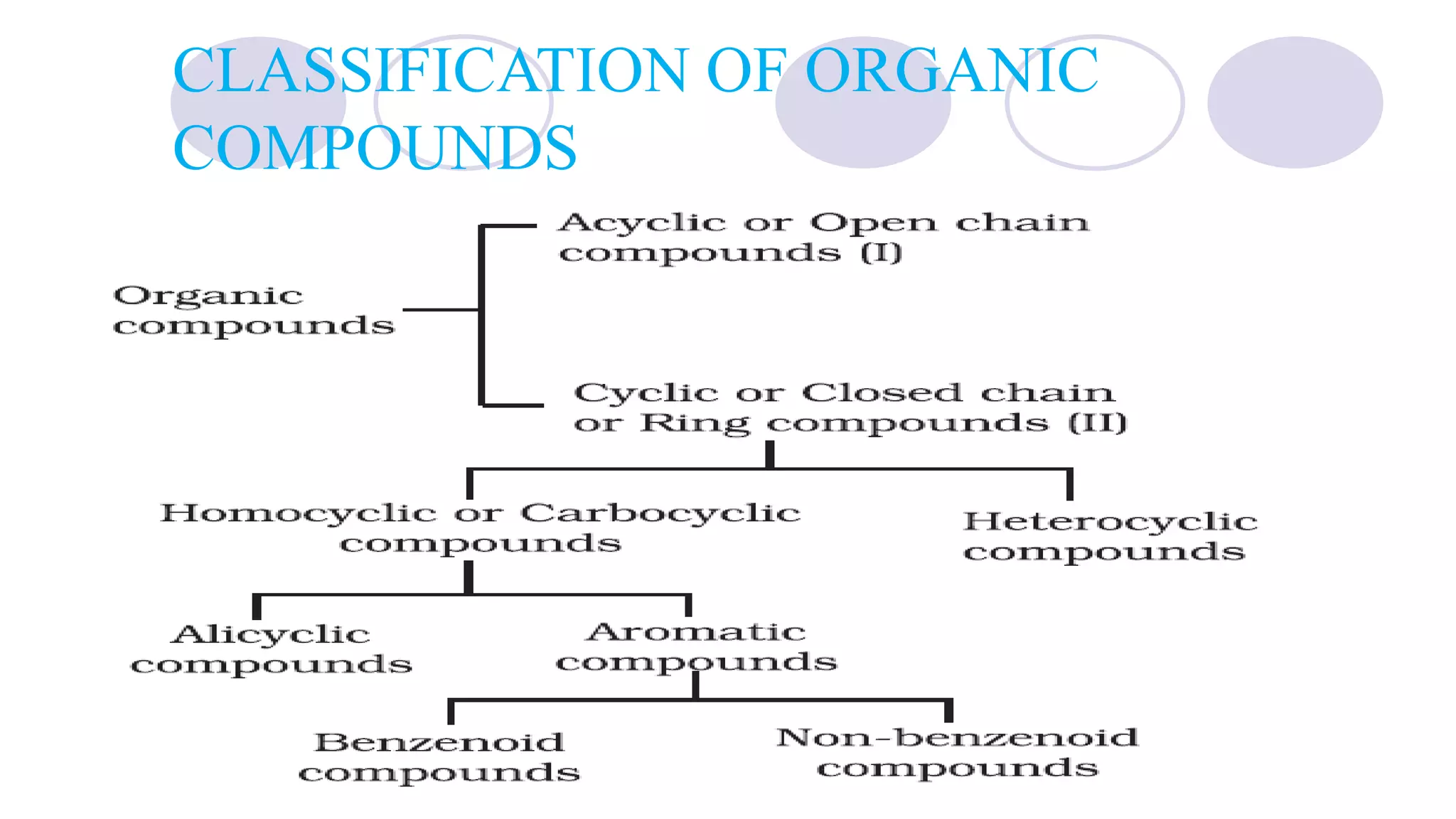
CLASSIFICATION OF ORGANIC
COMPOUNDS
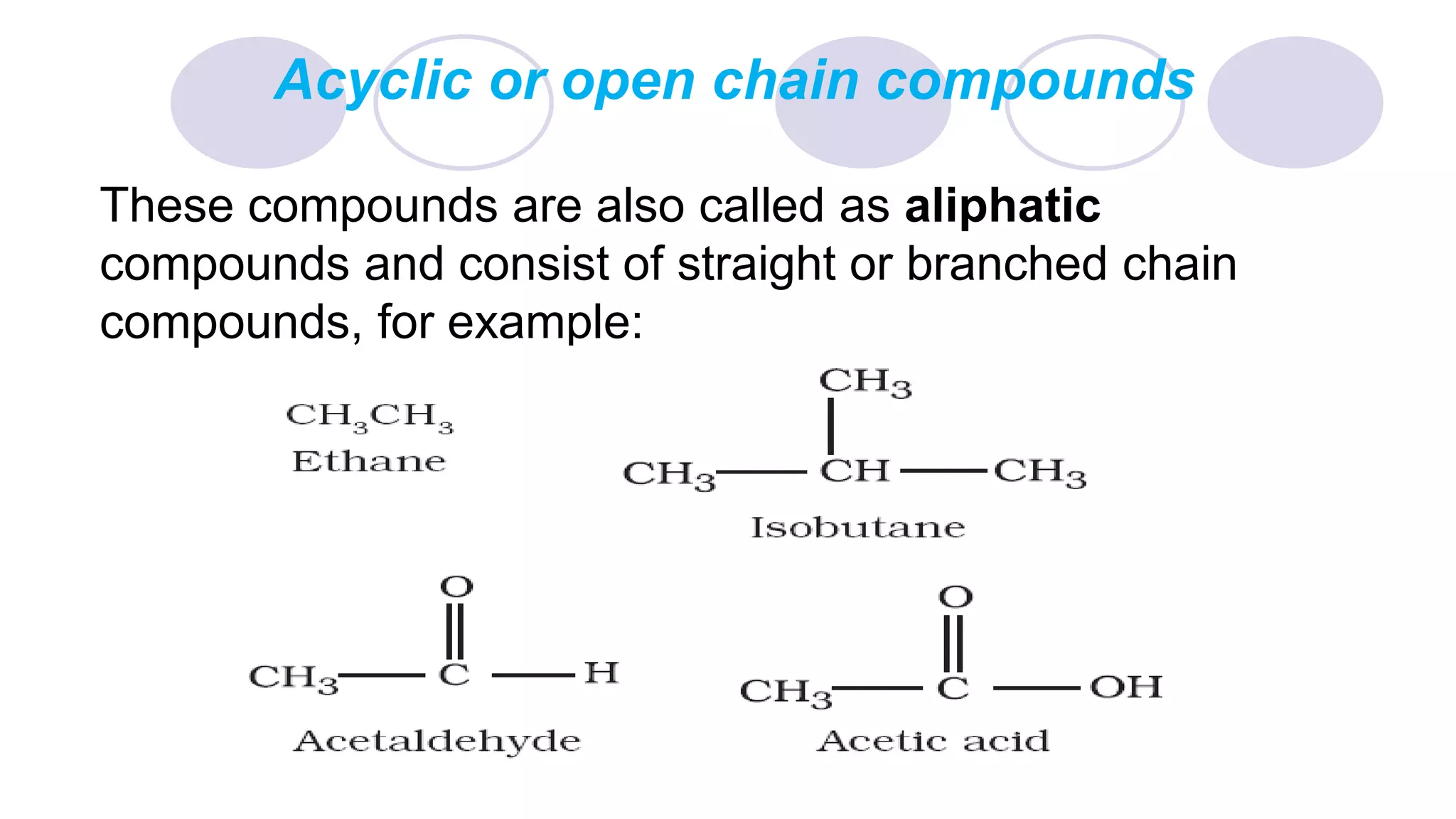
Acyclic or open chain compounds
These compounds are also called as aliphatic
compounds and consist of straight or branched chain
compounds, for example:
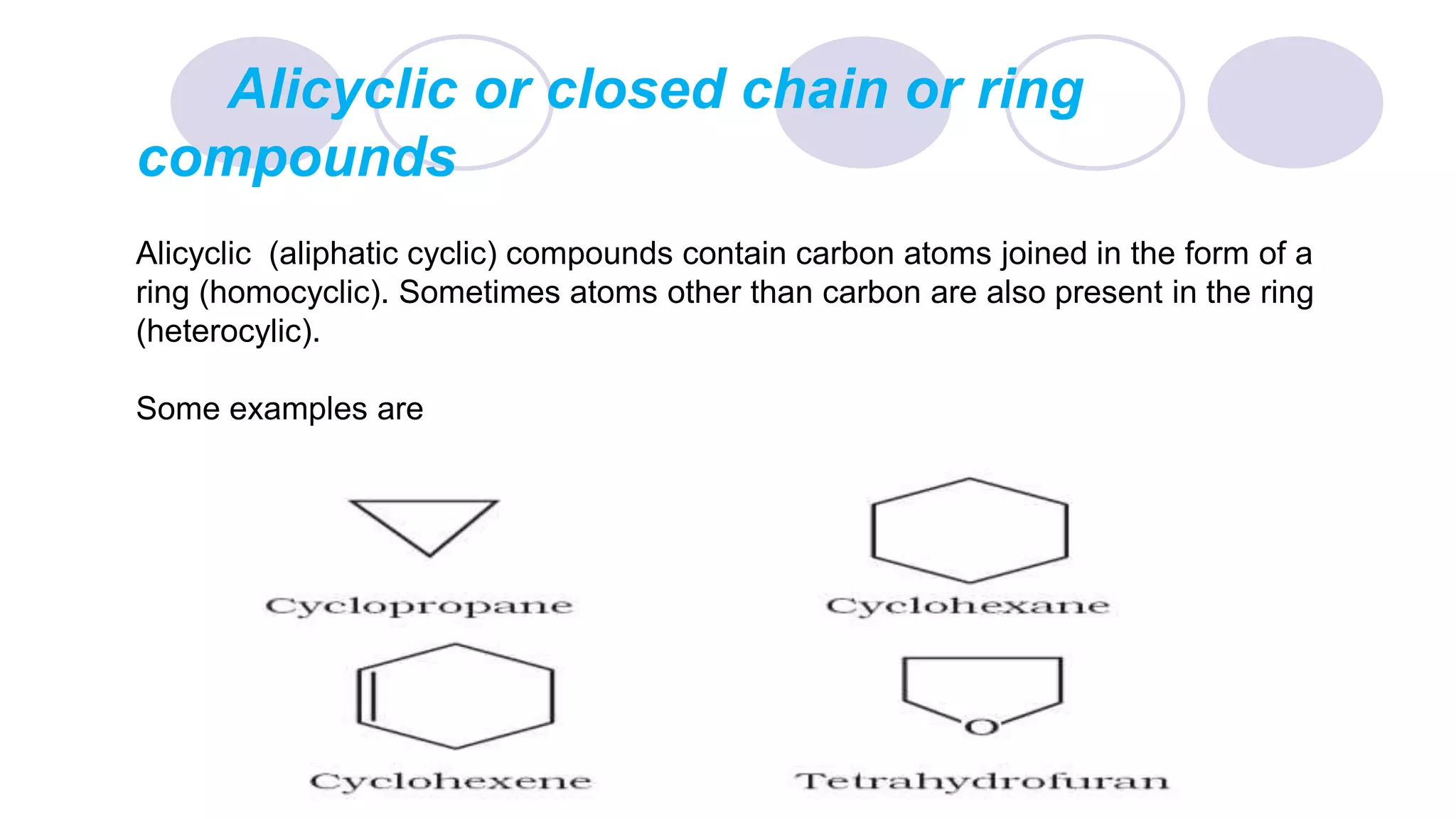
Alicyclic or closed chain or ring
compounds
Alicyclic (aliphatic cyclic) compounds contain carbon atoms joined in the form of a
ring (homocyclic). Sometimes atoms other than carbon are also present in the ring
(heterocylic).
Some examples are
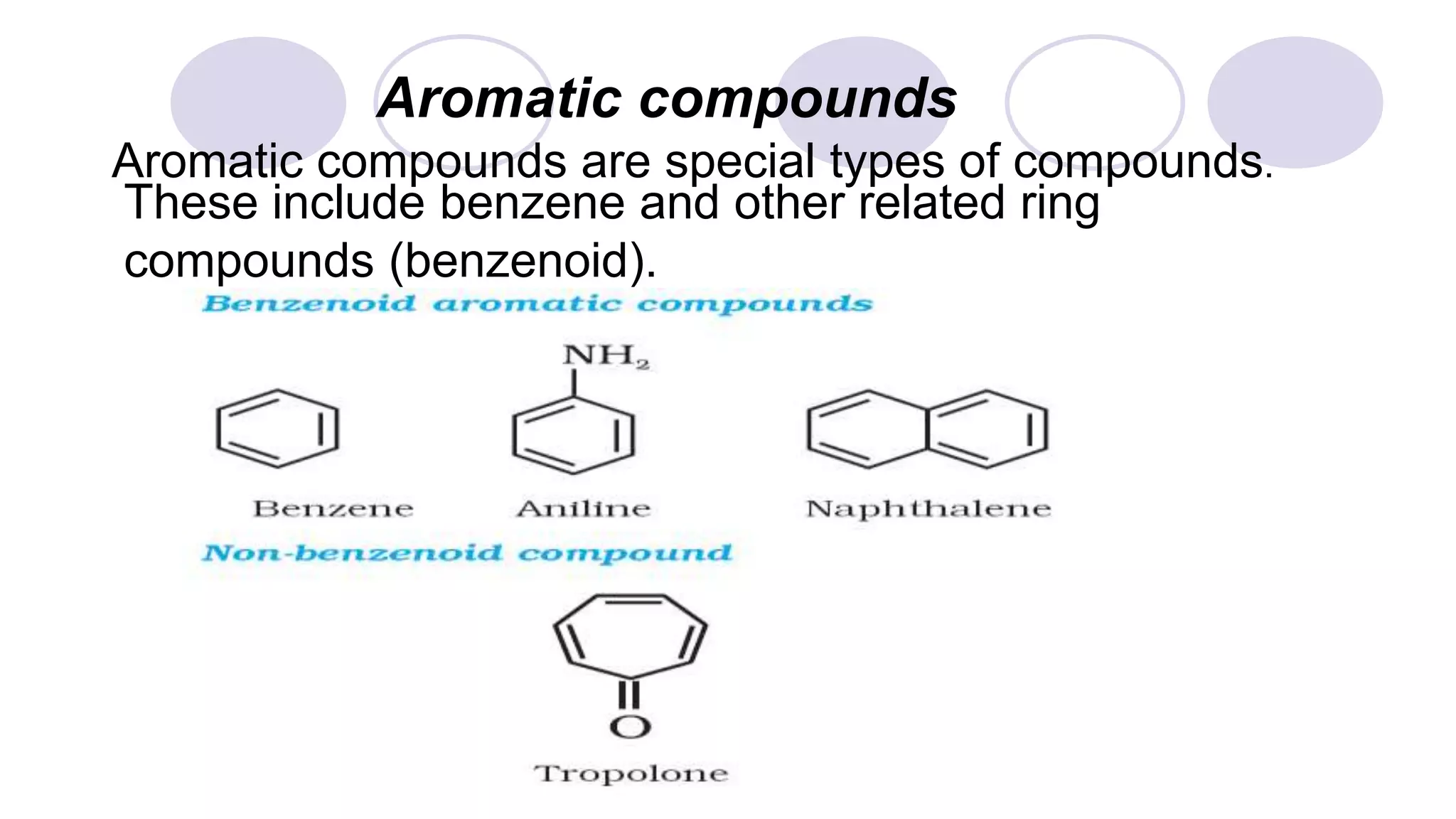
Aromatic compounds
Aromatic compounds are special types of compounds.
These include benzene and other related ring
compounds (benzenoid).
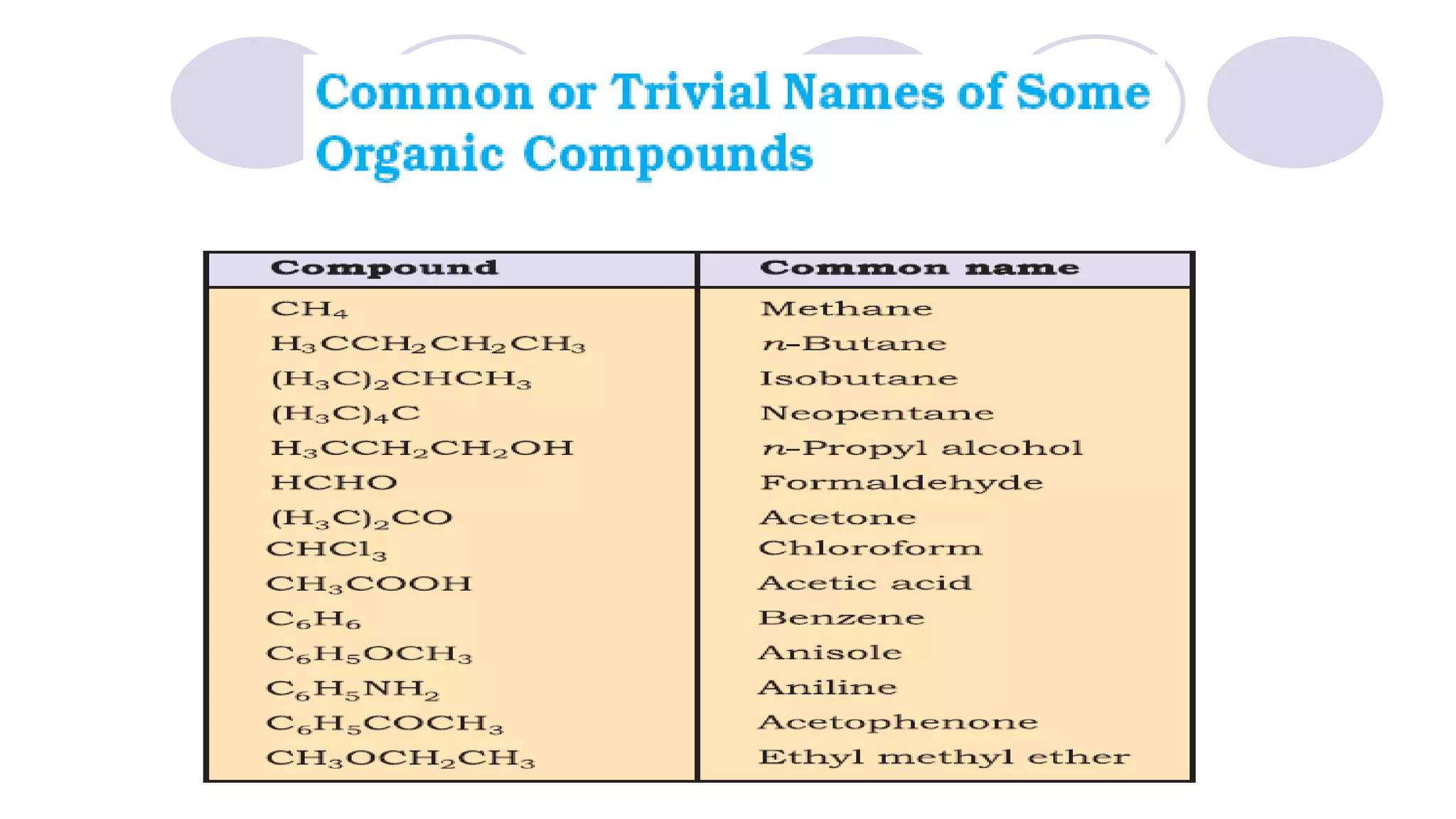
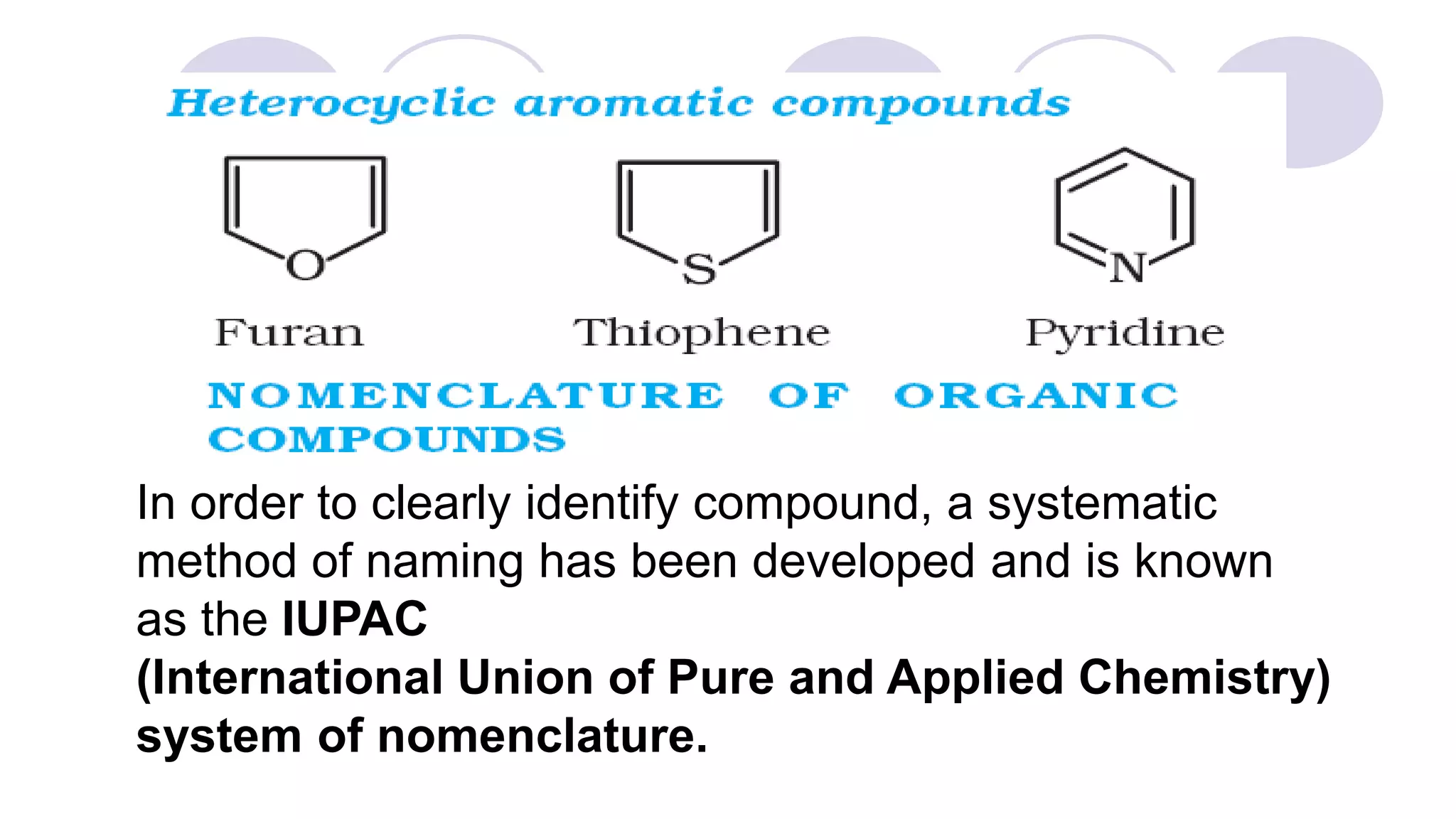
In order to clearly identify compound, a systematic
method of naming has been developed and is known
as the IUPAC
(International Union of Pure and Applied Chemistry)
system of nomenclature.
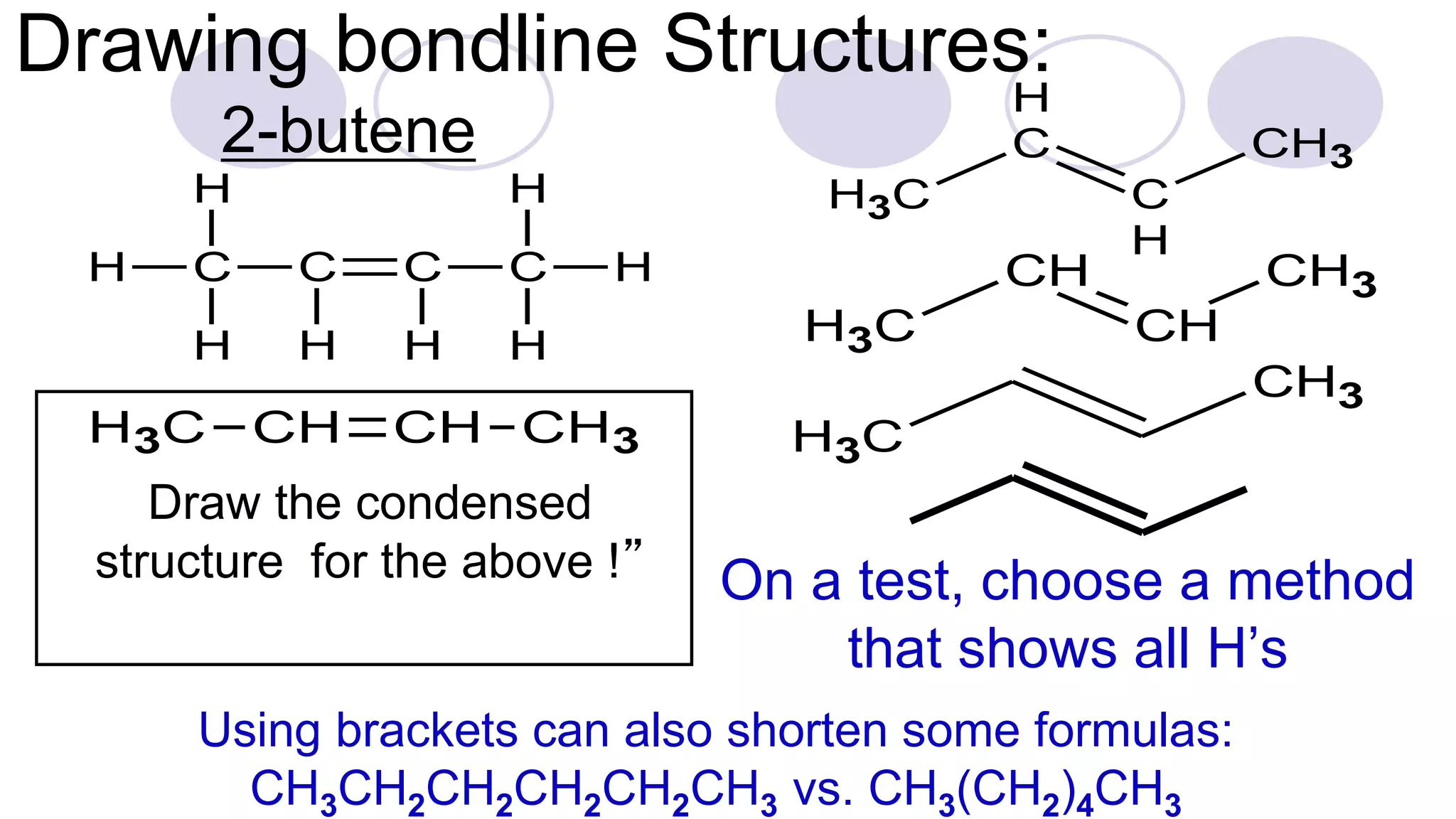
Drawing bondline Structures:
CH3
C
H
C
H
CH3
CH3
CH3
CH3
CH
CH
CH3
2-butene
Draw the condensed
structure for the above !”
C C C C
H
H
H
H H H
H
H
CH3 CH CH CH3
On a test, choose a method
that shows all H’s
Using brackets can also shorten some formulas:
CH3CH2CH2CH2CH2CH3 vs. CH3(CH2)4CH3
TRY THESE
1. What are the 3 classes of hydrocarbons, based on
number of carbon-carbon bonds?
2. Give the 10 organic homologous prefixes, in order, from
1-10.
3. Name these compounds:
CH3
C
H
C
H
CH3
CH3 CH3
CH3 CH3
CH3
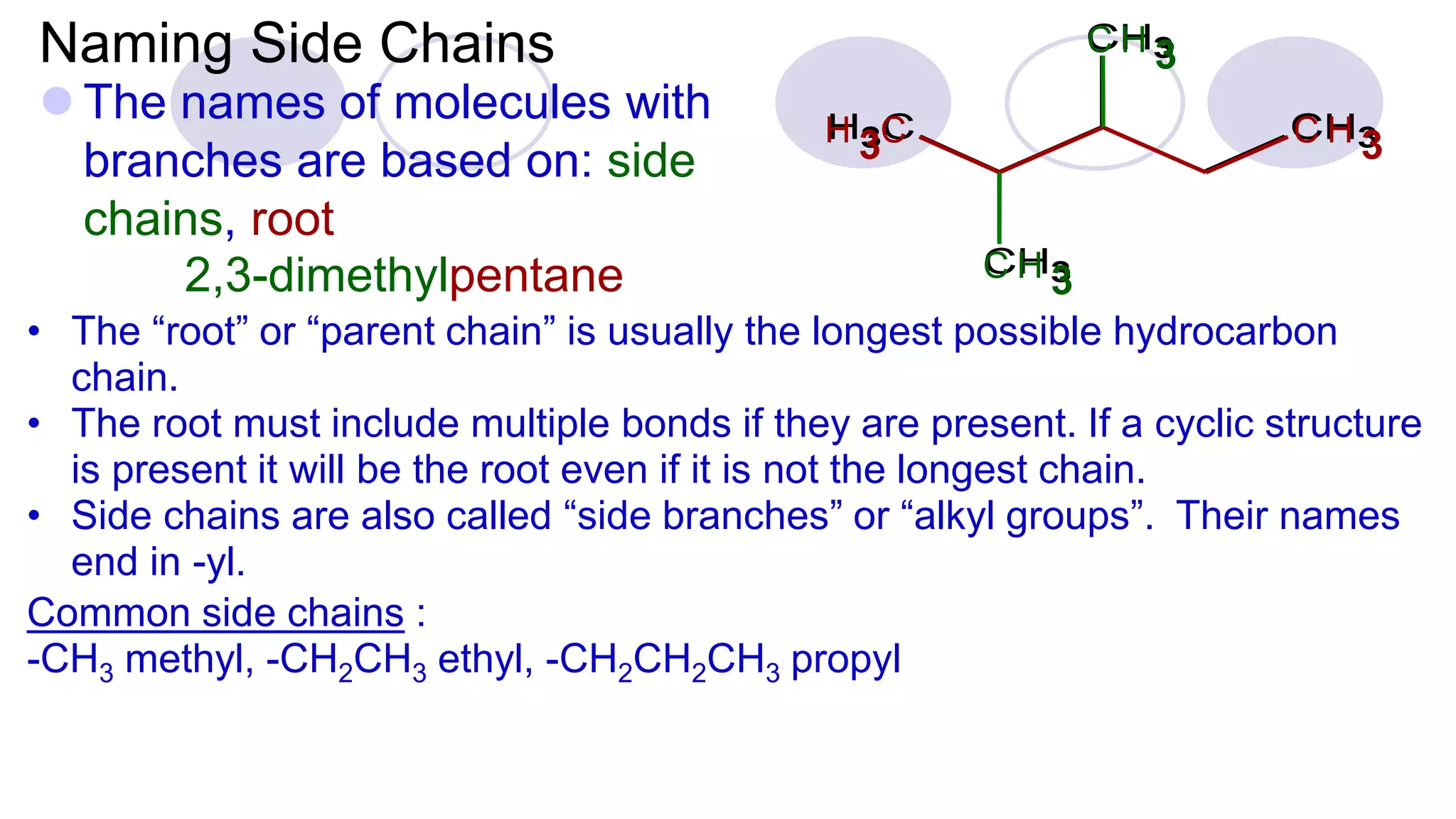
CH3Naming Side Chains
 The names of molecules with
branches are based on: side
chains, root
• The “root” or “parent chain” is usually the longest possible hydrocarbon
chain.
• The root must include multiple bonds if they are present. If a cyclic structure
is present it will be the root even if it is not the longest chain.
• Side chains are also called “side branches” or “alkyl groups”. Their names
end in -yl.
Common side chains :
-CH3 methyl, -CH2CH3 ethyl, -CH2CH2CH3 propyl
2,3-dimethylpentane
CH 3 C H 3
C H 3
C H 3
IUPAC Rules for Naming Hydrocarbons
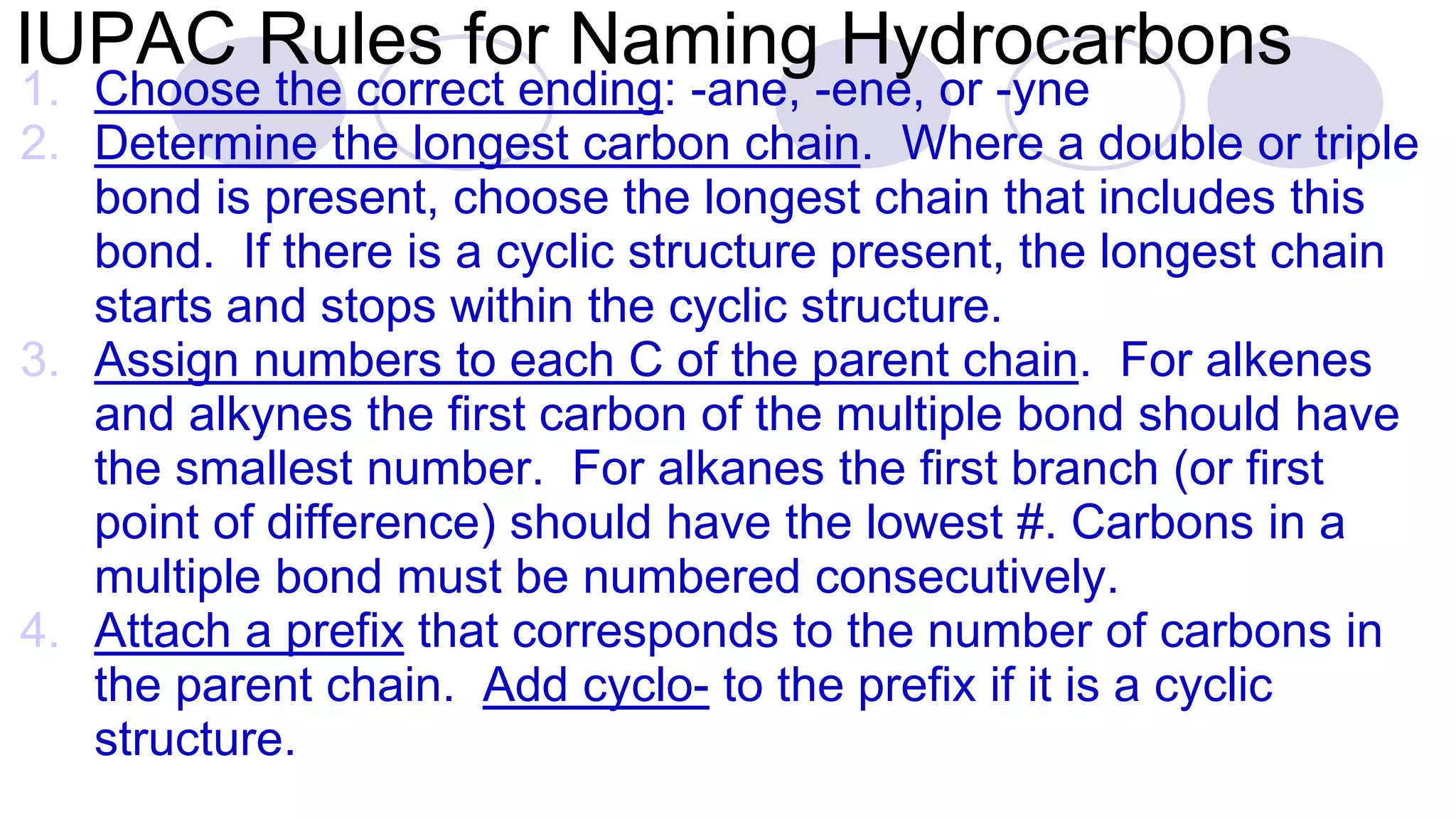
1. Choose the correct ending: -ane, -ene, or -yne
2. Determine the longest carbon chain. Where a double or triple
bond is present, choose the longest chain that includes this
bond. If there is a cyclic structure present, the longest chain
starts and stops within the cyclic structure.
3. Assign numbers to each C of the parent chain. For alkenes
and alkynes the first carbon of the multiple bond should have
the smallest number. For alkanes the first branch (or first
point of difference) should have the lowest #. Carbons in a
multiple bond must be numbered consecutively.
4. Attach a prefix that corresponds to the number of carbons in
the parent chain. Add cyclo- to the prefix if it is a cyclic
structure.
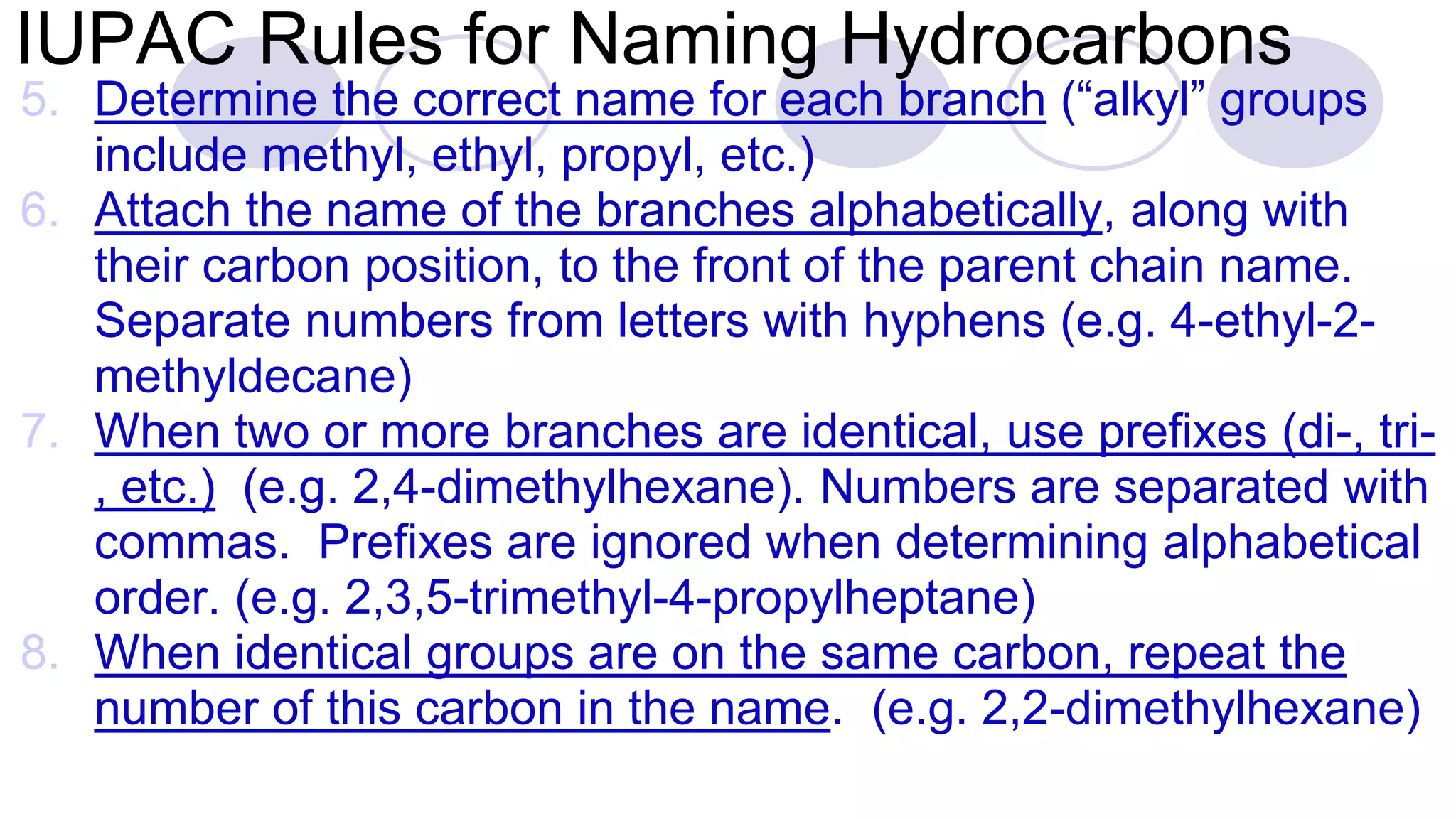
5. Determine the correct name for each branch (“alkyl” groups
include methyl, ethyl, propyl, etc.)
6. Attach the name of the branches alphabetically, along with
their carbon position, to the front of the parent chain name.
Separate numbers from letters with hyphens (e.g. 4-ethyl-2-
methyldecane)
7. When two or more branches are identical, use prefixes (di-, tri-
, etc.) (e.g. 2,4-dimethylhexane). Numbers are separated with
commas. Prefixes are ignored when determining alphabetical
order. (e.g. 2,3,5-trimethyl-4-propylheptane)
8. When identical groups are on the same carbon, repeat the
number of this carbon in the name. (e.g. 2,2-dimethylhexane)
IUPAC Rules for Naming Hydrocarbons
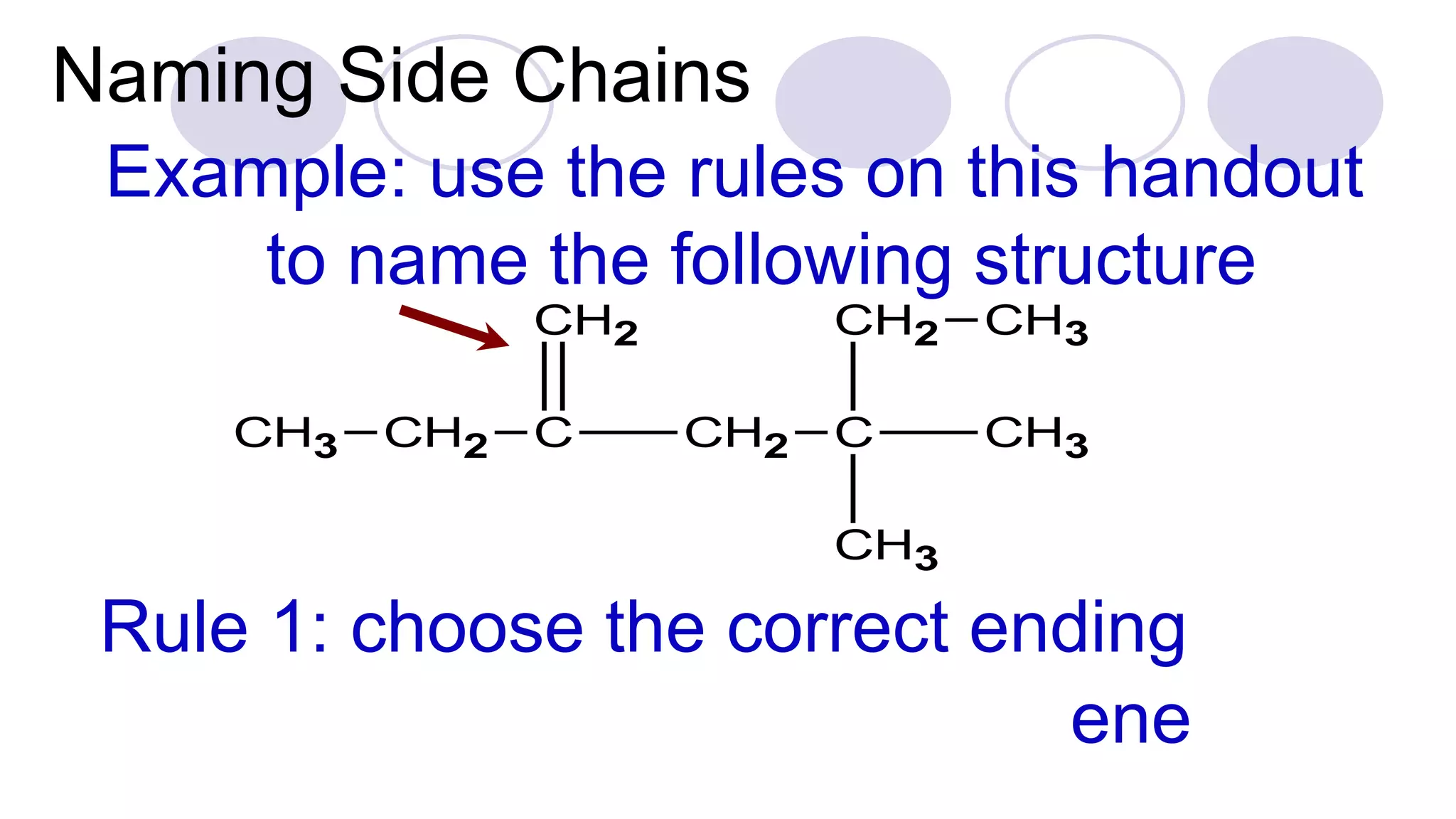
ene
Naming Side Chains
Example: use the rules on this handout
to name the following structure
CH3 CH2 C
CH2
CH2 C
CH2
CH3
CH3
CH3
Rule 1: choose the correct ending
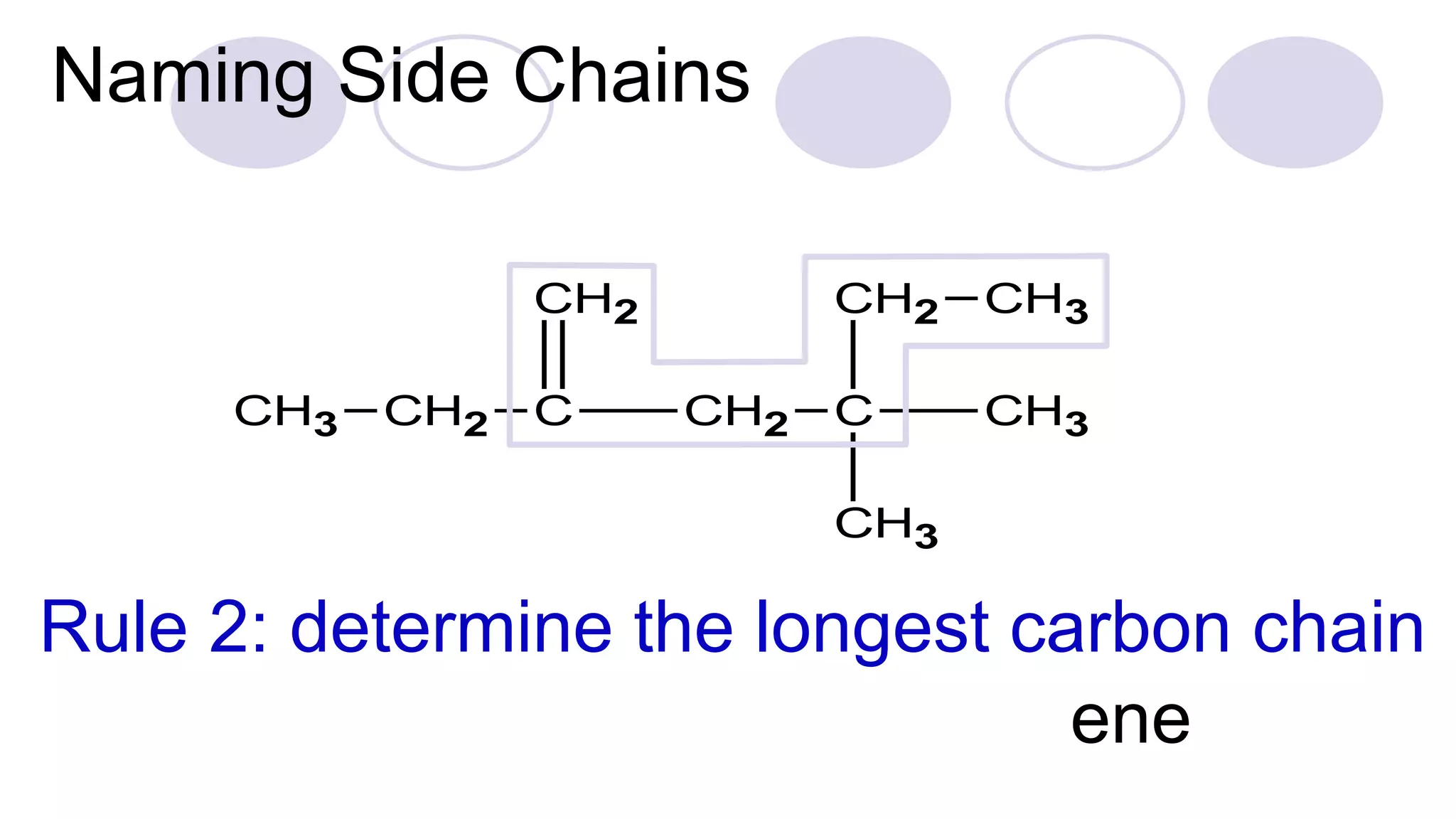
ene
Rule 2: determine the longest carbon chain
CH3 CH2 C
CH2
CH2 C
CH2
CH3
CH3
CH3
Naming Side Chains
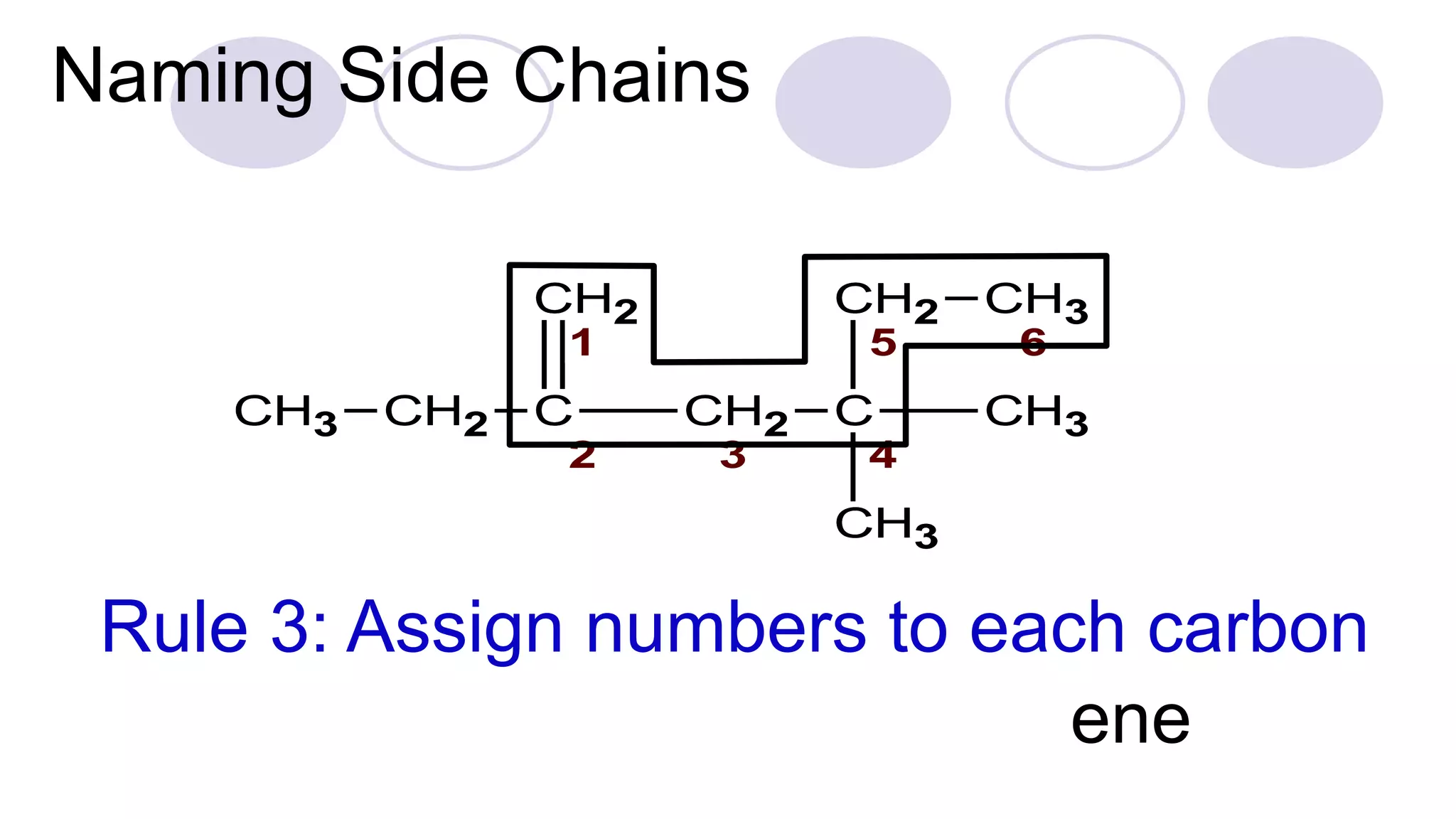
Rule 3: Assign numbers to each carbon
CH3 CH2 C
CH2
CH2 C
CH2
CH3
CH3
CH3
ene
Naming Side Chains
Rule 3: Assign numbers to each carbon
CH3 CH2 C
2
CH2
1
CH2
3
C
4
CH2
5
CH3
CH3
CH3
6
CH3 CH2 C
CH2
CH2 C
CH2
CH3
CH3
CH3
ene
Naming Side Chains
1-hexeneene
Rule 4: attach prefix (according to # of Cs)
Naming Side Chains
CH3 CH2 C
2
CH2
1
CH2
3
C
4
CH2
5
CH3
CH3
CH3
6
CH3 CH2 C
CH2
CH2 C
CH2
CH3
CH3
CH3
CH3 CH2 C
CH2
CH2 C
CH2
CH3
CH3
CH3
CH3 CH2 C
2
CH2
1
CH2
3
C
4
CH2
5
CH3
CH3
CH3
6
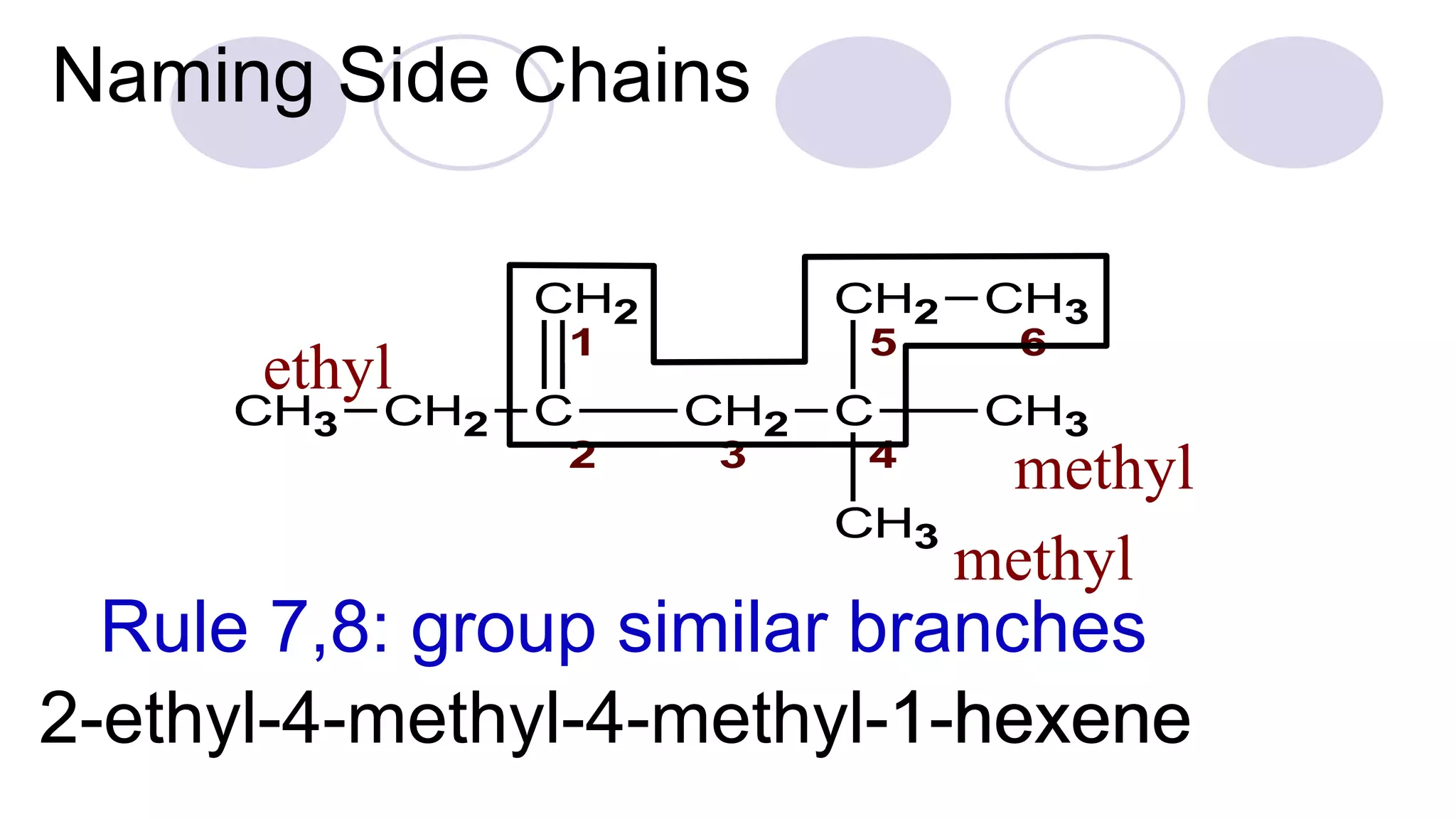
1-hexene2-ethyl-4-methyl-4-methyl-1-hexene
ethyl
methyl
methyl
Rule 6: attach name of branches alphabetically
Naming Side Chains
Rule 7,8: group similar branches
CH3 CH2 C
CH2
CH2 C
CH2
CH3
CH3
CH3
CH3 CH2 C
2
CH2
1
CH2
3
C
4
CH2
5
CH3
CH3
CH3
6
1-hexene2-ethyl-4-methyl-4-methyl-1-hexene
ethyl
methyl
methyl
Naming Side Chains
Rule 7,8: group similar branches
CH3 CH2 C
CH2
CH2 C
CH2
CH3
CH3
CH3
CH3 CH2 C
2
CH2
1
CH2
3
C
4
CH2
5
CH3
CH3
CH3
6
2-ethyl-4,4-dimethyl-1-hexene
ethyl
methyl
methyl
Naming Side Chains
Rules for naming IUPAC compounds
I. for branched chain alkanes:-
a) Identify the longest carbon chain
b) When there are two or more parent
chains of identical length, choose the
parent chain with the greater number of
substituents.
c) Identify and name the substituent(s).
 for One substituent start numbering from the end
that gives the substituent the lower number.
 Two or more identical substituents: number from
the end that gives the lower number to the substituent
encountered first.
 The number of times the substituent occurs is
indicated by a prefix di-, tri-, tetra-, penta-, hexa-, and
so on.
 A comma is used to separate position numbers.
 Two or more different substituents: list the
substituents in alphabetical order and number
from the end that gives the lower number to the
substituent encountered first. If there are
different substituents in equivalent positions at
opposite ends of the parent chain, give the
substituent of lower alphabetical order the lower
number.
 Prefixes such as di-, tri-, tetra-, penta-, hexa-,
and so on are not included in alphabetizing.
Draw the structures of the following
compounds
 1) hexanethioyl chloride
 2) 3-methyl pent-i-oic acid
 Propane 1,2,3 tricarboxylic acid.
 Propane 1,2,3 trial
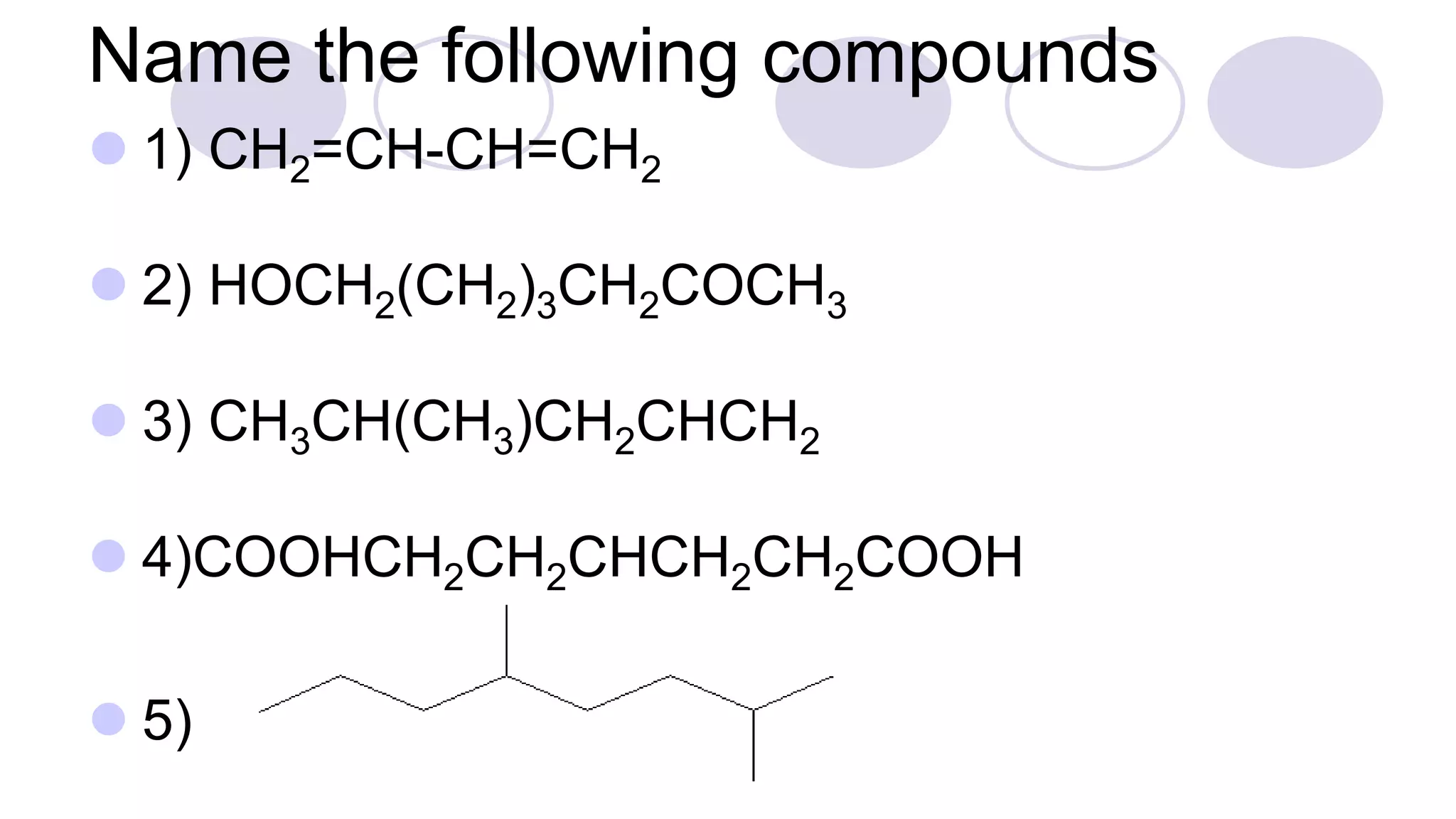
Name the following compounds
 1) CH2=CH-CH=CH2
 2) HOCH2(CH2)3CH2COCH3
 3) CH3CH(CH3)CH2CHCH2
 4)COOHCH2CH2CHCH2CH2COOH
 5)
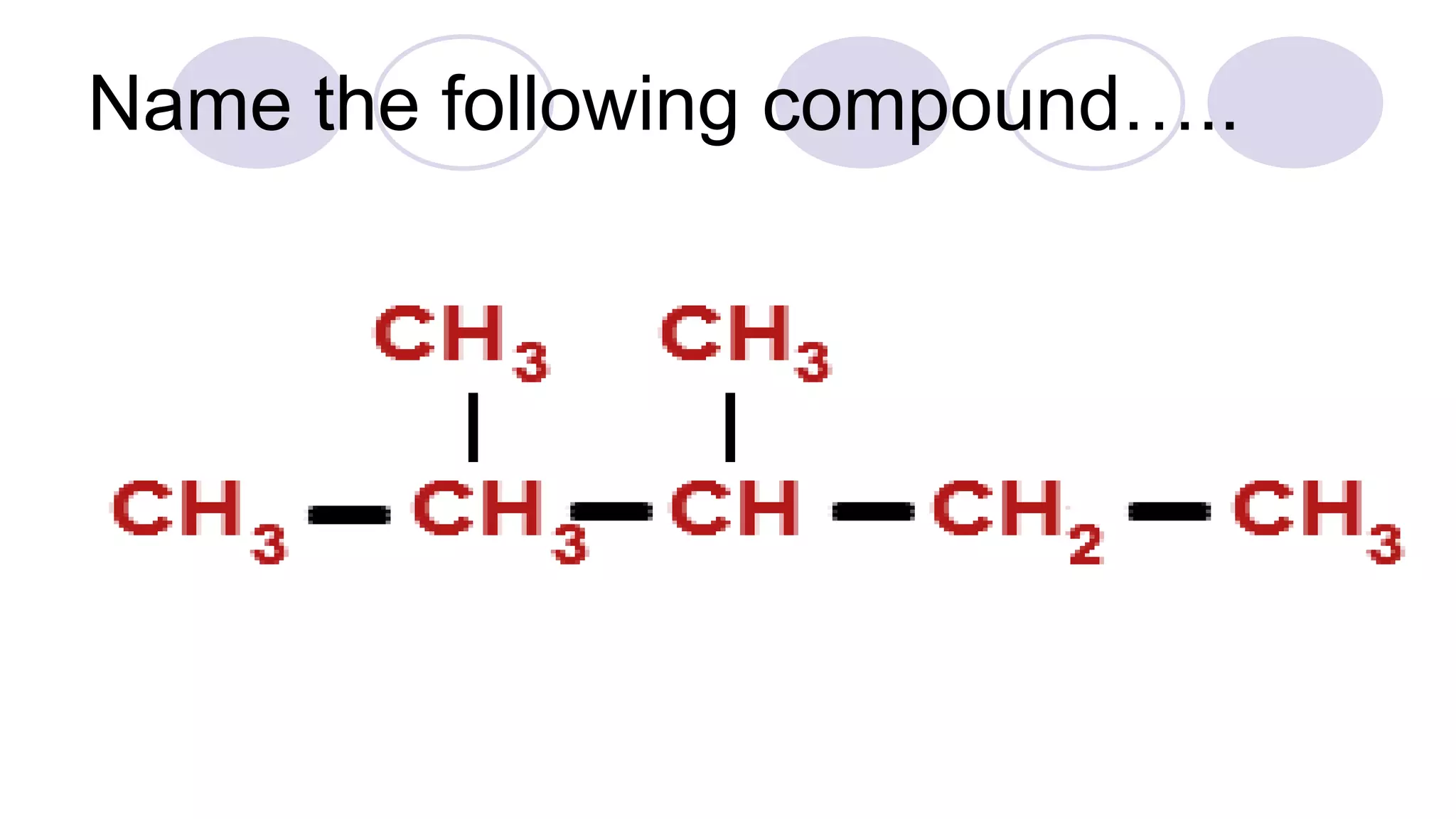
Name the following compound…..
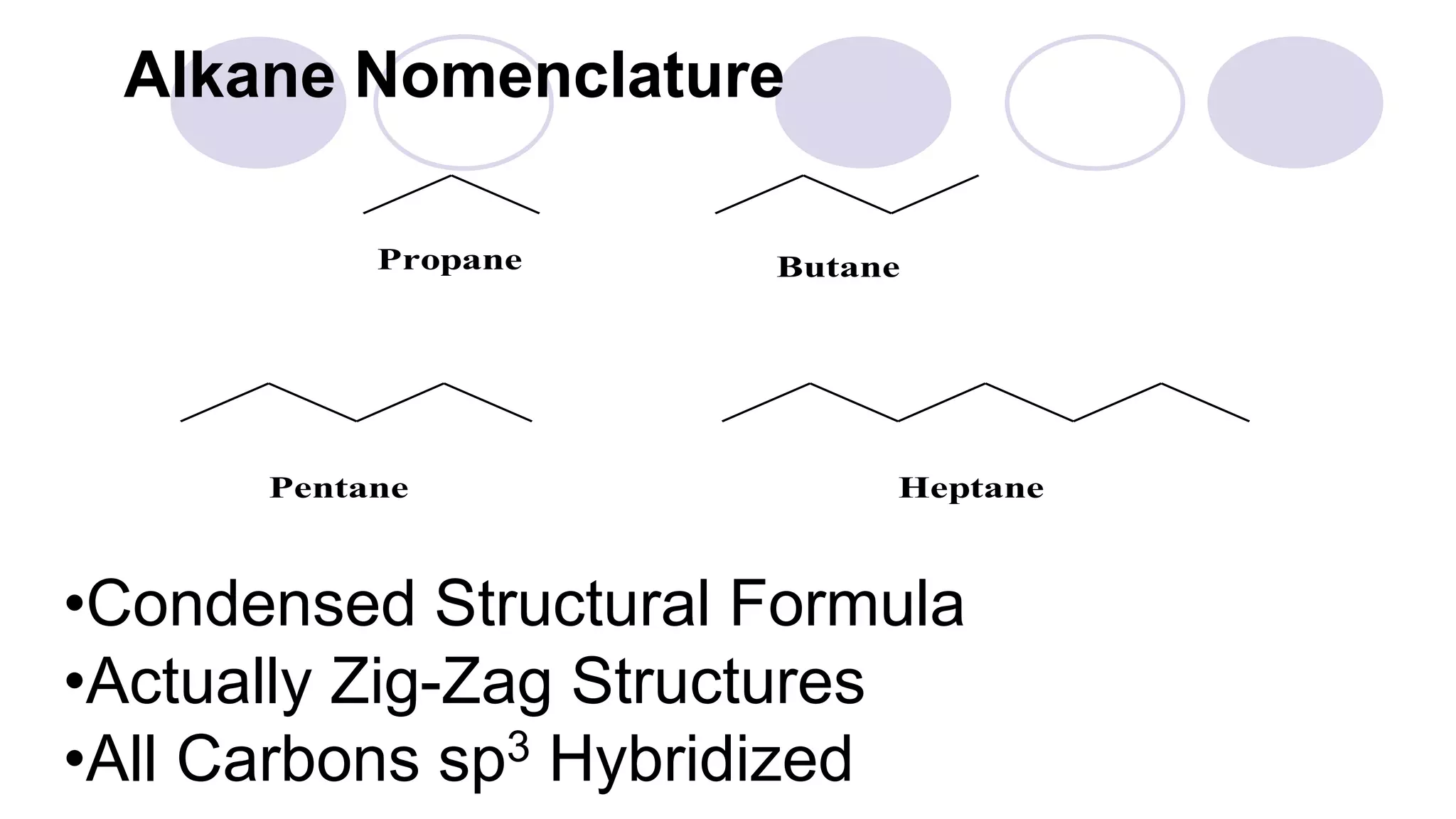
Alkane Nomenclature
Pentane Heptane
Propane Butane
•Condensed Structural Formula
•Actually Zig-Zag Structures
•All Carbons sp3 Hybridized
Alkane Nomenclature
Name the smaller rows that
branch off of the larger rows as
if they were little independent
alkanes of their own, better
known as alkyl groups.
Alkane Nomenclature
Hexane or n-hexane
Alkyl group: Methyl
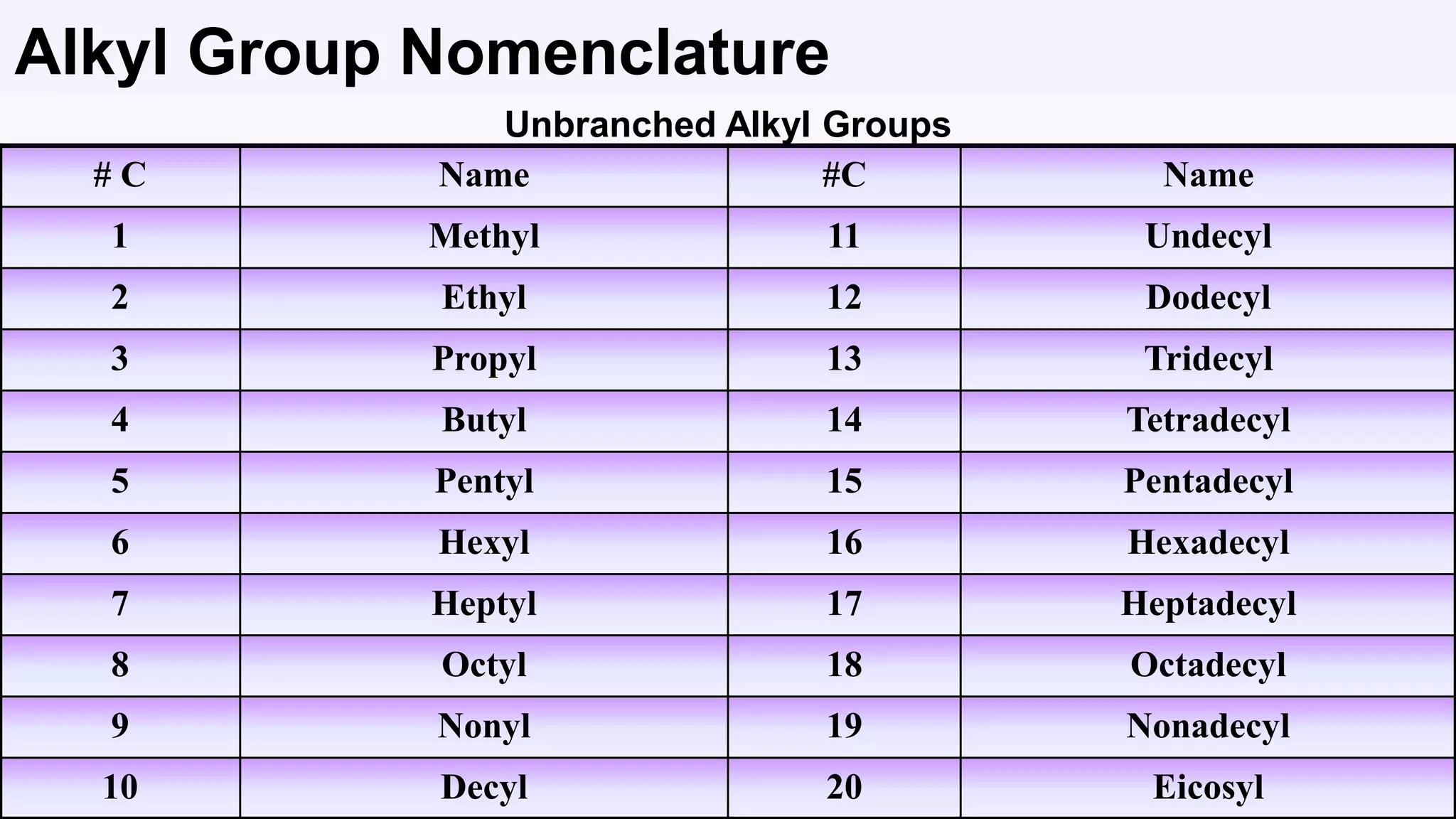
Alkyl Group Nomenclature
Unbranched Alkyl Groups
# C Name #C Name
1 Methyl 11 Undecyl
2 Ethyl 12 Dodecyl
3 Propyl 13 Tridecyl
4 Butyl 14 Tetradecyl
5 Pentyl 15 Pentadecyl
6 Hexyl 16 Hexadecyl
7 Heptyl 17 Heptadecyl
8 Octyl 18 Octadecyl
9 Nonyl 19 Nonadecyl
10 Decyl 20 Eicosyl
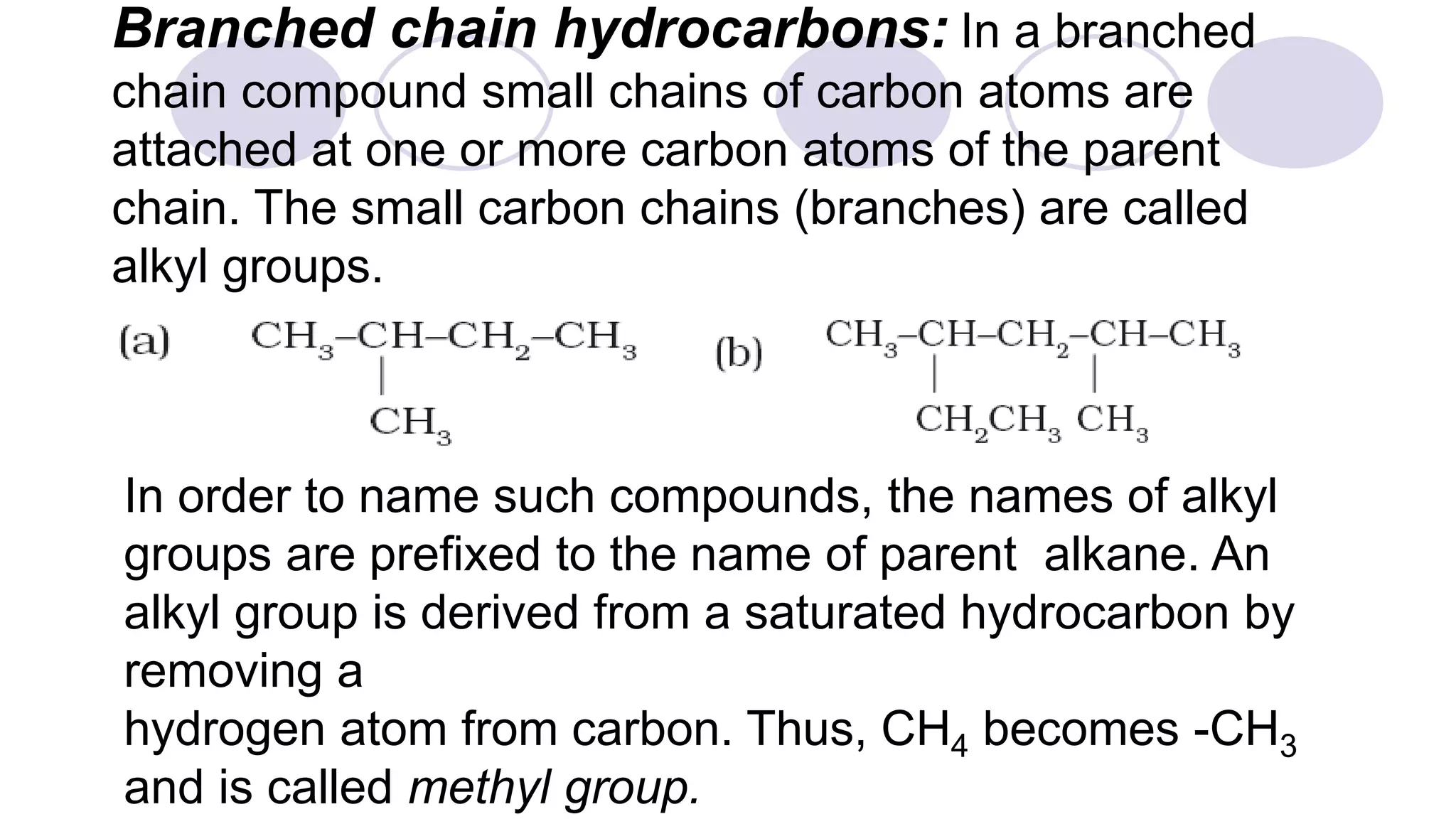
Branched chain hydrocarbons: In a branched
chain compound small chains of carbon atoms are
attached at one or more carbon atoms of the parent
chain. The small carbon chains (branches) are called
alkyl groups.
In order to name such compounds, the names of alkyl
groups are prefixed to the name of parent alkane. An
alkyl group is derived from a saturated hydrocarbon by
removing a
hydrogen atom from carbon. Thus, CH4 becomes -CH3
and is called methyl group.
Alkane Nomenclature
The carbons in an alkane are
sometimes classified by how
many other carbon atoms
are stuck to them.
Alkane Nomenclature
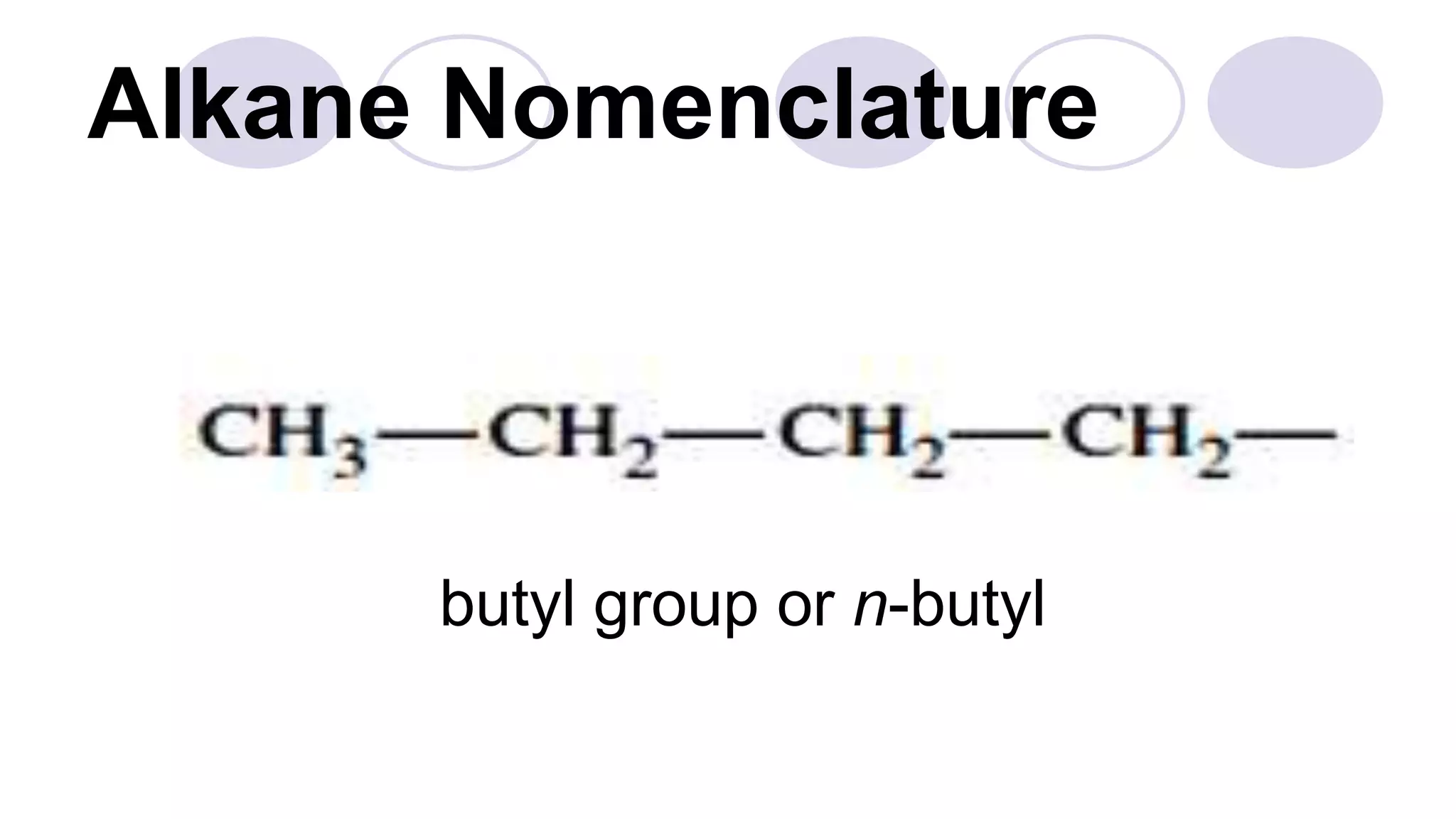
butyl group or n-butyl
Alkane Nomenclature
sec-butyl group
Alkane Nomenclature
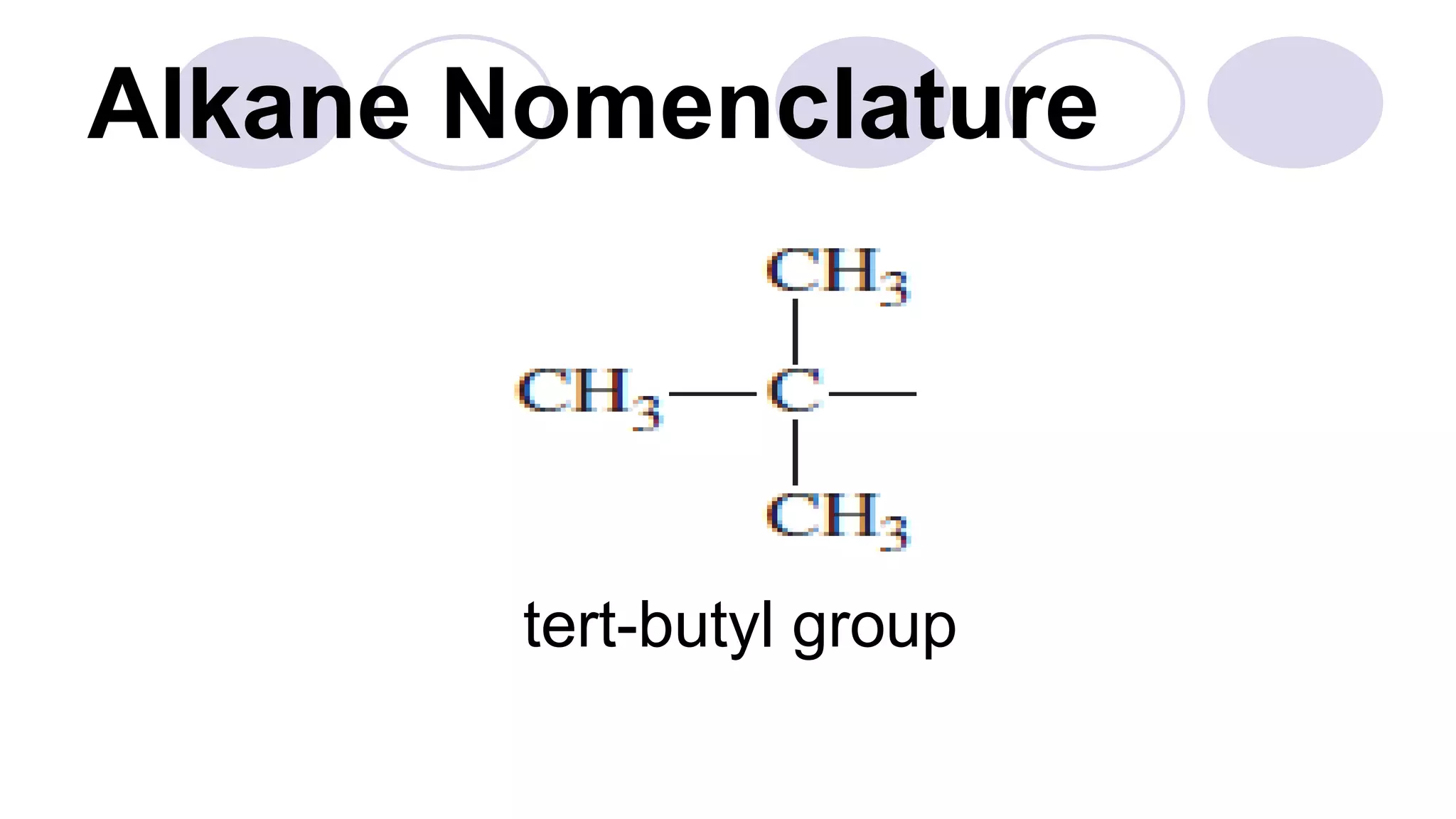
tert-butyl group
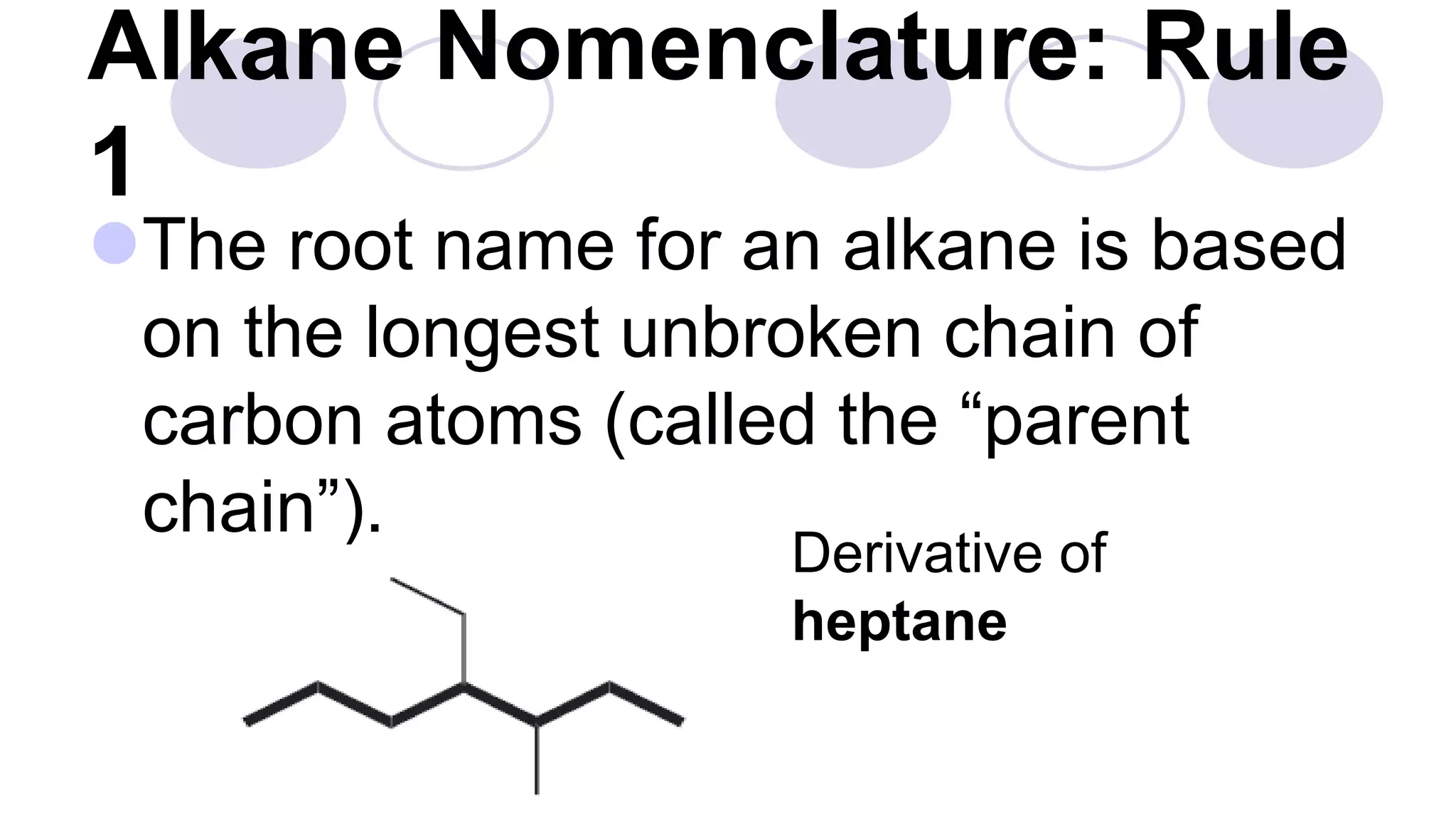
Alkane Nomenclature: Rule
1
The root name for an alkane is based
on the longest unbroken chain of
carbon atoms (called the “parent
chain”).
Derivative of
heptane
Alkane Nomenclature: Rule 1
When there are two longest
chains of equal length, use the
chain with the greater number
of substituents as the main
chain.
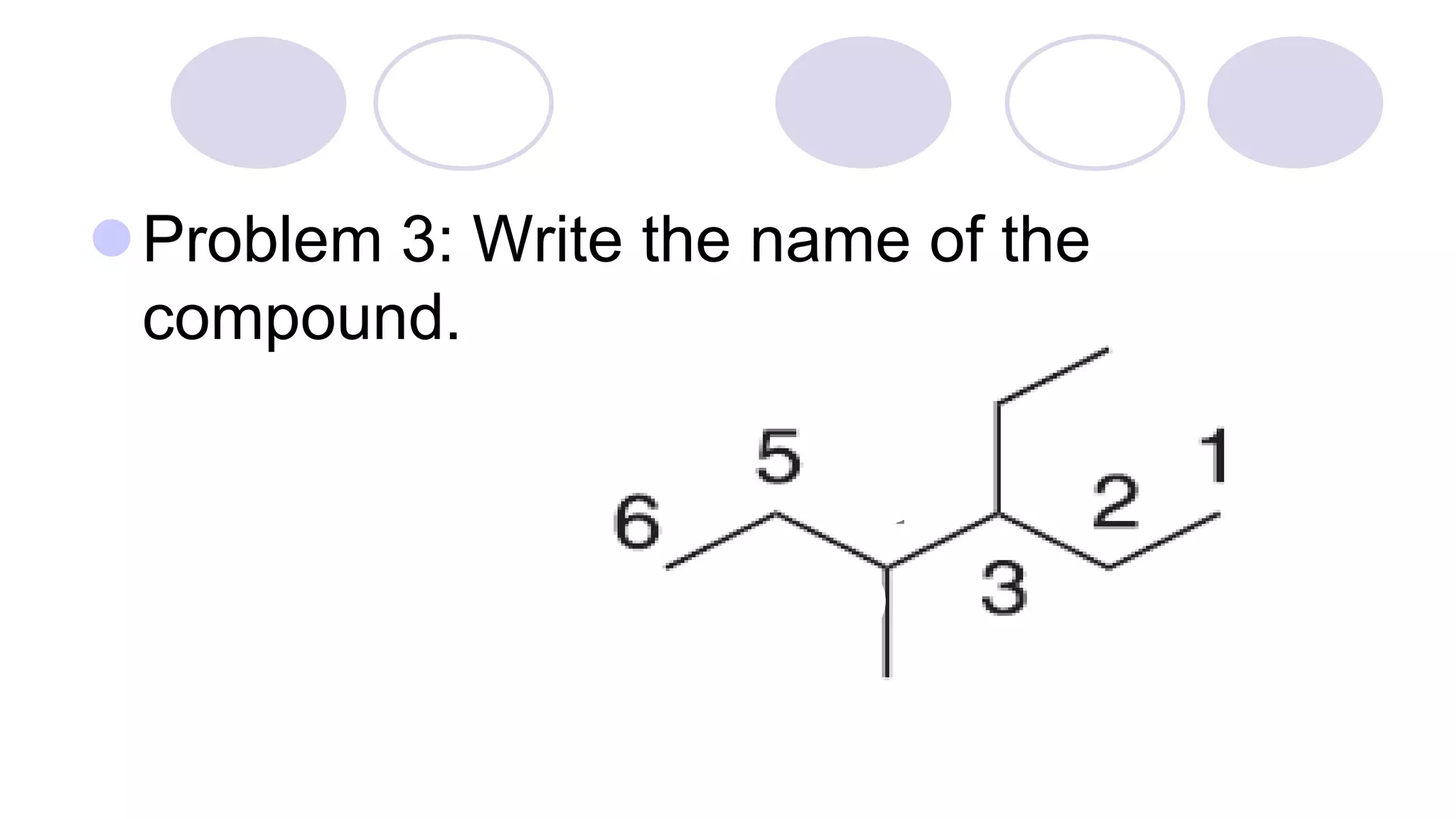
Problem 3: Write the name of the
compound.
answer
3-ethyl-4-methylhexane
Haloalkanes
Haloalkanes can be named just like
alkanes, with the halogen atom treated as
a substituent. Halogen substituents are
named fluoro-, chloro-, bromo-, and
iodo-.
When more than one halogen is present in
the parent chain, they must be named
alphabetically.
Haloalkanes
2-bromobutane
1,2-difluoropropane
Complex alkyl groups are named by a
systematic method using the longest
alkyl chain as the base alkyl group.
The base alkyl group is numbered
beginning with the carbon atom (the
“head carbon”) bonded to the main
chain.
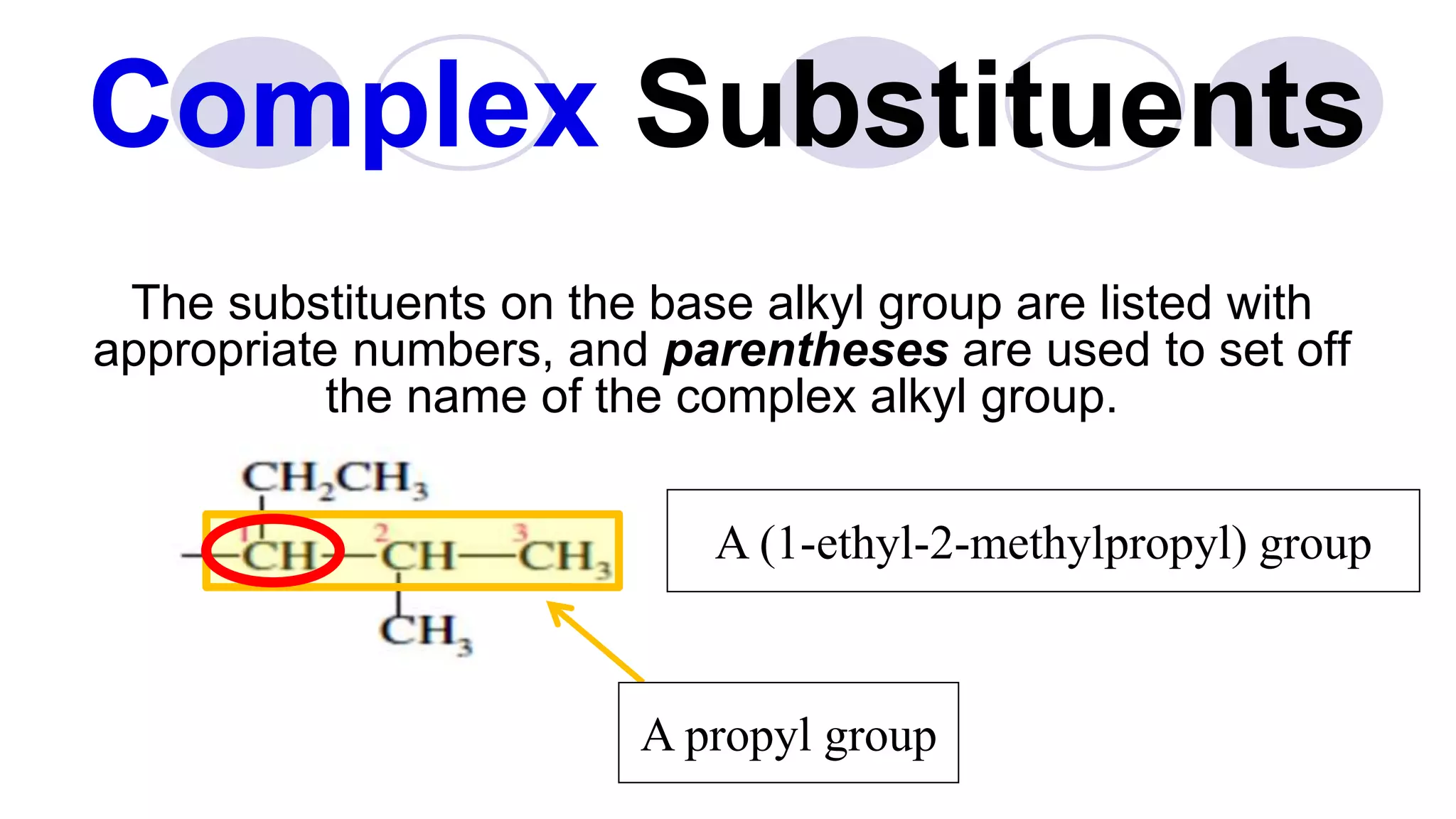
Complex Substituents
The substituents on the base alkyl group are listed with
appropriate numbers, and parentheses are used to set off
the name of the complex alkyl group.
A (1-ethyl-2-methylpropyl) group
A propyl group
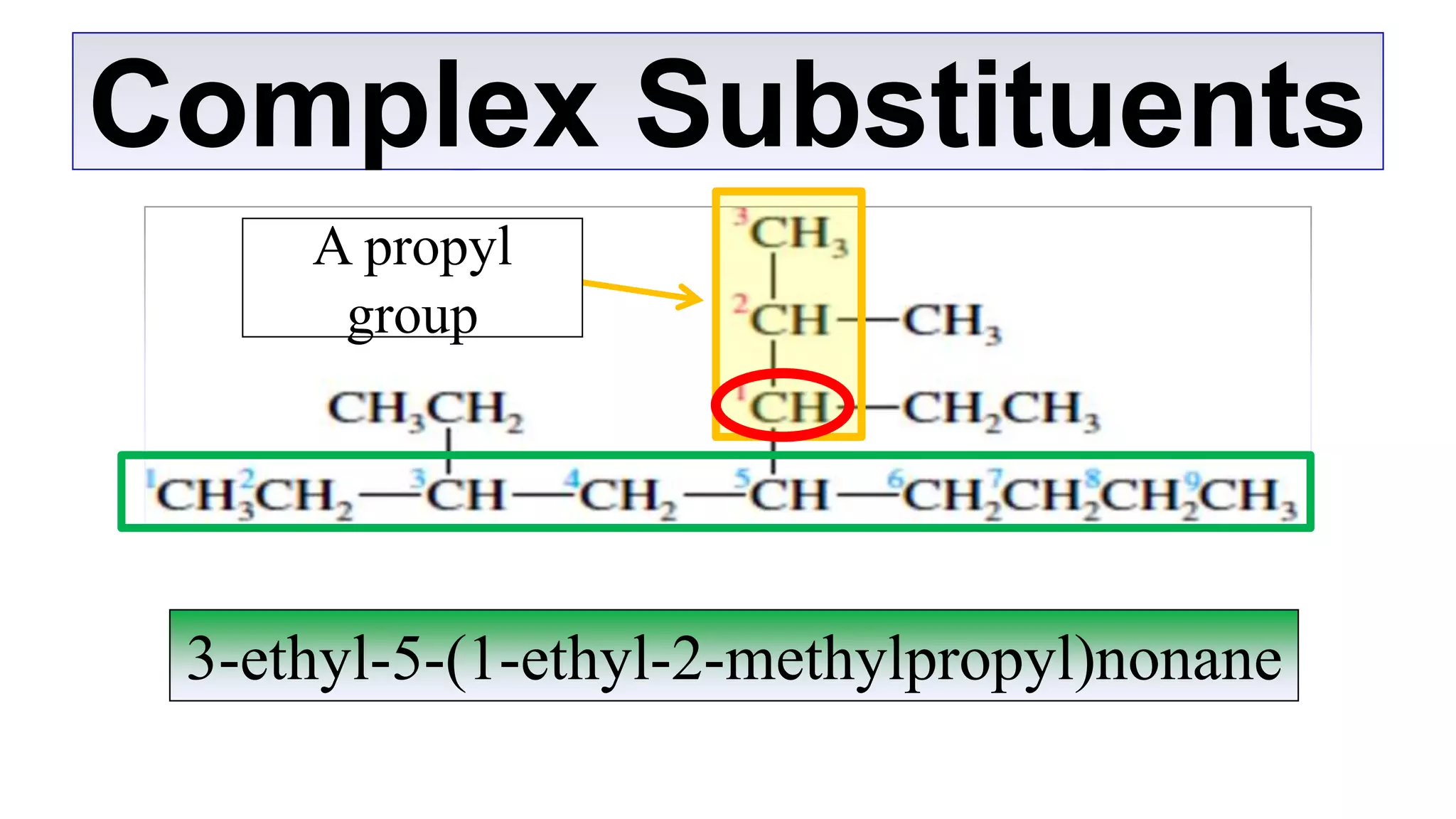
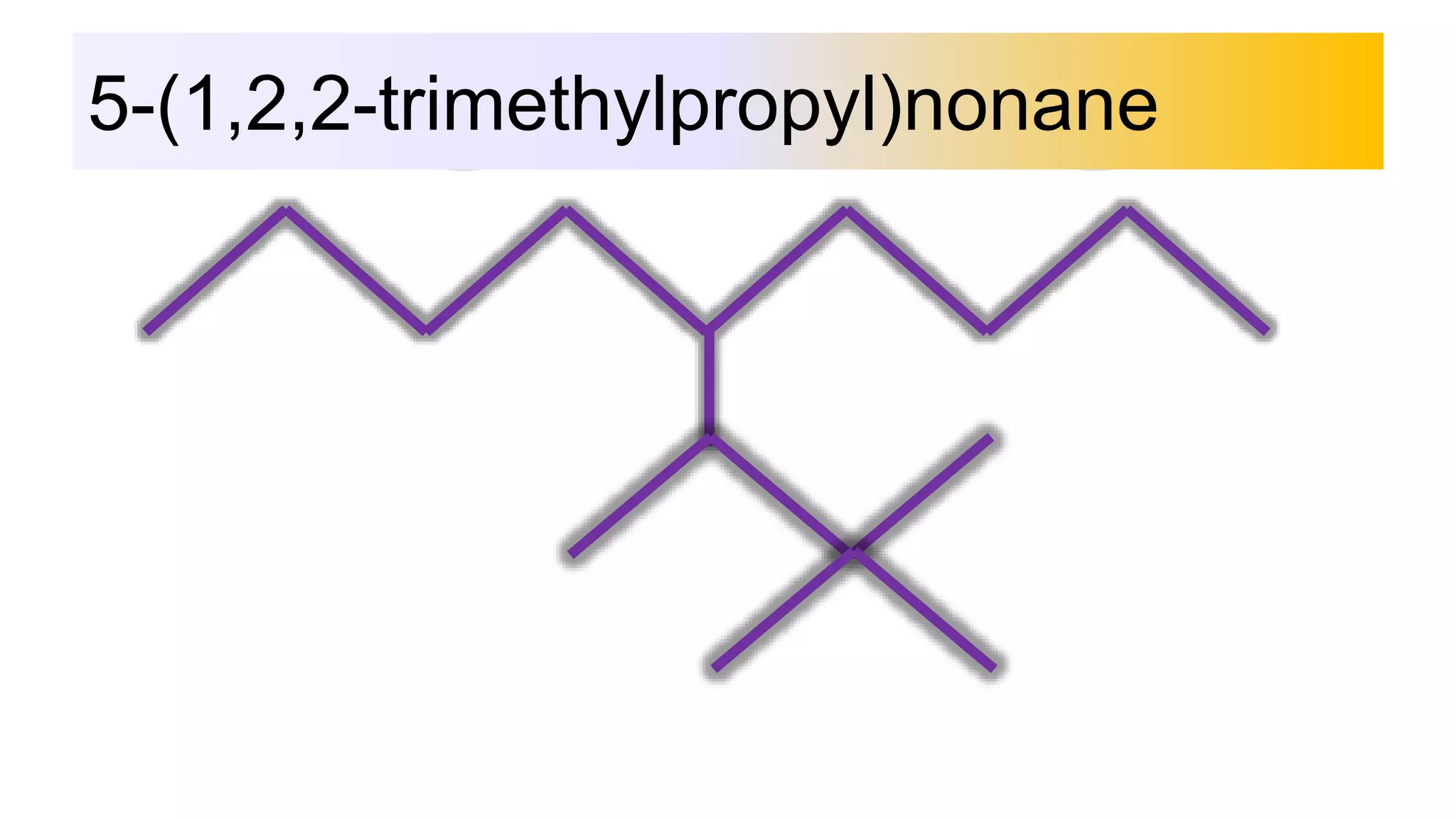
Complex Substituents
3-ethyl-5-(1-ethyl-2-methylpropyl)nonane
A propyl
group
5-(1,2,2-trimethylpropyl)nonane
Alkane Nomenclature
Compounds containing polyfunctional
groups
 Here a principle and a suboordinate functional group is
taken.
 The choice of functional group is made out of the order
of preference
The order of decreasing priority for some functional
groups is: -COOH, –SO3H, -COOR (R=alkyl group),
COCl, -CONH2, -CN,-HC=O, >C=O, -OH, -NH2, >C=C<,
-C≡C- .
 Alkyl group , phenyl group halogens alkoxy group are
always the prefixed substituents.
 Two or more identical groups are indicated by di, tri,
tetra, etc.
 We represent an IUPAC name in the following way
prefix/ word root/ suffix
 “a” is added to the word root if the primary suffix is not
added with a vowel.
 If “ene” if followed by y then the final “e” is cancelled
If an unbranched carbon chain is directly linked
to more than 2 like functional group , the
organic compound is named as a derivative of
the parent alkane which does not include the
carbon atom of the functional group.
Example pent-1,3,5 tricarboxylic acid.
Write the IUPAC names of the compounds from their given structures.
6-Methyloctan-3-ol Hexane- 2,4-dione
HW: Name the compound according to IUPAC system
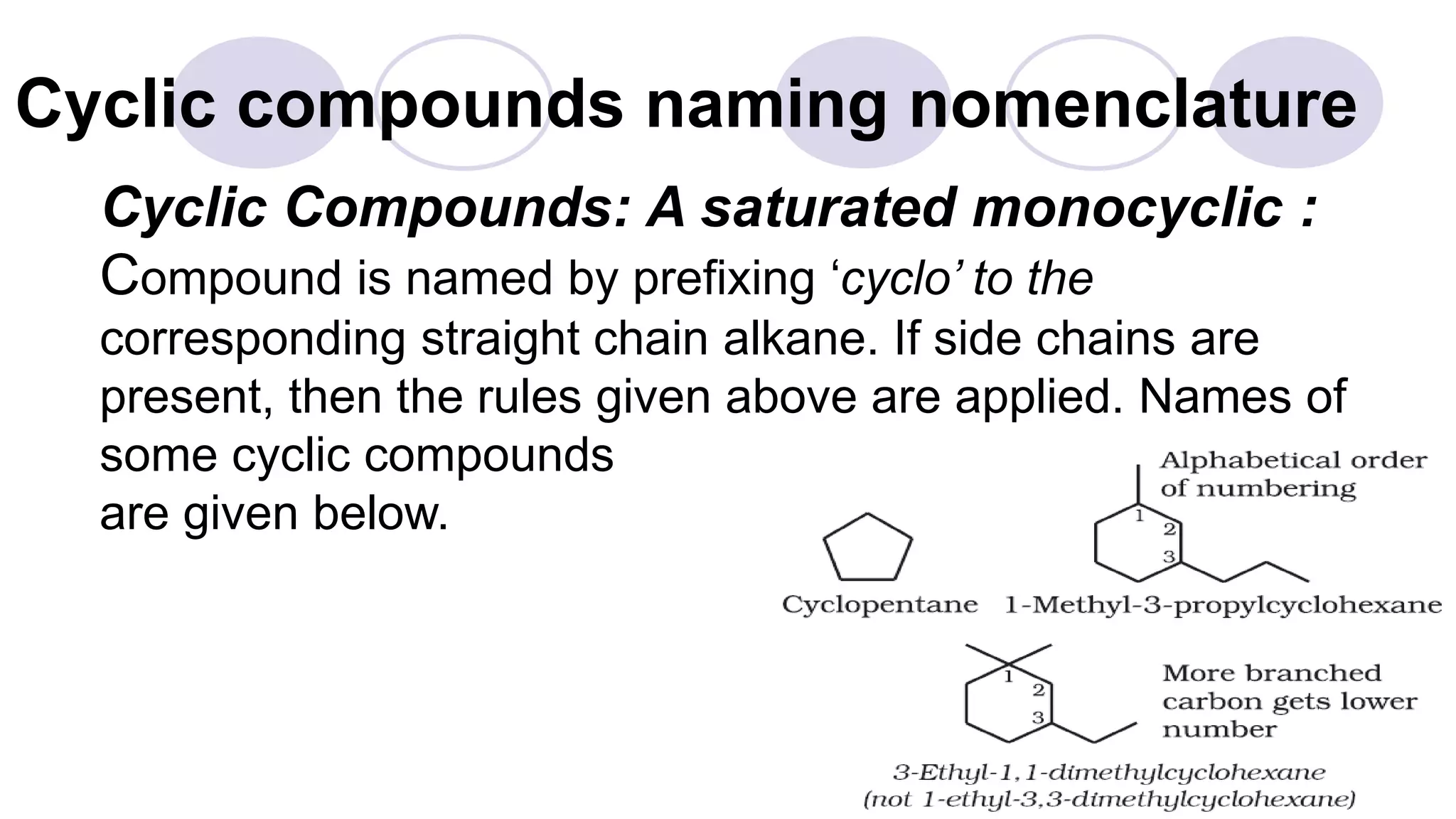
Cyclic Compounds: A saturated monocyclic :
Compound is named by prefixing ‘cyclo’ to the
corresponding straight chain alkane. If side chains are
present, then the rules given above are applied. Names of
some cyclic compounds
are given below.
Cyclic compounds naming nomenclature
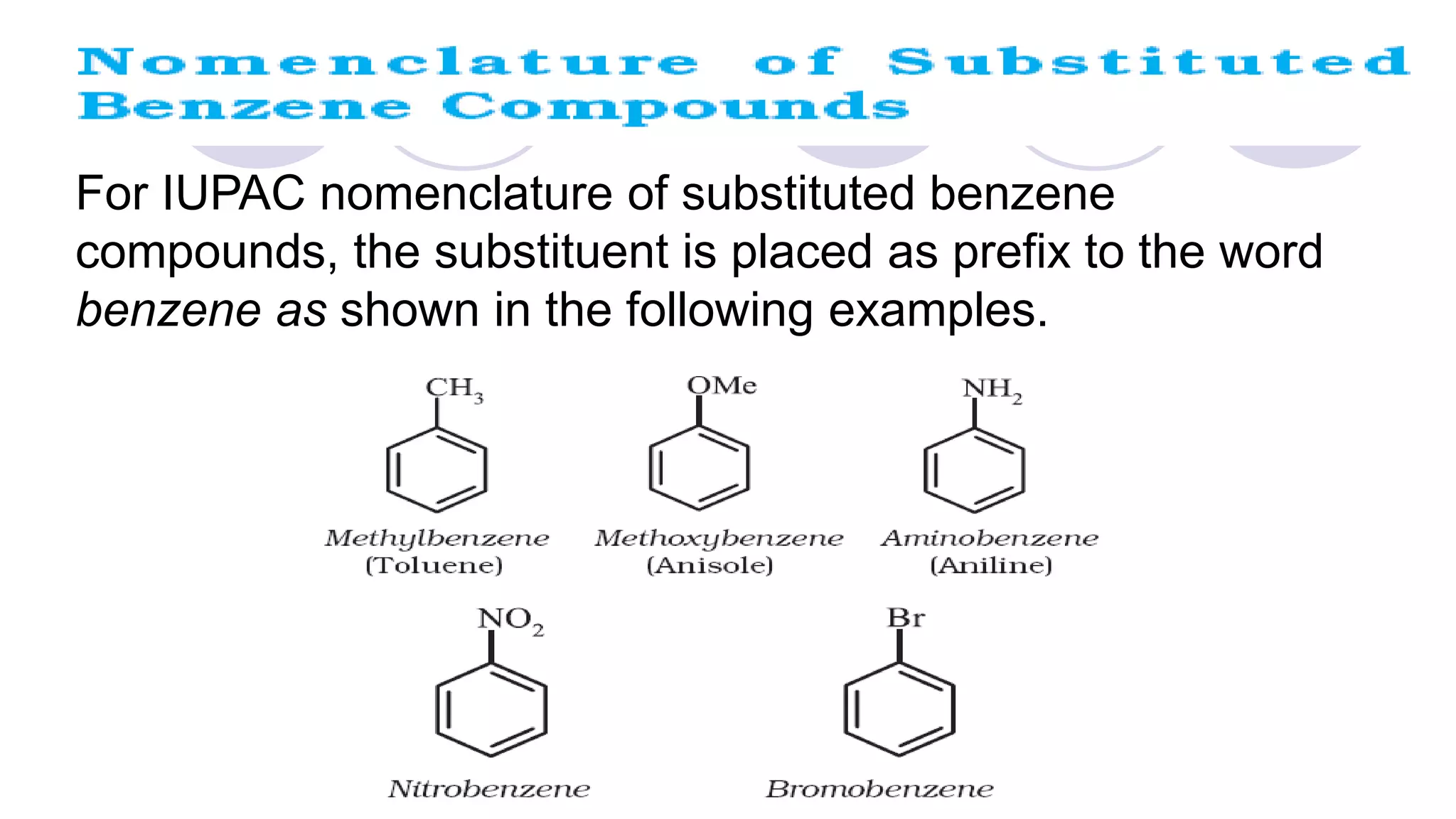
For IUPAC nomenclature of substituted benzene
compounds, the substituent is placed as prefix to the word
benzene as shown in the following examples.
If benzene ring is disubstituted, the position of substituents
is defined by numbering the carbon atoms of the ring such
that the substituents are located at the lowest numbers
possible.
In the trivial system of nomenclature the terms ortho (o),
meta (m) and para (p) are used as prefixes to indicate the
relative positions 1,2- ;1,3- and 1,4- respectively.
 Draw the structural formula for 1,3-dibromobenzene.
Section 14.2
• Substituent of the base
compound is assigned
number1 and then the
direction of numbering is
chosen such that the next
substituent gets the lowest
number. The substituents
appear in the name in
alphabetical order.

Iupac nomenclature class 11 CBSE-organic chemistry some basic principles and techniques

  • 1.
  • 2.
    STRUCTURAL REPRESENTATION OF ORGANICCOMPOUNDS Complete, condensed and bond line structural formulas Organic compounds structures are represented in several ways. 1. The Lewis structure or dot structure, dash structure, condensed structure and bond line structural formulas are some of the specific types. 2. The Lewis structures, however, can be simplified by representing the two-electron covalent bond by a dash (–).
  • 3.
    These structures canalso be represented by the following ways CH3 CH3 H2C H2C HC HC Ethane Ethene organic chemists use another way of representing the structures, in which only lines are used. In this bond-line structural representation of organic compounds, carbon and hydrogen atoms are not shown and the lines representing carbon-carbon bonds are drawn in a zig-zag fashion. For example i) CH3CH2CHCH2CH2CH2CH2CH3 | CH3 3-Methyloctane can be represented in various forms as:
  • 7.
    Thus, ethane (C2H6),ethene (C2H4), ethyne (C2H2) Such structural representations are called complete structural formula
  • 9.
  • 10.
    Acyclic or openchain compounds These compounds are also called as aliphatic compounds and consist of straight or branched chain compounds, for example:
  • 11.
    Alicyclic or closedchain or ring compounds Alicyclic (aliphatic cyclic) compounds contain carbon atoms joined in the form of a ring (homocyclic). Sometimes atoms other than carbon are also present in the ring (heterocylic). Some examples are
  • 12.
    Aromatic compounds Aromatic compoundsare special types of compounds. These include benzene and other related ring compounds (benzenoid).
  • 13.
    In order toclearly identify compound, a systematic method of naming has been developed and is known as the IUPAC (International Union of Pure and Applied Chemistry) system of nomenclature.
  • 14.
    Drawing bondline Structures: CH3 C H C H CH3 CH3 CH3 CH3 CH CH CH3 2-butene Drawthe condensed structure for the above !” C C C C H H H H H H H H CH3 CH CH CH3 On a test, choose a method that shows all H’s Using brackets can also shorten some formulas: CH3CH2CH2CH2CH2CH3 vs. CH3(CH2)4CH3
  • 15.
    TRY THESE 1. Whatare the 3 classes of hydrocarbons, based on number of carbon-carbon bonds? 2. Give the 10 organic homologous prefixes, in order, from 1-10. 3. Name these compounds: CH3 C H C H CH3 CH3 CH3
  • 16.
    CH3 CH3 CH3 CH3Naming SideChains  The names of molecules with branches are based on: side chains, root • The “root” or “parent chain” is usually the longest possible hydrocarbon chain. • The root must include multiple bonds if they are present. If a cyclic structure is present it will be the root even if it is not the longest chain. • Side chains are also called “side branches” or “alkyl groups”. Their names end in -yl. Common side chains : -CH3 methyl, -CH2CH3 ethyl, -CH2CH2CH3 propyl 2,3-dimethylpentane CH 3 C H 3 C H 3 C H 3
  • 17.
    IUPAC Rules forNaming Hydrocarbons 1. Choose the correct ending: -ane, -ene, or -yne 2. Determine the longest carbon chain. Where a double or triple bond is present, choose the longest chain that includes this bond. If there is a cyclic structure present, the longest chain starts and stops within the cyclic structure. 3. Assign numbers to each C of the parent chain. For alkenes and alkynes the first carbon of the multiple bond should have the smallest number. For alkanes the first branch (or first point of difference) should have the lowest #. Carbons in a multiple bond must be numbered consecutively. 4. Attach a prefix that corresponds to the number of carbons in the parent chain. Add cyclo- to the prefix if it is a cyclic structure.
  • 18.
    5. Determine thecorrect name for each branch (“alkyl” groups include methyl, ethyl, propyl, etc.) 6. Attach the name of the branches alphabetically, along with their carbon position, to the front of the parent chain name. Separate numbers from letters with hyphens (e.g. 4-ethyl-2- methyldecane) 7. When two or more branches are identical, use prefixes (di-, tri- , etc.) (e.g. 2,4-dimethylhexane). Numbers are separated with commas. Prefixes are ignored when determining alphabetical order. (e.g. 2,3,5-trimethyl-4-propylheptane) 8. When identical groups are on the same carbon, repeat the number of this carbon in the name. (e.g. 2,2-dimethylhexane) IUPAC Rules for Naming Hydrocarbons
  • 19.
    ene Naming Side Chains Example:use the rules on this handout to name the following structure CH3 CH2 C CH2 CH2 C CH2 CH3 CH3 CH3 Rule 1: choose the correct ending
  • 20.
    ene Rule 2: determinethe longest carbon chain CH3 CH2 C CH2 CH2 C CH2 CH3 CH3 CH3 Naming Side Chains
  • 21.
    Rule 3: Assignnumbers to each carbon CH3 CH2 C CH2 CH2 C CH2 CH3 CH3 CH3 ene Naming Side Chains
  • 22.
    Rule 3: Assignnumbers to each carbon CH3 CH2 C 2 CH2 1 CH2 3 C 4 CH2 5 CH3 CH3 CH3 6 CH3 CH2 C CH2 CH2 C CH2 CH3 CH3 CH3 ene Naming Side Chains
  • 23.
    1-hexeneene Rule 4: attachprefix (according to # of Cs) Naming Side Chains CH3 CH2 C 2 CH2 1 CH2 3 C 4 CH2 5 CH3 CH3 CH3 6 CH3 CH2 C CH2 CH2 C CH2 CH3 CH3 CH3
  • 24.
    CH3 CH2 C CH2 CH2C CH2 CH3 CH3 CH3 CH3 CH2 C 2 CH2 1 CH2 3 C 4 CH2 5 CH3 CH3 CH3 6 1-hexene2-ethyl-4-methyl-4-methyl-1-hexene ethyl methyl methyl Rule 6: attach name of branches alphabetically Naming Side Chains
  • 25.
    Rule 7,8: groupsimilar branches CH3 CH2 C CH2 CH2 C CH2 CH3 CH3 CH3 CH3 CH2 C 2 CH2 1 CH2 3 C 4 CH2 5 CH3 CH3 CH3 6 1-hexene2-ethyl-4-methyl-4-methyl-1-hexene ethyl methyl methyl Naming Side Chains
  • 26.
    Rule 7,8: groupsimilar branches CH3 CH2 C CH2 CH2 C CH2 CH3 CH3 CH3 CH3 CH2 C 2 CH2 1 CH2 3 C 4 CH2 5 CH3 CH3 CH3 6 2-ethyl-4,4-dimethyl-1-hexene ethyl methyl methyl Naming Side Chains
  • 27.
    Rules for namingIUPAC compounds I. for branched chain alkanes:- a) Identify the longest carbon chain b) When there are two or more parent chains of identical length, choose the parent chain with the greater number of substituents. c) Identify and name the substituent(s).
  • 28.
     for Onesubstituent start numbering from the end that gives the substituent the lower number.  Two or more identical substituents: number from the end that gives the lower number to the substituent encountered first.  The number of times the substituent occurs is indicated by a prefix di-, tri-, tetra-, penta-, hexa-, and so on.  A comma is used to separate position numbers.
  • 29.
     Two ormore different substituents: list the substituents in alphabetical order and number from the end that gives the lower number to the substituent encountered first. If there are different substituents in equivalent positions at opposite ends of the parent chain, give the substituent of lower alphabetical order the lower number.  Prefixes such as di-, tri-, tetra-, penta-, hexa-, and so on are not included in alphabetizing.
  • 30.
    Draw the structuresof the following compounds  1) hexanethioyl chloride  2) 3-methyl pent-i-oic acid  Propane 1,2,3 tricarboxylic acid.  Propane 1,2,3 trial
  • 31.
    Name the followingcompounds  1) CH2=CH-CH=CH2  2) HOCH2(CH2)3CH2COCH3  3) CH3CH(CH3)CH2CHCH2  4)COOHCH2CH2CHCH2CH2COOH  5)
  • 32.
    Name the followingcompound…..
  • 33.
    Alkane Nomenclature Pentane Heptane PropaneButane •Condensed Structural Formula •Actually Zig-Zag Structures •All Carbons sp3 Hybridized
  • 34.
    Alkane Nomenclature Name thesmaller rows that branch off of the larger rows as if they were little independent alkanes of their own, better known as alkyl groups.
  • 35.
    Alkane Nomenclature Hexane orn-hexane Alkyl group: Methyl
  • 36.
    Alkyl Group Nomenclature UnbranchedAlkyl Groups # C Name #C Name 1 Methyl 11 Undecyl 2 Ethyl 12 Dodecyl 3 Propyl 13 Tridecyl 4 Butyl 14 Tetradecyl 5 Pentyl 15 Pentadecyl 6 Hexyl 16 Hexadecyl 7 Heptyl 17 Heptadecyl 8 Octyl 18 Octadecyl 9 Nonyl 19 Nonadecyl 10 Decyl 20 Eicosyl
  • 37.
    Branched chain hydrocarbons:In a branched chain compound small chains of carbon atoms are attached at one or more carbon atoms of the parent chain. The small carbon chains (branches) are called alkyl groups. In order to name such compounds, the names of alkyl groups are prefixed to the name of parent alkane. An alkyl group is derived from a saturated hydrocarbon by removing a hydrogen atom from carbon. Thus, CH4 becomes -CH3 and is called methyl group.
  • 38.
    Alkane Nomenclature The carbonsin an alkane are sometimes classified by how many other carbon atoms are stuck to them.
  • 39.
  • 40.
  • 41.
  • 42.
    Alkane Nomenclature: Rule 1 Theroot name for an alkane is based on the longest unbroken chain of carbon atoms (called the “parent chain”). Derivative of heptane
  • 43.
    Alkane Nomenclature: Rule1 When there are two longest chains of equal length, use the chain with the greater number of substituents as the main chain.
  • 44.
    Problem 3: Writethe name of the compound.
  • 45.
  • 46.
    Haloalkanes Haloalkanes can benamed just like alkanes, with the halogen atom treated as a substituent. Halogen substituents are named fluoro-, chloro-, bromo-, and iodo-. When more than one halogen is present in the parent chain, they must be named alphabetically.
  • 47.
  • 48.
    Complex alkyl groupsare named by a systematic method using the longest alkyl chain as the base alkyl group. The base alkyl group is numbered beginning with the carbon atom (the “head carbon”) bonded to the main chain.
  • 49.
    Complex Substituents The substituentson the base alkyl group are listed with appropriate numbers, and parentheses are used to set off the name of the complex alkyl group. A (1-ethyl-2-methylpropyl) group A propyl group
  • 50.
  • 51.
  • 52.
  • 53.
    Compounds containing polyfunctional groups Here a principle and a suboordinate functional group is taken.  The choice of functional group is made out of the order of preference The order of decreasing priority for some functional groups is: -COOH, –SO3H, -COOR (R=alkyl group), COCl, -CONH2, -CN,-HC=O, >C=O, -OH, -NH2, >C=C<, -C≡C- .
  • 54.
     Alkyl group, phenyl group halogens alkoxy group are always the prefixed substituents.  Two or more identical groups are indicated by di, tri, tetra, etc.  We represent an IUPAC name in the following way prefix/ word root/ suffix  “a” is added to the word root if the primary suffix is not added with a vowel.  If “ene” if followed by y then the final “e” is cancelled
  • 55.
    If an unbranchedcarbon chain is directly linked to more than 2 like functional group , the organic compound is named as a derivative of the parent alkane which does not include the carbon atom of the functional group. Example pent-1,3,5 tricarboxylic acid.
  • 56.
    Write the IUPACnames of the compounds from their given structures. 6-Methyloctan-3-ol Hexane- 2,4-dione HW: Name the compound according to IUPAC system
  • 57.
    Cyclic Compounds: Asaturated monocyclic : Compound is named by prefixing ‘cyclo’ to the corresponding straight chain alkane. If side chains are present, then the rules given above are applied. Names of some cyclic compounds are given below. Cyclic compounds naming nomenclature
  • 58.
    For IUPAC nomenclatureof substituted benzene compounds, the substituent is placed as prefix to the word benzene as shown in the following examples.
  • 59.
    If benzene ringis disubstituted, the position of substituents is defined by numbering the carbon atoms of the ring such that the substituents are located at the lowest numbers possible. In the trivial system of nomenclature the terms ortho (o), meta (m) and para (p) are used as prefixes to indicate the relative positions 1,2- ;1,3- and 1,4- respectively.
  • 60.
     Draw thestructural formula for 1,3-dibromobenzene. Section 14.2
  • 61.
    • Substituent ofthe base compound is assigned number1 and then the direction of numbering is chosen such that the next substituent gets the lowest number. The substituents appear in the name in alphabetical order.