1
Department of Chemistry
University of Kashmir
Topic:-Alkynes
Presented By
Aadil Ali Wani
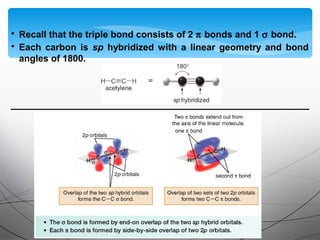
• Recall that the triple bond consists of 2 π bonds and 1 σ bond.
• Each carbon is sp hybridized with a linear geometry and bond
angles of 1800.
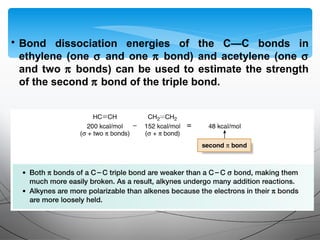
• Bond dissociation energies of the C—C bonds in
ethylene (one σ and one π bond) and acetylene (one σ
and two π bonds) can be used to estimate the strength
of the second π bond of the triple bond.
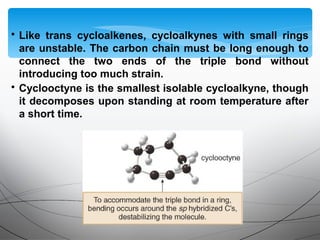
• Like trans cycloalkenes, cycloalkynes with small rings
are unstable. The carbon chain must be long enough to
connect the two ends of the triple bond without
introducing too much strain.
• Cyclooctyne is the smallest isolable cycloalkyne, though
it decomposes upon standing at room temperature after
a short time.
• Alkynes are named in the same general way that alkenes are
named.
• In the IUPAC system, change the –ane ending of the parent
alkane name to the suffix –yne.
• Choose the longest continuous chain that contains both atoms
of the triple bond and number the chain to give the triple bond
the lower number.
• Compounds with two triple bonds are named as diynes, those
with three are named as triynes and so forth.
• Compounds with both a double and triple bond are named as
enynes. The chain is numbered to give the first site of
unsaturation (either C=C or C≡C) the lower number.
• The simplest alkyne, H-C≡C-H, named in the IUPAC system as
ethyne, is more often called acetylene, its common name.
• The two-carbon alkyl group derived from acetylene is called an
ethynyl group.
Nomenclature
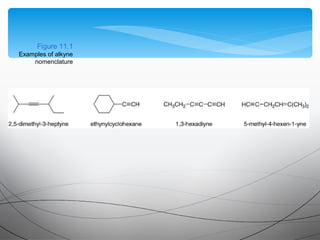
Figure 11.1
Examples of alkyne
nomenclature
• The physical properties of alkynes resemble those of
hydrocarbons of similar shape and molecular weight.
• Alkynes have low melting points and boiling points.
• Melting point and boiling point increase as the number
of carbons increases.
• Alkynes are soluble in organic solvents and insoluble in
water.
Physical Properties
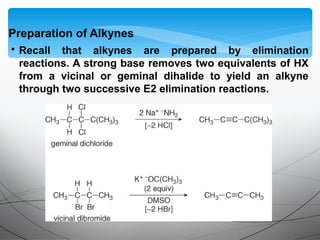
• Recall that alkynes are prepared by elimination
reactions. A strong base removes two equivalents of HX
from a vicinal or geminal dihalide to yield an alkyne
through two successive E2 elimination reactions.
Preparation of Alkynes
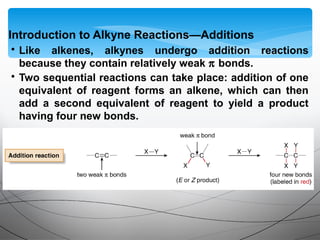
• Like alkenes, alkynes undergo addition reactions
because they contain relatively weak π bonds.
• Two sequential reactions can take place: addition of one
equivalent of reagent forms an alkene, which can then
add a second equivalent of reagent to yield a product
having four new bonds.
Introduction to Alkyne Reactions—Additions
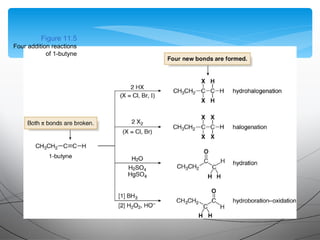
Figure 11.5
Four addition reactions
of 1-butyne
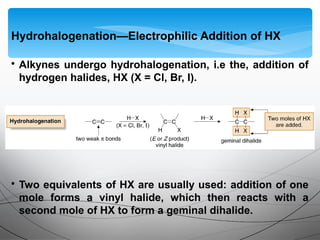
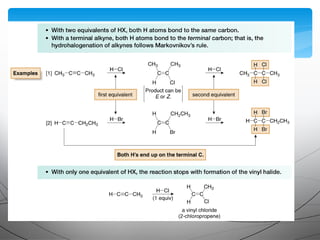
• Two equivalents of HX are usually used: addition of one
mole forms a vinyl halide, which then reacts with a
second mole of HX to form a geminal dihalide.
Hydrohalogenation—Electrophilic Addition of HX
• Alkynes undergo hydrohalogenation, i.e the, addition of
hydrogen halides, HX (X = Cl, Br, I).
• Electrophilic addition of HX to alkynes is slower than
electrophilic addition of HX to alkenes, even though alkynes are
more polarizable and have more loosely held π electrons than
alkenes.
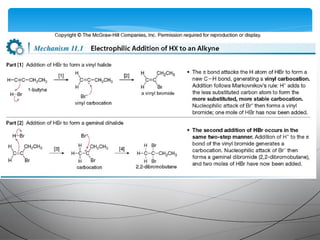
• Markovnikov addition in step [3] places the H on the terminal
carbon to form the more substituted carbocation A, rather than
the less substituted carbocation B.
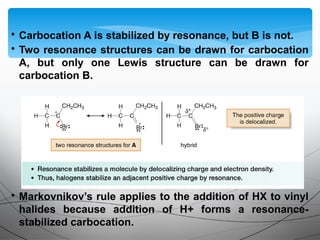
• Carbocation A is stabilized by resonance, but B is not.
• Two resonance structures can be drawn for carbocation
A, but only one Lewis structure can be drawn for
carbocation B.
• Markovnikov’s rule applies to the addition of HX to vinyl
halides because addition of H+ forms a resonance-
stabilized carbocation.
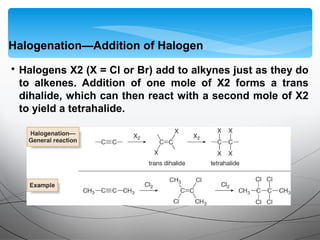
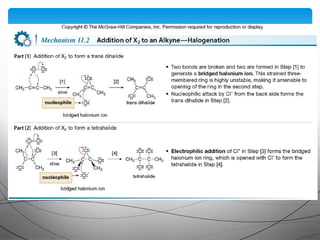
• Halogens X2 (X = Cl or Br) add to alkynes just as they do
to alkenes. Addition of one mole of X2 forms a trans
dihalide, which can then react with a second mole of X2
to yield a tetrahalide.
Halogenation—Addition of Halogen
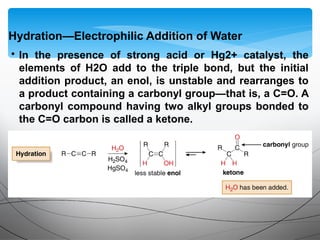
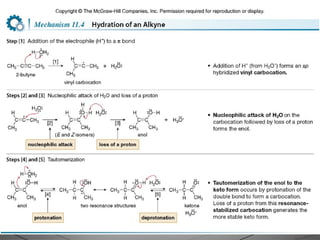
• In the presence of strong acid or Hg2+ catalyst, the
elements of H2O add to the triple bond, but the initial
addition product, an enol, is unstable and rearranges to
a product containing a carbonyl group—that is, a C=O. A
carbonyl compound having two alkyl groups bonded to
the C=O carbon is called a ketone.
Hydration—Electrophilic Addition of Water
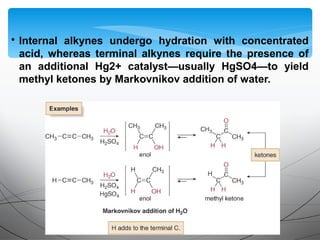
• Internal alkynes undergo hydration with concentrated
acid, whereas terminal alkynes require the presence of
an additional Hg2+ catalyst—usually HgSO4—to yield
methyl ketones by Markovnikov addition of water.
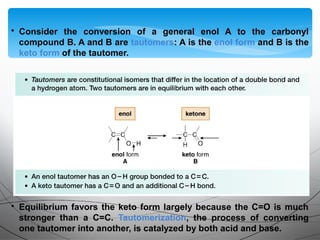
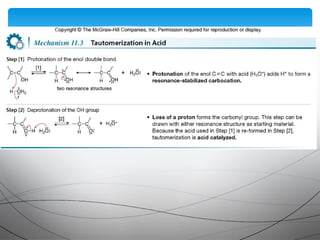
• Consider the conversion of a general enol A to the carbonyl
compound B. A and B are tautomers: A is the enol form and B is the
keto form of the tautomer.
• Equilibrium favors the keto form largely because the C=O is much
stronger than a C=C. Tautomerization, the process of converting
one tautomer into another, is catalyzed by both acid and base.
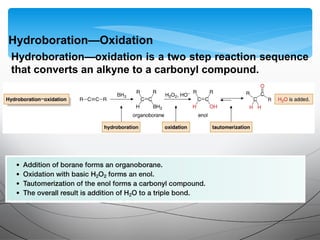
Hydroboration—Oxidation
Hydroboration—oxidation is a two step reaction sequence
that converts an alkyne to a carbonyl compound.
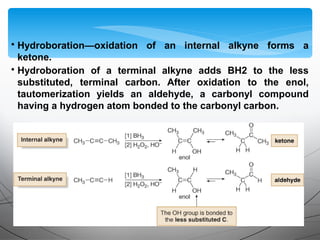
• Hydroboration—oxidation of an internal alkyne forms a
ketone.
• Hydroboration of a terminal alkyne adds BH2 to the less
substituted, terminal carbon. After oxidation to the enol,
tautomerization yields an aldehyde, a carbonyl compound
having a hydrogen atom bonded to the carbonyl carbon.
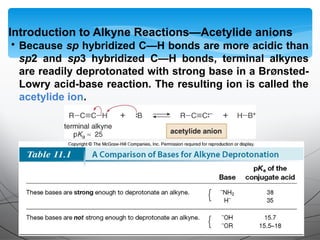
• Because sp hybridized C—H bonds are more acidic than
sp2 and sp3 hybridized C—H bonds, terminal alkynes
are readily deprotonated with strong base in a BrØnsted-
Lowry acid-base reaction. The resulting ion is called the
acetylide ion.
Introduction to Alkyne Reactions—Acetylide anions
Reactions of Acetylide Anions
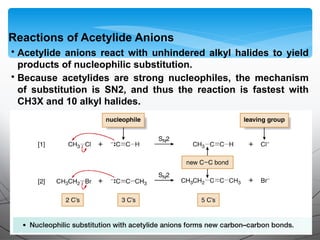
• Acetylide anions react with unhindered alkyl halides to yield
products of nucleophilic substitution.
• Because acetylides are strong nucleophiles, the mechanism
of substitution is SN2, and thus the reaction is fastest with
CH3X and 10 alkyl halides.
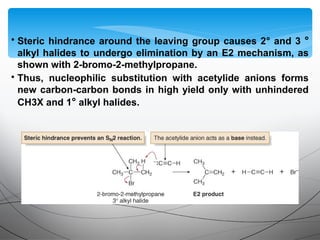
• Steric hindrance around the leaving group causes 2° and 3 °
alkyl halides to undergo elimination by an E2 mechanism, as
shown with 2-bromo-2-methylpropane.
• Thus, nucleophilic substitution with acetylide anions forms
new carbon-carbon bonds in high yield only with unhindered
CH3X and 1° alkyl halides.
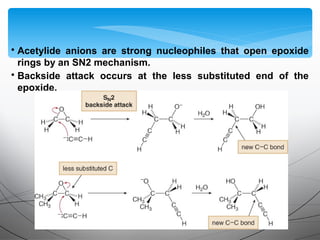
• Acetylide anions are strong nucleophiles that open epoxide
rings by an SN2 mechanism.
• Backside attack occurs at the less substituted end of the
epoxide.
Synthesis
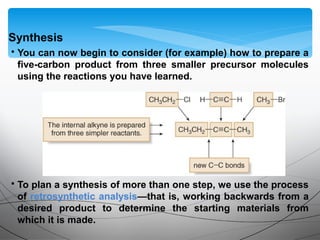
• You can now begin to consider (for example) how to prepare a
five-carbon product from three smaller precursor molecules
using the reactions you have learned.
• To plan a synthesis of more than one step, we use the process
of retrosynthetic analysis—that is, working backwards from a
desired product to determine the starting materials from
which it is made.
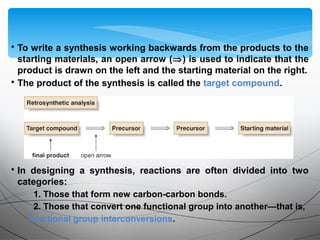
• To write a synthesis working backwards from the products to the
starting materials, an open arrow (⇒) is used to indicate that the
product is drawn on the left and the starting material on the right.
• The product of the synthesis is called the target compound.
• In designing a synthesis, reactions are often divided into two
categories:
1. Those that form new carbon-carbon bonds.
2. Those that convert one functional group into another—that is,
functional group interconversions.
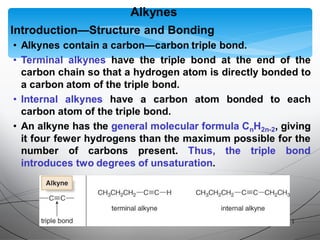
Alkynes

Alkynes

  • 1.
    1 Department of Chemistry Universityof Kashmir Topic:-Alkynes Presented By Aadil Ali Wani
  • 3.
    • Recall thatthe triple bond consists of 2 π bonds and 1 σ bond. • Each carbon is sp hybridized with a linear geometry and bond angles of 1800.
  • 4.
    • Bond dissociationenergies of the C—C bonds in ethylene (one σ and one π bond) and acetylene (one σ and two π bonds) can be used to estimate the strength of the second π bond of the triple bond.
  • 5.
    • Like transcycloalkenes, cycloalkynes with small rings are unstable. The carbon chain must be long enough to connect the two ends of the triple bond without introducing too much strain. • Cyclooctyne is the smallest isolable cycloalkyne, though it decomposes upon standing at room temperature after a short time.
  • 6.
    • Alkynes arenamed in the same general way that alkenes are named. • In the IUPAC system, change the –ane ending of the parent alkane name to the suffix –yne. • Choose the longest continuous chain that contains both atoms of the triple bond and number the chain to give the triple bond the lower number. • Compounds with two triple bonds are named as diynes, those with three are named as triynes and so forth. • Compounds with both a double and triple bond are named as enynes. The chain is numbered to give the first site of unsaturation (either C=C or C≡C) the lower number. • The simplest alkyne, H-C≡C-H, named in the IUPAC system as ethyne, is more often called acetylene, its common name. • The two-carbon alkyl group derived from acetylene is called an ethynyl group. Nomenclature
  • 7.
    Figure 11.1 Examples ofalkyne nomenclature
  • 8.
    • The physicalproperties of alkynes resemble those of hydrocarbons of similar shape and molecular weight. • Alkynes have low melting points and boiling points. • Melting point and boiling point increase as the number of carbons increases. • Alkynes are soluble in organic solvents and insoluble in water. Physical Properties
  • 9.
    • Recall thatalkynes are prepared by elimination reactions. A strong base removes two equivalents of HX from a vicinal or geminal dihalide to yield an alkyne through two successive E2 elimination reactions. Preparation of Alkynes
  • 10.
    • Like alkenes,alkynes undergo addition reactions because they contain relatively weak π bonds. • Two sequential reactions can take place: addition of one equivalent of reagent forms an alkene, which can then add a second equivalent of reagent to yield a product having four new bonds. Introduction to Alkyne Reactions—Additions
  • 11.
    Figure 11.5 Four additionreactions of 1-butyne
  • 12.
    • Two equivalentsof HX are usually used: addition of one mole forms a vinyl halide, which then reacts with a second mole of HX to form a geminal dihalide. Hydrohalogenation—Electrophilic Addition of HX • Alkynes undergo hydrohalogenation, i.e the, addition of hydrogen halides, HX (X = Cl, Br, I).
  • 15.
    • Electrophilic additionof HX to alkynes is slower than electrophilic addition of HX to alkenes, even though alkynes are more polarizable and have more loosely held π electrons than alkenes. • Markovnikov addition in step [3] places the H on the terminal carbon to form the more substituted carbocation A, rather than the less substituted carbocation B.
  • 16.
    • Carbocation Ais stabilized by resonance, but B is not. • Two resonance structures can be drawn for carbocation A, but only one Lewis structure can be drawn for carbocation B. • Markovnikov’s rule applies to the addition of HX to vinyl halides because addition of H+ forms a resonance- stabilized carbocation.
  • 17.
    • Halogens X2(X = Cl or Br) add to alkynes just as they do to alkenes. Addition of one mole of X2 forms a trans dihalide, which can then react with a second mole of X2 to yield a tetrahalide. Halogenation—Addition of Halogen
  • 19.
    • In thepresence of strong acid or Hg2+ catalyst, the elements of H2O add to the triple bond, but the initial addition product, an enol, is unstable and rearranges to a product containing a carbonyl group—that is, a C=O. A carbonyl compound having two alkyl groups bonded to the C=O carbon is called a ketone. Hydration—Electrophilic Addition of Water
  • 20.
    • Internal alkynesundergo hydration with concentrated acid, whereas terminal alkynes require the presence of an additional Hg2+ catalyst—usually HgSO4—to yield methyl ketones by Markovnikov addition of water.
  • 21.
    • Consider theconversion of a general enol A to the carbonyl compound B. A and B are tautomers: A is the enol form and B is the keto form of the tautomer. • Equilibrium favors the keto form largely because the C=O is much stronger than a C=C. Tautomerization, the process of converting one tautomer into another, is catalyzed by both acid and base.
  • 24.
    Hydroboration—Oxidation Hydroboration—oxidation is atwo step reaction sequence that converts an alkyne to a carbonyl compound.
  • 25.
    • Hydroboration—oxidation ofan internal alkyne forms a ketone. • Hydroboration of a terminal alkyne adds BH2 to the less substituted, terminal carbon. After oxidation to the enol, tautomerization yields an aldehyde, a carbonyl compound having a hydrogen atom bonded to the carbonyl carbon.
  • 26.
    • Because sphybridized C—H bonds are more acidic than sp2 and sp3 hybridized C—H bonds, terminal alkynes are readily deprotonated with strong base in a BrØnsted- Lowry acid-base reaction. The resulting ion is called the acetylide ion. Introduction to Alkyne Reactions—Acetylide anions
  • 27.
    Reactions of AcetylideAnions • Acetylide anions react with unhindered alkyl halides to yield products of nucleophilic substitution. • Because acetylides are strong nucleophiles, the mechanism of substitution is SN2, and thus the reaction is fastest with CH3X and 10 alkyl halides.
  • 28.
    • Steric hindrancearound the leaving group causes 2° and 3 ° alkyl halides to undergo elimination by an E2 mechanism, as shown with 2-bromo-2-methylpropane. • Thus, nucleophilic substitution with acetylide anions forms new carbon-carbon bonds in high yield only with unhindered CH3X and 1° alkyl halides.
  • 29.
    • Acetylide anionsare strong nucleophiles that open epoxide rings by an SN2 mechanism. • Backside attack occurs at the less substituted end of the epoxide.
  • 30.
    Synthesis • You cannow begin to consider (for example) how to prepare a five-carbon product from three smaller precursor molecules using the reactions you have learned. • To plan a synthesis of more than one step, we use the process of retrosynthetic analysis—that is, working backwards from a desired product to determine the starting materials from which it is made.
  • 31.
    • To writea synthesis working backwards from the products to the starting materials, an open arrow (⇒) is used to indicate that the product is drawn on the left and the starting material on the right. • The product of the synthesis is called the target compound. • In designing a synthesis, reactions are often divided into two categories: 1. Those that form new carbon-carbon bonds. 2. Those that convert one functional group into another—that is, functional group interconversions.